Ayushman Bharat Programme /
Pradhan Mantri Jan Arogya Yojana (AB-
PMJAY)
Vinayak J K
167
Mentor-Dr.Sumangala
1
CONTENT
● Introduction
● Objectives
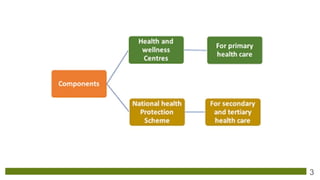
● Health and Wellness centers
● National health protection scheme
● Benefits
● Expected outcomes
● SWOT Analysis
2
3
● In February 2018, the Govt. of India announced two major
initiatives in health sectors.
● 1. Establishing Health and wellness centres
2.Pradhan Mantri Jan Arogya Yojana
● The main aim of these initiatives was to cover preventive
and health promotive interventions at primary, secondary
and tertiary care system
Introduction
4
Why there was need for Ayushman Bharat Programme ?
● Existing schemes where unable to
decrease out of pocket expenditure.
● Insufficient coverage by the previous
schemes.
● To achieve universal health
coverage.
● To address catastrophic health
problems.
OBJECTIVES OF AYUSHMAN BHARAT PROGRAMME
1. To converge various health insurance schemes across the
states
2. Providing medical benefits to below poverty line families
3. To improve access to hospitalisation care.
4. To Mainly focus on wellness of poor families
1. HEALTH and WELLNESS CENTERS
● The first health and wellness
center was inaugurated on 14th
april 2018 in Bijapur district of
Chhattisgarh
● So far 77,786 centers are
operational in the country as
on 2021
● The national health policy has envisioned health
and wellness centers as the foundation of India’s
health system.
● Under this 1.5 lakh centers will bring health care
system closer to homes of people
● The health and wellness centers will provide
comprehensive health care ,including facilities
such as
1. Maternal and Child Health Services
2. Communicable disease services
3. Services related to non communicable diseases
such as hypertension,diabetes and cancers of
oral,breast and cervix
● Health and wellness centers are also envisaged to incrementally
add primary health care services for
1. Mental health
2. ENT
3. Opthalmology
4. Oral health
5. Geriatric and palliative health care
6. Trauma care
● These centers will also provide free essential
drugs and diagnostic services
● The primary health care team at sub health center level
health and wellness centers is headed by community
health officer who is BSc/GNM nurse or an ayurveda
practitioner trained in primary care and public health
skills and certified in six months certificate programme
in community health.
● The team also includes other members such as multi
purpose workers that may be male or female and
accredited social health activists or ASHA workers.
Staff Pattern
Infrastructure
● Branding and color coding of all sub centres should be
done and citizen character will be displayed at each center.
● Space for examination room with adequate privacy.
● Diagnostics and medicine dispensing room.
● Wellness room and waiting area.
● Labor room at delivery points
● Expanded service packages planned to be provided at
functional health and wellness centers are as follows
1. Care in pregnancy and child birth
2. Neonatal and infant healthcare services
3. Childhood and adolescent health care services
4. Family planning,contraceptive services and other
reproductive health care services
5. General out patient care for acute simple illness and minor
ailments.
6. Screening prevention control and management of non
communicable diseases and chronic communicable
diseases like tuberculosis and leprosy.
7. Basic oral health care.
8. Care for common ophthalmic and ENT problems .
9. Emergency medical services including burns and trauma
2.PRADHAN MANTRI JAN AROGYA YOJANA (PMJAY)
● The second component of Ayushman Bharat Programme is pradhan
mantri jan arogya yojana.
● It is the flagship scheme introduced by Government of India launched
on 23 September 2018.
● It provides health coverage upto Rs. 5.00 lakh per family per year to
about 10.74 crore poor people for secondary and tertiary
hospitalisations.
● These vulnerable families are identified on the basis of socio
Economic caste census data
● PM-JAY has been designed to provide
financial risk protection against
catastrophic health expenditure that
impoverishes an estimated 6 crore
people every year.
● Over 21,800 hospitals have been
empanelled under this programme till
date.
● This has facilitated over 1.82 crore
hospitalisations, saving beneficiaries
over 22,500 crore in out of pocket
medical expenditure.
● Target groups eligible for AB-PMJAY
● In urban areas - people under 11 occupational criteria ,this criteria is
based on the data obtained from socio-economic caste census done in
2011
● Ragpicker
● Begger
● Construction workers
● Transport Workers
● Shop workers
● Domestic workers
● Street vendors
● Sanitation workers
● Home based workers
● Electrician,mechanic
● Washermam
● In rural areas - people under following 6 criteria are eligible
● D1- living in house with only one room with kucha walls and
kucha roof.
● D2-no adult member between ages 16-59.
● D3-households with no adult male member between age 16-59.
● D4-disabled member and no able-bodied adult member.
● D5-SC/ST households.
● D7-landless households deriving major income from manual
labour.
● Expenditure involved
● The expenditure incurred in premium payment will be shared between central
and state government in specified ratio as per ministry of finance guidelines
● In some states and union territories the expenditure is also covered by insurance
companies
● The expenditure is covered by any one of the following method.
1. Assurance model / Trust model
2. Insurance model
3. Mixed model
1. Assurance / Trust model
● The scheme is directly implemented by the SHA without
the intermediation of the insurance company.
● The financial risk of implementing the scheme is
completely on the government in this model.
● All the expenditures of the scheme are done by the
government
2. Insurance Model
● The SHA competitively selects an insurance company
through a tendering process to manage ABP in state.
● Based on market determined premium,SHA pays premium
to the insurance company per eligible family for the policy
period and
● Insurance company in turn does the claims settlement and
payments to the service provider.
3. Mixed model.
● The SHA engages both the previously mentioned models
in various capacities with with the aim of being more
economic, efficient, and allowing convergence with state
schemes.
● This model is usually employed by brownfield states
which had previously existing schemes covering a larger
group of beneficiaries.
BENEFITS OF AB-PMJAY
● Health cover of upto Rs 5 lakh per family per year for secondary and
tertiary care hospitalisation irrespective of family size ,age and gender
● Provides cashless access to hospitalisation services.
● All pre existing illnesses or conditions of all family members are
covered under the scheme.
● Benefits are portable and accessible across country in all empanelled
hospitals
● Over 1929 procedures are provided covering treatment, food ,drugs
and diagnostic services.
● PM-JAY also covers cost of hospitalisation,treatment,upto 3
days of pre-hospitalisation and 15 days of post hospitalisation
follow up care
EXPECTED OUTCOMES
● Increasing the trust of people on the service provision by public healthcare
facilities through health system strengthening and improvement.
● Availability of assured healthcare services to ensure continuum of care
● Reduction in out pocket expenditure of common people
● Increased awareness among the people about preventive and promotive
healthcare
● Enabling environment to increase the health seeking behaviour of poor
people.
● Reference
● Parks text book of preventive and social medicine
28th edition.
● https://nha.gov.in/PM-JAY
● www.nhm.gov.in
Ayushman bharat program power point presentation

Ayushman bharat program power point presentation

  • 1.
    Ayushman Bharat Programme/ Pradhan Mantri Jan Arogya Yojana (AB- PMJAY) Vinayak J K 167 Mentor-Dr.Sumangala 1
  • 2.
    CONTENT ● Introduction ● Objectives ●Health and Wellness centers ● National health protection scheme ● Benefits ● Expected outcomes ● SWOT Analysis 2
  • 3.
  • 4.
    ● In February2018, the Govt. of India announced two major initiatives in health sectors. ● 1. Establishing Health and wellness centres 2.Pradhan Mantri Jan Arogya Yojana ● The main aim of these initiatives was to cover preventive and health promotive interventions at primary, secondary and tertiary care system Introduction 4
  • 6.
    Why there wasneed for Ayushman Bharat Programme ? ● Existing schemes where unable to decrease out of pocket expenditure. ● Insufficient coverage by the previous schemes. ● To achieve universal health coverage. ● To address catastrophic health problems.
  • 7.
    OBJECTIVES OF AYUSHMANBHARAT PROGRAMME 1. To converge various health insurance schemes across the states 2. Providing medical benefits to below poverty line families 3. To improve access to hospitalisation care. 4. To Mainly focus on wellness of poor families
  • 8.
    1. HEALTH andWELLNESS CENTERS ● The first health and wellness center was inaugurated on 14th april 2018 in Bijapur district of Chhattisgarh ● So far 77,786 centers are operational in the country as on 2021
  • 9.
    ● The nationalhealth policy has envisioned health and wellness centers as the foundation of India’s health system. ● Under this 1.5 lakh centers will bring health care system closer to homes of people
  • 10.
    ● The healthand wellness centers will provide comprehensive health care ,including facilities such as 1. Maternal and Child Health Services 2. Communicable disease services 3. Services related to non communicable diseases such as hypertension,diabetes and cancers of oral,breast and cervix
  • 11.
    ● Health andwellness centers are also envisaged to incrementally add primary health care services for 1. Mental health 2. ENT 3. Opthalmology 4. Oral health 5. Geriatric and palliative health care 6. Trauma care ● These centers will also provide free essential drugs and diagnostic services
  • 12.
    ● The primaryhealth care team at sub health center level health and wellness centers is headed by community health officer who is BSc/GNM nurse or an ayurveda practitioner trained in primary care and public health skills and certified in six months certificate programme in community health. ● The team also includes other members such as multi purpose workers that may be male or female and accredited social health activists or ASHA workers. Staff Pattern
  • 13.
    Infrastructure ● Branding andcolor coding of all sub centres should be done and citizen character will be displayed at each center. ● Space for examination room with adequate privacy. ● Diagnostics and medicine dispensing room. ● Wellness room and waiting area. ● Labor room at delivery points
  • 14.
    ● Expanded servicepackages planned to be provided at functional health and wellness centers are as follows 1. Care in pregnancy and child birth 2. Neonatal and infant healthcare services 3. Childhood and adolescent health care services 4. Family planning,contraceptive services and other reproductive health care services 5. General out patient care for acute simple illness and minor ailments. 6. Screening prevention control and management of non communicable diseases and chronic communicable diseases like tuberculosis and leprosy.
  • 15.
    7. Basic oralhealth care. 8. Care for common ophthalmic and ENT problems . 9. Emergency medical services including burns and trauma
  • 16.
    2.PRADHAN MANTRI JANAROGYA YOJANA (PMJAY) ● The second component of Ayushman Bharat Programme is pradhan mantri jan arogya yojana. ● It is the flagship scheme introduced by Government of India launched on 23 September 2018. ● It provides health coverage upto Rs. 5.00 lakh per family per year to about 10.74 crore poor people for secondary and tertiary hospitalisations. ● These vulnerable families are identified on the basis of socio Economic caste census data
  • 17.
    ● PM-JAY hasbeen designed to provide financial risk protection against catastrophic health expenditure that impoverishes an estimated 6 crore people every year. ● Over 21,800 hospitals have been empanelled under this programme till date. ● This has facilitated over 1.82 crore hospitalisations, saving beneficiaries over 22,500 crore in out of pocket medical expenditure.
  • 18.
    ● Target groupseligible for AB-PMJAY ● In urban areas - people under 11 occupational criteria ,this criteria is based on the data obtained from socio-economic caste census done in 2011 ● Ragpicker ● Begger ● Construction workers ● Transport Workers ● Shop workers ● Domestic workers ● Street vendors ● Sanitation workers ● Home based workers ● Electrician,mechanic ● Washermam
  • 19.
    ● In ruralareas - people under following 6 criteria are eligible ● D1- living in house with only one room with kucha walls and kucha roof. ● D2-no adult member between ages 16-59. ● D3-households with no adult male member between age 16-59. ● D4-disabled member and no able-bodied adult member. ● D5-SC/ST households. ● D7-landless households deriving major income from manual labour.
  • 20.
    ● Expenditure involved ●The expenditure incurred in premium payment will be shared between central and state government in specified ratio as per ministry of finance guidelines ● In some states and union territories the expenditure is also covered by insurance companies ● The expenditure is covered by any one of the following method. 1. Assurance model / Trust model 2. Insurance model 3. Mixed model
  • 21.
    1. Assurance /Trust model ● The scheme is directly implemented by the SHA without the intermediation of the insurance company. ● The financial risk of implementing the scheme is completely on the government in this model. ● All the expenditures of the scheme are done by the government
  • 22.
    2. Insurance Model ●The SHA competitively selects an insurance company through a tendering process to manage ABP in state. ● Based on market determined premium,SHA pays premium to the insurance company per eligible family for the policy period and ● Insurance company in turn does the claims settlement and payments to the service provider.
  • 23.
    3. Mixed model. ●The SHA engages both the previously mentioned models in various capacities with with the aim of being more economic, efficient, and allowing convergence with state schemes. ● This model is usually employed by brownfield states which had previously existing schemes covering a larger group of beneficiaries.
  • 25.
    BENEFITS OF AB-PMJAY ●Health cover of upto Rs 5 lakh per family per year for secondary and tertiary care hospitalisation irrespective of family size ,age and gender ● Provides cashless access to hospitalisation services. ● All pre existing illnesses or conditions of all family members are covered under the scheme. ● Benefits are portable and accessible across country in all empanelled hospitals ● Over 1929 procedures are provided covering treatment, food ,drugs and diagnostic services.
  • 26.
    ● PM-JAY alsocovers cost of hospitalisation,treatment,upto 3 days of pre-hospitalisation and 15 days of post hospitalisation follow up care
  • 28.
    EXPECTED OUTCOMES ● Increasingthe trust of people on the service provision by public healthcare facilities through health system strengthening and improvement. ● Availability of assured healthcare services to ensure continuum of care ● Reduction in out pocket expenditure of common people ● Increased awareness among the people about preventive and promotive healthcare ● Enabling environment to increase the health seeking behaviour of poor people.
  • 30.
    ● Reference ● Parkstext book of preventive and social medicine 28th edition. ● https://nha.gov.in/PM-JAY ● www.nhm.gov.in