American Water Works Association
ANSI/AWWA E101-88
(Revision of ANSI/AWWA E101-77 [R82])
AWWA STANDARD
FOR
VERTICAL TURBINE PUMPS— LINE SHAFT
AND SUBMERSIBLE TYPES
Effective date: Aug. 1, 1988.
First edition approved by AWWA Board of Directors May 11, 1955.
This edition approved Jan. 24, 1988.
Approved by American National Standards Institute May 31, 1988.
AMERICAN WATER WORKS ASSOCIATION
6666 West Quincy Avenue, Denver, Colorado 80235
R
Copyright (C) 1998 American Water Works Association, All Rights Reserved.
AWWA Standard
This document is an American Water Works Association (AWWA) standard. It is not a specification.
AWWA standards describe minimum requirements and do not contain all of the engineering and
administrative information normally contained in specifications. The AWWA standards usually con-
tain options that must be evaluated by the user of the standard. Until each optional feature is
specified by the user, the product or service is not fully defined. AWWA publication of a standard
does not constitute endorsement of any product or product type, nor does AWWA test, certify, or
approve any product. The use of AWWA standards is entirely voluntary. AWWA standards are
intended to represent a consensus of the water supply industry that the product described will
provide satisfactory service. When AWWA revises or withdraws this standard, an official notice of
action will be placed on the first page of the classified advertising section of Journal AWWA. The
action becomes effective on the first day of the month following the month of Journal AWWA publi-
cation of the official notice.
American National Standard
An American National Standard implies a consensus of those substantially concerned with its scope
and provisions. An American National Standard is intended as a guide to aid the manufacturer, the
consumer, and the general public. The existence of an American National Standard does not in any
respect preclude anyone, whether that person has approved the standard or not, from manufactur-
ing, marketing, purchasing, or using products, processes, or procedures not conforming to the stand-
ard. American National Standards are subject to periodic review, and users are cautioned to obtain
the latest editions. Producers of goods made in conformity with an American National Standard are
encouraged to state on their own responsibility in advertising and promotional materials or on tags
or labels that the goods are produced in conformity with particular American National Standards.
CAUTION NOTICE: The American National Standards Institute (ANSI) approval date on the front
cover of this standard indicates completion of the ANSI approval process. This American National
Standard may be revised or withdrawn at any time. ANSI procedures require that action be taken
to reaffirm, revise, or withdraw this standard no later than five years from the date of publication.
Purchasers of American National Standards may receive current information on all standards by
calling or writing the American National Standards Institute, Inc., 11 West 42nd St., New York,
NY 10036 (212) 642-4900.
Copyright © 1988 by American Water Works Association
Printed in USA
ii
Copyright (C) 1998 American Water Works Association, All Rights Reserved.
Committee Personnel
The Subcommittee on Revision of ANSI/AWWA E101, which developed this
standard, had the following personnel at the time:
Chester A. Green, Chairman
Dale D. Curtis
Denis L. Maher Jr.
Walter N. Moline
Chi-Seng Yang
The AWWA Standards Committee on Vertical Turbine Pumps, which reviewed
and approved this standard, had the following personnel at the time of approval:
Chester A. Green, Chairman
Consumer Members
George Bryant, City of Montgomery, Montgomery, Ala. (AWWA)
R.H. Hohenstein, Board of Water and Light, Lansing, Mich. (AWWA)
R.E. Pillow, Baton Rouge Water Works Company, Baton Rouge, La. (AWWA)
F.E. Withrow Jr., Production & Pumping, Wichita, Kan. (AWWA)
General Interest Members
Manuel Carreno, CH2M Hill Southeast, Inc., Gainesville, Fla. (AWWA)
B.R. Elms,* Standards Engineer Liaison, AWWA, Denver, Colo. (AWWA)
C.A. Green, Parkhill, Smith & Cooper, Inc., Lubbock, Texas (AWWA)
W.R. Inhoffer,* Passaic Valley Water Commission, Clifton, N.J. (AWWA)
W.A. Kelley, Michigan Department of Public Health, Lansing, Mich. (CSSE)
D.L. Maher Jr., The Maher Corporation, North Reading, Mass. (NEWWA)
C.S. Mansfield Jr.,† Amory Engineers, Duxbury, Mass. (NEWWA)
S.C. McLendon, Holzmacher, McLendon & Murrell, Melville, N.Y. (AWWA)
J.F. Schultes, A.C. Schultes & Sons, Inc., Woodbury, N.J. (GWI)
Charles Stauffer, Stauffer & Associates, Inc., Overland Park, Kan. (AWWA)
T.J. Stolinski Jr., Black & Veatch, Kansas City, Mo. (AWWA)
A.F. Vondrick, Arthur Beard Engineering, Phoenix, Ariz. (AWWA)
Producer Members
Merrill Berman, Layne & Bowler, Inc., Memphis, Tenn. (AWWA)
D.D. Curtis, Crane Company, Columbus, Ohio (AWWA)
H.A.J. Greutink, Johnston Pump Company, Glendora, Calif. (AWWA)
W.N. Moline, Byron Jackson Pumps, Inc., Los Angeles, Calif. (AWWA)
Chi-Seng Yang, Goulds Pumps, Inc., Lubbock, Texas (AWWA)
________________
*Liaison, nonvoting
†Alternate
iii
Copyright (C) 1998 American Water Works Association, All Rights Reserved.
Foreword
I History of Standard.......................... vi
II Information Regarding Use of
This Standard ................................ vi
III Major Revisions .............................. vii
Part A—Line-Shaft Vertical Turbine
Pumps
A-1 Scope and Purpose ........................ 1
A-2 Definitions ....................................... 1
A-3 General
A-3.1 Standard Nomenclature.................... 5
A-3.2 Order Form ........................................ 5
A-3.3 Inspection and Certification by
Manufacturer .................................. 5
A-3.4 Information to Be Supplied by
Bidder .............................................. 5
A-3.5 Sanitary Codes................................... 5
A-4 Specifications
A-4.1 Pump Components............................. 5
A-4.2 Oil-Lubricated Pump Column ........ 16
A-4.3 Water-Lubricated Pump
Column........................................... 17
A-5 Engineering Data
A-5.1 Discharge Column Pipe................... 18
A-5.2 Column-Friction Loss...................... 18
A-5.3 Discharge Head Loss....................... 18
A-5.4 Mechanical Friction......................... 20
A-5.5 Line-Shaft Selection ........................ 23
A-6 Factory Inspection and Tests
A-6.1 Tests ................................................. 24
A-6.2 Running Test ................................... 24
A-6.3 Typical Laboratory Test
Arrangement ................................. 24
A-6.4 Capacity Measurement ................... 24
A-6.5 Head Measurement......................... 25
A-6.6 Velocity Head................................... 26
A-6.7 Horsepower Input............................ 26
A-6.8 Measurement of Speed.................... 26
A-6.9 Large-Pump Tests ........................... 27
A-6.10 Hydrostatic Tests ............................ 27
A-6.11 Recording and Computation of
Test Results................................... 27
A-6.12 Other Tests ...................................... 30
Part B—Submersible Vertical Turbine
Pumps
B-1 Scope and Purpose...................... 31
B-2 Definitions ..................................... 31
B-3 General
B-3.1 Standard Nomenclature.................. 32
B-3.2 Order Form ...................................... 32
B-3.3 Inspection and Certification by
Manufacturer ................................ 32
B-3.4 Information to Be Supplied by
Bidder ............................................ 32
B-3.5 Sanitary Codes ................................ 32
B-4 Specifications
B-4.1 Submersible Motor .......................... 33
B-4.2 Submersible Cable........................... 33
B-4.3 Surface Plate.................................... 41
B-4.4 Strainer ............................................ 41
B-4.5 Discharge Pipe................................. 41
B-4.6 Pump Bowls ..................................... 42
B-4.7 Impellers .......................................... 42
B-4.8 Pump Motor Coupling..................... 42
B-5 Engineering Data
B-5.1 Discharge Pipe................................. 42
B-5.2 Discharge Friction Loss .................. 42
B-5.3 Discharge-Elbow Head Loss ........... 42
Contents
SEC. PAGE SEC. PAGE
iv
Copyright (C) 1998 American Water Works Association, All Rights Reserved.
B-6 Factory Inspection and Tests
B-6.1 Tests ................................................. 42
B-6.2 Running Test ................................... 43
B-6.3 Typical Laboratory Test
Arrangement ................................. 44
B-6.4 Capacity Measurement ................... 44
B-6.5 Head Measurement ......................... 46
B-6.6 Velocity Head................................... 46
B-6.7 Power Input to Pump Motor........... 46
B-6.8 Large-Pump Tests ........................... 46
B-6.9 Hydrostatic Tests............................. 46
B-6.10 Recording and Computation of
Test Results................................... 46
B-6.11 Other Tests ...................................... 49
Appendices
A Field Testing of Vertical
Turbine Pumps
Purpose of Field Tests..................... 50
Accuracy of Field Testing................ 50
Definitions and Symbols ................. 54
Approved Instrumentation.............. 55
Test Procedure................................. 61
B Suggested Specification Form
for the Purchase of
Vertical Turbine Pumps .......... 66
Figures
1 Open Line-Shaft Pump (Surface
Discharge, Threaded Column,
and Bowls)....................................... 6
2 Enclosed Line-Shaft Pump
(Discharge Below Base, Threaded
Column, and Bowls)........................ 7
3 Friction-Loss Chart for Standard
Pipe Column.................................. 19
4 Head Loss in Discharge Heads....... 20
5 Mechanical Friction in Line
Shafts............................................. 21
6 Typical Laboratory Test
Arrangement—Line-Shaft Vertical
Turbine Pumps.............................. 25
7 Typical Submersible-Pump
Assembly (Bowl Assemblies)........ 34
8 Submersible-Pump Discharge
Styles and Surface-Plate
Assemblies ..................................... 35
9 Head-Loss Chart for Standard
Pipe ................................................ 43
10 Head-Loss Chart for 90o
Elbow...... 44
11 Typical Laboratory-Test
Arrangement—Submersible
Vertical Turbine Pumps ............... 45
12 Power-Loss Chart for Three-
Conductor Copper Cable............... 48
A.1 Field-Test Diagram for Line-Shaft
Vertical Turbine Deep-Well
Pump.............................................. 55
A.2 Field-Test Diagram for
Submersible Pump........................ 56
A.3 Field-Test Diagram for Vertical
Turbine Pump for Booster
Service............................................ 56
A.4 Piping Requirements for Orifices,
Flow Nozzles, and Venturi
Tubes.............................................. 57
A.5 Field-Test Report Form................... 62
Tables
1 Standard Nomenclature—Line-
Shaft Vertical Turbine Pumps ....... 8
2 Diameters and Weights of
Standard Discharge Column
Pipe Sizes....................................... 17
3 Line-Shaft Selection Chart for
Type B Material ............................ 22
4 Standard Nomenclature—
Submersible Vertical Turbine
Pumps ............................................ 36
A.1 Limits of Accuracy of Pump-
Test Measuring Devices in
Field Use........................................ 51
SEC. PAGE SEC. PAGE
v
Copyright (C) 1998 American Water Works Association, All Rights Reserved.
Foreword
This foreword is for information only and is not a part of AWWA E101.
I. History of Standard. This standard for vertical turbine pumps presents
the composite findings from studies conducted from 1949 to 1986 by committees
consisting of manufacturers, consumers, and engineers. The first standard was pub-
lished in 1955. In 1961 the standard was revised to include standards for submers-
ible vertical turbine pumps. Additional technical changes were added in the 1971
revision. Solid shaft motors were added in the 1977 revision, together with numer-
ous editorial changes and soft conversions to the international system of units. The
1977 standard was reaffirmed in 1982 without revision.
The standard is intended to serve as a guide in the preparation of specifica-
tions for the procurement of vertical turbine pumps in normal water service, as well
as an aid in designing pumps to be used for special conditions. Material lists are
provided from which the purchaser can select the proper pump metals or alloys for a
particular installation or wear environment. If any special items are not listed by
the purchaser, the selection of pump material will be made by the pump manufac-
turer.
II. Information Regarding Use of This Standard. The pump manufac-
turer will require local basic data prior to furnishing a pump and driver that will
meet the buyer’s needs. The information will include such items as the type of prime
mover and pump that is being requested, as well as the operating range and other
pertinent items that will be necessary in designing the unit. A specification form
that will provide the manufacturer with the needed information, as well as any
exceptions to the standard that the user may wish to include, is given in Appendix
B.
In addition to the information required on the suggested specification form, the
purchaser should include provisions for the following items in supplementary speci-
fications.
1. In all cases
a. Standard used—that is, AWWA E101, Standard for Vertical
Turbine Pumps—Line Shaft and Submersible Types.
b. Certification and test results by manufacturer (Sec. A-3.3.2, Sec. A-
6.2.2,
Sec. B-3.3.2, and Sec. B-6.2.2), if required.
c. Sanitary codes (Sec. A-3.5 and Sec. B-3.5).
d. Liquid to be pumped (Sec. A-1 and Sec. B-1).
e. Details of installation, if other than a well (Sec. A-1 and Sec. B-1).
f. Whether the impellers are to be enclosed, open, or of the semiopen type
(Sec. A-4.2.2 or Sec. A-4.3.2 and Sec. B-4.7), if there is a preference.
g. Performance tests (Sec. A-6.1 and Sec. B-6.1) that will be required, if
any.
h. If field conditions of installation are to be duplicated in the laboratory
test arrangement (Sec. A-6.3 and Sec. B-6.3), provide complete details
and a description of the arrangement.
i. If pump bowl assembly tests are not to be made in open sumps
(Sec. A-6.5 and Sec. B-6.5), specify test conditions.
vi
Copyright (C) 1998 American Water Works Association, All Rights Reserved.
j. If bowl size exceeds 20 in. (500 mm) OD, specify the basis for
performance guarantees (Sec. A-6.9.3 and Sec. B-6.8).
k. If tests other than those specified in this standard are to be performed
(Sec. A-6.12 and Sec. B-6.11), specify.
2. For line-shaft vertical turbine pumps, also specify
a. Type of motor, if other than specified in Sec. A-4.1.2.
b. Whether an oil-lubricated pump (Sec. A-4.2) or a water-lubricated pump
(Sec. A-4.3) is desired.
c. Table 1 lists two or more materials for certain parts. If there is a
preference for one material or the other, specify in each instance.
d. Whether pump-column sections are to be joined by threaded couplings
or by flanges.
3. For submersible vertical turbine pumps, also specify
a. Whether a strainer (Sec. B-4.4) will be required.
b. Discharge-elbow head loss (Sec. B-5.3), if this is essential.
c. Table 4 lists two or more materials for certain parts. If there is a
preference for one material or the other, specify in each instance.
d. Whether pump column sections are to be joined by threaded couplings
or by flanges.
III. Major Revisions. The AWWA Standards Committee on Vertical Turbine
Pumps (formerly ANSI B58) was reactivated in 1985 to review the 1977 standard
and to make revisions. The committee made several editorial changes for clarity and
accuracy. The material lists in Tables 1 and 4 were revised to delete references to
obsolete standards and to comply with current manufacturing practices. A formula
for design of shaft couplings was added as Sec. A-4.1.4. Tables for selection of elec-
trical cables for submersible pumps, which were included in earlier standards, were
deleted as not appropriately being a part of a pump standard.
vii
Copyright (C) 1998 American Water Works Association, All Rights Reserved.
This page intentionally blank.
Copyright (C) 1998 American Water Works Association, All Rights Reserved.
American Water Works Association
AWWA E101-88
(Revision of ANSI/AWWA E101-77 [R82])
AWWA STANDARD FOR
VERTICAL TURBINE PUMPS— LINE
SHAFT AND SUBMERSIBLE TYPES
Part A— Line-Shaft Vertical Turbine Pumps
SECTION A-1: SCOPE AND PURPOSE
Part A of this standard provides minimum requirements for line-shaft vertical
turbine pumps utilizing discharge column pipe up to and including 16 in. (400 mm)
in size. The standard deals with a pump configuration up to and including the
driver. Only electric motors are referred to as prime movers.
Purchasers who intend to use the pumps for pumping liquids other than clear,
cold water should modify the requirements to fit conditions of intended use, prefer-
ably after consultation with pump manufacturers.
SECTION A-2: DEFINITIONS
A-2.1 Line-shaft vertical turbine pump: A vertical-shaft centrifugal or mixed-
flow pump with rotating impeller or impellers, and with discharge from the pump-
ing element coaxial with the shaft. The pumping element is suspended by the con-
ductor system, which encloses a system of vertical shafting used to transmit power
to the impellers, the prime mover being external to the flow stream.
A-2.2 Pump: For purposes of this standard, a pump may be defined as a de-
vice used to provide energy for initiating or maintaining the movement of liquid. A
pump consists of three elements, defined as follows:
1
R
Copyright (C) 1998 American Water Works Association, All Rights Reserved.
A-2.2.1 The pump bowl assembly is either a single or multistage, centrifugal or
mixed-flow vertical pump with discharge coaxial with the shaft. It has open,
semiopen, or enclosed impellers. Assemblies are constructed for use with either open
or enclosed line shafts.
A-2.2.2 The column-and-shaft assembly consists of the column pipe that sus-
pends the pump bowl assembly from the head assembly and serves as a conductor
for the fluid from the pump bowl assembly to the discharge head. Contained within
the column pipe is the line shaft, which transmits the power from the driver to the
pump shaft. The line shaft is maintained in alignment throughout its length by
means of bearings and may be enclosed in a shaft-enclosing tube and generally lu-
bricated with oil, or it may be open and lubricated with the fluid that is being
pumped.
A-2.2.3 The head assembly consists of the driver, the base from which the col-
umn-and-shaft assembly and the bowl assembly are suspended, and may include the
discharge head, which directs the fluid into the desired piping system.
A-2.2.3.1 The driver is the mechanism mounted on the head assembly that
transmits or furnishes the power to the top shaft. It may contain the means for
impeller adjustment, and it provides a bearing to carry the thrust load. It may or
may not be a prime mover.
A-2.2.3.2 The discharge tee, in a discharge-below-base installation, is separated
from the head assembly and installed in a column pipe at a desired distance below
the head assembly.
A-2.3 Driver: For purposes of this standard, a driver may be defined as a de-
vice used to provide mechanical energy for the operation of a pump. Types of drivers
are defined as follows:
A-2.3.1 The vertical hollow-shaft motor drive is an electric motor having a mo-
tor shaft that has been bored on the center of its axis to receive the top shaft of the
pump. Impeller adjustment is made at the upper end of the motor, and a means to
carry the thrust on a bearing within the motor is provided.
A-2.3.2 The vertical solid-shaft motor drive is an electric motor having a con-
ventional solid shaft coupled to the top shaft of the pump. The coupling should
provide a means for impeller adjustment. The mechanical and hydraulic thrust of
the pump is carried by a thrust bearing in the motor.
A-2.3.3 The vertical hollow-shaft right-angle gear drive is a gear mechanism
having a shaft that has been bored on the center of its axis to receive the top shaft
of the pump. The horizontal shaft of the gear drive receives its power from the
prime mover and, through a pair of bevel gears, transmits it to the top shaft. Impel-
ler adjustment is made at the upper end of the gear drive, and a means to carry the
thrust on a bearing within the gear drive is provided.
A-2.3.4 The vertical hollow-shaft belted drive is a flat- or V-belt-driven mecha-
nism having a shaft that has been bored on the center of its axis to receive the top
shaft of the pump. Impeller adjustment is made at the upper end of the belted drive,
and a means to carry the thrust on a bearing within the belted drive is provided.
A-2.3.5 The combination drive includes a means for operating the pump with
two or more prime movers.
A-2.4 Datum: The elevation of that surface from which the weight of the
pump is supported. This is normally the elevation of the underside of the discharge
head or head base plate.
2 AWWA E101-88
Copyright (C) 1998 American Water Works Association, All Rights Reserved.
A-2.5 Setting: The nominal vertical distance, in feet (metres), from the datum
to the column pipe connection at the bowl assembly.
A-2.6 Static water level: The vertical distance, in feet (metres), from the da-
tum to the level of the atmospheric surface while no water is being drawn from the
pool.
A-2.7 Pumping water level: The vertical distance, in feet (metres), from the
datum to the level of the atmospheric surface while the specified fluid flow is being
drawn from the pool.
A-2.8 Drawdown: The difference, in feet (metres), between the pumping water
level and the static water level.
A-2.9 Specific yield: The rate of flow being pumped for a well divided by the
total drawdown as measured during the metered flow rate. It is expressed in US
gallons per minute per foot of drawdown (litres per second per metre of drawdown).
A-2.10 Pump capacity (Q): The volume rate of flow, expressed in gallons per
minute (cubic metres per hour), produced by the pump, calculated for specified con-
ditions.
A-2.11 Pump speed of rotation (n): The rate of rotation of the pump shaft,
expressed in revolutions per minute or revolutions per second.
A-2.12 Head: A quantity used to express the energy content of the liquid per
unit weight of the liquid, referred to any arbitrary datum. In terms of foot-pounds
(metre-kilograms) of energy per pound (kilogram) being pumped, all head quantities
have the dimension of feet (metres) of liquid.
A-2.12.1 Head below datum hb is the vertical distance, in feet (metres), be-
tween the datum and the pumping water level.
A-2.12.2 Head above datum ha is the head measured above the datum, ex-
pressed in feet (metres) of liquid, plus the velocity head (Sec. A-2.12.3) at the point
of measurement.
A-2.12.3 Velocity head hv is the kinetic energy per unit weight of the liquid at
a given section, expressed in feet (metres) of liquid. Velocity head is specifically
defined by the expression
v2
hv = ———— (Eq 1)
2g
Where:
v = velocity, in feet per second (metres per second)
g = 32.17 ft /s2
(9.81 m/s2
)
A-2.12.4 Suction head hs (closed system) is the algebraic sum of the pressure
in feet (metres) of liquid (measured at the pump suction connection) and the velocity
head at that point. Pump suction connection is the point at which the suction piping
is attached to the pump bowl assembly or its enclosing vessel. Note that a negative
suction head will add to the vertical distance from the datum, due to the algebraic
subtraction of a negative quantity.
VERTICAL TURBINE PUMPS 3
Copyright (C) 1998 American Water Works Association, All Rights Reserved.
A-2.12.5 Pump total head H is the bowl assembly head (Sec. A-2.12.6) minus
the column loss (Sec. A-2.12.7) and discharge head loss (Sec. A-2.12.8). This is the
head generally called for in pump specifications.
A-2.12.5.1 On open-suction installations, pump total head is the sum of the
head below datum and the head above datum.
A-2.12.5.2 On closed-suction installations, pump total head is the head above
datum plus the vertical distance, in feet (metres), from the datum to the pump
suction connection minus the suction head.
A-2.12.6 Bowl assembly head h1 is the energy imparted to the liquid by the
pump bowl assembly, expressed in feet (metres) of liquid. It is the head developed at
the discharge connection of the bowl assembly and is an integral multiple of the
head per stage as shown on the catalog rating chart, depending on the number of
stages in the bowl assembly.
A-2.12.7 The column loss hc is the value of the head loss, expressed in feet
(metres), caused by the flow friction in the column pipe.
A-2.12.8 Discharge head loss he is the value of the head loss, expressed in feet
(metres), caused by the flow friction in the discharge head assembly.
A-2.13 Line-shaft loss: The power, expressed in horsepower (kilowatts), re-
quired to overcome the rotation friction of the line shaft. This value is added to the
bowl assembly input (Sec. A-2.14.3) to predict the pump input (Sec. A-2.14.1).
A-2.14 Power is expressed in units of horsepower (kilowatts). One horsepower
is equivalent to 550 ft-lb/s, 33,000 ft-lb/min, 2545 Btu/h, or 0.746 kW.
A-2.14.1 Pump power input is the power delivered to the top shaft by the
driver, expressed in horsepower (kilowatts).
A-2.14.2 Driver power input is the power input to the driver, expressed in
horsepower (kilowatts).
A-2.14.3 Bowl assembly power input is the power delivered to the bowl assem-
bly shaft, expressed in horsepower (kilowatts).
A-2.15 Pump power output: For water having a specific weight of 62.4 lb/ft3
,
(relative density of 1.0), pump power output is defined as QH/3960. Pump power
output is expressed in horsepower (hp × 0.746 = kW) when Q is in gallons per
minute and H is in feet of water.
A-2.16 Bowl output: For water having a specific weight of 62.4 lb/ft3
(relative
density of 1.0), bowl output is defined as Qh1/3960. Bowl output is expressed in
horsepower (hp × 0.746 = kW) when Q is in gallons per minute and h1 is in feet of
water.
A-2.17 Pump efficiency (Ep): The ratio of pump power output to pump input,
expressed in percent.
A-2.18 Overall efficiency (E): The ratio of pump power output to prime mover
power input, expressed in percent.
A-2.19 Driver efficiency (Eg): The ratio of the driver power output to the driver
power input, expressed in percent.
A-2.20 Bowl assembly efficiency E1: The ratio of the bowl output to the bowl
assembly input, expressed in percent. This is the efficiency that is usually shown on
catalog rating charts.
4 AWWA E101-88
Copyright (C) 1998 American Water Works Association, All Rights Reserved.
SECTION A.3: GENERAL
Sec. A-3.1 Standard Nomenclature
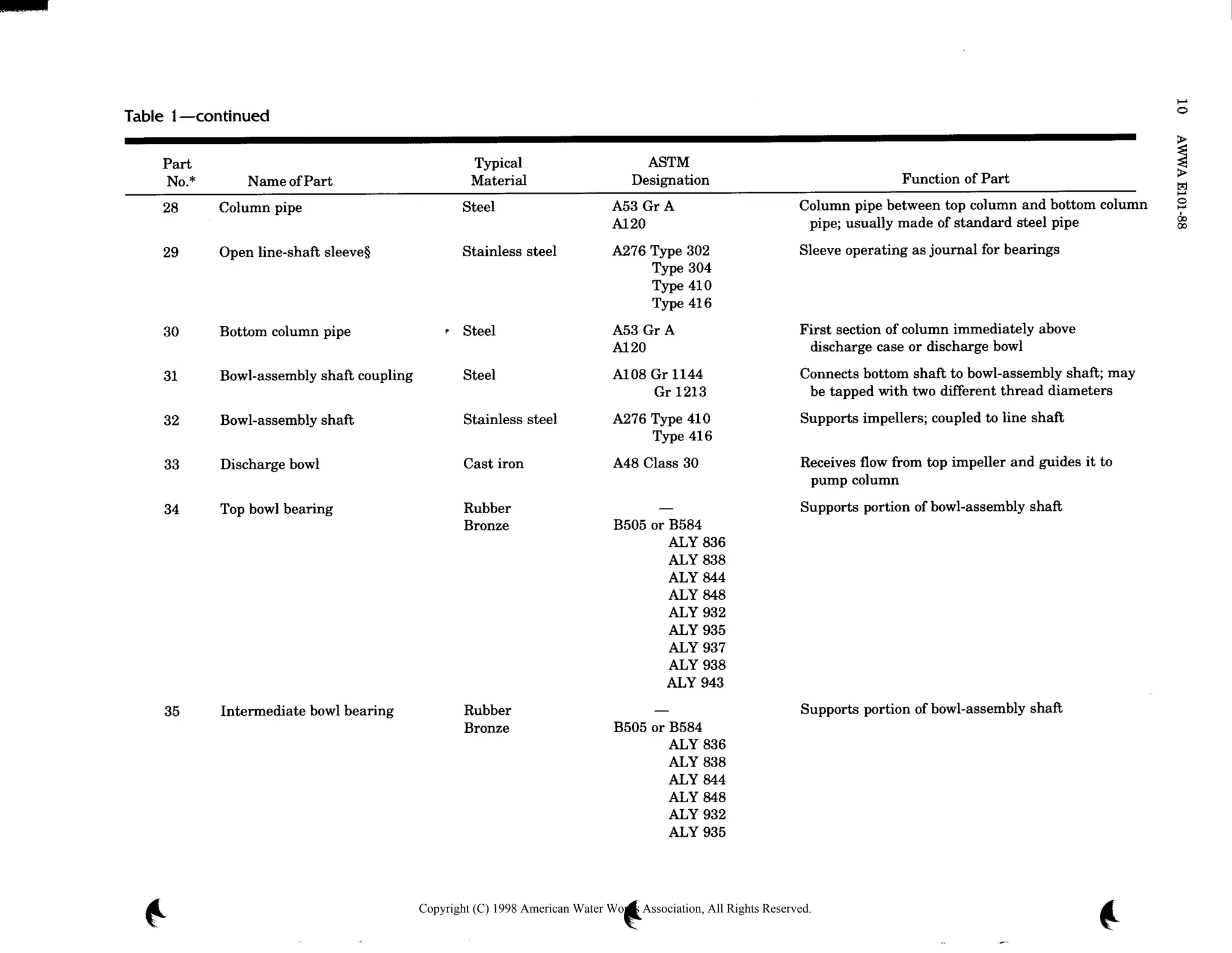
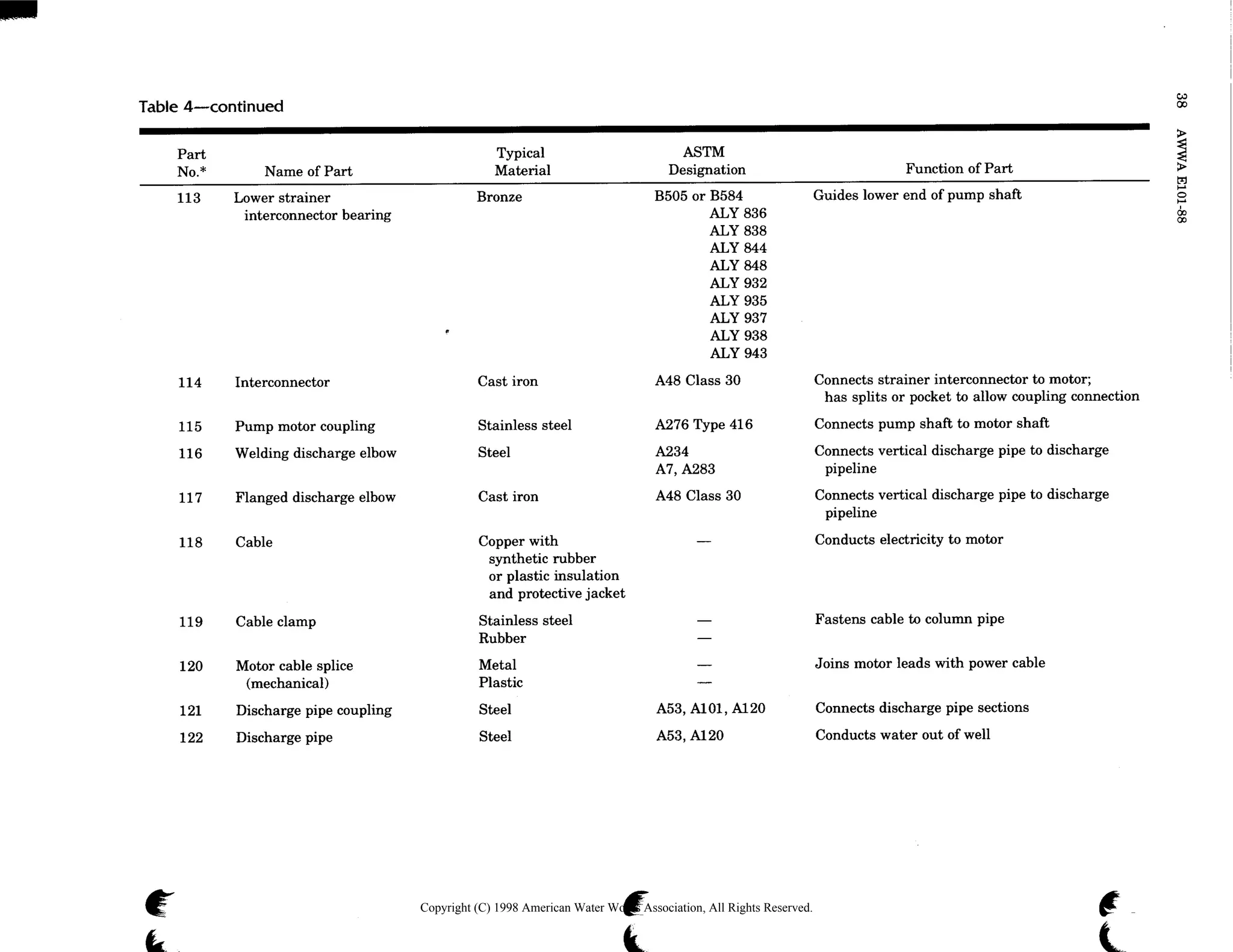
Table 1 (page 8) lists the names of parts in vertical turbine pumps, the func-
tion of each part, the material or materials from which the part is typically made,
and the ASTM* material designation. In the table, parts are listed by number; the
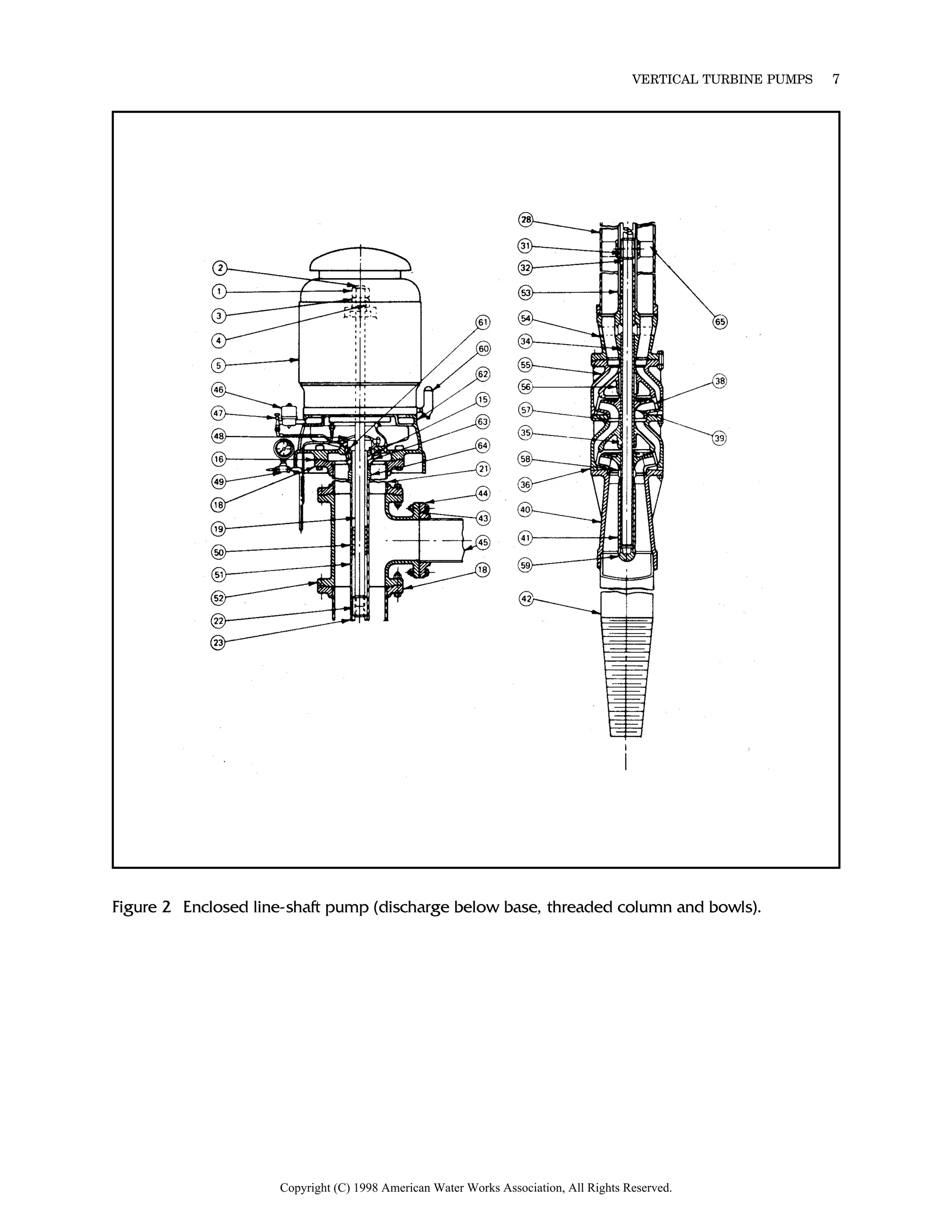
part number refers to the numbers in Figures 1 and 2 (pages 6 and 7).
Sec. A-3.2 Order Form
A specification form recommended for use in purchasing vertical turbine pumps
is given in Appendix B.
Sec. A-3.3 Inspection and Certification by Manufacturer
A-3.3.1 The manufacturer shall establish the necessary quality-control and in-
spection practices to ensure compliance with this standard.
A-3.3.2 The manufacturer shall, if required by the purchaser’s supplemental
specifications, furnish a sworn statement that the equipment furnished under the
purchaser’s order complies with all applicable requirements of this standard.
Sec. A-3.4 Information to Be Supplied by Bidder
The bidder shall submit, with its proposal, sufficient descriptive material or
outline drawings to demonstrate compliance with this standard and the purchaser’s
supplemental specifications, and a performance curve showing pump total head,
pump input power, and pump efficiency over the specified head range for the in-
stalled pump.
Sec. A-3.5 Sanitary Codes
The pump shall conform to the sanitary codes governing the installation. The
purchaser shall furnish, as part of these specifications, all information necessary for
the construction of the pump to meet these requirements.
SECTION A-4: SPECIFICATIONS
Sec. A-4.1 Pump Components
A-4.1.1 Pump base. A suitable base of cast iron or fabricated steel shall be
provided for mounting the driver and supporting the pump column.
A-4.1.2 Driver. With electric power, the motor, unless specified otherwise by
the purchaser, shall be of the full-voltage starting, vertical hollow-shaft squirrel-cage
induction type, and shall comply with ANSI C50.10.† The connection to the top shaft
shall be through a coupling or clutch in the motor head. The motor shall be of the
VERTICAL TURBINE PUMPS 5
*American Society for Testing and Materials, 1916 Race St., Philadelphia, PA 19103.
†ANSI C50.10—General Requirements for Synchronous Machines. Available from
American National Standards Institute, 1430 Broadway, New York, NY 10018.
Copyright (C) 1998 American Water Works Association, All Rights Reserved.
Figure 1 Open line-shaft pump (surface discharge, threaded column and bowls).
6 AWWA E101-88
Copyright (C) 1998 American Water Works Association, All Rights Reserved.
Figure 2 Enclosed line-shaft pump (discharge below base, threaded column and bowls).
VERTICAL TURBINE PUMPS 7
Copyright (C) 1998 American Water Works Association, All Rights Reserved.
Table 1 Standard Nomenclature—Line-Shaft Vertical Turbine Pumps
Part &pical ASTM
1
2
3
4
5
6
7
8
9
10
11
12
13
14
NO.*
Name of Part Ma~erial Designation Function of Part
Top shatt adjusting nut Bronze
Adjusting nut lock screw
or lock washer
Top drive coupling
Key for top drive coupling
Motor
Water slinger
Surface discharge head
Stufling-box studs and
hexagonal nuts (cap screws)
Stuffing-box gland
Stuffing-box lubrication fittings
Stuffig-box gasket
Prelubncation fittings
Top-shaft sleeve
Head base plate
Steel
Ductile iron
Steel
Part of motor
. Steel
—
Steel
Rubber
Cast iron
Steel
Steel
Brass
Stainless steel
Bronze
Cast iron
Steel
Copper
Rubber
Vellumoid
Commercial item
Stainless steel
Cast iron
Steel
B505 or B584, ALY 836
A108 Gr B1113
A536 Gr 65-45-12
A108 Gr 1018
GrBll13
Gr1213
—
A108
—
A108Gr Bll13
A48 Class 30
A307 Gr A or B
B16
A193
B584 ALY 836
A48 Class 30
—
—
—
—
—
A276 Type 304
Type 410
Type 416
A48 Class 30
A36
4$- @
___
-——.
—.—
. —-—
Means of adjusting impellers vertically by raising or
lowering shaft
Locks adjusting nut in place so that adjustment
cannot change while pump is in operation
Couples top shatl with motor rotor
Keys top shaft to tQp drive coupling
Drives pump
Keeps packing box leakage from shooting directly
into hollow shaft of motor or driver unit
Supports driver and pump colum~ discharges
water from pump column
Fastened in stuffing box to adjust
stutling-box gland
Compresses and holds packing in place
Conduct grease to packing and journal bearing
Placed under seat of packing containers to prevent
leakage
Conduct water to keep water-lubricated bearings
wet during starting cycle
Sleeve operating within packed area in top shaft
on open line-shaft pumps
Plate or casting that supports discharge head and
may become permanent part of foundation after
initial installation
Copyright (C) 1998 American Water Works Association, All Rights Reserved.
VERTICAL
TURBINE
PUMPS
9
m’
I
I
Copyright
(C)
1998
American
Water
Works
Association,
All
Rights
Reserved.
Table 1—continued
:
b
Part Typical ASTM 2
No.* Name of Part Material Designation Function of Part
>
m
+
28
29
30
31
32
33
34
Column pipe
Open line-shaft sleeves
Bottom column pipe
Bowl-assembly shaft coupling
Bowl-assembly shaft
Discharge bowl
Top bowl bearing
Steel
Stainless steel
P Steel
Steel
Stainless steel
Cast iron
Rubber
Bronze
35 Intermediate bowl bearing Rubber
Bronze
A53 Gr A
A120
A276 Type 302
Type 304
Type 410
Type 416
A53 Gr A
A120
A108 Gr 1144
Gr 1213
A276 Type 410
Type 416
A48 Class 30
—
B505 or B584
ALY 836
ALY 838
ALY 844
Column pipe between top column and bottom column S
pipe; usually made of standard steel pipe b
co
Sleeve operating as journal for bearings
First section of column immediately above
discharge case or discharge bowl
Connects bottom shaft to bowl-assembly shaft; may
be tapped with two different thread diameters
Supports impellers; coupled to line shaft
Receives flow from top impeller and guides it to
pump column
Supports portion of bowl-assembly shaft
ALY 848
ALY 932
ALY 935
ALY 937
ALY 938
ALY 943
— Supports portion of bowl-assembly shaft
B505 or B584
ALY 836
ALY 838
ALY 844
ALY 848
ALY 932
ALY 935
4!
.,. ,-
Copyright (C) 1998 American Water Works Association, All Rights Reserved.
ALY 937
ALY 938
ALY 943
36 Intermediate bowl Cast iron A48 Class 30 Guides flow received from impeller to next impeller
above
37 Impeller collet lock nut$ Steel A108Gr Bll13 Used to pull impeller on collet; locks collet in place
38 Impeller Cast iron A48 Class 30 Pumping element; receives water and impels it
Bronze B584 ALY 836 centrifugally to bowl passage
ALY838
ALY844
ALY848
ALY875
‘ Stainless steel A276 Type 416 Locks impeller to shaft
Steel A108 Gr B1113
Gr 1020
Gr 1213
Cast iron A48 Class 30 Receives water from well; guides to first impeller
39 Impeller lock collet
40 Suction case
41 Suction-case bearing Rubber — Supports bottom portion of pump shaft
Bronze B505 or B584
ALY 836
ALY 838
ALY 844
ALY 848
ALY 932
ALY 935
ALY 937
ALY 938
ALY 943
*See Figures 1 and 2.
~0.L.-oil lubricated.
$W.L.—water lubricated.
$Optional—these items are not furnished by all manufacturers.
Table continues on next page
Copyright (C) 1998 American Water Works Association, All Rights Reserved.
Table 1—continued
w
N
>
Part Typical ASTM
Name of Part
3
NO.* Material Designation Function of Part *
M
42 Keeps large foreign material out of pumps
. .
+
o
+
60
co
Seals joints between surface discharge head or
underground elbow and companion flange
Connects discharge pipe to integrally cast flanges on
discharge head or underground discharge elbow
Conducts water away from pump
Starts oil flow to line-shaft bearings when motor is
started
Steel
Stainless steel
Commercial item
—
Strainer
Discharge companion
gasket
Discharge companion
Discharge pipe
Solenoid oil valve
Sight-feed oil valve
—
flange
flange
43 —
44 Commercial item —
Commercial item
Commercial item
45
46
—
—
Commercial item
Bronze
Cast iron
Commercial item
Bronze
Means of adjusting oil flow to line-shaft bearings
Covers top of oil tube to prevent entrance of dust
47
48
—
B145
A48 Class 30
Tubing tension nut cap$
Water-level indicator assembly
Enclosed line-shaft bearing
Shaft-enclosing tube
Below-base discharge tee
Tubing adapter
Determines water level in well
49
50
—
B505, B584 Guides and supports shaft section; may couple
connecting sections of enclosing tube
Encloses line shaft
51 Steel A53 Gr A
A120
Changes flow from vertical to horizontal when dis-
charge is below surface; also forms part of column
Encloses shaft; adapts standard tube size to off-
standard tube size
52 Cast iron
Steel
Bronze
A48 Class 30
A120
53 B505 or B584
ALY 836
ALY 838
ALY 844
ALY 848
A120, A53
A48 Class 30
Steel
Cast iron
Guides flow to pump column
54 Discharge case Cast iron A48 Class 30
4!? e’
—.—
,.,
.=:,.-...
B
..
Copyright (C) 1998 American Water Works Association, All Rights Reserved.
55 Top bowl
56 Bypass seal$
57 Impeller seal ring$
58
59
60
61
62
63
64
65
Suction-case sand collar$
Suction-case plug
Oil-gauge assembly for
motor bearings
Packing follower$
Below-base discharge head
Tubing tension nut
Leek nut for tubing tension nut
Enclosing tube stabilizer
Cast iron A48 Class 30
Commercial item —
Cast iron A48 Class 30
Bronze B505 or B584
ALY 836
ALY 838
ALY 844
ALY 848
ALY 932
ALY 935
ALY 937
ALY 938
ALY 943
B148
Bronze B505 or B584
ALY 836
Malleable iron A47
Part of motor .
Cast iron A48 Class 30
Bronze B584 ALY 836
ALY838
ALY844
ALY848
Cast iron A48 Class 30
Rubber —
Receives flow from tQp impeller and guides it to
discharge case
Restricts leakage from bowls to oil tube; seals off
passages from enclosing tube
Provides water seal at impeller
Prevents sand from entering suction-case bearing
Plugs suction-case grease container
Shows level of oil in motor-oil reservoir
Tightens packing around enclosing tube
Supports motor above foundation when discharge is
below base
Maintains tension on shaft-enclosing tube
Locks tubing tension nut
Stabilizes shaft-enclosing tube
*See Figures 1 and 2.
tO.L.-oil lubricated.
$W.L.—water lubricated.
$Optional—these items are not furnished by all manufacturers.
Copyright (C) 1998 American Water Works Association, All Rights Reserved.
proper size to drive the pump continuously over the specified operating range with-
out the load exceeding the nameplate rating of the motor. The motor shall be rated
as drip proof with class B insulation and with a 1.15 service factor.
With an engine drive, the power shall be applied to the pump shaft through a
right-angle gear drive. The connection to the vertical shaft shall be through a cou-
pling or clutch in the gear head. The horizontal shaft shall rotate in the same direc-
tion as the engine drive, and shall be connected to the engine by a flexible shaft
coupling.
An optional method of driving, for an engine or horizontal electric motor, shall
be a belted drive—either a flat belt on a modified cylindrical pulley or a V-belt on a
V-groove pulley.
Rotation of the vertical shaft shall be counterclockwise when viewed from
above.
A thrust bearing of ample capacity to carry the weight of all rotating parts plus
the hydraulic thrust at maximum operating conditions shall be incorporated into the
driver. For antifriction bearings, the bearings shall be of such capacity that the
AFBMA* calculated rating life (L10) shall be no less than 8800 h. If the design and
operating conditions are such that upthrust can occur, then proper provisions shall
be made to accommodate the upthrust. This shall be done by the supplier.
A-4.1.3 Suction pipe and strainer. A strainer, if required, shall have a net in-
let area equal to at least three times the suction pipe area. The maximum opening
shall not be more than 75 percent of the minimum opening of the water passage
through the bowl or impeller.
A-4.1.4 Shaft couplings. Line shafts shall be coupled with steel couplings that
shall have a left-hand thread to tighten during pump operation. The maximum com-
bined shear stress, determined by the following formula, shall not exceed 20 percent
of the elastic limit in tension nor be more than 12 percent of the ultimate tensile
strength of the shafting steel used.
————————————————————————————
2F 321,000P
S = √ [ —————————]2
+ [—————————]2
(Eq 2)
π (D2
– d2
) n (D3
– d3
)
Where:
S = combined shear stress, in pounds per square inch
F = total axial thrust of the shaft, including hydraulic thrust plus the
weight of the shaft and all rotating parts supported by it, in pounds
D = outside diameter of the coupling, in inches
d = inside diameter of the coupling at the root of the threads, in inches
P = power transmitted by the shaft, in horsepower
n = rotational speed of the shaft, in revolutions per minute
14 AWWA E101-88
*Anti-Friction Bearing Manufacturers Association, 1101 Connecticut Ave. N.W., Suite 700,
Washington, DC 20036.
Copyright (C) 1998 American Water Works Association, All Rights Reserved.
‘1
VERTICAL TURBINE PUMPS 15
NOTE: in. x 25.40 = mm; lb x 0.454 = kg; psi x 6.895 = kPa; hp x 0.746 = kW;
rpm x 0.0167 = rps.
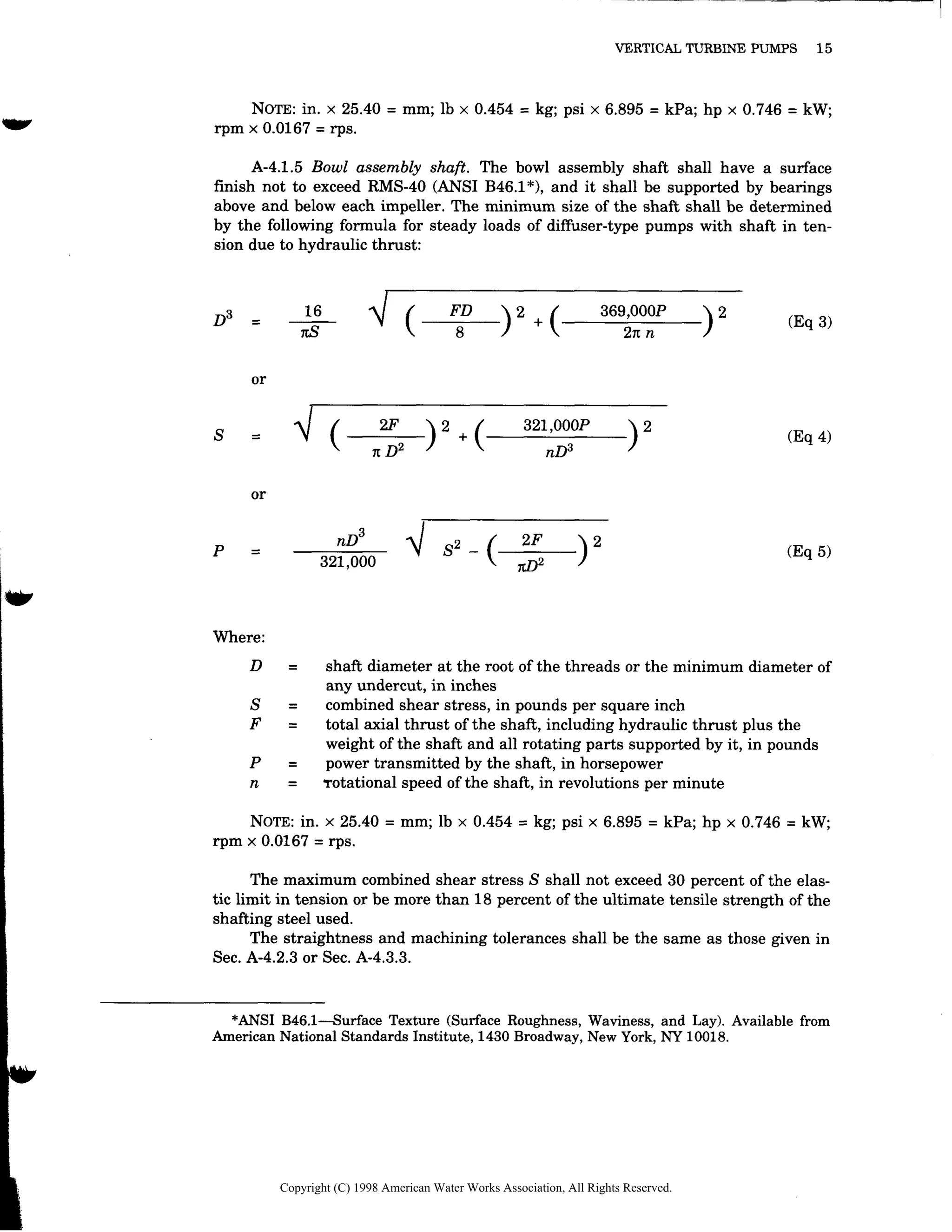
A-4.1.5 Bowl assembly shaft. The bowl assembly shaft shall have a surface
finish not to exceed RMS-40 (ANSI B46.1 *), and it shall be supported by bearings
above and below each impeller. The minimum size of the shaft shall be determined
by the following formula for steady loads of diffuser-type pumps with shaft in ten-
sion due to hydraulic thrust:
~3
s
P
16
J(
FD 2+
)(
369,000P
)
2
=
7S 8 27t n
(Eq 3)
or
N( 2F2
)(
321 ,000P
)
2
= +
n D2 nD3
or
(Eq 4)
= ‘D3 d S2-( ; )2
321,000
(Eq 5)
Where:
D= shaft diameter at the root of the threads or the minimum diameter of
any undercut, in inches
s= combined shear stress, in pounds per square inch
F= total axial thrust of the shaft, including hydraulic thrust plus the
weight of the shaft and all rotating parts supported by it, in pounds
P= power transmitted by the shaft, in horsepower
n= Notational speed of the shaft, in revolutions per minute
NOTE: in. x 25.40 = mm; lb x 0.454 = kg; psi x 6.895 = kPa; hp x 0.746 = kW;
rpm x 0.0167 = rps.
The maximum combined shear stress S shall not exceed 30 percent of the elas-
tic limit in tension or be more than 18 percent of the ultimate tensile strength of the
shafling steel used.
The straightness and machining tolerances shall be the same as those given in
Sec. A-4.2.3 or Sec. A-4.3.3.
*ANSI B46.1-Surface Texture (Surface Roughness, Waviness, and Lay). Available from
American National Standards Institute, 1430 Broadway, New York, NY 10018.
Copyright (C) 1998 American Water Works Association, All Rights Reserved.
Sec. A-4.2 Oil-Lubricated Pump Column
A-4.2.1 Pump bowls. The castings shall be free of blowholes, sand holes, and
other detrimental defects. The bowls shall be capable of withstanding a hydrostatic
pressure equal to twice the pressure at rated capacity or 11/2 times shut-off head,
whichever is greater. Bowls may be equipped with replaceable seal rings on the
suction side of enclosed impellers. The discharge case shall be provided with a
means of reducing to a minimum the leakage of water into the shaft-enclosing tube,
and must have bypass ports of sufficient area to permit the escape of water through
the seal or bushing.
A-4.2.2 Impellers. The impellers shall be of the enclosed, semiopen, or open
type, statically balanced. They shall be fastened securely to the impeller shaft with
keys, taper bushings, lock nuts, or split thrust rings. They shall be adjustable verti-
cally by means of a nut in the driver or an adjustable coupling between the pump
and the driver.
A-4.2.3 Line shafts. The line shafts shall be of a material listed in Table 1 and
have a surface finish not to exceed RMS 40 (ANSI B46.1), and of a size that con-
forms to Sec. A-4.1.5. For convenience, Table 3 (on page 22) may be used. The shaft
shall be furnished in interchangeable sections having a nominal length not to exceed
20 ft (6 m). To ensure accurate alignment of the shafts, they shall be straight within
0.005 in. (0.13 mm) total indicator reading for a 10-ft (3-m) section; the butting faces
shall be machined with center relief and square to the axis of the shaft; the maxi-
mum permissible error in the axial alignment of the thread axis with the axis of the
shaft shall be 0.002 in. in 6 in. (0.05 mm in 150 mm). The line shaft shall be coupled
with steel couplings that comply with the requirements of Sec. A-4.1.4.
A-4.2.4 Line-shaft bearings. The line-shaft bearings, which are also integral
tube couplings, shall be spaced not more than 5 ft (1.5 m) apart. The maximum
angle error of the thread axis to the bore axis shall be within 0.001 in. per in. (0.001
mm per mm) of thread length. The concentricity of the bore to the threads shall be
within 0.005 in. (0.13 mm) total indicator reading. The bearings must contain one or
more oil grooves or a separate bypass hole that will readily allow the oil to flow
through and lubricate the bearings below.
A-4.2.5 Shaft-enclosing tube. The shaft-enclosing tube shall be made of sched-
ule 80 steel pipe in interchangeable sections not more than 5 ft (1.5 m) in length.
The ends of the enclosing tube shall be square with the axis and shall butt to ensure
accurate alignment. The maximum angle error of the thread axis relative to the bore
axis shall be 0.001 in. per in. (0.001 mm per mm) of thread length. The enclosing
tube shall be stabilized in the column pipe by stabilizers.
A-4.2.6 Discharge column pipe. The pipe size shall be such that the friction
loss will not exceed 5 ft per 100 ft (5 cm per m), based on the rated capacity of the
pump. The pipe shall be furnished in interchangeable sections having a nominal
length of 10 ft (3 m); shall conform to the provisions in Table 2; and shall be con-
nected by threaded-sleeve couplings or flanges. The ends of each section of the pipe
may be faced parallel and machined with threads to permit ends to butt, or they
may be fixed with ANSI B1.20.1 standard tapered pipe threads.
A-4.2.7 Discharge-head assembly. At the surface or below-base discharge head,
a proper lubrication system must be installed. It shall consist of a manually oper-
ated sight-feed drip lubricator and an oil reservoir, constructed as an integral part
of the head or as a separate auxiliary unit. A tubing tension nut shall be installed in
16 AWWA E101-88
Copyright (C) 1998 American Water Works Association, All Rights Reserved.
the head to allow tension to be placed on the shaft-enclosing tube. Provision must be
made for sealing off the thread at the tension nut.
Sec. A-4.3 Water-Lubricated Pump Column
A-4.3.1 Pump bowls. The castings shall be free of blowholes, sand holes, and
other detrimental defects. The bowls shall be capable of withstanding a hydrostatic
pressure equal to twice the pressure at rated capacity or 11/2 times shut-off head,
whichever is greater. Bowls may be equipped with replaceable seal rings on the
suction side of enclosed impellers.
A-4.3.2 Impellers. The impellers shall be of the enclosed, semiopen, or open
type, statically balanced. They shall be fastened securely to the impeller shaft with
keys, taper bushings, or lock nuts. They shall be adjustable vertically by means of a
nut in the driver or an adjustable coupling between the pump and the driver.
A-4.3.3 Line shafts. The line shafts shall be of a material listed in Table 1 and
have a surface finish not to exceed RMS 40 (ANSI B46.1), and of a size that con-
forms to Sec. A-4.1.5 of this standard. For convenience, Table 3 (on page 22) may be
used. The shaft shall be furnished in interchangeable sections having a nominal
length of 10 ft (3 m). To ensure accurate alignment of the shafts, they shall be
straight within 0.005 in. (0.13 mm) total indicator reading for a 10-ft (3-m) section;
the butting faces shall be machined square to the axis of the shaft; the maximum
permissible error in the axial alignment of the thread axis with the axis of the shaft
shall be 0.002 in. in 6 in. (0.05 mm in 150 mm). The line shaft shall be coupled with
steel couplings complying with the requirements of Sec. A-4.1.4. The shaft shall be
provided with a noncorrosive wearing surface at the location of each guide bearing.
A-4.3.4 Line-shaft bearings. The shaft bearings shall be designed for vertical
turbine pump service, to be lubricated by the liquid pumped. They shall be mounted
in bearing retainers that shall be held in position in the column couplings by means
of the butted ends of the column pipes. The bearings shall be spaced at intervals of
not more than 10 ft (3 m).
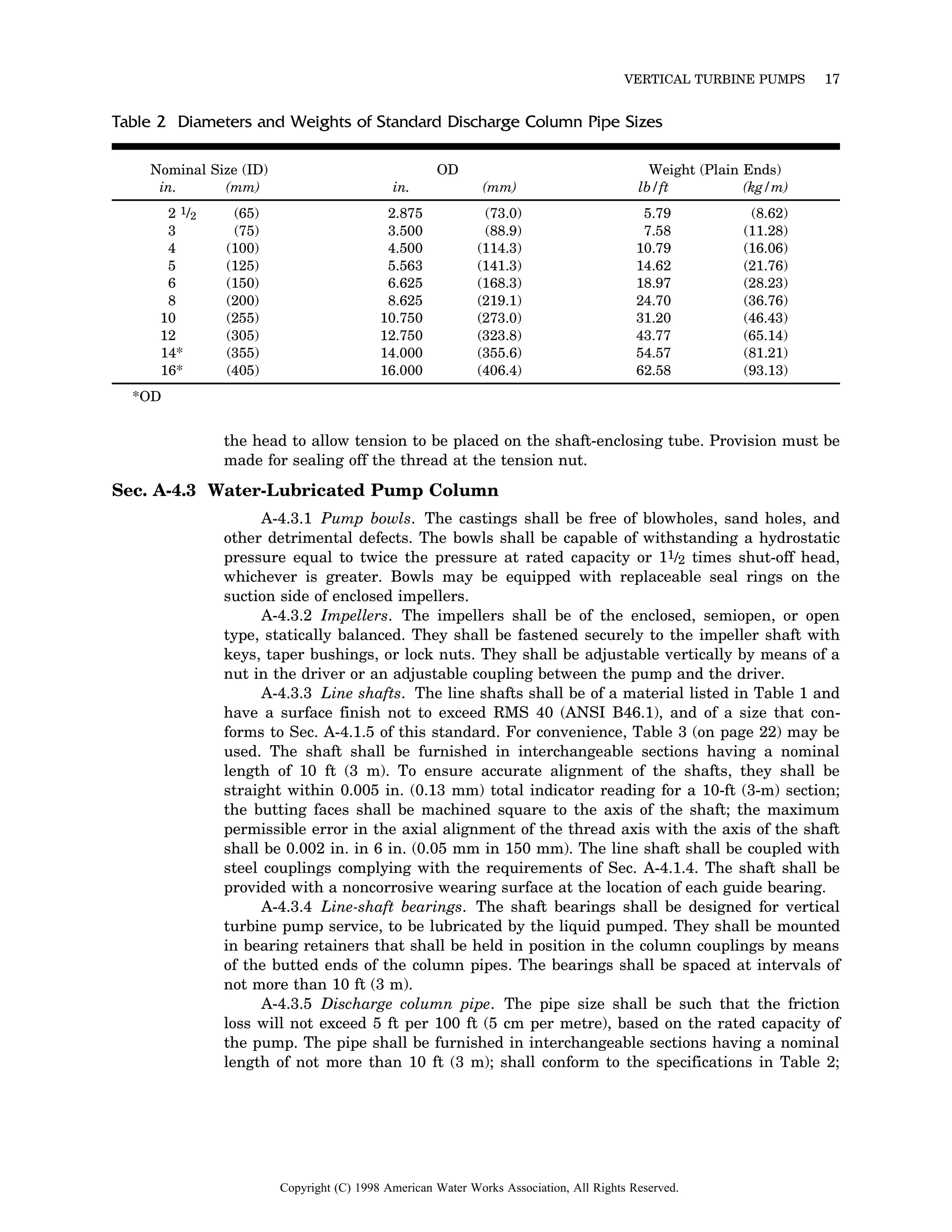
A-4.3.5 Discharge column pipe. The pipe size shall be such that the friction
loss will not exceed 5 ft per 100 ft (5 cm per metre), based on the rated capacity of
the pump. The pipe shall be furnished in interchangeable sections having a nominal
length of not more than 10 ft (3 m); shall conform to the specifications in Table 2;
Table 2 Diameters and Weights of Standard Discharge Column Pipe Sizes
Nominal Size (ID) OD Weight (Plain Ends)
in. (mm) in. (mm) lb/ft (kg/m)
2 1/2 (65) 2.875 (73.0) 5.79 (8.62)
3 (75) 3.500 (88.9) 7.58 (11.28)
4 (100) 4.500 (114.3) 10.79 (16.06)
5 (125) 5.563 (141.3) 14.62 (21.76)
6 (150) 6.625 (168.3) 18.97 (28.23)
8 (200) 8.625 (219.1) 24.70 (36.76)
10 (255) 10.750 (273.0) 31.20 (46.43)
12 (305) 12.750 (323.8) 43.77 (65.14)
14* (355) 14.000 (355.6) 54.57 (81.21)
16* (405) 16.000 (406.4) 62.58 (93.13)
*OD
VERTICAL TURBINE PUMPS 17
Copyright (C) 1998 American Water Works Association, All Rights Reserved.
and shall be connected with threaded sleeve-type couplings or flanges. The ends of
each section of column pipe shall be faced parallel and the threads machined to such
a degree that the ends will butt against the bearing retainer shoulder to ensure
proper alignment and to secure the bearing retainers when assembled.
A-4.3.6 Discharge-head assembly. The pump shall be provided with a dis-
charge head of the surface or underground type, as required, and shall be provided
with a shaft packing box and a renewable bronze bushing. The head shall also in-
clude a prelubrication connection to wet down the line-shaft bearings adequately
before starting the pump.
A-4.3.7 Prelubrication. On installations with a setting of more than 50 ft (15
m), provisions shall be made by the manufacturer to prelubricate line-shaft bearings
adequately before the pump is started.
If manual control is used and a source of fresh water under pressure is not
available, a prelubricating tank, with the necessary valves and fittings to connect it
to the pump, shall be provided. The size of the tank shall be adequate to permit a
thorough wetdown of all the line-shaft bearings before the power is applied, with an
adequate reserve for repeating the process in the event that the pump does not start
the first time.
If an automatic system is used, bypass fittings or other suitable means shall be
provided to bring the prelubricating water from ahead of the check valve into the
prelubricating opening of the discharge head. Normally this implies the use of a
time-delay relay in the starting system and a solenoid valve in the prelubricating
line.
A-4.3.8 Ratchets. Water-lubricated vertical turbine pumps having a setting of
50 ft (15 m) or more shall be provided with a nonreverse mechanism in the motor to
protect the line shaft and the motor from reverse rotation when the power is inter-
rupted and the water empties from the discharge column.
SECTION A-5: ENGINEERING DATA
Sec. A-5.1 Discharge Column Pipe
Diameters and weights of standard discharge column pipe sizes are given in
Table 2.
Sec. A-5.2 Column-Friction Loss
The column-friction chart (Figure 3) should be used as a design guide to deter-
mine the loss of head due to column friction. This chart was compiled from data on
head loss where the flow is between the inside diameter of the column pipe and the
outside diameter of the shaft-enclosing tube.
For open line shafting, assume the head losses to be equal to those indicated in
Figure 3 for a shaft-enclosing tube of a size that would normally enclose the open
line shaft in question.
Sec. A-5.3 Discharge Head Loss
The discharge head loss chart (Figure 4) should be used to determine the hy-
draulic losses in the discharge head. Losses in discharge heads vary with the size
of the head; the design of the head; and the size of tubing or shaft, column, and
discharge pipe used. Figure 4 represents estimated average losses based on
18 AWWA E101-88
Copyright (C) 1998 American Water Works Association, All Rights Reserved.
Figure 3 Friction-loss chart for standard pipe column.
NOTE: Friction loss determined by laboratory tests on new pipe (C = 140).
Diagonals are labeled to show nominal diameters (in inches) of outer pipe column and inner shaft-enclosing tube. For the outer
pipe columns, the calculations used in constructing the chart were based on inside diameters, which are close to the nominal
sizes for pipe up to and including 12 in. (for example, 10 in. = 10.2-in. ID). For pipe sizes 14 in. and larger, the diameters shown
are equivalent to the outside diameter of pipe with 3/8-in. wall thickness (for example, 16 in. = 15 1/4-in. ID). For the inner col-
umns (shaft-enclosing tubes), the calculations were based on the outside diameters of standard or extra-heavy pipe. Thus, “8 ×
2” on the chart is actually 8.071 × 2 3/8, and “16 × 3” is 15 1/4 × 3 1/2.
Conversion factor: in. × 25.40 = mm.
VERTICAL TURBINE PUMPS 19
Copyright (C) 1998 American Water Works Association, All Rights Reserved.
manufacturers’ information. When extreme accuracy is imperative, actual loss
measurements in the discharge head—with the correct tubing or shaft, column, and
discharge pipe—should be specified on the bid request by the purchaser.
Sec. A-5.4 Mechanical Friction
The mechanical-friction chart (Figure 5) should be used to determine the added
horsepower required to overcome the mechanical friction in rotating the line shaft.
The chart was compiled from test data submitted by representative turbine-pump
manufacturers. Variations in designs used by individual manufacturers may affect
the figures slightly.
Figure 4 Head loss in discharge heads.
Conversion factor: in. × 25.40 = mm.
20 AWWA E101-88
Copyright (C) 1998 American Water Works Association, All Rights Reserved.
Figure 5 Mechanical friction in line shafts.
NOTE: The chart shows values for enclosed shaft with oil or water lubrication and drip feed, or for open shaft with water lubrica-
tion. For enclosed shaft with flooded tube, read two times the value of friction shown on the chart.
VERTICAL TURBINE PUMPS 21
Copyright (C) 1998 American Water Works Association, All Rights Reserved.
Table 3 Line-Shaft Selection Chart for Type B Material*
Pump Thrust—1000 lb (kN)
Shaft 1 2 3 5 7.5 10 15 20 30
Diameter Speed (4.448) (8.896) (13.344) (22.24) (33.36) (44.48) (66.72) (88.96) (133.44)
in. (mm) rpm Power Rating—hp (hp × 0.746 = kW)
3/4 (19.05) 3500 39.7 38.8 37.4 32.4
2900 32.9 32.2 31.0 26.9
1760 20.0 19.5 18.8 16.3
1460 16.6 16.2 15.6 13.5
1 (25.40) 3500 94.5 93.8 93.0 89.5 82.5
2900 78.3 77.7 77.0 74.2 68.4
1760 47.5 47.2 46.7 45.0 41.5
1460 39.4 39.1 38.7 37.3 34.4
1 3/16 (30.16) 3500 167.0 167.0 166.0 163.0 157.0 149.0
2900 138.4 138.4 137.5 135.1 130.1 123.5
1760 84.0 84.0 83.5 82.0 79.0 75.0
1460 69.6 69.6 69.2 67.9 65.5 62.1
1 7/16 (36.51) 3500 296.0 294.0 289.0 283.0 264.0
2900 245.3 243.6 239.5 234.5 218.7
1760 149.0 146.0 145.0 142.0 133.0
1460 123.5 121.0 120.1 117.7 110.2
1160 98.3 97.6 96.0 94.0 87.6
960 81.4 80.8 79.5 77.8 72.5
1 1/2 (38.10) 3500 336.0 334.0 330.0 324.0 306.0
2900 278.4 276.7 273.4 268.5 253.5
1760 169.0 168.0 166.0 163.0 154.0
1460 140.0 139.2 137.5 135.1 127.6
1160 111.2 110.7 109.2 107.2 101.4
960 92.0 91.6 90.4 88.7 83.9
1 11/16 (42.86) 1760 252.0 251.0 248.0 246.0 239.0 227.0
1460 209.1 208.2 205.7 204.1 198.3 188.3
1160 166.0 165.0 164.0 162.0 157.0 150.0
960 137.4 136.6 135.7 134.1 129.9 124.1
860 123.0 122.0 121.0 120.0 117.0 111.0
710 101.6 100.7 99.9 99.1 96.6 91.6
*Steel with a minimum elastic limit of 40,000 psi (276,000 kPa) and a minimum ultimate tensile strength
of 67,000 psi (462,000 kPa).
22 AWWA E101-88
Copyright (C) 1998 American Water Works Association, All Rights Reserved.
Sec. A-5.5 Line-Shaft Selection
Line-shaft selection shall be made in accordance with the following procedure
using Table 3, or shall be calculated for the specific material used in accordance
with Sec. A-4.2.3 or Sec. A-4.3.3.
A-5.5.1 Table 3 does not limit the maximum rotative speed of shafts, the maxi-
mum setting of shafts, or the bearing spacing used with the shafting.
A-5.5.2 Table 3 defines the maximum recommended horsepower for a given
size of shaft, taking into account the effect of the hydraulic thrust of the pumping
equipment and the weight of the shaft and suspended rotating parts. The table is
applicable to any steel having a minimum elastic limit of 40,000 psi (276,000 kPa)
and a minimum ultimate tensile strength of 67,000 psi (462,000 kPa).
A-5.5.3 Horsepower ratings shown in Table 3 and calculated in accordance
with Sec. A-4.1.5 represent maximum loads and should not be increased by electric-
motor service factors.
Table 3— continued
Pump Thrust—1000 lb (kN)
Shaft 1 2 3 5 7.5 10 15 20 30
Diameter Speed (4.448) (8.896) (13.344) (22.24) (33.36) (44.48) (66.72) (88.96) (133.44)
in. (mm) rpm Power Rating—hp (hp × 0.746 = kW)
1 15/16 (49.21) 1760 393.0 392.0 390.0 382.0 373.0 345.0
1460 326.0 325.2 323.5 316.9 309.4 286.2
1160 259.0 258.0 257.0 252.0 246.0 228.0
960 214.3 213.5 212.7 208.6 203.6 188.7
860 192.0 192.0 191.0 187.0 182.0 169.0
710 158.5 158.5 157.7 154.4 150.3 139.5
2 3/16 (55.56) 1760 578.0 577.0 576.0 570.0 562.0 538.0
1460 479.5 478.7 477.8 472.8 466.2 446.3
1160 382.0 381.0 380.0 376.0 371.0 355.0
960 316.1 315.3 314.5 311.2 307.0 293.8
860 283.0 282.0 281.0 279.0 275.0 263.0
710 233.6 232.8 232.0 230.3 227.0 217.1
2 7/16 (61.91) 1760 816.0 815.0 810.0 802.0 781.0
1460 676.9 676.1 671.9 665.3 647.9
1160 537.0 537.0 533.0 529.0 515.0
960 444.4 444.4 441.1 437.8 426.2
860 398.0 398.0 395.0 392.0 381.0
710 328.6 328.6 326.1 323.6 314.6
2 11/16 (68.26) 1760 1070.0 1062.0 1055.0 1035.0
1460 887.6 881.0 875.2 858.6
1160 703.0 700.0 696.0 682.0
960 581.8 579.3 576.0 564.4
860 520.0 518.0 515.0 505.0
710 429.3 427.7 425.2 416.9
VERTICAL TURBINE PUMPS 23
Copyright (C) 1998 American Water Works Association, All Rights Reserved.
SECTION A-6: FACTORY INSPECTION AND TESTS
Sec. A-6.1 Tests
A-6.1.1 The procedure for determining the performance of a vertical turbine
pump by making a factory laboratory test of the bowl assembly and then calculating
the anticipated field performance is described below. Performance tests shall be
made only when specified in the purchaser’s inquiry and order. The inquiry and
order shall specify which of the following are required:
1. Running test.
2. Witnessed running test.
3. Sample calculation from test readings.
4. Shop inspection.
5. Hydrostatic test of discharge head.
6. Hydrostatic test of bowl assembly.
If other tests are required, the purchaser shall describe them in detail.
A-6.1.2 The manufacturer shall notify the purchaser not less than five days
prior to the date that the pump or pumps will be ready for inspection or witness
test.
Sec. A-6.2 Running Test
A-6.2.1 The pump bowl assembly will be operated from zero capacity to the
maximum capacity shown on the performance curve submitted with the manufac-
turer’s bid. Readings shall be taken at a minimum of five capacity points, including
one point within ± 2 percent of the design capacity specified on the request for bid.
The pump shall be operated at a speed within ± 5 percent of the design speed.
This does not apply to model or slow-speed tests described in Sec. A-6.9.
A-6.2.2 At the conclusion of the test, three copies of the anticipated fieldperfor-
mance curve shall be supplied to the purchaser, unless the purchaser requests test
curves based on the actual test data without corrections for anticipated field per-
formance.
Sec. A-6.3 Typical Laboratory Test Arrangement
Figure 6 shows a typical laboratory arrangement for the testing of a line-shaft
vertical turbine pump. A test laboratory will normally be constructed to provide
favorable suction conditions for pump performance. If the purchaser plans to use the
pump under questionable well or sump conditions and wants the pump to be tested
under these exact conditions, complete information should be included in the request
for bid. If there is nothing stated in the bid with relation to required well or sump
conditions, it shall be assumed that standard laboratory arrangements will be used.
Sec. A-6.4 Capacity Measurement
The capacity of the pump shall be measured by means of a standard venturi
tube, nozzle, orifice plate, pitot-tube traverse, or magnetic meter. The pump manu-
facturer shall supply evidence that the capacity-measuring device employed has
been properly calibrated, that it is in good condition, and that the pressure taps and
piping are proper for the instrument being used and are essentially the same as
24 AWWA E101-88
Copyright (C) 1998 American Water Works Association, All Rights Reserved.
during the calibration. Instruments that have not been calibrated should be geomet-
rically similar to properly calibrated models.
A description of the application of fluid meters is contained in the ASME publi-
cation Fluid Meters—Their Theory and Application.* A detailed description of the
various meters and their application is given in Chapter B-2 of that publication, the
physical constants and meter coefficients are indicated in Section C, and the dis-
charge coefficient tolerances of the various meters are indicated in Chapter C-7.
The surface conditions, size, and length of the pipe preceding the fluid-measur-
ing device are as important as the calibration of the device itself. Thus, piping
should be in close conformity with that used when the instrument was calibrated or
in accordance with the recommendations by the manufacturer of the fluid-measuring
device.
Fluid manometers or other instruments of equal accuracy should be used for
measuring the pressure differential across the meter.
Sec. A-6.5 Head Measurement
All pump bowl assembly tests shall be made in open sumps, unless otherwise
stated in the request for bid.
Figure 6 Typical laboratory test arrangement— line-shaft vertical turbine pumps.
VERTICAL TURBINE PUMPS 25
*Fluid-Meters—Their Theory and Application. Rept. ASME Res. Comm. on Fluid Meters.
Amer. Soc. Mech. Engr., New York (5th ed., 1959.) Available from American Society of
Mechanical Engineers, 345 East 47th St., New York, NY 10017.
Copyright (C) 1998 American Water Works Association, All Rights Reserved.
The pressure tap for head measurement shall be located in the discharge col-
umn not less than 2 ft (0.6 m) above the pump bowl assembly. The pressure tap
opening shall be at right angles to the pipe, free from burrs, flush with the surface
of the column pipe, and with a diameter of 1/8– 1/4 in. (3.18–6.35 mm).
As an alternate method, the pressure tap for head measurement can also be
located not less than 10 diameters downstream from the discharge elbow of the test
pump. (The elbow to be furnished with the pump shall be used.) When the pump
head is measured at this point, no deduction for elbow loss need be made in antici-
pating field performance.
For head measurements of 36 ft (11 m) or less, only fluid manometers shall be
used. For head measurements in excess of 36 ft (11 m), calibrated bourdon or other
gauges with equivalent accuracy and reliability can be used. All gauges shall be
calibrated before and after each series of tests.
Sec. A-6.6 Velocity Head
The average velocity in the pump column used to determine the velocity head
shall be calculated from dimensions obtained by actual internal measurement of the
pipe and external measurement of the shaft or enclosing tube at the point of pres-
sure measurement.
If the pressure measurement is made downstream from the discharge elbow,
the velocity head shall be obtained from actual measurement of the inside diameters
of the discharge pipe at the point where the pressure tap is located.
Sec. A-6.7 Horsepower Input
The power input to the pump shall be determined with a vertical dynamometer
or a calibrated electric motor.
The torque of the dynamometer shall be measured by means of a calibrated
scale, calibrated strain gauge, or other device of equivalent accuracy.
Squirrel-cage induction motors (when operated at greater than half the name-
plate rating), direct-current motors, synchronous motors, or wound-rotor induction
motors with short-circuited secondary resistance may be employed for the determi-
nation of shaft input, provided the efficiencies or losses have been ascertained by an
IEEE* test or its equivalent.
When the specifications call for an overall efficiency guarantee, the actual job
motor can be used without calibration and the overall efficiency calculated directly.
Calibrated laboratory-type electric meters and transformers shall be used to
measure power input to all motors.
Sec. A-6.8 Measurement of Speed
The rotating speed of the pump shall be obtained by a hand counter, electronic
computer, or a stroboscope counting slip. It should be noted that an accurate speed
reading is important in determining power input when a dynamometer is used. Ac-
curacy is less important when a calibrated motor is used.
26 AWWA E101-88
*Institute of Electrical and Electronics Engineers, 345 East 47th St., New York, NY 10017.
Copyright (C) 1998 American Water Works Association, All Rights Reserved.
Sec. A-6.9 Large-Pump Tests
A-6.9.1 On all pump bowl assemblies where the horsepower is not in excess of
200 hp (150 kW) and the bowl diameter is not in excess of 20 in. (500 mm), the
actual pump shall be tested in the manufacturer’s laboratory.
A-6.9.2 If the horsepower exceeds 200 hp (150 kW), it shall be permissible for
the manufacturer to test only the number of stages of the unit that come within this
power requirement. If a test is made on a limited number of stages, no increase in
efficiency shall be permitted for an increased number of stages when predicting the
final performance of the complete bowl assembly. The head and horsepower shall be
increased in direct proportion to the number of stages in the final assembly, com-
pared with the number of stages used in the laboratory test.
A-6.9.3 When the size of the bowls exceeds 20-in. (500-mm) OD, a laboratory
test on a model pump, homologous with the actual unit, may be used as a basis for
the determination of the performance of the actual unit.
NOTE: In general, when contract guarantees are to be based on model tests,
the contract should specify model performance rather than inferred actual-unit per-
formance. In the absence of this provision, allowance for the scale effect, if any, shall
be agreed on in writing by the representatives of both parties prior to the tests.
The model pump shall be run at a speed sufficient to develop a head per stage
at least equal to that of the actual unit, so that the velocities will equal or exceed
those of the actual unit; or the manufacturer must submit evidence that a single-
stage model does not cavitate under specified field suction conditions when operated
at a speed such that the velocities will equal or exceed those of the actual unit.
A-6.9.4 On bowl assemblies that have an OD exceeding 20 in. (500 mm) or
require more than 200 hp (150 kW), it shall be permissible to test the actual bowl
assembly at a speed slower than that at which the pump will run in the field, rather
than make a model test. No efficiency increase will be allowed when the perform-
ance in the slow-speed test is translated into that at full speed. The manufacturer
must submit evidence that a single-stage bowl assembly or a single-stage model does
not cavitate under specified field suction conditions when operated at a speed such
that the velocities will equal or exceed those of the actual unit.
A-6.9.5 All large bowl assembly full speed tests or model tests should be con-
ducted with identical submergence that will exist in the field, as shown on the re-
quest for bids, except as otherwise agreed on between the manufacturer and the
purchaser.
Sec. A-6.10 Hydrostatic Tests
A-6.10.1 A hydrostatic test on the pump bowl castings shall be made at 11/2
times the shut-off head developed by the pump bowl assembly or at twice the rated
head, whichever is greater.
A-6.10.2 A hydrostatic test on the discharge head shall be made at the pres-
sure defined in Sec. A-6.10.1, less the pump setting specified on the order.
Sec. A-6.11 Recording and Computation of Test Results
A-6.11.1 All instrument test readings, as well as corrected readings, shall be
recorded on the test sheet. Complete data concerning the pump, driver, and instru-
ment identification shall also be recorded.
VERTICAL TURBINE PUMPS 27
Copyright (C) 1998 American Water Works Association, All Rights Reserved.
28 AWWA E101-88
A-6.11.2 All test results shall be translated into performance at the anticipated
speed of the driver at the design point by the following formulas:
hd
Q=Qt( n ) (Eq 6)
nt
H=Ht~ n )2 (Eq 7)
nt
P=Pt( n )3 (IM 8)
nt
Where:
Q = pump capacity, in gallons per minute (cubic metres per hour)
t = indicated test values
n = anticipated operating speed, in revolutions per minute
(revolutions per second)
H= head, in feet (metres)
P= power, in horsepower (kilowatts)
NOTE: gpm x 0.2271 = m3/h; rpm x 0.0167 = rps; ft x 0.3048 = m; hp x 0.746 =
kW.
A-6.11.3 The bowl assembly input power PI, in horsepower, when measured by
a vertical dynamometer, is found using the expression
PI . KFnt (Eq 9)
Where:
K= dynamometer constant, 2nL/33,000
Where:
L = length of the lever arm, in feet (metres)
F= net force at the end of the lever arm, in pounds (Newtons)
nt = speed of the driver when the test reading is taken, in revolutions
per minute (revolutions per second)
NOTE: ft x 0.3048 = m; lb x 4.448 = N; rpm x 0.0167 = rps.
A-6.11.4 The electric-motor power input, in horsepower, is the corrected
kilowatt input to motor divided by 0.746.
“w
4
Copyright (C) 1998 American Water Works Association, All Rights Reserved.
VERTICAL TURBINE PUMPS 29
A-6.11.5 The bowl assembly input power Pl, in horsepower, to a pump driven
by an electric motor is
P1 =
kW
Eg
0.746
Where:
kW = corrected kilowatt input to motor
Eg = motor efllciency from the calibration curve
A-6.11.6 The pump-bowl assembly efficiency El is
El =
Qhl
3960 X (PI)
Where:
Q = measured capacity, in gallons per minute
hl = bowl assembly head, including velocity head, in feet
P1 = brake horsepower to the pump bowl assembly, measured by
dynamometer or calibrated motor
NOTE: gpm x 0.2271 = m3/h; ft x 0.3048 = m; hp x 0.746 = kW.
A-6.11.7 The pump total head H, in feet, is found by
H=hl–hc–he
Where:
(Eq 10)
(Eq 11)
(Eq 12)
hl = bowl assembly head from test, in feet
h. = column loss, in feet, obtained from Figure 3 and based on
complete pump setting
he = discharge head loss, in feet, from Figure 4 or actual test
.
NOTE: ft x 0.3048 = m.
A-6.11.8 The pump input power, in horsepower, is found by
P= Pl+P. +Pt. (Eq 13)
Where:
P1 = bowl assembly input power, in horsepower, calculated from test,
as in Sec. A-6.11.3 or Sec. A-6.11.5
Copyright (C) 1998 American Water Works Association, All Rights Reserved.
Pc = line-shaft loss in power, in horsepower, obtained from Figure 5 and
based on complete pump setting
Pt = thrust-bearing loss, in horsepower
NOTE: hp × 0.746 = kW.
A-6.11.9 The pump efficiency Ep is found using the equation
QH
Ep = ——————— (Eq 14)
3960 × P
in which the pump total head H, in feet (ft × 0.3048 = m), is obtained from Sec.
A-6.11.7 and the power input P, in horsepower (hp × 0.746 = kW), is obtained from
Sec. A-6.11.8.
A-6.11.10 The overall efficiency E is the pump efficiency Ep multiplied by the
driver efficiency Eg.
A-6.11.11 The complete pump total head, efficiency, and pump input power
should be plotted as ordinates on the same sheet against the capacity as abscissa to
show the anticipated field performance of the complete pumps.
Sec. A-6.12 Other Tests
For more complete tests or for tests involving fluids other than water refer to
Hydraulic Institute* test standards, as applicable.
30 AWWA E101-88
*Hydraulic Institute, 712 Lakewood Center North, 14600 Detroit Ave., Cleveland, OH
44107.
Copyright (C) 1998 American Water Works Association, All Rights Reserved.
Part B— SUBMERSIBLE VERTICAL TURBINE PUMPS
SECTION B-1: SCOPE AND PURPOSE
Part B of this standard provides minimum requirements for submersible verti-
cal turbine pumps utilizing a 71/2-hp motor or larger.
Purchasers who intend to use the pumps for pumping liquids other than clear,
cold water should modify the requirements, preferably after consultation with pump
manufacturers, to fit conditions of intended use.
SECTION B-2: DEFINITIONS
In addition to the definitions in this section, Sec. A-2.4 through Sec. A-2.12 and
Sec. A-2.14 through Sec. A-2.20 (line-shaft pumps) also apply to submersible pumps.
B-2.1 Submersible pump: An integral combination of a vertical turbine pump
close coupled to an electric motor designed for sustained and continuous operation
under water. The unit is suspended from a surface plate by the vertical discharge
pipe and receives electrical energy through a submersible power cable. This type of
pump has no line shaft or shaft-enclosing tube.
B-2.2 Pump: For purposes of this standard, a pump may be defined as a de-
vice used to provide energy for initiating or maintaining the movement of liquid. A
pump consists of seven elements, defined as follows:
B-2.2.1 The pump bowl assembly is a single or multistage, centrifugal or
mixed-flow vertical pump with discharge coaxial with the shaft. It can have open,
semiopen, or enclosed impellers.
B-2.2.2 The vertical discharge pipe conducts water from the pump bowl assem-
bly to the surface-plate connection. It supports the pump and driver in the well and
also supports an electric cable that carries current from the surface to the motor
lead connection.
31
Copyright (C) 1998 American Water Works Association, All Rights Reserved.
B-2.2.3 The head assembly consists of a surface plate from which the vertical
discharge pipe is suspended. It contains provisions for the cable to pass through and
may include an elbow that directs the water into a piping system as required.
B-2.2.4 The driver is a squirrel-cage induction electric motor suspended below
the interconnector at the bottom of the bowl assembly. It contains a bearing capable
of carrying the pump hydraulic-thrust load and the weight of all rotating parts.
B-2.2.5 The cable is the conductor that conducts power from the surface to the
motor terminal leads.
B-2.2.6 The splice is the waterproof device connecting the cable and the elec-
tric-motor leads or joining the cable below the surface.
B-2.2.7 The motor leads conduct electricity between the cable and the motor
windings.
SECTION B-3: GENERAL
Sec. B-3.1 Standard Nomenclature
Table 4 (page 36) lists the names of parts in submersible vertical turbine
pumps, the function of each part, the material or materials from which the part is
typically made, and the ASTM* material designation. In the table, parts are listed
by number; the part number refers to the numbers in Figures 7 and 8 (pages 34 and
35).
Sec. B-3.2 Order Form
A specification form recommended for use in purchasing vertical turbine pumps
is given in Appendix B.
Sec. B-3.3 Inspection and Certification by Manufacturer
B-3.3.1 The manufacturer shall establish the necessary quality-control and in-
spection practices to ensure compliance with this standard.
B-3.3.2 The manufacturer shall, if required by the purchaser’s supplemental
specifications, furnish a sworn statement that the equipment furnished under the
purchaser’s order complies with all applicable requirements of this standard.
Sec. B-3.4 Information to Be Supplied by Bidder
The bidder shall submit, with its proposal, sufficient descriptive material or
outline drawings to demonstrate compliance with this standard and the purchaser’s
supplemental specifications, and a performance curve showing pump total head,
pump input power, and pump efficiency over the specified head range for the in-
stalled pump.
Sec. B-3.5 Sanitary Codes
The pump shall conform to the sanitary codes governing the installation. The
purchaser shall furnish, as a part of these specifications, all information necessary
for the construction of the pump to meet these requirements.
32 AWWA E101-88
*American Society for Testing and Materials, 1916 Race St., Philadelphia, PA 19103.
Copyright (C) 1998 American Water Works Association, All Rights Reserved.
SECTION B-4: SPECIFICATIONS
Sec. B-4.1 Submersible Motor
B-4.1.1 Materials. Construction materials shall be suitable for their applica-
tion from the standpoints of corrosion resistance and mechanical performance.
B-4.1.2 Design. The motor shall be of the squirrel-cage induction type, suit-
able for across-the-line starting and shall be capable of reduced-voltage starting. It
shall be capable of continuous operation under water at the conditions specified.
B-4.1.3 Temperature. The motor temperature shall be rated no higher than
the allowable operating temperature of the motor thrust and radial bearings and in
no case shall it exceed the temperature rating of the insulation class used to wind
the motor.
B-4.1.4 Thrust bearing. A thrust bearing of ample capacity to carry the weight
of all rotating parts plus the hydraulic thrust at maximum operating head shall be
an integral part of the driver. For antifriction bearings, the bearing shall be of such
capacity that the AFBMA* calculated rating life (L10) shall be no less than 8800 h.
If the design and operating conditions are such that upthrust can occur, then proper
provision shall be made to accommodate the upthrust. This shall be done by the
supplier. It shall also have ample capacity to permit the pump to operate for short
periods with the discharge valve closed. Any operation of a submersible pump
against a closed valve is not advised due to possible damage to the motor.
B-4.1.5 Foreign matter. Suitable precautions shall be taken to restrict sand,
silt, or foreign material from entering the motor.
B-4.1.6 Pump size. The maximum motor diameter and the minimum inside
diameter of the well shall be in such relationship that under any operating condition
the water velocity past the motor shall not exceed 12 ft/s (3.7 m/s) nor be less than
0.5 ft/s (0.1 m/s). For this purpose a minor irregularity in the motor shape, such as
that caused by the cable connection, shall not be included in the motor-diameter
measurement.
Sec. B-4.2 Submersible Cable
B-4.2.1 Conductors. The cable shall consist of three or more separate conduc-
tors, including a ground cable or a single-cable assembly with three or more conduc-
tors, including one for a ground. Stranding shall meet ASTM class designation
standards†—class B on No. 10 and smaller cable and No. 1 through 4/0 cable; class
C on No. 9 through No. 2 cable. Each conductor shall be insulated by synthetic
rubber or plastic insulation suitable for continuous immersion in water. When three
or more single conductors are used, each must be jacketed. When a cable with three
or more conductors is used, it must be jacketed. The jacket material must be oil- and
water-resistant synthetic rubber, metal, or other suitable mechanically protective
VERTICAL TURBINE PUMPS 33
*Anti-Friction Bearing Manufacturers Association, 1101 Connecticut Ave. N.W., Suite 700,
Washington, DC 20036.
†Class B on No. 10 and smaller cable provides for at least 7 strands minimum; class C on
No. 9 through No. 2 cable provides for at least 19 strands minimum; and class B on No. 1
through 4/0 cable provides for at least 19 strands minimum.
Copyright (C) 1998 American Water Works Association, All Rights Reserved.
Figure 7 Typical submersible-pump assembly (bowl assemblies).
34 AWWA E101-88
Copyright (C) 1998 American Water Works Association, All Rights Reserved.
*Well seal surface plates are for use where well sealing is required; a flange must be welded to the casing by a continuous wa-
tertight weld or the plate must be grouted in place. Ordinary surface plates may be used where sanitary well seals are not
required.
Figure 8 Submersible-pump discharge styles and surface-plate assemblies.
VERTICAL TURBINE PUMPS 35
Copyright (C) 1998 American Water Works Association, All Rights Reserved.
Table 4 Standard Nomenclature—Submersible Vertical Turbine Pumps
‘w
a
*
Part Typical ASTM
3
No.* Name of Part Material Designation Function of Part *
32 Pump shaft Stainless steel
m
A276 Type 410 Transmits power to impellers
#
o
Type416
w
&
w
34 Top bowl bearing Bronze B505 or B584 Guides top end of pump shaft
ALY 836
ALY 838
ALY 844
ALY 848
. ALY 932
ALY 935
ALY 937
ALY 938
ALY 943
—
Rubber
35 Intermediate bowl bearing Bronze
36 Intermediate bowl
38 Impeller
39 Impeller lock collet
Rubber
Cast iron
Bronze
Cast iron
Steel
B505 or B584 Guides shaft at impellers
ALY 836
ALY 838
ALY 844
ALY 848
ALY 932
ALY 935
ALY 937
ALY 938
ALY 943
—
A48 Class 30
B584 ALY 836
ALY 838
ALY 844
ALY 848
ALY 875
A48 Class 30
Al 08
Directs flow from impeller to next impeller above
Imparts energy to water
Locks impeller to shaft
43
L
Copyright (C) 1998 American Water Works Association, All Rights Reserved.
40 Suction case
42 Strainer
101 Top bowl flange
102 Top or discharge bowl
110 Sand collar
Cast iron A48 Class 30 Directs water to first-stage impeller
Stainless steel Prevents large objects from entering pump
Galvanized steel
Bronze
Cast iron A48 Class 30 Connects pump to discharge pipe
Cast iron A48 Class 30 Guides flow to discharge pipe
Bronze B505 or B584 Restricts sand from entering bearing
ALY836
ALY838
ALY844
ALY848
ALY932
ALY935
ALY937
ALY938
ALY943
111 Upper strainer
interconnector bearing
Bronze B505 or B584 Guides lower end of pump shaft
ALY836
ALY838
ALY844
ALY848
ALY932
ALY935
ALY937
ALY938 I
ALY943
i
112 Strainer interconnector ~Cast iron A48 Class 30 Connects suction bowl to interconnector and #
supports strainer ~
I
*See Figures 7 and 8.
E
g I
Table continues on next page ~
s
2
g I
w
-1
I
Copyright (C) 1998 American Water Works Association, All Rights Reserved.
Table 4—continued
Part Typical ASTM
No.* Name of Part Material Designation Function of Part
113 Lower strainer Bronze
interconnector bearing
114 Interconnector
115 Pump motor coupling
116 Welding discharge elbow
117 Flanged discharge elbow
118 Cable
119 Cable clamp
120 Motor cable splice
(mechanical)
121 Discharge pipe coupling
122 Discharge pipe
Cast iron
Stainless steel
Steel
Cast iron
Copper with
synthetic rubber
or plastic insulation
and protective jacket
Stainless steel
Rubber
Metal
Plastic
Steel
Steel
B505 or B584
ALY 836
ALY 838
ALY 844
ALY 848
ALY 932
ALY 935
ALY 937
ALY 938
ALY 943
A48 Class 30
A276 Type 416
A234
A7, A283
A48 Class 30
—
—
—
—
—
A53, AIOl, A120
A53, A120
Guides lower end of pump shaft
Connects strainer interconnector to motoq
has splits or pocket tmallow coupling connection
Connects pump shaft to motor shaft
Connects vertical discharge pipe to discharge
pipeline
Connects vertical discharge pipe to discharge
pipeline
Conducts electricity to motor
Fastens cable to column pipe
Joins motor leads with power cable
Connects discharge pipe sections
Conducts water out of well
45
k.
Copyright (C) 1998 American Water Works Association, All Rights Reserved.
IL
“
’*
Lb
VERTICAL
TURBINE
PUMPS
39
m
N
!-(
*
7-I
1+
C6
Copyright
(C)
1998
American
Water
Works
Association,
All
Rights
Reserved.
Table 4—continued A
o
Part Typical ASTM
No.* Name of Part Material Designation Function of Part
131 Cable seal gland Bronze B505 or B584 Supports cable and seals between cable and
ALY 836 surface plate
ALY 838
ALY 844
ALY 848
ALY 932
ALY 935
ALY 93’7
ALY 938
ALY 943
132 Terminal box Cast iron A48 Class 30 Provides enclosure means of connecting cable and
Steel — surface wiring
133 Access hole plug Steel — Provides access to well
134 Well vent connection Steel — Makes provision for air vent for well
135 Suction interconnector Cast iron A48 Class 30 Connects motor h bottom intermediate bowl,
acts as suction bowl, and supports strainer
*See Figures 7 and 8.
e
k
Copyright (C) 1998 American Water Works Association, All Rights Reserved.
material. The cable shall have a sufficient conductor area to meet the minimum
requirement of the ICEA* code for operation in air. (The connecting electrical cable
from the starting equipment to the surface plate shall meet the National Electrical
Code or local codes, whichever govern.)
B-4.2.2 Supports. The cable shall be suitably supported from the column at
several points adequate for the type of cable used with corrosion-resistant clamps.
B-4.2.3 Fittings. All cable fittings and terminals shall be watertight at the
pressure encountered in use.
B-4.2.4 Lengths. For each 50 ft (15 m) of setting, 1 ft (0.3 m) of extra cable
shall be allowed to compensate for possible twist or sag of the cable during installa-
tion; 10 ft (3 m) shall be provided beyond the surface plate, unless otherwise speci-
fied.
B-4.2.5 Mechanical shielding. The electrical conductors shall be protected by a
corrosion-resistant mechanical-type shield where they pass the pump bowls.
Sec. B-4.3 Surface Plate
The surface plate (pump base) shall be rigid enough to support the entire
weight of the suspended parts when filled with water. The plate shall provide suit-
able openings for the power cable, well vent, and water-level indicator as required.
The plate shall provide a support for the power cable as required by the electrical
code. The plate shall also support the discharge connection furnished in a size ade-
quate for the required flow rate and in a pressure series consistent with the surface
pressure to be delivered by the pump.
Sec. B-4.4 Strainer
A strainer, if furnished, shall have a net inlet area equal to at least three times
the impeller inlet area. The maximum unit opening shall not be more than 75 per-
cent of the minimum opening of the water passage through the bowl or impeller.
Sec. B-4.5 Discharge Pipe
The discharge pipe may be furnished in random lengths connected by threaded
sleeve couplings. For settings up to 500 ft (150 m), the minimum weight shall con-
form to the values shown in Table 2 (on page 17) and shall have ANSI B1.20.1
standard tapered pipe threads. For pumps with a total head in excess of 500 ft (150
m), each application shall be checked to determine that the strengths of the pipe
and threaded joints are adequate. The discharge pipe will be secured so that it will
not unscrew. The reaction to the starting torque of the motor gives a force equal in
magnitude but opposite in direction to the turning force that the motor delivers to
the pump. A joint-tightening torque of 10 ft-lb/hp (18.2 N•m/kW) occurs in submers-
ible pumps. The size shall be such that velocities are not less than 4–5 ft/s (1.2–1.5
m/s) nor more than 12 ft/s (3.7 m/s).
VERTICAL TURBINE PUMPS 41
*Insulated Cable Engineers Association, P.O. Box P, South Yarmouth, MA 02664.
(Formerly the Insulated Power Cable Engineers Association.)
Copyright (C) 1998 American Water Works Association, All Rights Reserved.
Sec. B-4.6 Pump Bowls
Pump bowl castings shall be free of blowholes, sand holes, and other detrimen-
tal defects. The finished bowls shall be capable of withstanding a hydrostatic pres-
sure equal to twice the head at rated capacity or 11/2 times the shut-off head, which-
ever is greater. The bowls may be equipped with replaceable seal rings on the suc-
tion side of enclosed impellers.
Sec. B-4.7 Impellers
The impellers shall be of the open, semiopen, or enclosed type, statically bal-
anced. They shall be fastened securely to the impeller shaft with keys, taper bush-
ings, lock nuts, or set screws.
Sec. B-4.8 Pump Motor Coupling
The pump motor coupling shall be of a noncorrosive material and shall be ca-
pable of transmitting the total torque and total thrust of the unit in either direction.
SECTION B-5: ENGINEERING DATA
Sec. B-5.1 Discharge Pipe
Diameters and weights of standard discharge pipe sizes are given in Table 2
(page 17).
Sec. B-5.2 Discharge Friction Loss
The discharge pipe friction loss chart (Figure 9) may be used to determine the
loss in head due to friction.
Sec. B-5.3 Discharge-Elbow Head Loss
The discharge-elbow head-loss chart (Figure 10) may be used to determine the
hydraulic losses in the discharge elbow.
When extreme accuracy is imperative, actual loss measurements in the dis-
charge elbow to be used—with the correct discharge pipe—should be specified on bid
requested by purchaser.
SECTION B-6: FACTORY INSPECTION AND TESTS
Sec. B-6.1 Tests
B-6.1.1 The procedure for determining the performance of a vertical turbine
pump by making a factory laboratory test of the bowl assembly and then calculating
the anticipated field performance is described below. Performance tests will be made
only when specified in the purchaser’s inquiry and order. The inquiry and order
shall specify which of the following are required:
1. Running test.
2. Witnessed running test.
3. Sample calculation from test readings.
42 AWWA E101-88
Copyright (C) 1998 American Water Works Association, All Rights Reserved.
4. Shop inspection.
5. Hydrostatic test of bowl assembly.
If other tests are required, the purchaser shall describe them in detail.
B-6.1.2 The manufacturer shall notify the purchaser not less than five days
prior to the date that the pump or pumps will be ready for inspection or witness
test.
Sec. B-6.2 Running Test
B-6.2.1 The pump bowl assembly shall be operated from zero capacity to the
maximum capacity shown on the performance curve submitted with the manufac-
turer’s bid. Readings shall be taken at a minimum of five capacity points, including
the shut-off head and one point within ± 2 percent of the design capacity specified on
the request for bid.
B-6.2.2 At the conclusion of the test, three copies of the anticipated field per-
formance curve shall be supplied to the purchaser, unless the purchaser requests
test curves based on the actual test data without corrections for anticipated field
performance.
Figure 9 Head-loss chart for standard pipe.
NOTE: Diagonals are labeled to show nominal diameters of discharge column pipe (in inches). The calculations used in construct-
ing the chart were based on inside diameters, which are close to the nominal sizes (for example, 10 in. = 10.12 in. ID).
Conversion factor: in. × 25.4 = mm.
VERTICAL TURBINE PUMPS 43
Copyright (C) 1998 American Water Works Association, All Rights Reserved.
Sec. B-6.3 Typical Laboratory Test Arrangement
Figure 11 shows a typical laboratory arrangement for the testing of a submers-
ible vertical turbine pump. A test laboratory will normally be constructed to provide
favorable suction conditions for pump performance. If the purchaser plans to use the
pump under questionable well or sump conditions and wants the pump to be tested
under these exact conditions, complete information should be included in the request
for bid. If there is nothing stated in the bid with relation to required well or sump
conditions, it shall be assumed that standard laboratory arrangements will be used.
Sec. B-6.4 Capacity Measurement
The capacity of the pump shall be measured by means of a standard venturi
tube, nozzle, orifice plate, pitot-tube traverse, or magnetic meter. The pump manu-
facturer shall supply evidence that the capacity-measuring device employed has
been properly calibrated, that it is in good condition, and that the pressure taps and
piping are proper for the instrument being used and are essentially the same as
during the calibration. Instruments that have not been calibrated should be geomet-
rically similar to properly calibrated models.
NOTE: Diagonals are labeled to show nominal diameters of discharge elbow pipe (in inches). The calculations used in construct-
ing the chart were based on inside diameters, which are close to the nominal sizes (for example, 10 in. = 10.12 in. ID).
Conversion factor: in. × 25.4 = mm.
Figure 10 Head-loss chart for 90o
elbow.
44 AWWA E101-88
Copyright (C) 1998 American Water Works Association, All Rights Reserved.
A description of the application of fluid meters is contained in the ASME publi-
cation Fluid Meters—Their Theory and Application.* A detailed description of the
various meters and their application is given in Chapter B-2 of that publication, the
physical constants and meter coefficients are indicated in Section C, and the dis-
charge coefficient tolerances of the various meters are indicated in Chapter C-7.
The surface conditions, size, and length of the pipe preceding the fluid-measur-
ing device are as important as the calibration of the device itself. Thus, piping
should be in close conformity with that used when the instrument was calibrated or
in accordance with the recommendations by the manufacturer of the fluid-measuring
device.
Fluid manometers or other instruments of equal accuracy should be used for
measuring the pressure differential across the meter.
Figure 11 Typical laboratory-test arrangement— submersible vertical turbine pumps.
VERTICAL TURBINE PUMPS 45
*Fluid Meters—Their Theory and Application. Rept. ASME Res. Comm. on Fluid Meters.
American Society of Mechanical Engineers, New York (5th ed., 1959).
Copyright (C) 1998 American Water Works Association, All Rights Reserved.
Sec. B-6.5 Head Measurement
All pump bowl assembly tests shall be made in open sumps, unless otherwise
stated in the request for bid.
The pressure tap for head measurement shall be located in the discharge pipe
not less than 2 ft (0.6 m) above the pump bowl assembly. The pressure tap opening
shall be at right angles to the pipe, free from burrs, flush with the surface of the
discharge pipe, and with the diameter of 1/8–1/4 in. (3.18–6.35 mm).
As an alternate method, the pressure tap for head measurement can also be
located not less than 10 diameters downstream from the discharge elbow of the test
pump. (The elbow to be furnished with the pump shall be used.) When the pump
head is measured at this point, no deduction for elbow loss need be made in antici-
pating field performance.
For head measurements of 36 ft (11 m) or less, only fluid manometers shall be
used. For head measurements in excess of 36 ft (11 m), calibrated bourdon or other
gauges with equivalent accuracy and reliability can be used. All gauges shall be
calibrated before and after each series of tests.
Sec. B-6.6 Velocity Head
The average velocity in the pump column used to determine the velocity head
shall be calculated from dimensions obtained by actual internal measurement of the
pipe diameter at the point of pressure measurement.
If the pressure measurement is made downstream from the discharge elbow,
the velocity head shall be obtained from actual measurement of the inside diameters
of the discharge pipe at the point where the pressure tap is located.
Sec. B-6.7 Power Input to Pump Motor
The actual job motor shall be used, and the overall submersible-pump effi-
ciency shall be calculated from the measured power input.
Calibrated laboratory-type electric meters and transformers shall be used to
measure the power input to all motors.
Sec. B-6.8 Large-Pump Tests
Sec. A-6.9 of this standard shall also apply to submersible pumps.
Sec. B-6.9 Hydrostatic Tests
A hydrostatic test on the pump bowl castings shall be made at 11/2 times the
shut-off head developed by the pump bowl assembly or at twice the rated head,
whichever is greater.
Sec. B-6.10 Recording and Computation of Test Results
B-6.10.1 All instrument test readings, as well as corrected readings, shall be
recorded on the test sheet. Complete data concerning the pump, driver, and instru-
ment identification shall also be recorded.
46 AWWA E101-88
Copyright (C) 1998 American Water Works Association, All Rights Reserved.
VERTICAL TURBINE PUMPS 47
B-6.1O.2 AU test results shall be translated into performance at the anticipated
speed of the driver at the design point, by the following formulas:
Q=Qt( : )
H=Ht (
n
)
2
nt
P=Pt( n )3 (Eq 17)
nt
(Eq 15)
(Eq 16)
Where:
Q=
t =
n=
H=
P=
pump capacity, in gallons per minute (cubic metres per hour)
indicated test values
anticipated operating speed, in revolutions per minute (revolutions
per second)
head, in feet (metres)
power, in horsepower (kilowatts)
NOTE: gpm x 0.2271 = m3/h; rpm x 0.0167 = rps; ft x 0.3048 = m; hp x 0.746 =
kW.
B-6.1O.3 The motor power input, in horsepower, is the corrected kilowatt input
to motor divided by 0.746.
B-6.1 0.4 The bowl assembly input horsepower PI to a pump driven by an
electric motor is
PI .
kW
Eg
0.746
Where:
kW = corrected kilowatt input to motor
Eg = “motor efficiency from the calibration curve
B-6.1O.5 The pump bowl assembly efficiency El is
EI =
Q?u
3960 X P1
(Eq 18)
(Eq 19)
,#..-
Copyright (C) 1998 American Water Works Association, All Rights Reserved.
Where
Q = measured capacity, in gallons per minute
h1 = bowl assembly head, including velocity head, in feet
P1 = brake horsepower to the pump bowl assembly
NOTE: gpm × 0.2271 = m3
/h; ft × 0.3048 = m; hp × 0.746 = kW.
B-6.10.6 The pump total head H, in feet, is found using the equation
H = h1 – hc – he (Eq 20)
NOTE: Diagonals are labeled to show sizes (American Wire Gage of cable conductor wire, and are based on a copper tempera-
ture of 60o
C and an ambient air temperature of 30o
C. Current should not exceed the plotted maximum on any given line. Maxi-
mum values must be reduced by a factor of 0.82 for an air temperature of 40o
C.
Figure 12 Power-loss chart for three-conductor copper cable.
48 AWWA E101-88
Copyright (C) 1998 American Water Works Association, All Rights Reserved.
Where:
h1 = bowl assembly head from test, in feet
hc = column loss, in feet, obtained from Figure 9 and based on
complete pump setting
he = discharge-elbow loss, in feet, from Figure 10 or actual test
NOTE: ft × 0.3048 = m.
B-6.10.7 The pump input power P equals the bowl assembly input power P1
plus the cable loss Pw (obtained from Figure 12), from the surface plate to the motor.
P = P1 + Pw (Eq 21)
B-6.10.8 The overall efficiency E is found using the equation
QH
E = ——————— (Eq 22)
3960 × P
in which the pump total head H, in feet (ft × 0.3048 = m), is obtained from Sec.
B-6.10.6 and the power input P, in horsepower (hp × 0.746 = kW), is obtained from
Sec. B-6.10.7.
B-6.10.9 The complete pump total head, overall pump efficiency, and pump
input power should be plotted as ordinates on the same sheet against the capacity
as abscissa to show the anticipated field performance of the complete pumps.
Sec. B-6.11 Other Tests
For more complete tests or for tests involving fluids other than water refer to
Power Test Code for Centrifugal and Rotary Pumps* as applicable.
VERTICAL TURBINE PUMPS 49
*Available from American Society of Mechanical Engineers, 345 E. 47th St., New York, NY
10017.
Copyright (C) 1998 American Water Works Association, All Rights Reserved.
APPENDIX A
Field Testing of Vertical Turbine Pumps
This appendix is for information only and is not a part of AWWA E101.
Purpose of Field Tests
A field test gives an indication of the performance of a pump when it is operat-
ing under actual field conditions. Such a test indicates the operation of the pump
bowl assembly, the friction loss in the column pipe and discharge elbow, the bearing
losses in the line-shaft assembly or the cable loss on a submersible pump, the well
or system characteristics, the air content or sand content of the water, the vibration
and noise levels, and the operation of the driver and control equipment. Although all
of these items are important, they are normally judged on a qualitative basis as
compared to what is considered to be good engineering practice, unless specific re-
quirements are indicated in the individual specifications. The purpose of this appen-
dix is to establish a guide for the quantitative evaluation of the hydraulic perform-
ance of the complete pumping unit as installed in the field.
It is desirable to make field tests on new or reconditioned pumps to serve as a
standard of comparison for future tests. Thus, pump wear and changing operating
conditions may be indicated. Periodic tests should be made by the same procedure,
and an accurate record kept to give a complete and comparable history.
Field tests are sometimes used as acceptance tests. When this is done, the
accuracy of the test obtainable under field conditions with the specific test equip-
ment employed should be taken into account. Data to help determine the best possi-
ble accuracy obtainable with various instruments are included in AWWA E101,
Standard for Vertical Turbine Pumps—Line Shaft and Submersible Types. Under
most conditions, it is recommended that acceptance of the pump should be based on
tests made in a laboratory where accurate instruments used under controlled condi-
tions permit precise measurements. It is also recommended that field tests be used
as an overall indication of pump performance and as a guide to show when the
pump or well requires service.
Accuracy of Field Testing
The accuracy with which a field test can be made depends on the instruments
used in the test, the proper installation of the instruments, and the skill of the test
engineers. If accurate field tests are required, it is necessary to design the complete
pump installation with this in mind and to provide for the use of the most accurate
calibrated instruments.
It should be recognized that environmental conditions in a well or the design of
a sump can significantly affect field performance and also affect the apparent results
of field tests.
Table A.1 gives an indication of the best possible accuracy that can be expected
with the various instruments that may be used for a field test. The values given
assume that each instrument is properly installed, that it is the correct size for the
values to be measured, and that it is used by experienced engineers. A method of
50
Copyright (C) 1998 American Water Works Association, All Rights Reserved.
estimating the probable combined accuracy that will be obtained with the instru-
ments selected is illustrated in the following examples:
Example 1.
Pump conditions: head, 500 ft (150 m); setting, 450 ft (135 m). Instrumentation
is shown in the chart on page 52.
First, the head accuracy is weighted. Weighted accuracy of the electric sound-
ing line is 450/500 × 1/4 = 0.225 percent; weighted accuracy of the bourdon gauge is
50/500 × 1/2 = 0.050 percent; and the sum, or weighted-average head accuracy, is
0.275 percent. The combined accuracy of the efficiency Ac is the square root of the
quantity of the square of the weighted-average head accuracy plus the square of the
Table A.1 Limits of Accuracy of Pump-Test Measuring Devices in Field Use
Calibrated Limit of Accuracy
Quantity to be Measured Type of Measuring Device percent
Capacity Venturi meter ± 3/4
Nozzle ± 1
Pitot tube ± 1 1/2
Orifice ± 1 1/4
Disc ± 2
Piston ± 1/4
Volume or weight—tank ± 1
Propeller meter ± 4
Magnetic meter ± 2
Head Electric sounding line ± 1/4
Air line ± 1/2
Liquid manometer
(3–5-in. deflections) ± 3/4
Liquid manometer
(over 5-in. deflections) ± 1/2
Bourdon gauge—5-in. min. dial,
1/4–1/2 full scale ± 1
1/2–3/4 full scale ± 3/4
over 3/4 scale ± 1/2
Power Input Watt-hour meter and stopwatch ± 1 1/2
Portable recording watt meter ± 1 1/2
Test type precision watt meter
1/4–1/2 scale ± 3/4
1/2–3/4 scale ± 1/2
over 3/4 scale ± 1/4
Clamp-on ammeter ± 4
Speed Revolution counter and stopwatch ± 1 1/4
Hand-held tachometer ± 1 1/4
Stroboscope ± 1 1/2
Auto. counter and stopwatch ± 1/2
Voltage Test meter—1/4–1/2 scale ± 1
Test meter—1/2–3/4 scale ± 3/4
Test meter—3/4–full scale ± 1/2
Rectifier voltmeter ± 5
VERTICAL TURBINE PUMPS 51
Copyright (C) 1998 American Water Works Association, All Rights Reserved.
venturi-meter accuracy plus the square of the watt-meter accuracy. Pump speed and
voltage are not necessary in determining efficiency, so the values for the tachometer
and the voltage meter are not included under the radical.
—————————————
Ac = √ 0.2752
+ 0.752
+ 0.252
—————
Ac = √ 0.700
Ac = ± 0.837 percent (Eq A.1)
Example 2.
Pump conditions: head, 500 ft (150 m); setting, 450 ft (135 m). Instrumentation
is shown in the chart below.
The head accuracy is weighted in the same way as in Example 1.
450 ft (135 m)
Air line.......................................———————————
500 ft (150 m)
× 1/2 percent = 0.45 percent
50 ft (15 m)
Bourdon gauge ..........................———————————
500 ft (150 m)
× 1 percent = 0.10 percent
Field-Test Report Form Accuracy†
Line Number* Instrument percent
3 Electric sounding line ± 1/4
4 Bourdon gauge, 5-in. (127-mm) dial, 3/4 scale ± 3/4
9 Venturi meter ± 3/4
14 Watt meter, over 3/4 scale ± 1/4
19 Hand-held tachometer ± 1 1/4
11 Voltage meter, 3/4 full scale ± 1/2
*From Figure A.5.
†From Table A.1.
Field-Test Report Form Accuracy†
Line Number* Instrument percent
3 Air line ± 1/2
4 Bourdon gauge, 5-in. (127-mm) dial, 1/2 scale ± 1
9 Pitot tube ± 1 1/2
14 Watt-hour meter and stopwatch ± 1 1/2
19 Stroboscope ± 1 1/2
11 Rectifier voltmeter ± 5
*From Figure A.5.
†From Table A.1.
52 AWWA E101-88
Copyright (C) 1998 American Water Works Association, All Rights Reserved.
Weighted-average head accuracy ...................................0.55 percent
The combined accuracy of the efficiency Ac is the square root of the quantity of
the square of the weighted-average head accuracy plus the square of the pitot-tube
accuracy plus the square of the watt-hour meter accuracy.
————————————
Ac = √ 0.552
+ 1.52
+ 1.52
————
Ac = √ 4.8
Ac== ± 2.2 percent (Eq A.2)
Example 3.
Pump conditions: head, 500 ft (150 m); setting, 20 ft (6 m). Instrumentation is
shown in the chart below.
Weighted head accuracy is
20 ft (6 m)
Air line.......................................———————————
500 ft (150 m)
× 1/2 percent = 0.02 percent
480 ft (144 m)
Bourdon gauge ..........................———————————
500 ft (150 m)
× 1/2 percent = 0.48 percent
Weighted-average head accuracy ...................................0.50 percent
Field-Test Report Form Accuracy†
Line Number* Instrument percent
3 Air line ± 1/2
4 Bourdon gauge, 5-in. (127-mm) dial, full scale ± 3/4
9 Venturi meter ± 3/4
14 Watt meter over, 3/4 scale ± 1/4
19 Automatic counter and stopwatch ± 1/2
11 Voltage test meter, full scale ± 1/2
*From Figure A.5.
†From Table A.1.
VERTICAL TURBINE PUMPS 53
Copyright (C) 1998 American Water Works Association, All Rights Reserved.
The combined accuracy of the efficiency is
————————————
Ac = √ 0.52
+ 0.752
+ 0.252
————
Ac = √ 0.87
Ac = ± 0.93 percent (Eq A.3)
The approved and recommended procedure for conducting pump acceptance
tests is outlined in Sec. A-6 and Sec. B-6 of this standard.
It will be apparent that if the accuracy of all instrumentation is not taken into
account, the final result will possibly appear more accurate than it actually is. Indi-
vidual errors in reading the instruments are not accounted for, so the final combined
accuracy may be considered an optimistic figure at best.
Definitions and Symbols
Rate of flow (Q): Flow expressed in gallons per minute (cubic metres per hour).
Datum: The elevation of that surface from which the weight of the pump is
supported. This is normally the elevation of the underside of the discharge head or
head base plate.
Head above datum (ha): The head measured above the datum, expressed in
feet (metres) of liquid, plus the velocity head at the point of measurement.
Velocity head (hv): The kinetic energy per unit weight of the liquid at the point
of measurement, expressed in feet (metres) of liquid. Using the average velocity in
feet per second (metres per second) at the point of measurement, it is calculated
from the following expression:
v2
hv = ————— (Eq A.4)
2g
Where:
v = velocity, in feet per second (metres per second)
g = 32.17 ft/s2
(9.81 m/s2
)
Head below datum (hb): The vertical distance, in feet (metres), from the datum
to the pumping level.
Pump total head (H): The sum of the heads above and below datum (ha + hb).
Pump speed of rotation (n): This is expressed in revolutions per minute (rpm)
or revolutions per second (rps). The speed of submersible motors cannot be meas-
ured conveniently in field testing.
Pump output, in horsepower (hp): Calculated from the following expression:
QH × specific gravity of liquid pumped
hp = ————————————————————— (Eq A.5)
3960
54 AWWA E101-88
Copyright (C) 1998 American Water Works Association, All Rights Reserved.
Where:
Q = rate of flow, in gallons per minute
H = pump total head, in feet
Driver power input: The power input to the driver, expressed in horsepower.
In a line-shaft vertical turbine pump powered by an electric motor, driver power
input is equivalent to kilowatt input measured at the motor conduit box divided by
0.746. In a submersible vertical turbine pump, it is equivalent to kilowatt input
measured at the conduit box on the discharge head divided by 0.746. No satisfactory
evaluation of this term for engine-driven pumps is available.
Driver efficiency (Ed): The ratio of the driver output to the driver input, ex-
pressed in percent.
Overall efficiency (E): The ratio of pump output, in horsepower, to motor power
input.
Approved Instrumentation
Figures A.1, A.2, and A.3 show the placement of instruments and the dimen-
sions for three types of pump installation. Figure A.4 shows piping requirements for
orifices, flow nozzles, and venturi tubes.
Pitot-static tube. These instruments, available in several forms, correlate veloc-
Figure A.1 Field-test diagram for line-shaft vertical turbine deep-well pump.
NOTE: Numbers in parentheses refer to item numbers in report form (Figure A.5). Minimum dimensions are the lengths of straight
pipe required in Figure A.4 for the particular type of capacity-measuring device used.
VERTICAL TURBINE PUMPS 55
Copyright (C) 1998 American Water Works Association, All Rights Reserved.
Figure A.2 Field-test diagram for submersible pump.
Figure A.3 Field-test diagram for vertical turbine pump for booster service.
NOTE: Numbers in parentheses refer to item numbers in report form (Figure A.5). Minimum dimensions are the lengths of straight
pipe required in Figure A.4 for the particular type of capacity-measuring device used.
NOTE: Numbers in parentheses refer to item numbers in report form (Figure A.5). Minimum dimensions are the lengths of straight
pipe required in Figure A.4 for the particular type of capacity-measuring device used.
56 AWWA E101-88
Copyright (C) 1998 American Water Works Association, All Rights Reserved.
Figure A.4 Piping requirements for orifices, flow nozzles, and venturi tubes.
NOTE: All control valves must be installed on outlet side of primary element.
VERTICAL TURBINE PUMPS 57
Copyright (C) 1998 American Water Works Association, All Rights Reserved.
Figure A.4 Piping requirements for orifices, flow nozzles, and venturi tubes (continued).
NOTE: All control valves must be installed on outlet side of primary element. In diagram H, the distances shown are double those
at which there seemed to be no effect.
All diagrams in Figure A.4, except diagram H, abstracted from Supplement on Instruments and Apparatus, Part 5, Chap. 4, Flow
Measurement (PTC 19:5; 4-1959), Power Test Codes Comm., ASME, New York, N.Y.
58 AWWA E101-88
Copyright (C) 1998 American Water Works Association, All Rights Reserved.
ity head with rate of flow. Velocity-head distribution in pipe flow is nonuniform, and
for acceptable accuracy, a multiple-point traverse of the pipe cross section is manda-
tory. Pitot-static tube designs using a series of impact holes, each transmitting dif-
ferent velocity pressures to a common cavity within the tube, produce internal circu-
lation and cannot be presumed to measure average velocity head, unless the velocity
profile in the pipe flow under test agrees exactly with that prevailing in the pipe in
which the instrument was calibrated—an unusual circumstance. Consequently,
these devices are not deemed acceptable. Complete details on construction, formulas,
and use of acceptable types have been published.*
Thin-plate square-edged orifice. The orifice plate correlates static head differ-
ence, measured upstream and downstream, with rate of flow. Data on dimensions,
limitations, installation effects, and formulas have been published.*
Venturis and flow nozzles. These devices are based on the same principle as
the orifice plate, but introduce somewhat less head loss in a flow system.*
Flow measurement by volume or weight. The accuracy of volumetric measure-
ment depends on the accuracy of tank dimensional measurements and differences in
liquid level. The derivation of rate of flow, in turn, depends on the accuracy of time
measurement of the period of flow.
It is recommended that the minimum change in liquid level during any test
run not be less than 2 ft (0.6 m). The duration of any test run shall not be less than
1 min, when the tank is filled from an open discharge pipe. A submerged entrance
into the tank will cause an increase in the system head as the tank fills and will
result in a nonlinear change in rate of flow. Correlation of rate of flow with weight
is seldom feasible, except for extremely small flow.
Evaluation of various methods of flow measurement. It is impossible to extend
flow measurement beyond that corresponding to the system head which, of course,
equals the pump total head, unless the head above datum can be lowered for the
test. More often than not, this is not feasible, so the only portion of the pump char-
acteristic that can be measured in a field test is the region of rates of flow lower
than the design rate. It is also possible that the design rate cannot be reached if the
method of flow measurement introduces friction head loss, thereby raising the sys-
tem head. Substantial head losses are, indeed, incurred by introducing orifice plates
and flow nozzles into the system. In some cases this may reduce their usefulness.
The friction head loss introduced by insertion of a pitot-static tube, on the other
hand, can generally be neglected. Venturis also introduce very low losses, but be-
cause of their weight and length they are somewhat more expensive to employ in
field tests (unless they are a permanent part of the installation).
Head below datum hb. This distance can be measured by steel tape, electric
sounder, or the air-line gauge method. The elevation of the pumping water level is
determined electrically by measuring the length below datum of waterproof insu-
lated wire terminating in a shielded electrode that completes the circuit through a
magneto or dry cell to an indicating lamp, bell, or meter on touching the water’s
surface. The elevation of the pumping water level can be determined with the air-
line gauge method by subtracting the calibrated bourdon-tube gauge reading (con-
verted to feet of liquid) from the known length of airtight tubing (open at the bottom)
VERTICAL TURBINE PUMPS 59
*Fluid Meters—Their Theory and Application. Rept. ASME Res. Comm. on Fluid Meters.
American Society of Mechanical Engineers, New York (5th ed., 1959).
Copyright (C) 1998 American Water Works Association, All Rights Reserved.
that has been pumped full of air to the maximum gauge reading that can be at-
tained. The air-line gauge length, of course, must exceed the head below datum. In
the air-line gauge method, the gauge accuracy tolerance must be included (depend-
ent on gauge quality and the portion of the gauge range in use), unless the gauge is
calibrated before and after the test.
Head above datum ha. This quantity can be measured by means of a calibrated
bourdon-tube gauge (reading converted to feet of liquid) plus the distance from the
datum to the centerline of the gauge plus velocity head. When the head above da-
tum is quite low, it may be measured with manometers, using mercury or the liquid
being pumped as a manometer fluid. The choice of manometer fluid should produce
manometer deflections of at least 6 in. (150 mm).
Power measurement. Although not impossible, it is generally considered im-
practical to attempt to measure pump power input by means of a transmission dy-
namometer in field tests. The most frequently encountered alternative is that of
measuring driver power input, which is then multiplied by the driver efficiency.
The derived pump power input obtained by this method is subject to the accu-
racy tolerance on the driver efficiency. Since the only pump driver on which power
input measurements of the requisite degree of accuracy can be made is the direct-
drive electric motor, this standard deals with the measurement of electric power
only.
Watt-hour meters. These devices measure total energy, but may be used for
measuring power by introducing the time factor in the following formula:
4.826 KMR
driver power input = ———————— (Eq A.5)
t
Where:
K = disc constant, representing watt-hours per revolution
M = product of current and potential transformer ratios (if not used,
omit from formula)
R = total revolutions of watt-hour meter disc
t = time for total revolutions of disc, in seconds
The duration of this measurement shall not be less than 1 min. Commercial
watt-hour meter power measurements are expected to be within ±11/2 percent, un-
less specifically calibrated and used with a calibration chart. In this case the stated
accuracy of the calibration shall prevail.
Portable watt meters. Used with or without portable current and potential
transformer, portable watt meters are available in varying degrees of precision.
They may be used with the manufacturer’s statement of accuracy tolerance if they
are in good condition.
Clamp-on electrical measuring devices. Except for rough checks on motor load-
ing, these devices are deemed not acceptable for pump field tests.
Pump-speed measurement. The revolution counter and stopwatch provide a
simple and direct method of pump-speed measurement. They are to be preferred for
field tests over more elaborate devices that read directly in revolutions per minute
or revolutions per second. The expected accuracy tolerance for measurements based
on a duration may be improved by extending the duration of the reading.
60 AWWA E101-88
Copyright (C) 1998 American Water Works Association, All Rights Reserved.
Test Procedure
Preliminary agreement. The contractual obligations of the several parties in-
volved should be clarified to the point of mutual agreement before the start of test-
ing. The following salient points in hydraulic performance are among those that may
be considered desirable:
1. Rate of flow with specified tolerance.
2. Pump total head with specified tolerance.
3. Driver power input with specified tolerance.
4. Pump speed with specified tolerance.
5. Overall efficiency with specified tolerance.
6. Stipulation of hydraulic performance tolerance on field tests must take
strict account of the accuracy limitations inherent in field testing. Choice of instru-
mentation and installation effects shall be considered to avoid specification of unre-
alistic tolerances.
The following points in mechanical performance are also desirable:
1. Acceptable vibration limits specifying point of measurement and maximum
total indicator reading in mils (µm).
2. Noise-level limits above specified ambient noise level, also specifying loca-
tion at which noise level is to be measured.
Instrumentation. Choice, installation location, accuracy tolerances, and re-
quirements for calibration curves shall be mutually decided on.
Time limits. The effect of wear caused by abrasive material in the liquid being
pumped makes it mandatory that field tests, if conducted for the purpose of accep-
tance, be concluded as soon as possible after installation. This effect varies within
wide limits, so as much preliminary information as it is possible to obtain shall be
made available to all contracting parties for the purpose of agreement on the time of
test, or any allowances that shall be made for undue wear before the test is run.
Inspection and preliminary operation. All contracting parties shall make as
complete an inspection as possible of the installation to determine compliance with
installation requirements and correct connection of all instrumentation. On satisfac-
tory completion of this requirement, the pump shall be started. The pump, as well
as the instrumentation, should be checked immediately for any evidence of malfunc-
tion. An immediate check of pumping water level shall be made, followed peri-
odically by additional checks until the level has stabilized to the satisfaction of all
parties. Any evidence of cascading within the well or the presence of gas or abrasive
material shall also be collected at this time. A preliminary check of all test values
can then be made for stability of reading, and a final check can be made on any
possible malfunction.
Recording. The recording of test data may take any convenient form and shall
include make, type, size, and serial number of pump and driver; date of test; dura-
tion of run; description of instrumentation used; instrument constants or multipli-
ers; other basic physical constants or formulas used that are not specifically listed in
this code; and liquid temperature at pump discharge and pump submergence, as
well as the instrument readings. Additional data or remarks may also be included
by mutual agreement. Copies of test data and accompanying instrument calibration
curves shall be made available to all contracting parties. If several test runs are
made at different rates of flow, a performance curve can be drawn and it shall
become a part of the recorded data. An example of a satisfactory field test report
form is shown in Figure A.5.
VERTICAL TURBINE PUMPS 61
Copyright (C) 1998 American Water Works Association, All Rights Reserved.
Pump Field-Test Report
Test No. ________________________ Date _________________________
Owner: Name _____________________________________________
Address ___________________________________________
Pump: Location ___________________ Type ____________ Size _____________ Stages____________
Make ____________________________________ Serial No. ________________________________
Motor: Make ____________________________________ Serial No. ________________________________
Rated hp: _________ rpm ___________ vss __________ vhs __________ subm ___________
Power Supply: Nominal Voltage _________________________ Frequency ___________________________
Column: Pipe Size _______________ Shaft Size ________________ Discharge Pipe Size ______________
or Length _______________________________ Cable Size _______________________________
Test Conducted by: _______________________________ Witnessed by: _____________________________
Pump Serial No. __________________________________ Test Date ________________________________
Test Instruments
Head Below Datum Measured With_______________________________________________________________
Length Air Line (if used) ___________________________________________________________________
Discharge Pressure:
Make Gauge ________________ Size Face __________________ Serial No.__________________
Gauge Calibration: Date _______________ by _________________ Chart No. ________________
Manometer Fluid __________________________ Specific Gravity ___________________________
Measured Pipe Inside Diameter at Pressure Tap ___________________________________________________
Type Capacity-Measuring Device Used ___________________________________________________________
Size ____________________________________ Make ___________________________________
Serial No. ___________________________________________________________________________
Calibration: ____________ Date _____________ by ______________ Chart No. _____________
__________________ ft Downstream From _____________________ (Valve, Elbow, or Other Fixture)
__________________ ft Upstream From _______________________ (Valve, Elbow, or Other Fixture)
Measured Diameter of Pipe at Instrument __________________________________________________
Condition of Pipe Upstream: Excellent ____________ Good _____________ Poor _____________
Type and Make of Power-Measuring Device Used __________________________________________________
Watt-Hour Meter Disc Constant ________________ No. _____________________________________
Watt Meter Multiplier _________________________ No. _____________________________________
Current Transformers Ratio ___________________ No. _____________________________________
Potential Transformers Ratio __________________ No. _____________________________________
Calibration of Meter _________________________ Chart No. ________________________________
Date ____________________ by ______________________________
Voltmeter: Type __________________________________ Serial No. ________________________________
Ammeter: Type __________________________________ Serial No. ________________________________
Speed-Measuring Device ______________________________________________________________________
Figure A.5 Field-test report form.
62 AWWA E101-88
Copyright (C) 1998 American Water Works Association, All Rights Reserved.
Expected Accuracy of Field Test
Measurement Instrument Accuracy Accuracy Squared
Head above datum —
Head below datum —
Weighted-average head accuracy*
Capacity
Power
Sum of accuracy squared
√
———————
Combined accuracy
*Average is weighted according to the proportion of head above datum and head below datum to total head:
(accuracy hb) × hb /H + (accuracy ha) × ha /H = weighted-average head accuracy.
Test Readings and Calculations
All readings except No. 1 are taken when pumping
No. Symbol Units 1 2 3
1 Head below datum when not pumping ft (m)
2 Drawdown ft (m)
3 hb Head below datum ft (m)
4 Datum to centerline discharge gauge ft (m)
5 Pressure head reading ft or psi
(m or kg/cm2
)
6 Pressure head above datum ft (m)
7 h v Velocity head in discharge pipe* ft (m)
8 ha Head above datum* = (6) + (7) ft (m)
9 H Total head* = (3) + (8) ft (m)
10 Q Capacity readings gpm
(m3
/h)
Current Line A amp
11 Current Line B amp
Current Line C amp
Voltage Phase AB V
12 Voltage Phase BC V
Voltage Phase AC V
13 Revolutions of watt-hour meter disc
(constant)
14 Time sec
15 Watt meter reading
16 Electrical input* from (13 & 14)
or (15) kW
17 Horsepower input* = (16)/0.746 hp
18 Revolutions of counter
19 Time sec
20 Pump speed = (18) × 60/(19) rpm
21 Pump output = (9) × (10) ×
sp gr/3960 hp†
22 Overall efficiency* = (21) × (17) percent
23 Motor efficiency* (source) percent
24 Pump field efficiency* = (22)/(23) percent
*Calculated.
†Results will be in horsepower only if head measurements are in feet of liquid (hp × 0.746 = kW).
Figure A.5 (continued)
VERTICAL TURBINE PUMPS 63
Copyright (C) 1998 American Water Works Association, All Rights Reserved.
Test observations. Since at least two persons will generally be present during a
field acceptance test, the duties of making test observations may be distributed
among those present. It may be preferable, however, if the instrument locations
permit, to record each reading as a matter of mutual agreement. The practice of
making simultaneous and instantaneous readings of all instruments must be
avoided. For example, the transient response of a bourdon-tube gauge is much faster
than that of a mercury manometer. The recommended procedure is to make a con-
tinuous observation of at least 1 min of all instrumentation showing rate (or instan-
taneous values). During the prescribed observation period, if possible, all totaling
instruments are read against time to determine rate. With some experience, it is
possible to observe rate (instantaneous reading) instruments, mentally rejecting ran-
dom fluctuations, and selecting the value that represents that prevailing most of the
time during the observation period.
It should be mentioned that the use of linear scales for nonlinear values (inch
scales on differential manometers recording velocity head pressure from a pitot-
static tube, for example) may cause error in the process of obtaining a time-weighted
average, if the fluctuation is appreciable. Not withstanding any skill that may be
obtained with experience, it must be recognized that a considerable observational
error can still exist. If possible, readings should be repeated and different observers
should be employed to ensure complete agreement among all parties.
It is difficult to evaluate the effect of fluctuating readings because of the highly
variable damping that may be present with some types of instrumentation. It is not
recommended that any devices be used to increase damping of instrument readings,
as it is occasionally possible for some of these methods to superimpose a rectifying
effect or asymmetrical response on the instrument reading when subjected to dy-
namic fluctuations. It is desirable that the contracting parties agree in advance of
the test on minimum (or maximum) scale readings of instruments and on the mag-
nitude of fluctuation that may be acceptable, although fluctuations in readings occa-
sionally reflect system response and cannot be readily controlled.
Adjustment of field-test results. Occasionally the pump-driver speeds will devi-
ate slightly from the nominal value on which the pump performance guarantee is
based. In such cases, the application of the following hydraulic affinity relationships
should be made to adjust the test values to the design operating speed:
n
Q = Qt (————) (Eq A.6)
nt
n
H = Ht (————)2
(Eq A.7)
nt
n
P = Pt (————)3
(Eq A.8)
nt
Where:
Q = pump capacity, in gallons per minute (cubic metres per hour)
t = indicated test values
64 AWWA E101-88
Copyright (C) 1998 American Water Works Association, All Rights Reserved.
n = anticipated operating speed, in revolutions per minute (revolutions
per second)
H = head, in feet (metres)
P = power, in horsepower (kilowatts)
Evaluation of accuracy tolerances. Observation errors do not necessarily follow
the law of probability. If agreement on instrument readings cannot be reached be-
fore recording, the arithmetic average shall be used.
Instrumentation accuracy tolerances for individual measurements are given in
Table A.1. The value of the overall efficiency, however, is calculated from the head,
capacity, and driver power input measurements. It must be recognized that, in the
extreme case, the accuracy tolerance on overall efficiency could be as large as the
sum of the accuracy tolerances of these three measurements. It will, however, be
assumed that the most probable value of the overall efficiency accuracy tolerance is
the square root of the sum of the squares of the individual tolerances.
In the computation of test data, the final values obtained for head, capacity,
driver power input, overall efficiency, and pump speed shall be shown with the ap-
propriate tolerance following each value.
VERTICAL TURBINE PUMPS 65
Copyright (C) 1998 American Water Works Association, All Rights Reserved.
APPENDIX B
This appendix is for information only and is not a part of AWWA E101.
Suggested Specification Form for the Purchase of Vertical Turbine
Pumps
Vertical Turbine Pump Specifications
1. Purchaser ___________________________________________________________________________
2. Address _____________________________________________________________________________
3. Installation site _______________________________________________________________________
4. Job reference no. ____________________________Item no. _________________________________
5. No. required ________________________________ Date required _____________________________
6. Prime mover: Electric motor _________________________ Engine __________________________
Other ________________________________
7. Prime mover data:
Electrical: Voltage _________ Frequency ___________ Phase __________ rpm ___________
Mechanical: Engine (type desired): Gas _____ Gasoline _____ Diesel _____ Other _____
Maximum operating rpm ____________________
8. Driver: Vertical hollow-shaft motor drive (Sec. A-2.3.1) _______________________________________
8. Driver: Vertical solid-shaft motor drive (Sec. A-2.3.2) ________________________________________
8. Driver :Vertical hollow-shaft right-angle gear drive (Sec. A-2.3.3) _______________________________
8. Driver: Vertical hollow-shaft belted drive (Sec. A-2.3.4) _______________________________________
8. Driver: Combination drive (Sec. A-2.3.5) __________________________________________________
8. Driver: Submersible motor (Sec. B-2.1) ___________________________________________________
8. Driver: Other ________________________________________________________________________
9. Line-shaft lubrication required: Oil __________ Water _____________ Other ______________
10. Type of discharge: Surface ___________________________ Below base _____________________
10. Type of discharge: If below base: Distance from datum (see Sec. A-2.4) to centerline of
10. Type of discharge: If below base: discharge tee ____________________________________ ft (m)*
11. Other requirements ___________________________________________________________________
66
Copyright (C) 1998 American Water Works Association, All Rights Reserved.
Pump Operating Conditions
12. Design capacity _________________ gpm (m3
/h)*
13. Datum elevation ________________ ft (m)*
14. Pumping level below datum at design capacity ________________ ft (m)*
15. Total head above datum (static plus system friction) at design capacity ______________ ft (m)*
16. Total pump head at design capacity (line 14 plus line 15) _______________________ ft (m)*
17. Operating range: Minimum total pump head ______________________________ ft (m)*
17. Operating range: Maximum total pump head ______________________________ ft (m)*
18. Other operating conditions ______________________________________________________________
19. Overall length (datum to inlet of pump suction case—Part 40, Table 1) _______________ ft (m)*
20. Length of suction pipe required _____________________________ ft (m)*
Description of Installation
21. Type of installation: Well _______ Can _______ Sump ________ Other _________
22. Minimum inside diameter of well or casing to pump setting ____________________ in. (mm)*
23. Maximum permissible outside diameter of pump ______________________________ in. (mm)*
24. Total depth of well __________________________ ft (m)*
NOTE: A well is considered straight if a 20-ft (6-m) long cylinder equal to the maximum permissible outside
diameter of the pump will not bind when lowered to a depth equal to the pump setting.
25. Static water level below datum _________________ ft (m)*
26. Sand in water: (After 15-min pumping interval) Concentration—ppm (mg/L)* _____________________
27. Gas in water: (Type, if known) Concentration—ppm (mg/L)* __________________________________
28. Other conditions: _____________________________________________________________________
29. Special materials required to resist corrosion and/or erosion: __________________________________
____________________________________________________________________________________
Connections and Accessories
30. Discharge flange: ___________________________ in. (mm)*, 125-lb ANSI
31. Companion flange required: Yes ________ No ________ ___________in. (mm)*, 125-lb ANSI
32. Strainer required: Yes __________ No ___________
33. Lubricator required: Yes _________ No __________ Voltage _________ Frequency _________
34. Prelube water tank required: Yes _______ No ________ Capacity _________________ gal (L)*
35. Automatic lubrication controls required: Time delay relay __________ Float switch _________
36. Air line and gauge required: Yes ___________ No ___________
Pumps are to be furnished in accordance with AWWA E101-88, with the following
exceptions __________________________________________________________________________
___________________________________________________________________________________
NOTE: For submersible pumps, items 9, 20, 33, 34, and 35 do not apply.
*Indicate unit of measure.
VERTICAL TURBINE PUMPS 67
Copyright (C) 1998 American Water Works Association, All Rights Reserved.
1P-14M-45101-6/88-MG Printedonrecycledpaper.
Copyright (C) 1998 American Water Works Association, All Rights Reserved.

AWWA-E-101-Vertical-Turbine-Pumps.pdf

  • 1.
    American Water WorksAssociation ANSI/AWWA E101-88 (Revision of ANSI/AWWA E101-77 [R82]) AWWA STANDARD FOR VERTICAL TURBINE PUMPS— LINE SHAFT AND SUBMERSIBLE TYPES Effective date: Aug. 1, 1988. First edition approved by AWWA Board of Directors May 11, 1955. This edition approved Jan. 24, 1988. Approved by American National Standards Institute May 31, 1988. AMERICAN WATER WORKS ASSOCIATION 6666 West Quincy Avenue, Denver, Colorado 80235 R Copyright (C) 1998 American Water Works Association, All Rights Reserved.
  • 2.
    AWWA Standard This documentis an American Water Works Association (AWWA) standard. It is not a specification. AWWA standards describe minimum requirements and do not contain all of the engineering and administrative information normally contained in specifications. The AWWA standards usually con- tain options that must be evaluated by the user of the standard. Until each optional feature is specified by the user, the product or service is not fully defined. AWWA publication of a standard does not constitute endorsement of any product or product type, nor does AWWA test, certify, or approve any product. The use of AWWA standards is entirely voluntary. AWWA standards are intended to represent a consensus of the water supply industry that the product described will provide satisfactory service. When AWWA revises or withdraws this standard, an official notice of action will be placed on the first page of the classified advertising section of Journal AWWA. The action becomes effective on the first day of the month following the month of Journal AWWA publi- cation of the official notice. American National Standard An American National Standard implies a consensus of those substantially concerned with its scope and provisions. An American National Standard is intended as a guide to aid the manufacturer, the consumer, and the general public. The existence of an American National Standard does not in any respect preclude anyone, whether that person has approved the standard or not, from manufactur- ing, marketing, purchasing, or using products, processes, or procedures not conforming to the stand- ard. American National Standards are subject to periodic review, and users are cautioned to obtain the latest editions. Producers of goods made in conformity with an American National Standard are encouraged to state on their own responsibility in advertising and promotional materials or on tags or labels that the goods are produced in conformity with particular American National Standards. CAUTION NOTICE: The American National Standards Institute (ANSI) approval date on the front cover of this standard indicates completion of the ANSI approval process. This American National Standard may be revised or withdrawn at any time. ANSI procedures require that action be taken to reaffirm, revise, or withdraw this standard no later than five years from the date of publication. Purchasers of American National Standards may receive current information on all standards by calling or writing the American National Standards Institute, Inc., 11 West 42nd St., New York, NY 10036 (212) 642-4900. Copyright © 1988 by American Water Works Association Printed in USA ii Copyright (C) 1998 American Water Works Association, All Rights Reserved.
  • 3.
    Committee Personnel The Subcommitteeon Revision of ANSI/AWWA E101, which developed this standard, had the following personnel at the time: Chester A. Green, Chairman Dale D. Curtis Denis L. Maher Jr. Walter N. Moline Chi-Seng Yang The AWWA Standards Committee on Vertical Turbine Pumps, which reviewed and approved this standard, had the following personnel at the time of approval: Chester A. Green, Chairman Consumer Members George Bryant, City of Montgomery, Montgomery, Ala. (AWWA) R.H. Hohenstein, Board of Water and Light, Lansing, Mich. (AWWA) R.E. Pillow, Baton Rouge Water Works Company, Baton Rouge, La. (AWWA) F.E. Withrow Jr., Production & Pumping, Wichita, Kan. (AWWA) General Interest Members Manuel Carreno, CH2M Hill Southeast, Inc., Gainesville, Fla. (AWWA) B.R. Elms,* Standards Engineer Liaison, AWWA, Denver, Colo. (AWWA) C.A. Green, Parkhill, Smith & Cooper, Inc., Lubbock, Texas (AWWA) W.R. Inhoffer,* Passaic Valley Water Commission, Clifton, N.J. (AWWA) W.A. Kelley, Michigan Department of Public Health, Lansing, Mich. (CSSE) D.L. Maher Jr., The Maher Corporation, North Reading, Mass. (NEWWA) C.S. Mansfield Jr.,† Amory Engineers, Duxbury, Mass. (NEWWA) S.C. McLendon, Holzmacher, McLendon & Murrell, Melville, N.Y. (AWWA) J.F. Schultes, A.C. Schultes & Sons, Inc., Woodbury, N.J. (GWI) Charles Stauffer, Stauffer & Associates, Inc., Overland Park, Kan. (AWWA) T.J. Stolinski Jr., Black & Veatch, Kansas City, Mo. (AWWA) A.F. Vondrick, Arthur Beard Engineering, Phoenix, Ariz. (AWWA) Producer Members Merrill Berman, Layne & Bowler, Inc., Memphis, Tenn. (AWWA) D.D. Curtis, Crane Company, Columbus, Ohio (AWWA) H.A.J. Greutink, Johnston Pump Company, Glendora, Calif. (AWWA) W.N. Moline, Byron Jackson Pumps, Inc., Los Angeles, Calif. (AWWA) Chi-Seng Yang, Goulds Pumps, Inc., Lubbock, Texas (AWWA) ________________ *Liaison, nonvoting †Alternate iii Copyright (C) 1998 American Water Works Association, All Rights Reserved.
  • 4.
    Foreword I History ofStandard.......................... vi II Information Regarding Use of This Standard ................................ vi III Major Revisions .............................. vii Part A—Line-Shaft Vertical Turbine Pumps A-1 Scope and Purpose ........................ 1 A-2 Definitions ....................................... 1 A-3 General A-3.1 Standard Nomenclature.................... 5 A-3.2 Order Form ........................................ 5 A-3.3 Inspection and Certification by Manufacturer .................................. 5 A-3.4 Information to Be Supplied by Bidder .............................................. 5 A-3.5 Sanitary Codes................................... 5 A-4 Specifications A-4.1 Pump Components............................. 5 A-4.2 Oil-Lubricated Pump Column ........ 16 A-4.3 Water-Lubricated Pump Column........................................... 17 A-5 Engineering Data A-5.1 Discharge Column Pipe................... 18 A-5.2 Column-Friction Loss...................... 18 A-5.3 Discharge Head Loss....................... 18 A-5.4 Mechanical Friction......................... 20 A-5.5 Line-Shaft Selection ........................ 23 A-6 Factory Inspection and Tests A-6.1 Tests ................................................. 24 A-6.2 Running Test ................................... 24 A-6.3 Typical Laboratory Test Arrangement ................................. 24 A-6.4 Capacity Measurement ................... 24 A-6.5 Head Measurement......................... 25 A-6.6 Velocity Head................................... 26 A-6.7 Horsepower Input............................ 26 A-6.8 Measurement of Speed.................... 26 A-6.9 Large-Pump Tests ........................... 27 A-6.10 Hydrostatic Tests ............................ 27 A-6.11 Recording and Computation of Test Results................................... 27 A-6.12 Other Tests ...................................... 30 Part B—Submersible Vertical Turbine Pumps B-1 Scope and Purpose...................... 31 B-2 Definitions ..................................... 31 B-3 General B-3.1 Standard Nomenclature.................. 32 B-3.2 Order Form ...................................... 32 B-3.3 Inspection and Certification by Manufacturer ................................ 32 B-3.4 Information to Be Supplied by Bidder ............................................ 32 B-3.5 Sanitary Codes ................................ 32 B-4 Specifications B-4.1 Submersible Motor .......................... 33 B-4.2 Submersible Cable........................... 33 B-4.3 Surface Plate.................................... 41 B-4.4 Strainer ............................................ 41 B-4.5 Discharge Pipe................................. 41 B-4.6 Pump Bowls ..................................... 42 B-4.7 Impellers .......................................... 42 B-4.8 Pump Motor Coupling..................... 42 B-5 Engineering Data B-5.1 Discharge Pipe................................. 42 B-5.2 Discharge Friction Loss .................. 42 B-5.3 Discharge-Elbow Head Loss ........... 42 Contents SEC. PAGE SEC. PAGE iv Copyright (C) 1998 American Water Works Association, All Rights Reserved.
  • 5.
    B-6 Factory Inspectionand Tests B-6.1 Tests ................................................. 42 B-6.2 Running Test ................................... 43 B-6.3 Typical Laboratory Test Arrangement ................................. 44 B-6.4 Capacity Measurement ................... 44 B-6.5 Head Measurement ......................... 46 B-6.6 Velocity Head................................... 46 B-6.7 Power Input to Pump Motor........... 46 B-6.8 Large-Pump Tests ........................... 46 B-6.9 Hydrostatic Tests............................. 46 B-6.10 Recording and Computation of Test Results................................... 46 B-6.11 Other Tests ...................................... 49 Appendices A Field Testing of Vertical Turbine Pumps Purpose of Field Tests..................... 50 Accuracy of Field Testing................ 50 Definitions and Symbols ................. 54 Approved Instrumentation.............. 55 Test Procedure................................. 61 B Suggested Specification Form for the Purchase of Vertical Turbine Pumps .......... 66 Figures 1 Open Line-Shaft Pump (Surface Discharge, Threaded Column, and Bowls)....................................... 6 2 Enclosed Line-Shaft Pump (Discharge Below Base, Threaded Column, and Bowls)........................ 7 3 Friction-Loss Chart for Standard Pipe Column.................................. 19 4 Head Loss in Discharge Heads....... 20 5 Mechanical Friction in Line Shafts............................................. 21 6 Typical Laboratory Test Arrangement—Line-Shaft Vertical Turbine Pumps.............................. 25 7 Typical Submersible-Pump Assembly (Bowl Assemblies)........ 34 8 Submersible-Pump Discharge Styles and Surface-Plate Assemblies ..................................... 35 9 Head-Loss Chart for Standard Pipe ................................................ 43 10 Head-Loss Chart for 90o Elbow...... 44 11 Typical Laboratory-Test Arrangement—Submersible Vertical Turbine Pumps ............... 45 12 Power-Loss Chart for Three- Conductor Copper Cable............... 48 A.1 Field-Test Diagram for Line-Shaft Vertical Turbine Deep-Well Pump.............................................. 55 A.2 Field-Test Diagram for Submersible Pump........................ 56 A.3 Field-Test Diagram for Vertical Turbine Pump for Booster Service............................................ 56 A.4 Piping Requirements for Orifices, Flow Nozzles, and Venturi Tubes.............................................. 57 A.5 Field-Test Report Form................... 62 Tables 1 Standard Nomenclature—Line- Shaft Vertical Turbine Pumps ....... 8 2 Diameters and Weights of Standard Discharge Column Pipe Sizes....................................... 17 3 Line-Shaft Selection Chart for Type B Material ............................ 22 4 Standard Nomenclature— Submersible Vertical Turbine Pumps ............................................ 36 A.1 Limits of Accuracy of Pump- Test Measuring Devices in Field Use........................................ 51 SEC. PAGE SEC. PAGE v Copyright (C) 1998 American Water Works Association, All Rights Reserved.
  • 6.
    Foreword This foreword isfor information only and is not a part of AWWA E101. I. History of Standard. This standard for vertical turbine pumps presents the composite findings from studies conducted from 1949 to 1986 by committees consisting of manufacturers, consumers, and engineers. The first standard was pub- lished in 1955. In 1961 the standard was revised to include standards for submers- ible vertical turbine pumps. Additional technical changes were added in the 1971 revision. Solid shaft motors were added in the 1977 revision, together with numer- ous editorial changes and soft conversions to the international system of units. The 1977 standard was reaffirmed in 1982 without revision. The standard is intended to serve as a guide in the preparation of specifica- tions for the procurement of vertical turbine pumps in normal water service, as well as an aid in designing pumps to be used for special conditions. Material lists are provided from which the purchaser can select the proper pump metals or alloys for a particular installation or wear environment. If any special items are not listed by the purchaser, the selection of pump material will be made by the pump manufac- turer. II. Information Regarding Use of This Standard. The pump manufac- turer will require local basic data prior to furnishing a pump and driver that will meet the buyer’s needs. The information will include such items as the type of prime mover and pump that is being requested, as well as the operating range and other pertinent items that will be necessary in designing the unit. A specification form that will provide the manufacturer with the needed information, as well as any exceptions to the standard that the user may wish to include, is given in Appendix B. In addition to the information required on the suggested specification form, the purchaser should include provisions for the following items in supplementary speci- fications. 1. In all cases a. Standard used—that is, AWWA E101, Standard for Vertical Turbine Pumps—Line Shaft and Submersible Types. b. Certification and test results by manufacturer (Sec. A-3.3.2, Sec. A- 6.2.2, Sec. B-3.3.2, and Sec. B-6.2.2), if required. c. Sanitary codes (Sec. A-3.5 and Sec. B-3.5). d. Liquid to be pumped (Sec. A-1 and Sec. B-1). e. Details of installation, if other than a well (Sec. A-1 and Sec. B-1). f. Whether the impellers are to be enclosed, open, or of the semiopen type (Sec. A-4.2.2 or Sec. A-4.3.2 and Sec. B-4.7), if there is a preference. g. Performance tests (Sec. A-6.1 and Sec. B-6.1) that will be required, if any. h. If field conditions of installation are to be duplicated in the laboratory test arrangement (Sec. A-6.3 and Sec. B-6.3), provide complete details and a description of the arrangement. i. If pump bowl assembly tests are not to be made in open sumps (Sec. A-6.5 and Sec. B-6.5), specify test conditions. vi Copyright (C) 1998 American Water Works Association, All Rights Reserved.
  • 7.
    j. If bowlsize exceeds 20 in. (500 mm) OD, specify the basis for performance guarantees (Sec. A-6.9.3 and Sec. B-6.8). k. If tests other than those specified in this standard are to be performed (Sec. A-6.12 and Sec. B-6.11), specify. 2. For line-shaft vertical turbine pumps, also specify a. Type of motor, if other than specified in Sec. A-4.1.2. b. Whether an oil-lubricated pump (Sec. A-4.2) or a water-lubricated pump (Sec. A-4.3) is desired. c. Table 1 lists two or more materials for certain parts. If there is a preference for one material or the other, specify in each instance. d. Whether pump-column sections are to be joined by threaded couplings or by flanges. 3. For submersible vertical turbine pumps, also specify a. Whether a strainer (Sec. B-4.4) will be required. b. Discharge-elbow head loss (Sec. B-5.3), if this is essential. c. Table 4 lists two or more materials for certain parts. If there is a preference for one material or the other, specify in each instance. d. Whether pump column sections are to be joined by threaded couplings or by flanges. III. Major Revisions. The AWWA Standards Committee on Vertical Turbine Pumps (formerly ANSI B58) was reactivated in 1985 to review the 1977 standard and to make revisions. The committee made several editorial changes for clarity and accuracy. The material lists in Tables 1 and 4 were revised to delete references to obsolete standards and to comply with current manufacturing practices. A formula for design of shaft couplings was added as Sec. A-4.1.4. Tables for selection of elec- trical cables for submersible pumps, which were included in earlier standards, were deleted as not appropriately being a part of a pump standard. vii Copyright (C) 1998 American Water Works Association, All Rights Reserved.
  • 8.
    This page intentionallyblank. Copyright (C) 1998 American Water Works Association, All Rights Reserved.
  • 9.
    American Water WorksAssociation AWWA E101-88 (Revision of ANSI/AWWA E101-77 [R82]) AWWA STANDARD FOR VERTICAL TURBINE PUMPS— LINE SHAFT AND SUBMERSIBLE TYPES Part A— Line-Shaft Vertical Turbine Pumps SECTION A-1: SCOPE AND PURPOSE Part A of this standard provides minimum requirements for line-shaft vertical turbine pumps utilizing discharge column pipe up to and including 16 in. (400 mm) in size. The standard deals with a pump configuration up to and including the driver. Only electric motors are referred to as prime movers. Purchasers who intend to use the pumps for pumping liquids other than clear, cold water should modify the requirements to fit conditions of intended use, prefer- ably after consultation with pump manufacturers. SECTION A-2: DEFINITIONS A-2.1 Line-shaft vertical turbine pump: A vertical-shaft centrifugal or mixed- flow pump with rotating impeller or impellers, and with discharge from the pump- ing element coaxial with the shaft. The pumping element is suspended by the con- ductor system, which encloses a system of vertical shafting used to transmit power to the impellers, the prime mover being external to the flow stream. A-2.2 Pump: For purposes of this standard, a pump may be defined as a de- vice used to provide energy for initiating or maintaining the movement of liquid. A pump consists of three elements, defined as follows: 1 R Copyright (C) 1998 American Water Works Association, All Rights Reserved.
  • 10.
    A-2.2.1 The pumpbowl assembly is either a single or multistage, centrifugal or mixed-flow vertical pump with discharge coaxial with the shaft. It has open, semiopen, or enclosed impellers. Assemblies are constructed for use with either open or enclosed line shafts. A-2.2.2 The column-and-shaft assembly consists of the column pipe that sus- pends the pump bowl assembly from the head assembly and serves as a conductor for the fluid from the pump bowl assembly to the discharge head. Contained within the column pipe is the line shaft, which transmits the power from the driver to the pump shaft. The line shaft is maintained in alignment throughout its length by means of bearings and may be enclosed in a shaft-enclosing tube and generally lu- bricated with oil, or it may be open and lubricated with the fluid that is being pumped. A-2.2.3 The head assembly consists of the driver, the base from which the col- umn-and-shaft assembly and the bowl assembly are suspended, and may include the discharge head, which directs the fluid into the desired piping system. A-2.2.3.1 The driver is the mechanism mounted on the head assembly that transmits or furnishes the power to the top shaft. It may contain the means for impeller adjustment, and it provides a bearing to carry the thrust load. It may or may not be a prime mover. A-2.2.3.2 The discharge tee, in a discharge-below-base installation, is separated from the head assembly and installed in a column pipe at a desired distance below the head assembly. A-2.3 Driver: For purposes of this standard, a driver may be defined as a de- vice used to provide mechanical energy for the operation of a pump. Types of drivers are defined as follows: A-2.3.1 The vertical hollow-shaft motor drive is an electric motor having a mo- tor shaft that has been bored on the center of its axis to receive the top shaft of the pump. Impeller adjustment is made at the upper end of the motor, and a means to carry the thrust on a bearing within the motor is provided. A-2.3.2 The vertical solid-shaft motor drive is an electric motor having a con- ventional solid shaft coupled to the top shaft of the pump. The coupling should provide a means for impeller adjustment. The mechanical and hydraulic thrust of the pump is carried by a thrust bearing in the motor. A-2.3.3 The vertical hollow-shaft right-angle gear drive is a gear mechanism having a shaft that has been bored on the center of its axis to receive the top shaft of the pump. The horizontal shaft of the gear drive receives its power from the prime mover and, through a pair of bevel gears, transmits it to the top shaft. Impel- ler adjustment is made at the upper end of the gear drive, and a means to carry the thrust on a bearing within the gear drive is provided. A-2.3.4 The vertical hollow-shaft belted drive is a flat- or V-belt-driven mecha- nism having a shaft that has been bored on the center of its axis to receive the top shaft of the pump. Impeller adjustment is made at the upper end of the belted drive, and a means to carry the thrust on a bearing within the belted drive is provided. A-2.3.5 The combination drive includes a means for operating the pump with two or more prime movers. A-2.4 Datum: The elevation of that surface from which the weight of the pump is supported. This is normally the elevation of the underside of the discharge head or head base plate. 2 AWWA E101-88 Copyright (C) 1998 American Water Works Association, All Rights Reserved.
  • 11.
    A-2.5 Setting: Thenominal vertical distance, in feet (metres), from the datum to the column pipe connection at the bowl assembly. A-2.6 Static water level: The vertical distance, in feet (metres), from the da- tum to the level of the atmospheric surface while no water is being drawn from the pool. A-2.7 Pumping water level: The vertical distance, in feet (metres), from the datum to the level of the atmospheric surface while the specified fluid flow is being drawn from the pool. A-2.8 Drawdown: The difference, in feet (metres), between the pumping water level and the static water level. A-2.9 Specific yield: The rate of flow being pumped for a well divided by the total drawdown as measured during the metered flow rate. It is expressed in US gallons per minute per foot of drawdown (litres per second per metre of drawdown). A-2.10 Pump capacity (Q): The volume rate of flow, expressed in gallons per minute (cubic metres per hour), produced by the pump, calculated for specified con- ditions. A-2.11 Pump speed of rotation (n): The rate of rotation of the pump shaft, expressed in revolutions per minute or revolutions per second. A-2.12 Head: A quantity used to express the energy content of the liquid per unit weight of the liquid, referred to any arbitrary datum. In terms of foot-pounds (metre-kilograms) of energy per pound (kilogram) being pumped, all head quantities have the dimension of feet (metres) of liquid. A-2.12.1 Head below datum hb is the vertical distance, in feet (metres), be- tween the datum and the pumping water level. A-2.12.2 Head above datum ha is the head measured above the datum, ex- pressed in feet (metres) of liquid, plus the velocity head (Sec. A-2.12.3) at the point of measurement. A-2.12.3 Velocity head hv is the kinetic energy per unit weight of the liquid at a given section, expressed in feet (metres) of liquid. Velocity head is specifically defined by the expression v2 hv = ———— (Eq 1) 2g Where: v = velocity, in feet per second (metres per second) g = 32.17 ft /s2 (9.81 m/s2 ) A-2.12.4 Suction head hs (closed system) is the algebraic sum of the pressure in feet (metres) of liquid (measured at the pump suction connection) and the velocity head at that point. Pump suction connection is the point at which the suction piping is attached to the pump bowl assembly or its enclosing vessel. Note that a negative suction head will add to the vertical distance from the datum, due to the algebraic subtraction of a negative quantity. VERTICAL TURBINE PUMPS 3 Copyright (C) 1998 American Water Works Association, All Rights Reserved.
  • 12.
    A-2.12.5 Pump totalhead H is the bowl assembly head (Sec. A-2.12.6) minus the column loss (Sec. A-2.12.7) and discharge head loss (Sec. A-2.12.8). This is the head generally called for in pump specifications. A-2.12.5.1 On open-suction installations, pump total head is the sum of the head below datum and the head above datum. A-2.12.5.2 On closed-suction installations, pump total head is the head above datum plus the vertical distance, in feet (metres), from the datum to the pump suction connection minus the suction head. A-2.12.6 Bowl assembly head h1 is the energy imparted to the liquid by the pump bowl assembly, expressed in feet (metres) of liquid. It is the head developed at the discharge connection of the bowl assembly and is an integral multiple of the head per stage as shown on the catalog rating chart, depending on the number of stages in the bowl assembly. A-2.12.7 The column loss hc is the value of the head loss, expressed in feet (metres), caused by the flow friction in the column pipe. A-2.12.8 Discharge head loss he is the value of the head loss, expressed in feet (metres), caused by the flow friction in the discharge head assembly. A-2.13 Line-shaft loss: The power, expressed in horsepower (kilowatts), re- quired to overcome the rotation friction of the line shaft. This value is added to the bowl assembly input (Sec. A-2.14.3) to predict the pump input (Sec. A-2.14.1). A-2.14 Power is expressed in units of horsepower (kilowatts). One horsepower is equivalent to 550 ft-lb/s, 33,000 ft-lb/min, 2545 Btu/h, or 0.746 kW. A-2.14.1 Pump power input is the power delivered to the top shaft by the driver, expressed in horsepower (kilowatts). A-2.14.2 Driver power input is the power input to the driver, expressed in horsepower (kilowatts). A-2.14.3 Bowl assembly power input is the power delivered to the bowl assem- bly shaft, expressed in horsepower (kilowatts). A-2.15 Pump power output: For water having a specific weight of 62.4 lb/ft3 , (relative density of 1.0), pump power output is defined as QH/3960. Pump power output is expressed in horsepower (hp × 0.746 = kW) when Q is in gallons per minute and H is in feet of water. A-2.16 Bowl output: For water having a specific weight of 62.4 lb/ft3 (relative density of 1.0), bowl output is defined as Qh1/3960. Bowl output is expressed in horsepower (hp × 0.746 = kW) when Q is in gallons per minute and h1 is in feet of water. A-2.17 Pump efficiency (Ep): The ratio of pump power output to pump input, expressed in percent. A-2.18 Overall efficiency (E): The ratio of pump power output to prime mover power input, expressed in percent. A-2.19 Driver efficiency (Eg): The ratio of the driver power output to the driver power input, expressed in percent. A-2.20 Bowl assembly efficiency E1: The ratio of the bowl output to the bowl assembly input, expressed in percent. This is the efficiency that is usually shown on catalog rating charts. 4 AWWA E101-88 Copyright (C) 1998 American Water Works Association, All Rights Reserved.
  • 13.
    SECTION A.3: GENERAL Sec.A-3.1 Standard Nomenclature Table 1 (page 8) lists the names of parts in vertical turbine pumps, the func- tion of each part, the material or materials from which the part is typically made, and the ASTM* material designation. In the table, parts are listed by number; the part number refers to the numbers in Figures 1 and 2 (pages 6 and 7). Sec. A-3.2 Order Form A specification form recommended for use in purchasing vertical turbine pumps is given in Appendix B. Sec. A-3.3 Inspection and Certification by Manufacturer A-3.3.1 The manufacturer shall establish the necessary quality-control and in- spection practices to ensure compliance with this standard. A-3.3.2 The manufacturer shall, if required by the purchaser’s supplemental specifications, furnish a sworn statement that the equipment furnished under the purchaser’s order complies with all applicable requirements of this standard. Sec. A-3.4 Information to Be Supplied by Bidder The bidder shall submit, with its proposal, sufficient descriptive material or outline drawings to demonstrate compliance with this standard and the purchaser’s supplemental specifications, and a performance curve showing pump total head, pump input power, and pump efficiency over the specified head range for the in- stalled pump. Sec. A-3.5 Sanitary Codes The pump shall conform to the sanitary codes governing the installation. The purchaser shall furnish, as part of these specifications, all information necessary for the construction of the pump to meet these requirements. SECTION A-4: SPECIFICATIONS Sec. A-4.1 Pump Components A-4.1.1 Pump base. A suitable base of cast iron or fabricated steel shall be provided for mounting the driver and supporting the pump column. A-4.1.2 Driver. With electric power, the motor, unless specified otherwise by the purchaser, shall be of the full-voltage starting, vertical hollow-shaft squirrel-cage induction type, and shall comply with ANSI C50.10.† The connection to the top shaft shall be through a coupling or clutch in the motor head. The motor shall be of the VERTICAL TURBINE PUMPS 5 *American Society for Testing and Materials, 1916 Race St., Philadelphia, PA 19103. †ANSI C50.10—General Requirements for Synchronous Machines. Available from American National Standards Institute, 1430 Broadway, New York, NY 10018. Copyright (C) 1998 American Water Works Association, All Rights Reserved.
  • 14.
    Figure 1 Openline-shaft pump (surface discharge, threaded column and bowls). 6 AWWA E101-88 Copyright (C) 1998 American Water Works Association, All Rights Reserved.
  • 15.
    Figure 2 Enclosedline-shaft pump (discharge below base, threaded column and bowls). VERTICAL TURBINE PUMPS 7 Copyright (C) 1998 American Water Works Association, All Rights Reserved.
  • 16.
    Table 1 StandardNomenclature—Line-Shaft Vertical Turbine Pumps Part &pical ASTM 1 2 3 4 5 6 7 8 9 10 11 12 13 14 NO.* Name of Part Ma~erial Designation Function of Part Top shatt adjusting nut Bronze Adjusting nut lock screw or lock washer Top drive coupling Key for top drive coupling Motor Water slinger Surface discharge head Stufling-box studs and hexagonal nuts (cap screws) Stuffing-box gland Stuffing-box lubrication fittings Stuffig-box gasket Prelubncation fittings Top-shaft sleeve Head base plate Steel Ductile iron Steel Part of motor . Steel — Steel Rubber Cast iron Steel Steel Brass Stainless steel Bronze Cast iron Steel Copper Rubber Vellumoid Commercial item Stainless steel Cast iron Steel B505 or B584, ALY 836 A108 Gr B1113 A536 Gr 65-45-12 A108 Gr 1018 GrBll13 Gr1213 — A108 — A108Gr Bll13 A48 Class 30 A307 Gr A or B B16 A193 B584 ALY 836 A48 Class 30 — — — — — A276 Type 304 Type 410 Type 416 A48 Class 30 A36 4$- @ ___ -——. —.— . —-— Means of adjusting impellers vertically by raising or lowering shaft Locks adjusting nut in place so that adjustment cannot change while pump is in operation Couples top shatl with motor rotor Keys top shaft to tQp drive coupling Drives pump Keeps packing box leakage from shooting directly into hollow shaft of motor or driver unit Supports driver and pump colum~ discharges water from pump column Fastened in stuffing box to adjust stutling-box gland Compresses and holds packing in place Conduct grease to packing and journal bearing Placed under seat of packing containers to prevent leakage Conduct water to keep water-lubricated bearings wet during starting cycle Sleeve operating within packed area in top shaft on open line-shaft pumps Plate or casting that supports discharge head and may become permanent part of foundation after initial installation Copyright (C) 1998 American Water Works Association, All Rights Reserved.
  • 17.
  • 18.
    Table 1—continued : b Part TypicalASTM 2 No.* Name of Part Material Designation Function of Part > m + 28 29 30 31 32 33 34 Column pipe Open line-shaft sleeves Bottom column pipe Bowl-assembly shaft coupling Bowl-assembly shaft Discharge bowl Top bowl bearing Steel Stainless steel P Steel Steel Stainless steel Cast iron Rubber Bronze 35 Intermediate bowl bearing Rubber Bronze A53 Gr A A120 A276 Type 302 Type 304 Type 410 Type 416 A53 Gr A A120 A108 Gr 1144 Gr 1213 A276 Type 410 Type 416 A48 Class 30 — B505 or B584 ALY 836 ALY 838 ALY 844 Column pipe between top column and bottom column S pipe; usually made of standard steel pipe b co Sleeve operating as journal for bearings First section of column immediately above discharge case or discharge bowl Connects bottom shaft to bowl-assembly shaft; may be tapped with two different thread diameters Supports impellers; coupled to line shaft Receives flow from top impeller and guides it to pump column Supports portion of bowl-assembly shaft ALY 848 ALY 932 ALY 935 ALY 937 ALY 938 ALY 943 — Supports portion of bowl-assembly shaft B505 or B584 ALY 836 ALY 838 ALY 844 ALY 848 ALY 932 ALY 935 4! .,. ,- Copyright (C) 1998 American Water Works Association, All Rights Reserved.
  • 19.
    ALY 937 ALY 938 ALY943 36 Intermediate bowl Cast iron A48 Class 30 Guides flow received from impeller to next impeller above 37 Impeller collet lock nut$ Steel A108Gr Bll13 Used to pull impeller on collet; locks collet in place 38 Impeller Cast iron A48 Class 30 Pumping element; receives water and impels it Bronze B584 ALY 836 centrifugally to bowl passage ALY838 ALY844 ALY848 ALY875 ‘ Stainless steel A276 Type 416 Locks impeller to shaft Steel A108 Gr B1113 Gr 1020 Gr 1213 Cast iron A48 Class 30 Receives water from well; guides to first impeller 39 Impeller lock collet 40 Suction case 41 Suction-case bearing Rubber — Supports bottom portion of pump shaft Bronze B505 or B584 ALY 836 ALY 838 ALY 844 ALY 848 ALY 932 ALY 935 ALY 937 ALY 938 ALY 943 *See Figures 1 and 2. ~0.L.-oil lubricated. $W.L.—water lubricated. $Optional—these items are not furnished by all manufacturers. Table continues on next page Copyright (C) 1998 American Water Works Association, All Rights Reserved.
  • 20.
    Table 1—continued w N > Part TypicalASTM Name of Part 3 NO.* Material Designation Function of Part * M 42 Keeps large foreign material out of pumps . . + o + 60 co Seals joints between surface discharge head or underground elbow and companion flange Connects discharge pipe to integrally cast flanges on discharge head or underground discharge elbow Conducts water away from pump Starts oil flow to line-shaft bearings when motor is started Steel Stainless steel Commercial item — Strainer Discharge companion gasket Discharge companion Discharge pipe Solenoid oil valve Sight-feed oil valve — flange flange 43 — 44 Commercial item — Commercial item Commercial item 45 46 — — Commercial item Bronze Cast iron Commercial item Bronze Means of adjusting oil flow to line-shaft bearings Covers top of oil tube to prevent entrance of dust 47 48 — B145 A48 Class 30 Tubing tension nut cap$ Water-level indicator assembly Enclosed line-shaft bearing Shaft-enclosing tube Below-base discharge tee Tubing adapter Determines water level in well 49 50 — B505, B584 Guides and supports shaft section; may couple connecting sections of enclosing tube Encloses line shaft 51 Steel A53 Gr A A120 Changes flow from vertical to horizontal when dis- charge is below surface; also forms part of column Encloses shaft; adapts standard tube size to off- standard tube size 52 Cast iron Steel Bronze A48 Class 30 A120 53 B505 or B584 ALY 836 ALY 838 ALY 844 ALY 848 A120, A53 A48 Class 30 Steel Cast iron Guides flow to pump column 54 Discharge case Cast iron A48 Class 30 4!? e’ —.— ,., .=:,.-... B .. Copyright (C) 1998 American Water Works Association, All Rights Reserved.
  • 21.
    55 Top bowl 56Bypass seal$ 57 Impeller seal ring$ 58 59 60 61 62 63 64 65 Suction-case sand collar$ Suction-case plug Oil-gauge assembly for motor bearings Packing follower$ Below-base discharge head Tubing tension nut Leek nut for tubing tension nut Enclosing tube stabilizer Cast iron A48 Class 30 Commercial item — Cast iron A48 Class 30 Bronze B505 or B584 ALY 836 ALY 838 ALY 844 ALY 848 ALY 932 ALY 935 ALY 937 ALY 938 ALY 943 B148 Bronze B505 or B584 ALY 836 Malleable iron A47 Part of motor . Cast iron A48 Class 30 Cast iron A48 Class 30 Cast iron A48 Class 30 Bronze B584 ALY 836 ALY838 ALY844 ALY848 Cast iron A48 Class 30 Rubber — Receives flow from tQp impeller and guides it to discharge case Restricts leakage from bowls to oil tube; seals off passages from enclosing tube Provides water seal at impeller Prevents sand from entering suction-case bearing Plugs suction-case grease container Shows level of oil in motor-oil reservoir Tightens packing around enclosing tube Supports motor above foundation when discharge is below base Maintains tension on shaft-enclosing tube Locks tubing tension nut Stabilizes shaft-enclosing tube *See Figures 1 and 2. tO.L.-oil lubricated. $W.L.—water lubricated. $Optional—these items are not furnished by all manufacturers. Copyright (C) 1998 American Water Works Association, All Rights Reserved.
  • 22.
    proper size todrive the pump continuously over the specified operating range with- out the load exceeding the nameplate rating of the motor. The motor shall be rated as drip proof with class B insulation and with a 1.15 service factor. With an engine drive, the power shall be applied to the pump shaft through a right-angle gear drive. The connection to the vertical shaft shall be through a cou- pling or clutch in the gear head. The horizontal shaft shall rotate in the same direc- tion as the engine drive, and shall be connected to the engine by a flexible shaft coupling. An optional method of driving, for an engine or horizontal electric motor, shall be a belted drive—either a flat belt on a modified cylindrical pulley or a V-belt on a V-groove pulley. Rotation of the vertical shaft shall be counterclockwise when viewed from above. A thrust bearing of ample capacity to carry the weight of all rotating parts plus the hydraulic thrust at maximum operating conditions shall be incorporated into the driver. For antifriction bearings, the bearings shall be of such capacity that the AFBMA* calculated rating life (L10) shall be no less than 8800 h. If the design and operating conditions are such that upthrust can occur, then proper provisions shall be made to accommodate the upthrust. This shall be done by the supplier. A-4.1.3 Suction pipe and strainer. A strainer, if required, shall have a net in- let area equal to at least three times the suction pipe area. The maximum opening shall not be more than 75 percent of the minimum opening of the water passage through the bowl or impeller. A-4.1.4 Shaft couplings. Line shafts shall be coupled with steel couplings that shall have a left-hand thread to tighten during pump operation. The maximum com- bined shear stress, determined by the following formula, shall not exceed 20 percent of the elastic limit in tension nor be more than 12 percent of the ultimate tensile strength of the shafting steel used. ———————————————————————————— 2F 321,000P S = √ [ —————————]2 + [—————————]2 (Eq 2) π (D2 – d2 ) n (D3 – d3 ) Where: S = combined shear stress, in pounds per square inch F = total axial thrust of the shaft, including hydraulic thrust plus the weight of the shaft and all rotating parts supported by it, in pounds D = outside diameter of the coupling, in inches d = inside diameter of the coupling at the root of the threads, in inches P = power transmitted by the shaft, in horsepower n = rotational speed of the shaft, in revolutions per minute 14 AWWA E101-88 *Anti-Friction Bearing Manufacturers Association, 1101 Connecticut Ave. N.W., Suite 700, Washington, DC 20036. Copyright (C) 1998 American Water Works Association, All Rights Reserved.
  • 23.
    ‘1 VERTICAL TURBINE PUMPS15 NOTE: in. x 25.40 = mm; lb x 0.454 = kg; psi x 6.895 = kPa; hp x 0.746 = kW; rpm x 0.0167 = rps. A-4.1.5 Bowl assembly shaft. The bowl assembly shaft shall have a surface finish not to exceed RMS-40 (ANSI B46.1 *), and it shall be supported by bearings above and below each impeller. The minimum size of the shaft shall be determined by the following formula for steady loads of diffuser-type pumps with shaft in ten- sion due to hydraulic thrust: ~3 s P 16 J( FD 2+ )( 369,000P ) 2 = 7S 8 27t n (Eq 3) or N( 2F2 )( 321 ,000P ) 2 = + n D2 nD3 or (Eq 4) = ‘D3 d S2-( ; )2 321,000 (Eq 5) Where: D= shaft diameter at the root of the threads or the minimum diameter of any undercut, in inches s= combined shear stress, in pounds per square inch F= total axial thrust of the shaft, including hydraulic thrust plus the weight of the shaft and all rotating parts supported by it, in pounds P= power transmitted by the shaft, in horsepower n= Notational speed of the shaft, in revolutions per minute NOTE: in. x 25.40 = mm; lb x 0.454 = kg; psi x 6.895 = kPa; hp x 0.746 = kW; rpm x 0.0167 = rps. The maximum combined shear stress S shall not exceed 30 percent of the elas- tic limit in tension or be more than 18 percent of the ultimate tensile strength of the shafling steel used. The straightness and machining tolerances shall be the same as those given in Sec. A-4.2.3 or Sec. A-4.3.3. *ANSI B46.1-Surface Texture (Surface Roughness, Waviness, and Lay). Available from American National Standards Institute, 1430 Broadway, New York, NY 10018. Copyright (C) 1998 American Water Works Association, All Rights Reserved.
  • 24.
    Sec. A-4.2 Oil-LubricatedPump Column A-4.2.1 Pump bowls. The castings shall be free of blowholes, sand holes, and other detrimental defects. The bowls shall be capable of withstanding a hydrostatic pressure equal to twice the pressure at rated capacity or 11/2 times shut-off head, whichever is greater. Bowls may be equipped with replaceable seal rings on the suction side of enclosed impellers. The discharge case shall be provided with a means of reducing to a minimum the leakage of water into the shaft-enclosing tube, and must have bypass ports of sufficient area to permit the escape of water through the seal or bushing. A-4.2.2 Impellers. The impellers shall be of the enclosed, semiopen, or open type, statically balanced. They shall be fastened securely to the impeller shaft with keys, taper bushings, lock nuts, or split thrust rings. They shall be adjustable verti- cally by means of a nut in the driver or an adjustable coupling between the pump and the driver. A-4.2.3 Line shafts. The line shafts shall be of a material listed in Table 1 and have a surface finish not to exceed RMS 40 (ANSI B46.1), and of a size that con- forms to Sec. A-4.1.5. For convenience, Table 3 (on page 22) may be used. The shaft shall be furnished in interchangeable sections having a nominal length not to exceed 20 ft (6 m). To ensure accurate alignment of the shafts, they shall be straight within 0.005 in. (0.13 mm) total indicator reading for a 10-ft (3-m) section; the butting faces shall be machined with center relief and square to the axis of the shaft; the maxi- mum permissible error in the axial alignment of the thread axis with the axis of the shaft shall be 0.002 in. in 6 in. (0.05 mm in 150 mm). The line shaft shall be coupled with steel couplings that comply with the requirements of Sec. A-4.1.4. A-4.2.4 Line-shaft bearings. The line-shaft bearings, which are also integral tube couplings, shall be spaced not more than 5 ft (1.5 m) apart. The maximum angle error of the thread axis to the bore axis shall be within 0.001 in. per in. (0.001 mm per mm) of thread length. The concentricity of the bore to the threads shall be within 0.005 in. (0.13 mm) total indicator reading. The bearings must contain one or more oil grooves or a separate bypass hole that will readily allow the oil to flow through and lubricate the bearings below. A-4.2.5 Shaft-enclosing tube. The shaft-enclosing tube shall be made of sched- ule 80 steel pipe in interchangeable sections not more than 5 ft (1.5 m) in length. The ends of the enclosing tube shall be square with the axis and shall butt to ensure accurate alignment. The maximum angle error of the thread axis relative to the bore axis shall be 0.001 in. per in. (0.001 mm per mm) of thread length. The enclosing tube shall be stabilized in the column pipe by stabilizers. A-4.2.6 Discharge column pipe. The pipe size shall be such that the friction loss will not exceed 5 ft per 100 ft (5 cm per m), based on the rated capacity of the pump. The pipe shall be furnished in interchangeable sections having a nominal length of 10 ft (3 m); shall conform to the provisions in Table 2; and shall be con- nected by threaded-sleeve couplings or flanges. The ends of each section of the pipe may be faced parallel and machined with threads to permit ends to butt, or they may be fixed with ANSI B1.20.1 standard tapered pipe threads. A-4.2.7 Discharge-head assembly. At the surface or below-base discharge head, a proper lubrication system must be installed. It shall consist of a manually oper- ated sight-feed drip lubricator and an oil reservoir, constructed as an integral part of the head or as a separate auxiliary unit. A tubing tension nut shall be installed in 16 AWWA E101-88 Copyright (C) 1998 American Water Works Association, All Rights Reserved.
  • 25.
    the head toallow tension to be placed on the shaft-enclosing tube. Provision must be made for sealing off the thread at the tension nut. Sec. A-4.3 Water-Lubricated Pump Column A-4.3.1 Pump bowls. The castings shall be free of blowholes, sand holes, and other detrimental defects. The bowls shall be capable of withstanding a hydrostatic pressure equal to twice the pressure at rated capacity or 11/2 times shut-off head, whichever is greater. Bowls may be equipped with replaceable seal rings on the suction side of enclosed impellers. A-4.3.2 Impellers. The impellers shall be of the enclosed, semiopen, or open type, statically balanced. They shall be fastened securely to the impeller shaft with keys, taper bushings, or lock nuts. They shall be adjustable vertically by means of a nut in the driver or an adjustable coupling between the pump and the driver. A-4.3.3 Line shafts. The line shafts shall be of a material listed in Table 1 and have a surface finish not to exceed RMS 40 (ANSI B46.1), and of a size that con- forms to Sec. A-4.1.5 of this standard. For convenience, Table 3 (on page 22) may be used. The shaft shall be furnished in interchangeable sections having a nominal length of 10 ft (3 m). To ensure accurate alignment of the shafts, they shall be straight within 0.005 in. (0.13 mm) total indicator reading for a 10-ft (3-m) section; the butting faces shall be machined square to the axis of the shaft; the maximum permissible error in the axial alignment of the thread axis with the axis of the shaft shall be 0.002 in. in 6 in. (0.05 mm in 150 mm). The line shaft shall be coupled with steel couplings complying with the requirements of Sec. A-4.1.4. The shaft shall be provided with a noncorrosive wearing surface at the location of each guide bearing. A-4.3.4 Line-shaft bearings. The shaft bearings shall be designed for vertical turbine pump service, to be lubricated by the liquid pumped. They shall be mounted in bearing retainers that shall be held in position in the column couplings by means of the butted ends of the column pipes. The bearings shall be spaced at intervals of not more than 10 ft (3 m). A-4.3.5 Discharge column pipe. The pipe size shall be such that the friction loss will not exceed 5 ft per 100 ft (5 cm per metre), based on the rated capacity of the pump. The pipe shall be furnished in interchangeable sections having a nominal length of not more than 10 ft (3 m); shall conform to the specifications in Table 2; Table 2 Diameters and Weights of Standard Discharge Column Pipe Sizes Nominal Size (ID) OD Weight (Plain Ends) in. (mm) in. (mm) lb/ft (kg/m) 2 1/2 (65) 2.875 (73.0) 5.79 (8.62) 3 (75) 3.500 (88.9) 7.58 (11.28) 4 (100) 4.500 (114.3) 10.79 (16.06) 5 (125) 5.563 (141.3) 14.62 (21.76) 6 (150) 6.625 (168.3) 18.97 (28.23) 8 (200) 8.625 (219.1) 24.70 (36.76) 10 (255) 10.750 (273.0) 31.20 (46.43) 12 (305) 12.750 (323.8) 43.77 (65.14) 14* (355) 14.000 (355.6) 54.57 (81.21) 16* (405) 16.000 (406.4) 62.58 (93.13) *OD VERTICAL TURBINE PUMPS 17 Copyright (C) 1998 American Water Works Association, All Rights Reserved.
  • 26.
    and shall beconnected with threaded sleeve-type couplings or flanges. The ends of each section of column pipe shall be faced parallel and the threads machined to such a degree that the ends will butt against the bearing retainer shoulder to ensure proper alignment and to secure the bearing retainers when assembled. A-4.3.6 Discharge-head assembly. The pump shall be provided with a dis- charge head of the surface or underground type, as required, and shall be provided with a shaft packing box and a renewable bronze bushing. The head shall also in- clude a prelubrication connection to wet down the line-shaft bearings adequately before starting the pump. A-4.3.7 Prelubrication. On installations with a setting of more than 50 ft (15 m), provisions shall be made by the manufacturer to prelubricate line-shaft bearings adequately before the pump is started. If manual control is used and a source of fresh water under pressure is not available, a prelubricating tank, with the necessary valves and fittings to connect it to the pump, shall be provided. The size of the tank shall be adequate to permit a thorough wetdown of all the line-shaft bearings before the power is applied, with an adequate reserve for repeating the process in the event that the pump does not start the first time. If an automatic system is used, bypass fittings or other suitable means shall be provided to bring the prelubricating water from ahead of the check valve into the prelubricating opening of the discharge head. Normally this implies the use of a time-delay relay in the starting system and a solenoid valve in the prelubricating line. A-4.3.8 Ratchets. Water-lubricated vertical turbine pumps having a setting of 50 ft (15 m) or more shall be provided with a nonreverse mechanism in the motor to protect the line shaft and the motor from reverse rotation when the power is inter- rupted and the water empties from the discharge column. SECTION A-5: ENGINEERING DATA Sec. A-5.1 Discharge Column Pipe Diameters and weights of standard discharge column pipe sizes are given in Table 2. Sec. A-5.2 Column-Friction Loss The column-friction chart (Figure 3) should be used as a design guide to deter- mine the loss of head due to column friction. This chart was compiled from data on head loss where the flow is between the inside diameter of the column pipe and the outside diameter of the shaft-enclosing tube. For open line shafting, assume the head losses to be equal to those indicated in Figure 3 for a shaft-enclosing tube of a size that would normally enclose the open line shaft in question. Sec. A-5.3 Discharge Head Loss The discharge head loss chart (Figure 4) should be used to determine the hy- draulic losses in the discharge head. Losses in discharge heads vary with the size of the head; the design of the head; and the size of tubing or shaft, column, and discharge pipe used. Figure 4 represents estimated average losses based on 18 AWWA E101-88 Copyright (C) 1998 American Water Works Association, All Rights Reserved.
  • 27.
    Figure 3 Friction-losschart for standard pipe column. NOTE: Friction loss determined by laboratory tests on new pipe (C = 140). Diagonals are labeled to show nominal diameters (in inches) of outer pipe column and inner shaft-enclosing tube. For the outer pipe columns, the calculations used in constructing the chart were based on inside diameters, which are close to the nominal sizes for pipe up to and including 12 in. (for example, 10 in. = 10.2-in. ID). For pipe sizes 14 in. and larger, the diameters shown are equivalent to the outside diameter of pipe with 3/8-in. wall thickness (for example, 16 in. = 15 1/4-in. ID). For the inner col- umns (shaft-enclosing tubes), the calculations were based on the outside diameters of standard or extra-heavy pipe. Thus, “8 × 2” on the chart is actually 8.071 × 2 3/8, and “16 × 3” is 15 1/4 × 3 1/2. Conversion factor: in. × 25.40 = mm. VERTICAL TURBINE PUMPS 19 Copyright (C) 1998 American Water Works Association, All Rights Reserved.
  • 28.
    manufacturers’ information. Whenextreme accuracy is imperative, actual loss measurements in the discharge head—with the correct tubing or shaft, column, and discharge pipe—should be specified on the bid request by the purchaser. Sec. A-5.4 Mechanical Friction The mechanical-friction chart (Figure 5) should be used to determine the added horsepower required to overcome the mechanical friction in rotating the line shaft. The chart was compiled from test data submitted by representative turbine-pump manufacturers. Variations in designs used by individual manufacturers may affect the figures slightly. Figure 4 Head loss in discharge heads. Conversion factor: in. × 25.40 = mm. 20 AWWA E101-88 Copyright (C) 1998 American Water Works Association, All Rights Reserved.
  • 29.
    Figure 5 Mechanicalfriction in line shafts. NOTE: The chart shows values for enclosed shaft with oil or water lubrication and drip feed, or for open shaft with water lubrica- tion. For enclosed shaft with flooded tube, read two times the value of friction shown on the chart. VERTICAL TURBINE PUMPS 21 Copyright (C) 1998 American Water Works Association, All Rights Reserved.
  • 30.
    Table 3 Line-ShaftSelection Chart for Type B Material* Pump Thrust—1000 lb (kN) Shaft 1 2 3 5 7.5 10 15 20 30 Diameter Speed (4.448) (8.896) (13.344) (22.24) (33.36) (44.48) (66.72) (88.96) (133.44) in. (mm) rpm Power Rating—hp (hp × 0.746 = kW) 3/4 (19.05) 3500 39.7 38.8 37.4 32.4 2900 32.9 32.2 31.0 26.9 1760 20.0 19.5 18.8 16.3 1460 16.6 16.2 15.6 13.5 1 (25.40) 3500 94.5 93.8 93.0 89.5 82.5 2900 78.3 77.7 77.0 74.2 68.4 1760 47.5 47.2 46.7 45.0 41.5 1460 39.4 39.1 38.7 37.3 34.4 1 3/16 (30.16) 3500 167.0 167.0 166.0 163.0 157.0 149.0 2900 138.4 138.4 137.5 135.1 130.1 123.5 1760 84.0 84.0 83.5 82.0 79.0 75.0 1460 69.6 69.6 69.2 67.9 65.5 62.1 1 7/16 (36.51) 3500 296.0 294.0 289.0 283.0 264.0 2900 245.3 243.6 239.5 234.5 218.7 1760 149.0 146.0 145.0 142.0 133.0 1460 123.5 121.0 120.1 117.7 110.2 1160 98.3 97.6 96.0 94.0 87.6 960 81.4 80.8 79.5 77.8 72.5 1 1/2 (38.10) 3500 336.0 334.0 330.0 324.0 306.0 2900 278.4 276.7 273.4 268.5 253.5 1760 169.0 168.0 166.0 163.0 154.0 1460 140.0 139.2 137.5 135.1 127.6 1160 111.2 110.7 109.2 107.2 101.4 960 92.0 91.6 90.4 88.7 83.9 1 11/16 (42.86) 1760 252.0 251.0 248.0 246.0 239.0 227.0 1460 209.1 208.2 205.7 204.1 198.3 188.3 1160 166.0 165.0 164.0 162.0 157.0 150.0 960 137.4 136.6 135.7 134.1 129.9 124.1 860 123.0 122.0 121.0 120.0 117.0 111.0 710 101.6 100.7 99.9 99.1 96.6 91.6 *Steel with a minimum elastic limit of 40,000 psi (276,000 kPa) and a minimum ultimate tensile strength of 67,000 psi (462,000 kPa). 22 AWWA E101-88 Copyright (C) 1998 American Water Works Association, All Rights Reserved.
  • 31.
    Sec. A-5.5 Line-ShaftSelection Line-shaft selection shall be made in accordance with the following procedure using Table 3, or shall be calculated for the specific material used in accordance with Sec. A-4.2.3 or Sec. A-4.3.3. A-5.5.1 Table 3 does not limit the maximum rotative speed of shafts, the maxi- mum setting of shafts, or the bearing spacing used with the shafting. A-5.5.2 Table 3 defines the maximum recommended horsepower for a given size of shaft, taking into account the effect of the hydraulic thrust of the pumping equipment and the weight of the shaft and suspended rotating parts. The table is applicable to any steel having a minimum elastic limit of 40,000 psi (276,000 kPa) and a minimum ultimate tensile strength of 67,000 psi (462,000 kPa). A-5.5.3 Horsepower ratings shown in Table 3 and calculated in accordance with Sec. A-4.1.5 represent maximum loads and should not be increased by electric- motor service factors. Table 3— continued Pump Thrust—1000 lb (kN) Shaft 1 2 3 5 7.5 10 15 20 30 Diameter Speed (4.448) (8.896) (13.344) (22.24) (33.36) (44.48) (66.72) (88.96) (133.44) in. (mm) rpm Power Rating—hp (hp × 0.746 = kW) 1 15/16 (49.21) 1760 393.0 392.0 390.0 382.0 373.0 345.0 1460 326.0 325.2 323.5 316.9 309.4 286.2 1160 259.0 258.0 257.0 252.0 246.0 228.0 960 214.3 213.5 212.7 208.6 203.6 188.7 860 192.0 192.0 191.0 187.0 182.0 169.0 710 158.5 158.5 157.7 154.4 150.3 139.5 2 3/16 (55.56) 1760 578.0 577.0 576.0 570.0 562.0 538.0 1460 479.5 478.7 477.8 472.8 466.2 446.3 1160 382.0 381.0 380.0 376.0 371.0 355.0 960 316.1 315.3 314.5 311.2 307.0 293.8 860 283.0 282.0 281.0 279.0 275.0 263.0 710 233.6 232.8 232.0 230.3 227.0 217.1 2 7/16 (61.91) 1760 816.0 815.0 810.0 802.0 781.0 1460 676.9 676.1 671.9 665.3 647.9 1160 537.0 537.0 533.0 529.0 515.0 960 444.4 444.4 441.1 437.8 426.2 860 398.0 398.0 395.0 392.0 381.0 710 328.6 328.6 326.1 323.6 314.6 2 11/16 (68.26) 1760 1070.0 1062.0 1055.0 1035.0 1460 887.6 881.0 875.2 858.6 1160 703.0 700.0 696.0 682.0 960 581.8 579.3 576.0 564.4 860 520.0 518.0 515.0 505.0 710 429.3 427.7 425.2 416.9 VERTICAL TURBINE PUMPS 23 Copyright (C) 1998 American Water Works Association, All Rights Reserved.
  • 32.
    SECTION A-6: FACTORYINSPECTION AND TESTS Sec. A-6.1 Tests A-6.1.1 The procedure for determining the performance of a vertical turbine pump by making a factory laboratory test of the bowl assembly and then calculating the anticipated field performance is described below. Performance tests shall be made only when specified in the purchaser’s inquiry and order. The inquiry and order shall specify which of the following are required: 1. Running test. 2. Witnessed running test. 3. Sample calculation from test readings. 4. Shop inspection. 5. Hydrostatic test of discharge head. 6. Hydrostatic test of bowl assembly. If other tests are required, the purchaser shall describe them in detail. A-6.1.2 The manufacturer shall notify the purchaser not less than five days prior to the date that the pump or pumps will be ready for inspection or witness test. Sec. A-6.2 Running Test A-6.2.1 The pump bowl assembly will be operated from zero capacity to the maximum capacity shown on the performance curve submitted with the manufac- turer’s bid. Readings shall be taken at a minimum of five capacity points, including one point within ± 2 percent of the design capacity specified on the request for bid. The pump shall be operated at a speed within ± 5 percent of the design speed. This does not apply to model or slow-speed tests described in Sec. A-6.9. A-6.2.2 At the conclusion of the test, three copies of the anticipated fieldperfor- mance curve shall be supplied to the purchaser, unless the purchaser requests test curves based on the actual test data without corrections for anticipated field per- formance. Sec. A-6.3 Typical Laboratory Test Arrangement Figure 6 shows a typical laboratory arrangement for the testing of a line-shaft vertical turbine pump. A test laboratory will normally be constructed to provide favorable suction conditions for pump performance. If the purchaser plans to use the pump under questionable well or sump conditions and wants the pump to be tested under these exact conditions, complete information should be included in the request for bid. If there is nothing stated in the bid with relation to required well or sump conditions, it shall be assumed that standard laboratory arrangements will be used. Sec. A-6.4 Capacity Measurement The capacity of the pump shall be measured by means of a standard venturi tube, nozzle, orifice plate, pitot-tube traverse, or magnetic meter. The pump manu- facturer shall supply evidence that the capacity-measuring device employed has been properly calibrated, that it is in good condition, and that the pressure taps and piping are proper for the instrument being used and are essentially the same as 24 AWWA E101-88 Copyright (C) 1998 American Water Works Association, All Rights Reserved.
  • 33.
    during the calibration.Instruments that have not been calibrated should be geomet- rically similar to properly calibrated models. A description of the application of fluid meters is contained in the ASME publi- cation Fluid Meters—Their Theory and Application.* A detailed description of the various meters and their application is given in Chapter B-2 of that publication, the physical constants and meter coefficients are indicated in Section C, and the dis- charge coefficient tolerances of the various meters are indicated in Chapter C-7. The surface conditions, size, and length of the pipe preceding the fluid-measur- ing device are as important as the calibration of the device itself. Thus, piping should be in close conformity with that used when the instrument was calibrated or in accordance with the recommendations by the manufacturer of the fluid-measuring device. Fluid manometers or other instruments of equal accuracy should be used for measuring the pressure differential across the meter. Sec. A-6.5 Head Measurement All pump bowl assembly tests shall be made in open sumps, unless otherwise stated in the request for bid. Figure 6 Typical laboratory test arrangement— line-shaft vertical turbine pumps. VERTICAL TURBINE PUMPS 25 *Fluid-Meters—Their Theory and Application. Rept. ASME Res. Comm. on Fluid Meters. Amer. Soc. Mech. Engr., New York (5th ed., 1959.) Available from American Society of Mechanical Engineers, 345 East 47th St., New York, NY 10017. Copyright (C) 1998 American Water Works Association, All Rights Reserved.
  • 34.
    The pressure tapfor head measurement shall be located in the discharge col- umn not less than 2 ft (0.6 m) above the pump bowl assembly. The pressure tap opening shall be at right angles to the pipe, free from burrs, flush with the surface of the column pipe, and with a diameter of 1/8– 1/4 in. (3.18–6.35 mm). As an alternate method, the pressure tap for head measurement can also be located not less than 10 diameters downstream from the discharge elbow of the test pump. (The elbow to be furnished with the pump shall be used.) When the pump head is measured at this point, no deduction for elbow loss need be made in antici- pating field performance. For head measurements of 36 ft (11 m) or less, only fluid manometers shall be used. For head measurements in excess of 36 ft (11 m), calibrated bourdon or other gauges with equivalent accuracy and reliability can be used. All gauges shall be calibrated before and after each series of tests. Sec. A-6.6 Velocity Head The average velocity in the pump column used to determine the velocity head shall be calculated from dimensions obtained by actual internal measurement of the pipe and external measurement of the shaft or enclosing tube at the point of pres- sure measurement. If the pressure measurement is made downstream from the discharge elbow, the velocity head shall be obtained from actual measurement of the inside diameters of the discharge pipe at the point where the pressure tap is located. Sec. A-6.7 Horsepower Input The power input to the pump shall be determined with a vertical dynamometer or a calibrated electric motor. The torque of the dynamometer shall be measured by means of a calibrated scale, calibrated strain gauge, or other device of equivalent accuracy. Squirrel-cage induction motors (when operated at greater than half the name- plate rating), direct-current motors, synchronous motors, or wound-rotor induction motors with short-circuited secondary resistance may be employed for the determi- nation of shaft input, provided the efficiencies or losses have been ascertained by an IEEE* test or its equivalent. When the specifications call for an overall efficiency guarantee, the actual job motor can be used without calibration and the overall efficiency calculated directly. Calibrated laboratory-type electric meters and transformers shall be used to measure power input to all motors. Sec. A-6.8 Measurement of Speed The rotating speed of the pump shall be obtained by a hand counter, electronic computer, or a stroboscope counting slip. It should be noted that an accurate speed reading is important in determining power input when a dynamometer is used. Ac- curacy is less important when a calibrated motor is used. 26 AWWA E101-88 *Institute of Electrical and Electronics Engineers, 345 East 47th St., New York, NY 10017. Copyright (C) 1998 American Water Works Association, All Rights Reserved.
  • 35.
    Sec. A-6.9 Large-PumpTests A-6.9.1 On all pump bowl assemblies where the horsepower is not in excess of 200 hp (150 kW) and the bowl diameter is not in excess of 20 in. (500 mm), the actual pump shall be tested in the manufacturer’s laboratory. A-6.9.2 If the horsepower exceeds 200 hp (150 kW), it shall be permissible for the manufacturer to test only the number of stages of the unit that come within this power requirement. If a test is made on a limited number of stages, no increase in efficiency shall be permitted for an increased number of stages when predicting the final performance of the complete bowl assembly. The head and horsepower shall be increased in direct proportion to the number of stages in the final assembly, com- pared with the number of stages used in the laboratory test. A-6.9.3 When the size of the bowls exceeds 20-in. (500-mm) OD, a laboratory test on a model pump, homologous with the actual unit, may be used as a basis for the determination of the performance of the actual unit. NOTE: In general, when contract guarantees are to be based on model tests, the contract should specify model performance rather than inferred actual-unit per- formance. In the absence of this provision, allowance for the scale effect, if any, shall be agreed on in writing by the representatives of both parties prior to the tests. The model pump shall be run at a speed sufficient to develop a head per stage at least equal to that of the actual unit, so that the velocities will equal or exceed those of the actual unit; or the manufacturer must submit evidence that a single- stage model does not cavitate under specified field suction conditions when operated at a speed such that the velocities will equal or exceed those of the actual unit. A-6.9.4 On bowl assemblies that have an OD exceeding 20 in. (500 mm) or require more than 200 hp (150 kW), it shall be permissible to test the actual bowl assembly at a speed slower than that at which the pump will run in the field, rather than make a model test. No efficiency increase will be allowed when the perform- ance in the slow-speed test is translated into that at full speed. The manufacturer must submit evidence that a single-stage bowl assembly or a single-stage model does not cavitate under specified field suction conditions when operated at a speed such that the velocities will equal or exceed those of the actual unit. A-6.9.5 All large bowl assembly full speed tests or model tests should be con- ducted with identical submergence that will exist in the field, as shown on the re- quest for bids, except as otherwise agreed on between the manufacturer and the purchaser. Sec. A-6.10 Hydrostatic Tests A-6.10.1 A hydrostatic test on the pump bowl castings shall be made at 11/2 times the shut-off head developed by the pump bowl assembly or at twice the rated head, whichever is greater. A-6.10.2 A hydrostatic test on the discharge head shall be made at the pres- sure defined in Sec. A-6.10.1, less the pump setting specified on the order. Sec. A-6.11 Recording and Computation of Test Results A-6.11.1 All instrument test readings, as well as corrected readings, shall be recorded on the test sheet. Complete data concerning the pump, driver, and instru- ment identification shall also be recorded. VERTICAL TURBINE PUMPS 27 Copyright (C) 1998 American Water Works Association, All Rights Reserved.
  • 36.
    28 AWWA E101-88 A-6.11.2All test results shall be translated into performance at the anticipated speed of the driver at the design point by the following formulas: hd Q=Qt( n ) (Eq 6) nt H=Ht~ n )2 (Eq 7) nt P=Pt( n )3 (IM 8) nt Where: Q = pump capacity, in gallons per minute (cubic metres per hour) t = indicated test values n = anticipated operating speed, in revolutions per minute (revolutions per second) H= head, in feet (metres) P= power, in horsepower (kilowatts) NOTE: gpm x 0.2271 = m3/h; rpm x 0.0167 = rps; ft x 0.3048 = m; hp x 0.746 = kW. A-6.11.3 The bowl assembly input power PI, in horsepower, when measured by a vertical dynamometer, is found using the expression PI . KFnt (Eq 9) Where: K= dynamometer constant, 2nL/33,000 Where: L = length of the lever arm, in feet (metres) F= net force at the end of the lever arm, in pounds (Newtons) nt = speed of the driver when the test reading is taken, in revolutions per minute (revolutions per second) NOTE: ft x 0.3048 = m; lb x 4.448 = N; rpm x 0.0167 = rps. A-6.11.4 The electric-motor power input, in horsepower, is the corrected kilowatt input to motor divided by 0.746. “w 4 Copyright (C) 1998 American Water Works Association, All Rights Reserved.
  • 37.
    VERTICAL TURBINE PUMPS29 A-6.11.5 The bowl assembly input power Pl, in horsepower, to a pump driven by an electric motor is P1 = kW Eg 0.746 Where: kW = corrected kilowatt input to motor Eg = motor efllciency from the calibration curve A-6.11.6 The pump-bowl assembly efficiency El is El = Qhl 3960 X (PI) Where: Q = measured capacity, in gallons per minute hl = bowl assembly head, including velocity head, in feet P1 = brake horsepower to the pump bowl assembly, measured by dynamometer or calibrated motor NOTE: gpm x 0.2271 = m3/h; ft x 0.3048 = m; hp x 0.746 = kW. A-6.11.7 The pump total head H, in feet, is found by H=hl–hc–he Where: (Eq 10) (Eq 11) (Eq 12) hl = bowl assembly head from test, in feet h. = column loss, in feet, obtained from Figure 3 and based on complete pump setting he = discharge head loss, in feet, from Figure 4 or actual test . NOTE: ft x 0.3048 = m. A-6.11.8 The pump input power, in horsepower, is found by P= Pl+P. +Pt. (Eq 13) Where: P1 = bowl assembly input power, in horsepower, calculated from test, as in Sec. A-6.11.3 or Sec. A-6.11.5 Copyright (C) 1998 American Water Works Association, All Rights Reserved.
  • 38.
    Pc = line-shaftloss in power, in horsepower, obtained from Figure 5 and based on complete pump setting Pt = thrust-bearing loss, in horsepower NOTE: hp × 0.746 = kW. A-6.11.9 The pump efficiency Ep is found using the equation QH Ep = ——————— (Eq 14) 3960 × P in which the pump total head H, in feet (ft × 0.3048 = m), is obtained from Sec. A-6.11.7 and the power input P, in horsepower (hp × 0.746 = kW), is obtained from Sec. A-6.11.8. A-6.11.10 The overall efficiency E is the pump efficiency Ep multiplied by the driver efficiency Eg. A-6.11.11 The complete pump total head, efficiency, and pump input power should be plotted as ordinates on the same sheet against the capacity as abscissa to show the anticipated field performance of the complete pumps. Sec. A-6.12 Other Tests For more complete tests or for tests involving fluids other than water refer to Hydraulic Institute* test standards, as applicable. 30 AWWA E101-88 *Hydraulic Institute, 712 Lakewood Center North, 14600 Detroit Ave., Cleveland, OH 44107. Copyright (C) 1998 American Water Works Association, All Rights Reserved.
  • 39.
    Part B— SUBMERSIBLEVERTICAL TURBINE PUMPS SECTION B-1: SCOPE AND PURPOSE Part B of this standard provides minimum requirements for submersible verti- cal turbine pumps utilizing a 71/2-hp motor or larger. Purchasers who intend to use the pumps for pumping liquids other than clear, cold water should modify the requirements, preferably after consultation with pump manufacturers, to fit conditions of intended use. SECTION B-2: DEFINITIONS In addition to the definitions in this section, Sec. A-2.4 through Sec. A-2.12 and Sec. A-2.14 through Sec. A-2.20 (line-shaft pumps) also apply to submersible pumps. B-2.1 Submersible pump: An integral combination of a vertical turbine pump close coupled to an electric motor designed for sustained and continuous operation under water. The unit is suspended from a surface plate by the vertical discharge pipe and receives electrical energy through a submersible power cable. This type of pump has no line shaft or shaft-enclosing tube. B-2.2 Pump: For purposes of this standard, a pump may be defined as a de- vice used to provide energy for initiating or maintaining the movement of liquid. A pump consists of seven elements, defined as follows: B-2.2.1 The pump bowl assembly is a single or multistage, centrifugal or mixed-flow vertical pump with discharge coaxial with the shaft. It can have open, semiopen, or enclosed impellers. B-2.2.2 The vertical discharge pipe conducts water from the pump bowl assem- bly to the surface-plate connection. It supports the pump and driver in the well and also supports an electric cable that carries current from the surface to the motor lead connection. 31 Copyright (C) 1998 American Water Works Association, All Rights Reserved.
  • 40.
    B-2.2.3 The headassembly consists of a surface plate from which the vertical discharge pipe is suspended. It contains provisions for the cable to pass through and may include an elbow that directs the water into a piping system as required. B-2.2.4 The driver is a squirrel-cage induction electric motor suspended below the interconnector at the bottom of the bowl assembly. It contains a bearing capable of carrying the pump hydraulic-thrust load and the weight of all rotating parts. B-2.2.5 The cable is the conductor that conducts power from the surface to the motor terminal leads. B-2.2.6 The splice is the waterproof device connecting the cable and the elec- tric-motor leads or joining the cable below the surface. B-2.2.7 The motor leads conduct electricity between the cable and the motor windings. SECTION B-3: GENERAL Sec. B-3.1 Standard Nomenclature Table 4 (page 36) lists the names of parts in submersible vertical turbine pumps, the function of each part, the material or materials from which the part is typically made, and the ASTM* material designation. In the table, parts are listed by number; the part number refers to the numbers in Figures 7 and 8 (pages 34 and 35). Sec. B-3.2 Order Form A specification form recommended for use in purchasing vertical turbine pumps is given in Appendix B. Sec. B-3.3 Inspection and Certification by Manufacturer B-3.3.1 The manufacturer shall establish the necessary quality-control and in- spection practices to ensure compliance with this standard. B-3.3.2 The manufacturer shall, if required by the purchaser’s supplemental specifications, furnish a sworn statement that the equipment furnished under the purchaser’s order complies with all applicable requirements of this standard. Sec. B-3.4 Information to Be Supplied by Bidder The bidder shall submit, with its proposal, sufficient descriptive material or outline drawings to demonstrate compliance with this standard and the purchaser’s supplemental specifications, and a performance curve showing pump total head, pump input power, and pump efficiency over the specified head range for the in- stalled pump. Sec. B-3.5 Sanitary Codes The pump shall conform to the sanitary codes governing the installation. The purchaser shall furnish, as a part of these specifications, all information necessary for the construction of the pump to meet these requirements. 32 AWWA E101-88 *American Society for Testing and Materials, 1916 Race St., Philadelphia, PA 19103. Copyright (C) 1998 American Water Works Association, All Rights Reserved.
  • 41.
    SECTION B-4: SPECIFICATIONS Sec.B-4.1 Submersible Motor B-4.1.1 Materials. Construction materials shall be suitable for their applica- tion from the standpoints of corrosion resistance and mechanical performance. B-4.1.2 Design. The motor shall be of the squirrel-cage induction type, suit- able for across-the-line starting and shall be capable of reduced-voltage starting. It shall be capable of continuous operation under water at the conditions specified. B-4.1.3 Temperature. The motor temperature shall be rated no higher than the allowable operating temperature of the motor thrust and radial bearings and in no case shall it exceed the temperature rating of the insulation class used to wind the motor. B-4.1.4 Thrust bearing. A thrust bearing of ample capacity to carry the weight of all rotating parts plus the hydraulic thrust at maximum operating head shall be an integral part of the driver. For antifriction bearings, the bearing shall be of such capacity that the AFBMA* calculated rating life (L10) shall be no less than 8800 h. If the design and operating conditions are such that upthrust can occur, then proper provision shall be made to accommodate the upthrust. This shall be done by the supplier. It shall also have ample capacity to permit the pump to operate for short periods with the discharge valve closed. Any operation of a submersible pump against a closed valve is not advised due to possible damage to the motor. B-4.1.5 Foreign matter. Suitable precautions shall be taken to restrict sand, silt, or foreign material from entering the motor. B-4.1.6 Pump size. The maximum motor diameter and the minimum inside diameter of the well shall be in such relationship that under any operating condition the water velocity past the motor shall not exceed 12 ft/s (3.7 m/s) nor be less than 0.5 ft/s (0.1 m/s). For this purpose a minor irregularity in the motor shape, such as that caused by the cable connection, shall not be included in the motor-diameter measurement. Sec. B-4.2 Submersible Cable B-4.2.1 Conductors. The cable shall consist of three or more separate conduc- tors, including a ground cable or a single-cable assembly with three or more conduc- tors, including one for a ground. Stranding shall meet ASTM class designation standards†—class B on No. 10 and smaller cable and No. 1 through 4/0 cable; class C on No. 9 through No. 2 cable. Each conductor shall be insulated by synthetic rubber or plastic insulation suitable for continuous immersion in water. When three or more single conductors are used, each must be jacketed. When a cable with three or more conductors is used, it must be jacketed. The jacket material must be oil- and water-resistant synthetic rubber, metal, or other suitable mechanically protective VERTICAL TURBINE PUMPS 33 *Anti-Friction Bearing Manufacturers Association, 1101 Connecticut Ave. N.W., Suite 700, Washington, DC 20036. †Class B on No. 10 and smaller cable provides for at least 7 strands minimum; class C on No. 9 through No. 2 cable provides for at least 19 strands minimum; and class B on No. 1 through 4/0 cable provides for at least 19 strands minimum. Copyright (C) 1998 American Water Works Association, All Rights Reserved.
  • 42.
    Figure 7 Typicalsubmersible-pump assembly (bowl assemblies). 34 AWWA E101-88 Copyright (C) 1998 American Water Works Association, All Rights Reserved.
  • 43.
    *Well seal surfaceplates are for use where well sealing is required; a flange must be welded to the casing by a continuous wa- tertight weld or the plate must be grouted in place. Ordinary surface plates may be used where sanitary well seals are not required. Figure 8 Submersible-pump discharge styles and surface-plate assemblies. VERTICAL TURBINE PUMPS 35 Copyright (C) 1998 American Water Works Association, All Rights Reserved.
  • 44.
    Table 4 StandardNomenclature—Submersible Vertical Turbine Pumps ‘w a * Part Typical ASTM 3 No.* Name of Part Material Designation Function of Part * 32 Pump shaft Stainless steel m A276 Type 410 Transmits power to impellers # o Type416 w & w 34 Top bowl bearing Bronze B505 or B584 Guides top end of pump shaft ALY 836 ALY 838 ALY 844 ALY 848 . ALY 932 ALY 935 ALY 937 ALY 938 ALY 943 — Rubber 35 Intermediate bowl bearing Bronze 36 Intermediate bowl 38 Impeller 39 Impeller lock collet Rubber Cast iron Bronze Cast iron Steel B505 or B584 Guides shaft at impellers ALY 836 ALY 838 ALY 844 ALY 848 ALY 932 ALY 935 ALY 937 ALY 938 ALY 943 — A48 Class 30 B584 ALY 836 ALY 838 ALY 844 ALY 848 ALY 875 A48 Class 30 Al 08 Directs flow from impeller to next impeller above Imparts energy to water Locks impeller to shaft 43 L Copyright (C) 1998 American Water Works Association, All Rights Reserved.
  • 45.
    40 Suction case 42Strainer 101 Top bowl flange 102 Top or discharge bowl 110 Sand collar Cast iron A48 Class 30 Directs water to first-stage impeller Stainless steel Prevents large objects from entering pump Galvanized steel Bronze Cast iron A48 Class 30 Connects pump to discharge pipe Cast iron A48 Class 30 Guides flow to discharge pipe Bronze B505 or B584 Restricts sand from entering bearing ALY836 ALY838 ALY844 ALY848 ALY932 ALY935 ALY937 ALY938 ALY943 111 Upper strainer interconnector bearing Bronze B505 or B584 Guides lower end of pump shaft ALY836 ALY838 ALY844 ALY848 ALY932 ALY935 ALY937 ALY938 I ALY943 i 112 Strainer interconnector ~Cast iron A48 Class 30 Connects suction bowl to interconnector and # supports strainer ~ I *See Figures 7 and 8. E g I Table continues on next page ~ s 2 g I w -1 I Copyright (C) 1998 American Water Works Association, All Rights Reserved.
  • 46.
    Table 4—continued Part TypicalASTM No.* Name of Part Material Designation Function of Part 113 Lower strainer Bronze interconnector bearing 114 Interconnector 115 Pump motor coupling 116 Welding discharge elbow 117 Flanged discharge elbow 118 Cable 119 Cable clamp 120 Motor cable splice (mechanical) 121 Discharge pipe coupling 122 Discharge pipe Cast iron Stainless steel Steel Cast iron Copper with synthetic rubber or plastic insulation and protective jacket Stainless steel Rubber Metal Plastic Steel Steel B505 or B584 ALY 836 ALY 838 ALY 844 ALY 848 ALY 932 ALY 935 ALY 937 ALY 938 ALY 943 A48 Class 30 A276 Type 416 A234 A7, A283 A48 Class 30 — — — — — A53, AIOl, A120 A53, A120 Guides lower end of pump shaft Connects strainer interconnector to motoq has splits or pocket tmallow coupling connection Connects pump shaft to motor shaft Connects vertical discharge pipe to discharge pipeline Connects vertical discharge pipe to discharge pipeline Conducts electricity to motor Fastens cable to column pipe Joins motor leads with power cable Connects discharge pipe sections Conducts water out of well 45 k. Copyright (C) 1998 American Water Works Association, All Rights Reserved.
  • 47.
  • 48.
    Table 4—continued A o PartTypical ASTM No.* Name of Part Material Designation Function of Part 131 Cable seal gland Bronze B505 or B584 Supports cable and seals between cable and ALY 836 surface plate ALY 838 ALY 844 ALY 848 ALY 932 ALY 935 ALY 93’7 ALY 938 ALY 943 132 Terminal box Cast iron A48 Class 30 Provides enclosure means of connecting cable and Steel — surface wiring 133 Access hole plug Steel — Provides access to well 134 Well vent connection Steel — Makes provision for air vent for well 135 Suction interconnector Cast iron A48 Class 30 Connects motor h bottom intermediate bowl, acts as suction bowl, and supports strainer *See Figures 7 and 8. e k Copyright (C) 1998 American Water Works Association, All Rights Reserved.
  • 49.
    material. The cableshall have a sufficient conductor area to meet the minimum requirement of the ICEA* code for operation in air. (The connecting electrical cable from the starting equipment to the surface plate shall meet the National Electrical Code or local codes, whichever govern.) B-4.2.2 Supports. The cable shall be suitably supported from the column at several points adequate for the type of cable used with corrosion-resistant clamps. B-4.2.3 Fittings. All cable fittings and terminals shall be watertight at the pressure encountered in use. B-4.2.4 Lengths. For each 50 ft (15 m) of setting, 1 ft (0.3 m) of extra cable shall be allowed to compensate for possible twist or sag of the cable during installa- tion; 10 ft (3 m) shall be provided beyond the surface plate, unless otherwise speci- fied. B-4.2.5 Mechanical shielding. The electrical conductors shall be protected by a corrosion-resistant mechanical-type shield where they pass the pump bowls. Sec. B-4.3 Surface Plate The surface plate (pump base) shall be rigid enough to support the entire weight of the suspended parts when filled with water. The plate shall provide suit- able openings for the power cable, well vent, and water-level indicator as required. The plate shall provide a support for the power cable as required by the electrical code. The plate shall also support the discharge connection furnished in a size ade- quate for the required flow rate and in a pressure series consistent with the surface pressure to be delivered by the pump. Sec. B-4.4 Strainer A strainer, if furnished, shall have a net inlet area equal to at least three times the impeller inlet area. The maximum unit opening shall not be more than 75 per- cent of the minimum opening of the water passage through the bowl or impeller. Sec. B-4.5 Discharge Pipe The discharge pipe may be furnished in random lengths connected by threaded sleeve couplings. For settings up to 500 ft (150 m), the minimum weight shall con- form to the values shown in Table 2 (on page 17) and shall have ANSI B1.20.1 standard tapered pipe threads. For pumps with a total head in excess of 500 ft (150 m), each application shall be checked to determine that the strengths of the pipe and threaded joints are adequate. The discharge pipe will be secured so that it will not unscrew. The reaction to the starting torque of the motor gives a force equal in magnitude but opposite in direction to the turning force that the motor delivers to the pump. A joint-tightening torque of 10 ft-lb/hp (18.2 N•m/kW) occurs in submers- ible pumps. The size shall be such that velocities are not less than 4–5 ft/s (1.2–1.5 m/s) nor more than 12 ft/s (3.7 m/s). VERTICAL TURBINE PUMPS 41 *Insulated Cable Engineers Association, P.O. Box P, South Yarmouth, MA 02664. (Formerly the Insulated Power Cable Engineers Association.) Copyright (C) 1998 American Water Works Association, All Rights Reserved.
  • 50.
    Sec. B-4.6 PumpBowls Pump bowl castings shall be free of blowholes, sand holes, and other detrimen- tal defects. The finished bowls shall be capable of withstanding a hydrostatic pres- sure equal to twice the head at rated capacity or 11/2 times the shut-off head, which- ever is greater. The bowls may be equipped with replaceable seal rings on the suc- tion side of enclosed impellers. Sec. B-4.7 Impellers The impellers shall be of the open, semiopen, or enclosed type, statically bal- anced. They shall be fastened securely to the impeller shaft with keys, taper bush- ings, lock nuts, or set screws. Sec. B-4.8 Pump Motor Coupling The pump motor coupling shall be of a noncorrosive material and shall be ca- pable of transmitting the total torque and total thrust of the unit in either direction. SECTION B-5: ENGINEERING DATA Sec. B-5.1 Discharge Pipe Diameters and weights of standard discharge pipe sizes are given in Table 2 (page 17). Sec. B-5.2 Discharge Friction Loss The discharge pipe friction loss chart (Figure 9) may be used to determine the loss in head due to friction. Sec. B-5.3 Discharge-Elbow Head Loss The discharge-elbow head-loss chart (Figure 10) may be used to determine the hydraulic losses in the discharge elbow. When extreme accuracy is imperative, actual loss measurements in the dis- charge elbow to be used—with the correct discharge pipe—should be specified on bid requested by purchaser. SECTION B-6: FACTORY INSPECTION AND TESTS Sec. B-6.1 Tests B-6.1.1 The procedure for determining the performance of a vertical turbine pump by making a factory laboratory test of the bowl assembly and then calculating the anticipated field performance is described below. Performance tests will be made only when specified in the purchaser’s inquiry and order. The inquiry and order shall specify which of the following are required: 1. Running test. 2. Witnessed running test. 3. Sample calculation from test readings. 42 AWWA E101-88 Copyright (C) 1998 American Water Works Association, All Rights Reserved.
  • 51.
    4. Shop inspection. 5.Hydrostatic test of bowl assembly. If other tests are required, the purchaser shall describe them in detail. B-6.1.2 The manufacturer shall notify the purchaser not less than five days prior to the date that the pump or pumps will be ready for inspection or witness test. Sec. B-6.2 Running Test B-6.2.1 The pump bowl assembly shall be operated from zero capacity to the maximum capacity shown on the performance curve submitted with the manufac- turer’s bid. Readings shall be taken at a minimum of five capacity points, including the shut-off head and one point within ± 2 percent of the design capacity specified on the request for bid. B-6.2.2 At the conclusion of the test, three copies of the anticipated field per- formance curve shall be supplied to the purchaser, unless the purchaser requests test curves based on the actual test data without corrections for anticipated field performance. Figure 9 Head-loss chart for standard pipe. NOTE: Diagonals are labeled to show nominal diameters of discharge column pipe (in inches). The calculations used in construct- ing the chart were based on inside diameters, which are close to the nominal sizes (for example, 10 in. = 10.12 in. ID). Conversion factor: in. × 25.4 = mm. VERTICAL TURBINE PUMPS 43 Copyright (C) 1998 American Water Works Association, All Rights Reserved.
  • 52.
    Sec. B-6.3 TypicalLaboratory Test Arrangement Figure 11 shows a typical laboratory arrangement for the testing of a submers- ible vertical turbine pump. A test laboratory will normally be constructed to provide favorable suction conditions for pump performance. If the purchaser plans to use the pump under questionable well or sump conditions and wants the pump to be tested under these exact conditions, complete information should be included in the request for bid. If there is nothing stated in the bid with relation to required well or sump conditions, it shall be assumed that standard laboratory arrangements will be used. Sec. B-6.4 Capacity Measurement The capacity of the pump shall be measured by means of a standard venturi tube, nozzle, orifice plate, pitot-tube traverse, or magnetic meter. The pump manu- facturer shall supply evidence that the capacity-measuring device employed has been properly calibrated, that it is in good condition, and that the pressure taps and piping are proper for the instrument being used and are essentially the same as during the calibration. Instruments that have not been calibrated should be geomet- rically similar to properly calibrated models. NOTE: Diagonals are labeled to show nominal diameters of discharge elbow pipe (in inches). The calculations used in construct- ing the chart were based on inside diameters, which are close to the nominal sizes (for example, 10 in. = 10.12 in. ID). Conversion factor: in. × 25.4 = mm. Figure 10 Head-loss chart for 90o elbow. 44 AWWA E101-88 Copyright (C) 1998 American Water Works Association, All Rights Reserved.
  • 53.
    A description ofthe application of fluid meters is contained in the ASME publi- cation Fluid Meters—Their Theory and Application.* A detailed description of the various meters and their application is given in Chapter B-2 of that publication, the physical constants and meter coefficients are indicated in Section C, and the dis- charge coefficient tolerances of the various meters are indicated in Chapter C-7. The surface conditions, size, and length of the pipe preceding the fluid-measur- ing device are as important as the calibration of the device itself. Thus, piping should be in close conformity with that used when the instrument was calibrated or in accordance with the recommendations by the manufacturer of the fluid-measuring device. Fluid manometers or other instruments of equal accuracy should be used for measuring the pressure differential across the meter. Figure 11 Typical laboratory-test arrangement— submersible vertical turbine pumps. VERTICAL TURBINE PUMPS 45 *Fluid Meters—Their Theory and Application. Rept. ASME Res. Comm. on Fluid Meters. American Society of Mechanical Engineers, New York (5th ed., 1959). Copyright (C) 1998 American Water Works Association, All Rights Reserved.
  • 54.
    Sec. B-6.5 HeadMeasurement All pump bowl assembly tests shall be made in open sumps, unless otherwise stated in the request for bid. The pressure tap for head measurement shall be located in the discharge pipe not less than 2 ft (0.6 m) above the pump bowl assembly. The pressure tap opening shall be at right angles to the pipe, free from burrs, flush with the surface of the discharge pipe, and with the diameter of 1/8–1/4 in. (3.18–6.35 mm). As an alternate method, the pressure tap for head measurement can also be located not less than 10 diameters downstream from the discharge elbow of the test pump. (The elbow to be furnished with the pump shall be used.) When the pump head is measured at this point, no deduction for elbow loss need be made in antici- pating field performance. For head measurements of 36 ft (11 m) or less, only fluid manometers shall be used. For head measurements in excess of 36 ft (11 m), calibrated bourdon or other gauges with equivalent accuracy and reliability can be used. All gauges shall be calibrated before and after each series of tests. Sec. B-6.6 Velocity Head The average velocity in the pump column used to determine the velocity head shall be calculated from dimensions obtained by actual internal measurement of the pipe diameter at the point of pressure measurement. If the pressure measurement is made downstream from the discharge elbow, the velocity head shall be obtained from actual measurement of the inside diameters of the discharge pipe at the point where the pressure tap is located. Sec. B-6.7 Power Input to Pump Motor The actual job motor shall be used, and the overall submersible-pump effi- ciency shall be calculated from the measured power input. Calibrated laboratory-type electric meters and transformers shall be used to measure the power input to all motors. Sec. B-6.8 Large-Pump Tests Sec. A-6.9 of this standard shall also apply to submersible pumps. Sec. B-6.9 Hydrostatic Tests A hydrostatic test on the pump bowl castings shall be made at 11/2 times the shut-off head developed by the pump bowl assembly or at twice the rated head, whichever is greater. Sec. B-6.10 Recording and Computation of Test Results B-6.10.1 All instrument test readings, as well as corrected readings, shall be recorded on the test sheet. Complete data concerning the pump, driver, and instru- ment identification shall also be recorded. 46 AWWA E101-88 Copyright (C) 1998 American Water Works Association, All Rights Reserved.
  • 55.
    VERTICAL TURBINE PUMPS47 B-6.1O.2 AU test results shall be translated into performance at the anticipated speed of the driver at the design point, by the following formulas: Q=Qt( : ) H=Ht ( n ) 2 nt P=Pt( n )3 (Eq 17) nt (Eq 15) (Eq 16) Where: Q= t = n= H= P= pump capacity, in gallons per minute (cubic metres per hour) indicated test values anticipated operating speed, in revolutions per minute (revolutions per second) head, in feet (metres) power, in horsepower (kilowatts) NOTE: gpm x 0.2271 = m3/h; rpm x 0.0167 = rps; ft x 0.3048 = m; hp x 0.746 = kW. B-6.1O.3 The motor power input, in horsepower, is the corrected kilowatt input to motor divided by 0.746. B-6.1 0.4 The bowl assembly input horsepower PI to a pump driven by an electric motor is PI . kW Eg 0.746 Where: kW = corrected kilowatt input to motor Eg = “motor efficiency from the calibration curve B-6.1O.5 The pump bowl assembly efficiency El is EI = Q?u 3960 X P1 (Eq 18) (Eq 19) ,#..- Copyright (C) 1998 American Water Works Association, All Rights Reserved.
  • 56.
    Where Q = measuredcapacity, in gallons per minute h1 = bowl assembly head, including velocity head, in feet P1 = brake horsepower to the pump bowl assembly NOTE: gpm × 0.2271 = m3 /h; ft × 0.3048 = m; hp × 0.746 = kW. B-6.10.6 The pump total head H, in feet, is found using the equation H = h1 – hc – he (Eq 20) NOTE: Diagonals are labeled to show sizes (American Wire Gage of cable conductor wire, and are based on a copper tempera- ture of 60o C and an ambient air temperature of 30o C. Current should not exceed the plotted maximum on any given line. Maxi- mum values must be reduced by a factor of 0.82 for an air temperature of 40o C. Figure 12 Power-loss chart for three-conductor copper cable. 48 AWWA E101-88 Copyright (C) 1998 American Water Works Association, All Rights Reserved.
  • 57.
    Where: h1 = bowlassembly head from test, in feet hc = column loss, in feet, obtained from Figure 9 and based on complete pump setting he = discharge-elbow loss, in feet, from Figure 10 or actual test NOTE: ft × 0.3048 = m. B-6.10.7 The pump input power P equals the bowl assembly input power P1 plus the cable loss Pw (obtained from Figure 12), from the surface plate to the motor. P = P1 + Pw (Eq 21) B-6.10.8 The overall efficiency E is found using the equation QH E = ——————— (Eq 22) 3960 × P in which the pump total head H, in feet (ft × 0.3048 = m), is obtained from Sec. B-6.10.6 and the power input P, in horsepower (hp × 0.746 = kW), is obtained from Sec. B-6.10.7. B-6.10.9 The complete pump total head, overall pump efficiency, and pump input power should be plotted as ordinates on the same sheet against the capacity as abscissa to show the anticipated field performance of the complete pumps. Sec. B-6.11 Other Tests For more complete tests or for tests involving fluids other than water refer to Power Test Code for Centrifugal and Rotary Pumps* as applicable. VERTICAL TURBINE PUMPS 49 *Available from American Society of Mechanical Engineers, 345 E. 47th St., New York, NY 10017. Copyright (C) 1998 American Water Works Association, All Rights Reserved.
  • 58.
    APPENDIX A Field Testingof Vertical Turbine Pumps This appendix is for information only and is not a part of AWWA E101. Purpose of Field Tests A field test gives an indication of the performance of a pump when it is operat- ing under actual field conditions. Such a test indicates the operation of the pump bowl assembly, the friction loss in the column pipe and discharge elbow, the bearing losses in the line-shaft assembly or the cable loss on a submersible pump, the well or system characteristics, the air content or sand content of the water, the vibration and noise levels, and the operation of the driver and control equipment. Although all of these items are important, they are normally judged on a qualitative basis as compared to what is considered to be good engineering practice, unless specific re- quirements are indicated in the individual specifications. The purpose of this appen- dix is to establish a guide for the quantitative evaluation of the hydraulic perform- ance of the complete pumping unit as installed in the field. It is desirable to make field tests on new or reconditioned pumps to serve as a standard of comparison for future tests. Thus, pump wear and changing operating conditions may be indicated. Periodic tests should be made by the same procedure, and an accurate record kept to give a complete and comparable history. Field tests are sometimes used as acceptance tests. When this is done, the accuracy of the test obtainable under field conditions with the specific test equip- ment employed should be taken into account. Data to help determine the best possi- ble accuracy obtainable with various instruments are included in AWWA E101, Standard for Vertical Turbine Pumps—Line Shaft and Submersible Types. Under most conditions, it is recommended that acceptance of the pump should be based on tests made in a laboratory where accurate instruments used under controlled condi- tions permit precise measurements. It is also recommended that field tests be used as an overall indication of pump performance and as a guide to show when the pump or well requires service. Accuracy of Field Testing The accuracy with which a field test can be made depends on the instruments used in the test, the proper installation of the instruments, and the skill of the test engineers. If accurate field tests are required, it is necessary to design the complete pump installation with this in mind and to provide for the use of the most accurate calibrated instruments. It should be recognized that environmental conditions in a well or the design of a sump can significantly affect field performance and also affect the apparent results of field tests. Table A.1 gives an indication of the best possible accuracy that can be expected with the various instruments that may be used for a field test. The values given assume that each instrument is properly installed, that it is the correct size for the values to be measured, and that it is used by experienced engineers. A method of 50 Copyright (C) 1998 American Water Works Association, All Rights Reserved.
  • 59.
    estimating the probablecombined accuracy that will be obtained with the instru- ments selected is illustrated in the following examples: Example 1. Pump conditions: head, 500 ft (150 m); setting, 450 ft (135 m). Instrumentation is shown in the chart on page 52. First, the head accuracy is weighted. Weighted accuracy of the electric sound- ing line is 450/500 × 1/4 = 0.225 percent; weighted accuracy of the bourdon gauge is 50/500 × 1/2 = 0.050 percent; and the sum, or weighted-average head accuracy, is 0.275 percent. The combined accuracy of the efficiency Ac is the square root of the quantity of the square of the weighted-average head accuracy plus the square of the Table A.1 Limits of Accuracy of Pump-Test Measuring Devices in Field Use Calibrated Limit of Accuracy Quantity to be Measured Type of Measuring Device percent Capacity Venturi meter ± 3/4 Nozzle ± 1 Pitot tube ± 1 1/2 Orifice ± 1 1/4 Disc ± 2 Piston ± 1/4 Volume or weight—tank ± 1 Propeller meter ± 4 Magnetic meter ± 2 Head Electric sounding line ± 1/4 Air line ± 1/2 Liquid manometer (3–5-in. deflections) ± 3/4 Liquid manometer (over 5-in. deflections) ± 1/2 Bourdon gauge—5-in. min. dial, 1/4–1/2 full scale ± 1 1/2–3/4 full scale ± 3/4 over 3/4 scale ± 1/2 Power Input Watt-hour meter and stopwatch ± 1 1/2 Portable recording watt meter ± 1 1/2 Test type precision watt meter 1/4–1/2 scale ± 3/4 1/2–3/4 scale ± 1/2 over 3/4 scale ± 1/4 Clamp-on ammeter ± 4 Speed Revolution counter and stopwatch ± 1 1/4 Hand-held tachometer ± 1 1/4 Stroboscope ± 1 1/2 Auto. counter and stopwatch ± 1/2 Voltage Test meter—1/4–1/2 scale ± 1 Test meter—1/2–3/4 scale ± 3/4 Test meter—3/4–full scale ± 1/2 Rectifier voltmeter ± 5 VERTICAL TURBINE PUMPS 51 Copyright (C) 1998 American Water Works Association, All Rights Reserved.
  • 60.
    venturi-meter accuracy plusthe square of the watt-meter accuracy. Pump speed and voltage are not necessary in determining efficiency, so the values for the tachometer and the voltage meter are not included under the radical. ————————————— Ac = √ 0.2752 + 0.752 + 0.252 ————— Ac = √ 0.700 Ac = ± 0.837 percent (Eq A.1) Example 2. Pump conditions: head, 500 ft (150 m); setting, 450 ft (135 m). Instrumentation is shown in the chart below. The head accuracy is weighted in the same way as in Example 1. 450 ft (135 m) Air line.......................................——————————— 500 ft (150 m) × 1/2 percent = 0.45 percent 50 ft (15 m) Bourdon gauge ..........................——————————— 500 ft (150 m) × 1 percent = 0.10 percent Field-Test Report Form Accuracy† Line Number* Instrument percent 3 Electric sounding line ± 1/4 4 Bourdon gauge, 5-in. (127-mm) dial, 3/4 scale ± 3/4 9 Venturi meter ± 3/4 14 Watt meter, over 3/4 scale ± 1/4 19 Hand-held tachometer ± 1 1/4 11 Voltage meter, 3/4 full scale ± 1/2 *From Figure A.5. †From Table A.1. Field-Test Report Form Accuracy† Line Number* Instrument percent 3 Air line ± 1/2 4 Bourdon gauge, 5-in. (127-mm) dial, 1/2 scale ± 1 9 Pitot tube ± 1 1/2 14 Watt-hour meter and stopwatch ± 1 1/2 19 Stroboscope ± 1 1/2 11 Rectifier voltmeter ± 5 *From Figure A.5. †From Table A.1. 52 AWWA E101-88 Copyright (C) 1998 American Water Works Association, All Rights Reserved.
  • 61.
    Weighted-average head accuracy...................................0.55 percent The combined accuracy of the efficiency Ac is the square root of the quantity of the square of the weighted-average head accuracy plus the square of the pitot-tube accuracy plus the square of the watt-hour meter accuracy. ———————————— Ac = √ 0.552 + 1.52 + 1.52 ———— Ac = √ 4.8 Ac== ± 2.2 percent (Eq A.2) Example 3. Pump conditions: head, 500 ft (150 m); setting, 20 ft (6 m). Instrumentation is shown in the chart below. Weighted head accuracy is 20 ft (6 m) Air line.......................................——————————— 500 ft (150 m) × 1/2 percent = 0.02 percent 480 ft (144 m) Bourdon gauge ..........................——————————— 500 ft (150 m) × 1/2 percent = 0.48 percent Weighted-average head accuracy ...................................0.50 percent Field-Test Report Form Accuracy† Line Number* Instrument percent 3 Air line ± 1/2 4 Bourdon gauge, 5-in. (127-mm) dial, full scale ± 3/4 9 Venturi meter ± 3/4 14 Watt meter over, 3/4 scale ± 1/4 19 Automatic counter and stopwatch ± 1/2 11 Voltage test meter, full scale ± 1/2 *From Figure A.5. †From Table A.1. VERTICAL TURBINE PUMPS 53 Copyright (C) 1998 American Water Works Association, All Rights Reserved.
  • 62.
    The combined accuracyof the efficiency is ———————————— Ac = √ 0.52 + 0.752 + 0.252 ———— Ac = √ 0.87 Ac = ± 0.93 percent (Eq A.3) The approved and recommended procedure for conducting pump acceptance tests is outlined in Sec. A-6 and Sec. B-6 of this standard. It will be apparent that if the accuracy of all instrumentation is not taken into account, the final result will possibly appear more accurate than it actually is. Indi- vidual errors in reading the instruments are not accounted for, so the final combined accuracy may be considered an optimistic figure at best. Definitions and Symbols Rate of flow (Q): Flow expressed in gallons per minute (cubic metres per hour). Datum: The elevation of that surface from which the weight of the pump is supported. This is normally the elevation of the underside of the discharge head or head base plate. Head above datum (ha): The head measured above the datum, expressed in feet (metres) of liquid, plus the velocity head at the point of measurement. Velocity head (hv): The kinetic energy per unit weight of the liquid at the point of measurement, expressed in feet (metres) of liquid. Using the average velocity in feet per second (metres per second) at the point of measurement, it is calculated from the following expression: v2 hv = ————— (Eq A.4) 2g Where: v = velocity, in feet per second (metres per second) g = 32.17 ft/s2 (9.81 m/s2 ) Head below datum (hb): The vertical distance, in feet (metres), from the datum to the pumping level. Pump total head (H): The sum of the heads above and below datum (ha + hb). Pump speed of rotation (n): This is expressed in revolutions per minute (rpm) or revolutions per second (rps). The speed of submersible motors cannot be meas- ured conveniently in field testing. Pump output, in horsepower (hp): Calculated from the following expression: QH × specific gravity of liquid pumped hp = ————————————————————— (Eq A.5) 3960 54 AWWA E101-88 Copyright (C) 1998 American Water Works Association, All Rights Reserved.
  • 63.
    Where: Q = rateof flow, in gallons per minute H = pump total head, in feet Driver power input: The power input to the driver, expressed in horsepower. In a line-shaft vertical turbine pump powered by an electric motor, driver power input is equivalent to kilowatt input measured at the motor conduit box divided by 0.746. In a submersible vertical turbine pump, it is equivalent to kilowatt input measured at the conduit box on the discharge head divided by 0.746. No satisfactory evaluation of this term for engine-driven pumps is available. Driver efficiency (Ed): The ratio of the driver output to the driver input, ex- pressed in percent. Overall efficiency (E): The ratio of pump output, in horsepower, to motor power input. Approved Instrumentation Figures A.1, A.2, and A.3 show the placement of instruments and the dimen- sions for three types of pump installation. Figure A.4 shows piping requirements for orifices, flow nozzles, and venturi tubes. Pitot-static tube. These instruments, available in several forms, correlate veloc- Figure A.1 Field-test diagram for line-shaft vertical turbine deep-well pump. NOTE: Numbers in parentheses refer to item numbers in report form (Figure A.5). Minimum dimensions are the lengths of straight pipe required in Figure A.4 for the particular type of capacity-measuring device used. VERTICAL TURBINE PUMPS 55 Copyright (C) 1998 American Water Works Association, All Rights Reserved.
  • 64.
    Figure A.2 Field-testdiagram for submersible pump. Figure A.3 Field-test diagram for vertical turbine pump for booster service. NOTE: Numbers in parentheses refer to item numbers in report form (Figure A.5). Minimum dimensions are the lengths of straight pipe required in Figure A.4 for the particular type of capacity-measuring device used. NOTE: Numbers in parentheses refer to item numbers in report form (Figure A.5). Minimum dimensions are the lengths of straight pipe required in Figure A.4 for the particular type of capacity-measuring device used. 56 AWWA E101-88 Copyright (C) 1998 American Water Works Association, All Rights Reserved.
  • 65.
    Figure A.4 Pipingrequirements for orifices, flow nozzles, and venturi tubes. NOTE: All control valves must be installed on outlet side of primary element. VERTICAL TURBINE PUMPS 57 Copyright (C) 1998 American Water Works Association, All Rights Reserved.
  • 66.
    Figure A.4 Pipingrequirements for orifices, flow nozzles, and venturi tubes (continued). NOTE: All control valves must be installed on outlet side of primary element. In diagram H, the distances shown are double those at which there seemed to be no effect. All diagrams in Figure A.4, except diagram H, abstracted from Supplement on Instruments and Apparatus, Part 5, Chap. 4, Flow Measurement (PTC 19:5; 4-1959), Power Test Codes Comm., ASME, New York, N.Y. 58 AWWA E101-88 Copyright (C) 1998 American Water Works Association, All Rights Reserved.
  • 67.
    ity head withrate of flow. Velocity-head distribution in pipe flow is nonuniform, and for acceptable accuracy, a multiple-point traverse of the pipe cross section is manda- tory. Pitot-static tube designs using a series of impact holes, each transmitting dif- ferent velocity pressures to a common cavity within the tube, produce internal circu- lation and cannot be presumed to measure average velocity head, unless the velocity profile in the pipe flow under test agrees exactly with that prevailing in the pipe in which the instrument was calibrated—an unusual circumstance. Consequently, these devices are not deemed acceptable. Complete details on construction, formulas, and use of acceptable types have been published.* Thin-plate square-edged orifice. The orifice plate correlates static head differ- ence, measured upstream and downstream, with rate of flow. Data on dimensions, limitations, installation effects, and formulas have been published.* Venturis and flow nozzles. These devices are based on the same principle as the orifice plate, but introduce somewhat less head loss in a flow system.* Flow measurement by volume or weight. The accuracy of volumetric measure- ment depends on the accuracy of tank dimensional measurements and differences in liquid level. The derivation of rate of flow, in turn, depends on the accuracy of time measurement of the period of flow. It is recommended that the minimum change in liquid level during any test run not be less than 2 ft (0.6 m). The duration of any test run shall not be less than 1 min, when the tank is filled from an open discharge pipe. A submerged entrance into the tank will cause an increase in the system head as the tank fills and will result in a nonlinear change in rate of flow. Correlation of rate of flow with weight is seldom feasible, except for extremely small flow. Evaluation of various methods of flow measurement. It is impossible to extend flow measurement beyond that corresponding to the system head which, of course, equals the pump total head, unless the head above datum can be lowered for the test. More often than not, this is not feasible, so the only portion of the pump char- acteristic that can be measured in a field test is the region of rates of flow lower than the design rate. It is also possible that the design rate cannot be reached if the method of flow measurement introduces friction head loss, thereby raising the sys- tem head. Substantial head losses are, indeed, incurred by introducing orifice plates and flow nozzles into the system. In some cases this may reduce their usefulness. The friction head loss introduced by insertion of a pitot-static tube, on the other hand, can generally be neglected. Venturis also introduce very low losses, but be- cause of their weight and length they are somewhat more expensive to employ in field tests (unless they are a permanent part of the installation). Head below datum hb. This distance can be measured by steel tape, electric sounder, or the air-line gauge method. The elevation of the pumping water level is determined electrically by measuring the length below datum of waterproof insu- lated wire terminating in a shielded electrode that completes the circuit through a magneto or dry cell to an indicating lamp, bell, or meter on touching the water’s surface. The elevation of the pumping water level can be determined with the air- line gauge method by subtracting the calibrated bourdon-tube gauge reading (con- verted to feet of liquid) from the known length of airtight tubing (open at the bottom) VERTICAL TURBINE PUMPS 59 *Fluid Meters—Their Theory and Application. Rept. ASME Res. Comm. on Fluid Meters. American Society of Mechanical Engineers, New York (5th ed., 1959). Copyright (C) 1998 American Water Works Association, All Rights Reserved.
  • 68.
    that has beenpumped full of air to the maximum gauge reading that can be at- tained. The air-line gauge length, of course, must exceed the head below datum. In the air-line gauge method, the gauge accuracy tolerance must be included (depend- ent on gauge quality and the portion of the gauge range in use), unless the gauge is calibrated before and after the test. Head above datum ha. This quantity can be measured by means of a calibrated bourdon-tube gauge (reading converted to feet of liquid) plus the distance from the datum to the centerline of the gauge plus velocity head. When the head above da- tum is quite low, it may be measured with manometers, using mercury or the liquid being pumped as a manometer fluid. The choice of manometer fluid should produce manometer deflections of at least 6 in. (150 mm). Power measurement. Although not impossible, it is generally considered im- practical to attempt to measure pump power input by means of a transmission dy- namometer in field tests. The most frequently encountered alternative is that of measuring driver power input, which is then multiplied by the driver efficiency. The derived pump power input obtained by this method is subject to the accu- racy tolerance on the driver efficiency. Since the only pump driver on which power input measurements of the requisite degree of accuracy can be made is the direct- drive electric motor, this standard deals with the measurement of electric power only. Watt-hour meters. These devices measure total energy, but may be used for measuring power by introducing the time factor in the following formula: 4.826 KMR driver power input = ———————— (Eq A.5) t Where: K = disc constant, representing watt-hours per revolution M = product of current and potential transformer ratios (if not used, omit from formula) R = total revolutions of watt-hour meter disc t = time for total revolutions of disc, in seconds The duration of this measurement shall not be less than 1 min. Commercial watt-hour meter power measurements are expected to be within ±11/2 percent, un- less specifically calibrated and used with a calibration chart. In this case the stated accuracy of the calibration shall prevail. Portable watt meters. Used with or without portable current and potential transformer, portable watt meters are available in varying degrees of precision. They may be used with the manufacturer’s statement of accuracy tolerance if they are in good condition. Clamp-on electrical measuring devices. Except for rough checks on motor load- ing, these devices are deemed not acceptable for pump field tests. Pump-speed measurement. The revolution counter and stopwatch provide a simple and direct method of pump-speed measurement. They are to be preferred for field tests over more elaborate devices that read directly in revolutions per minute or revolutions per second. The expected accuracy tolerance for measurements based on a duration may be improved by extending the duration of the reading. 60 AWWA E101-88 Copyright (C) 1998 American Water Works Association, All Rights Reserved.
  • 69.
    Test Procedure Preliminary agreement.The contractual obligations of the several parties in- volved should be clarified to the point of mutual agreement before the start of test- ing. The following salient points in hydraulic performance are among those that may be considered desirable: 1. Rate of flow with specified tolerance. 2. Pump total head with specified tolerance. 3. Driver power input with specified tolerance. 4. Pump speed with specified tolerance. 5. Overall efficiency with specified tolerance. 6. Stipulation of hydraulic performance tolerance on field tests must take strict account of the accuracy limitations inherent in field testing. Choice of instru- mentation and installation effects shall be considered to avoid specification of unre- alistic tolerances. The following points in mechanical performance are also desirable: 1. Acceptable vibration limits specifying point of measurement and maximum total indicator reading in mils (µm). 2. Noise-level limits above specified ambient noise level, also specifying loca- tion at which noise level is to be measured. Instrumentation. Choice, installation location, accuracy tolerances, and re- quirements for calibration curves shall be mutually decided on. Time limits. The effect of wear caused by abrasive material in the liquid being pumped makes it mandatory that field tests, if conducted for the purpose of accep- tance, be concluded as soon as possible after installation. This effect varies within wide limits, so as much preliminary information as it is possible to obtain shall be made available to all contracting parties for the purpose of agreement on the time of test, or any allowances that shall be made for undue wear before the test is run. Inspection and preliminary operation. All contracting parties shall make as complete an inspection as possible of the installation to determine compliance with installation requirements and correct connection of all instrumentation. On satisfac- tory completion of this requirement, the pump shall be started. The pump, as well as the instrumentation, should be checked immediately for any evidence of malfunc- tion. An immediate check of pumping water level shall be made, followed peri- odically by additional checks until the level has stabilized to the satisfaction of all parties. Any evidence of cascading within the well or the presence of gas or abrasive material shall also be collected at this time. A preliminary check of all test values can then be made for stability of reading, and a final check can be made on any possible malfunction. Recording. The recording of test data may take any convenient form and shall include make, type, size, and serial number of pump and driver; date of test; dura- tion of run; description of instrumentation used; instrument constants or multipli- ers; other basic physical constants or formulas used that are not specifically listed in this code; and liquid temperature at pump discharge and pump submergence, as well as the instrument readings. Additional data or remarks may also be included by mutual agreement. Copies of test data and accompanying instrument calibration curves shall be made available to all contracting parties. If several test runs are made at different rates of flow, a performance curve can be drawn and it shall become a part of the recorded data. An example of a satisfactory field test report form is shown in Figure A.5. VERTICAL TURBINE PUMPS 61 Copyright (C) 1998 American Water Works Association, All Rights Reserved.
  • 70.
    Pump Field-Test Report TestNo. ________________________ Date _________________________ Owner: Name _____________________________________________ Address ___________________________________________ Pump: Location ___________________ Type ____________ Size _____________ Stages____________ Make ____________________________________ Serial No. ________________________________ Motor: Make ____________________________________ Serial No. ________________________________ Rated hp: _________ rpm ___________ vss __________ vhs __________ subm ___________ Power Supply: Nominal Voltage _________________________ Frequency ___________________________ Column: Pipe Size _______________ Shaft Size ________________ Discharge Pipe Size ______________ or Length _______________________________ Cable Size _______________________________ Test Conducted by: _______________________________ Witnessed by: _____________________________ Pump Serial No. __________________________________ Test Date ________________________________ Test Instruments Head Below Datum Measured With_______________________________________________________________ Length Air Line (if used) ___________________________________________________________________ Discharge Pressure: Make Gauge ________________ Size Face __________________ Serial No.__________________ Gauge Calibration: Date _______________ by _________________ Chart No. ________________ Manometer Fluid __________________________ Specific Gravity ___________________________ Measured Pipe Inside Diameter at Pressure Tap ___________________________________________________ Type Capacity-Measuring Device Used ___________________________________________________________ Size ____________________________________ Make ___________________________________ Serial No. ___________________________________________________________________________ Calibration: ____________ Date _____________ by ______________ Chart No. _____________ __________________ ft Downstream From _____________________ (Valve, Elbow, or Other Fixture) __________________ ft Upstream From _______________________ (Valve, Elbow, or Other Fixture) Measured Diameter of Pipe at Instrument __________________________________________________ Condition of Pipe Upstream: Excellent ____________ Good _____________ Poor _____________ Type and Make of Power-Measuring Device Used __________________________________________________ Watt-Hour Meter Disc Constant ________________ No. _____________________________________ Watt Meter Multiplier _________________________ No. _____________________________________ Current Transformers Ratio ___________________ No. _____________________________________ Potential Transformers Ratio __________________ No. _____________________________________ Calibration of Meter _________________________ Chart No. ________________________________ Date ____________________ by ______________________________ Voltmeter: Type __________________________________ Serial No. ________________________________ Ammeter: Type __________________________________ Serial No. ________________________________ Speed-Measuring Device ______________________________________________________________________ Figure A.5 Field-test report form. 62 AWWA E101-88 Copyright (C) 1998 American Water Works Association, All Rights Reserved.
  • 71.
    Expected Accuracy ofField Test Measurement Instrument Accuracy Accuracy Squared Head above datum — Head below datum — Weighted-average head accuracy* Capacity Power Sum of accuracy squared √ ——————— Combined accuracy *Average is weighted according to the proportion of head above datum and head below datum to total head: (accuracy hb) × hb /H + (accuracy ha) × ha /H = weighted-average head accuracy. Test Readings and Calculations All readings except No. 1 are taken when pumping No. Symbol Units 1 2 3 1 Head below datum when not pumping ft (m) 2 Drawdown ft (m) 3 hb Head below datum ft (m) 4 Datum to centerline discharge gauge ft (m) 5 Pressure head reading ft or psi (m or kg/cm2 ) 6 Pressure head above datum ft (m) 7 h v Velocity head in discharge pipe* ft (m) 8 ha Head above datum* = (6) + (7) ft (m) 9 H Total head* = (3) + (8) ft (m) 10 Q Capacity readings gpm (m3 /h) Current Line A amp 11 Current Line B amp Current Line C amp Voltage Phase AB V 12 Voltage Phase BC V Voltage Phase AC V 13 Revolutions of watt-hour meter disc (constant) 14 Time sec 15 Watt meter reading 16 Electrical input* from (13 & 14) or (15) kW 17 Horsepower input* = (16)/0.746 hp 18 Revolutions of counter 19 Time sec 20 Pump speed = (18) × 60/(19) rpm 21 Pump output = (9) × (10) × sp gr/3960 hp† 22 Overall efficiency* = (21) × (17) percent 23 Motor efficiency* (source) percent 24 Pump field efficiency* = (22)/(23) percent *Calculated. †Results will be in horsepower only if head measurements are in feet of liquid (hp × 0.746 = kW). Figure A.5 (continued) VERTICAL TURBINE PUMPS 63 Copyright (C) 1998 American Water Works Association, All Rights Reserved.
  • 72.
    Test observations. Sinceat least two persons will generally be present during a field acceptance test, the duties of making test observations may be distributed among those present. It may be preferable, however, if the instrument locations permit, to record each reading as a matter of mutual agreement. The practice of making simultaneous and instantaneous readings of all instruments must be avoided. For example, the transient response of a bourdon-tube gauge is much faster than that of a mercury manometer. The recommended procedure is to make a con- tinuous observation of at least 1 min of all instrumentation showing rate (or instan- taneous values). During the prescribed observation period, if possible, all totaling instruments are read against time to determine rate. With some experience, it is possible to observe rate (instantaneous reading) instruments, mentally rejecting ran- dom fluctuations, and selecting the value that represents that prevailing most of the time during the observation period. It should be mentioned that the use of linear scales for nonlinear values (inch scales on differential manometers recording velocity head pressure from a pitot- static tube, for example) may cause error in the process of obtaining a time-weighted average, if the fluctuation is appreciable. Not withstanding any skill that may be obtained with experience, it must be recognized that a considerable observational error can still exist. If possible, readings should be repeated and different observers should be employed to ensure complete agreement among all parties. It is difficult to evaluate the effect of fluctuating readings because of the highly variable damping that may be present with some types of instrumentation. It is not recommended that any devices be used to increase damping of instrument readings, as it is occasionally possible for some of these methods to superimpose a rectifying effect or asymmetrical response on the instrument reading when subjected to dy- namic fluctuations. It is desirable that the contracting parties agree in advance of the test on minimum (or maximum) scale readings of instruments and on the mag- nitude of fluctuation that may be acceptable, although fluctuations in readings occa- sionally reflect system response and cannot be readily controlled. Adjustment of field-test results. Occasionally the pump-driver speeds will devi- ate slightly from the nominal value on which the pump performance guarantee is based. In such cases, the application of the following hydraulic affinity relationships should be made to adjust the test values to the design operating speed: n Q = Qt (————) (Eq A.6) nt n H = Ht (————)2 (Eq A.7) nt n P = Pt (————)3 (Eq A.8) nt Where: Q = pump capacity, in gallons per minute (cubic metres per hour) t = indicated test values 64 AWWA E101-88 Copyright (C) 1998 American Water Works Association, All Rights Reserved.
  • 73.
    n = anticipatedoperating speed, in revolutions per minute (revolutions per second) H = head, in feet (metres) P = power, in horsepower (kilowatts) Evaluation of accuracy tolerances. Observation errors do not necessarily follow the law of probability. If agreement on instrument readings cannot be reached be- fore recording, the arithmetic average shall be used. Instrumentation accuracy tolerances for individual measurements are given in Table A.1. The value of the overall efficiency, however, is calculated from the head, capacity, and driver power input measurements. It must be recognized that, in the extreme case, the accuracy tolerance on overall efficiency could be as large as the sum of the accuracy tolerances of these three measurements. It will, however, be assumed that the most probable value of the overall efficiency accuracy tolerance is the square root of the sum of the squares of the individual tolerances. In the computation of test data, the final values obtained for head, capacity, driver power input, overall efficiency, and pump speed shall be shown with the ap- propriate tolerance following each value. VERTICAL TURBINE PUMPS 65 Copyright (C) 1998 American Water Works Association, All Rights Reserved.
  • 74.
    APPENDIX B This appendixis for information only and is not a part of AWWA E101. Suggested Specification Form for the Purchase of Vertical Turbine Pumps Vertical Turbine Pump Specifications 1. Purchaser ___________________________________________________________________________ 2. Address _____________________________________________________________________________ 3. Installation site _______________________________________________________________________ 4. Job reference no. ____________________________Item no. _________________________________ 5. No. required ________________________________ Date required _____________________________ 6. Prime mover: Electric motor _________________________ Engine __________________________ Other ________________________________ 7. Prime mover data: Electrical: Voltage _________ Frequency ___________ Phase __________ rpm ___________ Mechanical: Engine (type desired): Gas _____ Gasoline _____ Diesel _____ Other _____ Maximum operating rpm ____________________ 8. Driver: Vertical hollow-shaft motor drive (Sec. A-2.3.1) _______________________________________ 8. Driver: Vertical solid-shaft motor drive (Sec. A-2.3.2) ________________________________________ 8. Driver :Vertical hollow-shaft right-angle gear drive (Sec. A-2.3.3) _______________________________ 8. Driver: Vertical hollow-shaft belted drive (Sec. A-2.3.4) _______________________________________ 8. Driver: Combination drive (Sec. A-2.3.5) __________________________________________________ 8. Driver: Submersible motor (Sec. B-2.1) ___________________________________________________ 8. Driver: Other ________________________________________________________________________ 9. Line-shaft lubrication required: Oil __________ Water _____________ Other ______________ 10. Type of discharge: Surface ___________________________ Below base _____________________ 10. Type of discharge: If below base: Distance from datum (see Sec. A-2.4) to centerline of 10. Type of discharge: If below base: discharge tee ____________________________________ ft (m)* 11. Other requirements ___________________________________________________________________ 66 Copyright (C) 1998 American Water Works Association, All Rights Reserved.
  • 75.
    Pump Operating Conditions 12.Design capacity _________________ gpm (m3 /h)* 13. Datum elevation ________________ ft (m)* 14. Pumping level below datum at design capacity ________________ ft (m)* 15. Total head above datum (static plus system friction) at design capacity ______________ ft (m)* 16. Total pump head at design capacity (line 14 plus line 15) _______________________ ft (m)* 17. Operating range: Minimum total pump head ______________________________ ft (m)* 17. Operating range: Maximum total pump head ______________________________ ft (m)* 18. Other operating conditions ______________________________________________________________ 19. Overall length (datum to inlet of pump suction case—Part 40, Table 1) _______________ ft (m)* 20. Length of suction pipe required _____________________________ ft (m)* Description of Installation 21. Type of installation: Well _______ Can _______ Sump ________ Other _________ 22. Minimum inside diameter of well or casing to pump setting ____________________ in. (mm)* 23. Maximum permissible outside diameter of pump ______________________________ in. (mm)* 24. Total depth of well __________________________ ft (m)* NOTE: A well is considered straight if a 20-ft (6-m) long cylinder equal to the maximum permissible outside diameter of the pump will not bind when lowered to a depth equal to the pump setting. 25. Static water level below datum _________________ ft (m)* 26. Sand in water: (After 15-min pumping interval) Concentration—ppm (mg/L)* _____________________ 27. Gas in water: (Type, if known) Concentration—ppm (mg/L)* __________________________________ 28. Other conditions: _____________________________________________________________________ 29. Special materials required to resist corrosion and/or erosion: __________________________________ ____________________________________________________________________________________ Connections and Accessories 30. Discharge flange: ___________________________ in. (mm)*, 125-lb ANSI 31. Companion flange required: Yes ________ No ________ ___________in. (mm)*, 125-lb ANSI 32. Strainer required: Yes __________ No ___________ 33. Lubricator required: Yes _________ No __________ Voltage _________ Frequency _________ 34. Prelube water tank required: Yes _______ No ________ Capacity _________________ gal (L)* 35. Automatic lubrication controls required: Time delay relay __________ Float switch _________ 36. Air line and gauge required: Yes ___________ No ___________ Pumps are to be furnished in accordance with AWWA E101-88, with the following exceptions __________________________________________________________________________ ___________________________________________________________________________________ NOTE: For submersible pumps, items 9, 20, 33, 34, and 35 do not apply. *Indicate unit of measure. VERTICAL TURBINE PUMPS 67 Copyright (C) 1998 American Water Works Association, All Rights Reserved.
  • 76.
    1P-14M-45101-6/88-MG Printedonrecycledpaper. Copyright (C)1998 American Water Works Association, All Rights Reserved.