AUTOMATICALLY
GRADING BRAZILIAN
STUDENT ESSAYS
Erick Fonseca, Ivo Medeiros, Dayse
Kamikawachi, Alessandro Bokan
PROPOR 2018
AUTOMATIC ESSAY SCORING (AES)
➤ Score students essays — somewhat subjective!
➤ Fast, cheap and deterministic
➤ Can be exploited by students
➤ Good for feedback during writing practice
2
AES APPROACHES
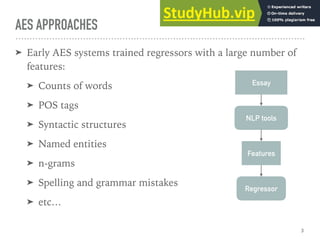
➤ Early AES systems trained regressors with a large number of
features:
➤ Counts of words
➤ POS tags
➤ Syntactic structures
➤ Named entities
➤ n-grams
➤ Spelling and grammar mistakes
➤ etc…
3
Essay
NLP tools
Features
Regressor
AES APPROACHES
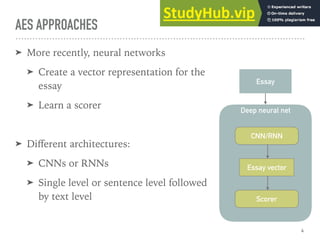
➤ More recently, neural networks
➤ Create a vector representation for the
essay
➤ Learn a scorer
➤ Different architectures:
➤ CNNs or RNNs
➤ Single level or sentence level followed
by text level
4
Essay
Deep neural net
CNN/RNN
Essay vector
Scorer
LET’S TRY BOTH!
➤ We tried both neural networks and feature-based models
➤ Compare their pros and cons!
➤ We used a dataset of ~56k essays graded by humans
➤ Larger than the English benchmark!
5
AES IN PORTUGUESE — ENEM
➤ Exam for high school students
➤ Argumentative essays with a given topic
➤ ENEM scores essays in five competencies:
1.Standard written norm
2.Adherence to the topic and style
3.Defend a point of view
4.Usage of argumentative language
5.Proposal of a solution for the given problem
6
ENEM DATASET
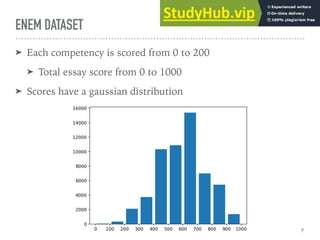
➤ Each competency is scored from 0 to 200
➤ Total essay score from 0 to 1000
➤ Scores have a gaussian distribution
7
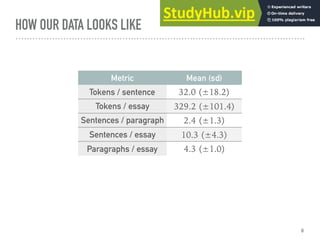
HOW OUR DATA LOOKS LIKE
8
Metric Mean (sd)
Tokens / sentence 32.0 (±18.2)
Tokens / essay 329.2 (±101.4)
Sentences / paragraph 2.4 (±1.3)
Sentences / essay 10.3 (±4.3)
Paragraphs / essay 4.3 (±1.0)
DEEP NEURAL NETWORK
➤ The good:
➤ Simpler to design
➤ No need to handcraft features
➤ Can learn some subtleties which are hard to describe
➤ The bad:
➤ Harder to train
➤ Needs much more computational power
➤ Careful parameter tuning
9
DEEP NEURAL NETWORK
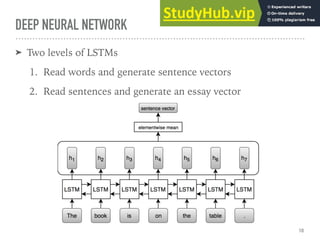
➤ Two levels of LSTMs
1. Read words and generate sentence vectors
2. Read sentences and generate an essay vector
10
DEEP NEURAL NETWORK
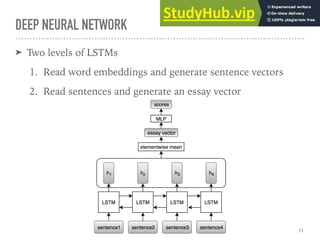
➤ Two levels of LSTMs
1. Read word embeddings and generate sentence vectors
2. Read sentences and generate an essay vector
11
DEEP NEURAL NETWORK
➤ Some variations yielded worse results
➤ Max pooling instead of mean
➤ CNNs instead of LSTMs
➤ The network outputs 5 scores
➤ Sigmoid activation; normalize scores to range [0, 1]
➤ Extra hidden layers did not help
➤ Optimize the Mean Squared Errors:
12
5
∑
i
(yi − ̂
yi)2
FEATURE ENGINEERING
➤ The bad:
➤ Hard to design
➤ Try to explain what makes an essay great!
➤ Needs more preprocessing tools
➤ The good:
➤ Computationally faster
➤ Easier to interpret
13
FEATURE ENGINEERING
➤ Only run a POS tagger
➤ Parsing is challenging because of mistakes (future work!)
➤ Use a list of hand picked expressions
➤ Connectives, propositives, oralities
➤ Use a list of automatically extracted words and n-grams
➤ Appearing in 5-50% of the essays
➤ Pearson ρ≥0.1 with scores
14
FEATURE ENGINEERING — FEATURES
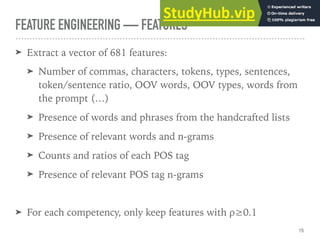
➤ Extract a vector of 681 features:
➤ Number of commas, characters, tokens, types, sentences,
token/sentence ratio, OOV words, OOV types, words from
the prompt (…)
➤ Presence of words and phrases from the handcrafted lists
➤ Presence of relevant words and n-grams
➤ Counts and ratios of each POS tag
➤ Presence of relevant POS tag n-grams
➤ For each competency, only keep features with ρ≥0.1
15
EXPERIMENTAL SETUP
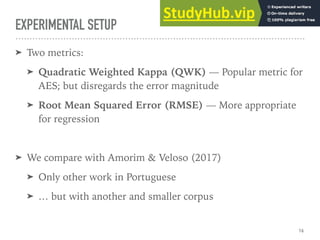
➤ Two metrics:
➤ Quadratic Weighted Kappa (QWK) — Popular metric for
AES; but disregards the error magnitude
➤ Root Mean Squared Error (RMSE) — More appropriate
for regression
➤ We compare with Amorim & Veloso (2017)
➤ Only other work in Portuguese
➤ … but with another and smaller corpus
16
RESULTS
17
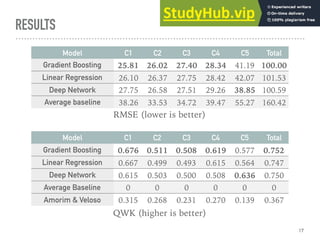
Model C1 C2 C3 C4 C5 Total
Gradient Boosting 25.81 26.02 27.40 28.34 41.19 100.00
Linear Regression 26.10 26.37 27.75 28.42 42.07 101.53
Deep Network 27.75 26.58 27.51 29.26 38.85 100.59
Average baseline 38.26 33.53 34.72 39.47 55.27 160.42
RMSE (lower is better)
Model C1 C2 C3 C4 C5 Total
Gradient Boosting 0.676 0.511 0.508 0.619 0.577 0.752
Linear Regression 0.667 0.499 0.493 0.615 0.564 0.747
Deep Network 0.615 0.503 0.500 0.508 0.636 0.750
Average Baseline 0 0 0 0 0 0
Amorim & Veloso 0.315 0.268 0.231 0.270 0.139 0.367
QWK (higher is better)
CONCLUSIONS
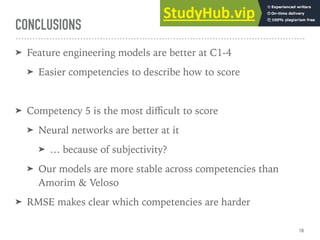
➤ Feature engineering models are better at C1-4
➤ Easier competencies to describe how to score
➤ Competency 5 is the most difficult to score
➤ Neural networks are better at it
➤ … because of subjectivity?
➤ Our models are more stable across competencies than
Amorim & Veloso
➤ RMSE makes clear which competencies are harder
18
CONCLUSIONS
➤ AES is still incipient in Portuguese!
➤ Feature-based models and DNNs have comparable
performance
➤ Many interesting directions for future works!
➤ Parsing (for grammatically incorrect sentences)
➤ Other network architectures
➤ Evaluate students’ writing skill evolution
19
THANK YOU!
QUESTIONS?
erick@letrus.com.br
ivopdm@letrus.com.br
dayse@letrus.com.br
abokan@letrus.com.br

Automatically Grading Brazilian Student Essays.pdf

  • 1.
    AUTOMATICALLY GRADING BRAZILIAN STUDENT ESSAYS ErickFonseca, Ivo Medeiros, Dayse Kamikawachi, Alessandro Bokan PROPOR 2018
  • 2.
    AUTOMATIC ESSAY SCORING(AES) ➤ Score students essays — somewhat subjective! ➤ Fast, cheap and deterministic ➤ Can be exploited by students ➤ Good for feedback during writing practice 2
  • 3.
    AES APPROACHES ➤ EarlyAES systems trained regressors with a large number of features: ➤ Counts of words ➤ POS tags ➤ Syntactic structures ➤ Named entities ➤ n-grams ➤ Spelling and grammar mistakes ➤ etc… 3 Essay NLP tools Features Regressor
  • 4.
    AES APPROACHES ➤ Morerecently, neural networks ➤ Create a vector representation for the essay ➤ Learn a scorer ➤ Different architectures: ➤ CNNs or RNNs ➤ Single level or sentence level followed by text level 4 Essay Deep neural net CNN/RNN Essay vector Scorer
  • 5.
    LET’S TRY BOTH! ➤We tried both neural networks and feature-based models ➤ Compare their pros and cons! ➤ We used a dataset of ~56k essays graded by humans ➤ Larger than the English benchmark! 5
  • 6.
    AES IN PORTUGUESE— ENEM ➤ Exam for high school students ➤ Argumentative essays with a given topic ➤ ENEM scores essays in five competencies: 1.Standard written norm 2.Adherence to the topic and style 3.Defend a point of view 4.Usage of argumentative language 5.Proposal of a solution for the given problem 6
  • 7.
    ENEM DATASET ➤ Eachcompetency is scored from 0 to 200 ➤ Total essay score from 0 to 1000 ➤ Scores have a gaussian distribution 7
  • 8.
    HOW OUR DATALOOKS LIKE 8 Metric Mean (sd) Tokens / sentence 32.0 (±18.2) Tokens / essay 329.2 (±101.4) Sentences / paragraph 2.4 (±1.3) Sentences / essay 10.3 (±4.3) Paragraphs / essay 4.3 (±1.0)
  • 9.
    DEEP NEURAL NETWORK ➤The good: ➤ Simpler to design ➤ No need to handcraft features ➤ Can learn some subtleties which are hard to describe ➤ The bad: ➤ Harder to train ➤ Needs much more computational power ➤ Careful parameter tuning 9
  • 10.
    DEEP NEURAL NETWORK ➤Two levels of LSTMs 1. Read words and generate sentence vectors 2. Read sentences and generate an essay vector 10
  • 11.
    DEEP NEURAL NETWORK ➤Two levels of LSTMs 1. Read word embeddings and generate sentence vectors 2. Read sentences and generate an essay vector 11
  • 12.
    DEEP NEURAL NETWORK ➤Some variations yielded worse results ➤ Max pooling instead of mean ➤ CNNs instead of LSTMs ➤ The network outputs 5 scores ➤ Sigmoid activation; normalize scores to range [0, 1] ➤ Extra hidden layers did not help ➤ Optimize the Mean Squared Errors: 12 5 ∑ i (yi − ̂ yi)2
  • 13.
    FEATURE ENGINEERING ➤ Thebad: ➤ Hard to design ➤ Try to explain what makes an essay great! ➤ Needs more preprocessing tools ➤ The good: ➤ Computationally faster ➤ Easier to interpret 13
  • 14.
    FEATURE ENGINEERING ➤ Onlyrun a POS tagger ➤ Parsing is challenging because of mistakes (future work!) ➤ Use a list of hand picked expressions ➤ Connectives, propositives, oralities ➤ Use a list of automatically extracted words and n-grams ➤ Appearing in 5-50% of the essays ➤ Pearson ρ≥0.1 with scores 14
  • 15.
    FEATURE ENGINEERING —FEATURES ➤ Extract a vector of 681 features: ➤ Number of commas, characters, tokens, types, sentences, token/sentence ratio, OOV words, OOV types, words from the prompt (…) ➤ Presence of words and phrases from the handcrafted lists ➤ Presence of relevant words and n-grams ➤ Counts and ratios of each POS tag ➤ Presence of relevant POS tag n-grams ➤ For each competency, only keep features with ρ≥0.1 15
  • 16.
    EXPERIMENTAL SETUP ➤ Twometrics: ➤ Quadratic Weighted Kappa (QWK) — Popular metric for AES; but disregards the error magnitude ➤ Root Mean Squared Error (RMSE) — More appropriate for regression ➤ We compare with Amorim & Veloso (2017) ➤ Only other work in Portuguese ➤ … but with another and smaller corpus 16
  • 17.
    RESULTS 17 Model C1 C2C3 C4 C5 Total Gradient Boosting 25.81 26.02 27.40 28.34 41.19 100.00 Linear Regression 26.10 26.37 27.75 28.42 42.07 101.53 Deep Network 27.75 26.58 27.51 29.26 38.85 100.59 Average baseline 38.26 33.53 34.72 39.47 55.27 160.42 RMSE (lower is better) Model C1 C2 C3 C4 C5 Total Gradient Boosting 0.676 0.511 0.508 0.619 0.577 0.752 Linear Regression 0.667 0.499 0.493 0.615 0.564 0.747 Deep Network 0.615 0.503 0.500 0.508 0.636 0.750 Average Baseline 0 0 0 0 0 0 Amorim & Veloso 0.315 0.268 0.231 0.270 0.139 0.367 QWK (higher is better)
  • 18.
    CONCLUSIONS ➤ Feature engineeringmodels are better at C1-4 ➤ Easier competencies to describe how to score ➤ Competency 5 is the most difficult to score ➤ Neural networks are better at it ➤ … because of subjectivity? ➤ Our models are more stable across competencies than Amorim & Veloso ➤ RMSE makes clear which competencies are harder 18
  • 19.
    CONCLUSIONS ➤ AES isstill incipient in Portuguese! ➤ Feature-based models and DNNs have comparable performance ➤ Many interesting directions for future works! ➤ Parsing (for grammatically incorrect sentences) ➤ Other network architectures ➤ Evaluate students’ writing skill evolution 19
  • 20.