DEVELOPMENT AND
IMPLEMENTATION OF AN
AUTOMATIC COUNTING
SYSTEM FOR CR-39 SSTND
Name: Moayyad Mazen
Alssabbagh
Matric No.: MGQ120003
Supervisor: Mr. Tan Li Kuo
Co-supervisor: Prof. Kwan-Hoong Ng and Dr. Vincent Phua
UNIVERSITI
M A L A Y A
MEDICAL PHYSICS RESEARCH PROJECT
MGQG6189
INTRODUCTION
• The CR-39 solid state passive nuclear track detector is a
popular method to measure charged particle and neutron
radiation due to its low cost, robustness, track
permanence, and insensitivity to Gamma, X-ray, Beta and
Electromagnetic waves.
• Heavy charged particles passing through these passive
detectors leave a narrow trail of damage; this damage is
visible at modest optical magnification levels.
• Traditional manual counting methods are labor intensive
and highly operator dependent.
11 July 2013
11 July 2013
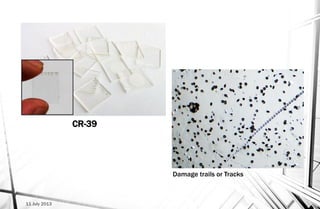
CR-39
Damage trails or Tracks
11 July 2013
• The main aim of this research is to develop
an affordable automatic CR-39 track
counting system.
• Comparing the obtained results from the
software with the manual ones.
OBJECTIVES
BACKGROUND AND LITERATURE
REVIEW
• CR-39 detectors are constructed from a polyallyl diglycol
carbonate (C12H18O7)
• Applications: Radon dosimetry, Personal neutron
dosimeter.
• Advantages: inexpensive, insensitive to EM, simple
processing method, robust, transparent and can be cut
into small pieces.
• Disadvantages: not reusable, counting is time consuming
(manual counting), Commercial digital system (expensive)
BACKGROUND AND LITERATURE
REVIEW (Cont.)
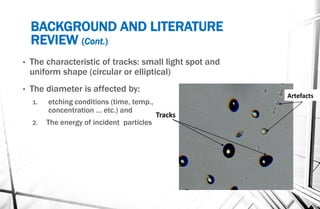
• The characteristic of tracks: small light spot and
uniform shape (circular or elliptical)
• The diameter is affected by:
1. etching conditions (time, temp.,
concentration … etc.) and
2. The energy of incident particles
Artefacts
Tracks
BACKGROUND AND LITERATURE
REVIEW (Cont.)
• Most track-reading systems use:
1. conventional optical microscopes.
2. high resolution charged couple device (CCD) camera to capture the magnified
picture.
• Commercial software packages used for track counting, such as:
• Image-Pro
• Free software as Image-J
• Monte Carlo simulation
• Others used MATLAB® (Patiris, Blekas, & Ioannides, 2007) (Ahn & Lee, 2005; Puglies, Sciani, Stanojev
Pereira, & Pugliesi, 2007) (Dwaikat, et al., 2010) (Zylstra, et al., 2012).
METHODOLOGY
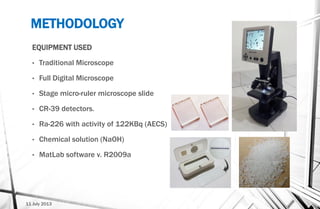
EQUIPMENT USED
• Traditional Microscope
• Full Digital Microscope
• Stage micro-ruler microscope slide
• CR-39 detectors.
• Ra-226 with activity of 122KBq (AECS)
• Chemical solution (NaOH)
• MatLab software v. R2009a
11 July 2013
METHODOLOGY (Cont.)
• A set of CR-39 detectors with dimensions of 1.5 cm x 1.3 cm were
exposed to Ra-226 for different time periods (1, 2, 4, 8 and 12 hours).
• 6 M of NaOH solution at a 70 ᵒC over 7 hours used for etching process.
• Two Microscopes were used to capture the images of the detectors:
• The first one was a traditional light microscope with a digital camera
connected to the eye piece. (0.3 MP)
• The second microscope was a full digital one with an LCD monitor with
an area of 3.5” which acts as a 10x eyepiece. (2 MP).
• The same magnification (40x) was used for both microscopes.
11 July 2013
METHODOLOGY (Cont.)
11 July 2013
• Manual and Automatic counting were performed for
both images from old and new microscope.
• A comparison between manual and automated
counting is performed.
RESULTS
11 July 2013
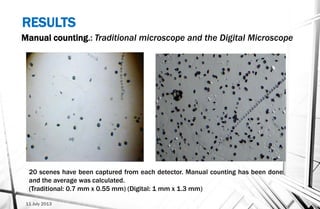
Manual counting.: Traditional microscope and the Digital Microscope
20 scenes have been captured from each detector. Manual counting has been done
and the average was calculated.
(Traditional: 0.7 mm x 0.55 mm) (Digital: 1 mm x 1.3 mm)
RESULTS (Cont.)
11 July 2013
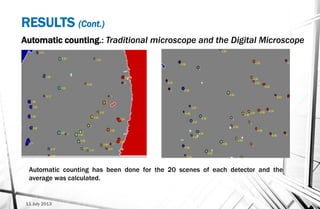
Automatic counting.: Traditional microscope and the Digital Microscope
Automatic counting has been done for the 20 scenes of each detector and the
average was calculated.
RESULTS (Cont.)
Manual counting.: Traditional microscope and the Digital Microscope
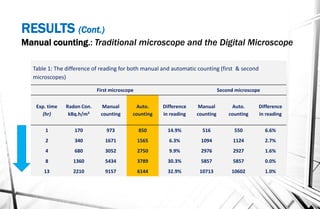
Table 1: The difference of reading for both manual and automatic counting (first & second
microscopes)
First microscope Second microscope
Exp. time
(hr)
Radon Con.
kBq.h/m3
Manual
counting
Auto.
counting
Difference
in reading
Manual
counting
Auto.
counting
Difference
in reading
1 170 973 850 14.9% 516 550 6.6%
2 340 1671 1565 6.3% 1094 1124 2.7%
4 680 3052 2750 9.9% 2976 2927 1.6%
8 1360 5434 3789 30.3% 5857 5857 0.0%
13 2210 9157 6144 32.9% 10713 10602 1.0%
RESULTS (Cont.)
11 July 2013
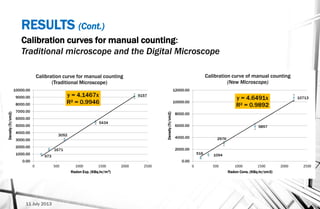
Calibration curves for manual counting:
Traditional microscope and the Digital Microscope
973
1671
3052
5434
9157y = 4.1467x
R² = 0.9946
0.00
1000.00
2000.00
3000.00
4000.00
5000.00
6000.00
7000.00
8000.00
9000.00
10000.00
0 500 1000 1500 2000 2500
Density(Tr/cm2)
Radon Exp. (KBq.hr/m3)
Calibration curve for manual counting
(Traditional Microscope)
516 1094
2976
5857
10713y = 4.6491x
R² = 0.9892
0.00
2000.00
4000.00
6000.00
8000.00
10000.00
12000.00
0 500 1000 1500 2000 2500
Density(Tr/cm2)
Radon Cons. (KBq.hr/cm3)
Calibration curve of manual counting
(New Microscope)
RESULTS (Cont.)
11 July 2013
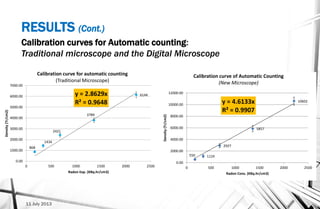
Calibration curves for Automatic counting:
Traditional microscope and the Digital Microscope
868
1434
2421
3789
6144y = 2.8629x
R² = 0.9648
0.00
1000.00
2000.00
3000.00
4000.00
5000.00
6000.00
7000.00
0 500 1000 1500 2000 2500
Density(Tr/cm2)
Radon Exp. (KBq.hr/cm3)
Calibration curve for automatic counting
(Traditional Microscope)
550 1124
2927
5857
10602y = 4.6133x
R² = 0.9907
0.00
2000.00
4000.00
6000.00
8000.00
10000.00
12000.00
0 500 1000 1500 2000 2500
Density(Tr/cm2)
Radon Cons. (KBq.hr/cm3)
Calibration curve of Automatic Counting
(New Microscope)
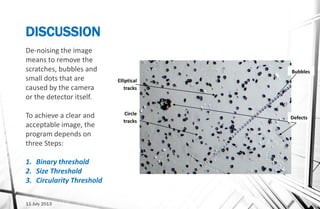
DISCUSSION
11 July 2013
Elliptical
tracks
Circle
tracks
Bubbles
Defects
De-noising the image
means to remove the
scratches, bubbles and
small dots that are
caused by the camera
or the detector itself.
To achieve a clear and
acceptable image, the
program depends on
three Steps:
1. Binary threshold
2. Size Threshold
3. Circularity Threshold
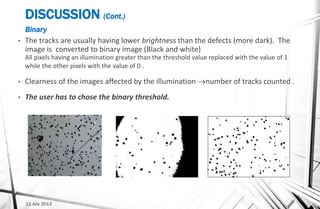
DISCUSSION (Cont.)
Binary
• The tracks are usually having lower brightness than the defects (more dark). The
image is converted to binary image (Black and white)
All pixels having an illumination greater than the threshold value replaced with the value of 1
while the other pixels with the value of 0 .
• Clearness of the images affected by the illumination number of tracks counted .
• The user has to chose the binary threshold.
Origin image Traditional Microscope Digital Microscope
11 July 2013
DISCUSSION (Cont.)
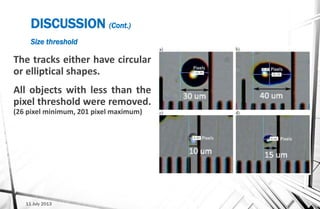
Size threshold
The tracks either have circular
or elliptical shapes.
All objects with less than the
pixel threshold were removed.
(26 pixel minimum, 201 pixel maximum)
11 July 2013
DISCUSSION (Cont.)
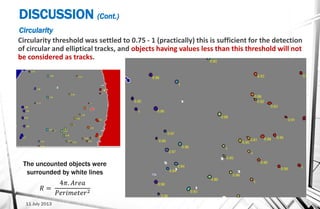
Circularity
Circularity threshold was settled to 0.75 - 1 (practically) this is sufficient for the detection
of circular and elliptical tracks, and objects having values less than this threshold will not
be considered as tracks.
11 July 2013
The uncounted objects were
surrounded by white lines
𝑅 =
4𝜋. 𝐴𝑟𝑒𝑎
𝑃𝑒𝑟𝑖𝑚𝑒𝑡𝑒𝑟2
LIMITATION
• The uniformity of illumination is very important to
reduce the graded black shadows on the image
edges
• The system currently lacks features such as counting
overlapping tracks and calculating their average size
to estimate the average energy
• The binary threshold value entered manually by the
user and still observer dependent
FUTURE WORK
• One of the suggested methods to count the overlapping tracks is
to divide the size of the overlapped tracks by the average size of
individual track. This method need to be tested for various
overlapping tracks from different detectors and different
particles’ energies
• An algorithm should be developed to calculate the binary
threshold value automatically.
• Enhance the system to detect tracks under the graded black
edges on image.
CONCLUSION
• By using MATLAB® software, an automatic system that can count
the tracks on the CR-39 was developed.
• The system is highly dependent on image clearness. Despite this,
the system showed the ability to count the tracks on different
resolutions (0.3 Megapixel and 2 Megapixel )
• A good ability to find and count elliptical tracks .
• The system takes less than one minute for track counting per
detector .
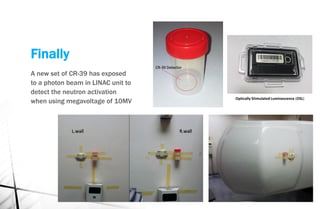
Finally
A new set of CR-39 has exposed
to a photon beam in LINAC unit to
detect the neutron activation
when using megavoltage of 10MV Optically Stimulated Luminescence (OSL)
Thank You
Questions
References
Spring, K. R., Fellers, T. J., & Davidson, M. W. (2013). Introduction to Charge-Coupled Devices
(CCDs). Retrieved April 30, 2013, from MicroscopyU:
http://www.microscopyu.com/articles/digitalimaging/ccdintro.html
Ahmed, S. N. (2007). Physics and Engineering of Radiation Detection (1st ed.). San Diego,
USA: Academic Press - Elsevier.
AHN, G. H., & LEE, J.-K. (2005). CONSTRUCTION OF AN ENVIRONMENTAL RADON MONITORING
SYSTEM USING CR-39 NUCLEAR TRACK DETECTORS. NUCLEAR ENGINEERING AND
TECHNOLOGY, 37(4), 395-400.
AL-Talbany, N. F., Jaafar, S. M., & Al-Nafiey, M. S. (2013). Measurement the Concentration of
Alpha Emitters in the Urine In Vitro, Natural Exposure. Journal of Natural Sciences Research,
3(3), 62-68.
Choppin, G., Rydberg, J., & Liljenzin, J. O. (2002). Radiochemistry and Nuclear Chemistry
(Third ed.). Butterworth-Heinemann.
Durrani, S. A., & Radomir, I. (1997). Radon Measurements by Etched track Detectors.
Singapore: World Scientific Pub. Co. Pte. Ltd.
Dwaikat, N., El-hasan, M., Sueyasu, M., Kada, W., Sato, F., Kato, Y., et al. (2010). A fast method
for the determination of the efficiency coefficient of bare CR-39 detector. Nuclear Instruments
and Methods in Physics Research B, 268, 3351–3355.
FELICE, P. D., COTELLESSA, G., CAPOGNI, M., CARDELLINI, F., PAGLIARI, M., & SCIOCCHETTI, G.
(2013). The Novel Track Recording Apparatus From Ssntd For Radon Measurement.
Romanian Journal of Physics, 58, S115-S125.
Gaillard, S., Fuchs, J., Galloudec, N. R.-L., & Cowan, T. E. (2007). Study of saturation of CR39
nuclear track detectors at high ion fluence and of associated artifact patterns. Review of
Scientific Instruments, 78, 013304.
Gonzalez, R. C., Woods, R. E., & Eddins, S. L. (2004). Digital Image Processing Using Matlab.
New Jersey, USA: Pearson Education. Inc.
KHAN, H. A., & KHAN, A. N. (1989). Solid state nuclear track detection (ssntd): a useful
scientific tool for basic and applied research. Journal of Islamic Academy of Sciences, 2:4,
303-312.
References
Matthews, R. (2013, Jan 6). Digital Image File Types Explained. Retrieved May 5, 2013, from
Wake Forest University Student, Faculty and Staff Web Pages:
http://users.wfu.edu/matthews/misc/graphics/formats/formats.html
Nikezic, D., & Yu, K. N. (2004). Formation and growth of tracks in nuclear track materials.
Materials Science and Engineering, 46, 51-123.
Nikezic, D., & Yu, K. N. (2007). Computer simulation of radon measurements with nuclear
track detectors. In S. J. Bianco, Computer Physics Research Trends (1st ed., pp. 119-150).
Nova Science Publishers, Inc.
Patiris, D. L., Blekas, K., & Ioannides, K. G. (2007). TRIAC II. A MatLab code for track
measurements from SSNT detectors. Computer Physics Communications, 177, 329-338.
Puglies, F., Sciani, V., Stanojev Pereira, M. A., & Pugliesi, R. (2007). Digital System to
Characterize Solid State Nuclear Track Detectors. Brazilian Journal of Physics, 37(2A), 446-
449.
References
Sidorov, M., & Ivanov, O. (Eds.). (2010). Nuclear Track Detectors: Design, Methods and
Applications. Nova Science Publishers, Inc.
Sinenian, N., Rosenberg, M. J., Manuel, S. , M. J.-E., Casey, D. T., Zylstra, A. B., Rinderknecht, H.
G., et al. (2012). The response of CR-39 nuclear track detector to 1-9 MeV protons. MA:
Plasma Science and Fusion Center.
Thorpe, G. S. (2001). Chemistry (3rd ed.). (D. Wright, S. Gomoll, & C. Bushee, Eds.) New York,
USA: Hungry Minds, Inc.
ZAKI, M. F., & EL-SHAER, Y. H. (2007). Particularization of alpha contamination using CR-39
track detectors. journal of physics, 69(4), 567-574.
Zylstra, A. B., Frenje, J. A., Se´guin, F. H., GatuJohnson, M., Casey, D. T., Rosenberg, M. J., et al.
(2012). A newmodeltoaccountfortrackoverlapinCR-39data. Nuclear Instruments and Methods
in Physics Research A, 681, 84-90.
References

Automatic reading cr39

  • 1.
    DEVELOPMENT AND IMPLEMENTATION OFAN AUTOMATIC COUNTING SYSTEM FOR CR-39 SSTND Name: Moayyad Mazen Alssabbagh Matric No.: MGQ120003 Supervisor: Mr. Tan Li Kuo Co-supervisor: Prof. Kwan-Hoong Ng and Dr. Vincent Phua UNIVERSITI M A L A Y A MEDICAL PHYSICS RESEARCH PROJECT MGQG6189
  • 2.
    INTRODUCTION • The CR-39solid state passive nuclear track detector is a popular method to measure charged particle and neutron radiation due to its low cost, robustness, track permanence, and insensitivity to Gamma, X-ray, Beta and Electromagnetic waves. • Heavy charged particles passing through these passive detectors leave a narrow trail of damage; this damage is visible at modest optical magnification levels. • Traditional manual counting methods are labor intensive and highly operator dependent. 11 July 2013
  • 3.
    11 July 2013 CR-39 Damagetrails or Tracks
  • 4.
    11 July 2013 •The main aim of this research is to develop an affordable automatic CR-39 track counting system. • Comparing the obtained results from the software with the manual ones. OBJECTIVES
  • 5.
    BACKGROUND AND LITERATURE REVIEW •CR-39 detectors are constructed from a polyallyl diglycol carbonate (C12H18O7) • Applications: Radon dosimetry, Personal neutron dosimeter. • Advantages: inexpensive, insensitive to EM, simple processing method, robust, transparent and can be cut into small pieces. • Disadvantages: not reusable, counting is time consuming (manual counting), Commercial digital system (expensive)
  • 6.
    BACKGROUND AND LITERATURE REVIEW(Cont.) • The characteristic of tracks: small light spot and uniform shape (circular or elliptical) • The diameter is affected by: 1. etching conditions (time, temp., concentration … etc.) and 2. The energy of incident particles Artefacts Tracks
  • 7.
    BACKGROUND AND LITERATURE REVIEW(Cont.) • Most track-reading systems use: 1. conventional optical microscopes. 2. high resolution charged couple device (CCD) camera to capture the magnified picture. • Commercial software packages used for track counting, such as: • Image-Pro • Free software as Image-J • Monte Carlo simulation • Others used MATLAB® (Patiris, Blekas, & Ioannides, 2007) (Ahn & Lee, 2005; Puglies, Sciani, Stanojev Pereira, & Pugliesi, 2007) (Dwaikat, et al., 2010) (Zylstra, et al., 2012).
  • 8.
    METHODOLOGY EQUIPMENT USED • TraditionalMicroscope • Full Digital Microscope • Stage micro-ruler microscope slide • CR-39 detectors. • Ra-226 with activity of 122KBq (AECS) • Chemical solution (NaOH) • MatLab software v. R2009a 11 July 2013
  • 9.
    METHODOLOGY (Cont.) • Aset of CR-39 detectors with dimensions of 1.5 cm x 1.3 cm were exposed to Ra-226 for different time periods (1, 2, 4, 8 and 12 hours). • 6 M of NaOH solution at a 70 ᵒC over 7 hours used for etching process. • Two Microscopes were used to capture the images of the detectors: • The first one was a traditional light microscope with a digital camera connected to the eye piece. (0.3 MP) • The second microscope was a full digital one with an LCD monitor with an area of 3.5” which acts as a 10x eyepiece. (2 MP). • The same magnification (40x) was used for both microscopes. 11 July 2013
  • 10.
    METHODOLOGY (Cont.) 11 July2013 • Manual and Automatic counting were performed for both images from old and new microscope. • A comparison between manual and automated counting is performed.
  • 11.
    RESULTS 11 July 2013 Manualcounting.: Traditional microscope and the Digital Microscope 20 scenes have been captured from each detector. Manual counting has been done and the average was calculated. (Traditional: 0.7 mm x 0.55 mm) (Digital: 1 mm x 1.3 mm)
  • 12.
    RESULTS (Cont.) 11 July2013 Automatic counting.: Traditional microscope and the Digital Microscope Automatic counting has been done for the 20 scenes of each detector and the average was calculated.
  • 13.
    RESULTS (Cont.) Manual counting.:Traditional microscope and the Digital Microscope Table 1: The difference of reading for both manual and automatic counting (first & second microscopes) First microscope Second microscope Exp. time (hr) Radon Con. kBq.h/m3 Manual counting Auto. counting Difference in reading Manual counting Auto. counting Difference in reading 1 170 973 850 14.9% 516 550 6.6% 2 340 1671 1565 6.3% 1094 1124 2.7% 4 680 3052 2750 9.9% 2976 2927 1.6% 8 1360 5434 3789 30.3% 5857 5857 0.0% 13 2210 9157 6144 32.9% 10713 10602 1.0%
  • 14.
    RESULTS (Cont.) 11 July2013 Calibration curves for manual counting: Traditional microscope and the Digital Microscope 973 1671 3052 5434 9157y = 4.1467x R² = 0.9946 0.00 1000.00 2000.00 3000.00 4000.00 5000.00 6000.00 7000.00 8000.00 9000.00 10000.00 0 500 1000 1500 2000 2500 Density(Tr/cm2) Radon Exp. (KBq.hr/m3) Calibration curve for manual counting (Traditional Microscope) 516 1094 2976 5857 10713y = 4.6491x R² = 0.9892 0.00 2000.00 4000.00 6000.00 8000.00 10000.00 12000.00 0 500 1000 1500 2000 2500 Density(Tr/cm2) Radon Cons. (KBq.hr/cm3) Calibration curve of manual counting (New Microscope)
  • 15.
    RESULTS (Cont.) 11 July2013 Calibration curves for Automatic counting: Traditional microscope and the Digital Microscope 868 1434 2421 3789 6144y = 2.8629x R² = 0.9648 0.00 1000.00 2000.00 3000.00 4000.00 5000.00 6000.00 7000.00 0 500 1000 1500 2000 2500 Density(Tr/cm2) Radon Exp. (KBq.hr/cm3) Calibration curve for automatic counting (Traditional Microscope) 550 1124 2927 5857 10602y = 4.6133x R² = 0.9907 0.00 2000.00 4000.00 6000.00 8000.00 10000.00 12000.00 0 500 1000 1500 2000 2500 Density(Tr/cm2) Radon Cons. (KBq.hr/cm3) Calibration curve of Automatic Counting (New Microscope)
  • 16.
    DISCUSSION 11 July 2013 Elliptical tracks Circle tracks Bubbles Defects De-noisingthe image means to remove the scratches, bubbles and small dots that are caused by the camera or the detector itself. To achieve a clear and acceptable image, the program depends on three Steps: 1. Binary threshold 2. Size Threshold 3. Circularity Threshold
  • 17.
    DISCUSSION (Cont.) Binary • Thetracks are usually having lower brightness than the defects (more dark). The image is converted to binary image (Black and white) All pixels having an illumination greater than the threshold value replaced with the value of 1 while the other pixels with the value of 0 . • Clearness of the images affected by the illumination number of tracks counted . • The user has to chose the binary threshold. Origin image Traditional Microscope Digital Microscope 11 July 2013
  • 18.
    DISCUSSION (Cont.) Size threshold Thetracks either have circular or elliptical shapes. All objects with less than the pixel threshold were removed. (26 pixel minimum, 201 pixel maximum) 11 July 2013
  • 19.
    DISCUSSION (Cont.) Circularity Circularity thresholdwas settled to 0.75 - 1 (practically) this is sufficient for the detection of circular and elliptical tracks, and objects having values less than this threshold will not be considered as tracks. 11 July 2013 The uncounted objects were surrounded by white lines 𝑅 = 4𝜋. 𝐴𝑟𝑒𝑎 𝑃𝑒𝑟𝑖𝑚𝑒𝑡𝑒𝑟2
  • 20.
    LIMITATION • The uniformityof illumination is very important to reduce the graded black shadows on the image edges • The system currently lacks features such as counting overlapping tracks and calculating their average size to estimate the average energy • The binary threshold value entered manually by the user and still observer dependent
  • 21.
    FUTURE WORK • Oneof the suggested methods to count the overlapping tracks is to divide the size of the overlapped tracks by the average size of individual track. This method need to be tested for various overlapping tracks from different detectors and different particles’ energies • An algorithm should be developed to calculate the binary threshold value automatically. • Enhance the system to detect tracks under the graded black edges on image.
  • 22.
    CONCLUSION • By usingMATLAB® software, an automatic system that can count the tracks on the CR-39 was developed. • The system is highly dependent on image clearness. Despite this, the system showed the ability to count the tracks on different resolutions (0.3 Megapixel and 2 Megapixel ) • A good ability to find and count elliptical tracks . • The system takes less than one minute for track counting per detector .
  • 23.
    Finally A new setof CR-39 has exposed to a photon beam in LINAC unit to detect the neutron activation when using megavoltage of 10MV Optically Stimulated Luminescence (OSL)
  • 24.
  • 25.
    References Spring, K. R.,Fellers, T. J., & Davidson, M. W. (2013). Introduction to Charge-Coupled Devices (CCDs). Retrieved April 30, 2013, from MicroscopyU: http://www.microscopyu.com/articles/digitalimaging/ccdintro.html Ahmed, S. N. (2007). Physics and Engineering of Radiation Detection (1st ed.). San Diego, USA: Academic Press - Elsevier. AHN, G. H., & LEE, J.-K. (2005). CONSTRUCTION OF AN ENVIRONMENTAL RADON MONITORING SYSTEM USING CR-39 NUCLEAR TRACK DETECTORS. NUCLEAR ENGINEERING AND TECHNOLOGY, 37(4), 395-400. AL-Talbany, N. F., Jaafar, S. M., & Al-Nafiey, M. S. (2013). Measurement the Concentration of Alpha Emitters in the Urine In Vitro, Natural Exposure. Journal of Natural Sciences Research, 3(3), 62-68. Choppin, G., Rydberg, J., & Liljenzin, J. O. (2002). Radiochemistry and Nuclear Chemistry (Third ed.). Butterworth-Heinemann. Durrani, S. A., & Radomir, I. (1997). Radon Measurements by Etched track Detectors. Singapore: World Scientific Pub. Co. Pte. Ltd.
  • 26.
    Dwaikat, N., El-hasan,M., Sueyasu, M., Kada, W., Sato, F., Kato, Y., et al. (2010). A fast method for the determination of the efficiency coefficient of bare CR-39 detector. Nuclear Instruments and Methods in Physics Research B, 268, 3351–3355. FELICE, P. D., COTELLESSA, G., CAPOGNI, M., CARDELLINI, F., PAGLIARI, M., & SCIOCCHETTI, G. (2013). The Novel Track Recording Apparatus From Ssntd For Radon Measurement. Romanian Journal of Physics, 58, S115-S125. Gaillard, S., Fuchs, J., Galloudec, N. R.-L., & Cowan, T. E. (2007). Study of saturation of CR39 nuclear track detectors at high ion fluence and of associated artifact patterns. Review of Scientific Instruments, 78, 013304. Gonzalez, R. C., Woods, R. E., & Eddins, S. L. (2004). Digital Image Processing Using Matlab. New Jersey, USA: Pearson Education. Inc. KHAN, H. A., & KHAN, A. N. (1989). Solid state nuclear track detection (ssntd): a useful scientific tool for basic and applied research. Journal of Islamic Academy of Sciences, 2:4, 303-312. References
  • 27.
    Matthews, R. (2013,Jan 6). Digital Image File Types Explained. Retrieved May 5, 2013, from Wake Forest University Student, Faculty and Staff Web Pages: http://users.wfu.edu/matthews/misc/graphics/formats/formats.html Nikezic, D., & Yu, K. N. (2004). Formation and growth of tracks in nuclear track materials. Materials Science and Engineering, 46, 51-123. Nikezic, D., & Yu, K. N. (2007). Computer simulation of radon measurements with nuclear track detectors. In S. J. Bianco, Computer Physics Research Trends (1st ed., pp. 119-150). Nova Science Publishers, Inc. Patiris, D. L., Blekas, K., & Ioannides, K. G. (2007). TRIAC II. A MatLab code for track measurements from SSNT detectors. Computer Physics Communications, 177, 329-338. Puglies, F., Sciani, V., Stanojev Pereira, M. A., & Pugliesi, R. (2007). Digital System to Characterize Solid State Nuclear Track Detectors. Brazilian Journal of Physics, 37(2A), 446- 449. References
  • 28.
    Sidorov, M., &Ivanov, O. (Eds.). (2010). Nuclear Track Detectors: Design, Methods and Applications. Nova Science Publishers, Inc. Sinenian, N., Rosenberg, M. J., Manuel, S. , M. J.-E., Casey, D. T., Zylstra, A. B., Rinderknecht, H. G., et al. (2012). The response of CR-39 nuclear track detector to 1-9 MeV protons. MA: Plasma Science and Fusion Center. Thorpe, G. S. (2001). Chemistry (3rd ed.). (D. Wright, S. Gomoll, & C. Bushee, Eds.) New York, USA: Hungry Minds, Inc. ZAKI, M. F., & EL-SHAER, Y. H. (2007). Particularization of alpha contamination using CR-39 track detectors. journal of physics, 69(4), 567-574. Zylstra, A. B., Frenje, J. A., Se´guin, F. H., GatuJohnson, M., Casey, D. T., Rosenberg, M. J., et al. (2012). A newmodeltoaccountfortrackoverlapinCR-39data. Nuclear Instruments and Methods in Physics Research A, 681, 84-90. References