
Building Your Own  Automated Trade Strategy Todd Hanson Ph.D. www.livetradesignals.com
Agenda Interests in Automated Trading Building Your Own Automated Trade Signals Livetradesignals Trade Signal Software
Todd Hanson Ph.D. in the News
Interest in Automated Trading Buyside Competitive advantage Capitalize on opportunities before competitors Leveraging Traders’ skills Scale each trader Easily add new ideas and strategies  Sellside Increase trading volume Attract & retain customers
Automated Strategies Automated Strategy – aka “Black Box” All processes of the trade decision are done by pre-programmed rules or parameters Most common way to auto trade FX TradeStation Platform MT4 Expert Advisors NinjaTrader Home grown (API and FIX)
Black Box Strategies Challenges of Automated trading Field of untested (demo only) models is huge Inconsistent reporting formats Model performance transparency is limited Novice traders focus on %ROR No attention on drawdown  No details on leverage used Finding a market tested model can be tough The trade is the trade, no user intervention
Risks of Commoditization Black Box Strategies If everyone has the same black boxes = cancels out competitive advantage Limited scope to use your skills – can only parameterize Often there isn’t a module that offers exactly the algorithm required An algorithm may be tied to a particular broker Can be expensive to employ Pressure to differentiate Hard for buy-side to understand what makes one’s strategies better than another’s Models rarely explain how they differ Buy-side users want to know “how it works”
Build your own Takes a large amount of time & effort (IT cycle) Maintenance issues Markets are continually evolving First mover gets the advantage Lost opportunity cost of slow evolution Build Your Own
Articulate the model’s basis  Identify the underlying parameters Moving Averages, Bollinger Bands, ATR, etc. Create the argument the conditions  “The IF” Create the trigger  “The THEN” Add in Risk Management Scaling Stop Loss Profit Taking Build Your Own
Back-test and re-tool Focus on the trigger Back-test and re-tool Focus on the exit Only then walk-forward test Data fitting begins after 2 minor changes of  the underlying parameters Don’t curve fit your model to fit the data Build Your Own
Algorithmic War Algorithms need to continually evolve Review of expected vs. actual performance  Competing with other algorithms over current opportunities New opportunities emerging Avoid being reverse engineered Opportunities may disappear Evolve or perish!
Ideas for New Strategies Interest is growing for algorithmic trading in multiple asset classes Equities, Futures, Forex, Bonds Trading and Market-making (e.g. bond pricing) Employ strategies from other asset classes Example: Trend strategy in equities may work in FX Minor parameter changes to a specific market may spawn a new opportunity Correlations between asset classes do exist S&P 500 and EURJPY correlation is high at times, seize the opportunity for playing the lagging one “Pairs Trade”
Automated Trade Signals Automated Trade Signals – aka “Grey Box” All information and computation done by system Trader’s discretion whether to trade or not Adds more views on the market Models scan more than a human ever could Employ strategies outside trader’s toolkit Flexibility in trader’s schedule A carpenter does not have just 1 hammer or 1 wood saw, why should a trader have just 1 strategy?
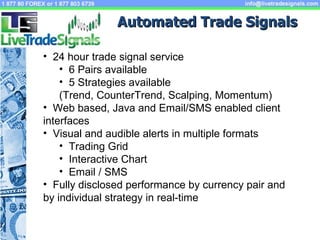
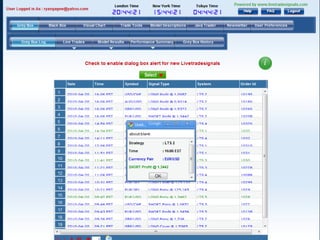
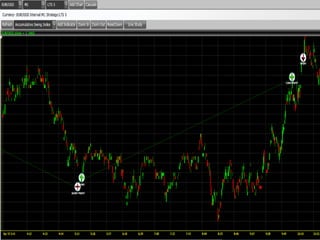
Automated Trade Signals  24 hour trade signal service 6 Pairs available 5 Strategies available (Trend, CounterTrend, Scalping, Momentum) Web based, Java and Email/SMS enabled client  interfaces Visual and audible alerts in multiple formats Trading Grid  Interactive Chart Email / SMS  Fully disclosed performance by currency pair and by individual strategy in real-time
 
 
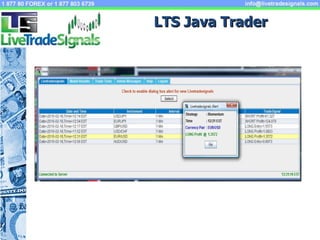
LTS Java Trader
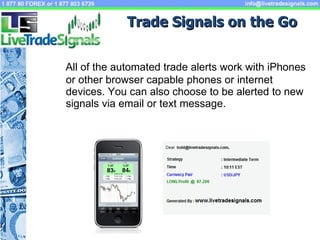
All of the automated trade alerts work with iPhones or other browser capable phones or internet devices. You can also choose to be alerted to new signals via email or text message. Trade Signals on the Go
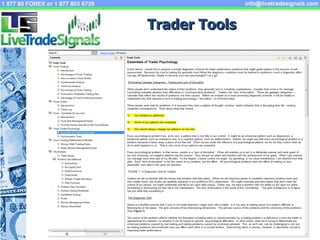
Trader Tools
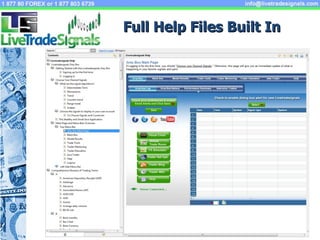
Full Help Files Built In
We will be continuing to host free seminars on Livetradesignals Product Suite. Please sign up at our website www.livetradesignals.com [email_address]

Automated Trade Strategy by Todd Hanson PhD

  • 1.
    Building Your Own Automated Trade Strategy Todd Hanson Ph.D. www.livetradesignals.com
  • 2.
    Agenda Interests inAutomated Trading Building Your Own Automated Trade Signals Livetradesignals Trade Signal Software
  • 3.
    Todd Hanson Ph.D.in the News
  • 4.
    Interest in AutomatedTrading Buyside Competitive advantage Capitalize on opportunities before competitors Leveraging Traders’ skills Scale each trader Easily add new ideas and strategies Sellside Increase trading volume Attract & retain customers
  • 5.
    Automated Strategies AutomatedStrategy – aka “Black Box” All processes of the trade decision are done by pre-programmed rules or parameters Most common way to auto trade FX TradeStation Platform MT4 Expert Advisors NinjaTrader Home grown (API and FIX)
  • 6.
    Black Box StrategiesChallenges of Automated trading Field of untested (demo only) models is huge Inconsistent reporting formats Model performance transparency is limited Novice traders focus on %ROR No attention on drawdown No details on leverage used Finding a market tested model can be tough The trade is the trade, no user intervention
  • 7.
    Risks of CommoditizationBlack Box Strategies If everyone has the same black boxes = cancels out competitive advantage Limited scope to use your skills – can only parameterize Often there isn’t a module that offers exactly the algorithm required An algorithm may be tied to a particular broker Can be expensive to employ Pressure to differentiate Hard for buy-side to understand what makes one’s strategies better than another’s Models rarely explain how they differ Buy-side users want to know “how it works”
  • 8.
    Build your ownTakes a large amount of time & effort (IT cycle) Maintenance issues Markets are continually evolving First mover gets the advantage Lost opportunity cost of slow evolution Build Your Own
  • 9.
    Articulate the model’sbasis Identify the underlying parameters Moving Averages, Bollinger Bands, ATR, etc. Create the argument the conditions “The IF” Create the trigger “The THEN” Add in Risk Management Scaling Stop Loss Profit Taking Build Your Own
  • 10.
    Back-test and re-toolFocus on the trigger Back-test and re-tool Focus on the exit Only then walk-forward test Data fitting begins after 2 minor changes of the underlying parameters Don’t curve fit your model to fit the data Build Your Own
  • 11.
    Algorithmic War Algorithmsneed to continually evolve Review of expected vs. actual performance Competing with other algorithms over current opportunities New opportunities emerging Avoid being reverse engineered Opportunities may disappear Evolve or perish!
  • 12.
    Ideas for NewStrategies Interest is growing for algorithmic trading in multiple asset classes Equities, Futures, Forex, Bonds Trading and Market-making (e.g. bond pricing) Employ strategies from other asset classes Example: Trend strategy in equities may work in FX Minor parameter changes to a specific market may spawn a new opportunity Correlations between asset classes do exist S&P 500 and EURJPY correlation is high at times, seize the opportunity for playing the lagging one “Pairs Trade”
  • 13.
    Automated Trade SignalsAutomated Trade Signals – aka “Grey Box” All information and computation done by system Trader’s discretion whether to trade or not Adds more views on the market Models scan more than a human ever could Employ strategies outside trader’s toolkit Flexibility in trader’s schedule A carpenter does not have just 1 hammer or 1 wood saw, why should a trader have just 1 strategy?
  • 14.
    Automated Trade Signals 24 hour trade signal service 6 Pairs available 5 Strategies available (Trend, CounterTrend, Scalping, Momentum) Web based, Java and Email/SMS enabled client interfaces Visual and audible alerts in multiple formats Trading Grid Interactive Chart Email / SMS Fully disclosed performance by currency pair and by individual strategy in real-time
  • 15.
  • 16.
  • 17.
  • 18.
    All of theautomated trade alerts work with iPhones or other browser capable phones or internet devices. You can also choose to be alerted to new signals via email or text message. Trade Signals on the Go
  • 19.
  • 20.
  • 21.
    We will becontinuing to host free seminars on Livetradesignals Product Suite. Please sign up at our website www.livetradesignals.com [email_address]

Editor's Notes

  • #5 Algorithmic trading is generating massive interest. On the Buyside, the interest is due to the competitive advantage that can be gained through algorithmic trading strategies like VWAP, pairs trading, index arbitrage etc. You have an advantage over regular traders if you can devise or use an algorithm that beats the rest. And if you can develop that algorithm yourself then you can go direct market access and avoid the fees that your brokerage firm would charge for executing the trade for you with their black box. On the sellside, the interest is due to the buyside’s excitement about algorithmic trading. Sellside firms looking for prime brokerage contracts must offer algorithmic trading capabilities in order to increase their trading volumes and thus their revenues, and to attract and retain customers.
  • #8 However, the current way in which many users are accessing algorithmic trading is presenting some problems to their visions of competitive advantage, leveraging their skills and the cost advantages. Firstly, let us look at the problems associated with “black box” strategies – i.e. parameterisable algo strategies made available by brokers or vendors. Firstly, with these strategies, if everyone has access to the same strategies then this to a large extent cancels out the competitive advantage. These black boxes are closed systems – you are relying on the algorithm inside being right, with no knowledge of how it works. Not being able to go inside is limiting your ability to use your skills to influence the algorithm. And if you see that there is some kind of disadvantage with the algorithm then you are unable to do anything about it directly. Using black boxes through your broker is also expensive. And if you are using a third party vendor’s black box then it may be that you have to use their entire market access platform, which you might not want to do. Secondly, you could build your own trading strategies in house. This is what the big banks and quant funds have always done. But this approach has a number of disadvantages. Apart from being particularly unattractive to those buyside firms with little IT capability, for any firm building strategies using traditional development approaches (C++, Java, VB, Excel etc.) involves a long IT cycle – and by the time the strategy is delivered the opportunity in the market may have disappeared – so there is an opportunity cost here. Also, the integration and maintenance issues are sizeable – and if the relevant people leave it can be difficult to work out how the systems work.
  • #9 However, the current way in which many users are accessing algorithmic trading is presenting some problems to their visions of competitive advantage, leveraging their skills and the cost advantages. Firstly, let us look at the problems associated with “black box” strategies – i.e. parameterisable algo strategies made available by brokers or vendors. Firstly, with these strategies, if everyone has access to the same strategies then this to a large extent cancels out the competitive advantage. These black boxes are closed systems – you are relying on the algorithm inside being right, with no knowledge of how it works. Not being able to go inside is limiting your ability to use your skills to influence the algorithm. And if you see that there is some kind of disadvantage with the algorithm then you are unable to do anything about it directly. Using black boxes through your broker is also expensive. And if you are using a third party vendor’s black box then it may be that you have to use their entire market access platform, which you might not want to do. Secondly, you could build your own trading strategies in house. This is what the big banks and quant funds have always done. But this approach has a number of disadvantages. Apart from being particularly unattractive to those buyside firms with little IT capability, for any firm building strategies using traditional development approaches (C++, Java, VB, Excel etc.) involves a long IT cycle – and by the time the strategy is delivered the opportunity in the market may have disappeared – so there is an opportunity cost here. Also, the integration and maintenance issues are sizeable – and if the relevant people leave it can be difficult to work out how the systems work.
  • #10 However, the current way in which many users are accessing algorithmic trading is presenting some problems to their visions of competitive advantage, leveraging their skills and the cost advantages. Firstly, let us look at the problems associated with “black box” strategies – i.e. parameterisable algo strategies made available by brokers or vendors. Firstly, with these strategies, if everyone has access to the same strategies then this to a large extent cancels out the competitive advantage. These black boxes are closed systems – you are relying on the algorithm inside being right, with no knowledge of how it works. Not being able to go inside is limiting your ability to use your skills to influence the algorithm. And if you see that there is some kind of disadvantage with the algorithm then you are unable to do anything about it directly. Using black boxes through your broker is also expensive. And if you are using a third party vendor’s black box then it may be that you have to use their entire market access platform, which you might not want to do. Secondly, you could build your own trading strategies in house. This is what the big banks and quant funds have always done. But this approach has a number of disadvantages. Apart from being particularly unattractive to those buyside firms with little IT capability, for any firm building strategies using traditional development approaches (C++, Java, VB, Excel etc.) involves a long IT cycle – and by the time the strategy is delivered the opportunity in the market may have disappeared – so there is an opportunity cost here. Also, the integration and maintenance issues are sizeable – and if the relevant people leave it can be difficult to work out how the systems work.
  • #11 However, the current way in which many users are accessing algorithmic trading is presenting some problems to their visions of competitive advantage, leveraging their skills and the cost advantages. Firstly, let us look at the problems associated with “black box” strategies – i.e. parameterisable algo strategies made available by brokers or vendors. Firstly, with these strategies, if everyone has access to the same strategies then this to a large extent cancels out the competitive advantage. These black boxes are closed systems – you are relying on the algorithm inside being right, with no knowledge of how it works. Not being able to go inside is limiting your ability to use your skills to influence the algorithm. And if you see that there is some kind of disadvantage with the algorithm then you are unable to do anything about it directly. Using black boxes through your broker is also expensive. And if you are using a third party vendor’s black box then it may be that you have to use their entire market access platform, which you might not want to do. Secondly, you could build your own trading strategies in house. This is what the big banks and quant funds have always done. But this approach has a number of disadvantages. Apart from being particularly unattractive to those buyside firms with little IT capability, for any firm building strategies using traditional development approaches (C++, Java, VB, Excel etc.) involves a long IT cycle – and by the time the strategy is delivered the opportunity in the market may have disappeared – so there is an opportunity cost here. Also, the integration and maintenance issues are sizeable – and if the relevant people leave it can be difficult to work out how the systems work.
  • #12 e.g. front running VWAP
  • #16 Need to update – trying to do so
  • #20 I recommend we pull from slide show
  • #21 Need to review the help files to see if we keep or dump