Quant Trader 
Presented by 
Quant Trade Technologies, Inc. 
Market Forecasting Algorithms
Premium selection of algorithms 
 
Self-optimizing ARIMA expert 
 
Finite Impulse Response Neural Network 
 
Finite State Markov Automation 
 
Stepwise Best Regression 
 
Square Root Regression 
 
Square Regression 
 
Logistic Regression 
2
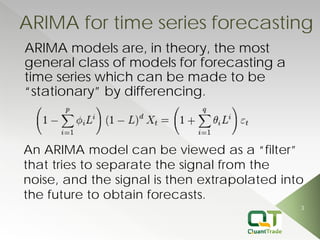
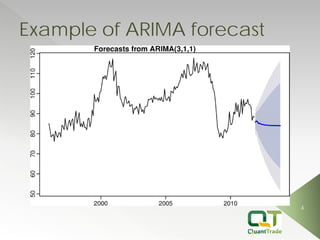
ARIMA for time series forecasting 
ARIMA models are, in theory, the most general class of models for forecasting a time series which can be made to be “stationary” by differencing. 3 
An ARIMA model can be viewed as a “filter” that tries to separate the signal from the noise, and the signal is then extrapolated into the future to obtain forecasts.
Example of ARIMA forecast 
4
Self-optimizing ARIMA expert 
 
Full ARIMA(p,d,q) implementation 
 
Unlimited order of mixed modeling 
 
Conditional error estimates 
 
Chi-square statistics on residuals 
 
Expert inference for optimal parameters 
 
Automatic trend adjustments 
 
Prediction on multiple future horizons 
5
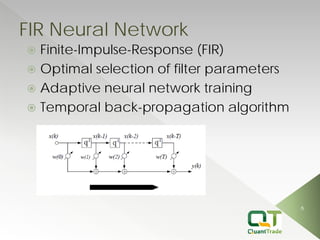
FIR Neural Network 
 
Finite-Impulse-Response (FIR) 
 
Optimal selection of filter parameters 
 
Adaptive neural network training 
 
Temporal back-propagation algorithm 
6
Finite State Markov Automation 
 
Market data flow exploration 
 
Dynamically construct Markov models 
 
Building state transition graph 
 
Predict future market states 
7
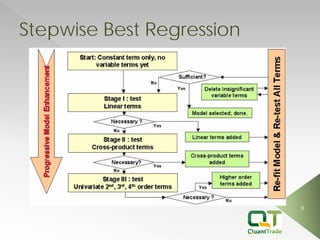
Stepwise Best Regression 
8
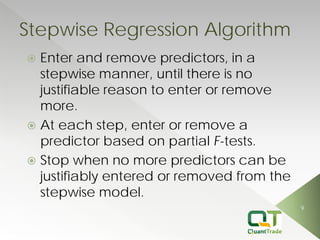
Stepwise Regression Algorithm 
 
Enter and remove predictors, in a stepwise manner, until there is no justifiable reason to enter or remove more. 
 
At each step, enter or remove a predictor based on partial F-tests. 
 
Stop when no more predictors can be justifiably entered or removed from the stepwise model. 
9
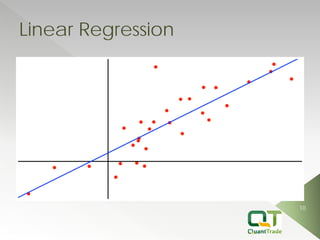
Linear Regression 
10
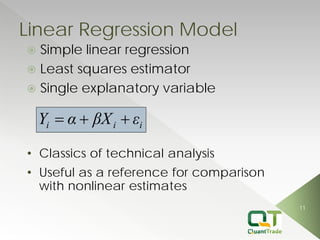
Linear Regression Model 
 
Simple linear regression 
 
Least squares estimator 
 
Single explanatory variable 
11 
iiiεβXαY++= 
• 
Classics of technical analysis 
• 
Useful as a reference for comparison with nonlinear estimates
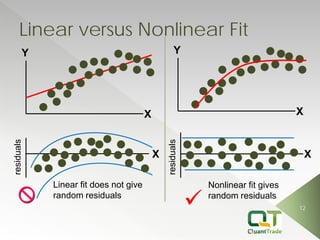
Linear versus Nonlinear Fit 
12 
Linear fit does not give random residuals 
Nonlinear fit gives random residuals 
 
X 
residuals 
X 
Y 
X 
residuals 
Y 
X
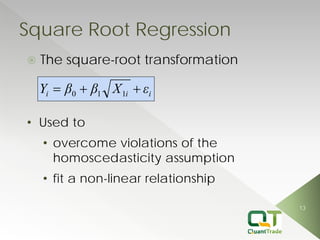
Square Root Regression 
 
The square-root transformation 
13 
iiiεXββY++=110 
• 
Used to 
• 
overcome violations of the homoscedasticity assumption 
• 
fit a non-linear relationship
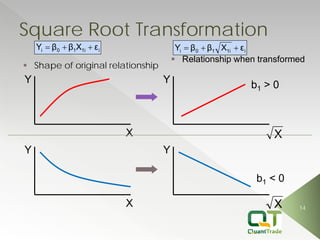
Square Root Transformation 
14 
 
Shape of original relationship 
X 
b1 > 0 
b1 < 0 
X 
Y 
Y 
Y 
Y XX 
 
Relationship when transformed 
i1i10iεXββY++=i1i10iεXββY++=
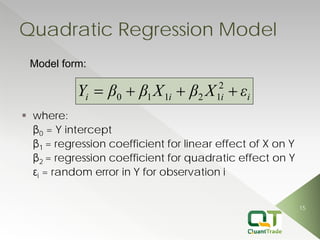
Quadratic Regression Model 
15 
 
where: β0 = Y intercept β1 = regression coefficient for linear effect of X on Y β2 = regression coefficient for quadratic effect on Y εi = random error in Y for observation i 
Model form: 
iiiiεXβXββY+++=212110
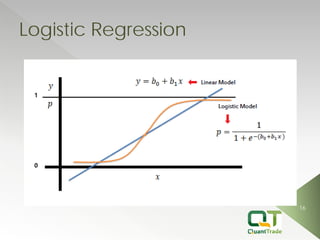
Logistic Regression 
16
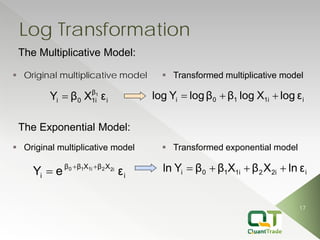
Log Transformation 
17 
 
Original multiplicative model 
 
Transformed multiplicative model 
iβ1i0iεXβY1=i1i10iε logX log ββ log Ylog++= 
The Multiplicative Model: 
 
Original multiplicative model 
 
Transformed exponential model 
i2i21i10iε ln XβXββ Yln+++= 
The Exponential Model: 
iXβXββiεeY2i21i10++=
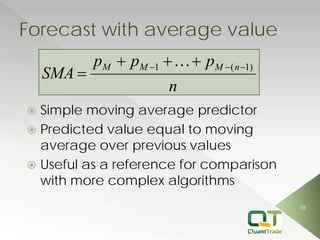
Forecast with average value 
 
Simple moving average predictor 
 
Predicted value equal to moving average over previous values 
 
Useful as a reference for comparison with more complex algorithms 
18 
npppSMAnMMM)1(1−−−+++ = 
History Prophet 
 
Dummy predictor for strategy testing 
 
Predicts every point with its future value 
 
Imitates a “prophet” knowing the future 
 
Delivers 100% of profitable trades 
 
Explicitly uses forward info 
 
Not suitable for practical trading 
 
Analog of “Maximum Profit System” 
19
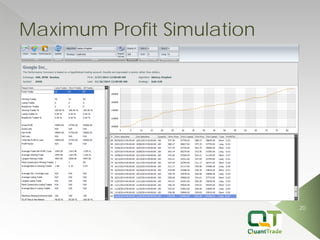
Maximum Profit Simulation 
20
Extensible algorithmic API 
 
Modular algorithmic server 
 
Extendable calculation engine 
 
Real-time C++ core framework 
 
Open standard development API 
 
Universal DLL interface 
 
Compatibility with development tools 
 
Multiple sample models 
21
22 
Pioneers in the fractal exploration of financial markets 
Trading futures and options involves the risk of loss. You should consider carefully whether futures or options are appropriate to your financial situation. You must review the customer account agreement and risk disclosure prior to establishing an account. Only risk capital should be used when trading futures or options. Investors could lose more than their initial investment. Past results are not necessarily indicative of futures results. The risk of loss in trading futures or options can be substantial, carefully consider the inherent risks of such an investment in light of your financial condition. Information contained, viewed, sent or attached is considered a solicitation for business. 
Quant Trade, LLC has been a Commodity Futures Trading Commission (CFTC) registered Commodity Trading Advisor (CTA) since September 4, 2007 and a member of the National Futures Association (NFA). 
Copyright @ 2012 Quant Trade, LLC. All rights reserved. No part of the materials including graphics or logos, available in this Web site may be copied, reproduced, translated or reduced to any electronic medium or machine- readable form, in whole or in part without written permission. 
2 N Riverside Plaza 
Suite 2325 
Chicago, Illinois 60606 
Quant Trade LLC 
(872) 225-2110

Quant Trader Algorithms

  • 1.
    Quant Trader Presentedby Quant Trade Technologies, Inc. Market Forecasting Algorithms
  • 2.
    Premium selection ofalgorithms  Self-optimizing ARIMA expert  Finite Impulse Response Neural Network  Finite State Markov Automation  Stepwise Best Regression  Square Root Regression  Square Regression  Logistic Regression 2
  • 3.
    ARIMA for timeseries forecasting ARIMA models are, in theory, the most general class of models for forecasting a time series which can be made to be “stationary” by differencing. 3 An ARIMA model can be viewed as a “filter” that tries to separate the signal from the noise, and the signal is then extrapolated into the future to obtain forecasts.
  • 4.
    Example of ARIMAforecast 4
  • 5.
    Self-optimizing ARIMA expert  Full ARIMA(p,d,q) implementation  Unlimited order of mixed modeling  Conditional error estimates  Chi-square statistics on residuals  Expert inference for optimal parameters  Automatic trend adjustments  Prediction on multiple future horizons 5
  • 6.
    FIR Neural Network  Finite-Impulse-Response (FIR)  Optimal selection of filter parameters  Adaptive neural network training  Temporal back-propagation algorithm 6
  • 7.
    Finite State MarkovAutomation  Market data flow exploration  Dynamically construct Markov models  Building state transition graph  Predict future market states 7
  • 8.
  • 9.
    Stepwise Regression Algorithm  Enter and remove predictors, in a stepwise manner, until there is no justifiable reason to enter or remove more.  At each step, enter or remove a predictor based on partial F-tests.  Stop when no more predictors can be justifiably entered or removed from the stepwise model. 9
  • 10.
  • 11.
    Linear Regression Model  Simple linear regression  Least squares estimator  Single explanatory variable 11 iiiεβXαY++= • Classics of technical analysis • Useful as a reference for comparison with nonlinear estimates
  • 12.
    Linear versus NonlinearFit 12 Linear fit does not give random residuals Nonlinear fit gives random residuals  X residuals X Y X residuals Y X
  • 13.
    Square Root Regression  The square-root transformation 13 iiiεXββY++=110 • Used to • overcome violations of the homoscedasticity assumption • fit a non-linear relationship
  • 14.
    Square Root Transformation 14  Shape of original relationship X b1 > 0 b1 < 0 X Y Y Y Y XX  Relationship when transformed i1i10iεXββY++=i1i10iεXββY++=
  • 15.
    Quadratic Regression Model 15  where: β0 = Y intercept β1 = regression coefficient for linear effect of X on Y β2 = regression coefficient for quadratic effect on Y εi = random error in Y for observation i Model form: iiiiεXβXββY+++=212110
  • 16.
  • 17.
    Log Transformation 17  Original multiplicative model  Transformed multiplicative model iβ1i0iεXβY1=i1i10iε logX log ββ log Ylog++= The Multiplicative Model:  Original multiplicative model  Transformed exponential model i2i21i10iε ln XβXββ Yln+++= The Exponential Model: iXβXββiεeY2i21i10++=
  • 18.
    Forecast with averagevalue  Simple moving average predictor  Predicted value equal to moving average over previous values  Useful as a reference for comparison with more complex algorithms 18 npppSMAnMMM)1(1−−−+++ = 
  • 19.
    History Prophet  Dummy predictor for strategy testing  Predicts every point with its future value  Imitates a “prophet” knowing the future  Delivers 100% of profitable trades  Explicitly uses forward info  Not suitable for practical trading  Analog of “Maximum Profit System” 19
  • 20.
  • 21.
    Extensible algorithmic API  Modular algorithmic server  Extendable calculation engine  Real-time C++ core framework  Open standard development API  Universal DLL interface  Compatibility with development tools  Multiple sample models 21
  • 22.
    22 Pioneers inthe fractal exploration of financial markets Trading futures and options involves the risk of loss. You should consider carefully whether futures or options are appropriate to your financial situation. You must review the customer account agreement and risk disclosure prior to establishing an account. Only risk capital should be used when trading futures or options. Investors could lose more than their initial investment. Past results are not necessarily indicative of futures results. The risk of loss in trading futures or options can be substantial, carefully consider the inherent risks of such an investment in light of your financial condition. Information contained, viewed, sent or attached is considered a solicitation for business. Quant Trade, LLC has been a Commodity Futures Trading Commission (CFTC) registered Commodity Trading Advisor (CTA) since September 4, 2007 and a member of the National Futures Association (NFA). Copyright @ 2012 Quant Trade, LLC. All rights reserved. No part of the materials including graphics or logos, available in this Web site may be copied, reproduced, translated or reduced to any electronic medium or machine- readable form, in whole or in part without written permission. 2 N Riverside Plaza Suite 2325 Chicago, Illinois 60606 Quant Trade LLC (872) 225-2110