
INSTITUTE 0F TECHNOLOGY &
MANAEMENT ALIGARH
FINAL YEAR PROJECT
AUTO PATH FINDER solar car
+
ANTI
FALLING
SUBMITTED BY
PROJECT GUIDE
MS.SAKSHI MITTAL
Project incharge
SACHIN
VARSHANEY
AIM OF PROJECT :
Saving Non Renewable Resources
i.e Petrol & Diesel.
Make Green City.
Save Life Of Human.
Contents:
I. Introduction
II. Description
III. Block diagram
IV. Solar panel
V. How much electricity do we use?
VI. Working of solar panel
VII. Rechargeable battery
VIII. Motor drive
IX. Dc motor
X. Sensor’s
XI. Working of I.R
XII. Circuit diagram
XIII. Microcontroller
XIV. Advantage’s of project
XV. Future prospects
XVI. References
Introduction:
Solar panel is the conversion of sunlight energy into
electricity.
Photovoltaic convert light into electric current.
Auto path finder solar controlled car system
Anti falling solar car .
Auto Path Finder Solar Car With Anti Falling
Description
The following are the major components used in this Project:
Solar Panel
6s22 (9volt ) Rechargeable Battery
Mabuchi Motor (12v)
Ir Led Tx (0.6 -0 .7 V)
Photo Diode (Rx)
89c2051 Microcontroller
Opto Coupler
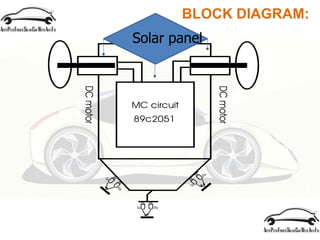
Solar panel
BLOCK DIAGRAM:
Solar panel:
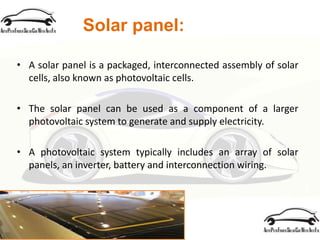
• A solar panel is a packaged, interconnected assembly of solar
cells, also known as photovoltaic cells.
• The solar panel can be used as a component of a larger
photovoltaic system to generate and supply electricity.
• A photovoltaic system typically includes an array of solar
panels, an inverter, battery and interconnection wiring.
How much electricity do we
use?
• A typical Indian home uses about 1 kW of power, or about 24
kWh per day
• If we average over everything – homes, factories, schools, etc.
we use about 37 kWh per day for each person.
WORKING OF SOLAR PANEL
SARFARAJ
RAVINDRA
SHASHANK
SATYAM
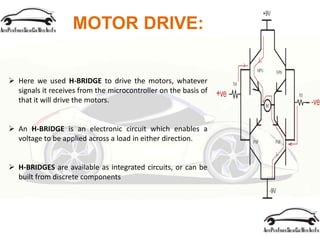
MOTOR DRIVE:
 Here we used H-BRIDGE to drive the motors, whatever
signals it receives from the microcontroller on the basis of
that it will drive the motors.
 An H-BRIDGE is an electronic circuit which enables a
voltage to be applied across a load in either direction.
 H-BRIDGES are available as integrated circuits, or can be
built from discrete components
Rechargeable battery:
 Solar cars use a range of batteries including
• Lead-acid batteries,
• nickel-metal hydride batteries (NiMH),
• Nickel-Cadmium batteries (NiCd),
• Lithium acid batteries
• lithium polymer batteries without any pollution.
 A rechargeable battery or storage battery is a group of one or
more electrochemical cells.
 Rechargeable batteries come in many different shapes and sizes, ranging
anything from a button cell to megawatt systems connected to stabilize an
electrical distribution network
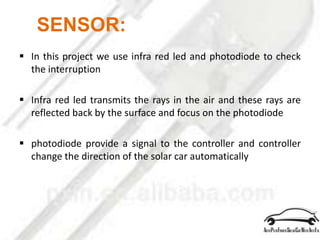
SENSOR:
 In this project we use infra red led and photodiode to check
the interruption
 Infra red led transmits the rays in the air and these rays are
reflected back by the surface and focus on the photodiode
 photodiode provide a signal to the controller and controller
change the direction of the solar car automatically
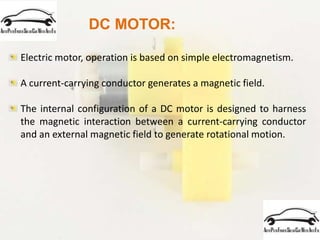
DC MOTOR:
Electric motor, operation is based on simple electromagnetism.
A current-carrying conductor generates a magnetic field.
The internal configuration of a DC motor is designed to harness
the magnetic interaction between a current-carrying conductor
and an external magnetic field to generate rotational motion.
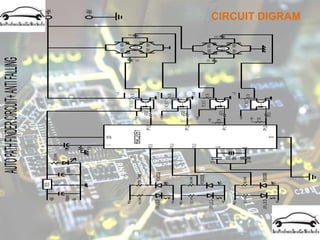
CIRCUIT DIGRAM
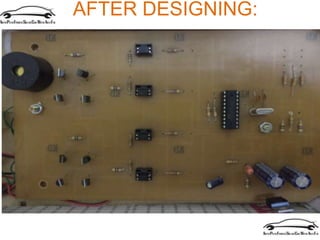
AFTER DESIGNING:
Microcontroller:
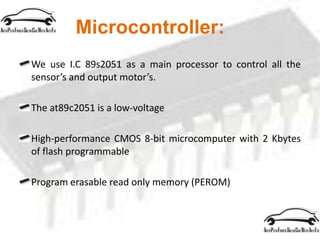
We use I.C 89s2051 as a main processor to control all the
sensor’s and output motor’s.
The at89c2051 is a low-voltage
High-performance CMOS 8-bit microcomputer with 2 Kbytes
of flash programmable
Program erasable read only memory (PEROM)
Advantage’s of project:
• Solar energy is a completely renewable resource.
• Oil, which is what most people currently use to power their
homes, is not a renewable resource. This means that as soon
as the oil is gone, it is gone forever and we will no longer have
power or energy.
• Solar cells make absolutely no noise at all.
• 4. Solar energy creates absolutely no pollution.
• 5. Very little maintenance is required to keep solar cells
running.
• 6. Solar panels and solar lighting may seem quite
expensive when you first purchase it, but in the long run
• 7. Solar powered panels and products are typically
extremely easy to install.
• 8. Solar power technology is improving consistently over
time.
FUTURE PROSPECTS:
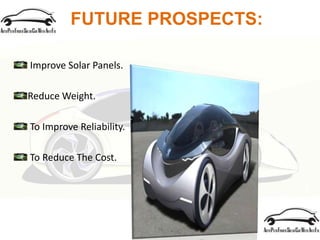
Improve Solar Panels.
Reduce Weight.
To Improve Reliability.
To Reduce The Cost.
REFERENCES:
 http://mpfwww.jpl.nasa.gov
 http://www.gmd.de
 http://www.electronics.com
 http://www.cs.cmu.edu
 http://sunsite.anu.edu.au
If u have more query plz
contact,,,,
+919557917790
Sarfaraj hussain

Auto path solar car

  • 1.
    INSTITUTE 0F TECHNOLOGY& MANAEMENT ALIGARH FINAL YEAR PROJECT AUTO PATH FINDER solar car + ANTI FALLING SUBMITTED BY PROJECT GUIDE MS.SAKSHI MITTAL Project incharge SACHIN VARSHANEY
  • 2.
    AIM OF PROJECT: Saving Non Renewable Resources i.e Petrol & Diesel. Make Green City. Save Life Of Human.
  • 3.
    Contents: I. Introduction II. Description III.Block diagram IV. Solar panel V. How much electricity do we use? VI. Working of solar panel VII. Rechargeable battery VIII. Motor drive IX. Dc motor X. Sensor’s XI. Working of I.R XII. Circuit diagram XIII. Microcontroller XIV. Advantage’s of project XV. Future prospects XVI. References
  • 4.
    Introduction: Solar panel isthe conversion of sunlight energy into electricity. Photovoltaic convert light into electric current. Auto path finder solar controlled car system Anti falling solar car . Auto Path Finder Solar Car With Anti Falling
  • 5.
    Description The following arethe major components used in this Project: Solar Panel 6s22 (9volt ) Rechargeable Battery Mabuchi Motor (12v) Ir Led Tx (0.6 -0 .7 V) Photo Diode (Rx) 89c2051 Microcontroller Opto Coupler
  • 6.
  • 7.
    Solar panel: • Asolar panel is a packaged, interconnected assembly of solar cells, also known as photovoltaic cells. • The solar panel can be used as a component of a larger photovoltaic system to generate and supply electricity. • A photovoltaic system typically includes an array of solar panels, an inverter, battery and interconnection wiring.
  • 8.
    How much electricitydo we use? • A typical Indian home uses about 1 kW of power, or about 24 kWh per day • If we average over everything – homes, factories, schools, etc. we use about 37 kWh per day for each person.
  • 9.
    WORKING OF SOLARPANEL SARFARAJ RAVINDRA SHASHANK SATYAM
  • 10.
    MOTOR DRIVE:  Herewe used H-BRIDGE to drive the motors, whatever signals it receives from the microcontroller on the basis of that it will drive the motors.  An H-BRIDGE is an electronic circuit which enables a voltage to be applied across a load in either direction.  H-BRIDGES are available as integrated circuits, or can be built from discrete components
  • 11.
    Rechargeable battery:  Solarcars use a range of batteries including • Lead-acid batteries, • nickel-metal hydride batteries (NiMH), • Nickel-Cadmium batteries (NiCd), • Lithium acid batteries • lithium polymer batteries without any pollution.  A rechargeable battery or storage battery is a group of one or more electrochemical cells.  Rechargeable batteries come in many different shapes and sizes, ranging anything from a button cell to megawatt systems connected to stabilize an electrical distribution network
  • 12.
    SENSOR:  In thisproject we use infra red led and photodiode to check the interruption  Infra red led transmits the rays in the air and these rays are reflected back by the surface and focus on the photodiode  photodiode provide a signal to the controller and controller change the direction of the solar car automatically
  • 13.
    DC MOTOR: Electric motor,operation is based on simple electromagnetism. A current-carrying conductor generates a magnetic field. The internal configuration of a DC motor is designed to harness the magnetic interaction between a current-carrying conductor and an external magnetic field to generate rotational motion.
  • 14.
  • 15.
  • 16.
    Microcontroller: We use I.C89s2051 as a main processor to control all the sensor’s and output motor’s. The at89c2051 is a low-voltage High-performance CMOS 8-bit microcomputer with 2 Kbytes of flash programmable Program erasable read only memory (PEROM)
  • 17.
    Advantage’s of project: •Solar energy is a completely renewable resource. • Oil, which is what most people currently use to power their homes, is not a renewable resource. This means that as soon as the oil is gone, it is gone forever and we will no longer have power or energy. • Solar cells make absolutely no noise at all.
  • 18.
    • 4. Solarenergy creates absolutely no pollution. • 5. Very little maintenance is required to keep solar cells running. • 6. Solar panels and solar lighting may seem quite expensive when you first purchase it, but in the long run • 7. Solar powered panels and products are typically extremely easy to install. • 8. Solar power technology is improving consistently over time.
  • 19.
    FUTURE PROSPECTS: Improve SolarPanels. Reduce Weight. To Improve Reliability. To Reduce The Cost.
  • 20.
    REFERENCES:  http://mpfwww.jpl.nasa.gov  http://www.gmd.de http://www.electronics.com  http://www.cs.cmu.edu  http://sunsite.anu.edu.au
  • 22.
    If u havemore query plz contact,,,, +919557917790 Sarfaraj hussain