Welcome
AUDIT TRAIL
Name:Alankar Nayak
Qualification: MSc. Biotechnology
Student ID: 151/082023
10/18/2022 www.clinosol.com | follow us on social media @clinosolresearch
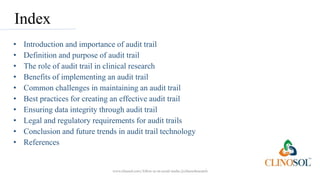
Index
• Introduction and importance of audit trail
• Definition and purpose of audit trail
• The role of audit trail in clinical research
• Benefits of implementing an audit trail
• Common challenges in maintaining an audit trail
• Best practices for creating an effective audit trail
• Ensuring data integrity through audit trail
• Legal and regulatory requirements for audit trails
• Conclusion and future trends in audit trail technology
• References
www.clinosol.com | follow us on social media @clinosolresearch
Introduction and importance of audit trail
10/18/2022 www.clinosol.com | follow us on social media @clinosolresearch
• In the realm of clinical research,maintaining transparencyand accountabilityis paramount.
To achievethis, the implementation of an audit trail is indispensable.By documenting every
interaction, modification, and accessto data,anaudit trail provides anunbiasedrecordto
validate the integrity of the researchprocess.In this article, wedelve into the essentialityof
an audit trail in clinical researchand its role in ensuring trust and reliability.
Definition and purpose of audit trail
10/18/2022 www.clinosol.com | follow us on social media @clinosolresearch
• An audit trail in clinical research refers to a chronological record of events,
activities, and changes made during the research process.
• Its purpose is to ensure transparency and accountability by providing an unbiased
documentation of data interactions, modifications, and access.
• This record plays a crucial role in building trust and reliability in clinical research,
as it allows for validation and verification of the research process.
The role of audit trail in clinical research
• The role of an audit trail in clinical research cannot be overstated. It acts as a reliable
and transparent documentation of the research process, offering validation and
verification of data interactions, modifications, and access.
• By ensuring accountability and trust, the audit trail becomes an essential tool in
upholding the integrity of clinical research and promoting the reliability of its findings.
10/18/2022 www.clinosol.com | follow us on social media @clinosolresearch
Benefits of implementing an audit trail
Implementing an audit trail in clinical research brings numerous benefits:
• It provides a comprehensive record of data interactions, modifications, and access,
promoting transparency and accountability.
• Audit trails enable researchers to validate and verify findings, enhance data integrity,
and enhance trustworthiness.
• By maintaining a reliable audit trail, the integrity and reliability of clinical research
can be upheld, ensuring the highest quality of data and findings.
10/18/2022 www.clinosol.com | follow us on social media @clinosolresearch
Common challenges in maintaining an audit trail
While implementing an audit trail in clinical research is crucial, there are common
challenges to be aware of.
• These challenges include ensuring consistent and accurate documentation.
• Managing large volumes of data.
• Addressing security concerns, and complying with regulatory requirements.
By understanding and addressing these challenges, researchers can maintain a robust
audit trail that upholds transparency and accountability in clinical research.
10/18/2022 www.clinosol.com | follow us on social media @clinosolresearch
Best practices for creating an effective audit trail
Creating an effective audit trail requires the following best practices:
• These include ensuring that documentation is performed consistently and accurately
• Implementing robust data management systems to handle large volumes of data,
prioritizing data security to protect sensitive information.
• Staying updated with relevant regulatory requirements. By adhering to these practices,
researchers can maintain a transparent and accountable clinical research process.
10/18/2022 www.clinosol.com | follow us on social media @clinosolresearch
Ensuring data integrity through audit trail
• An audit trail is essential for maintaining data integrity in clinical research. It
provides a detailed record of all activities and changes made to research data,
ensuring transparency and accountability.
• By following best practices, such as consistent and accurate documentation, robust
data management systems, and data security measures, researchers can confidently
demonstrate the validity and reliability of their findings.
10/18/2022 www.clinosol.com | follow us on social media @clinosolresearch
Legal and regulatory requirements for audit trails
• To ensure compliance with legal and regulatory requirements, clinical researchers must
maintain a comprehensive audit trail.
• This includes documenting all activities performed, changes made, and any deviations
from established protocols.
• A strong audit trail not only enhances data integrity but also provides a transparent and
accountable framework that meets the expectations of the authorities in the field of
clinical research.
10/18/2022 www.clinosol.com | follow us on social media @clinosolresearch
Conclusion and future trends in audit trail
technology
• In conclusion, audit trail technology plays a crucial role in ensuring transparency and
accountability in clinical research.
• As technology continues to advance, future trends in audit trail technology may include
automation, artificial intelligence, and blockchain integration to further enhance the
accuracy, reliability, and security of audit trails.
• Embracing these advancements will solidify the integrity of clinical research and maintain
public trust in the industry.
10/18/2022 www.clinosol.com | follow us on social media @clinosolresearch
References
Wu, D. T., Smart, N., Ciemins, E. L., Lanham, H. J., Lindberg, C., & Zheng, K.
(2017). Using EHR audit trail logs to analyze clinical workflow: a case study from
community-based ambulatory clinics. In AMIA Annual Symposium Proceedings
(Vol. 2017, p. 1820). American Medical Informatics Association.
Pal, A., Shinde, R., Miralles, M. S., Workman, P., & de Bono, J. (2021). Applications
of liquid biopsy in the Pharmacological Audit Trail for anticancer drug development.
Nature reviews Clinical oncology, 18(7), 454-467.
Oakley, J., Worley, C., Yu, L., Brooks, R. R., Özçelik, İ. L. K. E. R., Skjellum, A., &
Obeid, J. S. (2021). Scrybe: A Secure Audit Trail for Clinical Trial Data Fusion.
Digital Threats: Research and Practice.
Thank You!
www.clinosol.com
(India | Canada)
9121151622/623/624
info@clinosol.com
10/18/2022 www.clinosol.com | follow us on social media @clinosolresearch

Audit Trail

  • 1.
    Welcome AUDIT TRAIL Name:Alankar Nayak Qualification:MSc. Biotechnology Student ID: 151/082023 10/18/2022 www.clinosol.com | follow us on social media @clinosolresearch
  • 2.
    Index • Introduction andimportance of audit trail • Definition and purpose of audit trail • The role of audit trail in clinical research • Benefits of implementing an audit trail • Common challenges in maintaining an audit trail • Best practices for creating an effective audit trail • Ensuring data integrity through audit trail • Legal and regulatory requirements for audit trails • Conclusion and future trends in audit trail technology • References www.clinosol.com | follow us on social media @clinosolresearch
  • 3.
    Introduction and importanceof audit trail 10/18/2022 www.clinosol.com | follow us on social media @clinosolresearch • In the realm of clinical research,maintaining transparencyand accountabilityis paramount. To achievethis, the implementation of an audit trail is indispensable.By documenting every interaction, modification, and accessto data,anaudit trail provides anunbiasedrecordto validate the integrity of the researchprocess.In this article, wedelve into the essentialityof an audit trail in clinical researchand its role in ensuring trust and reliability.
  • 4.
    Definition and purposeof audit trail 10/18/2022 www.clinosol.com | follow us on social media @clinosolresearch • An audit trail in clinical research refers to a chronological record of events, activities, and changes made during the research process. • Its purpose is to ensure transparency and accountability by providing an unbiased documentation of data interactions, modifications, and access. • This record plays a crucial role in building trust and reliability in clinical research, as it allows for validation and verification of the research process.
  • 5.
    The role ofaudit trail in clinical research • The role of an audit trail in clinical research cannot be overstated. It acts as a reliable and transparent documentation of the research process, offering validation and verification of data interactions, modifications, and access. • By ensuring accountability and trust, the audit trail becomes an essential tool in upholding the integrity of clinical research and promoting the reliability of its findings. 10/18/2022 www.clinosol.com | follow us on social media @clinosolresearch
  • 6.
    Benefits of implementingan audit trail Implementing an audit trail in clinical research brings numerous benefits: • It provides a comprehensive record of data interactions, modifications, and access, promoting transparency and accountability. • Audit trails enable researchers to validate and verify findings, enhance data integrity, and enhance trustworthiness. • By maintaining a reliable audit trail, the integrity and reliability of clinical research can be upheld, ensuring the highest quality of data and findings. 10/18/2022 www.clinosol.com | follow us on social media @clinosolresearch
  • 7.
    Common challenges inmaintaining an audit trail While implementing an audit trail in clinical research is crucial, there are common challenges to be aware of. • These challenges include ensuring consistent and accurate documentation. • Managing large volumes of data. • Addressing security concerns, and complying with regulatory requirements. By understanding and addressing these challenges, researchers can maintain a robust audit trail that upholds transparency and accountability in clinical research. 10/18/2022 www.clinosol.com | follow us on social media @clinosolresearch
  • 8.
    Best practices forcreating an effective audit trail Creating an effective audit trail requires the following best practices: • These include ensuring that documentation is performed consistently and accurately • Implementing robust data management systems to handle large volumes of data, prioritizing data security to protect sensitive information. • Staying updated with relevant regulatory requirements. By adhering to these practices, researchers can maintain a transparent and accountable clinical research process. 10/18/2022 www.clinosol.com | follow us on social media @clinosolresearch
  • 9.
    Ensuring data integritythrough audit trail • An audit trail is essential for maintaining data integrity in clinical research. It provides a detailed record of all activities and changes made to research data, ensuring transparency and accountability. • By following best practices, such as consistent and accurate documentation, robust data management systems, and data security measures, researchers can confidently demonstrate the validity and reliability of their findings. 10/18/2022 www.clinosol.com | follow us on social media @clinosolresearch
  • 10.
    Legal and regulatoryrequirements for audit trails • To ensure compliance with legal and regulatory requirements, clinical researchers must maintain a comprehensive audit trail. • This includes documenting all activities performed, changes made, and any deviations from established protocols. • A strong audit trail not only enhances data integrity but also provides a transparent and accountable framework that meets the expectations of the authorities in the field of clinical research. 10/18/2022 www.clinosol.com | follow us on social media @clinosolresearch
  • 11.
    Conclusion and futuretrends in audit trail technology • In conclusion, audit trail technology plays a crucial role in ensuring transparency and accountability in clinical research. • As technology continues to advance, future trends in audit trail technology may include automation, artificial intelligence, and blockchain integration to further enhance the accuracy, reliability, and security of audit trails. • Embracing these advancements will solidify the integrity of clinical research and maintain public trust in the industry. 10/18/2022 www.clinosol.com | follow us on social media @clinosolresearch
  • 12.
    References Wu, D. T.,Smart, N., Ciemins, E. L., Lanham, H. J., Lindberg, C., & Zheng, K. (2017). Using EHR audit trail logs to analyze clinical workflow: a case study from community-based ambulatory clinics. In AMIA Annual Symposium Proceedings (Vol. 2017, p. 1820). American Medical Informatics Association. Pal, A., Shinde, R., Miralles, M. S., Workman, P., & de Bono, J. (2021). Applications of liquid biopsy in the Pharmacological Audit Trail for anticancer drug development. Nature reviews Clinical oncology, 18(7), 454-467. Oakley, J., Worley, C., Yu, L., Brooks, R. R., Özçelik, İ. L. K. E. R., Skjellum, A., & Obeid, J. S. (2021). Scrybe: A Secure Audit Trail for Clinical Trial Data Fusion. Digital Threats: Research and Practice.
  • 13.
    Thank You! www.clinosol.com (India |Canada) 9121151622/623/624 info@clinosol.com 10/18/2022 www.clinosol.com | follow us on social media @clinosolresearch

Editor's Notes