AUDIENCES Key Concepts in Media- Audience Theories Part 2
THEORY… There are several different arguments put forward into the debate about how Media actually “EFFECTS” us outside of our viewing. The three we shall look at are: Temperament Theory Desensitisation Social Learning
TEMPERAMENT THEORY Temperament theory comes from the ancient Greeks, “Temperament” is the part of our personality that is genetically based. Ivan Pavlov  used the theory as the basis for his classical conditioning experiment ( BEHAVIOURISM ) using the Greek “humors” to describe the behaviour of his dogs in response to two bells being rang at the same time: 1 to signify the beginning of a meal and one the end. Hans Eysenck  identified 4 types of people, he believed if they experienced the same trauma or event they would all react differently due to their genetic differences- their individual nature. The event/ trauma would not  CHANGE  who they are.
TEMPERAMENT THEORY Eysenck’s 4 types were: Neurotics-  tend to develop phobias/ have panic attacks. Extraverts-  have no fear or real memory of a traumatic experience. Introverts-  Unlikely to put themselves in a similar situation again. Psychotics-  May feel a connection to the negativity and get obsessed about it, perhaps wanting to recreate it again and again.
TEMPERAMENT THEORY TEMPERAMENT THEORY:  If applied to Media consumption the temperament theory explains that people will not generally be effected by Violent Films or traumatised by Horror Films unless it is generally in their nature to do so in the first place. The theory states that people’s “nature” will NOT be changed by Film or the Media. PROBLEMS: - The theory takes no consideration for the power of nurture over nature.
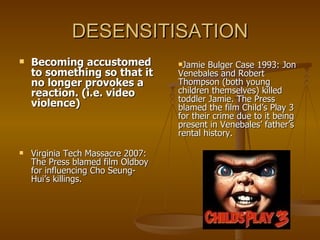
DESENSITISATION Becoming accustomed to something so that it no longer provokes a reaction. (i.e. video violence) Virginia Tech Massacre 2007: The Press blamed film Oldboy for influencing Cho Seung-Hui’s killings. Jamie Bulger Case 1993: Jon Venebales and Robert Thompson (both young children themselves) killed toddler Jamie. The Press blamed the film Child’s Play 3 for their crime due to it being present in Venebales’ father’s rental history.
DESENSITISATION Huesmann and Eron (1986)-  studied the effect of violent TV over a period of 22 years and found that the more violent TV someone watched the more they likely to be convicted of a criminal offence by the age of 50. Guy Cumberbatch-  believes there is no scientific evidence that relate media to violence and that some people are just naturally aggressive. Feshbach and Singer (1971)-  found that children shown aggressive TV over 6 weeks are LESS aggressive afterwards. Sparkfin et al. (1975) and Baron et al. (1978)-  found that TV did also have a pro-social effect, which had twice the effect of aggressive TV. Park et al. (1977)-  found that juvenile delinquents in US/ Belgium watching violent TV were more aggressive that those who weren’t.
DESENSITISATION PROBLEMS: Argument that aggressive people will seek out aggressive films not the other way round. There is so much conflicting data from different experiments and studies that do not correlate.  None of the studies can be seen to be accurate or to 100% prove their theory. - Measuring aggression is almost impossible.
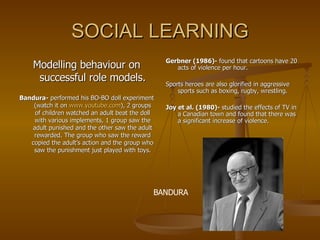
SOCIAL LEARNING Modelling behaviour on successful role models. Bandura-  performed his BO-BO doll experiment (watch it on  www.youtube.com ), 2 groups of children watched an adult beat the doll with various implements, 1 group saw the adult punished and the other saw the adult rewarded. The group who saw the reward copied the adult’s action and the group who saw the punishment just played with toys. Gerbner (1986)-  found that cartoons have 20 acts of violence per hour. Sports heroes are also glorified in aggressive sports such as boxing, rugby, wrestling. Joy et al. (1980)-  studied the effects of TV in a Canadian town and found that there was a significant increase of violence.  BANDURA
SOCIAL LEARNING ST Helena Study (1960s)-  TV was introduced to the island and levels of aggression were studied. No difference was found. It seemed young children were modelling their behaviour on their older role models and a strong neighbourhood watch community were far more influential on the behaviour of people that TV was. PROBLEMS: Generally promotes the idea that it is “role models” / “heroes” committing violence which contrasts the various political acts which have banned films such as the video nasties (when the violence was committed by dehumanized creatures and people in those). -Again, there is much debate within Social Learning theory.
THEORY EXERCISE There are a lot of names, dates, studies and theories to remember. Try printing off the earlier sheets, cutting up the names and studies separately and play a memory game with them by turning them over and trying to match the pairs. It will help you remember it all far better. Which of the theories do you most agree with? Write an essay defending your favourite theory in contrast to the others, use case studies from the media and scientific studies as explained to back up your own research.

Audiences Effects 2

  • 1.
    AUDIENCES Key Conceptsin Media- Audience Theories Part 2
  • 2.
    THEORY… There areseveral different arguments put forward into the debate about how Media actually “EFFECTS” us outside of our viewing. The three we shall look at are: Temperament Theory Desensitisation Social Learning
  • 3.
    TEMPERAMENT THEORY Temperamenttheory comes from the ancient Greeks, “Temperament” is the part of our personality that is genetically based. Ivan Pavlov used the theory as the basis for his classical conditioning experiment ( BEHAVIOURISM ) using the Greek “humors” to describe the behaviour of his dogs in response to two bells being rang at the same time: 1 to signify the beginning of a meal and one the end. Hans Eysenck identified 4 types of people, he believed if they experienced the same trauma or event they would all react differently due to their genetic differences- their individual nature. The event/ trauma would not CHANGE who they are.
  • 4.
    TEMPERAMENT THEORY Eysenck’s4 types were: Neurotics- tend to develop phobias/ have panic attacks. Extraverts- have no fear or real memory of a traumatic experience. Introverts- Unlikely to put themselves in a similar situation again. Psychotics- May feel a connection to the negativity and get obsessed about it, perhaps wanting to recreate it again and again.
  • 5.
    TEMPERAMENT THEORY TEMPERAMENTTHEORY: If applied to Media consumption the temperament theory explains that people will not generally be effected by Violent Films or traumatised by Horror Films unless it is generally in their nature to do so in the first place. The theory states that people’s “nature” will NOT be changed by Film or the Media. PROBLEMS: - The theory takes no consideration for the power of nurture over nature.
  • 6.
    DESENSITISATION Becoming accustomedto something so that it no longer provokes a reaction. (i.e. video violence) Virginia Tech Massacre 2007: The Press blamed film Oldboy for influencing Cho Seung-Hui’s killings. Jamie Bulger Case 1993: Jon Venebales and Robert Thompson (both young children themselves) killed toddler Jamie. The Press blamed the film Child’s Play 3 for their crime due to it being present in Venebales’ father’s rental history.
  • 7.
    DESENSITISATION Huesmann andEron (1986)- studied the effect of violent TV over a period of 22 years and found that the more violent TV someone watched the more they likely to be convicted of a criminal offence by the age of 50. Guy Cumberbatch- believes there is no scientific evidence that relate media to violence and that some people are just naturally aggressive. Feshbach and Singer (1971)- found that children shown aggressive TV over 6 weeks are LESS aggressive afterwards. Sparkfin et al. (1975) and Baron et al. (1978)- found that TV did also have a pro-social effect, which had twice the effect of aggressive TV. Park et al. (1977)- found that juvenile delinquents in US/ Belgium watching violent TV were more aggressive that those who weren’t.
  • 8.
    DESENSITISATION PROBLEMS: Argumentthat aggressive people will seek out aggressive films not the other way round. There is so much conflicting data from different experiments and studies that do not correlate. None of the studies can be seen to be accurate or to 100% prove their theory. - Measuring aggression is almost impossible.
  • 9.
    SOCIAL LEARNING Modellingbehaviour on successful role models. Bandura- performed his BO-BO doll experiment (watch it on www.youtube.com ), 2 groups of children watched an adult beat the doll with various implements, 1 group saw the adult punished and the other saw the adult rewarded. The group who saw the reward copied the adult’s action and the group who saw the punishment just played with toys. Gerbner (1986)- found that cartoons have 20 acts of violence per hour. Sports heroes are also glorified in aggressive sports such as boxing, rugby, wrestling. Joy et al. (1980)- studied the effects of TV in a Canadian town and found that there was a significant increase of violence. BANDURA
  • 10.
    SOCIAL LEARNING STHelena Study (1960s)- TV was introduced to the island and levels of aggression were studied. No difference was found. It seemed young children were modelling their behaviour on their older role models and a strong neighbourhood watch community were far more influential on the behaviour of people that TV was. PROBLEMS: Generally promotes the idea that it is “role models” / “heroes” committing violence which contrasts the various political acts which have banned films such as the video nasties (when the violence was committed by dehumanized creatures and people in those). -Again, there is much debate within Social Learning theory.
  • 11.
    THEORY EXERCISE Thereare a lot of names, dates, studies and theories to remember. Try printing off the earlier sheets, cutting up the names and studies separately and play a memory game with them by turning them over and trying to match the pairs. It will help you remember it all far better. Which of the theories do you most agree with? Write an essay defending your favourite theory in contrast to the others, use case studies from the media and scientific studies as explained to back up your own research.