Research is formalized curiosity.
It is poking and prying with a purpose.
--Zora Neale Hurston, writer
Media Effects
& Cultural Approaches to
Research
Media Research
• Studying the impact of messages
transmitted by various mass media
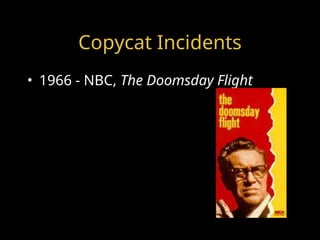
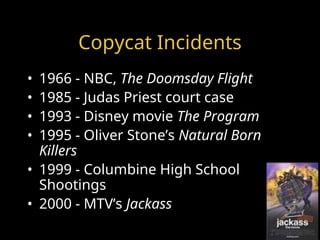
Copycat Incidents
• 1966 - NBC, The Doomsday Flight
Copycat Incidents
• 1966 - NBC, The Doomsday Flight
• 1985 - Judas Priest court case
Copycat Incidents
• 1966 - NBC, The Doomsday Flight
• 1985 - Judas Priest court case
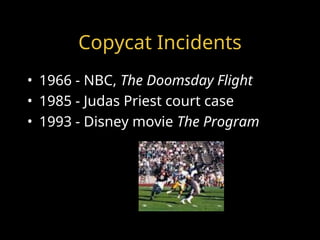
• 1993 - Disney movie The Program
Copycat Incidents
• 1966 - NBC, The Doomsday Flight
• 1985 - Judas Priest court case
• 1993 - Disney movie The Program
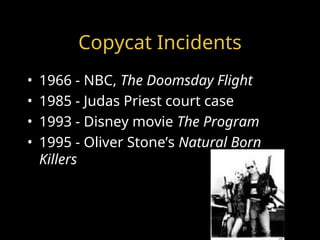
• 1995 - Oliver Stone’s Natural Born
Killers
Copycat Incidents
• 1966 - NBC, The Doomsday Flight
• 1985 - Judas Priest court case
• 1993 - Disney movie The Program
• 1995 - Oliver Stone’s Natural Born
Killers
• 1999 - Columbine High School
Shootings
Copycat Incidents
• 1966 - NBC, The Doomsday Flight
• 1985 - Judas Priest court case
• 1993 - Disney movie The Program
• 1995 - Oliver Stone’s Natural Born
Killers
• 1999 - Columbine High School
Shootings
• 2000 - MTV’s Jackass
Key Theories in Media
Research
• Hypodermic Needle Model
– Leni Riefenstahl films for Hitler:
• Triumph of the Will
• Olympiad
– Orson Welles Oct. 30, 1938 radio
broadcast of War of the Worlds
Key Phases in Media
Research
• Minimal Effects Model -
– Selective exposure
– Selective retention
• For some children, under some
conditions, some television is harmful.
For other children under the same
conditions, or for the same children
under other conditions, it may be
beneficial. For most children, under most
conditions, most television is probably
neither particularly harmful nor
particularly beneficial.
Key Phases in Media
Research
• Uses and Gratifications Model
– Why do we use the media?
Three Main Scientific
Approaches
1. Experimental Research
– Experimental Group
– Control Group
– Random Assignment
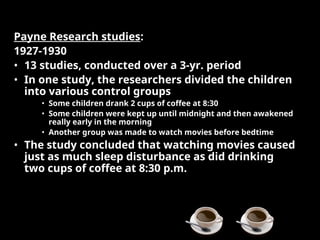
Payne Research studies:
1927-1930
• 13 studies, conducted over a 3-yr. period
• In one study, the researchers divided the children
into various control groups
• Some children drank 2 cups of coffee at 8:30
• Some children were kept up until midnight and then awakened
really early in the morning
• Another group was made to watch movies before bedtime
• The study concluded that watching movies caused
just as much sleep disturbance as did drinking
two cups of coffee at 8:30 p.m.
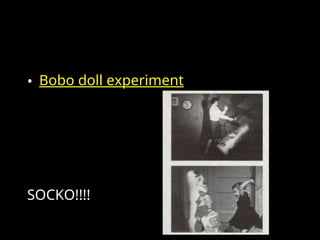
• Bobo doll experiment
SOCKO!!!!
Three Main Scientific
Approaches
2. Survey Research
– Does not control variables
– Shows correlations, not causality
– But, generalizable to larger population
– Problems of validity of questions
Three Main Scientific
Approaches
3. Content Analysis
– Systematically code and measure media
content
What counts as
“violence” on television?
• Is driving a sport-utility vehicle through a stream
violent?
• Is shooting a man before he sets off a bomb that’s
about to kill 100 people violent (or is that a good
deed)?
• Is a parent screaming at a child violent?
• Is it violence if the child screams back?
• Is an accidental shooting by a police officer violent?
• Is an image of a gun violent?
• Is an act of nature violent?
What counts as
“violence” on television?
• Is the context of violence important?
• If there’s remorse after a violent act, or “real”
consequences to violence in a certain program,
does that mitigate the conception of violence? Is
it possible to count acts of violence?
• Can the context of violent acts on television be
objectively understood, or is context more a
matter of personal interpretation?
• If there can be many definitions of violence, how
can we decide how much violence is on our
screens?
Theories of Media Effects
• The Cultivation Effect: Heavy TV viewing
leads individuals to perceive reality in ways
that are more consistent with TV’s version
of reality.
– “mean world syndrome”
– Italian TV: Berlusconi
Theories of Media Effects
• The Cultivation Effect: Heavy TV viewing
leads individuals to perceive reality in ways
that are more consistent with TV’s version
of reality.
– “mean world syndrome”
– Italian TV: Berlusconi
Theories of Media Effects
• Agenda-Setting: The more the news
media covers a subject, the more
importance audiences attach to that
subject.
e.g., Earth Day, Jaws, child abduction
Theories of Media Effects
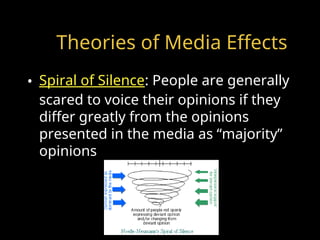
• Spiral of Silence: People are generally
scared to voice their opinions if they
differ greatly from the opinions
presented in the media as “majority”
opinions
Cultural Approaches to
Media Research
• Cultural Studies
– Textual Analysis: close reading of texts
Cultural Approaches to
Media Research
• Cultural Studies
– Textual Analysis: close reading of texts
– Audience Studies: focuses on people
who use the text
Cultural Approaches to
Media Research
• Cultural Studies
– Textual Analysis: close reading of texts
– Audience Studies: focuses on people
who use the text
– How do teenage boys watch WWF wrestling and
why?
– How do midwestern women read romance novels
and why
Cultural Approaches to
Media Research
• Cultural Studies
– Textual Analysis: close reading of texts
– Audience Studies: focuses on people who use
the text
– Political Economy: focuses on economic and
political forces that control media content
– Chris Martin
– Bettina Fabos
Cultural Approaches to
Media Research
• Cultural Studies
the cultural approach, unlike media effects
research, which is grounded in the social
sciences, “does not seek to explain human
behavior, but to understand it….It does not
attempt to predict human behavior, but to
diagnose human meanings.”
– James Carey:

Research sample only a presentation of research

  • 1.
    Research is formalizedcuriosity. It is poking and prying with a purpose. --Zora Neale Hurston, writer
  • 2.
    Media Effects & CulturalApproaches to Research
  • 3.
    Media Research • Studyingthe impact of messages transmitted by various mass media
  • 4.
    Copycat Incidents • 1966- NBC, The Doomsday Flight
  • 5.
    Copycat Incidents • 1966- NBC, The Doomsday Flight • 1985 - Judas Priest court case
  • 6.
    Copycat Incidents • 1966- NBC, The Doomsday Flight • 1985 - Judas Priest court case • 1993 - Disney movie The Program
  • 7.
    Copycat Incidents • 1966- NBC, The Doomsday Flight • 1985 - Judas Priest court case • 1993 - Disney movie The Program • 1995 - Oliver Stone’s Natural Born Killers
  • 8.
    Copycat Incidents • 1966- NBC, The Doomsday Flight • 1985 - Judas Priest court case • 1993 - Disney movie The Program • 1995 - Oliver Stone’s Natural Born Killers • 1999 - Columbine High School Shootings
  • 9.
    Copycat Incidents • 1966- NBC, The Doomsday Flight • 1985 - Judas Priest court case • 1993 - Disney movie The Program • 1995 - Oliver Stone’s Natural Born Killers • 1999 - Columbine High School Shootings • 2000 - MTV’s Jackass
  • 10.
    Key Theories inMedia Research • Hypodermic Needle Model – Leni Riefenstahl films for Hitler: • Triumph of the Will • Olympiad – Orson Welles Oct. 30, 1938 radio broadcast of War of the Worlds
  • 11.
    Key Phases inMedia Research • Minimal Effects Model - – Selective exposure – Selective retention
  • 12.
    • For somechildren, under some conditions, some television is harmful. For other children under the same conditions, or for the same children under other conditions, it may be beneficial. For most children, under most conditions, most television is probably neither particularly harmful nor particularly beneficial.
  • 13.
    Key Phases inMedia Research • Uses and Gratifications Model – Why do we use the media?
  • 14.
    Three Main Scientific Approaches 1.Experimental Research – Experimental Group – Control Group – Random Assignment
  • 15.
    Payne Research studies: 1927-1930 •13 studies, conducted over a 3-yr. period • In one study, the researchers divided the children into various control groups • Some children drank 2 cups of coffee at 8:30 • Some children were kept up until midnight and then awakened really early in the morning • Another group was made to watch movies before bedtime • The study concluded that watching movies caused just as much sleep disturbance as did drinking two cups of coffee at 8:30 p.m.
  • 16.
    • Bobo dollexperiment SOCKO!!!!
  • 17.
    Three Main Scientific Approaches 2.Survey Research – Does not control variables – Shows correlations, not causality – But, generalizable to larger population – Problems of validity of questions
  • 18.
    Three Main Scientific Approaches 3.Content Analysis – Systematically code and measure media content
  • 19.
    What counts as “violence”on television? • Is driving a sport-utility vehicle through a stream violent? • Is shooting a man before he sets off a bomb that’s about to kill 100 people violent (or is that a good deed)? • Is a parent screaming at a child violent? • Is it violence if the child screams back? • Is an accidental shooting by a police officer violent? • Is an image of a gun violent? • Is an act of nature violent?
  • 20.
    What counts as “violence”on television? • Is the context of violence important? • If there’s remorse after a violent act, or “real” consequences to violence in a certain program, does that mitigate the conception of violence? Is it possible to count acts of violence? • Can the context of violent acts on television be objectively understood, or is context more a matter of personal interpretation? • If there can be many definitions of violence, how can we decide how much violence is on our screens?
  • 21.
    Theories of MediaEffects • The Cultivation Effect: Heavy TV viewing leads individuals to perceive reality in ways that are more consistent with TV’s version of reality. – “mean world syndrome” – Italian TV: Berlusconi
  • 22.
    Theories of MediaEffects • The Cultivation Effect: Heavy TV viewing leads individuals to perceive reality in ways that are more consistent with TV’s version of reality. – “mean world syndrome” – Italian TV: Berlusconi
  • 23.
    Theories of MediaEffects • Agenda-Setting: The more the news media covers a subject, the more importance audiences attach to that subject. e.g., Earth Day, Jaws, child abduction
  • 24.
    Theories of MediaEffects • Spiral of Silence: People are generally scared to voice their opinions if they differ greatly from the opinions presented in the media as “majority” opinions
  • 25.
    Cultural Approaches to MediaResearch • Cultural Studies – Textual Analysis: close reading of texts
  • 26.
    Cultural Approaches to MediaResearch • Cultural Studies – Textual Analysis: close reading of texts – Audience Studies: focuses on people who use the text
  • 27.
    Cultural Approaches to MediaResearch • Cultural Studies – Textual Analysis: close reading of texts – Audience Studies: focuses on people who use the text – How do teenage boys watch WWF wrestling and why? – How do midwestern women read romance novels and why
  • 28.
    Cultural Approaches to MediaResearch • Cultural Studies – Textual Analysis: close reading of texts – Audience Studies: focuses on people who use the text – Political Economy: focuses on economic and political forces that control media content – Chris Martin – Bettina Fabos
  • 29.
    Cultural Approaches to MediaResearch • Cultural Studies the cultural approach, unlike media effects research, which is grounded in the social sciences, “does not seek to explain human behavior, but to understand it….It does not attempt to predict human behavior, but to diagnose human meanings.” – James Carey: