1Undergraduate Studies  ePortfolioCynthia KraftBA Psychology, 2011
Personal Statement of Cynthia Kraft
Personal Statement of Cynthia KraftSummer 2010 I spent four weeks shadowing counselors at Loma Linda University’s Genetics Clinic. My experience, and observations, fanned the flame already burning in my heart for biopsychosocial psychology.When I was young, about 12-years of age, I began a journey of personal study into the various components that “make a man whole.” I began by studying books like Mind, Character & Personality, Counsels on Diet and Foods, as well as Ministry of Healing. I also created India ink drawings of human organs that included charts on function and what foods/vitamins/minerals were required for optimum health. I was convinced that through properly meeting our basest of needs, humans didn’t have to be sick in body, mind, or spirit. It was then I saw myself at Loma Linda University completing my education.However, my mother had other plans. You see, my family-of-origin patterned itself after my mother’s side of the family, which didn’t approve of women being educated. It was expected that I would follow a more traditional role of raising a family and helping with family-of-origin traumas. When I married, my husband added working outside the home to my list of expected behaviors.
Personal Statement of Cynthia KraftWorking turned out to be a blessing. Several employers saw my capabilities and mentored me into high-level positions. This growth spurred me into breaking dysfunctional family ties and pursuing my secret desire of receiving a formal education. I took a few courses “here-n-there,” but the time for me to pursue my dreams openly had not yet come. Someday...Then, in 2008, after a long-term separation from my husband and 30 years in the corporate world, I found myself “free.” It didn’t take long for me to decide that it was time to finish my education. I’d always been interested in psychology, but because of my strong business acumen, it was suggested I go into healthcare administration. When the program was canceled during my second term, I considered it a providential redirection back into psychology. I wanted to be thoughtful and thorough in my decision so I asked myself, “What do I have to offer my field of interest”? To answer that question, I created and analyzed a list of my strengths and weaknesses. The analysis revealed a “good fit” as well as concrete, transferrable skills: writing abilities that meet objectives; analysis and interpretation of numerical data (financial); and, linear thinking that’s valuable in designingsystems, strategies, and plans.
Personal Statement of Cynthia KraftWith this skill-set in hand, I entered the world of academia as a full-time student. I have performed well in all my courses. I have been strengthened as a person and increased my adaptability. I view the journey thus far as exciting, despite detours and challenges. Without question or reserve, I’m ready to move forward with my education and to take the last steps needed for reaching my graduate degree goal.My interest in psychology includes a number of theories, therapies, and models. But my heart is most drawn to the biopsychosocial model. I was reared with a belief in the mind-body connection; and how, by choice, the greater populations are making themselves ill. I would like to focus on this model and its usefulness in the following areas of counseling and research:Genetics: The psychosocial aspects of genetics counseling for patients and families coping with genetic anomalies.
Neurogenesis: The relationship between hippocampal neurogenesis and addictive behaviors, schizophrenia, Parkinson’s and Alzheimer’s disease.
Prescription medication dependency.
Overprescribing of psychotropic medications. Are there alternatives?  Personal Statement of Cynthia KraftI will admit that I have been wooed by other graduate schools, e.g. Columbia University, but Loma Linda University is my school of choice. I’ve long desired an education from this Christian, academic institution because of our shared beliefs and mission statement. This Fall (2011), I will begin my graduate studies. The goal is to attain a MPH in Global Health/Maternal and Child Health and a Ph.D. in Health Psychology.
Resume of Cynthia KraftOBJECTIVE: Director of an international health organization COMPUTER  SKILLS: Fluent in accounting and Microsoft Office programsFINANCE SKILLS:Prepared financial support documentation for external audit that reduced audit fees to $43,000 from prior year fee of $128,000 for fully operating company.Conducted walk-through assessment and recommendation portion of SOX 404 internal audit process for a billion-dollar company.Provided full financial reporting and audit documentation for non-profitsDesigned internal reporting systems that enhanced operational efficiencies.OPERATIONAL  SKILLS:Establishment, publication and implementation of Operational Policies and Procedures, Personnel Policies, Injury and Illness Program, and Employee Handbook.Worked with all strata of personnel from CEO and Chairman of the Board to entry-level.EDUCATION: BA in Psychology, Argosy University, August 2011 EMPLOYMENT: Finance and Administration Consultant in the western U.S. since June 1997
Reflection of Cynthia KraftI came to Argosy when my program at another school was cancelled. It has been a bittersweet experience. I had hoped to have completed my undergrad studies a year ago, but… that didn’t work out. So now, I will finish with far more academic credits than needed. The good news, I guess, is the courses I had to retake, though unchallenging, were a reiteration of previous work. I feel that being a mature student, having worked for more than 30 years in upper-level management positions, and been an active life-long learner contributed to the ease of my coursework. The end product has been extensive exposure in all areas of academia with above average results.I have met some wonderful people while on this journey at Argosy. I wish all of them much success in their endeavors. I don’t know how many I will stay in contact with, but maybe a few. I’m also appreciative of the many good instructors that I’ve had and even the one-two that challenged my character. I can forgive them and move on. I hope that in their youth our exchanges became the impetus for growth rather than a stumbling block. My academic experience thus far has shown that our national education systems needs an overall. It is still functions largely after the original patterned. Today, however, the varied needs of students from other countries, re-entry students, new high school graduates, and mature students that have already worked 20+ years are not being met; we’ve been “lumped together in one pot.” Maybe it’s time a needs assessment were performed and reorganization begun.
Table of ContentsTable of ContentsResearch Skills: Self-Concept of Adolescents with NF1Cognitive Abilities and Communication Skills: Four-year Marketing Plan for Micro Imaging TechnologyEthics: Stem Cell ResearchDiversity Awareness: Asian American StudyFoundations of Psychology: 30-Minute Intake Interview with ClientApplied Psychology: Decision Making in Groups and Effective CommunicationInterpersonal Effectiveness: The Case of the Branch Davidians
Research SkillsSelf-Concept of Adolescents with NF1Cynthia KraftPSY 302: Research MethodsArgosy UniversityApril 22, 2011
Research SkillsSelf-Concept of Adolescents with NF1Introduction/Review of LiteratureNeurofibromatosis 1 (NF1) is one of the most common human birth disorders, occurring in one-in-thirty-to-thirty-five hundred births. It is found in all genders, races and ethnicities. NF1 varies in its degree of disfigurement, progression, symptoms, intensity, and life-threatening complications. Life with NF1 consists of much uncertainty and physical/psychosocial havoc. The aim, then, of counseling should be to work with patients and their families in acquiring optimal psychosocial functioning (Smith, 1986; Radtke, Sebold, Allison, Haidle, & Schneider, 2007; Rasmussen & Friedman, 2000; Terzi, Oguzkan-Balci, Anlar, Aysun, Guran, & Ayter,  2009).
Research SkillsIntroduction/Review of LiteratureMany persons diagnosed with NF1 wear psychological “masks” as a way of coping with the cosmetic burden of appearance and esteem. They are also impacted by pain and weakness, Unidentified Bright Objects (UBOs) or “NF spots,” underdeveloped language skills, and visuospatial functioning, a lower than average IQ, and poor academic achievement. (Learning disabilities are prevalent in 40-60% of cases.) An atypical psychological factor is the constant fear of a benign tumor becoming cancerous. Malignancy onset occurs earlier and more frequently (5-15% higher) in patients with NF1 when compared to the general population (Smith, 1986; Gaff & Clarke, 2007; Radtke et al., 2007).
Research SkillsIntroduction/Review of LiteratureIndividuals with NF1, especially children, are often socially impaired. Making and maintaining friendships is difficult. Ridicule and rejection by peers is common. A major psychosocial risk factor is the existence of Attention Deficit Disorder (ADD) with, and without, hyperactivity (39% incidence rate) (Barton & North, 2004; Radtke et al., 2007).
Research SkillsIntroduction/Review of LiteratureThe list of risk factors and potential risk factors in individuals with NF1 is long. Families experiencing a NF1 mutation may be overwhelmed with the information received. Unique concerns need to be addressed during psychosocial assessment and counseling. Families need to learn how to cope with everyday life that includes a varied and unpredictable future and labeling; develop communication skills; resist creating self-fulfilling prophecies; and, special needs, i.e. social situations, school, and/or work. Additional considerations are required in familial NF1 cases where both parent and child exhibit learning disabilities.
Research SkillsIntroduction/Review of LiteratureThe aim should be to provide families a sense of control, relief from anxiety, and assistance in obtaining needed interventional services (Radtke et al., 2007; Metcalfe, Plumridge, Coad, Shanks, & Gill, 2011; Plumridge, Metcalfe, Coad, & Gill, 2011).At the time B. Barton and K. North (2006) conducted their exploratory research, only two studies investigating the self-concept of children with NF1 had been conducted.  In both instances, only global self-concept was examined. At the same time, there were no previous studies investigating self-concept in children having NF1 and learning disabilities or ADHD.
Research SkillsIntroduction/Review of LiteratureThe goal was to 1) examine the self-concept of children and adolescents; 2) compare the self-concept between children with NF1, NF1 + low academic achievement, and NF1 + ADHD; and 3) examine academic self-concept in these three groups.One hundred and two individuals, aged eight to sixteen years, who satisfied diagnostic criteria, were identified and parents were contacted. Of those, forty-nine children and twenty-six adolescents participated in the study. Measures of academic achievement, intelligence, and self-concept were administered.
Research SkillsIntroduction/Review of LiteratureResults indicated that the majority of children and adolescents reported positive global self-concept, with some domain exceptions; however, general self-concept was poorer when compared to the normative mean values. There was also significantly poorer self-concept for physical abilities and mathematics. Academic achievement found no significant difference between the groups. All three reported inflated academic self-perceptions, which may be the result of positive illusory bias used as an adaptive or protective function (Barton & North, 2006).
Research SkillsIntroduction/Review of LiteratureThis research proposal will investigate the relationship between a positive self-concept and self-image anxiety in adolescents with NF1. It is hypothesized that self-concept training will moderately reduce self-image anxiety in neurofibromatosis type 1 (NF1) adolescent’s ages twelve to eighteen. It will also compare treatment effect to disease severity.
Research SkillsMethods: Research DesignThe study design will be a within-subjects design. Block randomization will be utilized to assign participants to one of four groups: two control groups and two treatment groups.  The treatment will be a computerized “brain game” design to enhance self-concept. At the beginning and end of the study, the Tennessee Self-Concept Scales (TSCS) will be administered to participants to determine overall effectiveness of self-concept therapy. The Rosenberg Self-Esteem Scales (RSES) will be administered as a pretest on a different day than the TSCS. After twelve weeks of treatment, the RSES and TSCS will again be administered on different days. Results will be analyzed using the Solomon Four-group design.
Research SkillsMethods: SampleThe target population is male and female adolescents ages twelve to eighteen that meet NF1 diagnostic criteria without central nervous system pathology. The sample will potentially include participants from children’s hospitals, genetics clinics, support groups, and a national registry. Families recognized as having NF1 will be contacted and asked to participate in the study.Inclusion criteria is age twelve to eighteen on last birthday, provision of written informed consent by both parents of minors and participants, completion of rating scales, ability to understand the English language, no custody issues, NF1 diagnosis without central nervous system pathology, and must
Research SkillsMethods: Samplemeet clinical severity of mild, moderate, or severe. Additional inclusion criteria may become apparent as the research proposal develops.Exclusion criteria is refusal to give written informed consent, refusal to complete rating scales, insufficient understanding of the English language, custody issues, intellectual delays, learning disabilities, and behavioral problems, e.g. ADHD. Each participant will be interviewed by two genetic medicine professionals and an NF1 experienced neurologist. A modified version of Riccardi’s Severity Scale (1999) will be employed to rate disease severity: mild, moderate, or severe (Barton & North, 2006).
Research SkillsMethods: MeasuresThere are three instruments to be used in this research: 1) a questionnaire to collect participant demographics; 2) the Rosenberg Self-Esteem Scales (RSES); and, the Tennessee Self-concept Scales (TSCS).The RSES is a widely-used self-esteem measure that includes ten self-descriptive items portraying how an individual feels about him or herself. It uses the Likert scale with items answered on a four-point scale.
Research SkillsMethods: MeasuresThe scoring is strongly disagree (SA = 3); agree (A = 2), disagree (D = 1), and strongly disagree (SD = 0). Items with an asterisk are reverse scored, that is strongly disagree (SA = 0); agree (A = 1), disagree (D = 2), and strongly disagree (SD = 3). The scale may be used for educational and research purposes without explicit permission (Rosenberg, 1965).
Research SkillsMethods: MeasuresThe TSCS includes one hundred self-descriptive items that portray what an individual likes, does, and feels. It is intended to summarize a person’s feelings of self worth, the degree to which the self-image is realistic, and whether or not that self-image is a deviant one. It provides overall assessment of self-esteem in five external and three internal self-concept elements and self criticism. The eight self-concept elements are: 1) Physical, 2) Moral and Ethics, 3) Personal, 4) Family, 5) Social, 6) Identity, 7) Satisfaction, and 8) Behavior (Jamaludin, Ahmad, Yusof, & Abdullah, 2009).
Research SkillsMethods: MeasuresEvery element will be measured according to item quantity involved. There are ninety items to be measured in the eight elements, half of which are positive and half that are negative. The ten remaining items are for measuring self critic and are all positive. Item totals are:  Physical Self (18 items); Moral and Ethics Self (18 items); Personal Self (18 items); Family Self (18 items); Social Self (18 items); Identity Self (30 items); Satisfaction Self (30 items); and, Behavior Self (30 items). The Tennessee Self-concept Scale instrument uses the Likert scale with items answered on a five-point scale. The scoring is very true (VT = 5); true (T = 4), unsure (U = 3), not true (NT = 2), and not true at all (NTA = 1) (Jamaludin et al., 2009).
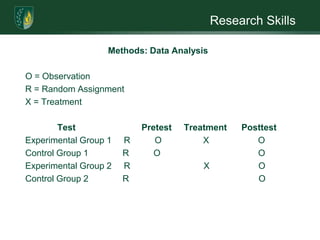
Research SkillsMethods: Data AnalysisPretest and Posttest data will be collected using the Rosenberg Self-Esteem Scales and Tennessee Self-concept Scales. The statistical analysis for the Solomon Four-group design will include converting posttest data to a 2 x 2 factorial design and use analysis of variance (ANOVA) to provide estimates of treatment effect, pretest effect, and interaction of pretest and treatment. In addition to testing the basic pretest-treatment-posttest, three additional tests will be conducted: 1) without treatment, 2) without pretest, and 3) without either pretest or treatment. In design notation, the procedure is as follows:
Research SkillsMethods: Data AnalysisO = ObservationR = Random AssignmentX = TreatmentTest                           Pretest     Treatment      PosttestExperimental Group 1     R          O                 X                    OControl Group 1              R          O                                        OExperimental Group 2     R                              X                    OControl Group 2              R                                                     O
Research SkillsMethods: Data AnalysisA significant difference between treatment means will indicate the treatment was effective. “If main and interactive effects of pretesting are negligible” (van Engelenburg, 1999, p. 3) analysis of covariance will be performed to determine effect of treatment. After overall effect is determined, participant data will be regrouping according to disease severity and the process repeated.
Research SkillsMethods: EthicsThe greatest ethical issues that might be encountered relate to Health Insurance Portability and Accountability (HIPAA) compliance and custody issues. Potential custody issues, e.g.  single/dual custody,  will be identified in advance and are included in the exclusion criteria. Additional ethical considerations for this study and how they will be handled are:
Research SkillsMethods: EthicsConfidentialityPrivacy measures, including numerical coding of participants, will be incorporated into the study to assure HIPAA compliance and confidentiality.  Study records will not be identifiable.
Research SkillsMethods: EthicsInformed ConsentParents of minors and potential participants will be contacted and full disclosure of the study communicated. Every effort will be made to verify that all parties have adequate comprehension, including all written documentation prepared at sixth grade reading level, to make an informed choice and understand their freedom of choice. If they are willing to participate in the study, informed consent forms will be provided to gather written confirmation of choice. It will also be made known to all parties that they are free to withdraw from the study at any time.
Research SkillsMethods: EthicsBenefits and Risks Potential benefits for the participants include: an educational experience, treatment, a questions and answers session at the conclusion of treatment, free disease rating, and referral(s) for follow-up care. Potential risks are considered to be minimal and might include emotional, mental, or physical distress during lengthy pretesting and/or treatment. Participants might also fear being negatively “labeled” by family and friends for participating in the study.
Research SkillsResults and Discussion
Research SkillsResults and DiscussionResults are presented for the relationship between a positive self-concept and self-image anxiety in adolescents with NF1 and the relationship between treatment effect and disease severity. The null hypothesis that “twelve sessions of self-concept training will not significantly change self-image anxiety in neurofibromatosis type 1 (NF1) adolescents ages twelve to eighteen” is expected to be rejected. The second null hypothesis that “there will not be a difference between treatment effect and disease severity” will also be rejected. It is anticipated that a moderate reduction in self-image anxiety will be found in the most severe cases of NF1 and wane as severity is reduced.
Research SkillsResults and DiscussionThe Solomon Four-group design involved random assignment of subjects to two treatment groups and two control groups (Braver & Braver, 1988; van Engelenburg, 1999). Statistical analysis is expected to reject the null hypothesis. Self-concept therapy is expected to improve the self-concept of adolescents with NF1. There are no other known studies to compare these findings against; but, in comparison to other genetic conditions that manifest similar symptoms, the findings support related studies and current thinking on the topic (Barton & North, 2006; Radtke et al., 2007; Slifer, Beck, Amari, Diver, Hilley, Kane & McDonnell, 2003; Mann, Hosman, Schaalma, & de Vries, 2004; Butler & Gasson, 2005; Van Tongerloo & De Paepe, 1998).
Research SkillsResults and DiscussionThe primary advantage of the Solomon Four-group design is its ability to show whether changes in the dependent variable are due to some interaction effect between the pretest and the treatment. Most internal threats to validity (e.g. history; maturation; priming, learning, and reactive effects) can be controlled as well as measured. Because this study is evaluating treatment effectiveness for a specific population, external threats to validity are a reduced concern. Those that might exist (e.g. interaction factors) could be measured and controlled in the same manner as the internal threats to validity.
Research SkillsResults and DiscussionTwo control groups serve to reduce the influence of confounding variables; and, various combinations of the tested and untested groups ensure that confounding and extraneous variables don’t influence results. There is sufficient statistical power; and, results are easy to generalize. The chief flaws in this design are the expense of administration, time commitment involved, and statistical complexities (Braver & Braver, 1988; van Engelenburg, 1999).
Research SkillsResults and DiscussionExpected results are: overall and severe rating treatment effect significant with moderate change, significant with minimal change for moderate rating and insignificant with no change for mild rating. The findings of this study can be applied to the target application. The dependent variable, self-concept, in the target population, adolescents with NF1, should be given more attention. Determining which treatments are the most effective will improve the psychosocial well-being of these individuals; and, the information collected could apply to other genetically-impaired populations.
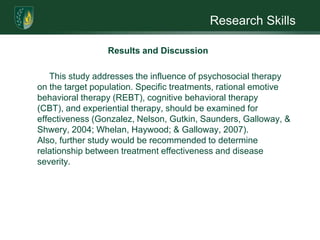
Research SkillsResults and DiscussionThis study addresses the influence of psychosocial therapy on the target population. Specific treatments, rational emotive behavioral therapy (REBT), cognitive behavioral therapy (CBT), and experiential therapy, should be examined for effectiveness (Gonzalez, Nelson, Gutkin, Saunders, Galloway, & Shwery, 2004; Whelan, Haywood; & Galloway, 2007). Also, further study would be recommended to determine relationship between treatment effectiveness and disease severity.
Research SkillsReferencesBarton, B. & North, K. (2004). Social skills of children with neurofibromatosis type 1 [Abstract]. Developmental medicine and child neurology, 46(8), 553-563.Barton, B. & North, K. (2006). The self-concept of children and adolescents with neurofibromatosis type 1. Child: care, health and development, 33(4), 401-408.Braver, M. C. W. & Braver, S. L. (1988). Statistical treatment of the solomon four-group design: a meta-analytic approach. American psychological association: Psychological bulletin, 104(1), 150-154.
Research SkillsReferencesButler, R. J. & Gasson, S. L. (2005). Self esteem/self-concept scales for children and adolescents: A review. Child and adolescent mental health, 10(4), 190-201.Fitts, W. H. (1965). Tennessee self-concept scale. Los Angeles, CA: Western Psychological Services.Gaff, C. L. & Clarke, A. (2007). Stigmatization, culture and counseling a commentary on growing up and living with NF1: A UK-Bangladeshi case study – by SantiRozario [Abstract]. Journal of Genetic Counseling, 16(5), 561-565.
Research SkillsReferencesGonzalez, J. E., Nelson, J. R., Gutkin, T. B., Saunders, A., Galloway, A. & Shwery, C. S. (2004). Rational emotive therapy with children and adolescents: A meta-analysis. Journal of emotional and behavioral disorders, 12(4), 222-235.Jamaludin, H. J., Ahmad, H. J., Yusof, R. & Abdullah, S. K. (2009). The reliability and validity of tennessee self-concept scale (tscs) instrument on residents of drug rehabilitation center. European journal of social sciences, 10(3), 349-363.Mann, M., Hosman, C. M. H., Schaalma, H. P., & de Vries, N. K. (2004). Self-esteem in a broad-spectrum approach for mental health promotion. Health education research, 19(4), 357-372.
Research SkillsReferencesMetcalf, A., Plumridge, G., Coad, J. Shanks, A. & Gill, P. (2011). Parents’ and children’s communication about genetic risk: a qualitative study, learning from families’ experiences [Abstract].European Journal of Human Genetics.doi: 10.1038/ejhg.2010.258 Plumridge, G. Metcalfe, A. Coad, J. & Gill, P. (2011). The role of support groups in facilitating families in coping with a genetic condition and in discussion of genetic risk information [Abstract]. Health Expectations. doi: 10.1111/j.1369-7625.2011.00663.x
Research SkillsReferencesRadtke, H. B., Sebold, C. D., Allison, C., Haidle, J. L., & Schneider, G. (2007). Neurofibromatosis type 1 in genetic counseling practice: recommendations of the national society of genetic counselors. Journal of Genetic Counseling, 16(4), 387-407. Rasmussen, S. A. & Friedman, J. M. (2000). NF1 gene and neurofibromatosis 1. American Journal of Epidemiology, 151(1), 33-40.Rosenberg, M. (1965). Society and the adolescent self-image. Princeton, NJ: Princeton University Press.
Research SkillsReferencesSlifer, K. J., Beck, M., Amari, A., Diver, T., Hilley, L. Kane, A. & McDonnell, S. (2003). Self-concept and satisfaction with physical appearance in youth with and without oral clefts. Children’s health care, 32(2), 81-101.Smith, M. R. (1986). Neurofibromatosis: Relinquishing the masks; a quest for quality of life [Abstract]. Journal of Advanced Nursing, 11(4), 459-464.Terzi, Y. K., Oguzkan-Balci, S., Anlar, B., Aysun, S., Guran, S. & Ayter, S. (2009). Reproductive decisions after prenatal diagnosis in neurofibromatosis type 1: Importance of genetic counseling [Abstract]. Genetic Counseling, 20(2), 195-202.
Research SkillsReferencesVan Engelenburg, G. (1999). Statistical analysis for the Solomon four-group design. (Research Report 99-06). Twente University, Enschede (Netherlands). Van Tongerloo, A. & De Paepe, A. (1998). Psychosocial adaptation in adolescents and young adults with marfan syndrome: An exploratory study. Journal of medical genetics, 35, 405-409.Whelan, A., Haywood, P. & Galloway, S. (2007). Low self-esteem: Group cognitive behavior therapy. British journal of learning disabilities, 35, 125-130.
Cognitive Abilities and Communication SkillsFour-Year Marketing Plan for Micro Imaging Technology (MIT)Cynthia KraftHADM 359: MarketingLoma Linda UniversityMarch 2009
Cognitive Abilities and Communication SkillsFOUR-YEAR MARKETING PLANMARCH 2009 Mico Imaging Technology970 CalleAmanecer Ste. FSan Clemente, CA 92673(949) 485-6001  The information contained herein is for information purposes only and is not to be copied or distributed to others. This is not an official document from the company.   
Cognitive Abilities and Communication SkillsExecutive SummaryThe purpose of this marketing plan is to increase awareness of Micro Imaging Technology, Inc. (OTC BB “MMTC”), its product, and generate working capital. This report will:Provide an overview of the company and its history
Explain the MIT 1000 System and its need in the marketplace
Summarize intended markets and the plan for reaching these markets
Summarize where the company is at in terms of product production
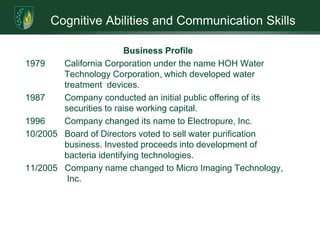
Identify the “keys to success” and “critical issues” facing the companyCognitive Abilities and Communication SkillsBusiness ProfileCurrently Micro Imaging Technology, Inc. (“MIT”) is a research and development organization. The desire is to be an international leader in the development, support, and marketing of rapid pathogenic testing. The time-line and emergence of MIT is as follows:
Cognitive Abilities and Communication SkillsBusiness Profile1979        California Corporation under the name HOH Water 	   	   Technology Corporation, which developed water 	 	   treatment  devices.1987 	   Company conducted an initial public offering of its 	       	   securities to raise working capital.1996	   Company changed its name to Electropure, Inc.10/2005   Board of Directors voted to sell water purification 	 	   business. Invested proceeds into development of 	 	   bacteria identifying technologies.11/2005   Company name changed to Micro Imaging Technology,	    Inc.
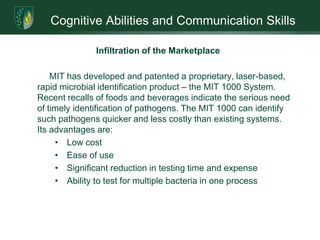
Cognitive Abilities and Communication SkillsInfiltration of the MarketplaceMIT has developed and patented a proprietary, laser-based, rapid microbial identification product – the MIT 1000 System. Recent recalls of foods and beverages indicate the serious need of timely identification of pathogens. The MIT 1000 can identify such pathogens quicker and less costly than existing systems. Its advantages are: Low cost
Ease of use
Significant reduction in testing time and expense
Ability to test for multiple bacteria in one process 
Cognitive Abilities and Communication SkillsInfiltration of the MarketplaceThe company’s goal is to complete certification processing and start placing equipment. Though multiple industries would benefit from the product, initial introduction has been narrowed to two markets: food quality control and clinical diagnostics. Multiple channels have been identified to assist in product delivery. The critical issue facing plan implementation is lack of working capital
Cognitive Abilities and Communication SkillsIntroductionMicro Imaging Technology, Inc. (“MIT”) has developed and patented a proprietary, laser-based, rapid microbial identification System. The accuracy and speed of this product are its winning attributes. The MIT 1000 System has the potential to revolutionize the $5 billion pathogenic test market. By identifying microbes in minutes, not days, significant cost per-test savings occurs. When compared to conventional methods, this savings can translate into thousands of lives and tens of millions of dollars.  
Cognitive Abilities and Communication SkillsIntroductionRevenues for rapid testing methods have expanded at an annual rate of 9.2 percent since 1998 with current growth projections for 30 percent – test demands are being driven by major health, safety and homeland security issues.
Cognitive Abilities and Communication SkillsIntroductionThe Company’s entrance into the pathogenic identification sector is timely.  There is an increasing demand, domestically and internationally, for safe food and water. Early detection and identification of pollutants and microorganisms will provide opportunities to address potential problems before they become serious. Recent episodes with contaminated peanut products, spinach, lettuce and meat, create a large and growing marketplace for pathogen detection. Current detection standards are costly and inefficient; yet, in growing demand. After 10 years in research and development, the MIT 1000 System is ready to enter, and lead, the marketplace.
Cognitive Abilities and Communication SkillsMission and GoalsIt is the mission of Micro Imaging Technology to be a profitable entity that meets the ever-growing needs of the bacteria test market. The Company intends to form credible, long-term relationships with all industry participants and make every effort at reaching the strategic goals and objectives of the Company. It is the Company’s aim to create an image that portrays a professional, trustworthy, accurate, and timely demeanor.
Cognitive Abilities and Communication SkillsMission and Goals: Strategic Marketing GoalsThe Company’s primary objective is to become the international leader in laser-based, rapid microbial identification systems. For the next four years, the focus is to achieve market acceptance through demonstrated system performance, independent validations, industry exhibitions and referrals. Three specific marketing goals are:Introduce the MIT 1000 System to the marketplace (See Target Market tables)
Develop and support product engineering
Develop supplier relationships for consumable productsCognitive Abilities and Communication SkillsMission and Goals: Strategic Sales GoalsSales efforts will be modest. Short-term goals are:Ten (10) end-user sales
Seventeen (17) optical systems sold to distributors and OEMs
Two (2) fully-executed licensing agreementsLong-term goals will increase at a proportionate rate after data for the first two-years has been collected and analyzed.
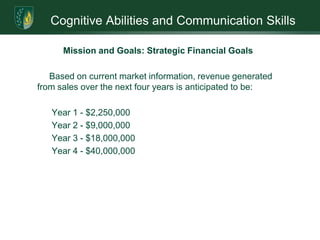
Cognitive Abilities and Communication SkillsMission and Goals: Strategic Financial GoalsBased on current market information, revenue generated from sales over the next four years is anticipated to be:Year 1 - $2,250,000Year 2 - $9,000,000Year 3 - $18,000,000Year 4 - $40,000,000
Cognitive Abilities and Communication SkillsMission and Goals: Strategic Financial GoalsFinancial goals are to provide funding for continued product development and introduce the MIT 1000 System into the marketplace. Tasks supporting this goal are:Select a long-term Investment Banking Partner
Define capital requirements and funding structure
Produce timely SEC and NASDAQ filings
Review all licensing and OEM negotiations and contracts
Provide quarterly financial information, budget and variances to the Board of DirectorsCognitive Abilities and Communication SkillsCore CompetenciesMicro Imaging Technology seeks to use its MIT 1000 System as its core competency. The advantage over competitive products is significant. The value to all industries requiring pathogenic testing is immeasurable; the cost and time savings over current methods measurable. Marketing efforts will be built around the following core features and benefits of the System:
Cognitive Abilities and Communication SkillsCore CompetenciesLaser-driven and optically-based microbial identification
Totally GREEN
Test preparation time faster than conventional test methods
Only required additive - clean water
Ability to identify 23 different species of bacteria without the use of chemicals, reagents, dyes or DNA processingCognitive Abilities and Communication SkillsCore CompetenciesAdditional microbes can be added to database: protozoa, fungi, and molds
Does not require user to have preconceived species knowledge prior to testing
Material test cost of less than $0.10 compared with typical competitive systems’ costs of $6.00 or greater
Capital investment 20% less than competitive systems Cognitive Abilities and Communication SkillsCore CompetenciesBy forming solid, credible relationships with the US Food Safety and Inspection Service (“FSIS”); Food and Drug Administration (“FDA”); testing laboratories; and, industry participants, MIT believes that it will be able to enter the marketplace with a leading edge over competition.
Cognitive Abilities and Communication SkillsSituation AnalysisMIT's entrance into the pathogenic identification sector is timely. There is an increasing demand, both domestically and internationally, for safe food and water. During 2007 approximately 76 million cases of food borne illnesses, resulting in 325,000 hospitalizations and 5,000 deaths were estimated to have occurred. During that same period there were increased cases of E. coli, Listeria and Salmonella food contaminations – causing the recall of more than 55 million pounds of processed meat and numerous shipments of lettuce, spinach, pepper and tomatoes. 
Cognitive Abilities and Communication SkillsSituation AnalysisMost recently (January 2009) is the recall of products containing peanut butter and/or peanut paste due to Salmonella contamination. More than 70 companies are involved with the recall which includes products such as: cookies, crackers, cereal, candy, ice cream, and some pet products. Since the recall and investigation are currently in progress, the full impact in dollars is yet unknown.Increased consumer awareness of recent infections and recalls has increased the pressure for companies and federal agencies to place more pathogen detection controls in place.
Cognitive Abilities and Communication SkillsSituation AnalysisFood and liquids are not the only products where bacterial infections can be contracted. According to the National Health and Nutrition Examination Survey, during the last few years Methicillin Resistant Staphylococcus aureus (MRSA) has become a hospital’s worst nightmare. Over 43 percent of all skin infections in the US are the result of MRSA and roughly 28 percent of the population is infected. In November 2007 the US Center for Disease Control (CDC) reported that in 2005 over 278,000 people were diagnosed and hospitalized for MRSA-related infections. CDC further reported that MRSA events are increasing from a rate of 22 percent in 1995 to a current rate of
Cognitive Abilities and Communication SkillsSituation Analysis64 percent and during 2007 invasive infections occurred in over 94,000 instances resulting in 19,000 deaths. MRSA screening of every new hospital patient is desired, but the cost and time is prohibitive – the MIT 1000 System provides a viable solution.Current microbe detection standards are costly, inefficient and unable to keep pace with the growing demand. Features and benefits of the MIT System counter these more costly methods with greater time/cost efficiency. The marketplace appears to be receptive to an alternative that supports early detection and easy communication.
Cognitive Abilities and Communication SkillsSWOT AnalysisThe SWOT analysis addresses the strengths and weakness within Micro Imaging Technology and the opportunities and threats that exist in its environment. Specific areas of leverage and internal/external improvement are identified:
Cognitive Abilities and Communication SkillsSWOT Analysis: StrengthsPatented technology with proprietary database – the MIT MICROBE LIBRARY
Science Advisors that include Nobel Prize-winning chemist, Kary Mullis, PhD
Strong executive management team
AOAC certification requires equipment accuracy at 90+%. Testing results by USDA: 90% on 275 tests; 98% on tests performed by North American Science Associates, Inc.Cognitive Abilities and Communication SkillsSWOT Analysis: StrengthsCertification of the MIT System’s test methodology by the Association of Analytical Communities
MIT 1000 System selected Finalist for Adaptive Business Leader’s 2008 Annual Innovations in Healthcare Award (2 of 90) 
Nine (9) distribution agreementsCognitive Abilities and Communication SkillsSWOT Analysis: WeaknessesNo cash-flow
Constantly seeking working capital to execute business plan
Single core activity
Competitors generating cash flow from product
Absence of distribution networks, whereas competitors have established contacts/networks
No manufacturing or product service experience
Education of marketplaceCognitive Abilities and Communication SkillsSWOT Analysis: OpportunitiesRecent recall of Kellogg products for salmonella indicates a high need for a more efficient detection system
Niche market
A MIT 1000 System installed at Pacific Coast Analytical Services
Cargill, Inc., one of the world’s largest suppliers of food products, has implied interest in the acquisition of MIT 1000 System upon receipt of AOAC certification.
European Partnership Agreement
International distribution networkCognitive Abilities and Communication SkillsSWOT Analysis: ThreatsCompetitors more established in marketplace
Stock market volatility
Legislative restrictions
Potential USDA requirementsCognitive Abilities and Communication SkillsCompetitors in the Pathogenic Test MarketThe like-systems against which the MIT 1000 System competes include:Enterotube II
Singlepath
Vitek      System
Real-Time PCR
MIDI GCSCognitive Abilities and Communication SkillsThe Target MarketThe applications for MIT's System are myriad; therefore, the Company has elected to focus it’s initial efforts on end-user systems for food inspection and clinical diagnostic applications. The Company, in parallel, will market systems and components to established OEMs, distributors and manufacturers of conventional microbial solutions
Cognitive Abilities and Communication SkillsThe Target Market: Food Quality Control In 1997, the Federal Government announced the Food Safety Initiative to reduce the incidence of food borne illnesses. To satisfy this initiative, both the FSIS and FDA implemented the Hazard Analysis and Critical Control Point (“HACCP”) system that requires processing facilities to identify points where contamination is likely to occur and put in place appropriate process controls to prevent contamination.About 8,000 FSIS employees are responsible for inspecting 8 billion poultry, 130 million head of livestock and 2.1 million pounds of egg liquid annually. Only a small fraction of products are actually inspected for bacteria.
Cognitive Abilities and Communication SkillsThe Target Market: Food Quality Control The FDA currently requires lengthy and elaborate laboratory procedures to identify the presence of E.coli, Salmonella, or Listeria in butchered meats. By the time bacteria is confirmed, the meat could have been processed, shipped, sold, and consumed. Throughout the food and drink industry, quality control laboratories are facing increasing pressure to cut turnaround times on microbiological testing. Companies continue to strive at reducing production cycle times and inventories, to implement just-in-time manufacturing processes and minimize the risk/ cost associated with potential in-process contamination and product recalls, which are expensive. 
Cognitive Abilities and Communication SkillsThe Target Market: Food Quality ControlThe capabilities of the MIT 1000 System will significantly reduce health risks to the consumer; and reduce the dangers and expenses associated with product recalls.
Cognitive Abilities and Communication SkillsThe Target Market: Clinical DiagnosticsThe health industry is in need of a timely, accurate, and cost effective means to diagnose disease-causing bacteria. Bacterial meningitis provides one example of the need. Bacterial meningitis can be quite severe and may result in brain damage, hearing loss, or learning disability. Nearly one-third of all the known cases in the US every year have fatal or debilitating effects on the victims. Bacterial meningitis initially manifests itself with flu-like symptoms causing infected individuals typically to take a wait-and-see attitude. However, having as few as two of the symptoms of bacterial meningitis is considered an extreme emergency. This disease can move quickly, sometimes
Cognitive Abilities and Communication SkillsThe Target Market: Clinical Diagnosticskilling in a matter of hours. Consequently, once bacterial meningitis is suspected or diagnosed, heavy doses of broad-spectrum antibiotics are used for treatment, even though this may not be very effective on the species eventually diagnosed.Today, it takes two to three days to identify the bacterial species causing meningitis. In addition, laboratory technicians must simultaneously check for all bacterial species known to cause the disease, which requires further labor-intensive procedures and expensive equipment. The cost for each test is estimated to be about $600. The MIT System will identify the bacteria species in minutes after the delivery of a sample and at a substantially lower cost.
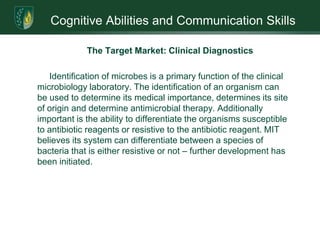
Cognitive Abilities and Communication SkillsThe Target Market: Clinical DiagnosticsIdentification of microbes is a primary function of the clinical microbiology laboratory. The identification of an organism can be used to determine its medical importance, determines its site of origin and determine antimicrobial therapy. Additionally important is the ability to differentiate the organisms susceptible to antibiotic reagents or resistive to the antibiotic reagent. MIT believes its system can differentiate between a species of bacteria that is either resistive or not – further development has been initiated.
Cognitive Abilities and Communication SkillsThe Target Market: Clinical DiagnosticsThe marketplace for Micro Imaging Technology’s product include: food quality control, clinical diagnostics, pharmaceutical quality assurance, semiconductor processing control, and water quality monitoring.  Initial sales and marketing efforts are centered on: Food Quality Control – monitoring the quality of any food product; and Clinical Diagnostics – providing more affordable and timely health care. These target applications represent $3 billion of the total rapid ID test market, requiring over one billion tests annually at approximately 200,000 facilities.
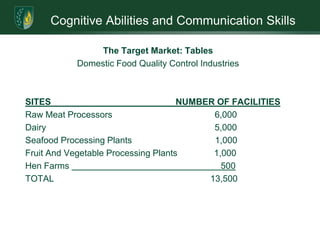
Cognitive Abilities and Communication SkillsThe Target Market: TablesDomestic Food Quality Control Industries SITES                                                   NUMBER OF FACILITIESRaw Meat Processors                                          6,000Dairy                                                                     5,000Seafood Processing Plants                                  1,000Fruit And Vegetable Processing Plants               1,000Hen Farms                                                              500TOTAL                                                                13,500
Cognitive Abilities and Communication SkillsThe Target Market: TablesDomestic Clinical Diagnostic Market SITES                                                       NUMBER OF FACILITIESClinical Laboratories                                                16,000Nursing Facilities                                                     15,000Home Health Agencies                                            11,000Hospital Laboratories                                                 6,000Rural Health Clinics                                                   4,000Total                                                                         52,000
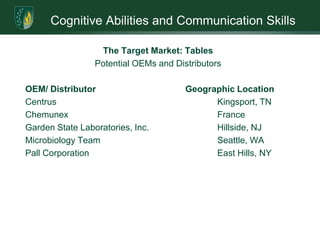
Cognitive Abilities and Communication SkillsThe Target Market: TablesPotential OEMs and Distributors OEM/ Distributor 			Geographic LocationCentrus						Kingsport, TNChemunex					FranceGarden State Laboratories, Inc.			Hillside, NJMicrobiology Team 				Seattle, WAPall Corporation					East Hills, NY
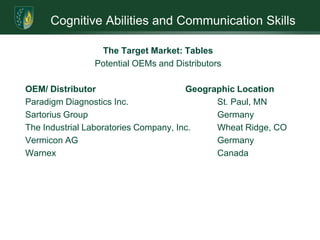
Cognitive Abilities and Communication SkillsThe Target Market: TablesPotential OEMs and Distributors OEM/ Distributor 			Geographic LocationParadigm Diagnostics Inc.			St. Paul, MNSartorius Group					GermanyThe Industrial Laboratories Company, Inc. 	Wheat Ridge, COVermicon AG 					GermanyWarnex 					Canada
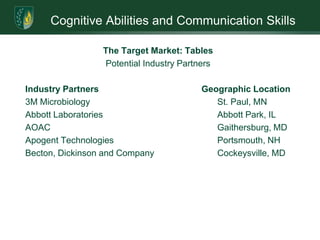
Cognitive Abilities and Communication SkillsThe Target Market: TablesPotential Industry PartnersIndustry Partners                                          Geographic Location3M Microbiology 				St. Paul, MNAbbott Laboratories 				Abbott Park, ILAOAC 						Gaithersburg, MDApogent Technologies 				Portsmouth, NHBecton, Dickinson and Company 		Cockeysville, MD
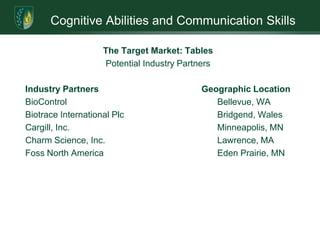
Cognitive Abilities and Communication SkillsThe Target Market: TablesPotential Industry PartnersIndustry Partners                                          Geographic LocationBioControl 					Bellevue, WABiotrace International Plc 			Bridgend, WalesCargill, Inc. 					Minneapolis, MNCharm Science, Inc. 				Lawrence, MAFoss North America 				Eden Prairie, MN
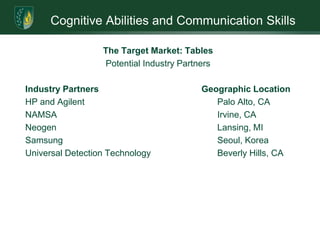
Cognitive Abilities and Communication SkillsThe Target Market: TablesPotential Industry PartnersIndustry Partners                                          Geographic LocationHP and Agilent 					Palo Alto, CANAMSA 					Irvine, CANeogen 					Lansing, MISamsung 					Seoul, KoreaUniversal Detection Technology 		Beverly Hills, CA
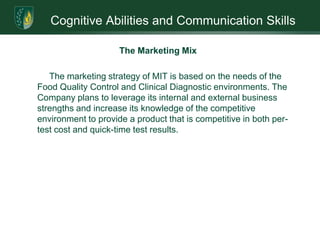
Cognitive Abilities and Communication SkillsThe Marketing MixThe marketing strategy of MIT is based on the needs of the Food Quality Control and Clinical Diagnostic environments. The Company plans to leverage its internal and external business strengths and increase its knowledge of the competitive environment to provide a product that is competitive in both per-test cost and quick-time test results.
Cognitive Abilities and Communication SkillsThe Marketing Mix: Product StrategyThe process of obtaining certifications and endorsements for pathogenic identification equipment is arduous, making product lines slow to develop.  MIT currently offers one product, the MIT 1000 System.  The Company’s technical focus in the near-term will be perfecting bacteria colony identification. At the same time, the Company will be cognizant of other opportunities and directions that would enhance products and services.
Cognitive Abilities and Communication SkillsThe Marketing Mix: Distribution StrategyMIT’s evolving marketing channel is a combination of direct sales efforts and independent Distributors and Manufacturer’s Representatives that are established in the target markets. The Company is establishing an international network of distributors and currently has nine (9) signed distribution agreements. This will eventually be augmented by the establishment of subsidiaries or partnerships in Europe and Asia. The Company is in meaningful discussion with five large companies with leadership positions in both market segments.
Cognitive Abilities and Communication SkillsThe Marketing Mix: Promotion StrategyMIT is a new participant in a well established, conservative and somewhat regulated market that is served by larger organizations, with market acceptance and access to larger resources. A major objective is to create MIT identity recognition, while introducing its new technology. Near term tasks include:
Cognitive Abilities and Communication SkillsThe Marketing Mix: Promotion StrategyPerformance validation through placement of systems in highly visible validation agencies and testing laboratories
Research and document sales and market strategies from competitive suppliers of rapid microbe identifying systems
Contact relevant industry participants and research organizations
Contact potential OEM customers and industry partnersCognitive Abilities and Communication SkillsThe Marketing Mix: Promotion StrategyCreate opportunities with collaborative partners; universities, manufacturers, industry participants, research laboratories, etc.
Develop marketing and sales tools, including expanded web site presentations.
Participate in industry, product and technical presentations and affiliationsCognitive Abilities and Communication SkillsThe Marketing Mix: Pricing StrategyRevenues will come from the sale of a complete system: training (laboratory and systems procedures), consumables, and annual software/ support fees.  Products will be priced competitively while focusing on initial market penetration.
Cognitive Abilities and Communication SkillsThe Marketing Mix: Sales Strategy and ForecastThe sales strategy will focus on direct sales to suppliers and users of pathogenic testing systems and development of distributor agreements. The MIT 1000 has a significant recurring revenue component with annual growth projected to at least 30% of total sales. Revenue will be derived from:
Cognitive Abilities and Communication SkillsThe Marketing Mix: Sales Strategy and ForecastCustom software packages (additional microbe identifiers and custom libraries), training and upgrades
Software licensing and distribution fees
Software and hardware service and support agreements
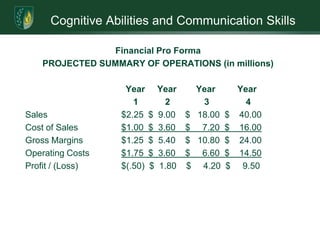
Consumables – 1) reusable and disposable testing vials; 2) water purification systems, 3) calibration and diagnostic packages, and 4) specimen preparation kits, including culture mediaCognitive Abilities and Communication SkillsFinancial Pro FormaThe focus of this marketing plan is to initiate action that will generate revenues for Micro Imaging Technology and better position the Company for the future. The market challenges that currently exist are that the Company is undercapitalized and the product is still in test certification process. A current Pro Forma Statement of Operations follows; line items for marketing and promotion have not yet been determined.
Cognitive Abilities and Communication SkillsFinancial Pro FormaPROJECTED SUMMARY OF OPERATIONS (in millions) 		                            Year     YearYearYear			                  1           2              3               4Sales 			$2.25  $  9.00    $   18.00  $    40.00 Cost of Sales		$1.00  $  3.60    $     7.20  $    16.00 Gross Margins		$1.25  $  5.40    $   10.80  $    24.00 Operating Costs	$1.75  $  3.60    $     6.60  $    14.50Profit / (Loss)		$(.50)  $  1.80    $     4.20  $     9.50
Cognitive Abilities and Communication SkillsMonitoringThe Company will track plan vs. actual results for each program. Status and progress will be addressed and reported to management each month. Management will hold monthly meetings to review progress and determine future steps. This topic will be included in year-end discussions and included in annual reports. Results of the program will determine marketing plans for the upcoming year. Adjustments will be made based on results from the previous year.
Cognitive Abilities and Communication SkillsMarketing LeadershipJohn Ricardi, VP of Business Development, will head marketing efforts and be responsible for overseeing the company’s marketing activities.  Everyone recognizes the challenges ahead, but have complete confidence in John’s talents and abilities.
Cognitive Abilities and Communication SkillsContingency PlanningThese are the most likely possible changes in the marketing plan:Industry downturn – Currently, the need for MIT’s product in the industry is great. A futuristic view sees nothing but growth and increased demand. In the event of an unforeseen downturn, the company would re-examine its selection of target markets and consider a change in direction, or other relevant alternatives.
Lack of key personnel – Losing key individuals in the company could have major ramifications, especially those individuals directly involved with product research and development. A contingency plan to bridge any potential personnel gaps needs to be developed.Cognitive Abilities and Communication SkillsContingency PlanningCompetition – Competition could emerge. Timing is crucial to the Company’s success.
Inadequate funding – Transitioning from a R&D-focused company to an outsource/service-based company with revenue streams is the aim. Inadequate funding could significantly impact both the window of opportunity and viability of the transition. Contingency plans for generating capital are continually being developed and in progress.Cognitive Abilities and Communication SkillsKeys to SuccessThe “Keys to Success” for Micro Imaging Technology include:Excellence in delivering product and support service
Leverage of opportunities
Attracting and retaining key partners and distributors
Continued product development
Public Relations and Marketing programs that develop and retain visibilityCognitive Abilities and Communication SkillsCritical IssuesThough the company has been operational for several years, the fact that it has focused on research and development without a revenue stream has been costly. Visibility is low. The potential outcome of testing certification is critical to bringing the product to market. Additional critical issues include:Acquisition of capital
Acquiring and retaining partnerships and distributors
Leveraging opportunities when there is a weak financial baseEthicsStem Cell ResearchCynthia KraftRELE 457: EthicsLoma Linda UniversityMay 8, 2009
EthicsStem Cell ResearchStem cell research is invaluable to the treatment and maintenance of many diseases and cognitive disorders, including, but not limited to: diabetes, different cancers, Parkinson’s disease, Alzheimer’s disease, and brain injury. For these reasons, I am a strong proponent of adult stem cell research, proponent of restricted embryonic stem cell research, an opponent of stem cell research focused on human cloning.
EthicsStem Cell ResearchEmbryonic stem cells are a “hot” political topic; as a result, researchers are developing ways to work with other stem cells. For example, in 2008, Harvard Stem Cell Institute (HSCI) announced that a team of its scientists had manipulated skin cells into becoming nerve cells (Associated Press (AP), 2008, para. 8). In March of this year, scientists from Canada and Britain were able to transform adult skin cells into stem cells using a method that is less apt to be rejected by the immune system (Reals, 2009, para. 2, 5). In addition, adult stem cells are recognized to replace blood cells in bone marrow transplant patients (Phillips, 2009, p. 2).
EthicsStem Cell ResearchStem cell research is not limited to those with existing illnesses and diseases. Research is also addressing how to inhibit or arrest the onset of age-related illnesses and genetic disorders. Scientists at HSCI have begun watching manufactured stem cells develop into specific diseases in a cell culture. The goal is to determine when cell genetics mutate into specific diseases. Already HSCI has developed stem cells for ten genetic disorders (AP, 2008, para. 1).
EthicsStem Cell ResearchThe primary stem cell research controversy is over the use of blastocysts (embryonic stem cells). Pro-life advocates consider the blastocyst to be a human life and its destruction immoral.The blastocysts used in research are developed from laboratory- fertilized human eggs (Phillips, 2009, p. 2); after-birth, including umbilical cord; and, aborted or unused in vitro fetuses (Irving, 1999, p. 2). Laboratory-created blastocysts exist for the purpose of research; and, a single-cell isn’t “human.” In addition, shouldn’t the afterbirth and discarded fetuses be available for research purposes? There is no life. What’s more valuable: contributing to society or ending up in the trash?
EthicsStem Cell ResearchWhen President Obama overturned the ruling on embryonic stem cell research, there continued to be much public opposition (Phillips, 2009, p. 3). My personal feeling is that we should emphasize the value of this research and put less energy into debate. The majority of the US population agrees with my positions on restricted embryonic stem cell research and human cloning.
EthicsStem Cell Research: Why Do I Feel So Strongly?According to the National Institutes of Health (2009), “The need for transplantable tissues and organs far outweighs the available supply” (Section VI). Cells manipulated into specific differentiating types could become a continuous source of replacement cells for use in regenerative therapies.  This potential would mean treatment and quality of life for individuals with:
EthicsStem Cell Research: Why Do I Feel So StronglyParkinson’s and Alzheimer’s diseases
Brain and spinal cord injury
Stroke and heart disease
Burns
Diabetes
Osteo- and Rheumatoid arthritis EthicsStem Cell Research: Why Do I Feel So StronglyCase In Point: At age sixteen, Cathy Mattson suffered brain injury in an automobile accident and wasn’t expected to live. Thirty years later, Cathy is “living” each day with no short-term memory (Van De Hey, 2009, p. 1). Should you not know, short-term memory is your conscious memory; it is where new information is received and old information retrieved. It lasts for approximately twenty seconds and allows you to know what you are doing right now (Hockenbury, 2006, p. 254). Can you imagine what it is like to be Cathy? How would you like to “live” each day without remembering it?
EthicsStem Cell Research: Why Do I Feel So StronglyResearch will not reverse the past thirty years, but it could provide Cathy a better tomorrow. Doesn’t she, and the millions of others like her, deserve a chance at a quality life? The benefits of adult and restricted embryonic stem cell research far outweigh the alternatives.
EthicsStem Cell Research: Why Do I Feel So StronglyI must ask myself, is this research immoral or unethical? I think not. Should it be supported? I believe “YES.” I feel that stem cell research is invaluable in the diagnosis, intervention, treatment and maintenance of many disorders and diseases. This is why I am a strong proponent of adult stem cell research, proponent of restricted embryonic stem cell research, an opponent of stem cell research focused on human cloning.
EthicsReferencesAssociated Press (AP). (2008). Scientists create stem cells for 10 disorders. MSNBC.com. Retrieved March 6, 2009 from http://www.msnbc.msn.com/id/26089057/from/ET/Hockenbury, D.H. & Hockenbury, S.E.  (2006). What is Memory?  Psychology (4th ed.). New York, NY: Worth Publishers. Irving, D.N. (1999). Stem cell research: Some pros and cons. Lifeissues.net. Retrieved April 26, 2009, from http://www.lifeissues.net/writers/irv/irv_19stemcellprocon.html
EthicsReferencesNational Institutes of Health (NIH). (2009). Stem cell basics:Stem cell information [World Wide Web site]. Bethseda, MD: National Institutes of Health, U.S. Department of Health and Human Services. Retrieved February 4, 2009 from http://stemcells/nih.gov/info/basicsReals, T. (2009). Stem cell research breakthrough. CBS News. Retrieved March 6, 2009 from http://www.cbsnews.com/blogs/2009/03/02/world/worldwatch/entry4837855.shtmlPhillips, Theresa. (2009). Pros and cons of stem cell research. About.com Biotech/Biomedical. Retrieved April 26, 2009 from http://biotech.about.com/od/bioethics/i/issuestemcells_2.htm
EthicsReferencesVan De Hey, Lisa. (2009). Cathy’s christian cottage in richvale. The Gridley Herald (online). Retrieved April 24, 2009, from http://www.gridleyherald.com/homepage/x126911745
Diversity AwarenessAsian American Study: The Chinese Immigration ExperienceCynthia KraftSOSC 20: Cultural DiversityFoothill CollegeMay 19, 2008
Diversity AwarenessThe Chinese Immigration Experience: ArrivalFirst wave Chinese Americans consisted of “mostly single males”… Many of which “intended to return (to China) after bettering themselves economically. (Marger 343)
“Chinese laborers were originally brought into the United States after 1848 to work in the gold fields, particularly in those aspects of mining that were most dangerous because few white men were willing to engage in blasting shafts, placing beams, and laying track lines in the gold mines.  Chinese immigrants also helped to build the Western railroad lines at pay few whites would accept – known as ‘coolie wages.’” (Abadinsky 40) 
Diversity AwarenessThe Chinese Immigration Experience: Discrimination“From their arrival during the Gold Rush, the Chinese experienced discrimination and often overt racism… Action in the form of legislation was used against Chinese immigrants and started as early as the 1850 Foreign Miners’ License Tax law. “In 1854 the California State Supreme Court categorized Chinese with Blacks and Indians, denying them the right to testify against white men in courts of law.”  (Anti-Chinese Movement and Chinese Exclusion)Diversity AwarenessThe Chinese Immigration Experience: Cultural Aspects“The Chinese brought with them to the United States traditions and practices that were integral to their daily lives, including specific religious beliefs and rituals.” (Chinese Temple in Oroville, California) 
Diversity AwarenessThe Chinese Immigration Experience: Cultural AspectsIn the area of Oroville, California, a large population of Chinese, approximately 10,000 resided.  Their contributions to early California history, gold rush activities, and the railroad were significant.  They even left some of their historic culture behind, as in the Chinese Temple, which was “built in the spring of 1863… and served as a place of worship for a community of 10,000 Chinese residents.  Funds for the Temple and furnishings were provided by the Emperor and Empress of China and local Chinese labor built the structure… which includes three chapels, with the main chapel dedicated to the worship of various faiths including Taoism, Confucianism, and Buddhism.” (Temple History)
Diversity AwarenessThe Chinese Immigration Experience: Economic Depression, the Chinese and Labor UnionsCalifornia was facing difficult times in the 1870s, when an interesting, and unfortunate, situation occurred, because the Chinese were “perceived by white workers as a labor threat.” (Marger 344)  “The primary event that precipitated the campaign against the Chinese… was the sudden onset of economic depression, high unemployment levels, and the disintegration of working-class standards of living.  (A) San Francisco ordinance prohibited the operation of opium dens, commercial establishments for the smoking of opium, ‘not because of health concerns as such, but because it was believed that the drug stimulated coolies into working harder than non-smoking whites.
Diversity AwarenessThe Chinese Immigration Experience: Economic Depression, the Chinese and Labor Unions“Depressed economic conditions and xenophobia led one Western state after another to follow San Francisco’s lead and enact anti-Chinese legislation that often included prohibiting the smoking of opium… an Oregon district court… stated: ‘Smoking opium is not our vice, and therefore it may be that this legislation proceeds more from a desire to vex and annoy the ‘Heathen Chinese’ in this respect, than to protect the people from the evil habit.” (Abadinsky 41)  Thus indicating that any measure deemed necessary would be implemented to restrict this ethnic group.
Diversity AwarenessThe Chinese Immigration Experience: Economic Depression, the Chinese and Labor Unions“Anti-Chinese efforts were supported and advanced by Samuel Gompers as part of his effort to establish the American Federation of Labor.  The Chinese served as scapegoats for organized labor that depicted the ‘yellow devils’ as undercutting wages and breaking strikes.”  (Abadinsky 42)
Diversity AwarenessThe Chinese Immigration Experience: The Chinese in Rural California“After their work was completed, the Chinese were often banned from the rural counties; by the 1860s they were clustering in cities on the Pacific coast, where they established Chinatowns – and where many of them smoked opium.” (Abadinsky 40)However, with all the dissention around them, the Chinese community in Oroville remained intact until “a major flood in 1907 decimated the (area) so that most Chinese left Oroville.  Some returned to China while others moved to Sacramento or San Francisco.” (Temple History) 
Diversity AwarenessThe Chinese Immigration Experience: The Chinese in Rural CaliforniaIn a small community in Plumas County, area housewives prepared cakes and pies for Chinese New Year, 1896.  They even pasted good luck banners to the beams of the Silver Creek Joss House, where the celebration took place. (Plumas County Places)
Diversity AwarenessThe Chinese Immigration Experience: The Chinese in Rural California  A rare interior photo of the Silver Creek Joss House shows cakes and pies given to the Chinese by local housewives for Chinese New Year, 1896.  There are papers pasted to the beams, which are good luck banners.  Today, the clock on the wall in the background hangs in the Plumas County Museum in Quincy, California.
Diversity AwarenessThe Chinese Immigration Experience: Exclusion and Immigration“Eventually, the United States government passed the Chinese Exclusion Act of 1882, a law that stood in place until its repeal in 1943.
 “In 1905, construction of an Immigration Station on Angel Island began in the area known as China Cove.  Surrounded by public controversy from its inception, the station began operation in 1910. 
Diversity AwarenessThe Chinese Immigration Experience: Exclusion and Immigration“As the ‘Ellis Island of the West,’ it was designed to handle the anticipated European immigrants arriving in California once the Panama Canal was opened.  Instead, the majority of immigrants to America via the West Coast came from Asia.
“On Ellis Island, immigrants were processed within hours or days; on Angel Island, they spent weeks or months.  This facility functioned primarily as a detention center.  Although all Asians were affected, the greatest impact was on the Chinese totaling 70 percent of the immigrants detained on Angel Island.” (Anti-Chinese Movement and Chinese Exclusion)Diversity AwarenessThe Chinese Immigration Experience: Data Regarding Early Chinese“Much information on the Chinese communities in 19th century and early 20th century comes to us via periodicals newspapers of the time.  Often what is depicted in the periodicals reflects a complicated history of relations and reactions that the Chinese experienced in coming to California, including material that often carries derogatory messages.
Diversity AwarenessThe Chinese Immigration Experience: Data Regarding Early Chinese“Yet these sources are often used today because of the scarcity of written documentation on certain aspects of Chinese American history.  One of the richest sources of documentation can be found in San Francisco’s The Wasp and The Wave and New York’s Harper’s Weekly.
Diversity AwarenessThe Chinese Immigration Experience: Data Regarding Early Chinese“These periodicals comment on the political, economic, and social events of the period.  Though often overtly distorted or opinionated, these documents tell us the history of what immigrants faced coming to the American West and the inter-ethnic tensions present.”  (Sentiments Concerning the Chinese: Illustrations from Periodicals)
Diversity AwarenessWorks CitedAbadinsky, Howard. “Drug Use and Legislation: A History.” Drug Use and Abuse, 6th ed. California: Thomson Wadsworth, 2008.Anti-Chinese Movement and Chinese Exclusion” The Bancroft Library: Chinese in California, 1850-1925. Available <http://bancroft.berkeley.edu/collections/chineseinca/antichinese.html.  Retrieved Sunday, May 11, 2008.“Chinese Temple in Oroville, California.” The Bancroft Library: Chinese in California, 1850-1925. Available <http://bancroft.berkeley.edu/collections/chineseinca/temple.html.  Retrieved Sunday, May 11, 2008.
Diversity AwarenessWorks CitedMarger, Martin N. “Asian Americans.” Race & Ethnic Relations, 7th ed. California: Thomson Wadsworth, 2006.Sentiments Concerning the Chinese: Illustrations from Periodicals. The Bancroft Library: Chinese in California, 1850-1925. Available <http://bancroft.berkeley.edu/collections/chineseinca/sentiments.html.  Retrieved Sunday, May 11, 2008.Temple History. The Bancroft Library: Oroville Chinese Temple. Available < http://bancroft.berkeley.edu/collections/oroville/history.html.> Retrieved Sunday, May 11, 2008.)

Au Psy492 M7 A3 E Portf Kraft C

  • 1.
    1Undergraduate Studies ePortfolioCynthia KraftBA Psychology, 2011
  • 2.
  • 3.
    Personal Statement ofCynthia KraftSummer 2010 I spent four weeks shadowing counselors at Loma Linda University’s Genetics Clinic. My experience, and observations, fanned the flame already burning in my heart for biopsychosocial psychology.When I was young, about 12-years of age, I began a journey of personal study into the various components that “make a man whole.” I began by studying books like Mind, Character & Personality, Counsels on Diet and Foods, as well as Ministry of Healing. I also created India ink drawings of human organs that included charts on function and what foods/vitamins/minerals were required for optimum health. I was convinced that through properly meeting our basest of needs, humans didn’t have to be sick in body, mind, or spirit. It was then I saw myself at Loma Linda University completing my education.However, my mother had other plans. You see, my family-of-origin patterned itself after my mother’s side of the family, which didn’t approve of women being educated. It was expected that I would follow a more traditional role of raising a family and helping with family-of-origin traumas. When I married, my husband added working outside the home to my list of expected behaviors.
  • 4.
    Personal Statement ofCynthia KraftWorking turned out to be a blessing. Several employers saw my capabilities and mentored me into high-level positions. This growth spurred me into breaking dysfunctional family ties and pursuing my secret desire of receiving a formal education. I took a few courses “here-n-there,” but the time for me to pursue my dreams openly had not yet come. Someday...Then, in 2008, after a long-term separation from my husband and 30 years in the corporate world, I found myself “free.” It didn’t take long for me to decide that it was time to finish my education. I’d always been interested in psychology, but because of my strong business acumen, it was suggested I go into healthcare administration. When the program was canceled during my second term, I considered it a providential redirection back into psychology. I wanted to be thoughtful and thorough in my decision so I asked myself, “What do I have to offer my field of interest”? To answer that question, I created and analyzed a list of my strengths and weaknesses. The analysis revealed a “good fit” as well as concrete, transferrable skills: writing abilities that meet objectives; analysis and interpretation of numerical data (financial); and, linear thinking that’s valuable in designingsystems, strategies, and plans.
  • 5.
    Personal Statement ofCynthia KraftWith this skill-set in hand, I entered the world of academia as a full-time student. I have performed well in all my courses. I have been strengthened as a person and increased my adaptability. I view the journey thus far as exciting, despite detours and challenges. Without question or reserve, I’m ready to move forward with my education and to take the last steps needed for reaching my graduate degree goal.My interest in psychology includes a number of theories, therapies, and models. But my heart is most drawn to the biopsychosocial model. I was reared with a belief in the mind-body connection; and how, by choice, the greater populations are making themselves ill. I would like to focus on this model and its usefulness in the following areas of counseling and research:Genetics: The psychosocial aspects of genetics counseling for patients and families coping with genetic anomalies.
  • 6.
    Neurogenesis: The relationshipbetween hippocampal neurogenesis and addictive behaviors, schizophrenia, Parkinson’s and Alzheimer’s disease.
  • 7.
  • 8.
    Overprescribing of psychotropicmedications. Are there alternatives? Personal Statement of Cynthia KraftI will admit that I have been wooed by other graduate schools, e.g. Columbia University, but Loma Linda University is my school of choice. I’ve long desired an education from this Christian, academic institution because of our shared beliefs and mission statement. This Fall (2011), I will begin my graduate studies. The goal is to attain a MPH in Global Health/Maternal and Child Health and a Ph.D. in Health Psychology.
  • 9.
    Resume of CynthiaKraftOBJECTIVE: Director of an international health organization COMPUTER SKILLS: Fluent in accounting and Microsoft Office programsFINANCE SKILLS:Prepared financial support documentation for external audit that reduced audit fees to $43,000 from prior year fee of $128,000 for fully operating company.Conducted walk-through assessment and recommendation portion of SOX 404 internal audit process for a billion-dollar company.Provided full financial reporting and audit documentation for non-profitsDesigned internal reporting systems that enhanced operational efficiencies.OPERATIONAL SKILLS:Establishment, publication and implementation of Operational Policies and Procedures, Personnel Policies, Injury and Illness Program, and Employee Handbook.Worked with all strata of personnel from CEO and Chairman of the Board to entry-level.EDUCATION: BA in Psychology, Argosy University, August 2011 EMPLOYMENT: Finance and Administration Consultant in the western U.S. since June 1997
  • 10.
    Reflection of CynthiaKraftI came to Argosy when my program at another school was cancelled. It has been a bittersweet experience. I had hoped to have completed my undergrad studies a year ago, but… that didn’t work out. So now, I will finish with far more academic credits than needed. The good news, I guess, is the courses I had to retake, though unchallenging, were a reiteration of previous work. I feel that being a mature student, having worked for more than 30 years in upper-level management positions, and been an active life-long learner contributed to the ease of my coursework. The end product has been extensive exposure in all areas of academia with above average results.I have met some wonderful people while on this journey at Argosy. I wish all of them much success in their endeavors. I don’t know how many I will stay in contact with, but maybe a few. I’m also appreciative of the many good instructors that I’ve had and even the one-two that challenged my character. I can forgive them and move on. I hope that in their youth our exchanges became the impetus for growth rather than a stumbling block. My academic experience thus far has shown that our national education systems needs an overall. It is still functions largely after the original patterned. Today, however, the varied needs of students from other countries, re-entry students, new high school graduates, and mature students that have already worked 20+ years are not being met; we’ve been “lumped together in one pot.” Maybe it’s time a needs assessment were performed and reorganization begun.
  • 11.
    Table of ContentsTableof ContentsResearch Skills: Self-Concept of Adolescents with NF1Cognitive Abilities and Communication Skills: Four-year Marketing Plan for Micro Imaging TechnologyEthics: Stem Cell ResearchDiversity Awareness: Asian American StudyFoundations of Psychology: 30-Minute Intake Interview with ClientApplied Psychology: Decision Making in Groups and Effective CommunicationInterpersonal Effectiveness: The Case of the Branch Davidians
  • 12.
    Research SkillsSelf-Concept ofAdolescents with NF1Cynthia KraftPSY 302: Research MethodsArgosy UniversityApril 22, 2011
  • 13.
    Research SkillsSelf-Concept ofAdolescents with NF1Introduction/Review of LiteratureNeurofibromatosis 1 (NF1) is one of the most common human birth disorders, occurring in one-in-thirty-to-thirty-five hundred births. It is found in all genders, races and ethnicities. NF1 varies in its degree of disfigurement, progression, symptoms, intensity, and life-threatening complications. Life with NF1 consists of much uncertainty and physical/psychosocial havoc. The aim, then, of counseling should be to work with patients and their families in acquiring optimal psychosocial functioning (Smith, 1986; Radtke, Sebold, Allison, Haidle, & Schneider, 2007; Rasmussen & Friedman, 2000; Terzi, Oguzkan-Balci, Anlar, Aysun, Guran, & Ayter, 2009).
  • 14.
    Research SkillsIntroduction/Review ofLiteratureMany persons diagnosed with NF1 wear psychological “masks” as a way of coping with the cosmetic burden of appearance and esteem. They are also impacted by pain and weakness, Unidentified Bright Objects (UBOs) or “NF spots,” underdeveloped language skills, and visuospatial functioning, a lower than average IQ, and poor academic achievement. (Learning disabilities are prevalent in 40-60% of cases.) An atypical psychological factor is the constant fear of a benign tumor becoming cancerous. Malignancy onset occurs earlier and more frequently (5-15% higher) in patients with NF1 when compared to the general population (Smith, 1986; Gaff & Clarke, 2007; Radtke et al., 2007).
  • 15.
    Research SkillsIntroduction/Review ofLiteratureIndividuals with NF1, especially children, are often socially impaired. Making and maintaining friendships is difficult. Ridicule and rejection by peers is common. A major psychosocial risk factor is the existence of Attention Deficit Disorder (ADD) with, and without, hyperactivity (39% incidence rate) (Barton & North, 2004; Radtke et al., 2007).
  • 16.
    Research SkillsIntroduction/Review ofLiteratureThe list of risk factors and potential risk factors in individuals with NF1 is long. Families experiencing a NF1 mutation may be overwhelmed with the information received. Unique concerns need to be addressed during psychosocial assessment and counseling. Families need to learn how to cope with everyday life that includes a varied and unpredictable future and labeling; develop communication skills; resist creating self-fulfilling prophecies; and, special needs, i.e. social situations, school, and/or work. Additional considerations are required in familial NF1 cases where both parent and child exhibit learning disabilities.
  • 17.
    Research SkillsIntroduction/Review ofLiteratureThe aim should be to provide families a sense of control, relief from anxiety, and assistance in obtaining needed interventional services (Radtke et al., 2007; Metcalfe, Plumridge, Coad, Shanks, & Gill, 2011; Plumridge, Metcalfe, Coad, & Gill, 2011).At the time B. Barton and K. North (2006) conducted their exploratory research, only two studies investigating the self-concept of children with NF1 had been conducted. In both instances, only global self-concept was examined. At the same time, there were no previous studies investigating self-concept in children having NF1 and learning disabilities or ADHD.
  • 18.
    Research SkillsIntroduction/Review ofLiteratureThe goal was to 1) examine the self-concept of children and adolescents; 2) compare the self-concept between children with NF1, NF1 + low academic achievement, and NF1 + ADHD; and 3) examine academic self-concept in these three groups.One hundred and two individuals, aged eight to sixteen years, who satisfied diagnostic criteria, were identified and parents were contacted. Of those, forty-nine children and twenty-six adolescents participated in the study. Measures of academic achievement, intelligence, and self-concept were administered.
  • 19.
    Research SkillsIntroduction/Review ofLiteratureResults indicated that the majority of children and adolescents reported positive global self-concept, with some domain exceptions; however, general self-concept was poorer when compared to the normative mean values. There was also significantly poorer self-concept for physical abilities and mathematics. Academic achievement found no significant difference between the groups. All three reported inflated academic self-perceptions, which may be the result of positive illusory bias used as an adaptive or protective function (Barton & North, 2006).
  • 20.
    Research SkillsIntroduction/Review ofLiteratureThis research proposal will investigate the relationship between a positive self-concept and self-image anxiety in adolescents with NF1. It is hypothesized that self-concept training will moderately reduce self-image anxiety in neurofibromatosis type 1 (NF1) adolescent’s ages twelve to eighteen. It will also compare treatment effect to disease severity.
  • 21.
    Research SkillsMethods: ResearchDesignThe study design will be a within-subjects design. Block randomization will be utilized to assign participants to one of four groups: two control groups and two treatment groups. The treatment will be a computerized “brain game” design to enhance self-concept. At the beginning and end of the study, the Tennessee Self-Concept Scales (TSCS) will be administered to participants to determine overall effectiveness of self-concept therapy. The Rosenberg Self-Esteem Scales (RSES) will be administered as a pretest on a different day than the TSCS. After twelve weeks of treatment, the RSES and TSCS will again be administered on different days. Results will be analyzed using the Solomon Four-group design.
  • 22.
    Research SkillsMethods: SampleThetarget population is male and female adolescents ages twelve to eighteen that meet NF1 diagnostic criteria without central nervous system pathology. The sample will potentially include participants from children’s hospitals, genetics clinics, support groups, and a national registry. Families recognized as having NF1 will be contacted and asked to participate in the study.Inclusion criteria is age twelve to eighteen on last birthday, provision of written informed consent by both parents of minors and participants, completion of rating scales, ability to understand the English language, no custody issues, NF1 diagnosis without central nervous system pathology, and must
  • 23.
    Research SkillsMethods: Samplemeetclinical severity of mild, moderate, or severe. Additional inclusion criteria may become apparent as the research proposal develops.Exclusion criteria is refusal to give written informed consent, refusal to complete rating scales, insufficient understanding of the English language, custody issues, intellectual delays, learning disabilities, and behavioral problems, e.g. ADHD. Each participant will be interviewed by two genetic medicine professionals and an NF1 experienced neurologist. A modified version of Riccardi’s Severity Scale (1999) will be employed to rate disease severity: mild, moderate, or severe (Barton & North, 2006).
  • 24.
    Research SkillsMethods: MeasuresThereare three instruments to be used in this research: 1) a questionnaire to collect participant demographics; 2) the Rosenberg Self-Esteem Scales (RSES); and, the Tennessee Self-concept Scales (TSCS).The RSES is a widely-used self-esteem measure that includes ten self-descriptive items portraying how an individual feels about him or herself. It uses the Likert scale with items answered on a four-point scale.
  • 25.
    Research SkillsMethods: MeasuresThescoring is strongly disagree (SA = 3); agree (A = 2), disagree (D = 1), and strongly disagree (SD = 0). Items with an asterisk are reverse scored, that is strongly disagree (SA = 0); agree (A = 1), disagree (D = 2), and strongly disagree (SD = 3). The scale may be used for educational and research purposes without explicit permission (Rosenberg, 1965).
  • 26.
    Research SkillsMethods: MeasuresTheTSCS includes one hundred self-descriptive items that portray what an individual likes, does, and feels. It is intended to summarize a person’s feelings of self worth, the degree to which the self-image is realistic, and whether or not that self-image is a deviant one. It provides overall assessment of self-esteem in five external and three internal self-concept elements and self criticism. The eight self-concept elements are: 1) Physical, 2) Moral and Ethics, 3) Personal, 4) Family, 5) Social, 6) Identity, 7) Satisfaction, and 8) Behavior (Jamaludin, Ahmad, Yusof, & Abdullah, 2009).
  • 27.
    Research SkillsMethods: MeasuresEveryelement will be measured according to item quantity involved. There are ninety items to be measured in the eight elements, half of which are positive and half that are negative. The ten remaining items are for measuring self critic and are all positive. Item totals are: Physical Self (18 items); Moral and Ethics Self (18 items); Personal Self (18 items); Family Self (18 items); Social Self (18 items); Identity Self (30 items); Satisfaction Self (30 items); and, Behavior Self (30 items). The Tennessee Self-concept Scale instrument uses the Likert scale with items answered on a five-point scale. The scoring is very true (VT = 5); true (T = 4), unsure (U = 3), not true (NT = 2), and not true at all (NTA = 1) (Jamaludin et al., 2009).
  • 28.
    Research SkillsMethods: DataAnalysisPretest and Posttest data will be collected using the Rosenberg Self-Esteem Scales and Tennessee Self-concept Scales. The statistical analysis for the Solomon Four-group design will include converting posttest data to a 2 x 2 factorial design and use analysis of variance (ANOVA) to provide estimates of treatment effect, pretest effect, and interaction of pretest and treatment. In addition to testing the basic pretest-treatment-posttest, three additional tests will be conducted: 1) without treatment, 2) without pretest, and 3) without either pretest or treatment. In design notation, the procedure is as follows:
  • 29.
    Research SkillsMethods: DataAnalysisO = ObservationR = Random AssignmentX = TreatmentTest Pretest Treatment PosttestExperimental Group 1 R O X OControl Group 1 R O OExperimental Group 2 R X OControl Group 2 R O
  • 30.
    Research SkillsMethods: DataAnalysisA significant difference between treatment means will indicate the treatment was effective. “If main and interactive effects of pretesting are negligible” (van Engelenburg, 1999, p. 3) analysis of covariance will be performed to determine effect of treatment. After overall effect is determined, participant data will be regrouping according to disease severity and the process repeated.
  • 31.
    Research SkillsMethods: EthicsThegreatest ethical issues that might be encountered relate to Health Insurance Portability and Accountability (HIPAA) compliance and custody issues. Potential custody issues, e.g. single/dual custody, will be identified in advance and are included in the exclusion criteria. Additional ethical considerations for this study and how they will be handled are:
  • 32.
    Research SkillsMethods: EthicsConfidentialityPrivacymeasures, including numerical coding of participants, will be incorporated into the study to assure HIPAA compliance and confidentiality. Study records will not be identifiable.
  • 33.
    Research SkillsMethods: EthicsInformedConsentParents of minors and potential participants will be contacted and full disclosure of the study communicated. Every effort will be made to verify that all parties have adequate comprehension, including all written documentation prepared at sixth grade reading level, to make an informed choice and understand their freedom of choice. If they are willing to participate in the study, informed consent forms will be provided to gather written confirmation of choice. It will also be made known to all parties that they are free to withdraw from the study at any time.
  • 34.
    Research SkillsMethods: EthicsBenefitsand Risks Potential benefits for the participants include: an educational experience, treatment, a questions and answers session at the conclusion of treatment, free disease rating, and referral(s) for follow-up care. Potential risks are considered to be minimal and might include emotional, mental, or physical distress during lengthy pretesting and/or treatment. Participants might also fear being negatively “labeled” by family and friends for participating in the study.
  • 35.
  • 36.
    Research SkillsResults andDiscussionResults are presented for the relationship between a positive self-concept and self-image anxiety in adolescents with NF1 and the relationship between treatment effect and disease severity. The null hypothesis that “twelve sessions of self-concept training will not significantly change self-image anxiety in neurofibromatosis type 1 (NF1) adolescents ages twelve to eighteen” is expected to be rejected. The second null hypothesis that “there will not be a difference between treatment effect and disease severity” will also be rejected. It is anticipated that a moderate reduction in self-image anxiety will be found in the most severe cases of NF1 and wane as severity is reduced.
  • 37.
    Research SkillsResults andDiscussionThe Solomon Four-group design involved random assignment of subjects to two treatment groups and two control groups (Braver & Braver, 1988; van Engelenburg, 1999). Statistical analysis is expected to reject the null hypothesis. Self-concept therapy is expected to improve the self-concept of adolescents with NF1. There are no other known studies to compare these findings against; but, in comparison to other genetic conditions that manifest similar symptoms, the findings support related studies and current thinking on the topic (Barton & North, 2006; Radtke et al., 2007; Slifer, Beck, Amari, Diver, Hilley, Kane & McDonnell, 2003; Mann, Hosman, Schaalma, & de Vries, 2004; Butler & Gasson, 2005; Van Tongerloo & De Paepe, 1998).
  • 38.
    Research SkillsResults andDiscussionThe primary advantage of the Solomon Four-group design is its ability to show whether changes in the dependent variable are due to some interaction effect between the pretest and the treatment. Most internal threats to validity (e.g. history; maturation; priming, learning, and reactive effects) can be controlled as well as measured. Because this study is evaluating treatment effectiveness for a specific population, external threats to validity are a reduced concern. Those that might exist (e.g. interaction factors) could be measured and controlled in the same manner as the internal threats to validity.
  • 39.
    Research SkillsResults andDiscussionTwo control groups serve to reduce the influence of confounding variables; and, various combinations of the tested and untested groups ensure that confounding and extraneous variables don’t influence results. There is sufficient statistical power; and, results are easy to generalize. The chief flaws in this design are the expense of administration, time commitment involved, and statistical complexities (Braver & Braver, 1988; van Engelenburg, 1999).
  • 40.
    Research SkillsResults andDiscussionExpected results are: overall and severe rating treatment effect significant with moderate change, significant with minimal change for moderate rating and insignificant with no change for mild rating. The findings of this study can be applied to the target application. The dependent variable, self-concept, in the target population, adolescents with NF1, should be given more attention. Determining which treatments are the most effective will improve the psychosocial well-being of these individuals; and, the information collected could apply to other genetically-impaired populations.
  • 41.
    Research SkillsResults andDiscussionThis study addresses the influence of psychosocial therapy on the target population. Specific treatments, rational emotive behavioral therapy (REBT), cognitive behavioral therapy (CBT), and experiential therapy, should be examined for effectiveness (Gonzalez, Nelson, Gutkin, Saunders, Galloway, & Shwery, 2004; Whelan, Haywood; & Galloway, 2007). Also, further study would be recommended to determine relationship between treatment effectiveness and disease severity.
  • 42.
    Research SkillsReferencesBarton, B.& North, K. (2004). Social skills of children with neurofibromatosis type 1 [Abstract]. Developmental medicine and child neurology, 46(8), 553-563.Barton, B. & North, K. (2006). The self-concept of children and adolescents with neurofibromatosis type 1. Child: care, health and development, 33(4), 401-408.Braver, M. C. W. & Braver, S. L. (1988). Statistical treatment of the solomon four-group design: a meta-analytic approach. American psychological association: Psychological bulletin, 104(1), 150-154.
  • 43.
    Research SkillsReferencesButler, R.J. & Gasson, S. L. (2005). Self esteem/self-concept scales for children and adolescents: A review. Child and adolescent mental health, 10(4), 190-201.Fitts, W. H. (1965). Tennessee self-concept scale. Los Angeles, CA: Western Psychological Services.Gaff, C. L. & Clarke, A. (2007). Stigmatization, culture and counseling a commentary on growing up and living with NF1: A UK-Bangladeshi case study – by SantiRozario [Abstract]. Journal of Genetic Counseling, 16(5), 561-565.
  • 44.
    Research SkillsReferencesGonzalez, J.E., Nelson, J. R., Gutkin, T. B., Saunders, A., Galloway, A. & Shwery, C. S. (2004). Rational emotive therapy with children and adolescents: A meta-analysis. Journal of emotional and behavioral disorders, 12(4), 222-235.Jamaludin, H. J., Ahmad, H. J., Yusof, R. & Abdullah, S. K. (2009). The reliability and validity of tennessee self-concept scale (tscs) instrument on residents of drug rehabilitation center. European journal of social sciences, 10(3), 349-363.Mann, M., Hosman, C. M. H., Schaalma, H. P., & de Vries, N. K. (2004). Self-esteem in a broad-spectrum approach for mental health promotion. Health education research, 19(4), 357-372.
  • 45.
    Research SkillsReferencesMetcalf, A.,Plumridge, G., Coad, J. Shanks, A. & Gill, P. (2011). Parents’ and children’s communication about genetic risk: a qualitative study, learning from families’ experiences [Abstract].European Journal of Human Genetics.doi: 10.1038/ejhg.2010.258 Plumridge, G. Metcalfe, A. Coad, J. & Gill, P. (2011). The role of support groups in facilitating families in coping with a genetic condition and in discussion of genetic risk information [Abstract]. Health Expectations. doi: 10.1111/j.1369-7625.2011.00663.x
  • 46.
    Research SkillsReferencesRadtke, H.B., Sebold, C. D., Allison, C., Haidle, J. L., & Schneider, G. (2007). Neurofibromatosis type 1 in genetic counseling practice: recommendations of the national society of genetic counselors. Journal of Genetic Counseling, 16(4), 387-407. Rasmussen, S. A. & Friedman, J. M. (2000). NF1 gene and neurofibromatosis 1. American Journal of Epidemiology, 151(1), 33-40.Rosenberg, M. (1965). Society and the adolescent self-image. Princeton, NJ: Princeton University Press.
  • 47.
    Research SkillsReferencesSlifer, K.J., Beck, M., Amari, A., Diver, T., Hilley, L. Kane, A. & McDonnell, S. (2003). Self-concept and satisfaction with physical appearance in youth with and without oral clefts. Children’s health care, 32(2), 81-101.Smith, M. R. (1986). Neurofibromatosis: Relinquishing the masks; a quest for quality of life [Abstract]. Journal of Advanced Nursing, 11(4), 459-464.Terzi, Y. K., Oguzkan-Balci, S., Anlar, B., Aysun, S., Guran, S. & Ayter, S. (2009). Reproductive decisions after prenatal diagnosis in neurofibromatosis type 1: Importance of genetic counseling [Abstract]. Genetic Counseling, 20(2), 195-202.
  • 48.
    Research SkillsReferencesVan Engelenburg,G. (1999). Statistical analysis for the Solomon four-group design. (Research Report 99-06). Twente University, Enschede (Netherlands). Van Tongerloo, A. & De Paepe, A. (1998). Psychosocial adaptation in adolescents and young adults with marfan syndrome: An exploratory study. Journal of medical genetics, 35, 405-409.Whelan, A., Haywood, P. & Galloway, S. (2007). Low self-esteem: Group cognitive behavior therapy. British journal of learning disabilities, 35, 125-130.
  • 49.
    Cognitive Abilities andCommunication SkillsFour-Year Marketing Plan for Micro Imaging Technology (MIT)Cynthia KraftHADM 359: MarketingLoma Linda UniversityMarch 2009
  • 50.
    Cognitive Abilities andCommunication SkillsFOUR-YEAR MARKETING PLANMARCH 2009 Mico Imaging Technology970 CalleAmanecer Ste. FSan Clemente, CA 92673(949) 485-6001  The information contained herein is for information purposes only and is not to be copied or distributed to others. This is not an official document from the company.   
  • 51.
    Cognitive Abilities andCommunication SkillsExecutive SummaryThe purpose of this marketing plan is to increase awareness of Micro Imaging Technology, Inc. (OTC BB “MMTC”), its product, and generate working capital. This report will:Provide an overview of the company and its history
  • 52.
    Explain the MIT1000 System and its need in the marketplace
  • 53.
    Summarize intended marketsand the plan for reaching these markets
  • 54.
    Summarize where thecompany is at in terms of product production
  • 55.
    Identify the “keysto success” and “critical issues” facing the companyCognitive Abilities and Communication SkillsBusiness ProfileCurrently Micro Imaging Technology, Inc. (“MIT”) is a research and development organization. The desire is to be an international leader in the development, support, and marketing of rapid pathogenic testing. The time-line and emergence of MIT is as follows:
  • 56.
    Cognitive Abilities andCommunication SkillsBusiness Profile1979 California Corporation under the name HOH Water Technology Corporation, which developed water treatment devices.1987 Company conducted an initial public offering of its securities to raise working capital.1996 Company changed its name to Electropure, Inc.10/2005 Board of Directors voted to sell water purification business. Invested proceeds into development of bacteria identifying technologies.11/2005 Company name changed to Micro Imaging Technology, Inc.
  • 57.
    Cognitive Abilities andCommunication SkillsInfiltration of the MarketplaceMIT has developed and patented a proprietary, laser-based, rapid microbial identification product – the MIT 1000 System. Recent recalls of foods and beverages indicate the serious need of timely identification of pathogens. The MIT 1000 can identify such pathogens quicker and less costly than existing systems. Its advantages are: Low cost
  • 58.
  • 59.
    Significant reduction intesting time and expense
  • 60.
    Ability to testfor multiple bacteria in one process 
  • 61.
    Cognitive Abilities andCommunication SkillsInfiltration of the MarketplaceThe company’s goal is to complete certification processing and start placing equipment. Though multiple industries would benefit from the product, initial introduction has been narrowed to two markets: food quality control and clinical diagnostics. Multiple channels have been identified to assist in product delivery. The critical issue facing plan implementation is lack of working capital
  • 62.
    Cognitive Abilities andCommunication SkillsIntroductionMicro Imaging Technology, Inc. (“MIT”) has developed and patented a proprietary, laser-based, rapid microbial identification System. The accuracy and speed of this product are its winning attributes. The MIT 1000 System has the potential to revolutionize the $5 billion pathogenic test market. By identifying microbes in minutes, not days, significant cost per-test savings occurs. When compared to conventional methods, this savings can translate into thousands of lives and tens of millions of dollars.  
  • 63.
    Cognitive Abilities andCommunication SkillsIntroductionRevenues for rapid testing methods have expanded at an annual rate of 9.2 percent since 1998 with current growth projections for 30 percent – test demands are being driven by major health, safety and homeland security issues.
  • 64.
    Cognitive Abilities andCommunication SkillsIntroductionThe Company’s entrance into the pathogenic identification sector is timely. There is an increasing demand, domestically and internationally, for safe food and water. Early detection and identification of pollutants and microorganisms will provide opportunities to address potential problems before they become serious. Recent episodes with contaminated peanut products, spinach, lettuce and meat, create a large and growing marketplace for pathogen detection. Current detection standards are costly and inefficient; yet, in growing demand. After 10 years in research and development, the MIT 1000 System is ready to enter, and lead, the marketplace.
  • 65.
    Cognitive Abilities andCommunication SkillsMission and GoalsIt is the mission of Micro Imaging Technology to be a profitable entity that meets the ever-growing needs of the bacteria test market. The Company intends to form credible, long-term relationships with all industry participants and make every effort at reaching the strategic goals and objectives of the Company. It is the Company’s aim to create an image that portrays a professional, trustworthy, accurate, and timely demeanor.
  • 66.
    Cognitive Abilities andCommunication SkillsMission and Goals: Strategic Marketing GoalsThe Company’s primary objective is to become the international leader in laser-based, rapid microbial identification systems. For the next four years, the focus is to achieve market acceptance through demonstrated system performance, independent validations, industry exhibitions and referrals. Three specific marketing goals are:Introduce the MIT 1000 System to the marketplace (See Target Market tables)
  • 67.
    Develop and supportproduct engineering
  • 68.
    Develop supplier relationshipsfor consumable productsCognitive Abilities and Communication SkillsMission and Goals: Strategic Sales GoalsSales efforts will be modest. Short-term goals are:Ten (10) end-user sales
  • 69.
    Seventeen (17) opticalsystems sold to distributors and OEMs
  • 70.
    Two (2) fully-executedlicensing agreementsLong-term goals will increase at a proportionate rate after data for the first two-years has been collected and analyzed.
  • 71.
    Cognitive Abilities andCommunication SkillsMission and Goals: Strategic Financial GoalsBased on current market information, revenue generated from sales over the next four years is anticipated to be:Year 1 - $2,250,000Year 2 - $9,000,000Year 3 - $18,000,000Year 4 - $40,000,000
  • 72.
    Cognitive Abilities andCommunication SkillsMission and Goals: Strategic Financial GoalsFinancial goals are to provide funding for continued product development and introduce the MIT 1000 System into the marketplace. Tasks supporting this goal are:Select a long-term Investment Banking Partner
  • 73.
    Define capital requirementsand funding structure
  • 74.
    Produce timely SECand NASDAQ filings
  • 75.
    Review all licensingand OEM negotiations and contracts
  • 76.
    Provide quarterly financialinformation, budget and variances to the Board of DirectorsCognitive Abilities and Communication SkillsCore CompetenciesMicro Imaging Technology seeks to use its MIT 1000 System as its core competency. The advantage over competitive products is significant. The value to all industries requiring pathogenic testing is immeasurable; the cost and time savings over current methods measurable. Marketing efforts will be built around the following core features and benefits of the System:
  • 77.
    Cognitive Abilities andCommunication SkillsCore CompetenciesLaser-driven and optically-based microbial identification
  • 78.
  • 79.
    Test preparation timefaster than conventional test methods
  • 80.
  • 81.
    Ability to identify23 different species of bacteria without the use of chemicals, reagents, dyes or DNA processingCognitive Abilities and Communication SkillsCore CompetenciesAdditional microbes can be added to database: protozoa, fungi, and molds
  • 82.
    Does not requireuser to have preconceived species knowledge prior to testing
  • 83.
    Material test costof less than $0.10 compared with typical competitive systems’ costs of $6.00 or greater
  • 84.
    Capital investment 20%less than competitive systems Cognitive Abilities and Communication SkillsCore CompetenciesBy forming solid, credible relationships with the US Food Safety and Inspection Service (“FSIS”); Food and Drug Administration (“FDA”); testing laboratories; and, industry participants, MIT believes that it will be able to enter the marketplace with a leading edge over competition.
  • 85.
    Cognitive Abilities andCommunication SkillsSituation AnalysisMIT's entrance into the pathogenic identification sector is timely. There is an increasing demand, both domestically and internationally, for safe food and water. During 2007 approximately 76 million cases of food borne illnesses, resulting in 325,000 hospitalizations and 5,000 deaths were estimated to have occurred. During that same period there were increased cases of E. coli, Listeria and Salmonella food contaminations – causing the recall of more than 55 million pounds of processed meat and numerous shipments of lettuce, spinach, pepper and tomatoes. 
  • 86.
    Cognitive Abilities andCommunication SkillsSituation AnalysisMost recently (January 2009) is the recall of products containing peanut butter and/or peanut paste due to Salmonella contamination. More than 70 companies are involved with the recall which includes products such as: cookies, crackers, cereal, candy, ice cream, and some pet products. Since the recall and investigation are currently in progress, the full impact in dollars is yet unknown.Increased consumer awareness of recent infections and recalls has increased the pressure for companies and federal agencies to place more pathogen detection controls in place.
  • 87.
    Cognitive Abilities andCommunication SkillsSituation AnalysisFood and liquids are not the only products where bacterial infections can be contracted. According to the National Health and Nutrition Examination Survey, during the last few years Methicillin Resistant Staphylococcus aureus (MRSA) has become a hospital’s worst nightmare. Over 43 percent of all skin infections in the US are the result of MRSA and roughly 28 percent of the population is infected. In November 2007 the US Center for Disease Control (CDC) reported that in 2005 over 278,000 people were diagnosed and hospitalized for MRSA-related infections. CDC further reported that MRSA events are increasing from a rate of 22 percent in 1995 to a current rate of
  • 88.
    Cognitive Abilities andCommunication SkillsSituation Analysis64 percent and during 2007 invasive infections occurred in over 94,000 instances resulting in 19,000 deaths. MRSA screening of every new hospital patient is desired, but the cost and time is prohibitive – the MIT 1000 System provides a viable solution.Current microbe detection standards are costly, inefficient and unable to keep pace with the growing demand. Features and benefits of the MIT System counter these more costly methods with greater time/cost efficiency. The marketplace appears to be receptive to an alternative that supports early detection and easy communication.
  • 89.
    Cognitive Abilities andCommunication SkillsSWOT AnalysisThe SWOT analysis addresses the strengths and weakness within Micro Imaging Technology and the opportunities and threats that exist in its environment. Specific areas of leverage and internal/external improvement are identified:
  • 90.
    Cognitive Abilities andCommunication SkillsSWOT Analysis: StrengthsPatented technology with proprietary database – the MIT MICROBE LIBRARY
  • 91.
    Science Advisors thatinclude Nobel Prize-winning chemist, Kary Mullis, PhD
  • 92.
  • 93.
    AOAC certification requiresequipment accuracy at 90+%. Testing results by USDA: 90% on 275 tests; 98% on tests performed by North American Science Associates, Inc.Cognitive Abilities and Communication SkillsSWOT Analysis: StrengthsCertification of the MIT System’s test methodology by the Association of Analytical Communities
  • 94.
    MIT 1000 Systemselected Finalist for Adaptive Business Leader’s 2008 Annual Innovations in Healthcare Award (2 of 90) 
  • 95.
    Nine (9) distributionagreementsCognitive Abilities and Communication SkillsSWOT Analysis: WeaknessesNo cash-flow
  • 96.
    Constantly seeking workingcapital to execute business plan
  • 97.
  • 98.
  • 99.
    Absence of distributionnetworks, whereas competitors have established contacts/networks
  • 100.
    No manufacturing orproduct service experience
  • 101.
    Education of marketplaceCognitiveAbilities and Communication SkillsSWOT Analysis: OpportunitiesRecent recall of Kellogg products for salmonella indicates a high need for a more efficient detection system
  • 102.
  • 103.
    A MIT 1000System installed at Pacific Coast Analytical Services
  • 104.
    Cargill, Inc., oneof the world’s largest suppliers of food products, has implied interest in the acquisition of MIT 1000 System upon receipt of AOAC certification.
  • 105.
  • 106.
    International distribution networkCognitiveAbilities and Communication SkillsSWOT Analysis: ThreatsCompetitors more established in marketplace
  • 107.
  • 108.
  • 109.
    Potential USDA requirementsCognitiveAbilities and Communication SkillsCompetitors in the Pathogenic Test MarketThe like-systems against which the MIT 1000 System competes include:Enterotube II
  • 110.
  • 111.
    Vitek System
  • 112.
  • 113.
    MIDI GCSCognitive Abilitiesand Communication SkillsThe Target MarketThe applications for MIT's System are myriad; therefore, the Company has elected to focus it’s initial efforts on end-user systems for food inspection and clinical diagnostic applications. The Company, in parallel, will market systems and components to established OEMs, distributors and manufacturers of conventional microbial solutions
  • 114.
    Cognitive Abilities andCommunication SkillsThe Target Market: Food Quality Control In 1997, the Federal Government announced the Food Safety Initiative to reduce the incidence of food borne illnesses. To satisfy this initiative, both the FSIS and FDA implemented the Hazard Analysis and Critical Control Point (“HACCP”) system that requires processing facilities to identify points where contamination is likely to occur and put in place appropriate process controls to prevent contamination.About 8,000 FSIS employees are responsible for inspecting 8 billion poultry, 130 million head of livestock and 2.1 million pounds of egg liquid annually. Only a small fraction of products are actually inspected for bacteria.
  • 115.
    Cognitive Abilities andCommunication SkillsThe Target Market: Food Quality Control The FDA currently requires lengthy and elaborate laboratory procedures to identify the presence of E.coli, Salmonella, or Listeria in butchered meats. By the time bacteria is confirmed, the meat could have been processed, shipped, sold, and consumed. Throughout the food and drink industry, quality control laboratories are facing increasing pressure to cut turnaround times on microbiological testing. Companies continue to strive at reducing production cycle times and inventories, to implement just-in-time manufacturing processes and minimize the risk/ cost associated with potential in-process contamination and product recalls, which are expensive. 
  • 116.
    Cognitive Abilities andCommunication SkillsThe Target Market: Food Quality ControlThe capabilities of the MIT 1000 System will significantly reduce health risks to the consumer; and reduce the dangers and expenses associated with product recalls.
  • 117.
    Cognitive Abilities andCommunication SkillsThe Target Market: Clinical DiagnosticsThe health industry is in need of a timely, accurate, and cost effective means to diagnose disease-causing bacteria. Bacterial meningitis provides one example of the need. Bacterial meningitis can be quite severe and may result in brain damage, hearing loss, or learning disability. Nearly one-third of all the known cases in the US every year have fatal or debilitating effects on the victims. Bacterial meningitis initially manifests itself with flu-like symptoms causing infected individuals typically to take a wait-and-see attitude. However, having as few as two of the symptoms of bacterial meningitis is considered an extreme emergency. This disease can move quickly, sometimes
  • 118.
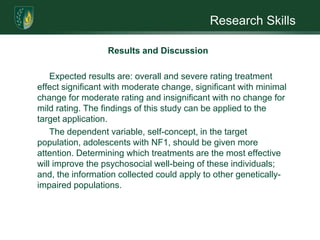
    Cognitive Abilities andCommunication SkillsThe Target Market: Clinical Diagnosticskilling in a matter of hours. Consequently, once bacterial meningitis is suspected or diagnosed, heavy doses of broad-spectrum antibiotics are used for treatment, even though this may not be very effective on the species eventually diagnosed.Today, it takes two to three days to identify the bacterial species causing meningitis. In addition, laboratory technicians must simultaneously check for all bacterial species known to cause the disease, which requires further labor-intensive procedures and expensive equipment. The cost for each test is estimated to be about $600. The MIT System will identify the bacteria species in minutes after the delivery of a sample and at a substantially lower cost.
  • 119.
    Cognitive Abilities andCommunication SkillsThe Target Market: Clinical DiagnosticsIdentification of microbes is a primary function of the clinical microbiology laboratory. The identification of an organism can be used to determine its medical importance, determines its site of origin and determine antimicrobial therapy. Additionally important is the ability to differentiate the organisms susceptible to antibiotic reagents or resistive to the antibiotic reagent. MIT believes its system can differentiate between a species of bacteria that is either resistive or not – further development has been initiated.
  • 120.
    Cognitive Abilities andCommunication SkillsThe Target Market: Clinical DiagnosticsThe marketplace for Micro Imaging Technology’s product include: food quality control, clinical diagnostics, pharmaceutical quality assurance, semiconductor processing control, and water quality monitoring. Initial sales and marketing efforts are centered on: Food Quality Control – monitoring the quality of any food product; and Clinical Diagnostics – providing more affordable and timely health care. These target applications represent $3 billion of the total rapid ID test market, requiring over one billion tests annually at approximately 200,000 facilities.
  • 121.
    Cognitive Abilities andCommunication SkillsThe Target Market: TablesDomestic Food Quality Control Industries SITES NUMBER OF FACILITIESRaw Meat Processors 6,000Dairy 5,000Seafood Processing Plants 1,000Fruit And Vegetable Processing Plants 1,000Hen Farms 500TOTAL 13,500
  • 122.
    Cognitive Abilities andCommunication SkillsThe Target Market: TablesDomestic Clinical Diagnostic Market SITES NUMBER OF FACILITIESClinical Laboratories 16,000Nursing Facilities 15,000Home Health Agencies 11,000Hospital Laboratories 6,000Rural Health Clinics 4,000Total 52,000
  • 123.
    Cognitive Abilities andCommunication SkillsThe Target Market: TablesPotential OEMs and Distributors OEM/ Distributor Geographic LocationCentrus Kingsport, TNChemunex FranceGarden State Laboratories, Inc. Hillside, NJMicrobiology Team Seattle, WAPall Corporation East Hills, NY
  • 124.
    Cognitive Abilities andCommunication SkillsThe Target Market: TablesPotential OEMs and Distributors OEM/ Distributor Geographic LocationParadigm Diagnostics Inc. St. Paul, MNSartorius Group GermanyThe Industrial Laboratories Company, Inc. Wheat Ridge, COVermicon AG GermanyWarnex Canada
  • 125.
    Cognitive Abilities andCommunication SkillsThe Target Market: TablesPotential Industry PartnersIndustry Partners Geographic Location3M Microbiology St. Paul, MNAbbott Laboratories Abbott Park, ILAOAC Gaithersburg, MDApogent Technologies Portsmouth, NHBecton, Dickinson and Company Cockeysville, MD
  • 126.
    Cognitive Abilities andCommunication SkillsThe Target Market: TablesPotential Industry PartnersIndustry Partners Geographic LocationBioControl Bellevue, WABiotrace International Plc Bridgend, WalesCargill, Inc. Minneapolis, MNCharm Science, Inc. Lawrence, MAFoss North America Eden Prairie, MN
  • 127.
    Cognitive Abilities andCommunication SkillsThe Target Market: TablesPotential Industry PartnersIndustry Partners Geographic LocationHP and Agilent Palo Alto, CANAMSA Irvine, CANeogen Lansing, MISamsung Seoul, KoreaUniversal Detection Technology Beverly Hills, CA
  • 128.
    Cognitive Abilities andCommunication SkillsThe Marketing MixThe marketing strategy of MIT is based on the needs of the Food Quality Control and Clinical Diagnostic environments. The Company plans to leverage its internal and external business strengths and increase its knowledge of the competitive environment to provide a product that is competitive in both per-test cost and quick-time test results.
  • 129.
    Cognitive Abilities andCommunication SkillsThe Marketing Mix: Product StrategyThe process of obtaining certifications and endorsements for pathogenic identification equipment is arduous, making product lines slow to develop. MIT currently offers one product, the MIT 1000 System.  The Company’s technical focus in the near-term will be perfecting bacteria colony identification. At the same time, the Company will be cognizant of other opportunities and directions that would enhance products and services.
  • 130.
    Cognitive Abilities andCommunication SkillsThe Marketing Mix: Distribution StrategyMIT’s evolving marketing channel is a combination of direct sales efforts and independent Distributors and Manufacturer’s Representatives that are established in the target markets. The Company is establishing an international network of distributors and currently has nine (9) signed distribution agreements. This will eventually be augmented by the establishment of subsidiaries or partnerships in Europe and Asia. The Company is in meaningful discussion with five large companies with leadership positions in both market segments.
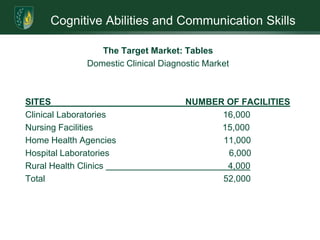
  • 131.
    Cognitive Abilities andCommunication SkillsThe Marketing Mix: Promotion StrategyMIT is a new participant in a well established, conservative and somewhat regulated market that is served by larger organizations, with market acceptance and access to larger resources. A major objective is to create MIT identity recognition, while introducing its new technology. Near term tasks include:
  • 132.
    Cognitive Abilities andCommunication SkillsThe Marketing Mix: Promotion StrategyPerformance validation through placement of systems in highly visible validation agencies and testing laboratories
  • 133.
    Research and documentsales and market strategies from competitive suppliers of rapid microbe identifying systems
  • 134.
    Contact relevant industryparticipants and research organizations
  • 135.
    Contact potential OEMcustomers and industry partnersCognitive Abilities and Communication SkillsThe Marketing Mix: Promotion StrategyCreate opportunities with collaborative partners; universities, manufacturers, industry participants, research laboratories, etc.
  • 136.
    Develop marketing andsales tools, including expanded web site presentations.
  • 137.
    Participate in industry,product and technical presentations and affiliationsCognitive Abilities and Communication SkillsThe Marketing Mix: Pricing StrategyRevenues will come from the sale of a complete system: training (laboratory and systems procedures), consumables, and annual software/ support fees. Products will be priced competitively while focusing on initial market penetration.
  • 138.
    Cognitive Abilities andCommunication SkillsThe Marketing Mix: Sales Strategy and ForecastThe sales strategy will focus on direct sales to suppliers and users of pathogenic testing systems and development of distributor agreements. The MIT 1000 has a significant recurring revenue component with annual growth projected to at least 30% of total sales. Revenue will be derived from:
  • 139.
    Cognitive Abilities andCommunication SkillsThe Marketing Mix: Sales Strategy and ForecastCustom software packages (additional microbe identifiers and custom libraries), training and upgrades
  • 140.
    Software licensing anddistribution fees
  • 141.
    Software and hardwareservice and support agreements
  • 142.
    Consumables – 1)reusable and disposable testing vials; 2) water purification systems, 3) calibration and diagnostic packages, and 4) specimen preparation kits, including culture mediaCognitive Abilities and Communication SkillsFinancial Pro FormaThe focus of this marketing plan is to initiate action that will generate revenues for Micro Imaging Technology and better position the Company for the future. The market challenges that currently exist are that the Company is undercapitalized and the product is still in test certification process. A current Pro Forma Statement of Operations follows; line items for marketing and promotion have not yet been determined.
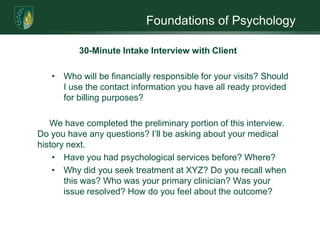
  • 143.
    Cognitive Abilities andCommunication SkillsFinancial Pro FormaPROJECTED SUMMARY OF OPERATIONS (in millions)  Year YearYearYear 1 2 3 4Sales $2.25 $ 9.00 $ 18.00 $ 40.00 Cost of Sales $1.00 $ 3.60 $ 7.20 $ 16.00 Gross Margins $1.25 $ 5.40 $ 10.80 $ 24.00 Operating Costs $1.75 $ 3.60 $ 6.60 $ 14.50Profit / (Loss) $(.50) $ 1.80 $ 4.20 $ 9.50
  • 144.
    Cognitive Abilities andCommunication SkillsMonitoringThe Company will track plan vs. actual results for each program. Status and progress will be addressed and reported to management each month. Management will hold monthly meetings to review progress and determine future steps. This topic will be included in year-end discussions and included in annual reports. Results of the program will determine marketing plans for the upcoming year. Adjustments will be made based on results from the previous year.
  • 145.
    Cognitive Abilities andCommunication SkillsMarketing LeadershipJohn Ricardi, VP of Business Development, will head marketing efforts and be responsible for overseeing the company’s marketing activities. Everyone recognizes the challenges ahead, but have complete confidence in John’s talents and abilities.
  • 146.
    Cognitive Abilities andCommunication SkillsContingency PlanningThese are the most likely possible changes in the marketing plan:Industry downturn – Currently, the need for MIT’s product in the industry is great. A futuristic view sees nothing but growth and increased demand. In the event of an unforeseen downturn, the company would re-examine its selection of target markets and consider a change in direction, or other relevant alternatives.
  • 147.
    Lack of keypersonnel – Losing key individuals in the company could have major ramifications, especially those individuals directly involved with product research and development. A contingency plan to bridge any potential personnel gaps needs to be developed.Cognitive Abilities and Communication SkillsContingency PlanningCompetition – Competition could emerge. Timing is crucial to the Company’s success.
  • 148.
    Inadequate funding –Transitioning from a R&D-focused company to an outsource/service-based company with revenue streams is the aim. Inadequate funding could significantly impact both the window of opportunity and viability of the transition. Contingency plans for generating capital are continually being developed and in progress.Cognitive Abilities and Communication SkillsKeys to SuccessThe “Keys to Success” for Micro Imaging Technology include:Excellence in delivering product and support service
  • 149.
  • 150.
    Attracting and retainingkey partners and distributors
  • 151.
  • 152.
    Public Relations andMarketing programs that develop and retain visibilityCognitive Abilities and Communication SkillsCritical IssuesThough the company has been operational for several years, the fact that it has focused on research and development without a revenue stream has been costly. Visibility is low. The potential outcome of testing certification is critical to bringing the product to market. Additional critical issues include:Acquisition of capital
  • 153.
    Acquiring and retainingpartnerships and distributors
  • 154.
    Leveraging opportunities whenthere is a weak financial baseEthicsStem Cell ResearchCynthia KraftRELE 457: EthicsLoma Linda UniversityMay 8, 2009
  • 155.
    EthicsStem Cell ResearchStemcell research is invaluable to the treatment and maintenance of many diseases and cognitive disorders, including, but not limited to: diabetes, different cancers, Parkinson’s disease, Alzheimer’s disease, and brain injury. For these reasons, I am a strong proponent of adult stem cell research, proponent of restricted embryonic stem cell research, an opponent of stem cell research focused on human cloning.
  • 156.
    EthicsStem Cell ResearchEmbryonicstem cells are a “hot” political topic; as a result, researchers are developing ways to work with other stem cells. For example, in 2008, Harvard Stem Cell Institute (HSCI) announced that a team of its scientists had manipulated skin cells into becoming nerve cells (Associated Press (AP), 2008, para. 8). In March of this year, scientists from Canada and Britain were able to transform adult skin cells into stem cells using a method that is less apt to be rejected by the immune system (Reals, 2009, para. 2, 5). In addition, adult stem cells are recognized to replace blood cells in bone marrow transplant patients (Phillips, 2009, p. 2).
  • 157.
    EthicsStem Cell ResearchStemcell research is not limited to those with existing illnesses and diseases. Research is also addressing how to inhibit or arrest the onset of age-related illnesses and genetic disorders. Scientists at HSCI have begun watching manufactured stem cells develop into specific diseases in a cell culture. The goal is to determine when cell genetics mutate into specific diseases. Already HSCI has developed stem cells for ten genetic disorders (AP, 2008, para. 1).
  • 158.
    EthicsStem Cell ResearchTheprimary stem cell research controversy is over the use of blastocysts (embryonic stem cells). Pro-life advocates consider the blastocyst to be a human life and its destruction immoral.The blastocysts used in research are developed from laboratory- fertilized human eggs (Phillips, 2009, p. 2); after-birth, including umbilical cord; and, aborted or unused in vitro fetuses (Irving, 1999, p. 2). Laboratory-created blastocysts exist for the purpose of research; and, a single-cell isn’t “human.” In addition, shouldn’t the afterbirth and discarded fetuses be available for research purposes? There is no life. What’s more valuable: contributing to society or ending up in the trash?
  • 159.
    EthicsStem Cell ResearchWhenPresident Obama overturned the ruling on embryonic stem cell research, there continued to be much public opposition (Phillips, 2009, p. 3). My personal feeling is that we should emphasize the value of this research and put less energy into debate. The majority of the US population agrees with my positions on restricted embryonic stem cell research and human cloning.
  • 160.
    EthicsStem Cell Research:Why Do I Feel So Strongly?According to the National Institutes of Health (2009), “The need for transplantable tissues and organs far outweighs the available supply” (Section VI). Cells manipulated into specific differentiating types could become a continuous source of replacement cells for use in regenerative therapies. This potential would mean treatment and quality of life for individuals with:
  • 161.
    EthicsStem Cell Research:Why Do I Feel So StronglyParkinson’s and Alzheimer’s diseases
  • 162.
    Brain and spinalcord injury
  • 163.
  • 164.
  • 165.
  • 166.
    Osteo- and Rheumatoidarthritis EthicsStem Cell Research: Why Do I Feel So StronglyCase In Point: At age sixteen, Cathy Mattson suffered brain injury in an automobile accident and wasn’t expected to live. Thirty years later, Cathy is “living” each day with no short-term memory (Van De Hey, 2009, p. 1). Should you not know, short-term memory is your conscious memory; it is where new information is received and old information retrieved. It lasts for approximately twenty seconds and allows you to know what you are doing right now (Hockenbury, 2006, p. 254). Can you imagine what it is like to be Cathy? How would you like to “live” each day without remembering it?
  • 167.
    EthicsStem Cell Research:Why Do I Feel So StronglyResearch will not reverse the past thirty years, but it could provide Cathy a better tomorrow. Doesn’t she, and the millions of others like her, deserve a chance at a quality life? The benefits of adult and restricted embryonic stem cell research far outweigh the alternatives.
  • 168.
    EthicsStem Cell Research:Why Do I Feel So StronglyI must ask myself, is this research immoral or unethical? I think not. Should it be supported? I believe “YES.” I feel that stem cell research is invaluable in the diagnosis, intervention, treatment and maintenance of many disorders and diseases. This is why I am a strong proponent of adult stem cell research, proponent of restricted embryonic stem cell research, an opponent of stem cell research focused on human cloning.
  • 169.
    EthicsReferencesAssociated Press (AP).(2008). Scientists create stem cells for 10 disorders. MSNBC.com. Retrieved March 6, 2009 from http://www.msnbc.msn.com/id/26089057/from/ET/Hockenbury, D.H. & Hockenbury, S.E. (2006). What is Memory? Psychology (4th ed.). New York, NY: Worth Publishers. Irving, D.N. (1999). Stem cell research: Some pros and cons. Lifeissues.net. Retrieved April 26, 2009, from http://www.lifeissues.net/writers/irv/irv_19stemcellprocon.html
  • 170.
    EthicsReferencesNational Institutes ofHealth (NIH). (2009). Stem cell basics:Stem cell information [World Wide Web site]. Bethseda, MD: National Institutes of Health, U.S. Department of Health and Human Services. Retrieved February 4, 2009 from http://stemcells/nih.gov/info/basicsReals, T. (2009). Stem cell research breakthrough. CBS News. Retrieved March 6, 2009 from http://www.cbsnews.com/blogs/2009/03/02/world/worldwatch/entry4837855.shtmlPhillips, Theresa. (2009). Pros and cons of stem cell research. About.com Biotech/Biomedical. Retrieved April 26, 2009 from http://biotech.about.com/od/bioethics/i/issuestemcells_2.htm
  • 171.
    EthicsReferencesVan De Hey,Lisa. (2009). Cathy’s christian cottage in richvale. The Gridley Herald (online). Retrieved April 24, 2009, from http://www.gridleyherald.com/homepage/x126911745
  • 172.
    Diversity AwarenessAsian AmericanStudy: The Chinese Immigration ExperienceCynthia KraftSOSC 20: Cultural DiversityFoothill CollegeMay 19, 2008
  • 173.
    Diversity AwarenessThe ChineseImmigration Experience: ArrivalFirst wave Chinese Americans consisted of “mostly single males”… Many of which “intended to return (to China) after bettering themselves economically. (Marger 343)
  • 174.
    “Chinese laborers wereoriginally brought into the United States after 1848 to work in the gold fields, particularly in those aspects of mining that were most dangerous because few white men were willing to engage in blasting shafts, placing beams, and laying track lines in the gold mines. Chinese immigrants also helped to build the Western railroad lines at pay few whites would accept – known as ‘coolie wages.’” (Abadinsky 40) 
  • 175.
    Diversity AwarenessThe ChineseImmigration Experience: Discrimination“From their arrival during the Gold Rush, the Chinese experienced discrimination and often overt racism… Action in the form of legislation was used against Chinese immigrants and started as early as the 1850 Foreign Miners’ License Tax law. “In 1854 the California State Supreme Court categorized Chinese with Blacks and Indians, denying them the right to testify against white men in courts of law.” (Anti-Chinese Movement and Chinese Exclusion)Diversity AwarenessThe Chinese Immigration Experience: Cultural Aspects“The Chinese brought with them to the United States traditions and practices that were integral to their daily lives, including specific religious beliefs and rituals.” (Chinese Temple in Oroville, California) 
  • 176.
    Diversity AwarenessThe ChineseImmigration Experience: Cultural AspectsIn the area of Oroville, California, a large population of Chinese, approximately 10,000 resided. Their contributions to early California history, gold rush activities, and the railroad were significant. They even left some of their historic culture behind, as in the Chinese Temple, which was “built in the spring of 1863… and served as a place of worship for a community of 10,000 Chinese residents. Funds for the Temple and furnishings were provided by the Emperor and Empress of China and local Chinese labor built the structure… which includes three chapels, with the main chapel dedicated to the worship of various faiths including Taoism, Confucianism, and Buddhism.” (Temple History)
  • 177.
    Diversity AwarenessThe ChineseImmigration Experience: Economic Depression, the Chinese and Labor UnionsCalifornia was facing difficult times in the 1870s, when an interesting, and unfortunate, situation occurred, because the Chinese were “perceived by white workers as a labor threat.” (Marger 344) “The primary event that precipitated the campaign against the Chinese… was the sudden onset of economic depression, high unemployment levels, and the disintegration of working-class standards of living. (A) San Francisco ordinance prohibited the operation of opium dens, commercial establishments for the smoking of opium, ‘not because of health concerns as such, but because it was believed that the drug stimulated coolies into working harder than non-smoking whites.
  • 178.
    Diversity AwarenessThe ChineseImmigration Experience: Economic Depression, the Chinese and Labor Unions“Depressed economic conditions and xenophobia led one Western state after another to follow San Francisco’s lead and enact anti-Chinese legislation that often included prohibiting the smoking of opium… an Oregon district court… stated: ‘Smoking opium is not our vice, and therefore it may be that this legislation proceeds more from a desire to vex and annoy the ‘Heathen Chinese’ in this respect, than to protect the people from the evil habit.” (Abadinsky 41) Thus indicating that any measure deemed necessary would be implemented to restrict this ethnic group.
  • 179.
    Diversity AwarenessThe ChineseImmigration Experience: Economic Depression, the Chinese and Labor Unions“Anti-Chinese efforts were supported and advanced by Samuel Gompers as part of his effort to establish the American Federation of Labor. The Chinese served as scapegoats for organized labor that depicted the ‘yellow devils’ as undercutting wages and breaking strikes.” (Abadinsky 42)
  • 180.
    Diversity AwarenessThe ChineseImmigration Experience: The Chinese in Rural California“After their work was completed, the Chinese were often banned from the rural counties; by the 1860s they were clustering in cities on the Pacific coast, where they established Chinatowns – and where many of them smoked opium.” (Abadinsky 40)However, with all the dissention around them, the Chinese community in Oroville remained intact until “a major flood in 1907 decimated the (area) so that most Chinese left Oroville. Some returned to China while others moved to Sacramento or San Francisco.” (Temple History) 
  • 181.
    Diversity AwarenessThe ChineseImmigration Experience: The Chinese in Rural CaliforniaIn a small community in Plumas County, area housewives prepared cakes and pies for Chinese New Year, 1896. They even pasted good luck banners to the beams of the Silver Creek Joss House, where the celebration took place. (Plumas County Places)
  • 182.
    Diversity AwarenessThe ChineseImmigration Experience: The Chinese in Rural California  A rare interior photo of the Silver Creek Joss House shows cakes and pies given to the Chinese by local housewives for Chinese New Year, 1896. There are papers pasted to the beams, which are good luck banners. Today, the clock on the wall in the background hangs in the Plumas County Museum in Quincy, California.
  • 183.
    Diversity AwarenessThe ChineseImmigration Experience: Exclusion and Immigration“Eventually, the United States government passed the Chinese Exclusion Act of 1882, a law that stood in place until its repeal in 1943.
  • 184.
     “In 1905, constructionof an Immigration Station on Angel Island began in the area known as China Cove. Surrounded by public controversy from its inception, the station began operation in 1910. 
  • 185.
    Diversity AwarenessThe ChineseImmigration Experience: Exclusion and Immigration“As the ‘Ellis Island of the West,’ it was designed to handle the anticipated European immigrants arriving in California once the Panama Canal was opened. Instead, the majority of immigrants to America via the West Coast came from Asia.
  • 186.
    “On Ellis Island,immigrants were processed within hours or days; on Angel Island, they spent weeks or months. This facility functioned primarily as a detention center. Although all Asians were affected, the greatest impact was on the Chinese totaling 70 percent of the immigrants detained on Angel Island.” (Anti-Chinese Movement and Chinese Exclusion)Diversity AwarenessThe Chinese Immigration Experience: Data Regarding Early Chinese“Much information on the Chinese communities in 19th century and early 20th century comes to us via periodicals newspapers of the time. Often what is depicted in the periodicals reflects a complicated history of relations and reactions that the Chinese experienced in coming to California, including material that often carries derogatory messages.
  • 187.
    Diversity AwarenessThe ChineseImmigration Experience: Data Regarding Early Chinese“Yet these sources are often used today because of the scarcity of written documentation on certain aspects of Chinese American history. One of the richest sources of documentation can be found in San Francisco’s The Wasp and The Wave and New York’s Harper’s Weekly.
  • 188.
    Diversity AwarenessThe ChineseImmigration Experience: Data Regarding Early Chinese“These periodicals comment on the political, economic, and social events of the period. Though often overtly distorted or opinionated, these documents tell us the history of what immigrants faced coming to the American West and the inter-ethnic tensions present.” (Sentiments Concerning the Chinese: Illustrations from Periodicals)
  • 189.
    Diversity AwarenessWorks CitedAbadinsky,Howard. “Drug Use and Legislation: A History.” Drug Use and Abuse, 6th ed. California: Thomson Wadsworth, 2008.Anti-Chinese Movement and Chinese Exclusion” The Bancroft Library: Chinese in California, 1850-1925. Available <http://bancroft.berkeley.edu/collections/chineseinca/antichinese.html. Retrieved Sunday, May 11, 2008.“Chinese Temple in Oroville, California.” The Bancroft Library: Chinese in California, 1850-1925. Available <http://bancroft.berkeley.edu/collections/chineseinca/temple.html. Retrieved Sunday, May 11, 2008.
  • 190.
    Diversity AwarenessWorks CitedMarger,Martin N. “Asian Americans.” Race & Ethnic Relations, 7th ed. California: Thomson Wadsworth, 2006.Sentiments Concerning the Chinese: Illustrations from Periodicals. The Bancroft Library: Chinese in California, 1850-1925. Available <http://bancroft.berkeley.edu/collections/chineseinca/sentiments.html. Retrieved Sunday, May 11, 2008.Temple History. The Bancroft Library: Oroville Chinese Temple. Available < http://bancroft.berkeley.edu/collections/oroville/history.html.> Retrieved Sunday, May 11, 2008.)