ATTRA is the national sustainable agriculture information service operated by the National
Center for Appropriate Technology, through a grant from the Rural Business-Cooperative Service,
U.S. Department of Agriculture. These organizations do not recommend or endorse products,
companies, or individuals. NCAT has offices in Fayetteville,Arkansas (P.O. Box 3657, Fayetteville,
AR 72702), Butte, Montana, and Davis, California.
National SustainableAgriculture Information Service
www.attra.ncat.orgwww.attra.ncat.org
Introduction
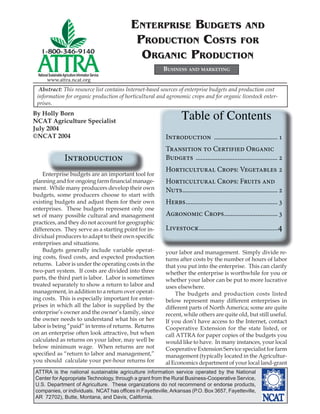
Enterprise budgets are an important tool forEnterprise budgets are an important tool for
planning and for ongoing farm financial manage-
ment. While many producers develop their own
budgets, some producers choose to start with
existing budgets and adjust them for their own
enterprises. These budgets represent only one
set of many possible cultural and management
practices, and they do not account for geographic
differences. They serve as a starting point for in-
dividual producers to adapt to their own specific
enterprises and situations.
Budgets generally include variable operat-
ing costs, fixed costs, and expected production
returns. Labor is under the operating costs in the
two-part system. If costs are divided into three
parts, the third part is labor. Labor is sometimes
treated separately to show a return to labor and
management, in addition to a return over operat-
ing costs. This is especially important for enter-
prises in which all the labor is supplied by the
enterprise’s owner and the owner’s family, since
the owner needs to understand what his or her
labor is being “paid” in terms of returns. Returns
on an enterprise often look attractive, but when
calculated as returns on your labor, may well be
below minimum wage. When returns are not
specified as “return to labor and management,”
you should calculate your per-hour returns for
your labor and management. Simply divide re-
turns after costs by the number of hours of labor
that you put into the enterprise. This can clarify
whether the enterprise is worthwhile for you or
whether your labor can be put to more lucrative
uses elsewhere.
The budgets and production costs listed
below represent many different enterprises in
different parts of North America; some are quite
recent, while others are quite old, but still useful.
If you don’t have access to the Internet, contact
Cooperative Extension for the state listed, or
call ATTRA for paper copies of the budgets you
would like to have. In many instances, your local
Cooperative Extension Service specialist for farm
management (typically located in the Agricultur-
al Economics department of your local land-grant
Table of Contents
Introduction ...................................... 1
Transition to Certified Organic
Budgets ................................................. 2
Horticultural Crops: Vegetables 2
Horticultural Crops: Fruits and
Nuts......................................................... 2
Herbs....................................................... 3
Agronomic Crops................................ 3
Livestock...............................................4
By Holly Born
NCAT Agriculture Specialist
July 2004
©NCAT 2004
BUSINESS AND MARKETING
Abstract: This resource list contains Internet-based sources of enterprise budgets and production cost
information for organic production of horticultural and agronomic crops and for organic livestock enter-
prises.
ENTERPRISE BUDGETS AND
PRODUCTION COSTS FOR
ORGANIC PRODUCTION
PAGE 2 //ENTERPRISE BUDGETS AND PRODUCTION COSTS FOR ORGANIC PRODUCTION
university) should be able to assist or recommenduniversity) should be able to assist or recommend
someone to assist in adapting enterprise budgetssomeone to assist in adapting enterprise budgets
to reflect your individual enterprises, and showto reflect your individual enterprises, and show
you how to use the budgets to improve youryou how to use the budgets to improve your
farm financial management. Since resources varyfarm financial management. Since resources vary
widely from state to state, no single route existswidely from state to state, no single route exists
for local assistance.
For conventional production, the Agricul-For conventional production, the Agricul-
tural Risk Budget Library at www.agrisk.umn.tural Risk Budget Library at www.agrisk.umn.
edu contains budgets for a very wide range ofedu contains budgets for a very wide range of
crops and livestock. In developing a budget forcrops and livestock. In developing a budget for
organic production, in many cases, a budget fororganic production, in many cases, a budget for
conventional cropping or livestock may be theconventional cropping or livestock may be the
best starting point. The budget can then be tai-best starting point. The budget can then be tai-
lored to specific individual situations, includinglored to specific individual situations, including
organic production.
Transition to Certified
Organic Budgets
British Columbia (2002)
Available budgets: dairy (fluid milk), spelt,Available budgets: dairy (fluid milk), spelt,
potatoes, oat, apple, sweet corn, carrots, winterpotatoes, oat, apple, sweet corn, carrots, winter
squash, spinach, salad greens, and cauliflower.
www.agf.gov.bc.ca/busmgmt/budgets/spe-www.agf.gov.bc.ca/busmgmt/budgets/spe-
cialty_organic.htm
Horticultural Crops:
Vegetables
British Columbia (1992-1996)
Available budgets: garlic, carrots, celery, cornAvailable budgets: garlic, carrots, celery, corn
for processing, peas for processing, whole beansfor processing, peas for processing, whole beans
for processing.
www.agf.gov.bc.ca/busmgmt/budgets/spe-www.agf.gov.bc.ca/busmgmt/budgets/spe-
cialty_organic.htm
California (1996)
Available budgets: processing tomatoes,Available budgets: processing tomatoes,
mixed vegetables.
www.agecon.ucdavis.edu/outreach/crop/
cost.htm
California, Central Coast (1994)California, Central Coast (1994)
Available budgets: cabbage, cauliflower,
cucumbers, garlic, leaf lettuce, romaine lettuce,
red onions, yellow onions, non-staked snap peas,
non-staked snow peas, green bell peppers, red
bell peppers, sweet corn, large variety winter
squash, small variety winter squash, barley cover
crop, vetch cover crop.
Included are yield and return ranges for selected
central coast organic vegetable crops, whole farm an-
nual equipment, investment, and business overhead
costs for a diversified organic vegetable operation,
and hourly equipment costs for a diversified organic
vegetable operation.
http://vric.ucdavis.edu/veginfo/topics/
prodcosts/organiccosts.html
New Jersey (1996)
Available budgets: bell pepper, cabbage, cau-
liflower, cucumber, leaf lettuce, yellow onions,
pumpkins, sweet corn, fresh market tomato, and
processing tomato.
http://aesop.rutgers.edu/~farmmgmt/ne-
budgets/organic.html
North Carolina (2003)
Available budgets: fresh market broccoli,
kale, tomatoes, sweet corn, salad mix, leaf lettuce,
peppers, and summer squash.
www.ces.ncsu.edu/chatham/ag/SustAg/
organiccoststudy.pdf
Wisconsin (1990)Wisconsin (1990)
Potatoes: brief comparison of costs and re-
turns of organic and conventional potatoes.
www.wisc.edu/cias/pubs/briefs/004.html
Horticultural Crops:
Fruits and Nuts
California (2003)
Available budgets: strawberries.
www.agecon.ucdavis.edu/outreach/crop/
cost-studies/StrawbOrgCC03.pdf
//ENTERPRISE BUDGETS AND PRODUCTION COSTS FOR ORGANIC PRODUCTION PAGE 3
Wisconsin (1999)Wisconsin (1999)
Available budgets: echinacea.
www.wisc.edu/cias/pubs/briefs/048.html
Agronomic Crops
California (1996)
Available budgets: cotton, rice.
www.agecon.ucdavis.edu/outreach/crop/
cost.htm
Illinois (2003)
Available budgets: food-grade soybeans,
food-grade corn.
http://web.aces.uiuc.edu/value/
Illinois (2001)
Available budgets: pasture (red clover, red
mammoth clover, alfalfa, timothy), cereal rye
grain, blue corn, soft red winter wheat, soy-
bean.
www.aces.uiuc.edu/~asap/research/stew_www.aces.uiuc.edu/~asap/research/stew_
farm/Appendix-rep-02.html#Production%20B
uds,%20Conv
Kansas (2003)
Available budgets: corn, blue corn, sweet
corn, wheat, Austrian winter peas, alfalfa, clover
seed.
www.kansasruralcenter.org/publications/
Organic%20cropping.pdf
Michigan (2001)
Available budgets: grain corn, soybeans, and
oats.
Includes downloads of Excel budgets so you can
do your own calculations.
www.aec.msu.edu/agecon/aecreports/bud
gets01.htm
California (2002)California (2002)
Available budgets: almonds.
www.agecon.ucdavis.edu/outreach/crop/
cost-studies/AlmondOrgVN02.pdfcost-studies/AlmondOrgVN02.pdf
California (1996)California (1996)
Available budgets: almonds, apples, table
grapes, raisins, lemons, oranges, walnuts.grapes, raisins, lemons, oranges, walnuts.
www.agecon.ucdavis.edu/outreach/crop/
cost.htmcost.htm
New Jersey (1996)New Jersey (1996)
Available budgets: fresh market apples, ma-
ture trees.ture trees.
http://aesop.rutgers.edu/~farmmgmt/
nebudgets/organic.htmlnebudgets/organic.html
New York (no date)New York (no date)
Available budgets: strawberries (greenhouse
production).production).
www.hort.cornell.edu/department/faculty/
pritts/straw.htmpritts/straw.html
Herbs
Washington State (2003)Washington State (2003)
Available budgets: goldenseal.
http://smallfarms.wsu.edu/crops/organic
Goldenseal.htmlGoldenseal.html
British Columbia (2002)British Columbia (2002)
Available budgets: calendula, American
skullcap, catnip, dandelion root, lavender,skullcap, catnip, dandelion root, lavender,
lemon balm, licorice root, nettle, passion flow-lemon balm, licorice root, nettle, passion flow-
er, marshmallow root, chamomile, red clover,er, marshmallow root, chamomile, red clover,
shepherd’s purse, and yarrow.shepherd’s purse, and yarrow.
www.agf.gov.bc.ca/busmgmt/budgets/budwww.agf.gov.bc.ca/busmgmt/budgets/bud
get_pdf/small_scale/small_scale_Mixed_herb_get_pdf/small_scale/small_scale_Mixed_herb_
Win.pdfWin.pdf
PAGE 4 //ENTERPRISE BUDGETS AND PRODUCTION COSTS FOR ORGANIC PRODUCTION
New Jersey (1996)New Jersey (1996)
Available production costs: grain corn, silage
corn, soybeans, alfalfa (new seeding), alfalfa (es-
tablished stand).
http://aesop.rutgers.edu/~farmmgmt/ne-
budgets/organic.html
North Dakota (2003)
Available budgets: spring wheat, durum, feed
barley, grain corn, sunflower oil, confectionery
sunflower, soybeans, oats, flax, field peas, millet,
buckwheat, rye, and rotational green manure
fallow.
Has an excellent overview of organic production,
crop rotation, and machinery used in organic produc-
tion. There are also organic crop budgets from 2000
available.
www.ext.nodak.edu/extpubs/agecon/
ecguides/2003org.pdf
Livestock
British Columbia (2002)
Available budgets: free-range laying hens.
www.agf.gov.bc.ca/busmgmt/budgets/bud-
get_pdf/poultry/organic_eggs_2002.pdf
California (2002)
Production costs for organic and conventional
milk.
http://californiaagriculture.ucop.edu/
0205SO/pdfs/orgmilk.pdf
Iowa (2003)
Available budgets: pork (two-litter pasture
farrow-to-finish).
www.extension.iastate.edu/ipic/reports/www.extension.iastate.edu/ipic/reports/
99swinereports/asl-1679.pdf
Iowa (2003)
Available cost information: pork.
www.extension.iastate.edu/agdm/livestock/www.extension.iastate.edu/agdm/livestock/
html/b1-80.html
New Jersey (1996)New Jersey (1996)
Available budgets: dairy goat, spring lamb.
Budgets for dairy goat include scenarios of pro-
duction levels of 1500, 1800 or 2100 pounds of milk
per doe.per doe.
http://aesop.rutgers.edu/~farmmgmt/ne-
budgets/organic.html#live
Pennsylvania (1999)
Available budgets: egg production (small-
scale).
http://agalternatives.aers.psu.edu/livestock/http://agalternatives.aers.psu.edu/livestock/
small_scale_egg/small_scale_egg.pdf
Enterprise Budgets and Production Costs
for Organic Production
By Holly Born
NCAT Agriculture Specialist
August 2004
©NCAT 2004
Edited by Paul Williams
Formatted by Ashley Rieske
The electronic version of Enterprise Budgets
and Production Costs for Organic Production
is located at:
HTML
http://www.attra.ncat.org/attra-pub/enterprisebud-
gets.html
PDF
http://www.attra.ncat.org/attra-pub/PDF/enter-
prisebudgets.pdf
RL 041/Slot# 264
Version#081104

Enterprise Budgets and Production Costs for Organic Production

  • 1.
    ATTRA is thenational sustainable agriculture information service operated by the National Center for Appropriate Technology, through a grant from the Rural Business-Cooperative Service, U.S. Department of Agriculture. These organizations do not recommend or endorse products, companies, or individuals. NCAT has offices in Fayetteville,Arkansas (P.O. Box 3657, Fayetteville, AR 72702), Butte, Montana, and Davis, California. National SustainableAgriculture Information Service www.attra.ncat.orgwww.attra.ncat.org Introduction Enterprise budgets are an important tool forEnterprise budgets are an important tool for planning and for ongoing farm financial manage- ment. While many producers develop their own budgets, some producers choose to start with existing budgets and adjust them for their own enterprises. These budgets represent only one set of many possible cultural and management practices, and they do not account for geographic differences. They serve as a starting point for in- dividual producers to adapt to their own specific enterprises and situations. Budgets generally include variable operat- ing costs, fixed costs, and expected production returns. Labor is under the operating costs in the two-part system. If costs are divided into three parts, the third part is labor. Labor is sometimes treated separately to show a return to labor and management, in addition to a return over operat- ing costs. This is especially important for enter- prises in which all the labor is supplied by the enterprise’s owner and the owner’s family, since the owner needs to understand what his or her labor is being “paid” in terms of returns. Returns on an enterprise often look attractive, but when calculated as returns on your labor, may well be below minimum wage. When returns are not specified as “return to labor and management,” you should calculate your per-hour returns for your labor and management. Simply divide re- turns after costs by the number of hours of labor that you put into the enterprise. This can clarify whether the enterprise is worthwhile for you or whether your labor can be put to more lucrative uses elsewhere. The budgets and production costs listed below represent many different enterprises in different parts of North America; some are quite recent, while others are quite old, but still useful. If you don’t have access to the Internet, contact Cooperative Extension for the state listed, or call ATTRA for paper copies of the budgets you would like to have. In many instances, your local Cooperative Extension Service specialist for farm management (typically located in the Agricultur- al Economics department of your local land-grant Table of Contents Introduction ...................................... 1 Transition to Certified Organic Budgets ................................................. 2 Horticultural Crops: Vegetables 2 Horticultural Crops: Fruits and Nuts......................................................... 2 Herbs....................................................... 3 Agronomic Crops................................ 3 Livestock...............................................4 By Holly Born NCAT Agriculture Specialist July 2004 ©NCAT 2004 BUSINESS AND MARKETING Abstract: This resource list contains Internet-based sources of enterprise budgets and production cost information for organic production of horticultural and agronomic crops and for organic livestock enter- prises. ENTERPRISE BUDGETS AND PRODUCTION COSTS FOR ORGANIC PRODUCTION
  • 2.
    PAGE 2 //ENTERPRISEBUDGETS AND PRODUCTION COSTS FOR ORGANIC PRODUCTION university) should be able to assist or recommenduniversity) should be able to assist or recommend someone to assist in adapting enterprise budgetssomeone to assist in adapting enterprise budgets to reflect your individual enterprises, and showto reflect your individual enterprises, and show you how to use the budgets to improve youryou how to use the budgets to improve your farm financial management. Since resources varyfarm financial management. Since resources vary widely from state to state, no single route existswidely from state to state, no single route exists for local assistance. For conventional production, the Agricul-For conventional production, the Agricul- tural Risk Budget Library at www.agrisk.umn.tural Risk Budget Library at www.agrisk.umn. edu contains budgets for a very wide range ofedu contains budgets for a very wide range of crops and livestock. In developing a budget forcrops and livestock. In developing a budget for organic production, in many cases, a budget fororganic production, in many cases, a budget for conventional cropping or livestock may be theconventional cropping or livestock may be the best starting point. The budget can then be tai-best starting point. The budget can then be tai- lored to specific individual situations, includinglored to specific individual situations, including organic production. Transition to Certified Organic Budgets British Columbia (2002) Available budgets: dairy (fluid milk), spelt,Available budgets: dairy (fluid milk), spelt, potatoes, oat, apple, sweet corn, carrots, winterpotatoes, oat, apple, sweet corn, carrots, winter squash, spinach, salad greens, and cauliflower. www.agf.gov.bc.ca/busmgmt/budgets/spe-www.agf.gov.bc.ca/busmgmt/budgets/spe- cialty_organic.htm Horticultural Crops: Vegetables British Columbia (1992-1996) Available budgets: garlic, carrots, celery, cornAvailable budgets: garlic, carrots, celery, corn for processing, peas for processing, whole beansfor processing, peas for processing, whole beans for processing. www.agf.gov.bc.ca/busmgmt/budgets/spe-www.agf.gov.bc.ca/busmgmt/budgets/spe- cialty_organic.htm California (1996) Available budgets: processing tomatoes,Available budgets: processing tomatoes, mixed vegetables. www.agecon.ucdavis.edu/outreach/crop/ cost.htm California, Central Coast (1994)California, Central Coast (1994) Available budgets: cabbage, cauliflower, cucumbers, garlic, leaf lettuce, romaine lettuce, red onions, yellow onions, non-staked snap peas, non-staked snow peas, green bell peppers, red bell peppers, sweet corn, large variety winter squash, small variety winter squash, barley cover crop, vetch cover crop. Included are yield and return ranges for selected central coast organic vegetable crops, whole farm an- nual equipment, investment, and business overhead costs for a diversified organic vegetable operation, and hourly equipment costs for a diversified organic vegetable operation. http://vric.ucdavis.edu/veginfo/topics/ prodcosts/organiccosts.html New Jersey (1996) Available budgets: bell pepper, cabbage, cau- liflower, cucumber, leaf lettuce, yellow onions, pumpkins, sweet corn, fresh market tomato, and processing tomato. http://aesop.rutgers.edu/~farmmgmt/ne- budgets/organic.html North Carolina (2003) Available budgets: fresh market broccoli, kale, tomatoes, sweet corn, salad mix, leaf lettuce, peppers, and summer squash. www.ces.ncsu.edu/chatham/ag/SustAg/ organiccoststudy.pdf Wisconsin (1990)Wisconsin (1990) Potatoes: brief comparison of costs and re- turns of organic and conventional potatoes. www.wisc.edu/cias/pubs/briefs/004.html Horticultural Crops: Fruits and Nuts California (2003) Available budgets: strawberries. www.agecon.ucdavis.edu/outreach/crop/ cost-studies/StrawbOrgCC03.pdf
  • 3.
    //ENTERPRISE BUDGETS ANDPRODUCTION COSTS FOR ORGANIC PRODUCTION PAGE 3 Wisconsin (1999)Wisconsin (1999) Available budgets: echinacea. www.wisc.edu/cias/pubs/briefs/048.html Agronomic Crops California (1996) Available budgets: cotton, rice. www.agecon.ucdavis.edu/outreach/crop/ cost.htm Illinois (2003) Available budgets: food-grade soybeans, food-grade corn. http://web.aces.uiuc.edu/value/ Illinois (2001) Available budgets: pasture (red clover, red mammoth clover, alfalfa, timothy), cereal rye grain, blue corn, soft red winter wheat, soy- bean. www.aces.uiuc.edu/~asap/research/stew_www.aces.uiuc.edu/~asap/research/stew_ farm/Appendix-rep-02.html#Production%20B uds,%20Conv Kansas (2003) Available budgets: corn, blue corn, sweet corn, wheat, Austrian winter peas, alfalfa, clover seed. www.kansasruralcenter.org/publications/ Organic%20cropping.pdf Michigan (2001) Available budgets: grain corn, soybeans, and oats. Includes downloads of Excel budgets so you can do your own calculations. www.aec.msu.edu/agecon/aecreports/bud gets01.htm California (2002)California (2002) Available budgets: almonds. www.agecon.ucdavis.edu/outreach/crop/ cost-studies/AlmondOrgVN02.pdfcost-studies/AlmondOrgVN02.pdf California (1996)California (1996) Available budgets: almonds, apples, table grapes, raisins, lemons, oranges, walnuts.grapes, raisins, lemons, oranges, walnuts. www.agecon.ucdavis.edu/outreach/crop/ cost.htmcost.htm New Jersey (1996)New Jersey (1996) Available budgets: fresh market apples, ma- ture trees.ture trees. http://aesop.rutgers.edu/~farmmgmt/ nebudgets/organic.htmlnebudgets/organic.html New York (no date)New York (no date) Available budgets: strawberries (greenhouse production).production). www.hort.cornell.edu/department/faculty/ pritts/straw.htmpritts/straw.html Herbs Washington State (2003)Washington State (2003) Available budgets: goldenseal. http://smallfarms.wsu.edu/crops/organic Goldenseal.htmlGoldenseal.html British Columbia (2002)British Columbia (2002) Available budgets: calendula, American skullcap, catnip, dandelion root, lavender,skullcap, catnip, dandelion root, lavender, lemon balm, licorice root, nettle, passion flow-lemon balm, licorice root, nettle, passion flow- er, marshmallow root, chamomile, red clover,er, marshmallow root, chamomile, red clover, shepherd’s purse, and yarrow.shepherd’s purse, and yarrow. www.agf.gov.bc.ca/busmgmt/budgets/budwww.agf.gov.bc.ca/busmgmt/budgets/bud get_pdf/small_scale/small_scale_Mixed_herb_get_pdf/small_scale/small_scale_Mixed_herb_ Win.pdfWin.pdf
  • 4.
    PAGE 4 //ENTERPRISEBUDGETS AND PRODUCTION COSTS FOR ORGANIC PRODUCTION New Jersey (1996)New Jersey (1996) Available production costs: grain corn, silage corn, soybeans, alfalfa (new seeding), alfalfa (es- tablished stand). http://aesop.rutgers.edu/~farmmgmt/ne- budgets/organic.html North Dakota (2003) Available budgets: spring wheat, durum, feed barley, grain corn, sunflower oil, confectionery sunflower, soybeans, oats, flax, field peas, millet, buckwheat, rye, and rotational green manure fallow. Has an excellent overview of organic production, crop rotation, and machinery used in organic produc- tion. There are also organic crop budgets from 2000 available. www.ext.nodak.edu/extpubs/agecon/ ecguides/2003org.pdf Livestock British Columbia (2002) Available budgets: free-range laying hens. www.agf.gov.bc.ca/busmgmt/budgets/bud- get_pdf/poultry/organic_eggs_2002.pdf California (2002) Production costs for organic and conventional milk. http://californiaagriculture.ucop.edu/ 0205SO/pdfs/orgmilk.pdf Iowa (2003) Available budgets: pork (two-litter pasture farrow-to-finish). www.extension.iastate.edu/ipic/reports/www.extension.iastate.edu/ipic/reports/ 99swinereports/asl-1679.pdf Iowa (2003) Available cost information: pork. www.extension.iastate.edu/agdm/livestock/www.extension.iastate.edu/agdm/livestock/ html/b1-80.html New Jersey (1996)New Jersey (1996) Available budgets: dairy goat, spring lamb. Budgets for dairy goat include scenarios of pro- duction levels of 1500, 1800 or 2100 pounds of milk per doe.per doe. http://aesop.rutgers.edu/~farmmgmt/ne- budgets/organic.html#live Pennsylvania (1999) Available budgets: egg production (small- scale). http://agalternatives.aers.psu.edu/livestock/http://agalternatives.aers.psu.edu/livestock/ small_scale_egg/small_scale_egg.pdf Enterprise Budgets and Production Costs for Organic Production By Holly Born NCAT Agriculture Specialist August 2004 ©NCAT 2004 Edited by Paul Williams Formatted by Ashley Rieske The electronic version of Enterprise Budgets and Production Costs for Organic Production is located at: HTML http://www.attra.ncat.org/attra-pub/enterprisebud- gets.html PDF http://www.attra.ncat.org/attra-pub/PDF/enter- prisebudgets.pdf RL 041/Slot# 264 Version#081104