LABOR LAWS
PROF. SITARA NAZIR
CONTENT
INTRODUCTION
IMPORTANCE OF LABOR
LAW
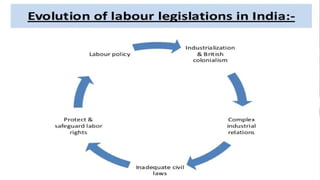
EVOLUTION OF LABOR
LEGISLATION IN INDIA
OBJECTIVE OF LL
PRINCIPLES OF LL
CLASSIFICATION OF LL
About Labor Law
• ‘Labor legislation’ is a body of law formed for
the working class of people to provide them
with legal rights, and also restrict them with
rules and regulations. It defines the rights and
obligations of the working class.
• The emergence of labor laws has its roots in the
18th and 19th centuries. The labor law emerged
as a result of the industrial revolution that took
place in those centuries. The Industrial
Revolution changed the rural culture to
industrial culture which led to various
developments.
• The labor laws were first enacted by the
Western Countries. England was the first
country where workers were exploited by rich
upper-class employers.
About Fabrikam
OUR STORY MISSION PHILOSOPHY PRODUCTS AND
SERVICES
KEY
ACHIEVEMENTS
IMPORTANCE OF LL
 Improve industrial relation i.e. employee-employer relations
and minimize industrial disputes.
 Protects workers from exploitation by the employers or
management.
 Helps workers in getting fair wages.
 Minimize labor unrest.
 Reduces conflicts and strikes etc.
 Ensure job security for worker.
 Fixes rest pauses and work hours etc.
 Provide compensation of workers, who are victims of
accident.
Mission
 What is the reason the
company exists?
 Do you have an official
company mission
statement?
 The evolution of labor laws started with the establishment of the International Labour
Organization (ILO) in 1919. It was due to the implementation of the Treaty of Versailles
whose objective is to make various policies, and programs relating to their works and its
standards. 187 countries of the World are members of this organization whose Constitution
was drafted by the Labor Commission.
 India, also, had labor laws before independence. Some of the laws regarding labor classes
were The Indian Slavery Act, 1843, The Indian Trade Unions Act 1926, and
The Societies Registration Act, 1860. These laws were repealed after India became
independent. The Industrial Disputes Act, 1947, was enacted in 1947 which replaced all
the previous Acts. Various rights of the workers were introduced to the Indian Constitution
for protection from any kind of exploitation.
 Some rights relating to the laborers that were incorporated in the Constitution are equal
work equal pay, abolition of child labor, abolition of bonded labor, decent living wages,
maternity benefits, and right to work, just and human working conditions. These are the
rights of the workers that are being safeguarded by the Indian Constitution working in an
establishment. In the 20th century, these laws were codified and implemented by the
Indian Parliament. With the changing times, labor laws started evolving over some time.
OBJECTIVES OF LABR LAW
The objectives of labor legislations are
two-fold:
•Preservation of the health, safety and
welfare of workers.
•Maintenance of good relations between
employers and employees.
SOCIAL JUSTICE
•The essence of democracy is ensuring social justice to all sections of the
community.
•This demands the protection of those who cannot protect themselves.
•In modern industrial set-up, workers, left to themselves, are unable to
protect their interest Therefore, the State has to intervene to help them by
granting them freedom of association, the power of collective bargaining
and by providing for mediation or arbitration in the case of industrial
conflict.
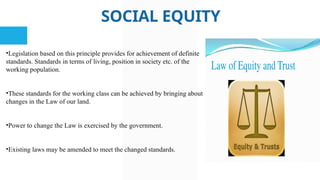
SOCIAL EQUITY
•Legislation based on this principle provides for achievement of definite
standards. Standards in terms of living, position in society etc. of the
working population.
•These standards for the working class can be achieved by bringing about
changes in the Law of our land.
•Power to change the Law is exercised by the government.
•Existing laws may be amended to meet the changed standards.
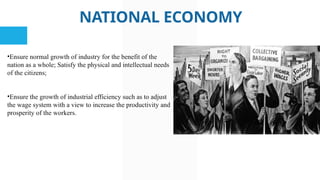
NATIONAL ECONOMY
•Ensure normal growth of industry for the benefit of the
nation as a whole; Satisfy the physical and intellectual needs
of the citizens;
•Ensure the growth of industrial efficiency such as to adjust
the wage system with a view to increase the productivity and
prosperity of the workers.
INTERNATIONAL UNIFORMITY
•Since its inception, securing minimum standards (for the working
population – worldwide) on a uniform basis in respect of all labor
matters has been the main objective of ILO.
•To this end, conventions are passed at the conferences of ILO.
•As a member of the ILO, adopting these conventions would require
appropriate legislation to be brought about.
•The influence of International labor conventions has been
significant in shaping the course of labor legislation in India.
Classification
of Labour Laws
 The various labor legislations can be
classified in a number of ways depending
upon the object of study. For example,
they can be classified on any one of the
following arbitrary bases:
1.Purpose
2.Legislature
3.Period of Enactment
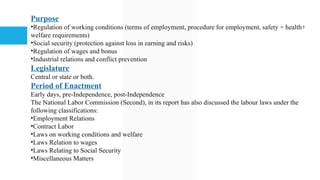
Purpose
•Regulation of working conditions (terms of employment, procedure for employment, safety + health+
welfare requirements)
•Social security (protection against loss in earning and risks)
•Regulation of wages and bonus
•Industrial relations and conflict prevention
Legislature
Central or state or both.
Period of Enactment
Early days, pre-Independence, post-Independence
The National Labor Commission (Second), in its report has also discussed the labour laws under the
following classifications:
•Employment Relations
•Contract Labor
•Laws on working conditions and welfare
•Laws Relation to wages
•Laws Relating to Social Security
•Miscellaneous Matters
Thank you
QUESTIONS?

LABOR LAWS . MODULE-1.pptx pgdm hr specialization

  • 1.
  • 2.
    CONTENT INTRODUCTION IMPORTANCE OF LABOR LAW EVOLUTIONOF LABOR LEGISLATION IN INDIA OBJECTIVE OF LL PRINCIPLES OF LL CLASSIFICATION OF LL
  • 3.
    About Labor Law •‘Labor legislation’ is a body of law formed for the working class of people to provide them with legal rights, and also restrict them with rules and regulations. It defines the rights and obligations of the working class. • The emergence of labor laws has its roots in the 18th and 19th centuries. The labor law emerged as a result of the industrial revolution that took place in those centuries. The Industrial Revolution changed the rural culture to industrial culture which led to various developments. • The labor laws were first enacted by the Western Countries. England was the first country where workers were exploited by rich upper-class employers.
  • 4.
    About Fabrikam OUR STORYMISSION PHILOSOPHY PRODUCTS AND SERVICES KEY ACHIEVEMENTS
  • 5.
    IMPORTANCE OF LL Improve industrial relation i.e. employee-employer relations and minimize industrial disputes.  Protects workers from exploitation by the employers or management.  Helps workers in getting fair wages.  Minimize labor unrest.  Reduces conflicts and strikes etc.  Ensure job security for worker.  Fixes rest pauses and work hours etc.  Provide compensation of workers, who are victims of accident.
  • 6.
    Mission  What isthe reason the company exists?  Do you have an official company mission statement?
  • 7.
     The evolutionof labor laws started with the establishment of the International Labour Organization (ILO) in 1919. It was due to the implementation of the Treaty of Versailles whose objective is to make various policies, and programs relating to their works and its standards. 187 countries of the World are members of this organization whose Constitution was drafted by the Labor Commission.  India, also, had labor laws before independence. Some of the laws regarding labor classes were The Indian Slavery Act, 1843, The Indian Trade Unions Act 1926, and The Societies Registration Act, 1860. These laws were repealed after India became independent. The Industrial Disputes Act, 1947, was enacted in 1947 which replaced all the previous Acts. Various rights of the workers were introduced to the Indian Constitution for protection from any kind of exploitation.  Some rights relating to the laborers that were incorporated in the Constitution are equal work equal pay, abolition of child labor, abolition of bonded labor, decent living wages, maternity benefits, and right to work, just and human working conditions. These are the rights of the workers that are being safeguarded by the Indian Constitution working in an establishment. In the 20th century, these laws were codified and implemented by the Indian Parliament. With the changing times, labor laws started evolving over some time.
  • 8.
    OBJECTIVES OF LABRLAW The objectives of labor legislations are two-fold: •Preservation of the health, safety and welfare of workers. •Maintenance of good relations between employers and employees.
  • 10.
    SOCIAL JUSTICE •The essenceof democracy is ensuring social justice to all sections of the community. •This demands the protection of those who cannot protect themselves. •In modern industrial set-up, workers, left to themselves, are unable to protect their interest Therefore, the State has to intervene to help them by granting them freedom of association, the power of collective bargaining and by providing for mediation or arbitration in the case of industrial conflict.
  • 11.
    SOCIAL EQUITY •Legislation basedon this principle provides for achievement of definite standards. Standards in terms of living, position in society etc. of the working population. •These standards for the working class can be achieved by bringing about changes in the Law of our land. •Power to change the Law is exercised by the government. •Existing laws may be amended to meet the changed standards.
  • 12.
    NATIONAL ECONOMY •Ensure normalgrowth of industry for the benefit of the nation as a whole; Satisfy the physical and intellectual needs of the citizens; •Ensure the growth of industrial efficiency such as to adjust the wage system with a view to increase the productivity and prosperity of the workers.
  • 13.
    INTERNATIONAL UNIFORMITY •Since itsinception, securing minimum standards (for the working population – worldwide) on a uniform basis in respect of all labor matters has been the main objective of ILO. •To this end, conventions are passed at the conferences of ILO. •As a member of the ILO, adopting these conventions would require appropriate legislation to be brought about. •The influence of International labor conventions has been significant in shaping the course of labor legislation in India.
  • 15.
    Classification of Labour Laws The various labor legislations can be classified in a number of ways depending upon the object of study. For example, they can be classified on any one of the following arbitrary bases: 1.Purpose 2.Legislature 3.Period of Enactment
  • 16.
    Purpose •Regulation of workingconditions (terms of employment, procedure for employment, safety + health+ welfare requirements) •Social security (protection against loss in earning and risks) •Regulation of wages and bonus •Industrial relations and conflict prevention Legislature Central or state or both. Period of Enactment Early days, pre-Independence, post-Independence The National Labor Commission (Second), in its report has also discussed the labour laws under the following classifications: •Employment Relations •Contract Labor •Laws on working conditions and welfare •Laws Relation to wages •Laws Relating to Social Security •Miscellaneous Matters
  • 17.