Attracting the Audience
By Rosa Peck
In order to ensure we satisfied our audience’s
expectations we carried out a pre-production
survey on the programme ‘Survey Monkey’,
which allowed us to successfully layout our
document and distribute it to receive a sufficient
amount.
The questions we asked in the ‘Genre
Survey’ were:
• What is your gender?
• What is your age?
• What genre was the last film you watched?
• What was the last genre of film you watched
at the cinema?
• What is your favourite type of genre?
• What is your least favourite type of genre?
• What is your favourite film?
The questions we asked in the context
survey were:
•What is your age?
•What is your gender?
•Does your film appeal to you more if you can
relate to it?
•When choosing a film what do you look for?
•Do you prefer stereotypical characters or non-
conventional characters?
•What time period do you like a film to be set in?
In our results we got 45% male responses and 55%
female responses, with the most popular age range
being 16-20, closely followed by 21-25.
The largest percentage on favourite type of genre
was Rom Com with 25% of people voting, however,
we chose not to produce a Rom Com due to the fact
that we believed that it would be too difficult to
present it in an accurate, realistic way.
We looked at the second most popular genre
which was 19% Thriller. This was not a huge
majority, however looking at the answers to the
question ‘What was the last genre of film you
watched at the cinema?’ Thriller was the most
popular. Due to the fact we want our film to go
to cinemas, we decided on a Thriller genre.
After our rough cut was improved with some of
the suggestions the audience members gave us.
We showed our film to 5 males and 5 females
and asked them questions at the end such as:
• ‘Was the genre and storyline clear?’
• ‘Would you pay to watch this film?’
• ‘Is this opening tense enough?’
• ‘Would you carry on watching the film?’
• ‘Have you got any improvements?
A mixture of responses were given back to us, mostly being
positive, however a few criticisms were made. These include:
The music being at the same sound level throughout. Taking
this on bored we used a tool on Serif Movie Plus X6, which
alters the loudness of the sound. I suggested that on the shots
where tension should be created, it was key to raise the sound
of the music.
The other improvement was that there needed to be a
variation (this was an unclear comment, however it became
clear that the male critic meant that it would be an
improvement if a variety of shots were used.) Taking this on
board, we added more close ups and extreme close up shots,
which in our research was a common convention of a Thriller
film.
These two criticisms made vast improvements
to our opening scene as a whole, and when
showing the same audience the final cut, they
all agreed that they would want to carry on
watching the film and that it was a lot better
than it was in the rough cut, which was
essential.
The fact that we used the target audience and
the secondary audience as our rough cut
audience was helpful as we were able to get
improvements from both audiences. Also the
fact that both audiences said that they would
pay to watch our film was very satisfying seeing
as we knew that the film appealed to more than
just our focus group.
The mise en scene of our film opening was
realistic. The setting being a normal middle class
house, was relatable for many of our rough cut
viewing members, but also would be relatable
to the audience members of the whole film.
The props and costume used in our opening
were stereotypical for a teenage girl- our target
audience. Some of these props include a pink
hair dryer, an iPhone 5S and a pair on pink
slippers. Seeing as most of our target audience
members would have all three of these props, it
was very obvious that they were able to relate
to our main character- Emily.
This easy relation was key for us seeing as this
would make the future events more affecting.
The area where we challenged the stereotype of
a thriller film was our lighting. Using high key
lighting instead of (a typical thriller film’s) low
key lighting, enabled a realistic atmosphere,
enabling, again, for the audience to relate the
character and the situation, making the future
events, again, more impactful.
One narrative theory: Propps’ (theorist) who
came up with 8 character types based on folk
tales and legends that he studied from different
countries. He found that they were all quite
similar and that they seemed to be about the
same basic problems and the same types of
character kept cropping up. He focused on the
way there seemed to be different ‘types’ of
characters rather than individuals. He
recognised 8 character types:
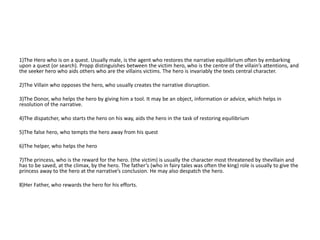
1)The Hero who is on a quest. Usually male, is the agent who restores the narrative equilibrium often by embarking
upon a quest (or search). Propp distinguishes between the victim hero, who is the centre of the villain’s attentions, and
the seeker hero who aids others who are the villains victims. The hero is invariably the texts central character.
2)The Villain who opposes the hero, who usually creates the narrative disruption.
3)The Donor, who helps the hero by giving him a tool. It may be an object, information or advice, which helps in
resolution of the narrative.
4)The dispatcher, who starts the hero on his way, aids the hero in the task of restoring equilibrium
5)The false hero, who tempts the hero away from his quest
6)The helper, who helps the hero
7)The princess, who is the reward for the hero. (the victim) is usually the character most threatened by thevillain and
has to be saved, at the climax, by the hero. The father’s (who in fairy tales was often the king) role is usually to give the
princess away to the hero at the narrative’s conclusion. He may also despatch the hero.
8)Her Father, who rewards the hero for his efforts.
Due to the fact our characters related to some
of Propps’ theory, we thought we should use
these character types, we used number 2) who
is the stalker, and number 7) who is our victim-
Emily.
Strauss believed that the way we understand words depends not so much on
any meanings they themselves directly contain, but more by our
understanding between the word itself and their ‘opposite’- Binary Opposites.
An example of Binary Opposites is the understanding of the word ‘Villain’
depends on the difference between that word and the opposing word- ‘Hero’.
Many Thrillers include Binary Opposites, for example characters being ‘sane
or insane’ or ‘good or evil’. An example in films of ‘good or evil’ is in Harry
Potter, where Voldermort who is seen as ‘evil’ wants the ‘good’ character
Harry dead. This is a Binary Opposite, and these opposites are emphasised in
the way that they look- Harry looking like a normal teenage boy, and
Voldermort looking scary. This fits in with our film, with Emily being and
looking like a normal teenage girl, and the stalker wearing dark colours and
looking suspicious. The connection that both the ‘good’ characters are
teenagers is interesting, as a stereotype of a teenager is the fact they can be
naïve, which could suggest the fact that being ‘good’ makes you inferior the
‘evil’ character.
Roland Barthes’ Semantic Code (SEM), refers to the
connotation within the story that gives additional
meaning over the basic denotative meaning of the
word. The Symbolic code is very similar to the
Semantic Code, but acts at a wider level, organising
semantic meanings into broader and deeper sets of
meaning. The sign is an object that has no meaning,
for example the mobile phone. However, the
meaning it actually carries- the messages from the
stalker, signals the danger and obsession.

Attracting the audience

  • 1.
  • 2.
    In order toensure we satisfied our audience’s expectations we carried out a pre-production survey on the programme ‘Survey Monkey’, which allowed us to successfully layout our document and distribute it to receive a sufficient amount.
  • 3.
    The questions weasked in the ‘Genre Survey’ were: • What is your gender? • What is your age? • What genre was the last film you watched? • What was the last genre of film you watched at the cinema? • What is your favourite type of genre? • What is your least favourite type of genre? • What is your favourite film?
  • 4.
    The questions weasked in the context survey were: •What is your age? •What is your gender? •Does your film appeal to you more if you can relate to it? •When choosing a film what do you look for? •Do you prefer stereotypical characters or non- conventional characters? •What time period do you like a film to be set in?
  • 5.
    In our resultswe got 45% male responses and 55% female responses, with the most popular age range being 16-20, closely followed by 21-25. The largest percentage on favourite type of genre was Rom Com with 25% of people voting, however, we chose not to produce a Rom Com due to the fact that we believed that it would be too difficult to present it in an accurate, realistic way.
  • 6.
    We looked atthe second most popular genre which was 19% Thriller. This was not a huge majority, however looking at the answers to the question ‘What was the last genre of film you watched at the cinema?’ Thriller was the most popular. Due to the fact we want our film to go to cinemas, we decided on a Thriller genre.
  • 7.
    After our roughcut was improved with some of the suggestions the audience members gave us. We showed our film to 5 males and 5 females and asked them questions at the end such as:
  • 8.
    • ‘Was thegenre and storyline clear?’ • ‘Would you pay to watch this film?’ • ‘Is this opening tense enough?’ • ‘Would you carry on watching the film?’ • ‘Have you got any improvements?
  • 9.
    A mixture ofresponses were given back to us, mostly being positive, however a few criticisms were made. These include: The music being at the same sound level throughout. Taking this on bored we used a tool on Serif Movie Plus X6, which alters the loudness of the sound. I suggested that on the shots where tension should be created, it was key to raise the sound of the music. The other improvement was that there needed to be a variation (this was an unclear comment, however it became clear that the male critic meant that it would be an improvement if a variety of shots were used.) Taking this on board, we added more close ups and extreme close up shots, which in our research was a common convention of a Thriller film.
  • 10.
    These two criticismsmade vast improvements to our opening scene as a whole, and when showing the same audience the final cut, they all agreed that they would want to carry on watching the film and that it was a lot better than it was in the rough cut, which was essential.
  • 11.
    The fact thatwe used the target audience and the secondary audience as our rough cut audience was helpful as we were able to get improvements from both audiences. Also the fact that both audiences said that they would pay to watch our film was very satisfying seeing as we knew that the film appealed to more than just our focus group.
  • 12.
    The mise enscene of our film opening was realistic. The setting being a normal middle class house, was relatable for many of our rough cut viewing members, but also would be relatable to the audience members of the whole film.
  • 13.
    The props andcostume used in our opening were stereotypical for a teenage girl- our target audience. Some of these props include a pink hair dryer, an iPhone 5S and a pair on pink slippers. Seeing as most of our target audience members would have all three of these props, it was very obvious that they were able to relate to our main character- Emily.
  • 14.
    This easy relationwas key for us seeing as this would make the future events more affecting. The area where we challenged the stereotype of a thriller film was our lighting. Using high key lighting instead of (a typical thriller film’s) low key lighting, enabled a realistic atmosphere, enabling, again, for the audience to relate the character and the situation, making the future events, again, more impactful.
  • 15.
    One narrative theory:Propps’ (theorist) who came up with 8 character types based on folk tales and legends that he studied from different countries. He found that they were all quite similar and that they seemed to be about the same basic problems and the same types of character kept cropping up. He focused on the way there seemed to be different ‘types’ of characters rather than individuals. He recognised 8 character types:
  • 16.
    1)The Hero whois on a quest. Usually male, is the agent who restores the narrative equilibrium often by embarking upon a quest (or search). Propp distinguishes between the victim hero, who is the centre of the villain’s attentions, and the seeker hero who aids others who are the villains victims. The hero is invariably the texts central character. 2)The Villain who opposes the hero, who usually creates the narrative disruption. 3)The Donor, who helps the hero by giving him a tool. It may be an object, information or advice, which helps in resolution of the narrative. 4)The dispatcher, who starts the hero on his way, aids the hero in the task of restoring equilibrium 5)The false hero, who tempts the hero away from his quest 6)The helper, who helps the hero 7)The princess, who is the reward for the hero. (the victim) is usually the character most threatened by thevillain and has to be saved, at the climax, by the hero. The father’s (who in fairy tales was often the king) role is usually to give the princess away to the hero at the narrative’s conclusion. He may also despatch the hero. 8)Her Father, who rewards the hero for his efforts.
  • 17.
    Due to thefact our characters related to some of Propps’ theory, we thought we should use these character types, we used number 2) who is the stalker, and number 7) who is our victim- Emily.
  • 18.
    Strauss believed thatthe way we understand words depends not so much on any meanings they themselves directly contain, but more by our understanding between the word itself and their ‘opposite’- Binary Opposites. An example of Binary Opposites is the understanding of the word ‘Villain’ depends on the difference between that word and the opposing word- ‘Hero’. Many Thrillers include Binary Opposites, for example characters being ‘sane or insane’ or ‘good or evil’. An example in films of ‘good or evil’ is in Harry Potter, where Voldermort who is seen as ‘evil’ wants the ‘good’ character Harry dead. This is a Binary Opposite, and these opposites are emphasised in the way that they look- Harry looking like a normal teenage boy, and Voldermort looking scary. This fits in with our film, with Emily being and looking like a normal teenage girl, and the stalker wearing dark colours and looking suspicious. The connection that both the ‘good’ characters are teenagers is interesting, as a stereotype of a teenager is the fact they can be naïve, which could suggest the fact that being ‘good’ makes you inferior the ‘evil’ character.
  • 19.
    Roland Barthes’ SemanticCode (SEM), refers to the connotation within the story that gives additional meaning over the basic denotative meaning of the word. The Symbolic code is very similar to the Semantic Code, but acts at a wider level, organising semantic meanings into broader and deeper sets of meaning. The sign is an object that has no meaning, for example the mobile phone. However, the meaning it actually carries- the messages from the stalker, signals the danger and obsession.