Attracting & Retaining Demand Planning & Forecasting Talent Jason Breault Managing Director March 1, 2011
Who would have guessed? … he hits shots no self-respecting professional golfer would ever admit to … [he] seems relieved just to get off the first tee without embarrassing himself
A lot has changed Reporting structure of supply chain Appreciation of the financial impact supply chain offers CEO’s crediting supply chain as a key enabler of performance & strategy in annual reports Growth of big box retailing & e-commerce have placed increased attention on the consumer shopping experience, shifting the balance of power from manufacturer to retailer.
How has the recession affected your business? Companies outsourcing more (plants, DC’s, etc) Retailers have been driving down inventories & cutting SKU’s Private label vs. branded wars
Current supply chain landscape Priorities* Improve efficiency / productivity Reduce operating costs Top barriers to achieving supply chain goals* Forecast accuracy / demand variability Supply chain network complexity Lack of internal cross-functional collaboration & visibility * Source: Annual (2010) Gartner Supply Chain Study
How have recent market trends affected forecasting your business? Consumer buying shifts have turned traditional models upside down The moment of truth has moved from the shelf to coupon clipping at the kitchen table or on the laptop or i-Phone Statistical models based on history are not keeping pace with the speed in consumer changes Do we have enough models/algorithms? Are they being proactively tuned? (if not automatically in the tool itself) Traditional trade and advertising spend are not delivering the same ROI’s anymore It used to be the Oprah effect.  Now, what role will social media play?   Retailers are changing their inventory patterns Suppliers may not be as dependable if cash strapped
How have recent market trends affected forecasting your business? Long lead time raw materials and cost of commodities are becoming harder to predict  Food & product safety concerns are changing consumer and customer behavior “ Recession-proof” industries no longer seem so recession proof Fuel costs – are they artificially low and will they drive more domestic collaboration? What have we learned – what about risks like a terrorist attack, Icelandic volcanoes, US inflation, etc.
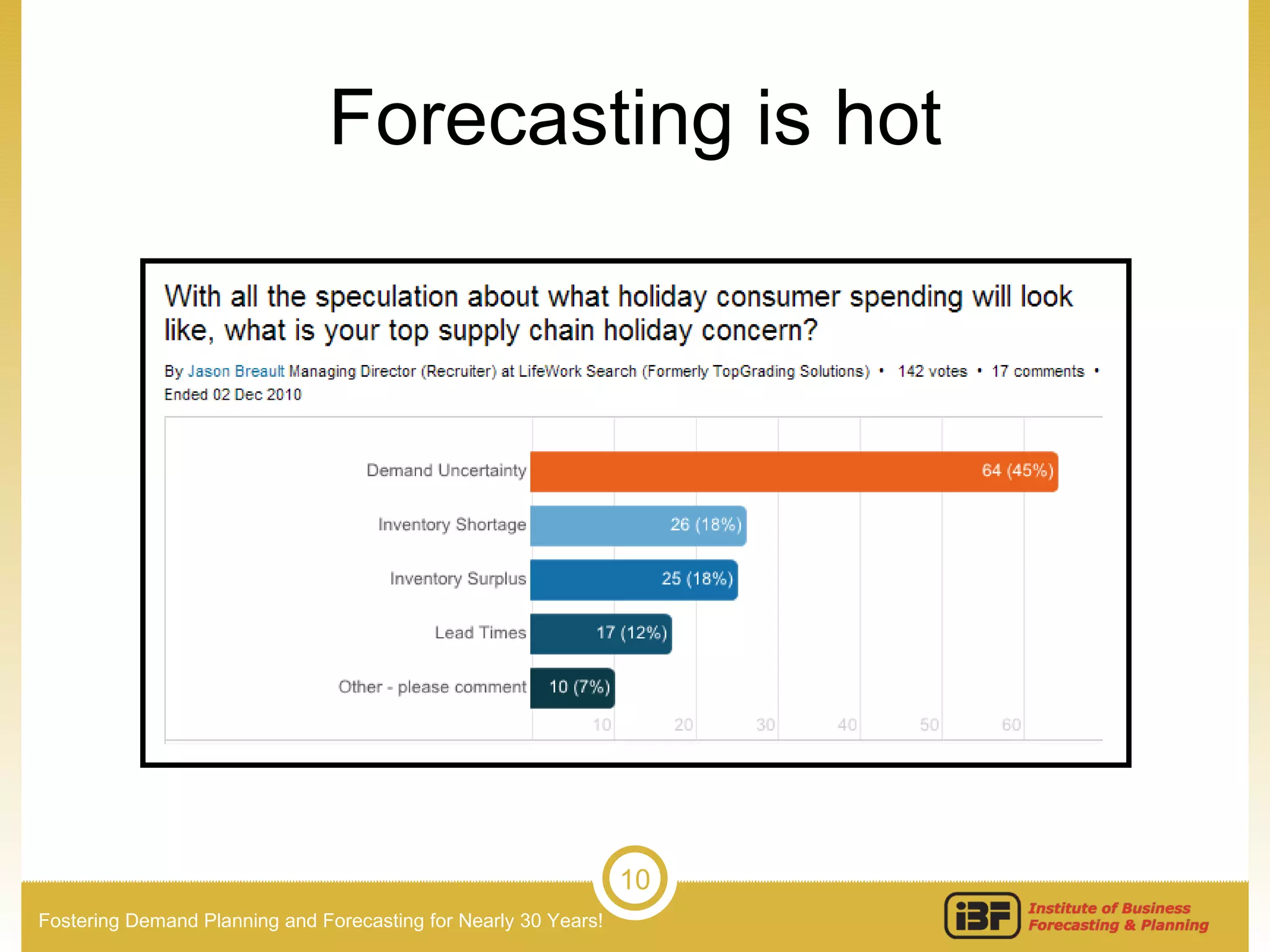
Forecasting is hot Executives want better information and cross functional groups are ready to “partner” again Lots of job stability Companies building processes from scratch Hearing about a lot of requests for software
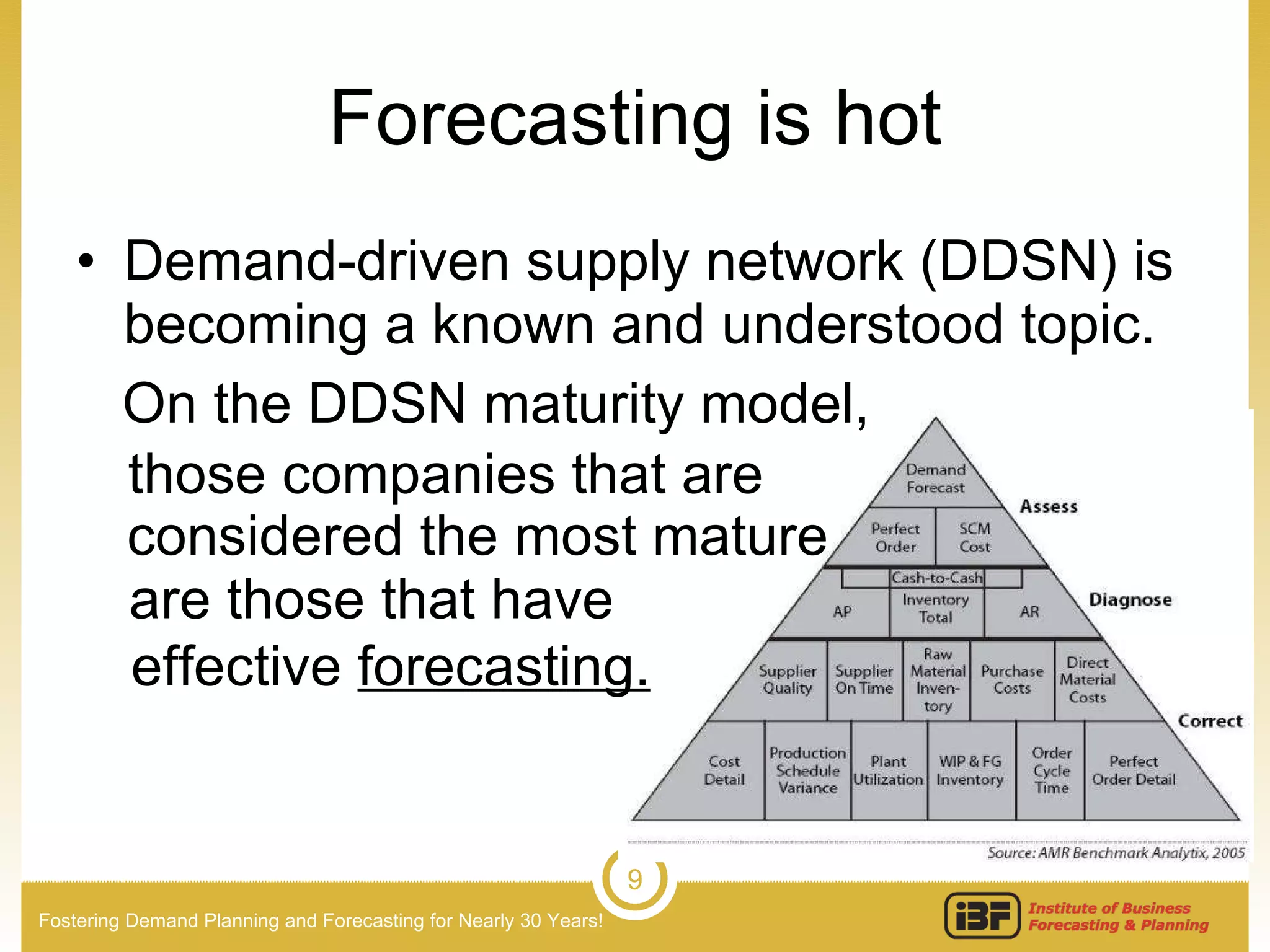
Forecasting is hot Demand-driven supply network (DDSN) is becoming a known and understood topic.  On the DDSN maturity model,  those companies that are considered the most mature are those that have effective  forecasting.
Forecasting is hot
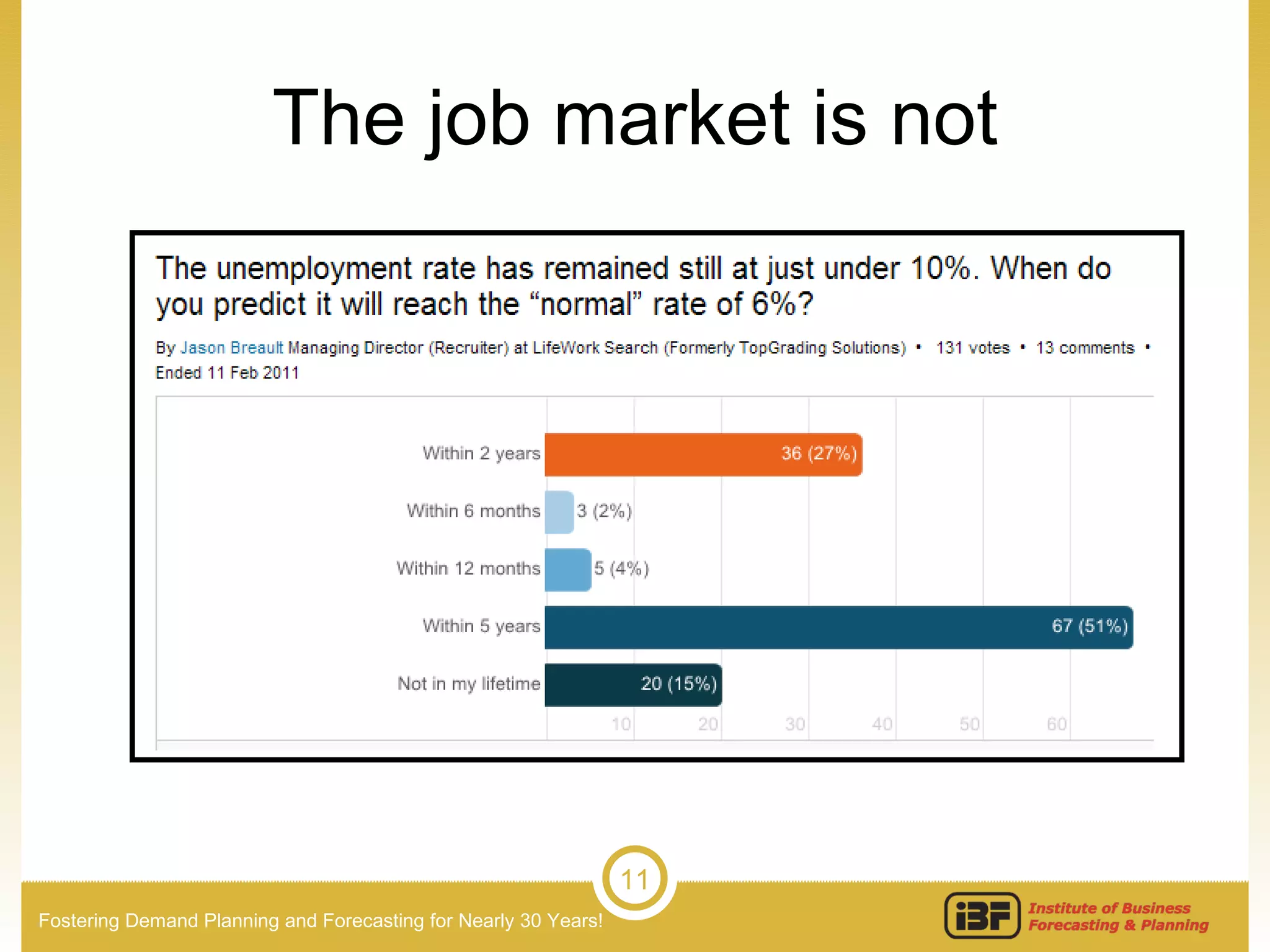
The job market is not
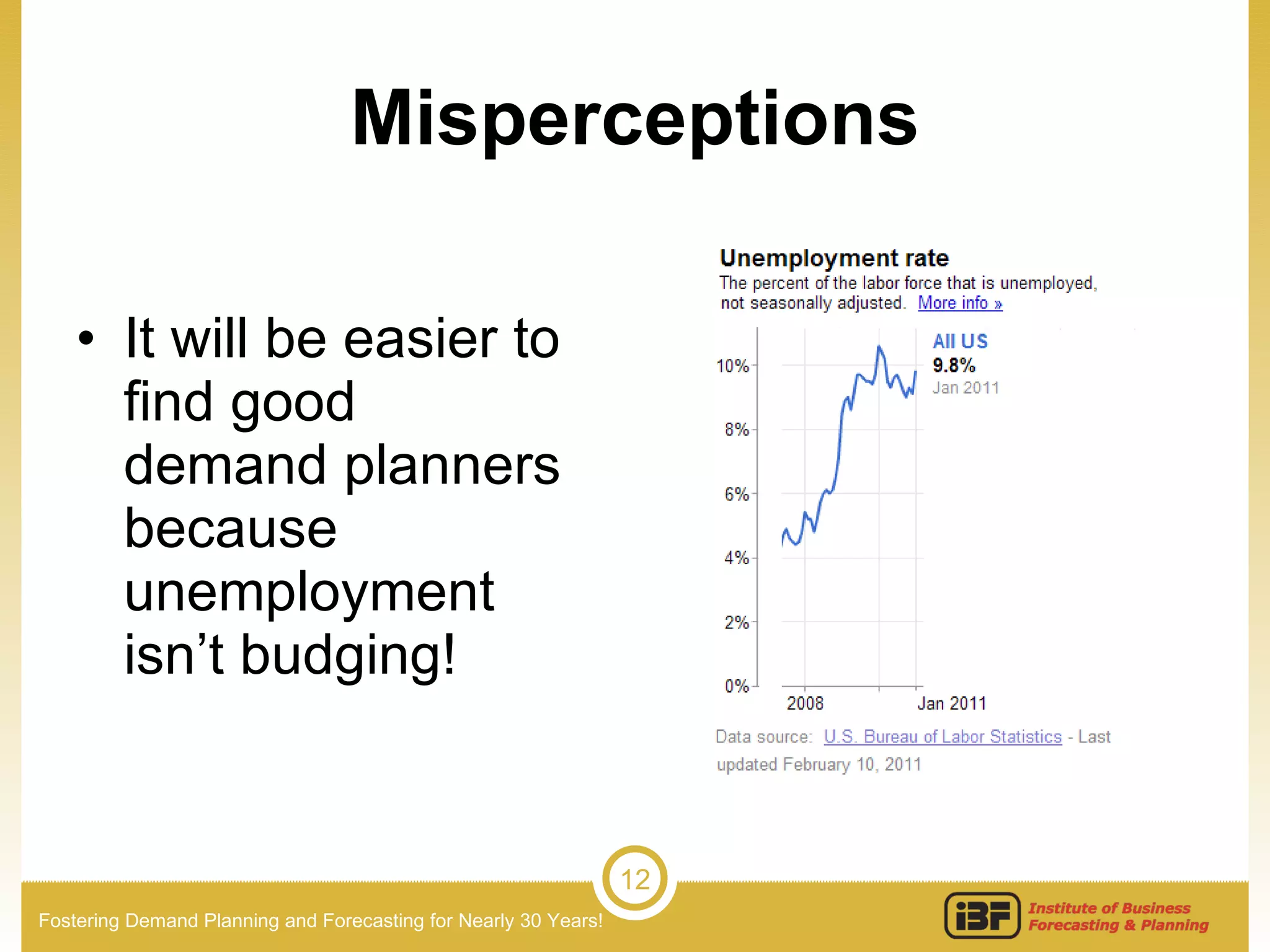
Misperceptions It will be easier to find good demand planners because unemployment isn’t budging!
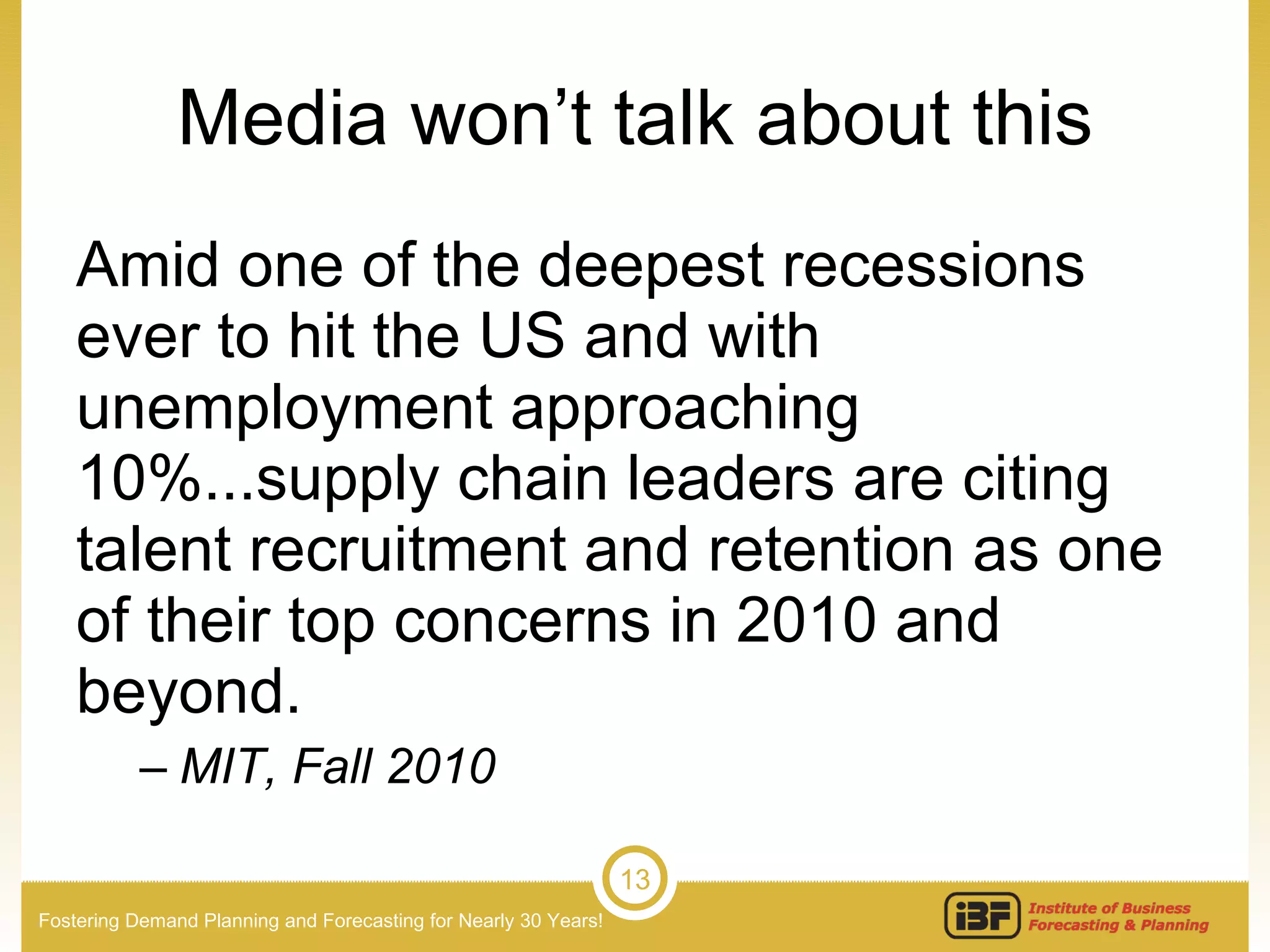
Media won’t talk about this Amid one of the deepest recessions ever to hit the US and with unemployment approaching 10%...supply chain leaders are citing talent recruitment and retention as one of their top concerns in 2010 and beyond. MIT, Fall 2010
Strong Demand Planners are hard to find and increasingly difficult to retain Demand Planning skills required are changing Managing 4 generations can become workplace warfare Smart companies are hanging on and valuing these skills or making counter offers (14-28 day counter) Why is hiring, on-boarding and career-pathing of demand planners so important?
Forecasting talent shortfall Is the profession growing or the skill set shrinking? How does geography play a role? Does technology help or hinder the experience level of a demand planner? Are companies investing in technology or holding back but expecting more from individuals? Technology sophistication has increased, and the pressure to reduce  supply chain costs and working capital has increased,  yet there is an overall shortfall in demand planning skills and talent!
Current State of demand planning organizations The organizational capabilities, the processes, and the tools are at varying levels of sophistication in companies Applies to retailers and manufacturers  More is being expected of demand planners, and the supply chain in general, as the economy has put significant pressure on business results
Skills required to be an effective  demand planner Analytical Skills  Dealing with Ambiguity Communication Skills Interpersonal Savvy Ability to build cross functional relationships & influence a variety of disciplines Command skills Can encourage direct and tough debate Technological Savvy & Systems Aptitude Often strong analytical skills, communication or command skills, and  dealing with ambiguity are hard to find combinations in the same person
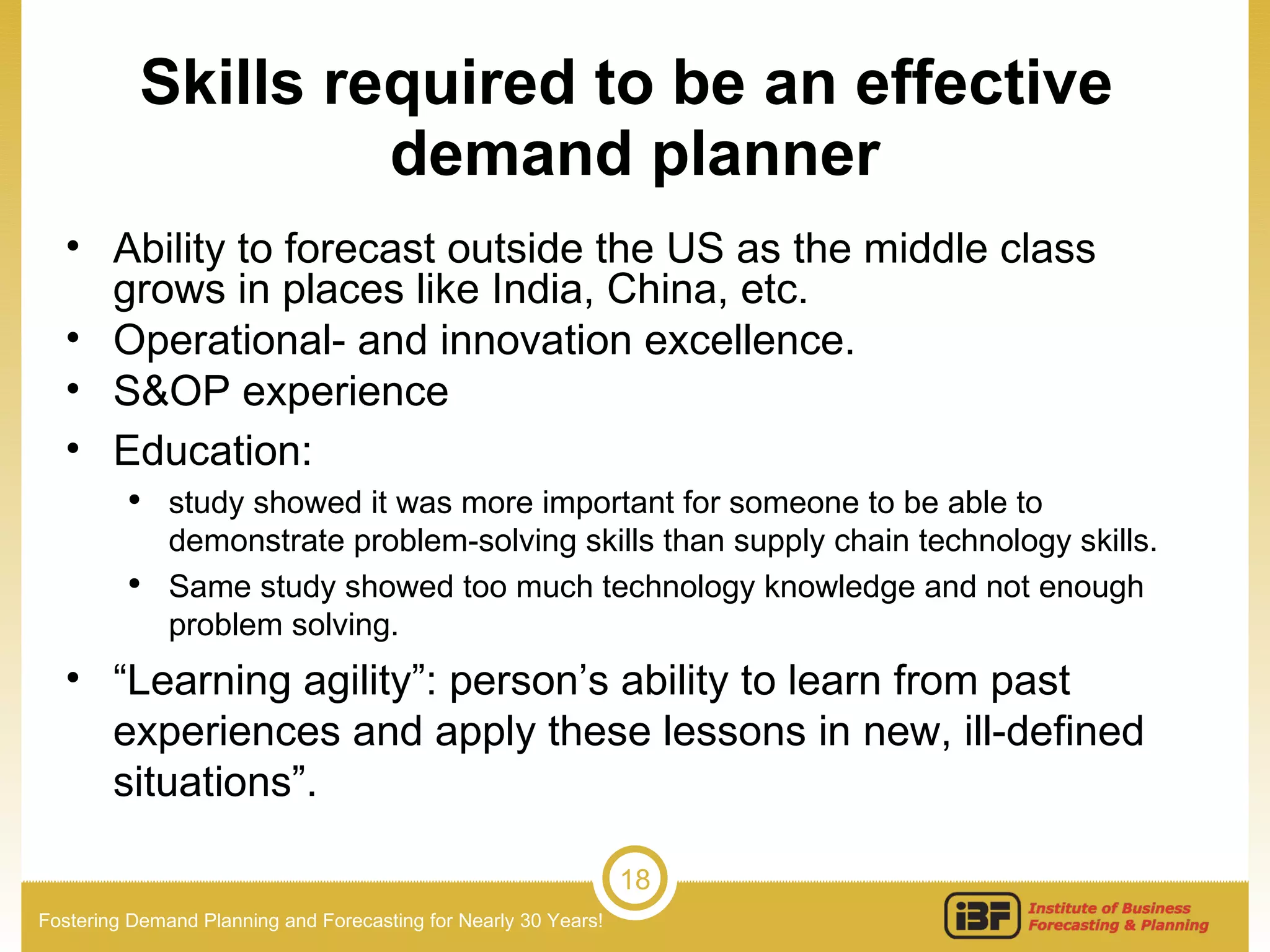
Skills required to be an effective  demand planner Ability to forecast outside the US as the middle class grows in places like India, China, etc. Operational- and innovation excellence. S&OP experience Education:   study showed it was more important for someone to be able to demonstrate problem-solving skills than supply chain technology skills.  Same study showed too much technology knowledge and not enough problem solving. “ Learning agility”: person’s ability to learn from past experiences and apply these lessons in new, ill-defined situations”.
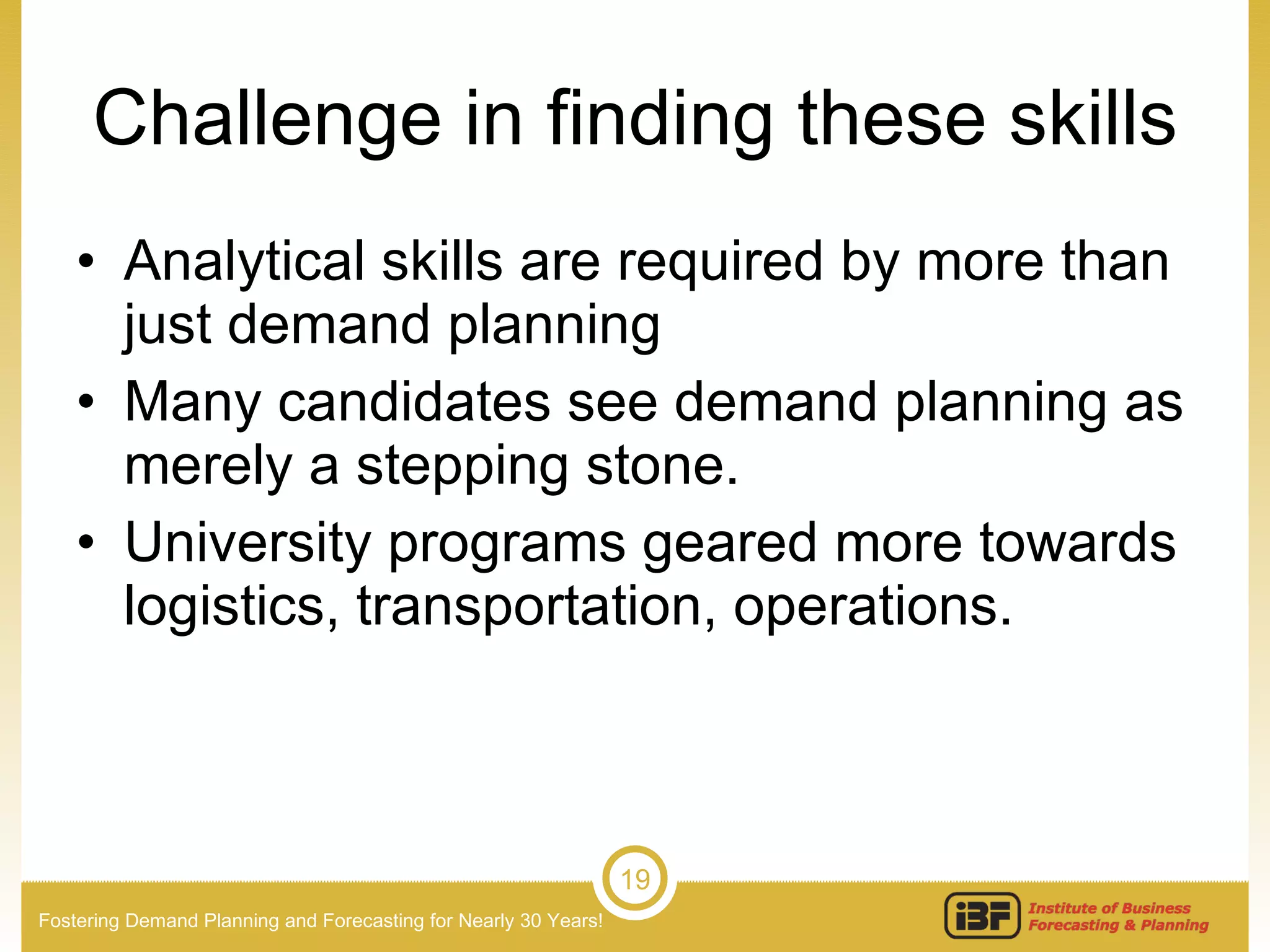
Challenge in finding these skills Analytical skills are required by more than just demand planning Many candidates see demand planning as merely a stepping stone. University programs geared more towards logistics, transportation, operations.
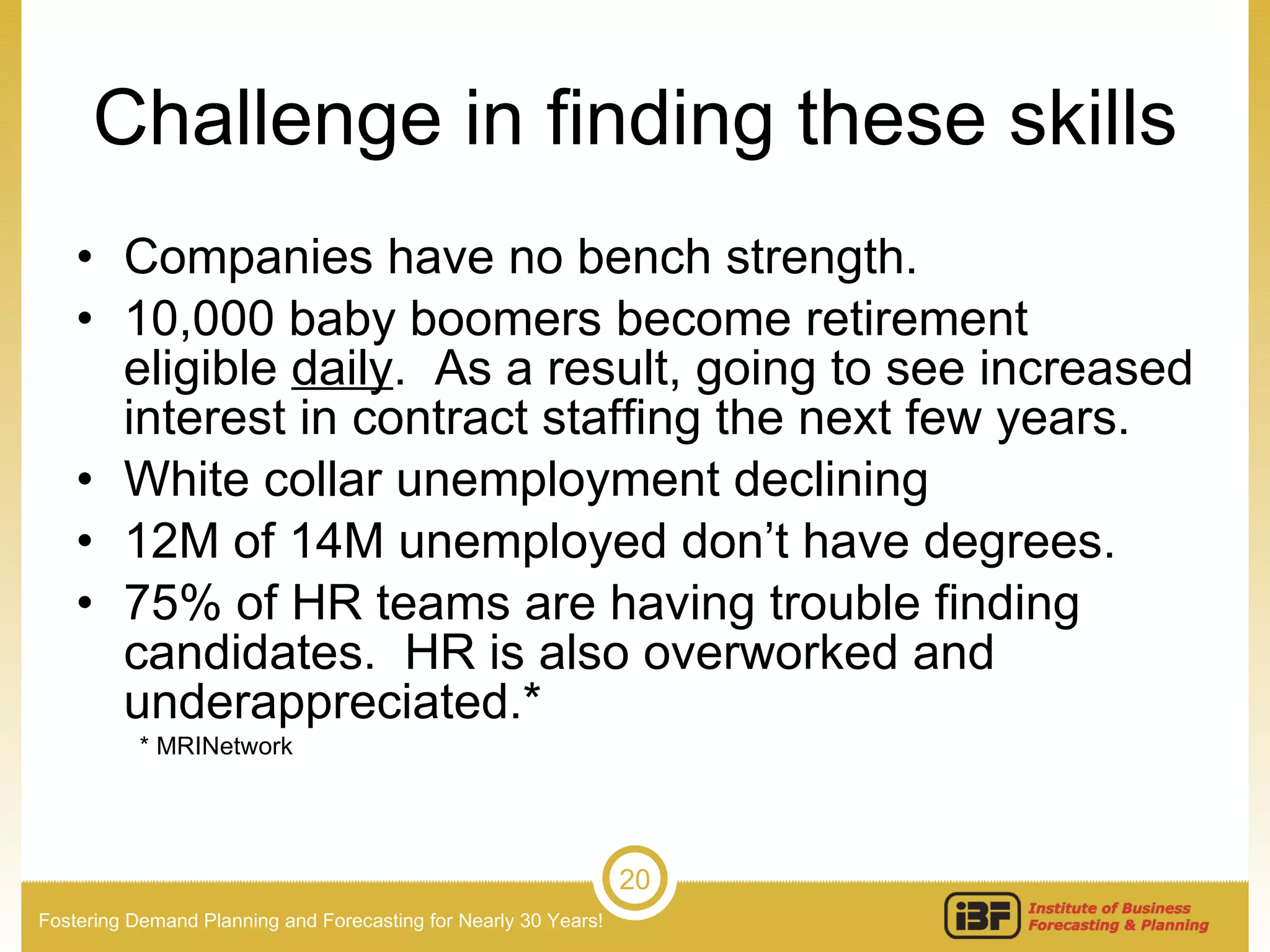
Challenge in finding these skills Companies have no bench strength.  10,000 baby boomers become retirement eligible  daily .  As a result, going to see increased interest in contract staffing the next few years. White collar unemployment declining 12M of 14M unemployed don’t have degrees. 75% of HR teams are having trouble finding candidates.  HR is also overworked and underappreciated.* * MRINetwork
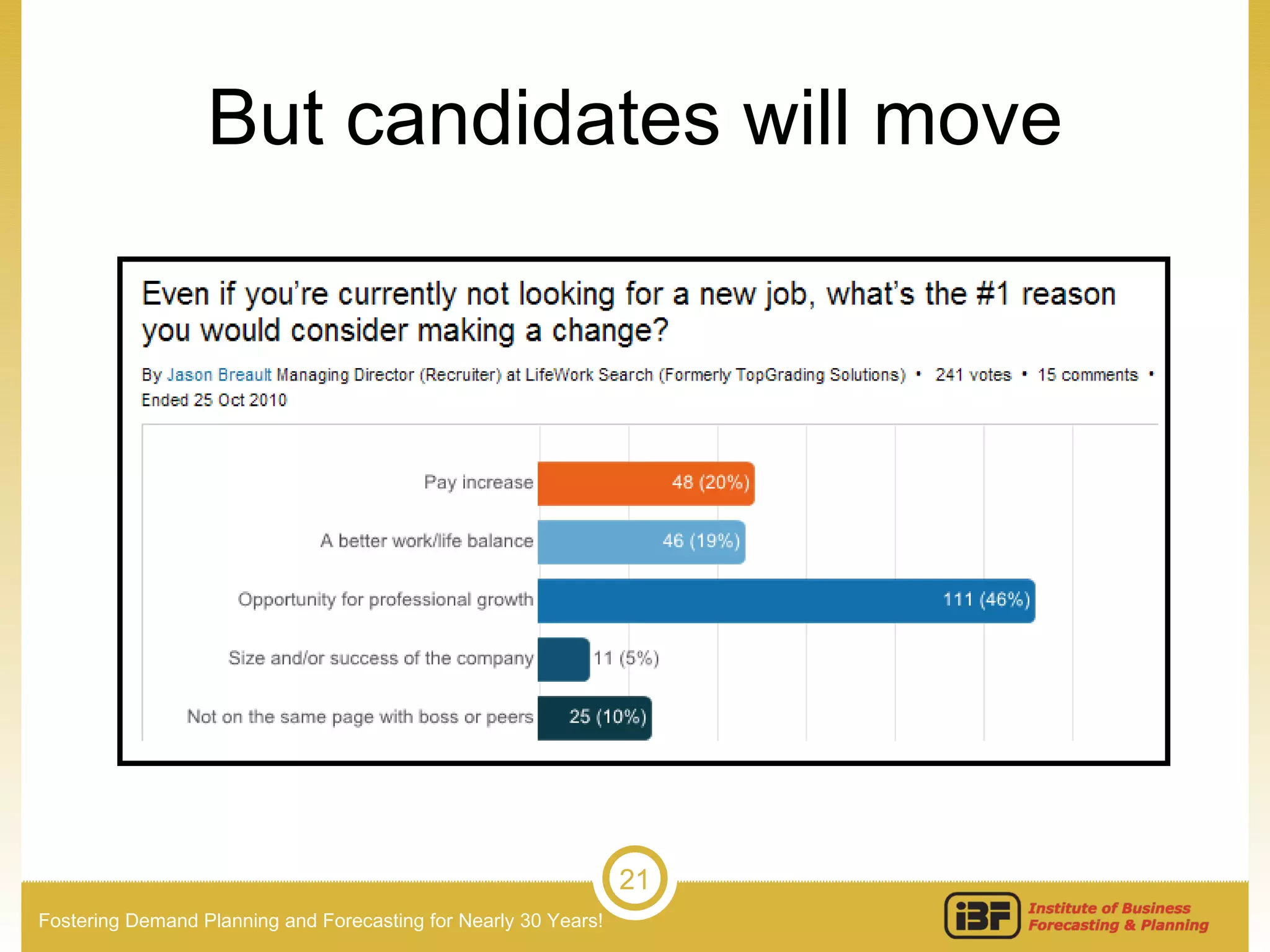
But candidates will move
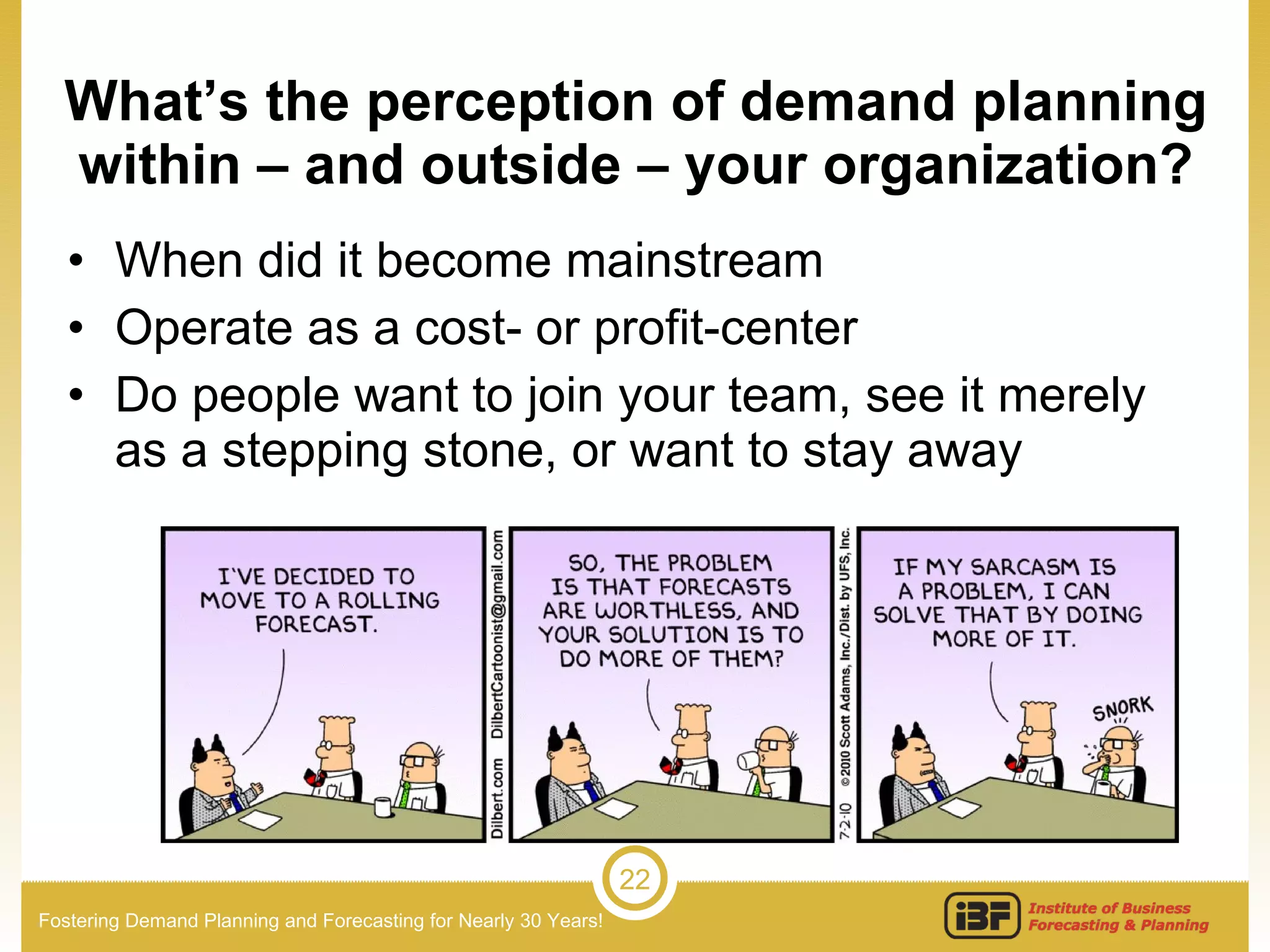
What’s the perception of demand planning within – and outside – your organization? When did it become mainstream Operate as a cost- or profit-center Do people want to join your team, see it merely as a stepping stone, or want to stay away
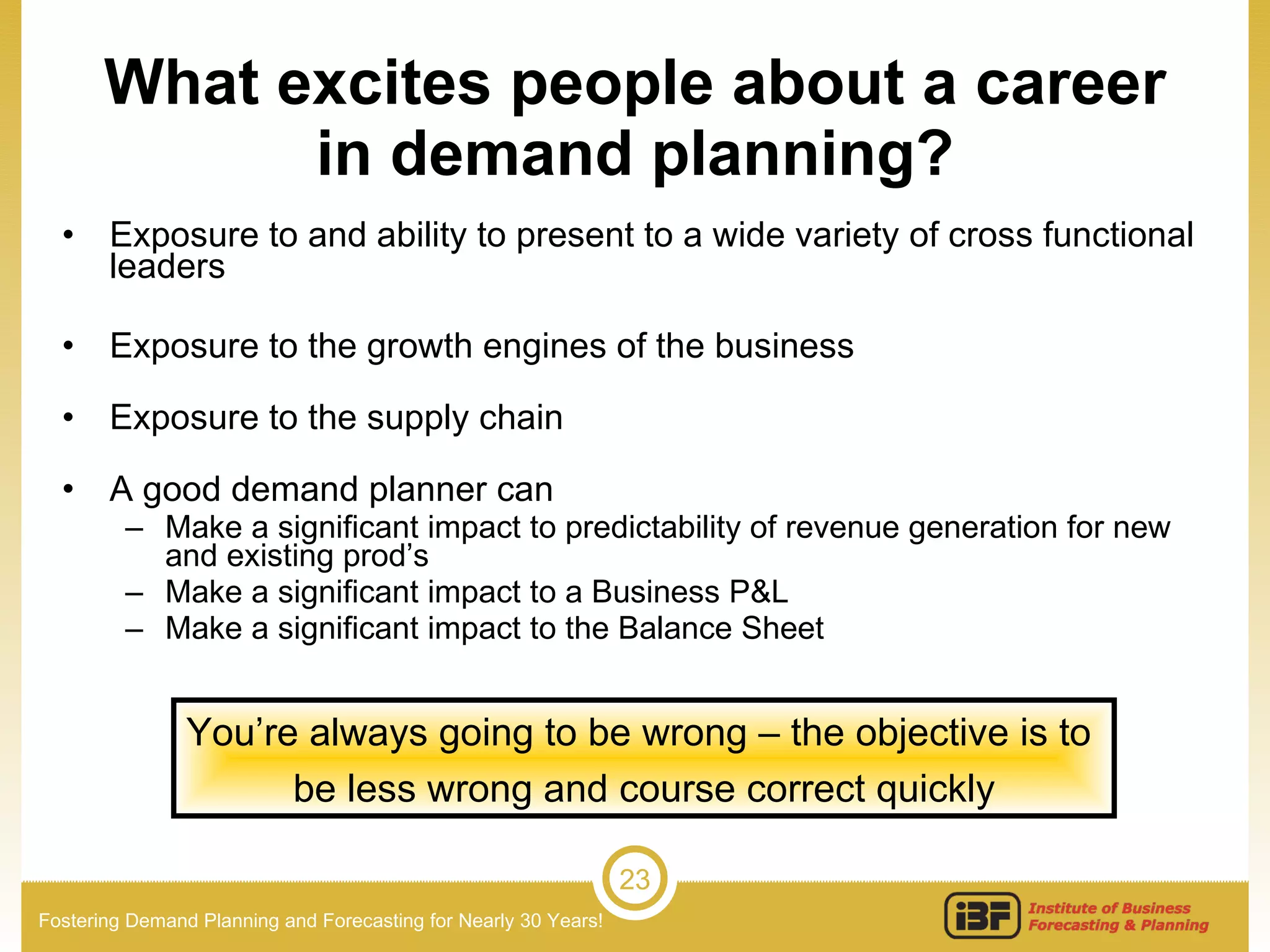
What excites people about a career in demand planning? Exposure to and ability to present to a wide variety of cross functional leaders Exposure to the growth engines of the business Exposure to the supply chain A good demand planner can Make a significant impact to predictability of revenue generation for new and existing prod’s Make a significant impact to a Business P&L Make a significant impact to the Balance Sheet You’re always going to be wrong – the objective is to  be less wrong and course correct quickly
What’s causing turnover & retention issues? The large amount of data manipulation using excel spreadsheets Lack of effective report generation tools DP’s are often the ones asked to generate reports to Mkt’g/Merchandising  Lack of common processes & technologies Lack of senior leadership support for S&OP Perception that companies do not value the importance of improved forecasting Much of demand planner burn-out comes from:
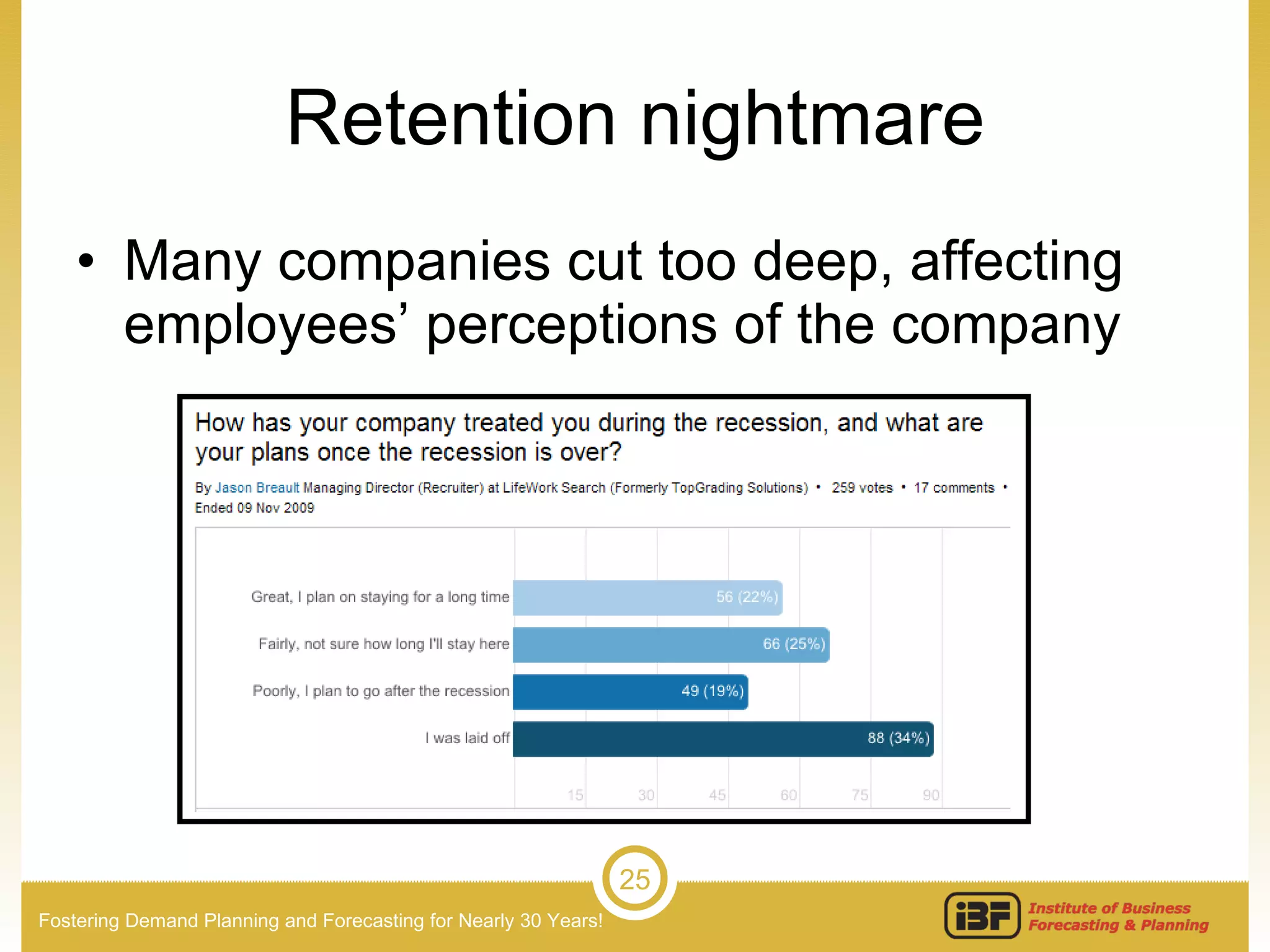
Retention nightmare Many companies cut too deep, affecting employees’ perceptions of the company
How to keep people in demand planning longer Demonstrate that the role is on par with or even more significant than marketers, sales, merchandisers Ensure a culture that encourages debate around difficult topics Have a tiered structure & career path to aspire to and also a way into other parts of the organization: Create manager levels beneath the Directors for growth and people mgm’t experience Future roles can be in supply chain, marketing, sales Create incentives around business performance Invest in training, education and certification to build the skills  Companies are going to have to visibly communicate the value of the roles within their organizations:
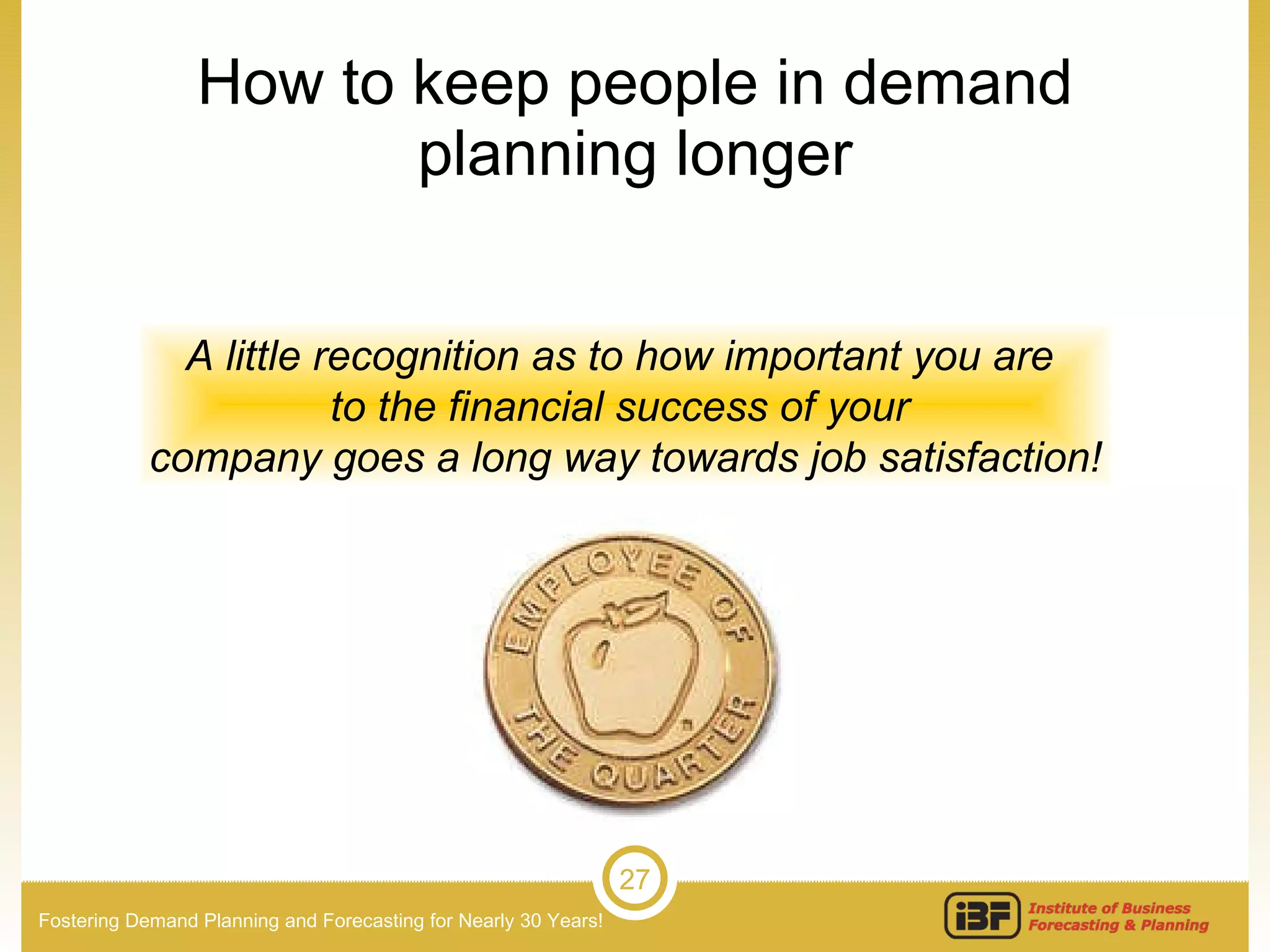
How to keep people in demand planning longer A little recognition as to how important you are  to the financial success of your  company goes a long way towards job satisfaction!
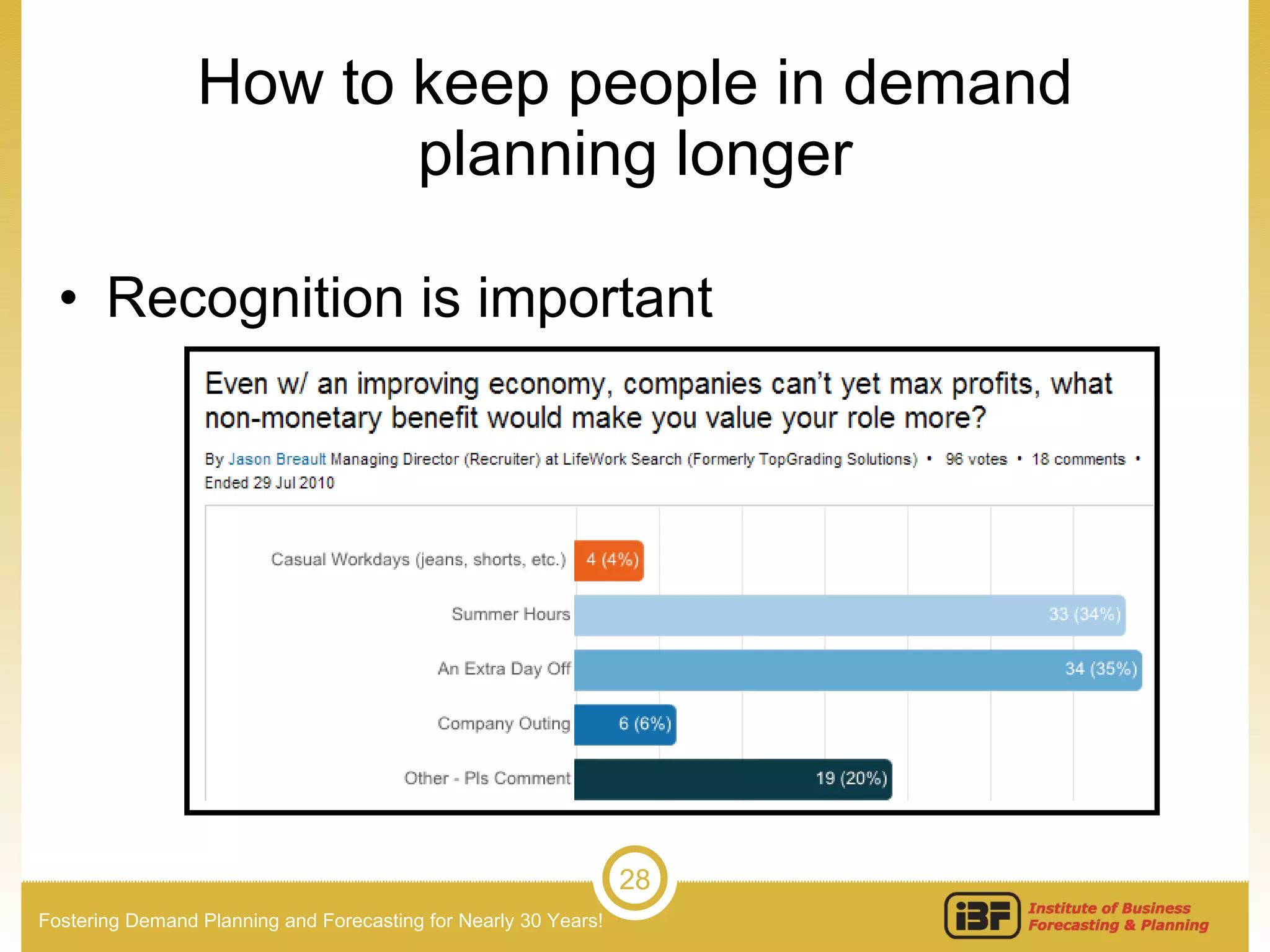
How to keep people in demand planning longer Recognition is important
What are you doing to ensure the team grows and gains the skills of the DP of the future? Training & Education Individual capabilities Building business skills so a DP can relate to various functions Program to build management competencies Process Training on 6 Sigma Continuous Improvement Skills Training Exposure to forecasting process improvements externally Technology Investment in training on the current and future tool Succession pipeline from other parts of the organization
What other parts of the organization are demand planners coming from?  Operational Excellence / 6-Sigma Team Supply Planning Sales and Sales Planning Marketing Consumer/Customer Insights Departments Project Management Organizations
How are you ensuring a constant flow of talent into your organization? Alma maters Industry associations IBF, APICS, CSCMP Formal partnerships with Colleges, Universities Intern pool at specific colleges & universities 6 Sigma Organizations Networking & visibility at Supply Chain events Consultants Social Networking Going with the flow or standing out? What type of manager are you?
Industry differences in talent Retailers have stepped up improvements in demand planning over the past 2-3 years Adopting the consumer goods capabilities and moving into more process and technological sophistication The evolution will be the capability of demand planners to provide insights back and forth between manufacturers & retailers
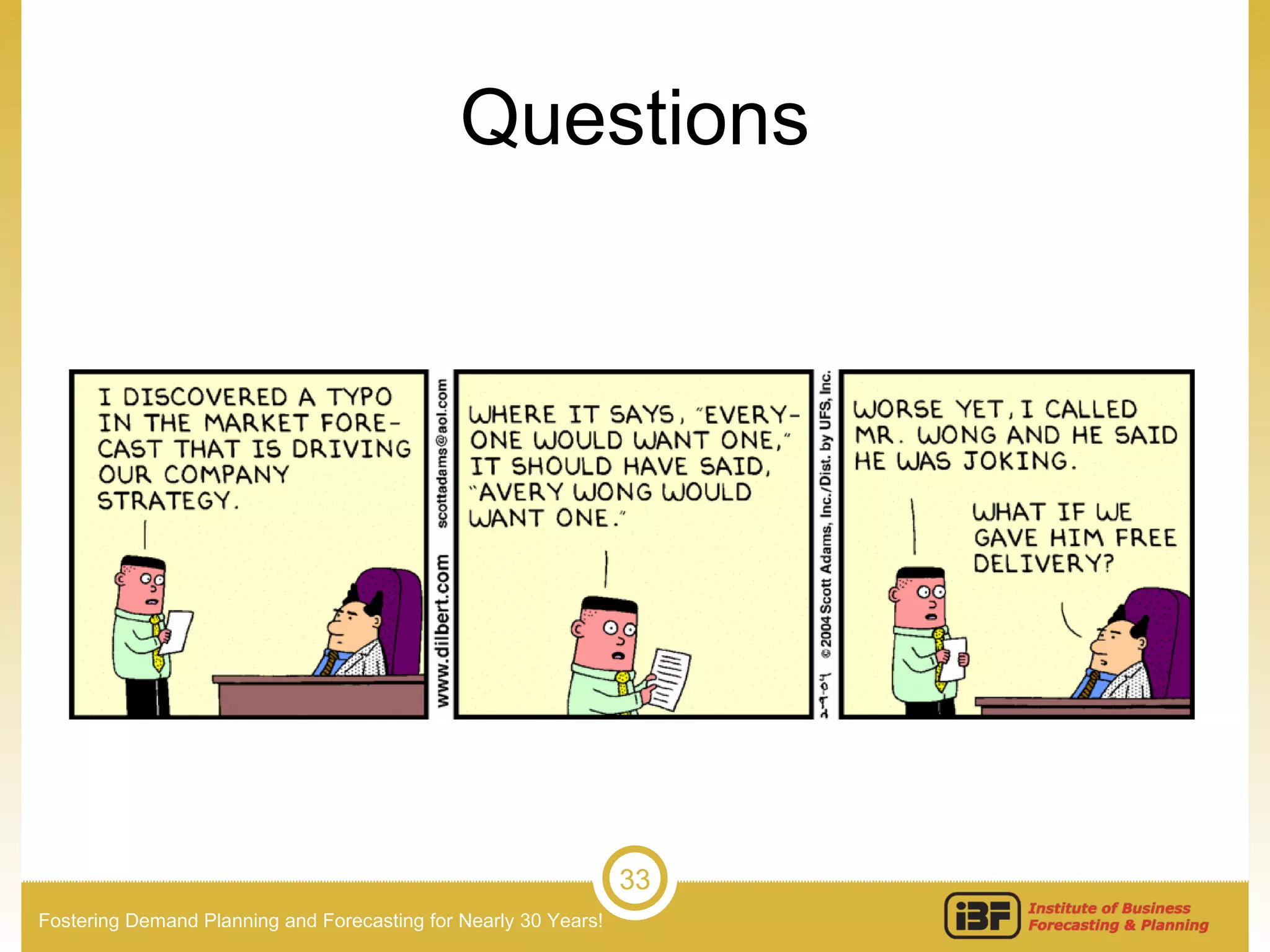
Questions
Contact Information Jason Breault Managing Director Life Work Search [email_address]

Attracting & Retaining Demand Planning & Forecasting Talent

  • 1.
    Attracting & RetainingDemand Planning & Forecasting Talent Jason Breault Managing Director March 1, 2011
  • 2.
    Who would haveguessed? … he hits shots no self-respecting professional golfer would ever admit to … [he] seems relieved just to get off the first tee without embarrassing himself
  • 3.
    A lot haschanged Reporting structure of supply chain Appreciation of the financial impact supply chain offers CEO’s crediting supply chain as a key enabler of performance & strategy in annual reports Growth of big box retailing & e-commerce have placed increased attention on the consumer shopping experience, shifting the balance of power from manufacturer to retailer.
  • 4.
    How has therecession affected your business? Companies outsourcing more (plants, DC’s, etc) Retailers have been driving down inventories & cutting SKU’s Private label vs. branded wars
  • 5.
    Current supply chainlandscape Priorities* Improve efficiency / productivity Reduce operating costs Top barriers to achieving supply chain goals* Forecast accuracy / demand variability Supply chain network complexity Lack of internal cross-functional collaboration & visibility * Source: Annual (2010) Gartner Supply Chain Study
  • 6.
    How have recentmarket trends affected forecasting your business? Consumer buying shifts have turned traditional models upside down The moment of truth has moved from the shelf to coupon clipping at the kitchen table or on the laptop or i-Phone Statistical models based on history are not keeping pace with the speed in consumer changes Do we have enough models/algorithms? Are they being proactively tuned? (if not automatically in the tool itself) Traditional trade and advertising spend are not delivering the same ROI’s anymore It used to be the Oprah effect. Now, what role will social media play? Retailers are changing their inventory patterns Suppliers may not be as dependable if cash strapped
  • 7.
    How have recentmarket trends affected forecasting your business? Long lead time raw materials and cost of commodities are becoming harder to predict Food & product safety concerns are changing consumer and customer behavior “ Recession-proof” industries no longer seem so recession proof Fuel costs – are they artificially low and will they drive more domestic collaboration? What have we learned – what about risks like a terrorist attack, Icelandic volcanoes, US inflation, etc.
  • 8.
    Forecasting is hotExecutives want better information and cross functional groups are ready to “partner” again Lots of job stability Companies building processes from scratch Hearing about a lot of requests for software
  • 9.
    Forecasting is hotDemand-driven supply network (DDSN) is becoming a known and understood topic. On the DDSN maturity model, those companies that are considered the most mature are those that have effective forecasting.
  • 10.
  • 11.
  • 12.
    Misperceptions It willbe easier to find good demand planners because unemployment isn’t budging!
  • 13.
    Media won’t talkabout this Amid one of the deepest recessions ever to hit the US and with unemployment approaching 10%...supply chain leaders are citing talent recruitment and retention as one of their top concerns in 2010 and beyond. MIT, Fall 2010
  • 14.
    Strong Demand Plannersare hard to find and increasingly difficult to retain Demand Planning skills required are changing Managing 4 generations can become workplace warfare Smart companies are hanging on and valuing these skills or making counter offers (14-28 day counter) Why is hiring, on-boarding and career-pathing of demand planners so important?
  • 15.
    Forecasting talent shortfallIs the profession growing or the skill set shrinking? How does geography play a role? Does technology help or hinder the experience level of a demand planner? Are companies investing in technology or holding back but expecting more from individuals? Technology sophistication has increased, and the pressure to reduce supply chain costs and working capital has increased, yet there is an overall shortfall in demand planning skills and talent!
  • 16.
    Current State ofdemand planning organizations The organizational capabilities, the processes, and the tools are at varying levels of sophistication in companies Applies to retailers and manufacturers More is being expected of demand planners, and the supply chain in general, as the economy has put significant pressure on business results
  • 17.
    Skills required tobe an effective demand planner Analytical Skills Dealing with Ambiguity Communication Skills Interpersonal Savvy Ability to build cross functional relationships & influence a variety of disciplines Command skills Can encourage direct and tough debate Technological Savvy & Systems Aptitude Often strong analytical skills, communication or command skills, and dealing with ambiguity are hard to find combinations in the same person
  • 18.
    Skills required tobe an effective demand planner Ability to forecast outside the US as the middle class grows in places like India, China, etc. Operational- and innovation excellence. S&OP experience Education: study showed it was more important for someone to be able to demonstrate problem-solving skills than supply chain technology skills. Same study showed too much technology knowledge and not enough problem solving. “ Learning agility”: person’s ability to learn from past experiences and apply these lessons in new, ill-defined situations”.
  • 19.
    Challenge in findingthese skills Analytical skills are required by more than just demand planning Many candidates see demand planning as merely a stepping stone. University programs geared more towards logistics, transportation, operations.
  • 20.
    Challenge in findingthese skills Companies have no bench strength. 10,000 baby boomers become retirement eligible daily . As a result, going to see increased interest in contract staffing the next few years. White collar unemployment declining 12M of 14M unemployed don’t have degrees. 75% of HR teams are having trouble finding candidates. HR is also overworked and underappreciated.* * MRINetwork
  • 21.
  • 22.
    What’s the perceptionof demand planning within – and outside – your organization? When did it become mainstream Operate as a cost- or profit-center Do people want to join your team, see it merely as a stepping stone, or want to stay away
  • 23.
    What excites peopleabout a career in demand planning? Exposure to and ability to present to a wide variety of cross functional leaders Exposure to the growth engines of the business Exposure to the supply chain A good demand planner can Make a significant impact to predictability of revenue generation for new and existing prod’s Make a significant impact to a Business P&L Make a significant impact to the Balance Sheet You’re always going to be wrong – the objective is to be less wrong and course correct quickly
  • 24.
    What’s causing turnover& retention issues? The large amount of data manipulation using excel spreadsheets Lack of effective report generation tools DP’s are often the ones asked to generate reports to Mkt’g/Merchandising Lack of common processes & technologies Lack of senior leadership support for S&OP Perception that companies do not value the importance of improved forecasting Much of demand planner burn-out comes from:
  • 25.
    Retention nightmare Manycompanies cut too deep, affecting employees’ perceptions of the company
  • 26.
    How to keeppeople in demand planning longer Demonstrate that the role is on par with or even more significant than marketers, sales, merchandisers Ensure a culture that encourages debate around difficult topics Have a tiered structure & career path to aspire to and also a way into other parts of the organization: Create manager levels beneath the Directors for growth and people mgm’t experience Future roles can be in supply chain, marketing, sales Create incentives around business performance Invest in training, education and certification to build the skills Companies are going to have to visibly communicate the value of the roles within their organizations:
  • 27.
    How to keeppeople in demand planning longer A little recognition as to how important you are to the financial success of your company goes a long way towards job satisfaction!
  • 28.
    How to keeppeople in demand planning longer Recognition is important
  • 29.
    What are youdoing to ensure the team grows and gains the skills of the DP of the future? Training & Education Individual capabilities Building business skills so a DP can relate to various functions Program to build management competencies Process Training on 6 Sigma Continuous Improvement Skills Training Exposure to forecasting process improvements externally Technology Investment in training on the current and future tool Succession pipeline from other parts of the organization
  • 30.
    What other partsof the organization are demand planners coming from? Operational Excellence / 6-Sigma Team Supply Planning Sales and Sales Planning Marketing Consumer/Customer Insights Departments Project Management Organizations
  • 31.
    How are youensuring a constant flow of talent into your organization? Alma maters Industry associations IBF, APICS, CSCMP Formal partnerships with Colleges, Universities Intern pool at specific colleges & universities 6 Sigma Organizations Networking & visibility at Supply Chain events Consultants Social Networking Going with the flow or standing out? What type of manager are you?
  • 32.
    Industry differences intalent Retailers have stepped up improvements in demand planning over the past 2-3 years Adopting the consumer goods capabilities and moving into more process and technological sophistication The evolution will be the capability of demand planners to provide insights back and forth between manufacturers & retailers
  • 33.
  • 34.
    Contact Information JasonBreault Managing Director Life Work Search [email_address]