Atomic
Number,
Atomic Mass,
Proton
Neutro
n
Electro
n
So far you have
learned about the
different subatomic
particles of an atom.
REVIEW
Proton
It is the number of protons
that identify the atoms of an
element.
Number of
protons
Remember: All atoms in an
element contain the same
number of protons in their
nuclei.
-is the number of protons, and therefore also
the total positive charge, in the atomic nucleus.
Atomic Number
Each element has their respective atomic
number.
Key Learning
Points
Locate the atomic number in the
periodic table.
Identify the subatomic particles
associated with mass number
Determine the number of neutrons
from the mass number
Define isotope
Atomic
Number
Z
This is the number of units of positive charge in
the nucleus.
Atomic
Mass
A
Mass
Number
Atomic
Weight
Proto
n Neutron
0
n
Electron
p+
-
e
-
e
Z=p+=
A =p++ 0
n
-
e
= + 0
n
= Z + 0
n
0
n =A-p+
=A -
e
=A-Z
-
Element
Z A
Atomic
Weight
p+ -
e 0
n
Au
Al
U
79
13
79 197
238 92
14
Proton
Neutro
n
Electro
n
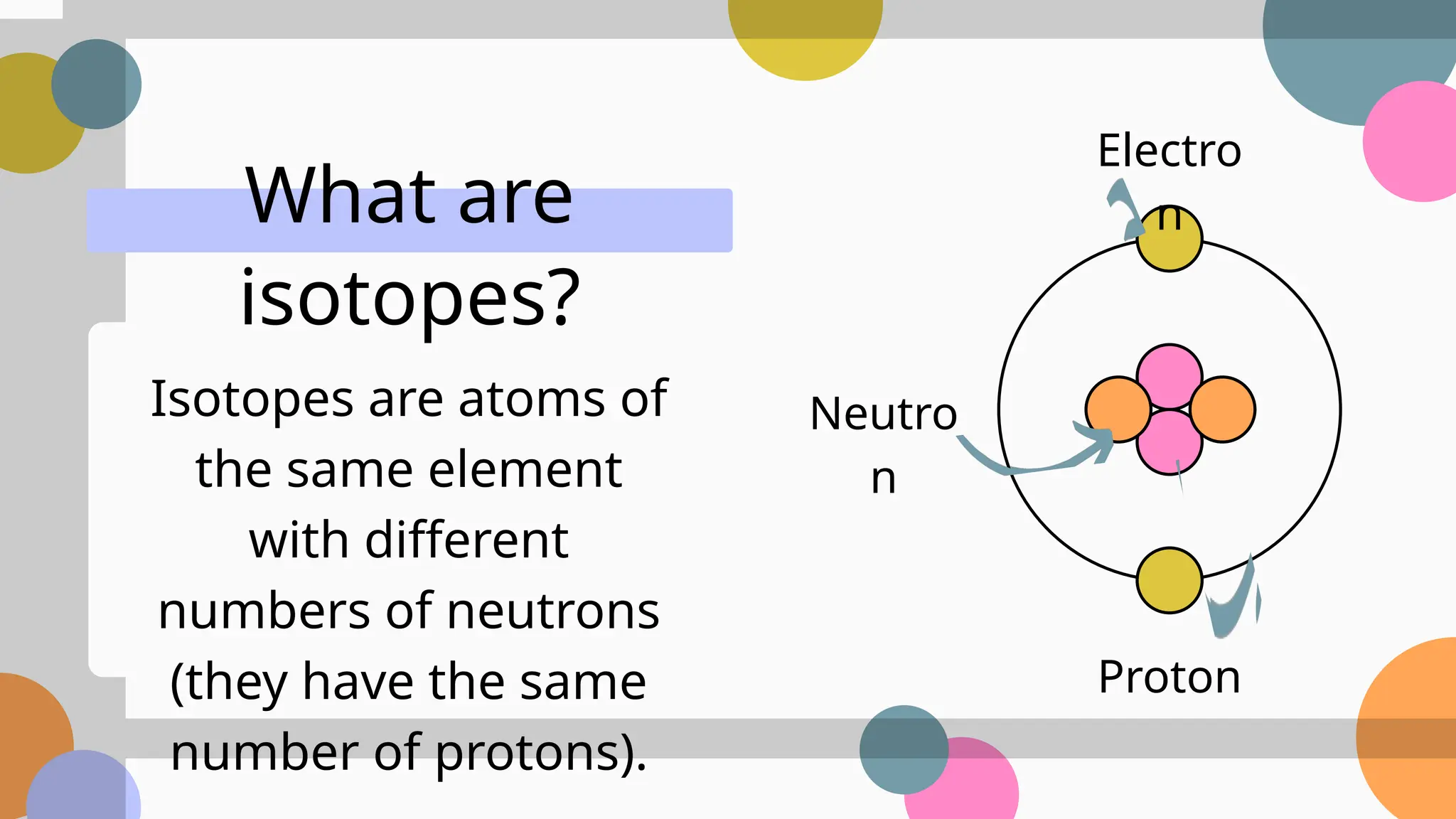
Isotopes are atoms of
the same element
with different
numbers of neutrons
(they have the same
number of protons).
What are
isotopes?
There are three isotopes
of hydrogen. All
hydrogen atoms contain
one proton (and one
electron), but they can
have different numbers
of neutrons. Hydrogen-1
Hydrog
en-1
Hydrog
en-2
Hydrog
en-3
Example
1
There are two isotopes of chlorine.
All chlorine atoms contain
seventeen protons (and seventeen
electrons), but they can have
different numbers of neutrons.
Chlorine-35 is the most commonly
Example
2
Isotopes have the same
chemical properties. This
is because the number of
electrons determines
chemical properties,
isotopes have the same
number of electrons in
Propertie
s
The relative atomic mass of
an element in the periodic
table, is the weighted
average of the masses of
the atoms of the isotopes.
Relative atomic mass takes
into account the abundance
of each of the isotopes of
The relative atomic mass
of chlorine is 35.45 rather
than a whole number.
This is due to chlorine
having two isotopes
(chlorine-35 and chlorine-
Relative Atomic
Mass
Copper has two isotopes:
• Copper-63 which accounts for
69% of copper
• Copper-65 which accounts for
31% of copper
Calculate the relative atomic mass
of copper to one decimal place.
Calculating the Relative Atomic
Mass
Questio
n
(69 X 63) + (31 X
65) = 6362
6362 / 100 = 63.6
Answe
r
Isotopes
Atomic Structure & the
Periodic Table
B = Blur
C = Confetti
D = Drumroll
O = Bubbles
You can press these keys whilst on
present mode.
Q = Quiet
U = Unveil
0-9 = Timer
Keyboard
Shortcuts

ATOMIC NO.-ATOMIC MASS-ISOTOPE-SCIENCE 8-Q3.pptx

  • 1.
  • 2.
    Proton Neutro n Electro n So far youhave learned about the different subatomic particles of an atom. REVIEW
  • 3.
    Proton It is thenumber of protons that identify the atoms of an element. Number of protons Remember: All atoms in an element contain the same number of protons in their nuclei.
  • 4.
    -is the numberof protons, and therefore also the total positive charge, in the atomic nucleus. Atomic Number Each element has their respective atomic number.
  • 5.
    Key Learning Points Locate theatomic number in the periodic table. Identify the subatomic particles associated with mass number Determine the number of neutrons from the mass number Define isotope
  • 6.
    Atomic Number Z This is thenumber of units of positive charge in the nucleus.
  • 7.
  • 8.
  • 9.
  • 10.
    A =p++ 0 n - e =+ 0 n = Z + 0 n
  • 11.
  • 12.
    Element Z A Atomic Weight p+ - e0 n Au Al U 79 13 79 197 238 92 14
  • 14.
    Proton Neutro n Electro n Isotopes are atomsof the same element with different numbers of neutrons (they have the same number of protons). What are isotopes?
  • 15.
    There are threeisotopes of hydrogen. All hydrogen atoms contain one proton (and one electron), but they can have different numbers of neutrons. Hydrogen-1 Hydrog en-1 Hydrog en-2 Hydrog en-3 Example 1
  • 16.
    There are twoisotopes of chlorine. All chlorine atoms contain seventeen protons (and seventeen electrons), but they can have different numbers of neutrons. Chlorine-35 is the most commonly Example 2
  • 17.
    Isotopes have thesame chemical properties. This is because the number of electrons determines chemical properties, isotopes have the same number of electrons in Propertie s
  • 18.
    The relative atomicmass of an element in the periodic table, is the weighted average of the masses of the atoms of the isotopes. Relative atomic mass takes into account the abundance of each of the isotopes of The relative atomic mass of chlorine is 35.45 rather than a whole number. This is due to chlorine having two isotopes (chlorine-35 and chlorine- Relative Atomic Mass
  • 19.
    Copper has twoisotopes: • Copper-63 which accounts for 69% of copper • Copper-65 which accounts for 31% of copper Calculate the relative atomic mass of copper to one decimal place. Calculating the Relative Atomic Mass Questio n (69 X 63) + (31 X 65) = 6362 6362 / 100 = 63.6 Answe r
  • 20.
    Isotopes Atomic Structure &the Periodic Table
  • 21.
    B = Blur C= Confetti D = Drumroll O = Bubbles You can press these keys whilst on present mode. Q = Quiet U = Unveil 0-9 = Timer Keyboard Shortcuts

Editor's Notes

  • #2 So far you have learned about the different subatomic particles of an atom. And how they are arranged in the current model of the atom.
  • #4 If you look at your periodic table, you will notice that there is no two element that has the same atomic number.
  • #6 Again if we say ATOMIC NUMBER, this is the individual number of each element in the periodic table. Meaning to say this the number of protons in the nucleus.
  • #7 Again if we say ATOMIC NUMBER, this is the individual number of each element in the periodic table. Meaning to say this the number of protons in the nucleus.
  • #8 Again if we say ATOMIC NUMBER, this is the individual number of each element in the periodic table. Meaning to say this the number of protons in the nucleus.
  • #9 Again if we say ATOMIC NUMBER, this is the individual number of each element in the periodic table. Meaning to say this the number of protons in the nucleus.
  • #10 Again if we say ATOMIC NUMBER, this is the individual number of each element in the periodic table. Meaning to say this the number of protons in the nucleus.
  • #11 Again if we say ATOMIC NUMBER, this is the individual number of each element in the periodic table. Meaning to say this the number of protons in the nucleus.