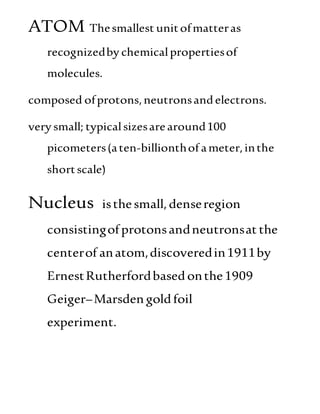
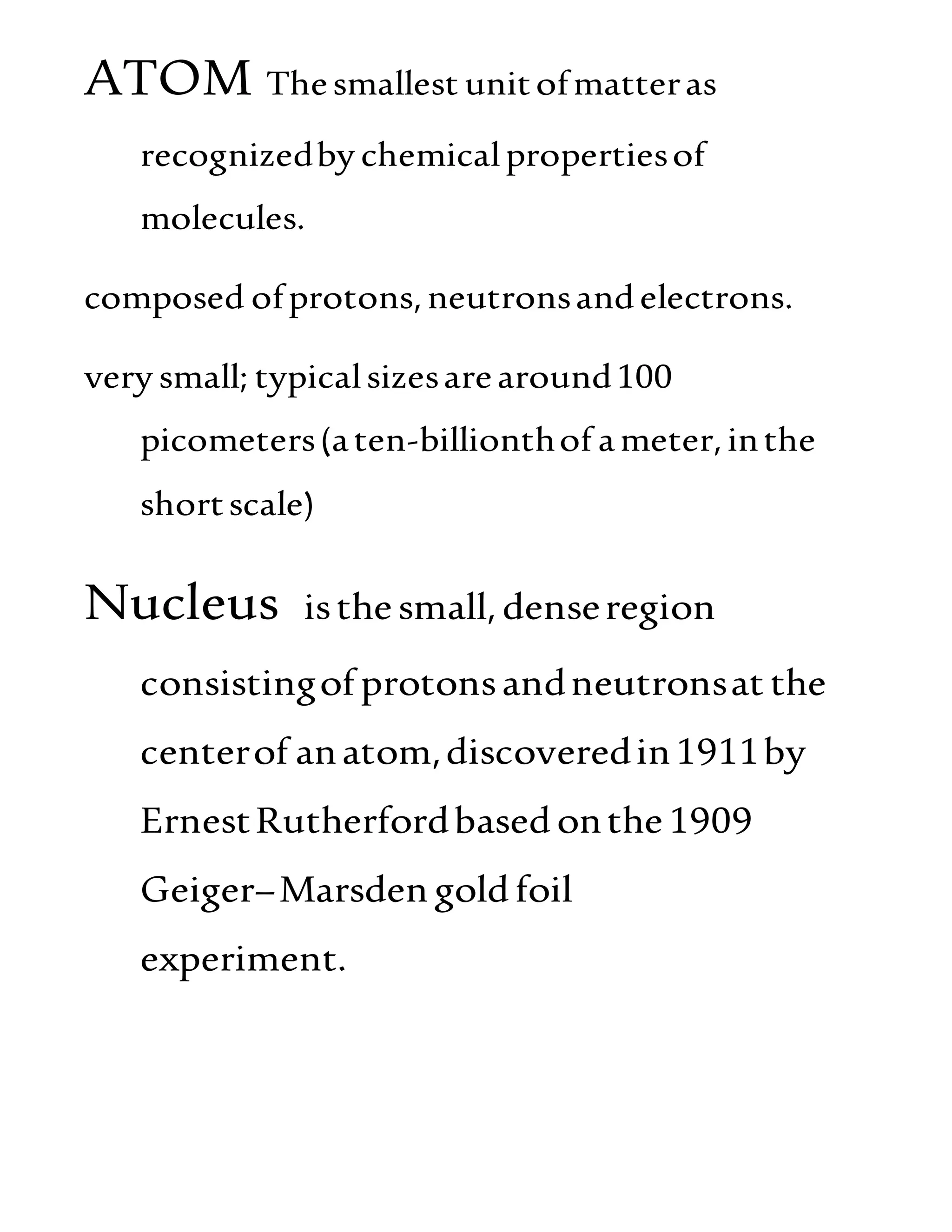
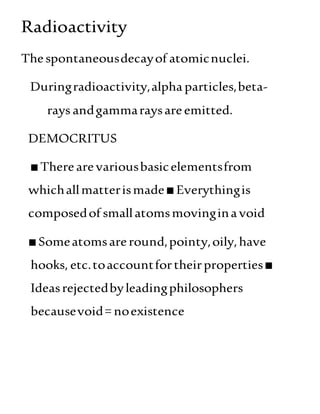
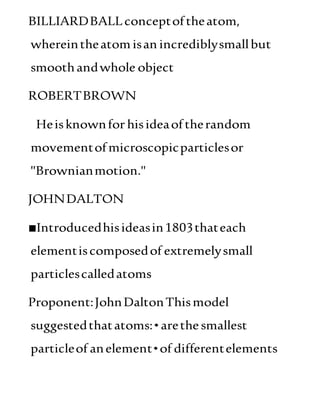
The atom is the smallest unit of matter and is composed of protons, neutrons, and electrons. Atoms have a small but dense nucleus at the center, containing protons and neutrons, as discovered by Ernest Rutherford in his 1909 gold foil experiment. Various models were proposed to explain the structure of the atom, starting with Democritus' idea of basic elements made of atoms. John Dalton introduced the idea that elements are made of unique atoms, while J.J. Thomson's "plum pudding" model had a positive sphere with electrons embedded in it. Rutherford determined atoms had a small, dense nucleus through his gold foil experiment, and Niels Bohr added the concept of electron energy levels to explain atomic stability



![Lesson 2 Structure of an Atom [Autosaved].pptx](https://cdn.slidesharecdn.com/ss_thumbnails/lesson2structureofanatomautosaved-260202051705-8f8baabf-thumbnail.jpg?width=640&height=640&fit=bounds)


