CONTENTS
• Definition of atmosphere
• Composition of atmosphere
• Structure of atmosphere
• Troposphere
• Stratosphere
• Ionosphere or Thermosphere
• Exosphere
• Magnetic sphere
• Conclusion
Definition of atmosphere
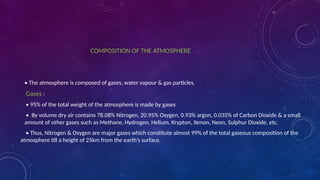
• Atmosphere is a thick gaseous envelope which surrounds the earth and is attached to the
earth’s surface by gravitational force.
• According to a study of NASA, it extends till a height of 80,000 km above the earth’s surface.
• It is estimated that 97% of the effective atmosphere is confined up to a height of 29 km above the
earth’s surface.
COMPOSITION OF THE ATMOSPHERE
• The atmosphere is composed of gases, water vapour & gas particles.
Gases :
• 95% of the total weight of the atmosphere is made by gases
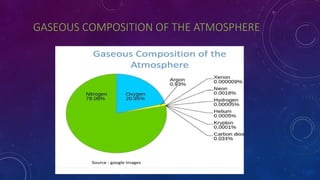
• By volume dry air contains 78.08% Nitrogen, 20.95% Oxygen, 0.93% argon, 0.035% of Carbon Dioxide & a small
amount of other gases such as Methane, Hydrogen, Helium, Krypton, Xenon, Neon, Sulphur Dioxide, etc.
• Thus, Nitrogen & Oxygen are major gases which constitute almost 99% of the total gaseous composition of the
atmosphere till a height of 25km from the earth’s surface.
GASEOUS COMPOSITION OF THE ATMOSPHERE
Importance of Different Gases:
• Nitrogen is generally chemically inactive but it dilutes the oxygen & makes it breathable. It is also absorbed
by the plant in the form of nitrate & helps in their growth.
• Oxygen makes breathing possible & is also essential for combustion.
• Carbon dioxide is used by green plants for photosynthesis & it also regulates the temperature of the earth
through green house effect.
• At ground level ozone is a pollutant but the ozone layer of stratosphere protects the earth from the Ultra
Violet radiation of the Sun.
Dust Particles :
The dust particles present in the atmosphere are divided into two types – terrestrial
dust particles & cosmic dust particles
Terrestrial dust particles are mainly found up to a height of 5 km from the earth’s
surface.
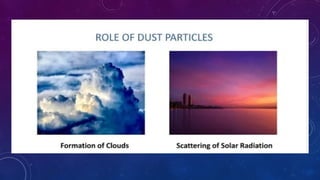
They act as hygroscopic nuclei & help in the formation of clouds
Cosmic dust particles are found mainly above the height of 50 km & they originate
due to the disintegration of celestial bodies that enter the earth’s atmosphere. They
help in the formation of notelet clouds.
• Dust particles help in the scattering of solar radiate. Which adds varied charming
colours of red & orange to sunrise & sunset
Water Vapour:
The availability of water vapour is generally up to a height of 12 km. However, some amount of water
vapour is also found above the height of 50 km in the middle part of the atmosphere. The vertical
currents of the atmosphere first carries it to the stratosphere & then due to an increase in the
temperature of stratosphere it reaches above the height of 50 km. After crossing the ozone layer this
vapour starts condensing & forms notelet clouds.
Three processes are responsible for the presence of water vapour in the atmosphere.
They are :
(a) Evaporation
(b) Eva- trantranspiration
(c)Sublimation
The water vapour is responsible for various types of weather phenomena that occur in the atmosphere,
such as- formation of clouds, different forms of precipitation, storms, etc.
• Water vapour also helps in heating the atmosphere as it absorbs terrestrial radiation
STRUCTURE OF THE ATMOSPHERE
As we go up higher in the atmosphere variations occur in temperature. Based on the characteristics of
temperature the vertical structure of the atmosphere can be divided into following 6 concentric layers :
(i) Troposphere
(ii)Stratosphere
(iii) Mesosphere
(iv)ionospheres or Thermosphere
(v) Exosphere
• (vi) Magnetosphere
Troposphere
Lower most layer of the atmosphere
Its average height is 8-18 km, i.e. 8 km at the poles & 18 km at the equator. The reason of greater
height at the equator is the presence of convectional currents due to which the air rises up vertically
to a greater height.
All kinds of weather phenomena (e.g. Fog, cloud, dew, frost, rainfall, snowfall, thunder- storms,
lightning, etc.) occur in this layer.
• It is the zone of radiation, conduction & convection
Stratosphere
• It is located just above the troposphere & is separated from it by a transition belt having a thickness of
1.5 km which is known as the troopers.
• It extends up to a height of 50 km.
•In the lower part of the stratosphere between a height of 15-35 km, heavy concentration of ozone gas
is found. This is known as the ‘ozone layer’.
•Temperature gradually increases with height in this layer due to the presence of ozone layer as ozone
absorbs the UV rays coming from the sun.
Mesosphere
Mesosphere extends between a height of 50-80 km
It is separated from stratosphere by a transitional belt known as Strat pause.
Temperature decreases with increasing height in the layer
At the upper limit of mesosphere the temperature becomes -85°C to -100°C
This is the coldest layer of the atmosphere
• Entitlement clouds & cosmic or meteoric dust are found here
Thermosphere or ionosphere
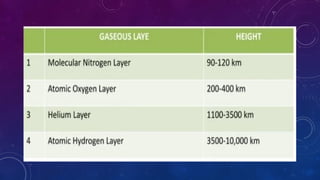
This layer extends up to a height of 500 km
It is separated from mesosphere by a transition belt known as ‘mesopause’
Temperature increases with increasing height in this belt & at the upper limit of this belt it becomes +25°C
lionised particles are present in this layer which are capable of reflecting back radio waves
• This layer has made radio communication & telecommunication possible on earth
Exosphere
Exosphere extends till a height of 2000 km
In this layer temperature increases rapidly with increasing height
At the upper limit of this layer the temperature is recorded as 1000°C
This layer is dominated by ionised particles
• Molecules & atoms of Oxygen, Hydrogen & Helium are found in this layer.
Magnetosphere
This sphere extends beyond the height of 2000 km to a height of 80,000 km
Magnetosphere is the region where the temperature continuously increases with increasing
height & where the effect of earth’s gravitation decreases.
At the upper limit of this layer temperature becomes 1700°C
This layer is dominated by charged particles, i.e. Electrons & protons. A dense layer of these
particles is found between the height of 3000-16,000 km.
This layer is affected by cosmic rays, solar flares & solar storms.
• Studies have shown that solar flares & solar storms affect the temperature of magnetosphere
which in turn influence the weather changes of troposphere
Conclusion
Thus, it is clear that a lot of variations are there in the structure of the atmosphere
• Not only that, further researches are required for the upper layers of the atmosphere
Reference
• Singh, S: Physical Geography, Prayag Pustak Bhawan, Allahabad, 2012
• Critchfield, Howard J: General Climatology,

Atmosphere in Environmental microbiology

  • 2.
    CONTENTS • Definition ofatmosphere • Composition of atmosphere • Structure of atmosphere • Troposphere • Stratosphere • Ionosphere or Thermosphere • Exosphere • Magnetic sphere • Conclusion
  • 3.
    Definition of atmosphere •Atmosphere is a thick gaseous envelope which surrounds the earth and is attached to the earth’s surface by gravitational force. • According to a study of NASA, it extends till a height of 80,000 km above the earth’s surface. • It is estimated that 97% of the effective atmosphere is confined up to a height of 29 km above the earth’s surface.
  • 4.
    COMPOSITION OF THEATMOSPHERE • The atmosphere is composed of gases, water vapour & gas particles. Gases : • 95% of the total weight of the atmosphere is made by gases • By volume dry air contains 78.08% Nitrogen, 20.95% Oxygen, 0.93% argon, 0.035% of Carbon Dioxide & a small amount of other gases such as Methane, Hydrogen, Helium, Krypton, Xenon, Neon, Sulphur Dioxide, etc. • Thus, Nitrogen & Oxygen are major gases which constitute almost 99% of the total gaseous composition of the atmosphere till a height of 25km from the earth’s surface.
  • 5.
    GASEOUS COMPOSITION OFTHE ATMOSPHERE
  • 7.
    Importance of DifferentGases: • Nitrogen is generally chemically inactive but it dilutes the oxygen & makes it breathable. It is also absorbed by the plant in the form of nitrate & helps in their growth. • Oxygen makes breathing possible & is also essential for combustion. • Carbon dioxide is used by green plants for photosynthesis & it also regulates the temperature of the earth through green house effect. • At ground level ozone is a pollutant but the ozone layer of stratosphere protects the earth from the Ultra Violet radiation of the Sun.
  • 8.
    Dust Particles : Thedust particles present in the atmosphere are divided into two types – terrestrial dust particles & cosmic dust particles Terrestrial dust particles are mainly found up to a height of 5 km from the earth’s surface. They act as hygroscopic nuclei & help in the formation of clouds Cosmic dust particles are found mainly above the height of 50 km & they originate due to the disintegration of celestial bodies that enter the earth’s atmosphere. They help in the formation of notelet clouds. • Dust particles help in the scattering of solar radiate. Which adds varied charming colours of red & orange to sunrise & sunset
  • 10.
    Water Vapour: The availabilityof water vapour is generally up to a height of 12 km. However, some amount of water vapour is also found above the height of 50 km in the middle part of the atmosphere. The vertical currents of the atmosphere first carries it to the stratosphere & then due to an increase in the temperature of stratosphere it reaches above the height of 50 km. After crossing the ozone layer this vapour starts condensing & forms notelet clouds. Three processes are responsible for the presence of water vapour in the atmosphere. They are : (a) Evaporation (b) Eva- trantranspiration (c)Sublimation The water vapour is responsible for various types of weather phenomena that occur in the atmosphere, such as- formation of clouds, different forms of precipitation, storms, etc. • Water vapour also helps in heating the atmosphere as it absorbs terrestrial radiation
  • 11.
    STRUCTURE OF THEATMOSPHERE As we go up higher in the atmosphere variations occur in temperature. Based on the characteristics of temperature the vertical structure of the atmosphere can be divided into following 6 concentric layers : (i) Troposphere (ii)Stratosphere (iii) Mesosphere (iv)ionospheres or Thermosphere (v) Exosphere • (vi) Magnetosphere
  • 12.
    Troposphere Lower most layerof the atmosphere Its average height is 8-18 km, i.e. 8 km at the poles & 18 km at the equator. The reason of greater height at the equator is the presence of convectional currents due to which the air rises up vertically to a greater height. All kinds of weather phenomena (e.g. Fog, cloud, dew, frost, rainfall, snowfall, thunder- storms, lightning, etc.) occur in this layer. • It is the zone of radiation, conduction & convection
  • 13.
    Stratosphere • It islocated just above the troposphere & is separated from it by a transition belt having a thickness of 1.5 km which is known as the troopers. • It extends up to a height of 50 km. •In the lower part of the stratosphere between a height of 15-35 km, heavy concentration of ozone gas is found. This is known as the ‘ozone layer’. •Temperature gradually increases with height in this layer due to the presence of ozone layer as ozone absorbs the UV rays coming from the sun.
  • 14.
    Mesosphere Mesosphere extends betweena height of 50-80 km It is separated from stratosphere by a transitional belt known as Strat pause. Temperature decreases with increasing height in the layer At the upper limit of mesosphere the temperature becomes -85°C to -100°C This is the coldest layer of the atmosphere • Entitlement clouds & cosmic or meteoric dust are found here
  • 15.
    Thermosphere or ionosphere Thislayer extends up to a height of 500 km It is separated from mesosphere by a transition belt known as ‘mesopause’ Temperature increases with increasing height in this belt & at the upper limit of this belt it becomes +25°C lionised particles are present in this layer which are capable of reflecting back radio waves • This layer has made radio communication & telecommunication possible on earth
  • 16.
    Exosphere Exosphere extends tilla height of 2000 km In this layer temperature increases rapidly with increasing height At the upper limit of this layer the temperature is recorded as 1000°C This layer is dominated by ionised particles • Molecules & atoms of Oxygen, Hydrogen & Helium are found in this layer.
  • 17.
    Magnetosphere This sphere extendsbeyond the height of 2000 km to a height of 80,000 km Magnetosphere is the region where the temperature continuously increases with increasing height & where the effect of earth’s gravitation decreases. At the upper limit of this layer temperature becomes 1700°C This layer is dominated by charged particles, i.e. Electrons & protons. A dense layer of these particles is found between the height of 3000-16,000 km. This layer is affected by cosmic rays, solar flares & solar storms. • Studies have shown that solar flares & solar storms affect the temperature of magnetosphere which in turn influence the weather changes of troposphere
  • 18.
    Conclusion Thus, it isclear that a lot of variations are there in the structure of the atmosphere • Not only that, further researches are required for the upper layers of the atmosphere
  • 19.
    Reference • Singh, S:Physical Geography, Prayag Pustak Bhawan, Allahabad, 2012 • Critchfield, Howard J: General Climatology,