ATHENS
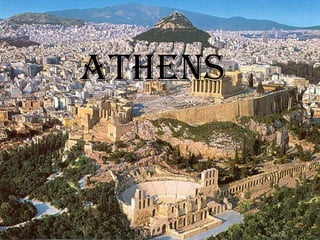
ATHENS
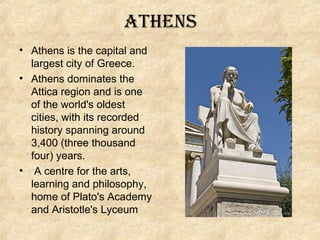
• Athens is the capital and
largest city of Greece.
• Athens dominates the
Attica region and is one
of the world's oldest
cities, with its recorded
history spanning around
3,400 (three thousand
four) years.
• A centre for the arts,
learning and philosophy,
home of Plato's Academy
and Aristotle's Lyceum
THE GODS
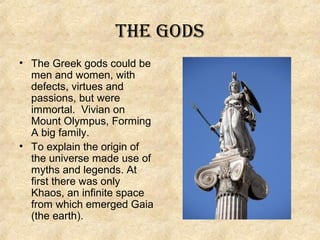
• The Greek gods could be
men and women, with
defects, virtues and
passions, but were
immortal. Vivian on
Mount Olympus, Forming
A big family.
• To explain the origin of
the universe made use of
​
myths and legends. At
first there was only
Khaos, an infinite space
from which emerged Gaia
(the earth).
architecture
• Athenian architecture was
applied mainly to the
construction of temples,
usually rectangular, with
a wide central hall called
Naos where stood the
figure of God
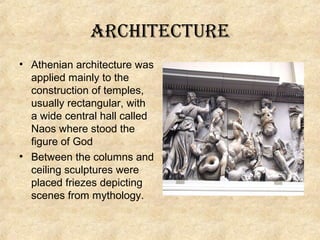
• Between the columns and
ceiling sculptures were
placed friezes depicting
scenes from mythology.
the Olympics
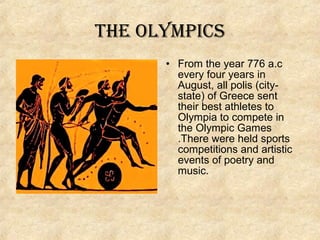
• From the year 776 a.c
every four years in
August, all polis (citystate) of Greece sent
their best athletes to
Olympia to compete in
the Olympic Games
.There were held sports
competitions and artistic
events of poetry and
music.
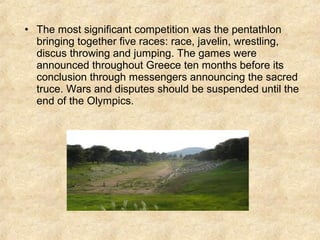
• The most significant competition was the pentathlon
bringing together five races: race, javelin, wrestling,
discus throwing and jumping. The games were
announced throughout Greece ten months before its
conclusion through messengers announcing the sacred
truce. Wars and disputes should be suspended until the
end of the Olympics.
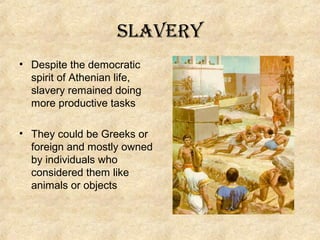
slavery
• Despite the democratic
spirit of Athenian life,
slavery remained doing
more productive tasks
• They could be Greeks or
foreign and mostly owned
by individuals who
considered them like
animals or objects
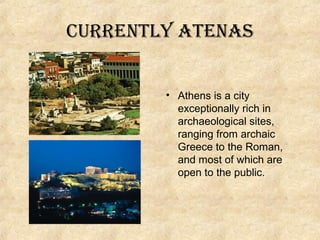
currently atenas
• Athens is a city
exceptionally rich in
archaeological sites,
ranging from archaic
Greece to the Roman,
and most of which are
open to the public.
geography
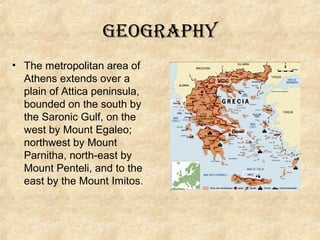
• The metropolitan area of ​
Athens extends over a
plain of Attica peninsula,
bounded on the south by
the Saronic Gulf, on the
west by Mount Egaleo;
northwest by Mount
Parnitha, north-east by
Mount Penteli, and to the
east by the Mount Imitos.
geography
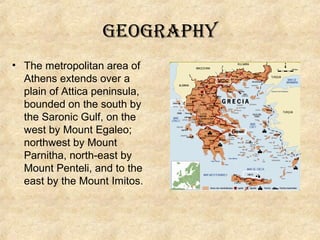
• The metropolitan area of ​
Athens extends over a
plain of Attica peninsula,
bounded on the south by
the Saronic Gulf, on the
west by Mount Egaleo;
northwest by Mount
Parnitha, north-east by
Mount Penteli, and to the
east by the Mount Imitos.

Athens Pablo 1E

  • 1.
  • 2.
    ATHENS • Athens isthe capital and largest city of Greece. • Athens dominates the Attica region and is one of the world's oldest cities, with its recorded history spanning around 3,400 (three thousand four) years. • A centre for the arts, learning and philosophy, home of Plato's Academy and Aristotle's Lyceum
  • 3.
    THE GODS • TheGreek gods could be men and women, with defects, virtues and passions, but were immortal. Vivian on Mount Olympus, Forming A big family. • To explain the origin of the universe made use of ​ myths and legends. At first there was only Khaos, an infinite space from which emerged Gaia (the earth).
  • 4.
    architecture • Athenian architecturewas applied mainly to the construction of temples, usually rectangular, with a wide central hall called Naos where stood the figure of God • Between the columns and ceiling sculptures were placed friezes depicting scenes from mythology.
  • 5.
    the Olympics • Fromthe year 776 a.c every four years in August, all polis (citystate) of Greece sent their best athletes to Olympia to compete in the Olympic Games .There were held sports competitions and artistic events of poetry and music.
  • 6.
    • The mostsignificant competition was the pentathlon bringing together five races: race, javelin, wrestling, discus throwing and jumping. The games were announced throughout Greece ten months before its conclusion through messengers announcing the sacred truce. Wars and disputes should be suspended until the end of the Olympics.
  • 7.
    slavery • Despite thedemocratic spirit of Athenian life, slavery remained doing more productive tasks • They could be Greeks or foreign and mostly owned by individuals who considered them like animals or objects
  • 8.
    currently atenas • Athensis a city exceptionally rich in archaeological sites, ranging from archaic Greece to the Roman, and most of which are open to the public.
  • 9.
    geography • The metropolitanarea of ​ Athens extends over a plain of Attica peninsula, bounded on the south by the Saronic Gulf, on the west by Mount Egaleo; northwest by Mount Parnitha, north-east by Mount Penteli, and to the east by the Mount Imitos.
  • 10.
    geography • The metropolitanarea of ​ Athens extends over a plain of Attica peninsula, bounded on the south by the Saronic Gulf, on the west by Mount Egaleo; northwest by Mount Parnitha, north-east by Mount Penteli, and to the east by the Mount Imitos.