Crea%vity	in	the	Classroom:		
Empowering	Students	to	Think	
Outside	the	Box	
Denise	Silfee	
English	Language	Fellow	in	Sudan	
June	2-3,	2016	
ATER	Conference,	Kigali,	Rwanda
Let’s	Get	Warmed	Up:	
Shipwreck	Ac%vity	
Materials	Needed	for	this	Ac>vity:	A	way	to	
show	students	the	items	they	can	consider–	
paper	handouts,	or	a	list	on	the	board	
	
*Pictures	are	helpful	for	students	to	learn	
vocabulary
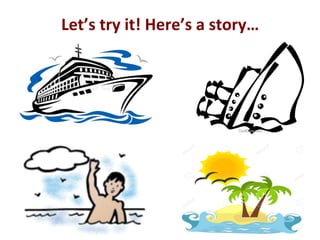
Let’s	try	it!	Here’s	a	story…
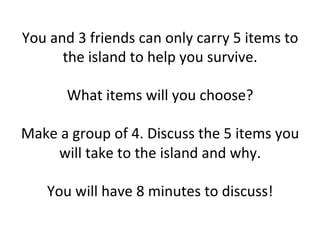
You	and	3	friends	can	only	carry	5	items	to	
the	island	to	help	you	survive.		
	
What	items	will	you	choose?	
	
Make	a	group	of	4.	Discuss	the	5	items	you	
will	take	to	the	island	and	why.		
	
You	will	have	8	minutes	to	discuss!
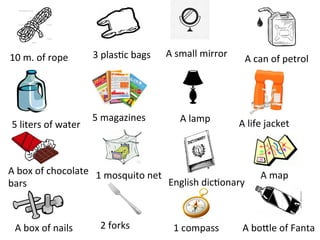
10	m.	of	rope		
5	liters	of	water	
A	box	of	chocolate	
bars	
A	box	of	nails	
3	plas>c	bags	
5	magazines	
1	mosquito	net	
2	forks	
A	small	mirror	
A	lamp	
English	dic>onary	
1	compass	
A	can	of	petrol	
A	life	jacket	
A	map	
A	boUle	of	Fanta
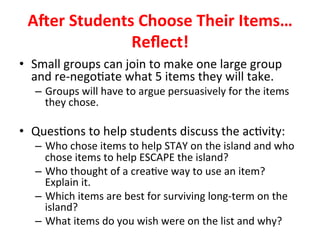
ARer	Students	Choose	Their	Items…	
Reflect!		
•  Small	groups	can	join	to	make	one	large	group	
and	re-nego>ate	what	5	items	they	will	take.	
–  Groups	will	have	to	argue	persuasively	for	the	items	
they	chose.	
		
•  Ques>ons	to	help	students	discuss	the	ac>vity:		
–  Who	chose	items	to	help	STAY	on	the	island	and	who	
chose	items	to	help	ESCAPE	the	island?	
–  Who	thought	of	a	crea>ve	way	to	use	an	item?	
Explain	it.		
–  Which	items	are	best	for	surviving	long-term	on	the	
island?		
–  What	items	do	you	wish	were	on	the	list	and	why?
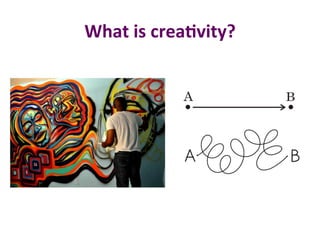
What	is	crea%vity?
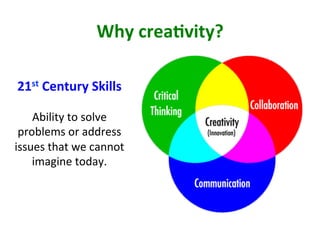
Why	crea%vity?	
21st	Century	Skills	
	
Ability	to	solve	
problems	or	address	
issues	that	we	cannot	
imagine	today.
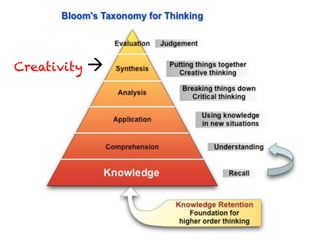
Creativity	à
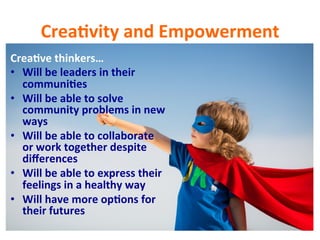
Crea%vity	and	Empowerment	
Crea%ve	thinkers…		
•  Will	be	leaders	in	their	
communi%es	
•  Will	be	able	to	solve	
community	problems	in	new	
ways	
•  Will	be	able	to	collaborate	
or	work	together	despite	
differences		
•  Will	be	able	to	express	their	
feelings	in	a	healthy	way		
•  Will	have	more	op%ons	for	
their	futures
How	can	teachers	encourage	
crea%vity?	
•  Provide	students	with	>me	to	think	
(brainstorm)	and	imagine	possibili>es	
•  All	ideas	accepted:	There	is	no	BAD	idea!		
•  Open-ended	problems/ques>ons	with	
more	than	one	answer	or	no	right	answer	
•  Be	willing	to	give	up	a	liUle	control
Examples	of	Ac%vi%es	that	Encourage	
Crea%ve	Thinking	
•  Shipwreck	
	
•  Group	Performance	
	
•  Blackout	poetry		
•  Write	a	story
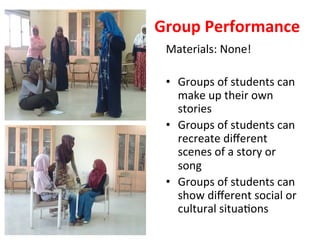
Group	Performance	
Materials:	None!		
	
•  Groups	of	students	can	
make	up	their	own	
stories	
•  Groups	of	students	can	
recreate	different	
scenes	of	a	story	or	
song		
•  Groups	of	students	can	
show	different	social	or	
cultural	situa>ons
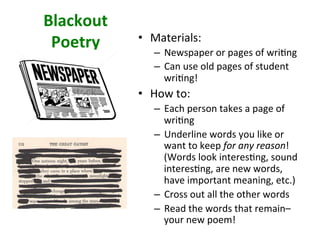
Blackout	
Poetry	 •  Materials:		
–  Newspaper	or	pages	of	wri>ng	
–  Can	use	old	pages	of	student	
wri>ng!		
•  How	to:		
–  Each	person	takes	a	page	of	
wri>ng	
–  Underline	words	you	like	or	
want	to	keep	for	any	reason!	
(Words	look	interes>ng,	sound	
interes>ng,	are	new	words,	
have	important	meaning,	etc.)	
–  Cross	out	all	the	other	words	
–  Read	the	words	that	remain–	
your	new	poem!
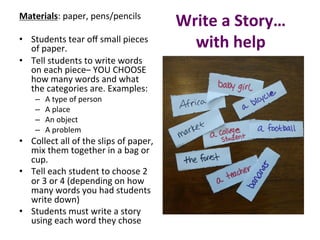
Write	a	Story…	
with	help	
Materials:	paper,	pens/pencils		
	
•  Students	tear	off	small	pieces	
of	paper.	
•  Tell	students	to	write	words	
on	each	piece–	YOU	CHOOSE	
how	many	words	and	what	
the	categories	are.	Examples:		
–  A	type	of	person	
–  A	place	
–  An	object	
–  A	problem		
•  Collect	all	of	the	slips	of	paper,	
mix	them	together	in	a	bag	or	
cup.		
•  Tell	each	student	to	choose	2	
or	3	or	4	(depending	on	how	
many	words	you	had	students	
write	down)	
•  Students	must	write	a	story	
using	each	word	they	chose
Let’s	try	it!		
•  Rip	off	two	small	pieces	of	paper	
•  On	one	small	piece	of	paper:		
–  Write	down	any	ITEM	
•  On	the	other	small	piece	of	paper:		
–  Write	down	any	PLACE	or	LOCATION	
•  Give	them	to	me!	I	will	mix	them	up.			
•  Now	choose	two	new	small	pieces	of	paper	
•  You	must	write	a	story	that	includes	the	items	on	
your	two	pieces	of	paper…	CHALLENGE:	these	two	
items	must	be	the	main	parts	of	the	story!
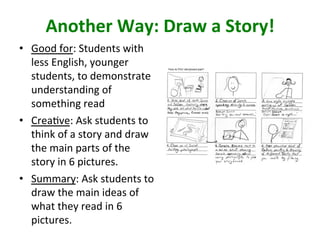
Another	Way:	Draw	a	Story!	
•  Good	for:	Students	with	
less	English,	younger	
students,	to	demonstrate	
understanding	of	
something	read	
•  Crea>ve:	Ask	students	to	
think	of	a	story	and	draw	
the	main	parts	of	the	
story	in	6	pictures.		
•  Summary:	Ask	students	to	
draw	the	main	ideas	of	
what	they	read	in	6	
pictures.
Remember…		
•  Crea>vity	can	be	prac>ced	and	developed	
•  Crea>vity	requires	>me	and	open-ended	
assignments	(no	right	answer)	
•  Crea>vity	can	be	demonstrated	through	art,	
wri>ng,	ac>ng,	music,	problem-solving		
•  All	teaching	situa>ons	are	different	…	do	
what’s	best	for	your	situa>on,	but	I	encourage	
you	to	take	a	risk!	J
Thank you!

Denise Silfee
English Language Fellow in Sudan
denise.silfee@gmail.com

ATER Presentation June 2016