ST&I:Tunisia’s Lifeboat!
(Towards Equitable Sustainable
Knowledge Society)
Prof. Jelel Ezzine
Tunisian Association for the Advancement
of Science, Technology and Innovation (TAASTI)
ATEI Innovation Day
February 21st, 2015
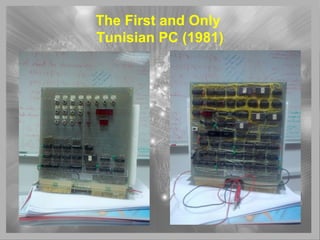
The First and Only
Tunisian PC (1981)
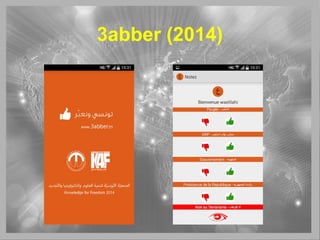
3abber (2014)
Apple, Microsoft & FB!
Outline

1. The Tunisian Paradox,
2. An Innovation System in the Making,
3. Tunisia’s Achilles’ heel,
4. A Post Revolution Vision,
5. A Debut of a Solution,
Outline
1. The Tunisian Paradox,
2. An Innovation System in the Making,
3. Tunisia’s Achilles’ heel,
4. A Post Revolution Vision,
5. A Debut of a Solution,
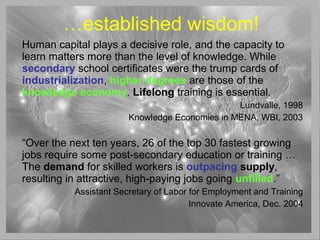
…established wisdom!
Human capital plays a decisive role, and the capacity to
learn matters more than the level of knowledge. While
secondary school certificates were the trump cards of
industrialization, higher degrees are those of the
knowledge economy. Lifelong training is essential.
Lundvalle, 1998
Knowledge Economies in MENA, WBI, 2003
“Over the next ten years, 26 of the top 30 fastest growing
jobs require some post-secondary education or training …
The demand for skilled workers is outpacing supply,
resulting in attractive, high-paying jobs going unfilled.”
Assistant Secretary of Labor for Employment and Training
Innovate America, Dec. 2004
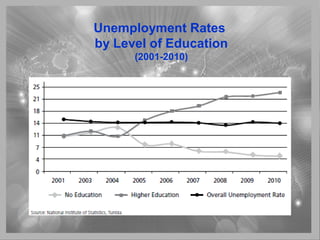
Unemployment Rates
by Level of Education
(2001-2010)
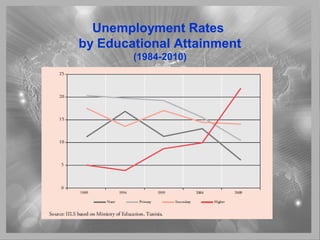
Unemployment Rates
by Educational Attainment
(1984-2010)
Outline
1. The Tunisian Paradox,
2. An Innovation System in the Making,
3. Tunisia’s Achilles’ heel,
4. A Post Revolution Vision,
5. A Debut of a Solution,
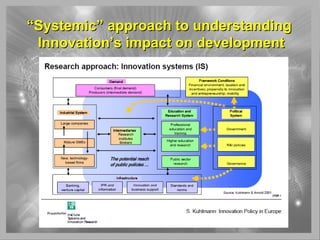
““Systemic” approach to understandingSystemic” approach to understanding
Innovation’s impact on developmentInnovation’s impact on development
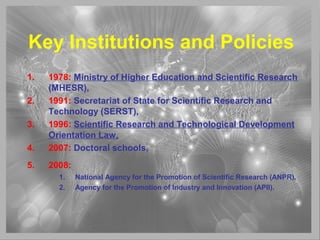
Key Institutions and Policies
1. 1978: Ministry of Higher Education and Scientific Research
(MHESR),
2. 1991: Secretariat of State for Scientific Research and
Technology (SERST),
3. 1996: Scientific Research and Technological Development
Orientation Law,
4. 2007: Doctoral schools,
5. 2008:
1. National Agency for the Promotion of Scientific Research (ANPR),
2. Agency for the Promotion of Industry and Innovation (APII).
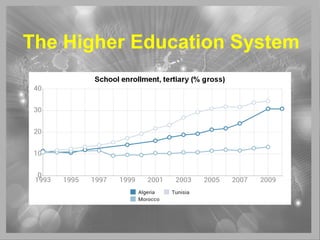
The Higher Education System
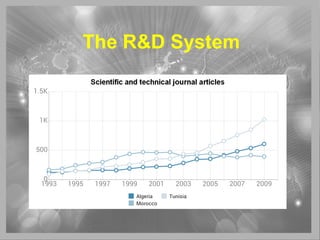
The R&D System
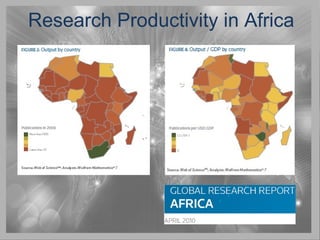
Research Productivity in Africa
“A number of countries are challenging the traditional scientific superpowers,”
said Sir Chris Llewellyn Smith of Oxford university, who chaired the study team.
Among smaller countries, the Royal Society report singles out Tunisia,
where R&D spending rose from 0.03 per cent of GDP in 1996 to 1.25 per
cent in 2009. Its priority is life sciences and medicine – with an official
aim to increase pharmaceutical exports five-fold within five years.
Although the study does not cover the impact of the recent overthrow of
Arab autocrats, such as … of Tunisia, Sir Chris said: “I would expect it to
have a good influence on science.”
Outline
1. The Tunisian Paradox,
2. An Innovation System in the Making,
3. Tunisia’s Achilles’ heel,
4. A Post Revolution Vision,
5. A Debut of a Solution,
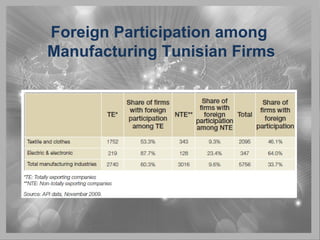
Foreign Participation among
Manufacturing Tunisian Firms
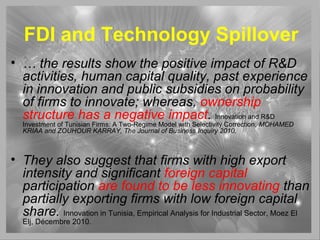
FDI and Technology Spillover
• … the results show the positive impact of R&D
activities, human capital quality, past experience
in innovation and public subsidies on probability
of firms to innovate; whereas, ownership
structure has a negative impact. Innovation and R&D
Investment of Tunisian Firms: A Two-Regime Model with Selectivity Correction, MOHAMED
KRIAA and ZOUHOUR KARRAY, The Journal of Business Inquiry 2010,
• They also suggest that firms with high export
intensity and significant foreign capital
participation are found to be less innovating than
partially exporting firms with low foreign capital
share. Innovation in Tunisia, Empirical Analysis for Industrial Sector, Moez El
Elj, Décembre 2010.
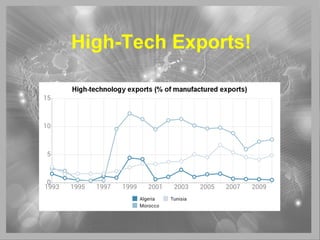
High-Tech Exports!
Shortcomings of current policy
responses
1. Lack of a collective vision,
2. Despite the isolated successes, the “system”
didn’t deliver growth, and thus jobs and
wellbeing,
3. Lack of global coherence, and absence of
coordination, led to a systemic failure,
4. Despite industrial modernization programs,
innovation remains frail,
5. Absence of synergies even with the multitudes of
incentives and programs.
Recommendations:
Higher Education System:
1. Grant autonomy to the leading universities,
within a healthy differentiation program,
2. Reshape university governance by adapting best
practices and structures compatible with high
quality education and research training,
3. Allow universities to diversify their funding by
maximising returns while playing their role as a
local engine of socio-economic growth and
development,
Recommendations:
Industry System:
1. Adopt a long term industrial policy capable, in
the short and medium terms, of consolidating the
competitive sectors, while launching
progressively a dozen of high value-added
niches within a coherent strategy,
2. Initiate national innovation procurement
programs, to accelerate the implementation of
the industrial policy,
3. Champion a number of targeted large national
ST&I projects to enhance capacity, encourage
collaborative work, and boost collective learning,
Recommendations:
Governance:
1. Create a Vice Prime Minister position, or
equivalent, to coordinate the complex ST&I
system, and insure its alignment with the
remaining national policies and strategies,
2. Streamline the structure of the actual NIS with
confirmed models while keeping the same
components and slightly modifying their
missions and roles,
3. Built effective and sufficient capacity due
regards ST&I policy analysis and design along
with R&D management capabilities.
Outline
1. The Tunisian Paradox,
2. An Innovation System in the Making,
3. Tunisia’s Achilles’ heel,
4. A Post Revolution Vision,
5. A Debut of a Solution,
Sustainable Knowledge Society
•A sustainable knowledge society is an emancipative vision, based
on the concept of sustainable development and the assessment of
what technology can contribute to it, and how technology
development and its social framing will influence the functioning of a
sustainable society.
•sustainable development is not a positive but a normative concept,
ethical rather than analytical.
•To promote sustainability, there needs to be explicit identification of
the direction of development a society wishes to strive for, and a
permanent social learning process in pursuit of this goal, involving
scientists and engineers as all other members of society.
Outline
1. The Tunisian Paradox,
2. An Innovation System in the Making,
3. Tunisia’s Achilles’ heel,
4. A Post Revolution Vision,
5. A Debut of a Solution,
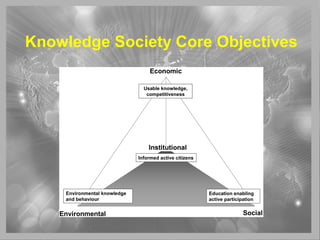
Knowledge Society Core Objectives
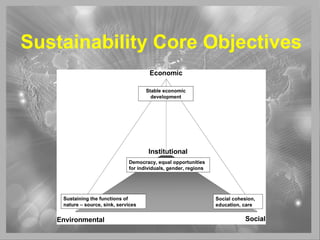
Sustainability Core Objectives
ST&I:Tunisia’s Lifeboat! (Towards Equitable Sustainable Knowledge Society)

ST&I:Tunisia’s Lifeboat! (Towards Equitable Sustainable Knowledge Society)

  • 2.
    ST&I:Tunisia’s Lifeboat! (Towards EquitableSustainable Knowledge Society) Prof. Jelel Ezzine Tunisian Association for the Advancement of Science, Technology and Innovation (TAASTI) ATEI Innovation Day February 21st, 2015
  • 3.
    The First andOnly Tunisian PC (1981)
  • 4.
  • 5.
  • 6.
    Outline 1. The TunisianParadox, 2. An Innovation System in the Making, 3. Tunisia’s Achilles’ heel, 4. A Post Revolution Vision, 5. A Debut of a Solution,
  • 7.
    Outline 1. The TunisianParadox, 2. An Innovation System in the Making, 3. Tunisia’s Achilles’ heel, 4. A Post Revolution Vision, 5. A Debut of a Solution,
  • 8.
    …established wisdom! Human capitalplays a decisive role, and the capacity to learn matters more than the level of knowledge. While secondary school certificates were the trump cards of industrialization, higher degrees are those of the knowledge economy. Lifelong training is essential. Lundvalle, 1998 Knowledge Economies in MENA, WBI, 2003 “Over the next ten years, 26 of the top 30 fastest growing jobs require some post-secondary education or training … The demand for skilled workers is outpacing supply, resulting in attractive, high-paying jobs going unfilled.” Assistant Secretary of Labor for Employment and Training Innovate America, Dec. 2004
  • 9.
    Unemployment Rates by Levelof Education (2001-2010)
  • 10.
    Unemployment Rates by EducationalAttainment (1984-2010)
  • 11.
    Outline 1. The TunisianParadox, 2. An Innovation System in the Making, 3. Tunisia’s Achilles’ heel, 4. A Post Revolution Vision, 5. A Debut of a Solution,
  • 12.
    ““Systemic” approach tounderstandingSystemic” approach to understanding Innovation’s impact on developmentInnovation’s impact on development
  • 13.
    Key Institutions andPolicies 1. 1978: Ministry of Higher Education and Scientific Research (MHESR), 2. 1991: Secretariat of State for Scientific Research and Technology (SERST), 3. 1996: Scientific Research and Technological Development Orientation Law, 4. 2007: Doctoral schools, 5. 2008: 1. National Agency for the Promotion of Scientific Research (ANPR), 2. Agency for the Promotion of Industry and Innovation (APII).
  • 14.
  • 15.
  • 16.
  • 17.
    “A number ofcountries are challenging the traditional scientific superpowers,” said Sir Chris Llewellyn Smith of Oxford university, who chaired the study team. Among smaller countries, the Royal Society report singles out Tunisia, where R&D spending rose from 0.03 per cent of GDP in 1996 to 1.25 per cent in 2009. Its priority is life sciences and medicine – with an official aim to increase pharmaceutical exports five-fold within five years. Although the study does not cover the impact of the recent overthrow of Arab autocrats, such as … of Tunisia, Sir Chris said: “I would expect it to have a good influence on science.”
  • 18.
    Outline 1. The TunisianParadox, 2. An Innovation System in the Making, 3. Tunisia’s Achilles’ heel, 4. A Post Revolution Vision, 5. A Debut of a Solution,
  • 19.
  • 20.
    FDI and TechnologySpillover • … the results show the positive impact of R&D activities, human capital quality, past experience in innovation and public subsidies on probability of firms to innovate; whereas, ownership structure has a negative impact. Innovation and R&D Investment of Tunisian Firms: A Two-Regime Model with Selectivity Correction, MOHAMED KRIAA and ZOUHOUR KARRAY, The Journal of Business Inquiry 2010, • They also suggest that firms with high export intensity and significant foreign capital participation are found to be less innovating than partially exporting firms with low foreign capital share. Innovation in Tunisia, Empirical Analysis for Industrial Sector, Moez El Elj, Décembre 2010.
  • 21.
  • 22.
    Shortcomings of currentpolicy responses 1. Lack of a collective vision, 2. Despite the isolated successes, the “system” didn’t deliver growth, and thus jobs and wellbeing, 3. Lack of global coherence, and absence of coordination, led to a systemic failure, 4. Despite industrial modernization programs, innovation remains frail, 5. Absence of synergies even with the multitudes of incentives and programs.
  • 23.
    Recommendations: Higher Education System: 1.Grant autonomy to the leading universities, within a healthy differentiation program, 2. Reshape university governance by adapting best practices and structures compatible with high quality education and research training, 3. Allow universities to diversify their funding by maximising returns while playing their role as a local engine of socio-economic growth and development,
  • 24.
    Recommendations: Industry System: 1. Adopta long term industrial policy capable, in the short and medium terms, of consolidating the competitive sectors, while launching progressively a dozen of high value-added niches within a coherent strategy, 2. Initiate national innovation procurement programs, to accelerate the implementation of the industrial policy, 3. Champion a number of targeted large national ST&I projects to enhance capacity, encourage collaborative work, and boost collective learning,
  • 25.
    Recommendations: Governance: 1. Create aVice Prime Minister position, or equivalent, to coordinate the complex ST&I system, and insure its alignment with the remaining national policies and strategies, 2. Streamline the structure of the actual NIS with confirmed models while keeping the same components and slightly modifying their missions and roles, 3. Built effective and sufficient capacity due regards ST&I policy analysis and design along with R&D management capabilities.
  • 26.
    Outline 1. The TunisianParadox, 2. An Innovation System in the Making, 3. Tunisia’s Achilles’ heel, 4. A Post Revolution Vision, 5. A Debut of a Solution,
  • 27.
    Sustainable Knowledge Society •Asustainable knowledge society is an emancipative vision, based on the concept of sustainable development and the assessment of what technology can contribute to it, and how technology development and its social framing will influence the functioning of a sustainable society. •sustainable development is not a positive but a normative concept, ethical rather than analytical. •To promote sustainability, there needs to be explicit identification of the direction of development a society wishes to strive for, and a permanent social learning process in pursuit of this goal, involving scientists and engineers as all other members of society.
  • 29.
    Outline 1. The TunisianParadox, 2. An Innovation System in the Making, 3. Tunisia’s Achilles’ heel, 4. A Post Revolution Vision, 5. A Debut of a Solution,
  • 30.
  • 31.