Strategy
President’s Statement AI in Egypt
4.1 The Case for an AI Strategy
4.2 SWOT Analysis
Human Capacity Building
8.1 General Awareness
8.2 Formal Education and Training
8.3 Promoting AI Research in Egypt
AI for Development
7.1 Agriculture, Water Management and
Environment
7.2 Healthcare
7.3 Economic Planning and Growth
7.4 Manufacturing and Smart
Infrastructure Management
7.5 Arabic Natural Language Processing
7.6 Finance and Banking
Phase 1: Implementation Plan
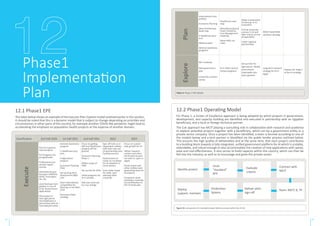
12.1 EPE
12.2 Operational Model
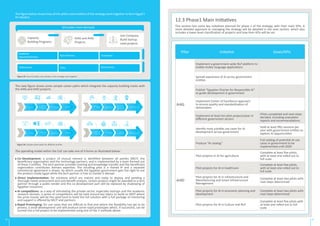
12.3 Main Initiatives
Implementation Methodology
11.1 Implementation Framework
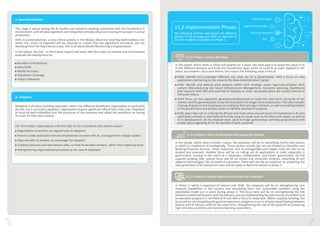
11.2 Implementation Phases
Executive Summary Strategy Overview
5.1 Vision and Mission
5.2 Pillars and Enablers
International Activities Monitoring and Evaluation
13.1 Total Strategy Impact
13.2 Strategy Thought Leadership
13.3 Strategy Execution Effectiveness
Background
3.1 What is an AI System?
3.2 AI Strategies and Initiatives
around the World
AI for Government Strategy Enablers
10.1 Governance
10.2 Data
10.3 Infrastructure
10.4 Ecosystem
Conclusion and Next Steps
Table of Contents
1 4
2 5
3 6
8
7
12
11
9 13
10 14
Appendix A: List of Main Contributors
Appendix B: References
1 2
President’s
Statement
3 4
Egypt is keen to embrace the digital era, as advancements in technology continue to evolve
every day. These developments create promising opportunities for laying the foundation
for a national economy that is based on the emerging technologies of the Fourth Industrial
Revolution, most notably Artificial Intelligence. This necessitates intensifying efforts to
adopt such technologies, and developing clear strategies to utilize those technologies
in building a modern state and achieving Egypt’s development goals, aiming to improve
Egyptians’ quality of life.
Therefore, I have mandated the National Council for Artificial Intelligence to develop a
comprehensive national plan, aiming to pave the way for indigenizing the AI industry and
strengthening Egypt’s leading role at the regional level to become an active global player in
this field.
The National AI Strategy has been drafted according to a model that promotes effective
partnerships between the government and the private sectors to create a dynamic work
environment that spurs innovation, supports building Digital Egypt, and achieves the digital
transformation led by AI applications. This is in addition to encouraging investment in
Research and Development (R&D) in such technologies, raising awareness of its significance,
and developing human capital to create a generation of young Egyptians capable of
developing AI applications, in line with the national needs and the country’s priorities.
We strongly believe that as emerging technologies create opportunities, they also pose
challenges that we should be prepared for. Thus, we aim, through the National AI Strategy,
to open the door to dialogue with stakeholders and promote international cooperation
to exchange views on the best practices for developing and using AI to build the common
good. This is in addition to adopting and leading strong stances on AI ethics and the social
and economic impact of using AI applications in African and Arab countries, under the
umbrella of the African Union (AU) and the League of Arab States (LAS) to reach a common
vision that reflects our needs and aspirations, and conforms to our values and principles.
Egypt gives its full support to the Strategy to ensure a successful implementation. I trust in
the Egyptian competence, capable of mobilizing all energies to transform the Strategy into
action plans, which can be translated into tangible, real-life results. We endeavor to keep
up with AI developments to reach a new cultural milestone and create a promising future
for our great country.
Abdel Fattah Al–Sisi
President of the Arab Republic of Egypt
Executive
Summary
In November 2019, the Egyptian Cabinet approved the formation of the National Council for
Artificial Intelligence (NCAI) to include representatives from all relevant government entities as well
as independent experts in the field of Artificial Intelligence (AI). The Council’s main objective is to
formalize and govern the implementation of Egypt’s National AI Strategy.
The present document is the culmination of efforts by the Technical Committee of the National
Council, and builds on previous work carried out in 2019 by the Ministry of Communications and
Information Technology and the Ministry of Higher Education and Scientific Research, along with
input from independent experts and private sector companies. The Technical Committee would like
to extend its thanks to all parties for the roles they have played in producing this document.
Recent studies and economic indicators all point to the net positive effect that can be realized from
absorbing AI into international economies. Egypt is no exception; given the right investment climate
and upskilling/reskilling strategy for its labor, the country stands to benefit substantially from the
opportunities AI affords while avoiding its risks, most notably the rise of unemployment.
To this end, Egypt is embarking on developing a national strategy for AI, which aims to realize the
following vision:
1. Exploit AI technologies to support the achievement of Egypt’s sustainable development goals, to
the benefit of all Egyptians.
2. Play a key role in facilitating regional cooperation within the African and Arab regions and establish
Egypt as an active international player in AI.
The strategy consists of the following four pillars
1. AI for Government: The rapid adoption of AI technologies through the automation of
government processes and embedding AI into the decision-making cycle to increase
efficiency and transparency.
2. AI for Development: Apply AI in different economic sectors based on a phased
approach, with the aim of realizing efficiencies, achieving higher economic growth
and better competitiveness. Key projects will be identified and implemented through
domestic and international partnerships, and will always include a capacity building
element, to foster technology and knowledge transfer, and help grow the local
ecosystem. Priority sectors for phase 1 include: Agriculture/ Environment/ Water
Management - Healthcare - Arabic Natural Language Processing (NLP) - Economic
Planning and Development - Manufacturing and Smart Infrastructure Management.
3. Capacity Building: Prepare the Egyptian population for the age of AI at all levels, from
general awareness to school, university and equivalent education, to professional
training for technical and non-technical disciplines.
4. International Activities: Play a key role in fostering cooperation on the regional and
international levels by championing relevant initiatives, representing African and
Arab positions, and actively participating in AI-related discussions and international
projects.
The mission statement emerging from this vision is to:
Create an AI Industry in Egypt, including the development of skills, technology, ecosystem,
infrastructure, and governance mechanisms to ensure its sustainability and competitiveness.
To achieve the vision and mission above, Egypt will work on the following dimensions:
1. Embed AI technologies in government operations to make them more efficient and transparent.
2. Utilize AI in key developmental sectors to make an economic impact and to solve local and regional
problems in support of Egypt’s sustainable development strategy and in line with the UN’s SDGs
for the benefit of all Egyptians.
3. Encourage investment in AI research and innovation through public-private partnerships and
initiatives with universities, research centers, and the private sector.
4. Become a regional hub for AI education and talent serving local, regional and international market
needs.
5. Support lifelong learning and reskilling programs to contribute to workforce development and
sustained employability
6. Create a thriving AI ecosystem by supporting local entrepreneurship and innovation efforts, and
fostering an academic scientific environment full of ideas, inventions, and discoveries.
7. Promote a human-centric AI approach where people’s wellbeing is a priority and facilitate multi
stakeholder dialogue on the deployment of responsible AI for the benefit of society and to inform
related policy discussions.
8. Capitalize on AI as an opportunity for inclusion of the marginalized, not only for safety net
programs, but also in initiatives that promote human advancement and self-development.
9. Facilitate cooperation on the Arab and African levels, working to unite Arab and African voices
and efforts in AI for the benefit of all.
10. Actively contribute to global efforts and playing an active role in AI different international fora,
especially around topics of AI Ethics, future of work, responsible AI and the social and economic
impact of AI.
5 6
5 6
Supporting the four pillars are the following four enablers
1. Governance: including ethics, laws and regulations, tracking and monitoring
2. Data: including collection, management and monetization strategies
3. Ecosystem: including private sector, research and academia, and civil society
4. Infrastructure: including fair access to compute, storage, networking, and other
assets
The strategy will be implemented in a phased approach; the first phase started in 2020 and
lasts until the end of 2022. It focuses on training graduates and professionals to fulfil market
needs and proving the value of AI in the different strategic sectors by starting pilot projects
within government in partnership with local and foreign entities. This phase will further focus
on building regional bridges to unify AI efforts on the African and Arab levels, as well as active
participation in international organizations on topics such as AI Ethics, AI for SDGs, and the
impact of AI on labor markets and education. During the first phase, preparations for the
second phase will take place, which will include an assessment of further priority sectors and
paving the way for a focus on growing the ecosystem, especially startups. Details of phase 1
are included in this document, and an operational plan will be issued regarding further phases
in due course.
The National Council for AI (NCAI) will oversee the implementation of this strategy and will set
and track the relevant KPIs to measure progress and make adjustments where needed.
AI and specifically, data-driven methods such as Machine Learning, are promising a radical
transformation of the economic and social systems worldwide. By 2030, AI is forecast to add $15
trillion to the global economy, with countries that manage to fully absorb AI into their economies
expecting to see up to 25% of their GDP growth driven by AI.
From computer vision techniques allowing real-time analysis and understanding of videos and
images, to Natural Language Processing (NLP) algorithms enabling the creation of chatbots capable
of carrying out human-like conversation, to probabilist Deep Learning systems used in complex
decision-making processes such as medical diagnosis - to list but a few applications - it has become
impossible for nations to ignore the promise and impact of AI.
AI has therefore gained increasing priority on the policy agendas for governmental institutions, at
both national and international levels. Many national government initiatives to date focus on using
AI technologies for development and economic growth, fostering research and strengthening the
ecosystem, in particular AI startups. International and regional organizations have also started paying
due attention to AI and each has started to carve out a niche for itself based on its competencies and
membership composition.
Applying AI to areas such as education or healthcare can facilitate access, overcome staff shortages,
and reduce risks and costs. On the other hand, concerns are growing about increasingly automated
and autonomous AI systems widening the technological, economic, and social gaps due to the lack of
basic infrastructure and human capacity capable of exploiting this technology, especially in countries
with a large proportion of low-skilled or unskilled labor.
AI promises the biggest labor market transformation since the industrial age and threatens to
marginalize groups not adequately prepared for its arrival. There are also growing concerns about
the ethics of AI systems and issues such as bias, gender equality, insufficient regulation, and the
loss of nuances in culture and language, for example due to the use of Natural Language Processing
(NLP) systems. No single country or actor has all the answers to these challenges. Therefore, there is
a need for international cooperation, broad dialogue and multi-stakeholder responses to exchange
knowledge and best practices and guide the development and use of AI for the wider good.
On the national level, countries need to work on developing their own stances towards AI, capitalizing
on their comparative strengths and ensuring a minimization of adverse effects generated by AI to
ensure they are not left behind in the global race for technological dominance.
Background
7 8
3.1 What is an AI System?
An AI system, as explained by the OECD’s AI Experts Group (AIGO), is “a machine-based system
that can, for a given set of human-defined objectives, make predictions, recommendations or
decisions influencing real or virtual environments. It uses machine and/or human-based inputs
to perceive real and/or virtual environments; abstract such perceptions into models (in an
automated manner e.g. with ML or manually); and use model inference to formulate options for
information or action.” AI systems are designed to operate with varying levels of autonomy.
The term AI in itself has morphed over the years since it was coined by John McCarthy et al at
Dartmouth University in 1956. It was initially thought to act as an umbrella term encompassing all
actions which, if performed by a machine, the machine can be termed “intelligent”. Early efforts
in AI development focused on creating machines and software systems which could mimic the
human brain. This led to the inception of the “expert systems” of the 1960s, which were based
on hierarchical rules programmed by domain experts, for example in medicine or agriculture.
However, such systems were always limited by: a) the knowledge of the experts involved in
programming them; b) the cost of developing such systems, especially the high cost of computing
and storage hardware; and c) the complexity of the software tools and systems required to model
highly intricate processes. This led to two phases of so-called “AI winters” during which relatively
little research was done.
The dawn of the third millennium brought significant advancements in data search and retrieval
algorithms. Coupled with exponentially decreasing costs of storage and compute hardware, as
well as the advent of startups such as Google which managed to create a business model based
on the analysis of user data, the scene was set for a resurgence in a long-dormant field of AI, that
of Machine Learning (ML). ML is a subfield of AI, which relies on complex analysis of large datasets
to infer rules and extract features, then use those to “predict” new values for unknown data.
Having a proven business model for using data commercially encouraged many organizations to
fund research in ML both in academia and in the private sector itself, to the point where the latter
has now leapfrogged academic research in most areas of ML.
Since then, many subfields of ML have emerged, including Deep Learning (DL), which is based
on Artificial Neural Networks, which are structures comprised of small software nodes that
mimic the neurons in the human brain and are governed by complicated differential equations;
Reinforcement Learning (RL), which uses feedback loops and the concept of reward to simulate
a “learning” mechanism; Transfer Learning (TL), which relies on the ability to apply rules learnt
in one domain to another without a large investment in retraining, and many other subfields
that emerge every day. However, the one common thread is the importance of data and the
algorithms (called “models”) utilized to analyze them. With the prevalence of cloud computing,
many of these models have now become off-the-shelf modules that can be accessed on platforms
such as Amazon’s AWS, Google’s GCP, or Microsoft’s Azure, without the user having to develop
any of them from scratch. However, there is still a need for custom algorithms that solve specific
problems.
Despite the prevalence of data-driven techniques, the world is currently experiencing a revival of
the methods of old, known as “rule-based” or “symbolic” AI. Some of the world’s most powerful
AI products have managed to combine both techniques to achieve optimal results.
3.2 AI Strategies and Initiatives Around the World
According to different studies and reports, an AI strategy can be defined as a set of synchronized
government policies that have an objective of maximizing potential benefits and minimizing
potential costs of AI for the economy and society. Each strategy outlines a number of initiatives the
government plans to undertake, usually over a period of 3-10 years.
Currently AI is one of the top priorities of policy agendas for most countries at both national and
international levels. Most AI strategies share common characteristics, such as a focus on talent
development, while considering the needs, the economic, social, ethical, and political context and
the development goals of each country.
A survey of over 30 national AI strategies around the world shows that some countries focus on AI
applications or scientific research, while others also cover initiatives to promote open data, ethical
standards, digital infrastructure and labor market redesign. However, all strategies aim to promote
the use and development of AI.
AI is also one of the top priorities on the agendas of International and Regional organizations such
as the Group of Seven (G7), Group of Twenty (G20), UNESCO, OECD, WIPO, the European Union,
League of Arab States the African Union, etc. This international dialogue aims at building a common
understanding of emerging AI technologies. The UN also has numerous ongoing initiatives related to
AI with the objective of identifying principles and policy priorities for AI with the aim of accelerating
progress towards the UN Sustainable Development Goals (SDGs).
Therefore, in order to find an optimal strategic direction for the introduction of an AI Strategy, Egypt
should focus on two levels:
International Level: Different national AI strategies and international efforts around the world to
learn from them with the aim of solving problems and producing actual solutions for the benefit
of Egypt.
National Level: Egypt’s needs and development goals.
An important distinction to be made is that between “weak” and “strong” AI or “general” and
“narrow” AI. General AI (sometimes referred to as “AGI” or “Artificial General Intelligence”) is a
hypothetical concept which revolves around a machine fully replicating the functions of a human
brain to the point that it is indistinguishable from a real brain, and by which it is able to perform any
task a human being can. AGI remains the subject of science-fiction films to this day and there is no
current path which can lead to it despite some attempts. Weak or narrow AI on the other hand refers
to a system which is capable of performing one task at or even above the level of a human-being.
Most of these systems utilize data-driven methods and are deployed within one specific setting. All
systems we currently refer to as “AI” fall under this classification.
9 10
in Egypt
Figure1: Predicted annual growth rates in 2035 of Gross Value added (a good predictor of GDP) comparing baseline to a scenario where AI has been
absorbed by the economy (Source: Accenture)
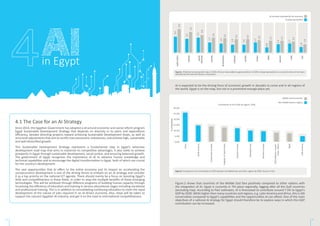
AI is expected to be the driving force of economic growth in decades to come and in all regions of
the world. Egypt is on the map, but not in a prominent enough place yet.
Figure2: Comparison of AI contribution to GDP between the Middle East and other regions by 2030. (Source: PwC)
Figure.2 shows that countries of the Middle East fare positively compared to other nations with
the integration of AI. Egypt is currently in 7th place regionally, lagging after all the Gulf countries
(excluding Iraq). According to PwC estimates, AI is forecasted to contribute around 7.5% to Egypt’s
GDP by 2030. While higher than many countries and regions, e.g. Latin America and Africa, this is still
conservative compared to Egypt’s capabilities and the opportunities AI can afford. One of the main
objectives of a national AI strategy for Egypt should therefore be to explore ways in which this GDP
contribution can be increased.
4.1 The Case for an AI Strategy
Since 2014, the Egyptian Government has adopted a structural economic and social reform program
Egypt Sustainable Development Strategy that depends on diversity in its plans and expenditure
efficiency, besides directing projects toward achieving Sustainable Development Goals, as well as
structural adjustments that aim to rectify macroeconomic imbalances, and achieve high, sustainable
and well-diversified growth.
This Sustainable Development Strategy represents a fundamental step in Egypt’s extensive
development road map that aims to maximize its competitive advantages. It also seeks to achieve
prosperity in Egypt through sustainable development, social justice, and ensuring balanced growth.
The government of Egypt recognizes the importance of AI to advance human knowledge and
technical capabilities and to encourage the digital transformation in Egypt, both of which are crucial
for the country’s development.
The vast opportunities that AI offers to the entire economy and its impact on accelerating the
socioeconomic development is one of the driving forces to embark on an AI strategy and consider
it as a top priority on the national ICT agenda. There should mainly be a focus on boosting Egypt’s
skills and competitiveness in these fields, in order to reap the multiple benefits of these emerging
technologies. This will be achieved through different programs of building human capacity through
increasing the efficiency of education and training in various educational stages including vocational
and professional training. This is in addition to consolidating continuing education to meet the rapid
development of the nature of jobs required in an AI-driven economy. Also, steps will be taken to
support the nascent Egyptian AI industry, and get it on the road to international competitiveness.
GERMANY
NETHERLANDS
SWEDEN
UNITED
KINGDOM
FINLAND
UNITED
STATES
AUSTRIA
FRANCE
JAPAN
BELGIUM
SPAIN
ITALY
2.6
2.1
2.5
1.7
1.6
1.4
1.4
1.7
0.8
1.6
1.7
1.0
4.6
4.1
3.9
3.6
3.2
3.0
3.0
2.9
2.7
2.7
2.5
1.8
AI has been absorbed by the economy
Comparing baseline
Northern
Europe
Developed
Asia
Southern
Europe
Kingdom
of
Saudi
Arabia
United
Arab
Emirates
North
America
China
GCC4
(Bahrain.
Kuwait.
Oman.
Qatar)
Egypt
Latin
America
Non-Middle Eastern regions
Middle East economies
0.0%
5.0%
10.0%
15.0%
20.0%
25.0%
30.0%
Contribution of AI to GDP by regions, 2030
%
of
Baseline
11 12
Some of the capabilities Egypt should exploit in order to bridge that gap include:
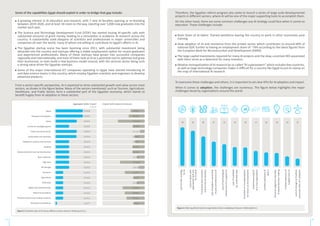
From a sector-specific perspective, AI is expected to drive substantial growth and value across most
sectors, as shown in the figure below. Many of the sectors mentioned, such as Tourism, Agriculture,
Healthcare, and Public Sector, form a substantial part of the Egyptian economy, which stands to
benefit hugely from AI adoption in these sectors.
A growing interest in AI education and research, with 7 new AI faculties opening or re-branding
between 2019-2020, and at least 10 more on the way, injecting over 3,000 new graduates into the
market each year.
The Science and Technology Development Fund (STDF) has started issuing AI-specific calls with
substantial amounts of grant money, leading to a stimulation in academic AI research across the
country. A substantially sized diaspora of scientists and professionals in major universities and
companies all over the world, many of whom are willing to contribute to Egypt’s efforts in AI.
The Egyptian startup scene has been booming since 2011, with substantial investment being
attracted into the country and startups offering a viable employment option for recent graduates
and experienced professionals. Many of these startups have grown into successful companies
regionally and internationally, and most of them look at AI as a potential tool to optimize and grow
their businesses, or even build a new business model around, with the services sector being such
a strong value driver for Egyptian startups.
Some of the major international ICT companies operating in Egypt have started introducing AI
and data science teams in the country, which employ Egyptian scientists and engineers to develop
advanced products.
Therefore, the Egyptian reform program also seeks to launch a series of large-scale developmental
projects in different sectors, where AI will be one of the major supporting tools to accomplish them.
On the other hand, there are some common challenges any AI strategy could face when it comes to
execution. These challenges include:
Brain Drain of AI talent: Trained workforce leaving the country to work in other economies post
training.
Slow adoption of AI and resistance from the private sector, which contributes to around 60% of
national GDP, further to having an employment share of ~74% according to the latest figures from
the European Bank for Reconstruction and Development (EBRD).
The large capital investments required for many AI projects and the slow, uncertain ROI associated
with them serve as a deterrent for many investors.
Relative monopolization of AI research by so-called “AI superpowers” which includes few countries,
as well as large technology companies makes it difficult for a country like Egypt to put its stamp on
the map of international AI research.
To overcome these challenges and others, it is important to set clear KPIs for AI adoption and impact.
When it comes to adoption, the challenges are numerous. The figure below highlights the major
challenges faced by organizations around the world.
Figure 3: Potential value of AI across different sectors (Source: McKinsey & Co.)
Retail
Transport and logistics
Travel
Consumer packaged goods
Public and social sector
Automotive and assembly
Healthcare systems and services
Banking
Advanced electronics/ semiconductors
Basic materials
High tech
Oil and gas
Insurance
Agriculture
Chemicals
Media and entertainment
Telecommunications
Pharmaceuticals and medical products
Aerospace and defense
0.4-0.8 3.2-5.7
0.4-0.5 4.9-6.4
0.3-0.5 7.2-11.6
0.2-0.5 2.5-4.9
0.3-0.4 1.1-1.4
0.3-0.4 2.6-4.0
0.2-0.3 2.9-3.7
0.2-0.3 2.5-5.2
0.2-0.3 3.3-5.3
0.2-0.3 1.6-3.1
0.2-0.3 5.7-10.2
0.2-0.2 1.8-1.9
0.1-0.3 3.2-7.1
0.1-0.2 2.4-3.7
0.1-0.2 1.0-2.3
0.1-0.2 2.9-6.9
0.1-0.2 2.9-6.3
0.1-0.1 4.2-6.1
< 0.1 T 1.8-3.2
Aggregate dollar impact
trillion$
Impact as% industry revenues
Figure 4: Most significant barriers organizations face in adopting AI (Source: McKinsey& Co.)
Lack
of
clear
strategy
for
Al
Lack
of
talent
with
appropriate
skill
sets
for
Al
work
Functional
silos
constrain
end-to-end
Al
solutions
Lack
of
leaders›
ownership
of
and
commitment
to
Al
Lack
of
technological
infrastructure
to
support
Al
Lack
of
available
(ie,
collected)
data
Uncertain
or
low
expectations
for
return
on
Al
investments
Underresourcing
for
Al
in
line
organization
Limited
usefulness
of
data
2
Personal
judgment
overrides
Al-based
decision
making
Limited
relevance
of
insights
from
Al
Lack
of
changes
to
frontline
processes
after
Al›s
adoption
12
18
19
20
21
24
24
25
27
30
42
43
13 14
4.2 SWOT Analysis
To accurately determine the elements of an Egyptian AI strategy, it is important to conduct a status
quo assessment of the state of AI in Egypt and the country’s readiness to embark on a journey of AI
adoption.
Human Resources
Egyptian scientists and engineers with expertise in AI are employed by universities, research
centers, and industrial companies alike. Hundreds of AI researchers are employed by the National
Research Center, the Academy of Scientific Research and Technology (ASRT) and its affiliates,
Agriculture Research Center, etc.
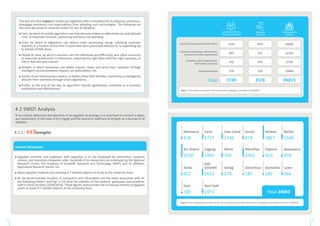
Many Egyptian students are choosing ICT-related subjects to study at the university level.
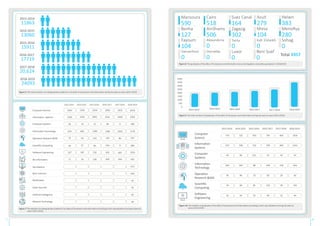
As the governmental Faculties of Computers and Information are the areas associated with AI,
the following (Table 1 and Figs. 5-13) show the statistics of the students, graduates, and academic
staff in those faculties (2018/2019). These figures demonstrate the increasing interest of Egyptian
youth to study ICT related subjects at the university level.
Strengths
4.2.1
The lack of a clear impact AI model can negatively affect motivation for AI adoption, and hence,
disengage businesses and organizations from adopting such technologies. The following are
the main key areas to measure impact for any AI adoption:
Cash, by which AI and ML algorithms can help decision makers to effectively use, and allocate
cash, to maximize turnover, optimizing inventory and spending.
Time, by which AI algorithms can reduce order processing, hiring, satisfying customer
requests in a fraction of the time it could have been processed without AI, to expediting Go
to Market (GTM) times.
People & Labor, by which a business can hire effectively and efficiently, and utilize resources
to maximize productivity. Furthermore, matching the right labor with the right company, or
role in fast and easy manner
Growth, in which businesses can better acquire, retain and serve their customer through
intelligent recommendation engines, ad-optimization, etc.
Assets, AI can help business owners, to better utilize their facilities, machinery or intelligently
allocate their inventory through smart algorithms.
Profits, at the end of the day, AI algorithms should significantly contribute to a business
profitability and effectiveness.
15 16
Academic Staff and
Teaching Assistants
Graduate
Students
Undergraduate
Students
Total
Faculty of Computers and Information
Computer Engineering, and Electronic
and Communication departments
Computer science departments,
the Faculties of Science
Private Universities
3357
515
454
250
4576 49819
10800
2739
12187
24093
1232
897
350
270
2749
Table 1: The statistics of academic staff and students in Egyptian universities in 2018/2019
Mansoura
574
Cairo
1727
Suez Canal
1746
Assiut
674
Helwan
3867
Ain Shams
3520
Zagazig
1991
Minia
766
Menofiya
2562
Fayoum
410
Tanta
422
Kafr
Elsheikh
1653
Sohag
278
Damanhour
185
Domieetta
180
Banha
1560
Alexanderia
459
Luxor
266
Suez
180
Beni Suef
1073 Total 24093
Figure 5: The undergraduate students in Faculties of Computers and Information versus the Egyptian universities enrolled in 2018/2019
Figure 9: The total numbers of graduates of Faculties of Computers and Information during the past six years (2013-2019)
0
500
1000
1500
2000
2500
3000
3500
4000
2013-2014 2014-2015 2015-2016 2016-2017 2017-2018 2018-2019
Computer
Science
773 723 763 745 855 1016
Information
Systems
673 700 729 790 843 1412
Computer
Systems
44 60 411 41 42 41
Information
Technology
363 367 88 340 470 664
Operation
Research &DSS
36 40 23 82 20 82
Scientific
Computing
54 60 81 122 50 142
Software
Engineering
23 50 25 69 32 40
2013-2014 2014-2015 2015-2016 2016-2017 2017-2018 2018-2019
Figure 10: The statistics of graduates of Faculties of Computers and Information according to their specializations during the past six
years (2013-2019)
Figure 6: The total numbers of undergraduate students in Faculties of Computers and Information during the past six years (2013-2019)
2013-2014
11863
2014-2015
13060
2015-2016
15911
2016-2017
17719
2017-2018
20,624
2018-2019
24093
Figure 8: The graduates of Faculties of Computers and Information versus the Egyptian universities graduated in 2018/2019
Cairo
518
AinShams
506
Alexanderia
0
Damanhour
0
Suez Canal
164
Zagazig
302
Tanta
0
Domietta
0
Asuit
279
Minia
104
Kafr Elsheikh
0
Luxor
0
Helwn
383
Menofiya
280
Sohag
0
Beni Suef
0
Mansoura
590
Benha
127
Fayoum
104
Total 3357
Computer Science
2013-2014 2014-2015 2015-2016 2016-2017 2017-2018
1256
1043 2250 1850 1955
Information Systems 1033
1329 2041 2541 2369
Computer Systems 14
46 31 48 0
Information Technology 681
679 1180 1384 1503
Operation Research &DSS 54
72 110 124 86
Scientific Computing 57
64 90 244 0
Software Engineering 187
127 132 432 607
Bio-Medical
Bio-informatics
Basic Sciences
Multimedia
Cyber Security
Artificial Intelligence
Network Technology
74
71 136 200 244
2018-2019
3070
2302
186
1170
347
380
1553
372
935
564
42
62
65
49
Figure7:ThestatisticsofundergraduatestudentsinFacultiesofComputersandInformationaccordingtotheirspecializationsduringthepastsix
years (2013-2019)
17 18
Associate
Professor Lecturer
Assistant
Lecturer
Teaching
Assistant
102
260
370
426
Professor
74 ICT Sector
Research and Development
Data Resources
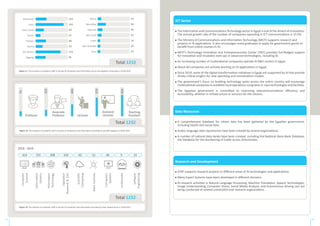
The Information and Communications Technology sector in Egypt is one of the drivers of innovation.
The annual growth rate of the number of companies operating in ICT communications is 13.5%.
The Ministry of Communications and Information Technology (MCIT) supports research and
projects in AI applications. It also encourages many graduates to apply for government grants to
benefit from online courses in AI.
MCIT’s Technology Innovation and Entrepreneurship Center (TIEC) provides full-fledged support
for innovation and incubates start-ups in advanced technologies, including AI.
An increasing number of multinational companies operate AI R&D centers in Egypt.
About 60 companies are actively working on AI applications in Egypt.
Since 2019, some of the digital transformation initiatives in Egypt are supported by AI that provide
timely critical insights for new operating and monetization models.
The government’s focus on building technology parks across the entire country will encourage
multinational companies to establish local operations using best-in-class technologies and facilities.
The Egyptian government is committed to improving telecommunications efficiency and
accessibility, whether in infrastructure or services for the citizens.
STDF supports research projects in different areas of AI technologies and applications.
Many Expert Systems have been developed in different domains.
AI research activities in Natural Language Processing, Machine Translation, Speech Technologies,
Image Understanding, Computer Vision, Social Media Analysis, and Autonomous Driving cars are
being conducted at several universities and research organizations.
A comprehensive database for citizen data has been gathered by the Egyptian government,
including health and social data.
Arabic language data repositories have been created by several organizations.
A number of national data banks have been created, including the National Gene Bank Database,
the Database for the Numbering of Cattle across Directorates.
Computer
Science
Operation
Research
&
DSS
Computers
Systems
Information
Systems
Scientific
Computing
multimedia
Information
Technology
Basic
Sciences
Software
Engineering
2018 - 2019
414 331 208 102 62 51 40 9 15
Figure 12: The statistics of academic staff in Faculty of Computers and Information according to scientific degrees in 2018-2019
Figure 13: The statistics of academic staff in Faculty of Computers and Information according to their departments in 2018-2019
Figure 11: The numbers of academic staff in Faculty of Computers and Information versus the Egyptian universities in 2018-2019
Mansoura 103
Zagazig 99
Cairo 243
Minia 24
Suez Canal 83
Menofiya 96
Assiut 47
Fayoum 46
Helwan 80
Beni Suef 47
Banha 93
Luxor 16
Ain Shams 210
Kafr Elsheikh 20
Suez 25
Total 1232
Total 1232
Total 1232
19 20
Insufficient AI Research and Education:
Insufficient number of experts and skilled engineers capable of developing, implementing,
maintaining, and operating AI systems.
AI education is not provided in pre-university education.
Research Planning, Management, Social Needs, and Innovation:
No specialized national body is responsible for integrating and/or coordinating demand driven AI
research efforts.
Lack of a comprehensive mechanism connecting knowledge with innovation.
The current legislative system does not cover the emerging challenges that AI presents, e.g. ethical
issues, liability, data bias.
Data Availability and Quality:
Non-availability of data collected by institutions for research purposes.
The poor integration of databases raises many problems, such as redundancy, inconsistency and
inaccuracy of the data needed to mine and extract useful knowledge.
Universities and Research Institutions Physical Infrastructure:
Internet bandwidth is not wide enough for big data, especially when required to be processed
remotely.
Universities and national research institutions do not have enough computing power to run AI
applications.
Inadequate awareness of the importance of intellectual property and its protection.
Weaknesses
4.2.2
AI and Machine Learning could solve many governmental problems, such as inferring knowledge
from data, detecting and averting security threats, fake news detection, etc.
There are many problems related to lack of technical expertise that knowledge-based systems
could solve in many domains, such as healthcare, transportation, agriculture, etc.
There are social and business needs for better tools related to Arabic Natural Language Processing
such as Machine Translation, Text Summarization, and Semantic Information Retrieval.
Opportunities
4.2.3
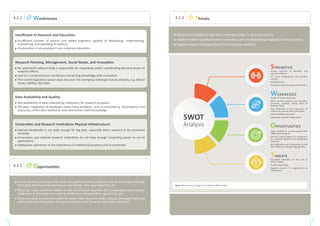
Figure 14: A summary of Egypt’s AI readiness SWOT analysis
Decreased availability of data due to limiting changes in open data policies.
Inability to retain capable domestic researchers, who are attracted by employers in other countries.
Negative impact of AI applications on the Egyptian workforce.
Threats
4.2.4
SWOT
Analysis
Weaknesses
Strengths
Opportunities
Threats
Human resources in education and
research institutes .
ICT sector infrastructure and provided
services.
Data Resources.
Existing AI research projects and systems.
Quality of Human Resources.
Weak research planning and innovation
processes, especially linking them to
society’s needs.
Poor awareness of the importance of
intellectual property and its protection.
Data availability and quality.
Inadequate research infrastructure.
Huge potential to increase government
effectiveness using AI.
Decision support systems to compensate
for technical expertise and standaridize
processes.
NLP applications can compensate for the
lack of literacy or foreign language skills.
Decreased availability of data due to
policy changes.
Human capital flight.
Negative impact of AI applications on
employment.
21 22
Strategy
Overview
This section translates the above findings into a strategic framework that capitalizes on the
strengths and opportunities and attempts to address weaknesses and minimize threats. It
is important to note that Egypt is currently undergoing a massive digital transformation of
the government sector, which inevitably has to move in parallel with the execution of the AI
strategy. In addition, being a country of relatively limited resources, it is important to prioritize
areas where the most gain can be achieved in the short term in order to prove the value of AI in
different domains, and maximize the return for the Egyptian taxpayer. Therefore, the starting
point has to be defining a clear vision and mission statement to identify exactly what Egypt
hopes to achieve by adopting AI, where trade-offs will be made, and how this can translated
into an implementation plan, as outlined in the following sections.
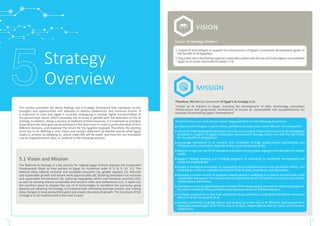
5.1 Vision and Mission
The National AI Strategy is a key priority for helping Egypt achieve relevant UN Sustainable
Development Goals as they pertain to Egypt (in numerical order 4, 5, 8, 9, 10, 11). The
relevant SDGs address inclusive and equitable education (4), gender equality (5), inclusive
and sustainable growth and decent work opportunities (8), fostering innovation via inclusive
and sustainable infrastructure (9), reducing inequalities within and between countries (10),
as well as working toward sustainable and resilient cities and settlements (11). It spells out
the country’s plans to deepen the use of AI technologies to transform the economy, going
beyond just adopting technology, to fundamentally rethinking business models and making
deep changes to reap productivity gains and create new areas of growth. The 1st phase of the
strategy is to be implemented in the next 3 years.
Therefore, the Mission Statement of Egypt’s AI strategy is to:
“Create an AI Industry in Egypt, including the development of skills, technology, ecosystem,
infrastructure and governance mechanisms to ensure its sustainability and competitiveness for
purposes of promoting Egypt’s development.”
To achieve the vision and mission above, Egypt will work on the following dimensions:
Embed AI technologies in government operations to make them more efficient and transparent.
Utilize AI in key developmental sectors to make an economic impact and to solve local and regional
problems in support of Egypt’s sustainable development strategy and in line with the UN’s SDGs
for the benefit of all Egyptians.
Encourage investment in AI research and innovation through public-private partnerships and
initiatives with universities, research centers, and the private sector.
Become a regional hub for AI education and talent serving local, regional and international market
needs.
Support lifelong learning and reskilling programs to contribute to workforce development and
sustained employability
Create a thriving AI ecosystem by supporting local entrepreneurship and innovation efforts, and
fostering an academic scientific environment full of ideas, inventions, and discoveries.
Promote a human-centric AI approach where people’s wellbeing is a priority and facilitate multi
stakeholder dialogue on the deployment of responsible AI for the benefit of society and to inform
related policy discussions.
Capitalizeon AIasan opportunity forinclusion of themarginalized,not only forsafetynetprograms,
but also in initiatives that promote human advancement and self-development.
Facilitate cooperation on the Arab and African levels, working to unite Arab and African voices and
efforts in AI for the benefit of all.
Actively contribute to global efforts and playing an active role in AI different international fora,
especially around topics of AI Ethics, future of work, responsible AI and the social and economic
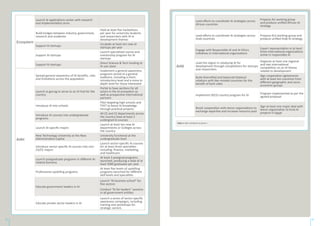
impact of AI.
mission
Egypt’s AI Strategy Vision is:
1. Exploit AI technologies to support the achievement of Egypt’s sustainable development goals, to
the benefit of all Egyptians.
2. Play a key role in facilitating regional cooperation within the African and Arab regions and establish
Egypt as an active international player in AI.
vision
23 24
PILLARS
ENABLERS
AI for Government
Governance
Data
Infrastructure
AIforDevelopment
Capacity Building
InternationalActivities
Ecosystem
5.2 Pillars and Enablers
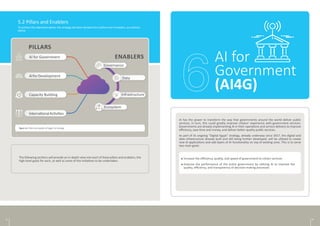
To achieve the objectives above, the strategy has been divided into 4 pillars and 4 enablers, as outlined
below.
Figure 15: Pillars and enablers of Egypt’s AI Strategy
The following sections will provide an in-depth view into each of these pillars and enablers, the
high-level goals for each, as well as some of the initiatives to be undertaken.
AI for
Government
(AI4G)
AI has the power to transform the way that governments around the world deliver public
services. In turn, this could greatly improve citizens’ experience with government services.
Governments are already implementing AI in their operations and service delivery to improve
efficiency, save time and money, and deliver better quality public services.
As part of its ongoing “Digital Egypt” strategy, already underway since 2017, the digital and
data infrastructure already built and still being further developed, will be utilized to create
new AI applications and add layers of AI functionality on top of existing ones. This is to serve
two main goals:
Increase the efficiency, quality, and speed of government-to-citizen services
Improve the performance of the entire government by utilizing AI to improve the
quality, efficiency, and transparency of decision-making processes
25 26
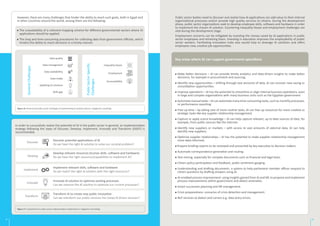
However, there are many challenges that hinder the ability to reach such goals, both in Egypt and
in other countries around the world, among them are the following:
The unavailability of a coherent mapping scheme for different governmental sectors where AI
applications should be applied.
The long and time-consuming procedures for collecting data from government officials, which
hinders the ability to reach decisions in a timely manner.
Figure 16: General and public sector challenges of implementing AI solutions (Source: Capgemini consulting)
In order to successfully realize the potential of AI in the public sector in general, an implementation
strategy following the steps of Discover, Develop, Implement, Innovate and Transform (DDIIT) is
recommended.
Figure 17: A potential AI in public sector implementation model (Source: Capgemini consulting)
Public sector bodies need to discover and realize how AI applications can add value to their internal
organizational processes and/or provide high quality services to citizens. During the development
phase, public sector organizations seek to develop employee skills, software and hardware in order
to implement the chosen AI solution. Countering inequality biases and employment challenges are
vital during the development stage.
Employment concerns can be mitigated by investing the money saved by AI applications in public
sector employees and retraining them. Investing in education improves the employability of public
sector workers. Facilitating innovation hubs also would help to leverage AI solutions and offers
employees new, creative job opportunities.
Key areas where AI can support government operations
Make better decisions – AI can provide timely analytics and data-driven insights to make better
decisions, for example in procurement and sourcing.
Identify new opportunities – shifting through vast amounts of data, AI can uncover new saving or
consolidation opportunities.
Improve operations – AI has the potential to streamline or align internal business operations, even
in large and complex organizations with many business units such as the Egyptian government
Automate manual tasks – AI can automate many time-consuming tasks, such as monthly processes,
or performance reporting.
Free up time – by taking care of more routine tasks, AI can free up resources for more creative or
strategic tasks like key supplier relationship management.
Capture or apply scarce knowledge – AI can help capture relevant, up to date sources of data, for
example, from public sources like the Internet.
Identify new suppliers or markets – with access to vast amounts of external data, AI can help
identify new suppliers.
Optimize supplier relationships – AI has the potential to make supplier relationship management
more data-informed.
Prepare briefing reports to be reviewed and presented by key executive to decision makers.
Automate correspondence generation and routing.
Text mining, especially for complex documents such as financial and legal texts.
Citizen policy participation and feedback, public sentiment gauging.
Understanding and drafting documents: a system to help parliament member offices respond to
citizen questions by drafting answers using AI.
AI-enabled process improvement: using insights gained from AI and ML to propose and implement
process improvements within government and detect anomalies.
Smart succession planning and HR management.
Crisis preparedness: scenarios of crisis detection and management.
NLP services to detect and correct e.g. data entry errors.
Public
Sector
Specific
Challenges
General
Challenges
Data quality
Data management
Data availabilility
Data intake
Updating Al solutions
Skills gap
Inequality biases
Employment
Accountability
Discover
Develop
Implement
Innovate
Transform
Discover potential applications of Al
Do we have the right Al solution to solve our societal problem?
Develop relevant resources (human skills, software and hardware)
Do we have the right resources/capabilities to implement Al?
Implement relevant skills, software and hardware
Do we match the right Al solution with the right resources?
Innovate Al solution to optimize existing processes
Can we improve the Al solution to optimise our current processes?
Transform Al to create new public innovation
Can we transform our public services into (new) Al driven services?
27 28
“Foster the use of AI in vital developmental sectors using partnerships with local beneficiaries and
local or foreign tech partners to ensure knowledge transfer while addressing Egypt’s development
needs. Identify and execute key projects in those sectors either directly or through the ecosystem,
e.g. startups.”
With the rapid development and implementation of AI, all actors including governments, NGOs,
companies and international organizations should encourage and prioritize the use of AI in areas
of sustainable development such as healthcare, agriculture/food supply, environment, water
management, education, infrastructure management, economic planning and growth, and others
which are in line with the priority sectors that have been identified according to Egypt Sustainable
Development Strategy and in line with the UN’s Sustainable Development Goals.
ThispillaraimsatusingAIandotheradvancedtechnologyinkeyprioritysectorstosolvetheproblems
facing society, while, at the same time, building the capabilities of human cadres.
One of the most important features of the recent Egyptian reform program
is how it focuses on some areas that have not been reformed for decades
such as the agricultural sector, which is one of the main economic sectors in
Egypt. The agricultural sector in Egypt accounts for 15% of GDP. It employs
over 8 million people or 32% of the total workforce.
Therefore, Egypt is currently launching a series of mega developmental
projects in the agriculture and food supply sectors. Research on the use of
AI in agriculture is among the main fields of development of the AI Strategy
of Egypt.
The use of AI in agriculture helps farmers gain insights from analyzing data such as temperature,
precipitation, wind speed, and solar radiation, and optimize them for maximum conditions for crops,
soil, and consumers. It is worth noting here that Egypt’s emphasis will not be on automation per se,
AI for
Development
(AI4D)
Impact of AI in Agriculture
AI technology is used in agriculture to improve results while reducing the environmental cost; for
example by helping farmers optimize crop yields by identifying variables such as humidity, light
and temperature.
7.1 Agriculture, Water Management and Environment
29 30
which in many cases means sacrificing jobs, but on enhancing the process and reducing problems
such as child labour. Ways in which AI has been proven to help in agriculture include the following:
AI provides more efficient ways to produce, harvest and sell essential crops.
AI implementation emphasis on checking defective crops and improving the potential for
healthy crop production.
The growth in AI technology has strengthened agro-based businesses to run more efficiently.
AI is being used in applications such as automated machine adjustments for weather forecasting
and disease or pest identification.
AI can improve crop management practices thus, helping many tech businesses invest in
algorithms that are becoming useful in agriculture.
AI solutions have the potential to solve the challenges farmers face such as climate variation, an
infestation of pests and weeds that reduces yields.
Forecasted Weather Data: AI is helping the farmer to stay updated with data related to weather
forecasting. The forecasted/ predicted data help farmers maximize yields and profits without
riskingthecrop.Theanalysisofthedatageneratedhelpsthefarmertotakeessentialprecautions.
Monitored Crop and Soil Health: AI can be used to monitor and identify possible defects and
nutrient deficiencies in the soil. With computer vision, AI identifies possible defects through
images captured by the camera mounted on vehicles, drones, or through satellite imaging.
Deep learning algorithms are developed to analyze flora patterns in agriculture. Such AI-enabled
applications are supportive in understanding soil defects, plant pests, and diseases.
Decreased Pesticide Usage: Farmers can use AI to manage weeds by implementing computer
vision, robotics, and machine learning. With the help of AI, the data gathered is analyzed to
keep check on weeds, which helps the farmers to spray chemicals only where the weeds are.
This reduces the usage of the chemical spraying, instead of traditional methods of spraying the
entire field.
AI Agriculture Bots: AI-enabled agriculture bots assist farmers in finding more efficient ways to
protect their crops from weeds and enable optimize irrigation based on crop needs at any given
time.
The implementation of such applications will be done through partnerships and co-development
projects, specifically related to studying the effects of climate, flow of waterways, data-gathering
procedures, agricultural monitoring, irrigation, spot spraying and identification of crops which
will maximize the yearly harvest, in addition to capacity building and skills development to enable
new generations of developers and users of these AI applications.
7.2 Healthcare
The potential for AI in healthcare is vast. AI is increasingly
becoming a part of the healthcare eco-system. AI is
already being used to detect diseases, such as cancer in
their early stages. The use of AI is enabling review and
translation of mammograms 30 times faster with 99%
accuracy, reducing the need for unnecessary biopsies.
Additionally, AI increases the ability for healthcare
professionals to better understand the day-to-day
patterns and needs of the people they care for, and
with that understanding they are able to provide better
feedback, guidance and support for staying healthy.
In Egypt, specialists as such as pathologists and radiologists are very few in number relative to the
overall population (especially in the rural areas), therefore Egypt should focus on AI applications for
early diagnosis and detection of diabetic retinopathy and cancers.
Additionally, the following areas could be of high value within healthcare for Egypt: chronic disease
management, mental health support, combating social issues such as domestic violence and
addiction, pediatric triage, drug-drug interaction, and establishing an Egyptian biobank.
AI
7.3 Economic Planning and Growth
AI and data science can be very beneficial in dealing with
economic planning. Advanced algorithms can be used to
forecast economic numbers. This can provide useful tools for
the government and the central bank to alleviate economic
downturns, by providing economic stimulus or adjusting the
interest rates, based on the economic forecasts.
Macro-level and micro-level activity can be recorded, and
analyzed using data science, in order to discover trends and
alleviatepotentialproblems. Demographics canbeforecasted,
as a tool to gauge population increase.
The economic impact of AI is likely to be more severe on the developing countries than other parts of
the world. Developing countries are determined to be very selective about the AI technologies they
deploy, focusing on the applications that contribute to the growth of the country while empowering
its workforce.
Multinational companies and other foreign entities operating in Egypt are encouraged to explore
ways to mitigate any potential economic impact resulting from introducing AI into their operations.
Companies are encouraged to think outside the box and work hand in hand with local governments,
communities, NGOs and other bodies to explore programs of safety nets, and transition mechanisms
when deploying AI systems.
Ontheotherhand,thepositiveeconomicimpactforEgyptcanbesignificant.Moreresearchisneeded
to determine ways of maximizing this impact, for example by determining the most appropriate job
categories of the future and associated skills, as well as ways to maximize job creation through AI.
WhilethemostprominentapplicationsofAIinmanufacturing
center around robotics and full-factory automation as well
as predictive maintenance of equipment and factories,
Egypt’s focus should be more on areas that help increase the
competitiveness of Egyptian products for both the domestic
and foreign markets, without reducing human labour as a
goal. Examples include promoting small local industries,
shortening the innovation cycle, establishing testing facilities
for advanced industrial production or advanced transport
systems and creating an application development support
system for industry needs, especially with regard to synergies
and outputs from the public, private or PPP sectors.
7.4 Manufacturing and Smart Infrastructure Management
On the infrastructure side, potential use cases include predictive maintenance of public assets, using
predictive analytics in public safety, crime prevention, and traffic management.
More partnerships and cooperation are needed with entities that have expertise in using AI in
large-scale data analysis to determine the right mix of economic activities, infrastructure planning,
education, transportation needs and other services the region needs to optimize the use of its
natural and human resources.
Crucial to this pillar is reliance on accurate, inclusive and disaggregated data that accounts for every
member of society and captures the nuances of realities on the ground. In that respect, there needs
to be out of the box tools of data collection methodologies that accounts for every member of society
including informal workers and the marginalized. The adoption of well-designed data classification
and insight monetization strategy can help enable startups in data driven innovation initiatives that
offer win-win scenarios for development planning as well a thriving business community.
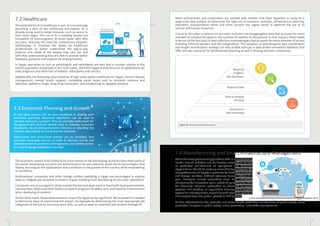
Figure 18: Economic planning framework
Required
Insights/
Key Questions
Required Data
Tools to Analyze
the Data
Governance
and Ownership
31 32
Given the close ties between AI and its applications in manufacturing, and the other technologies
of the so-called “Fourth Industrial Revolution”, this section serves as a sidebar to introduce the
concept and give an overview of its implications for Egypt. A more thorough study will be conducted
elsewhere.
The name “Fourth Industrial Revolution” was launched at the World Economic Forum in Davos,
Switzerland, in 2016. It is characterized by a set of features as it combines the physical world, the
digital world and the biological world, which affects all economic sectors, and compared to previous
industrial revolutions, the fourth industrial revolution is developing at a tremendous speed, leading
to the transformation of entire production systems, management, and governance.
The First Industrial Revolution used water and steam power to mechanize production. The Second
used electric power to create mass production. The Third used electronics and information
technology to automate production. Now a Fourth Industrial Revolution is building on the Third, the
digital revolution that has been occurring since the middle of the last century (The world Economic
Forum): Internet, enormous processing capacity, the ability to store information, and the unlimited
potential for access to knowledge.
The 4th
industrial revolution refers to the new industrial wave that is mainly based on the industry in
terms of its use of technology, especially modern technology in new areas, such as robots, artificial
intelligence, 3D printing, the Internet of Things (IoT), etc., and the use of this technology in everyday
life (Harvard Business Terminology Guide Review).
Today, and with the advent of the 4th
industrial revolution, a discussion of the impact of new
technologies such as AI and the overwhelming role that data plays in this context is crucial.
AI and the 4th
industrial revolution will have a great role in shaping the future of humanity. Most
studieshaveconfirmedthatthe4th
industrialrevolution willimposeanewreality,fullofopportunities
and challenges, as the concept of the “4th
industrial revolution” revolves around the automation
of the industry and the reduction of manpower in it, as the role of the individual in it is limited
to supervising only the industry, which necessitates the use of Scientific capabilities to possess an
advanced technical and digital infrastructure.
Therefore, the main concern of the fourth industrial revolution is the possibility of losing jobs in
favor of robots and AI, so many studies were done and there was a marked discrepancy in statistics
between one study and another about the percentage of jobs that could disappear.
One of those studies is a study conducted by OECD in 2015, which included 34 countries, most of
them from the developed countries, the results were that 14% of the jobs are exposed to great risk,
32% are exposed to less risk, and the study concluded that 210 million jobs in 32 countries are at
risk.
A comparison of lost jobs between developed and developing countries indicates that jobs in
developing countries are at greater risk than those in developed countries because the production
level and management is different between developing and developed countries.
With the advent of the 4th
industrial revolution, and concerns over its impact on work, it is of utter
importance that Egypt works to develop a vision of future work markets- global and local, and a
strategy for the impact of the 4th
industrial revolution on Egypt’s economic and jobs.
In light of this, human skills development becomes a key priority issue and crucial in mitigating the
effects of these technological shocks. This need to re-skill workers to adapt to the Fourth Industrial
Revolution is also in line with the fourth sustainable development goal which stresses on the need
to increase the number of youth and adults that have relevant skills and acquire the knowledge and
skills needed to promote sustainable development, employment, decent jobs and entrepreneurship.
7.5 Arabic Natural Language Processing
While digitization is a first step towards improved information access, great value can be extracted
from enriching this data and linking it to other data and information sources. Natural Language
Processing (NLP) can play a vital role in this, allowing not only a more user-friendly way of interacting
with such systems in natural language (text or speech), but also a powerful tool for extracting
contextual information and presenting it directly to the user, or as input to other systems.
NLP is the field that targets the analysis and processing of large amounts of natural language (or the
language used by humans).
NLP can automate analysis of Arabic text on the internet, search for certain content, apply opinion
mining, perform text summarization, and other tasks.
Arabic is spoken by more than 400 million speakers. It is recognized as the 4th
most used language of
the Internet and it uses its own set of characters.
Recently, Arabic and its dialects have begun to gain ground in the area of research within Natural
Language Processing. NLP is used to create Arabic chatbots that use machine learning to understand
the structure of the language as well as to understand the “meaning” of the words.
In addition to that, NLP is used for text recognition. Optical Character Recognition (OCR) is the main
technology for automatic text recognition, which helps to translate printed or handwritten documents
into a machine-readable format, and extract valuable information from it through Named Entity
Recognition (NER) and classification technologies.
While some efforts have been put into developing NLP systems for the Arabic language, there is still
a massive untapped opportunity in both text and speech, including various dialects, nuances, and
domain specific applications. Therefore, it is important for Egypt to work towards establishing a full
NLP stack for use by government and other entities, which also circumvents the need for using cloud
services that can compromise data locality.
Then, developing countries including Egypt should:
Have innovation policies compatible with the Fourth Industrial Revolution, it is important that
these innovation policies be coupled by socioeconomic policies (including safety nets) to mitigate
the potential negative effects of the Fourth Industrial Revolution on jobs.
Encourage innovation and scientific research in the field of AI and other components of the
Fourth Industrial Revolution.
Create AI Capacity building and training programs.
OrganizeawarenesscampaigntoeducatethebusinesssectorontheimportanceofAIapplications
as one of the main components of the Fourth Industrial Revolution.
7.4.1 The Fourth Industrial Revolution
33 34
7.6 Finance and Banking
With more than 70% of the population still to have
formal financial accounts, 22.4% of SMEs have access
to financing and with the rise in mobile wallets and
payments, AI provides an unprecedented opportunity
to expedite financial inclusion for both businesses
and individuals.
AICreditScoringcancreatescorecardstotheinformal
financing sectors, creating access to financing, and
thus empowering un-bankable individuals and small
businesses to contribute greatly to the Egyptian
economy.
Creating a formal credit bureau for the informal sector, that utilizes the power of AI to score people
and businesses with no credit history, to access financing, and then providing creditors access to
such services, could have great impact on micro financiers, lenders and farmers as well who could
opt for seed financing.
Certainly, it is just scoring that hinders lenders from giving loans. There is a lot of bureaucracy
involved that disengages askers, and there is a long Know Your Customer (KYC) processes that could
be cut short using AI based KYC as well.
To enable such a technology, a well-regulated consortium of data sharing needs to be built, from
telecom providers, banks, consumer lenders, to create a nationwide alternative scoring bureau, that
enables such an ambitious project.
Human
Capacity
Building (AI4H)
Human capacity building is arguably the most important pillar of Egypt’s AI strategy, and possibly
also the most difficult to fully implement. Due to the wide range of AI actors and the roles they play
across an AI system’s lifecycle, it is prudent to develop a full framework for capacity building that will
take into account not just the more traditional roles of a data scientist, a Machine Learning developer,
researcher and others, but also adjacent roles needed on AI development teams, as well as within
society at large. The following chart shows a rough distribution of technical and non-technical roles
typically associated with AI. The width of the rung indicates the relative number of people who fall
into each category. This framework will then be used to derive and develop appropriate programs
and courses at the various levels.
NON-TECHNICAL ROLES
TECHNICAL ROLES
Data Architects
MLOps & QA
Knowledge Engineers
Data Scientists
Machine Learning Engineers (/Specialists)
Data Analysts/Engineers
General Software Developers
(not in scope, included for illustrative purposes)
Leaders
Non-Tech Professionals
Non-STEM University Students
School Children
General Public
Figure 19: Relative distribution of technical and non-technical AI-related roles
35 36
8.2 Formal Education and Training
8.2.1 Schools
AI is a rapidly evolving field, and starting to teach it at the university level puts students under
significant pressure to absorb a huge amount of knowledge at once. It is therefore essential to
start exposing students to the basics of AI during their school education. This will also broaden
the “base” from which future AI experts at all levels can emerge.
In the Egyptian education system, preparatory years and the first year of secondary school are
the best times to teach students about AI. The second and third years of the secondary stage are
the ones leading to high-school diploma which puts students and families alike under stress, and
unless AI becomes a mandatory subject in those years, enrollment will be very low.
Teaching AI to school students needs to happen in a fun, interactive way, and take into account
their level of numeracy and technology knowledge. The following are some sample modules that
could be incorporated in school curricula, inspired by the AI4k12 initiative and AI + Ethics course
for middle school.
Computers with Intelligence:
What is AI and how is it different from other programs?
Why do we need AI?
You are using AI without noticing (examples from real life).
8.1 General Awareness
Raising public awareness of AI, its uses, benefits, risks and limitations, has been recognized as a gap
not just in Egypt, but in most parts of the world. The confusion about using the term “intelligence”
associated with what are essentially Machine Learning applications, fueled by science fiction books
and films, have created a lot of public uncertainty and in some cases fear of AI. However, if the Egypt
(and the world at large) stands to benefit from the gains AI promises, we need to start by educating
our general public and create a base of educated, knowledgeable users of AI systems. Over time,
it is this wider base that will ultimately also produce the technical professionals and highly skilled
specialists the country needs to implement and boost its ambitious AI plans.
General awareness must start at the very basic levels of society, and programs and content must be
accessible to even those with limited or no formal education. Different levels of courses and training
programs must then be designed to help recipients “climb up” the rungs of the capacity building
pyramid shown above.
General awareness programs will be easily consumable, mostly in the form of short videos or
interactive games to help the audience grasp the basic concepts of AI and separate myth from fact.
The types of audiences can be roughly classified into those that require: general awareness, formal
education, or professional training. The following sections will shed light on the requirements for
each type of programs, with a special section dedicated to boosting AI research in Egypt.
Societal Implication of AI
AI use cases: Students are given examples from real life, in business and government, on the use
of AI to solve problems or enhance the wellbeing of people.
What can go wrong (threats)? And what to do about it?
How does AI work?
Computer parts
Sensors
Processing
AI programs
The concept of Algorithm
Advanced AI
How to train a simple classifier?
Applying AI to different problems
AI and Ethics
Each one of the above modules can be expanded to be taught in a full academic year or as summer
boot camp during school holidays, and can also be complemented by student competitions and
challenges. Companies such as Google have already developed dedicated programs for this age
group.
In to deliver these modules; Egypt needs to have an important enabling factor: teachers who can
teach students about AI in the most exciting and efficient way, therefore a TOT program is highly
needed.
37 38
8.2.2 Universities
Universitystudentsareclassifiedintotechnicalandnon-technicalmajors,accordingtotheframework
above. “Technical” majors include Computer Engineering (CE), Computer Science (CS), and other
related fields which should teach AI as a core subject during undergraduate studies. Egypt has
already taken a step forward in this regard by opening new, dedicated “Faculties of AI” in universities
such as Kafr El Sheikh, Monoufeya, and the Arab Academy of Science and Technology. Others, such
as Cairo University, have renamed their Faculties of “Computers and Information” into “Computers
and AI” to stress the emphasis on AI as a core subject. They have also strengthened their teaching
and research capabilities to match this focus. Most other Faculties of Engineering and Computer
Science have added AI departments or at least have started teaching the basics of AI and Machine
Learning in the final years of undergraduate studies. In most cases however, these courses are too
theoretical and do not prepare graduates for the job market. It is therefore necessary to complement
them with postgraduate courses (both degree and non-degree programs) to give them the deeper
knowledge and practical experience they need. These courses should also be accessible to non-
CE and CS graduates with adequate levels of mathematics and programming knowledge, such as
graduates of the Faculty of Sciences and related fields. Postgraduate programs will be divided into
two categories: “broad” programs, offering a wide range of topics related to AI and data science, and
more specialized ones, for example focusing on one technology such as NLP or Computer Vision, or
one industry such as Machine Learning applications in financial services. These programs can vary
in duration from weeks to a whole academic year, but differ from traditional postgraduate programs
in that their focus is more on the practical aspects than the theory. As part of the longer programs,
students should be required to develop at least one end to end AI project, including learning how
to deploy an AI system into production, and how to assess its ethical, social and economic impact.
Such programs will ideally be developed together with specialized institutions, such as world-leading
academic entities for longer degree programs, and leading AI companies in Egypt and abroad for
shorter, more specialized courses. This will achieve the dual benefit of also producing graduates who
already fulfil the job requirements those companies are looking for.
39 40
In addition to formal courses during the academic year, the summer holidays can be used to give
more hands-on experience. Here are some examples:
Boot-camp: teaching new languages and packages and using them in small projects and introduce
them to the world of AI and data science through for example gamification.
AI Hackathon: competition in using AI in solving some real-life programs.
Internship in public and private sectors where they evaluate the potential of using AI in different
settings and help in implementing them.
The government can introduce small funds for students targeting solving small problems needed
in Egypt using AI.
Students in other fields will not have the computing background that allows them to appreciate
and use AI in their respective fields. Therefore, they need two courses: one is an introduction in
computing and the other is the use of AI in their respective field.
Introduction to Computing: components of a computer system, concepts and basics of Algorithm,
basics of data structure, and Python programming language (or Julia programming language if it
becomes the norm).
Specialized AI: The pre-requisite of this course is the previous course in this list. Then this course is
designed based on the background of students: AI in law, AI in literature, AI in history, etc.
Each one of these courses can span one or two semesters depending on the depth. It is advisable to
give them in 3rd
and 4th
year of university study so they have a good grasp of their field of expertise
and, hence, can have a clearer idea on how to use AI in it. Also, it is advisable that these two courses
be given in two consecutive semesters or years.
As a further measure to bridge the gap between theoretical knowledge and practical training at
the university level, the Egyptian Ministries of Communications and Information Technology (MCIT)
and Higher Education and Scientific Research (MHESR) have teamed up to establish a dedicated
technology university in the New Administrative Capital. Egypt University of Informatics (EUI) will
offer both undergraduate and postgraduate programs in several technical disciplines including AI,
and will offer a unique opportunity for students to apply their learning to real-life projects and
problems throughout their education.
Furthermore, MCIT has also embarked on an ambitious initiative called the Digital Egypt Builders
Initiative (DEBI), which offers professional masters degrees to outstanding graduates of technical
disciplines. The course of study, lasting for one year post graduation, will cover the latest topics in
the discipline of choice (AI being one of them), in addition to managerial and soft skills needed in
the workplace such as teamwork, project management, presentation, communication, planning,
among others. Students will be granted full scholarships and will also be offered unique training and
internship opportunities by leading companies working in Egypt.
8.2.3 Technical and Vocation Training (TVET)
In 2018, students who joined the technical schools in Egypt represent 55% of the total number of
students.Thislargenumber,totalingabout2millionstudentsaspertheCapitalCenterforEconomical
Studies and Research (CCESR), represents a great potential for Egyptian workforce.
However, technical schools face many challenges including lack of resources, low student motivation,
and the lack of qualified teachers. Any curriculum design for TVET schools must therefore start with
a strong teacher enablement program and adequate funds allocated to hardware and software
resources. It is also important to specify the exact goals we aim to achieve by introducing AI into
TVET schools. These goals include:
Being able to discover talents among students regarding computing in general and AI in particular
and make the best use of them.
Train the students on how to use AI to enhance their work. This mainly involves process automation.
Encourage innovations, pick the innovations that can be used on a larger scale, and implement
them nationwide. This will help the economy and also serves as inspiration to students.
Having a workforce of educators who can train students in technical schools on AI techniques.
Metrics to measure progress towards these goals include:
The number of students who showed great talent in using AI in innovative ways.
The percentage of students who end up using AI in at least one aspect of their job.
Having one AI educator for every 25 students.
The number of innovations generated by the alumni of technical schools who have been trained to
use AI in their jobs.
Challenges Suggested Course of Actions
Students in those technical schools are less
familiar with computing in general.
Start with a semester-long course about
“Introduction to Computing”.
Also, summer camps that give introduction to
computing can be useful.
Computing, especially AI, requires
some theoretical education. Students in
technical schools are more hands-on and
hence more theoretical studies is not easy
for them.
AI-related courses must be more hand-on, such as:
How to automate a process?
How to know whether a process can be
automated?
How to use AI techniques to detects faults in a
product.
ThesoftwaretoolsusedmusthaveArabicinterface.
Students needs inspiration to be able
to digest this advanced material. This is
because students join technical schools
because they just want to get any degree
and could not get into traditional schools.
Therefore, they are not very enthusiastic
about education in general.
Introducing a course about “AI and Society”. This
course has the following goals:
Explain the importance of AI to the different
fields, with concentration on the fields related to
the technical school.
Explain how AI can complement their artifact
does not replace them as workers.
Give them inspiration stories from advanced
countries, like Germany, Japan, and Singapore,
whose technical education was a decisive factor
to the advancement of these countries, and who
AI was used in that context.
Some of them may have heard about AI
and are afraid of AI to take over their jobs.
The course of “AI and Society” mentioned in the
above row will solve this problem.
Technical schools, in general, face financial
problems. Training them on using AI in their
work requires advanced, hence expensive,
equipment.
Fund raising from private sectors, who will benefit
from those educated students in the future, can be
a good source of funding.
Non-technical professionals are potential “Domain Experts”. The Domain Expert is one of the most
important roles on any AI development team, as he/she contributes much-needed expertise in
applyingAItotheproblemathand.Theirexpertknowledgeisinvaluableonmanylevels:inidentifying
the exact problem to be solved, showing how it is solved today and what benefits can be gained from
using better techniques (such as Machine Learning). They also contribute advice on data collection,
if they don’t do it themselves. Once initial results are produced, they are the ones who can validate
themfroma“business”perspective,judgingforexample,whethera5%improvementinperformance
is adequate, or is a 95% accuracy is acceptable. An AI or data science team without a domain expert
is tapping in the dark and might end up producing results that are irrelevant at best, or wrong and
misleading at worst. It is therefore imperative to produce a generation of strong domain experts to
complement the technical experts in all fields where we hope to apply AI. Teaching domain experts
can be done in a similar way to introducing non-technical students to AI. An introductory course
in AI and data science, followed by a domain-specific, hand-on course that culminates in a joined
project with technical experts, are the right combination to produce professionals who are ready to
engage with a technical team in a real-life project setting. The rest of the required knowledge will be
acquired over time as their hands-on experience grows.
For executive-level professionals, in startups as well as government and private sector, special
versions of these programs need to be created, in the form of “AI Business Schools” or workshop-
style settings where real-life use cases in their domains can be discussed, and non-technical aspects
of AI projects taught, such as financial, HR, management, and others. Startups specifically could
benefit from mentoring on building knowledge and institutional capacity in AI.
8.2.4 Professionals
For professionals already in the market, at any level below leadership, the same classification used
above for university students also applies. Those working in IT-related jobs, specifically around
software development, will require upskilling programs to allow them to specialize in AI system
development, or apply their knowledge to an AI-specific project (for example, a DevOps engineer
learning how to do MLOps). Some of these specialized roles are listed in the capacity building pyramid
at the beginning of this chapter. These upskilling courses will typically be short in duration (one week
up to three months at most), and are better designed and delivered by companies working in the
field of choice.
The table below summarizes some of the challenges facing TVET schools and suggests ways of
overcoming them in order to deliver high-quality AI education:
There are several advantages to that. First, it will address challenges relevant to Egypt’s development
goals today. Second, these solutions can, later, take the form of startups or knowledge transfer to
other countries. Third, it will serve as a very good public-awareness about the usefulness of AI and
that it is an opportunity not a threat.
The second path must be pursued in the medium to long term, after the first path has already
started. This will train Egyptian researchers to pursue high-quality research and establish Egypt as a
scientific hub in the region. This, in turn, will pave the road for possible collaboration with top-notch
research centers and universities worldwide. It will benefit the first path by providing the tools and
the base that allow them to solve outstanding problems.
Most researchers will try to pursue the second path because, as pure academics, the incentives of
higher prestige and funding, are more prevalent in basic research. Therefore, there must be some
measures from the government to encourage researchers taking also the first path, as a short-term
goal. This encouragement can take the form of a fund dedicated only to the first path, using work
generated from that path for evaluation and promotion of academic researchers, etc.
Research in AI in Egypt has two paths. Both of
them must be pursued but at different paces.
The first path is “applied research”, doing
research to solve a problem already existent
in Egypt. The second path is to focus more
on basic research, leading to publications in
leading journals or conferences. In order to
realize tangible benefits from AI and prove its
value, the immediate focus should be on applied
research, while building a solid base to enable
basic research in the medium to long term.
8.3 Promoting AI Research in Egypt
Table 2: Challenges with TVET schools and education in Egypt
41 42
Another problem facing all countries in their standing in AI research and competitiveness is
insufficient talent. Egypt’s position would be considerably enhanced if it can retain ICT talent and
tempt them to stay, in service for their country. Also, many Egyptian ICT students are studying abroad
for undergraduate or graduate degrees. Active recruitment of these students and expatriates to
return and participate in the AI workforce would be very beneficial.
It worth mentioning here, that in the last few decades the fields of AI, machine learning and data
analytics have attracted a lot of research in Egypt. Nowadays there is a large number of productive
and competent researchers at different universities and research institutions. Egyptian AI researchers
are among the leading ones in the greater Middle East. In some topics such as Arabic NLP they are
the top in the world. According to Google Scholar statistics, the top 50 AI scientist in Egypt produced
8545 publications (as of 11/2020). They have an average H-Index of 20.9 (The H-Index means that
the researcher has H papers that are cited H times or more). So Egypt seems to have some readiness
to innovate and engage in high-technology AI projects. According to a study by Stanford University
researchers (see https://journals.plos.org/plosbiology/article?id=10.1371/journal.pbio.3000918)
the top 2 % scientists of the world (using a measure that consists of the number of publications and
the citation numbers) have 16 scientists in Egypt specialized in AI.
International
Activities
(AI4X)
Play a key role in fostering cooperation on the regional and international levels by championing
relevant initiatives, representing African and Arab positions, and actively participating in AI-
related discussions and international projects.
For developing countries, AI represents both an opportunity and a threat. International
cooperation promises the narrowing of innovation and industrialization gaps, offers the possibility
of addressing some of the countries’ most challenging problems, and opens up new fields of
cooperation and partnerships.
Therefore, Egypt believes in the worldwide transfer of knowledge, which exists through building
a network of relations with relevant and related entities. It also acknowledges the importance of
setting and developing regional capacity building programs and joint AI strategies.
Egypt is working actively on the international level to bring the perspective of developing countries
to international discussions, helping narrow the gap in AI knowledge and development, and foster
the use of AI applications that focus on economic and social development.
Encouraging international cooperation in AI development and deployment in general helps to
bridge geo-technological lines and necessitates a multi-stakeholder effort at the national, regional
and international levels. Technological exchanges/consultations should take place between
governments and their populations, between the public and private sectors, between and among
international governments.
43 44
To promote research in Egyptian universities, the following policies are suggested
Increase AI research funding through local and international funding agencies.
Have a track to fund applied research that focuses on solving some of Egypt’s problems or
participates in some of the national projects. These projects could be in collaboration with Egyptian
ministries, or public or private sector companies.
Actively recruit Egyptian students working on their PhD degrees abroad to come back and join
faculties of Egyptian universities, including giving incentives to encourage them. Recruit some
renowned Egyptian expatriate researchers to join or have visiting positions in newly established
centers for AI research in Egypt.
Establish new centers for AI research. This will boost AI research output, will improve the ICT and
AI echo-system, and will provide a vehicle to hire researchers from abroad. Establish research
centers of excellence that span several universities and can spur cooperation among researchers.
Link universities or research centers in Egypt with corresponding foreign entities, which are
currently undertaking research on policy and regulation related to data and AI.
Promote the development of international research networks to advance AI and to distribute its
knowledge and transformation potential to countries in the very early stages of AI capacity.
Bilateral Cooperation
Regional and
International Cooperation Policy Harmonization Leadership Position
Figure 20: Scope of international cooperation
Cooperation and collaboration with other countries, international bodies and relevant consortia and
fora are key to keeping Egypt at the forefront of the latest advancements in technology, policies and
partnerships while generating more investment opportunities in the country.
Enablers
The Cabinet of Ministers, during its meeting on Thursday 21 November 2019, chaired by Prime
Minister Dr. Mostafa Madbouli, approved a draft resolution on establishing a national council for AI.
The National Council for AI (NCAI) is chaired by the Minister of Communications and Information
Technology and includes representatives from government entities, private sector and independent
experts and heads of several bodies concerned.
The Council is in charge of outlining, implementing and governing AI strategy in close coordination
with the concerned experts and entities.
10.1 Governance
10.1.1 National Council for AI
45 46
International/Regional Cooperation: Egypt intends to share its know-how and experience through
the appropriate regional and international platforms in order to support capacity building programs,
development efforts, and the adjustment of policies and laws to keep pace with the international
digital evolution and to be one of the main voices worldwide helping to bridge the gap between
developed and developing countries.
This cooperation will be done through:
Active participation in international conferences and relevant consortia and fora
Launching initiatives on the regional level to unify voices and promote cooperation
Contribution to international initiatives promoting AI research, ethical considerations, capacity
building, socio-economic impact, and other relevant topics
Stronglypushing“AIforDevelopment”asathemeandapriorityacrossallregionalandinternational
fora, to promote the responsible use of AI to attain tangible benefits for humanity
Bilateral Cooperation: Egypt intends to strengthen its bilateral cooperation with different countries
with the aim of exchanging experience and best practices.
This cooperation will be done through:
Government-to-government collaboration agreements
Study visits and workshops
Inviting experts from different entities to present their experience at events organized by Egypt
Identifying and launching projects of mutual interest and benefit with friendly countries on a
bilateral or multilateral basis
The Council responsibilities are as follows:
Outlining the National AI Strategy.
Devising a follow up mechanism for the implementation of the National AI Strategy in a way that
adheres with the international best practices in this field.
Identifying national priorities in AI applications.
Recommending national policies and plans pertaining to the technical, legal and economic
framework of AI applications.
Reviewing any kind of cooperation both regionally and internationally which includes exchanging
best practices and expertise.
Identifying AI applications that provides smart, safe and sustainable solutions and services.
Reviewing international protocols and agreements in the field of AI.
Recommending programs for capacity building and for supporting the AI industry in Egypt.
Therefore, the Egyptian Parliament ratified the Personal Data Protection Law in early 2020. The
Law promotes the security of personal data, which is being processed and stored online. It also
sets a legal framework to regulate data transmission with other countries.
Each new wave of data represents major opportunities for any country to become a world leader
in this area. In this regard, Egypt should be able to move forward in implementing its own data
strategy with principles that suit its local environment, while ensuring relevance to global practices
such that Egypt can have a leading role on the matter through a solid international presence.
In addition, having an effective data strategy means having the right type of data, at the right time,
accessible to the right people via the right channels, while being governed and protected in the
right way.
10.1.2 Responsible/Ethical AI Policies
Despite the undeniable benefits of AI, its misuse can potentially cause harm to individuals or
communities. The existence of policies, regulations, and legislations to mitigate potential misuse
whether ethical, legal, or socio-economic, can promote and enable the widespread adoption of
AI solutions. Raising awareness as to what responsible AI and ethical AI is, could also serve as a
powerful enabler.
10.2 Data
The volume of data produced in the world is growing rapidly, from 33 zettabytes in 2018 to an
expected 175 zettabytes in 2025. Furthermore, the way in which data is stored and processed will
change dramatically over the coming 5 years. Today 80% of the processing and analysis of data takes
place in data centers and centralized computing facilities, and 20% in smart connected objects, such
as cars, home appliances or manufacturing robots, and in computing facilities close to the user
(‘edge computing’). By 2025 these proportions are likely to be inverted.
Data will reshape the way we produce, consume and live. Benefits will be felt in every single aspect
of our lives, ranging from more conscious energy consumption and product, material and food
traceability, to healthier lives and better healthcare.
Classification Description
Top Secret
Disclosure of top-secret data would cause severe damage to national
security.
Secret
Disclosure of secret data would cause serious damage to national
security. This data is considered less sensitive than data classified as
top secret.
Confidential
Confidential data is usually data that is exempt from disclosure under
laws such as the Freedom of Information Act but is not classified as
national security data.
Sensitive But Unclassified
(SBU)
SBU data is data that is not considered vital to national security, but
its disclosure would do some harm. Many agencies classify data
they collect from citizens as SBU. In Canada, the SBU classification is
referred to as protected (A, B, C).
Unclassified Unclassified is data that has no classification or is not sensitive.
Table 3: Data Classification Example
47 48
Towards this end, the following steps should be taken:
Develop a dedicated track within NCAI for AI ethics to:
Advise the government on the ethical and legal use of AI and data and related ethical, legal, policy,
and governance issues.
Identify ethical problems that can arise with the use of AI in Egypt.
Put in place guidelines for Responsible and Ethical AI to be used as a reference for AI practitioners
and companies in Egypt (the “Egyptian Charter for Responsible AI”).
Communicate and coordinate with appropriate government bodies to issue legislations and
regulations when and where needed. For example, building on the recently ratified Personal Data
Protection Law and expanding into areas of data anonymization, Intellectual Property Rights (IPR)
and patent law.
Educate AI practitioners as much as possible on the ethics of AI. This can be promoted through
ensuring that universities that grant AI degrees have a course on ethics in technology/AI as part of
their curriculum.
The following points list major Key Performance Indicators (KPIs) for ensuring Responsible/Ethical
AI in Egypt:
The establishment of a dedicated track within NCAI for AI Ethics.
Publish guidelines for Responsible and Ethical development of AI.
A set of rules and regulations for responsible AI use.
Ethics in AI/technology courses being offered in universities as part of computing degrees.
Data Types
Sources
Frequency
Collection mechanisms
Collection
Storage
Protection
Curation (maintenance, quality, updates)
Management
Analysis
Access/ Availability
Monetization
Use
GOVERNANCE
10.2.1 Elements of a Data Strategy
Figure 21: Elements of a Data Strategy
One of the main elements of a data strategy is “Data Classification”. Data classification allows
governments and private sectors to categorize information according to its sensitivity and thus
deploy suitable and effective security measures, while maximizing the benefit from this data. More
sensitive data, such as human resources or customer information, can be classified in a way that
shows that disclosure has a higher risk. Information data, such as those used for marketing, would
be classified at a lower risk.
Data classified at a higher risk can create security and access requirements that do not exist for
lower risks, which might not require much protection altogether. Government classification of data
is something created out of policy for maintaining national security or the privacy of citizen data.
Military and intelligence organizations set their classifications on the ramifications of disclosure
of the data. Civilian agencies also look to prevent unauthorized disclosure, but they also have to
consider the integrity of the data.
The following table lists examples of data classification categories and descriptions used in some
countries.
A successful data strategy defines the roles and responsibilities of each data actor (such as the data
owner, curator, or user), the process to enable them to collaborate, and the underlying policies
governing the interaction. The key here is building transparency through clear and comprehensive
communication of what data will be shared, how, why, and what benefit it brings to the economy,
and addressing any concerns.
An elaboration of Egypt’s infrastructure readiness and plans is out of the scope of this document.
However, it is important to point out that the lack of a cloud infrastructure in Egypt, especially a
presence for one of the major public cloud providers, aka ‘hyperscalers’ such as AWS, Google CP
or Microsoft Azure poses some serious obstacles to the rapid adoption of AI due to data locality
restrictions which prevent any data from leaving the country. Having a local datacenter not only
provides scalable storage and compute resources, but also gives Egyptian entities access to stacks of
AI and Machine Learning services which are constantly updated on these clouds, thereby eliminating
the need to write many of these services from scratch or ask the provider to deploy them on-prem,
an expensive and lengthy exercise which also does not guarantee they are kept up to date.
As far as software is concerned, it is important to keep abreast of recent developments in the world
of AI, which are almost daily by today’s measures. Reliance on open-source or ‘whitebox’ algorithms
and tools were possible, have got to be priorities for Egypt given its support for the principles
of responsible AI published by the OECD, and which include important clauses on transparency,
traceabilityandreliability.Avoidingvendorlock-inisanotherimperativeanditisthereforeparamount
to diversify partnerships as much as possible and build local capacity that is able to deal with a wide
variety of vendor solutions, both on-prem and in the cloud.
10.4 Ecosystem
Currently,therearestepstakentoestablishacenterthatwillplayaconsiderableroleintheapplication
of AI to governmental and non-governmental problems, the so called AI Center of Excellence (CoE).
The center will employ highly qualified AI researchers, possessing higher degrees, and it will be
the vehicle for designing AI solutions and implementing them for a variety of problems facing the
country. Specifically, it will have the following roles:
10.4.1 Establishment of an AI Center of Excellence
Tackling national projects that are based on AI application and big data. For example, the CoE could
apply AI to Egypt’s Ministry of Irrigation, optimizing water use with the help of AI.
Contacting government ministries and government agencies in order to search for tasks where AI
can be applied for more efficient operation and better performance. Many government agencies
may not have the AI insight to know that some of their operations can be improved (using AI), and
the CoE can educate them on these possible enhancements.
The CoE can be a vehicle to reverse the brain drain. This is by specifically targeting employment of
Egyptian researchers with higher degrees (such as PhD) from top universities of the world. In the
absence of such hiring opportunities in Egypt these students may likely not come back leading to
loss of talent that is quite detrimental for the country.
The CoE can provide internships for students and recent graduates. By training researchers and
giving them real experience in tackling AI problems, it can have a large positive impact on creating
a talented AI workforce that will benefit other work sectors as well.
10.4.2 Entrepreneurship and Startups
The infusion of AI, Machine Learning and data analytics into various aspects of entrepreneurship
have transformed the entrepreneurial ecosystem and the global business environment around the
world. AI has already penetrated firmly into many areas of business, professional, personal and even
daily life. Entrepreneurs and startups are considered as major contributors to the growth of the
global economy. A key pillar of Egypt in the near future is creating further job opportunities for youth
in various economic sectors, especially through entrepreneurship as youth represent more than
50% of the Egyptian population. By empowering entrepreneurs, students, and startup communities
in Egypt, we can fulfill the central pledge of the 2030 Agenda for Sustainable Development, which
is to “leave no one behind”. It is therefore important for governments and private sector to pay
equal attention to AI startups which can be a strong contributor to an AI-driven economic growth.
Providing support means helping start-ups with the right advice and infrastructure (legal, ethical,
technical, etc.) needed to create responsible AI products.
The government started to encourage technology companies around two decades ago. Since then
a large number of start-up companies have appeared. Many of them produced work that was
outsourced to companies and businesses abroad. The trend kept improving and there are now tens
of these companies, and many of them grew to become large companies with over 1,000 employees.
49 50
10.3 Infrastructure
Benefits of Data availability
No data-driven economy can exist without availability of and access to data.
Transparency: Individuals can access their data, and could provide useful additional information
or feedback for improvement.
Data Monetization
Data can be both a revenue stream for the government and a catalyst for an entire ecosystem.
Innovation and Entrepreneurship are interconnected. Innovation is the specific tool of entrepreneurs;
the means by which they exploit change for a different business or a different service. Egypt seeks
to organize competitions at different levels to stimulate the use of AI in solving real challenges and
creating new market opportunities.
The purpose of these competitions is to bring promising entrepreneurs and startups from around the
world in contact with investors, mentors, donors, and government representatives with the purpose
of solving innovation challenges using AI applications. It offers an opportunity to match start-ups with
larger companies on the national and multinational levels.
Objectives include:
These challenges and competitions will also raise awareness of AI technologies in Egypt and the
region, as well as provide a platform for participants to share AI ideas and applications and support
the development of their entrepreneurial skills and discover how to build successful AI applications.
10.4.3 Boosting the AI Sector in Egypt
Government projects can provide a boost to AI companies in Egypt. As mentioned above, there are
over 30 mediums-sized companies (employeeing 30 or more people) in Egypt that are specialized in
AI and its applications. These will thrive if they share in some of the government projects. It would
be beneficial for the country if most of these projects are allocated to an Egyptian company or an
international company with an office in Egypt, provided that the quality and/or cost expected from
this company is as favorable or better as any other purely international company.
The project allocation process could be run as follows:
a. Runapilot,announcedasacompetition,usingasubsetofrelevant,non-sensitive,legally-approved
data. Companies are free to apply their algorithms on this data subset as a preliminary test. This
is similar to kaggle.com’s competitions.
b. Solicit a written proposal from the candidate companies that will present their solution methods.
This is akin to ITIDA’s call for proposals that seek topics from companies and researchers in the
ITAC funding track.
c. Review the proposals (with the help of experts from academic institutions), and based on the
solution methodology, quality and reputation of the participants, and the performance in the
blind competition of Point a) decide on the best company to take on the project.
d. For large projects or certain specific projects stipulate that any foreign company that bids for a
project has a joint partner company from Egypt.
In addition, the following steps are to be pursued to push this achieved momentum, until Egypt
occupies an advanced position worldwide in AI technology:
a. Increase the funding offered to start-ups, also through government-related bodies.
b. Create AI-specific start-up incubators. These will provide office space, business and market advice,
clerical help, etc. This will serve to reduce the cost for starting a company and will channel the
focus of the engineers and scientists towards the technical problem at hand.
c. Provide incentives for public and private companies to purchase AI products locally (from Egyptian
AI companies) rather than import it from abroad.
d. Initiate some national projects that make use of AI technologies. This will solve a national problem
and also boost the AI industry in Egypt. Some of the projects can be posed in the form of a
competition. This will give strong incentive for producing the best work.
e. ProvideTechparks,innovationhubs,R&Dgrants,competitions,etc.Thesewillprovideinfrastructure
and help for start-ups.
10.4.4 Combating the AI Brain Drain
The immigration of Egyptian scientists and engineers to more advanced economies can have the
most detrimental impact on the health of the AI sector in Egypt. Brain drain is a major problem that
plagues many countries, even some advanced ones like Russia and France. The AI industry is mainly
based on the availability of talent. To combat the brain drain, the following steps can be taken:
Newly established Center on AI Applications and the AI and computer departments could favor the
employment of faculty members with PhD from leading international universities. These students
would otherwise seek employment in the country they are studying, leading to a loss of talent for
Egypt.
The Center of AI Applications and other future centers of excellence could hire Egyptian expatriates
that are prominent worldwide. For example a leading Egyptian AI researcher living in the US could
be hired as a consultant or a part-time researcher at these centers. In the current age where
remote employment is becoming prevalent this arrangement is quite feasible.
At the same time some multinational companies set up branches in Egypt and had large groups
working on machine learning research and applications, such as IBM and the Cairo Microsoft
Innovation Center (CMIC). Also, organizations such as ITIDA set up technology incubation programs
(TIEC) and funding programs to help start-up companies that are built on innovative ideas. Recently
some larger companies such as Raisa Energy established large machine learning groups to solve
engineering problems in the oil and gas field. Valeo, Inc. also set up a branch in Egypt with over
1900 employees working on research in autonomous vehicles. The four major telecommunication
companies also have large data analytics groups. There have been some acquisitions of Egyptian
companies by multi-nationals. For example, SysDSoft was acquired by Intel in 2011, and Newport
Media (with its biggest office in Cairo) was acquired by Atmel Corporation.
Today there is a healthy ecosystem of innovation and start-up companies that is one of the best in the
greater Middle East. Examples of successful companies are ITWorx, which has over 800 employees
and has a large group of them working on machine learning and in particular NLP. Overall there are
over 30 companies with number of employees more than 30 each working mainly on AI in Egypt.
Support innovative AI applications that create value for society and empower entrepreneurs.
Provide startups and entrepreneurs with greater access to knowledge.
Allow startups and entrepreneurs to invent and claim credit for their innovation.
Provide the knowledge needed for designing and implementing large-scale, effective AI applications.
Provide startups and entrepreneurs with process-based, project-centric workshops and training.
51 52
Given the long-term nature of this strategic exercise and at the same time, the fast pace with which
the industry moves, it would be prudent to divide the implementation plan into phases, each with
a declared high-level goal and initiatives. Phase 1 should be outlined in detail, while Phases 2 and 3
can be defined at a high level now, to be reviewed and detailed later based on market need, changes
in priorities, and lessons learned from Phase 1. We therefore adopt what we call an “Execute, Plan,
Explore” (EPE) framework, which is described in detail in the next sections.
Implementation
Methodology
11.1.1 Explore
This is where we build different visions for potential AI use cases, to progress Egypt’s AI leadership.
Consortiums of business experts, academics, researchers and potential beneficiaries will form
committees to scope and study potential use cases to progress the strategy and enable further
adoption.
Activities in the Explore phase will focus on building different roadmaps, policies and research
initiatives and the ones which have the highest feasibility potential will move to “The Plan” phase.
The Explore phase will select and evaluate ideas based on the below AI Theme Canvas:
Feasibility score [1-5], how feasible is the theme, scored based on
Data Availability: Is the data to train models available, can it be aggregated rapidly and with ease?
Scalability & Generalization: How generalized is the potential project and can it be adopted at
scale?
Readiness of Technology and Research: Is the technology for deployment and production readily
available, or is it still in research?
Talent & Capability: Are calibers to govern, build, deploy and monitor the project available?
Time to Market: How fast can this project be deployed?
Funding: Is Funding available?
Vision
(Explore)
P
r
o
j
e
c
t
s
(
E
x
e
c
u
t
e
)
G
o
a
l
s
(
P
l
a
n
)
Figure 22: The Explore-Plan-Execute Framework
After the above canvas is filled, a score will be given to the different themes based on Feasible,
Important and Urgent Matrix.
11.1 EPE Framework
The EPE framework adopts a funnel approach,
whereby for each time period, ideally half a calendar
year, initiatives are categorized based on their stage
of maturity/implementation, as described below:
The Explore Theme is about finding strategic
projects/use cases to focus on implementing and
testing. More on the Areas of Focus levels.
The Plan Theme is about building a POV to ensure
the feasibility of the use case, or project. While
finding the budget, data requirements and target
users. More on the Goals, and what success looks
like level.
The Execute Theme is about having ready to
implement projects on the ground and rolling
out AI applications at scale. This focuses on the
Project Execution level.
53 54
Problem
Statement
(Value)
Hardware
and Software
Requirements
Needed
Investments
AI Impact
Assessment &
Scope
(Is AI the right choice?
How will it help?)
Industry & Users
Returns on
Investment
(Direct & Indirect)
Partners & Stakeholders
Implementation
Impact
(Macro & Micro)
Scope of
Implementation
Data Needs
Talent &
Capability
Figure 23: Elements of the EPE Explore phase
Overall alignment of the project to the Egyptian AI strategy
Is the problem to be solved important to as many people, or is it common enough?
Will Egypt gain better ranking in Indices measuring AI readiness and leadership?
Importance Score [1-5], how important is the project to further progress Egyptian leadership in AI
Urgency Score [1-5], how urgent is the project towards Egyptian societal and economic status
Is the problem related to a major problem currently facing Egypt?
Is time to get in Execution of the essence?
Are there consequences for not taking immediate action?
The highest scored themes will move to the “Plan” phase.
11.1.2 Plan
The plan aims to develop experiments in order to confirm the “prove the value” of the theme or
project previously agreed upon in the explore phase. In “Plan”, Egypt is working to prove the value in
terms of feasibility and impact of the model. Hence, this phase will involve a lot of experimentation,
code-build, testing and validation. Once the model is proven, both technically and from an impact
point of view, the project moves to execution.
The following will describe the general philosophy of operation for the “Plan” phase:
Classify the problem: Frame the Problem at hand, stating a clear problem statement, and
prioritizing the problem as per the mentioned above.
Acquire data: Identify where the data exists to support the problem the center of expertise is
trying to solve. Data used in AI can come from a variety of sources, such as ERP systems, IoT
edge devices or mainframe data or public data. The data used may be structured (such as NoSQL
database records) or unstructured (such as images or videos).
Preprocess data: This is to prepare data for AI execution. Steps here include data transformation,
normalization and cleansing, as well as the selection of training sets.
Model the problem: Determine the optimum AI algorithm to be used for training or clustering. A
range of algorithms can be acquired and extended to suit different purposes.
Validate and execute: Validate results, determine the platform to execute models and algorithms,
and then execute the AI models.
POV Presentation: Presenting the work done in front of a committee of experts, with the Impact
forecasted, to be moved to “Execute”.
If approved, the output of every “Plan” project might have one or more of the below outputs:
Predictive engines that provide instant scoring, prediction, ranking, recommendation. For the
beneficiary to directly connect to it
Modularized Frameworks that can be easily repeatable in “Execute” phase
Variable engines that can continuously learn with every new data point and change
Analytical engines that can analyze root causes of anomalies and exceptions and take next action
autonomously
Visualizing platform that includes patterns and seasonality and non-intuitive relationships
Global near Real-time, full visibility on the whole network
Smart Portal, Backend & Frontend Design and Implementation to allow business users, to access
and analyze their operations
Restful APIs for all Algorithms and Analytics
The ‘Plan’ phase has four main success criteria:
i. High impact use case
AI is only as useful as the impact it can deliver. The Egyptian National AI strategy aims at putting
Egypt at a trajectory of AI leadership, by utilizing AI to power and impact its GDP.
To that matter, AI application in Industry or government should have a clear framework to quantify
and measure postproduction impact. The below framework is proposed, to quantify a use case’ s
impact:
People & Labor: a more effective labor and people performance management
Time Effectiveness: making organizations be time conscious and efficient and lead the market in
service and product to market
Assets: Creating superior ROA by better allocating assets whether warehouse, machine, or
equipment
Growth & Revenue: Building better services and products that accommodate customer needs and
recommending more products to them
Profitability: Optimizing total supply chain costs and reducing ineffective spending to upheaving
profitability
ii. Scalability of the use case
In “Plan”, all activities are operating with mass adoption in mind. The Explore phase cascaded the
“Plan” pipeline of potential projects, based on how common the problem is, and how feasible it is to
deploy an AI at scale to solve the problem.
Although, in “Plan”, entities will be working to build a Proof of Value, it has to accommodate how
scalable is the use case at hand. The following should be considered in any “Plan” initiative:
Historical Data: The availability of the Data, that has enough samples, representative of the
population that the AI will target or, the data is available to the end beneficiary so that they can
train their models and output the required accuracy and impact.
Time to Onboard: The number of hours needed to onboard a new organization, such as a
government entity, organization, or a business.
Operating Costs: After deployment, how expensive will it be to update the algorithm, considering
all expenses necessary, including talent needed, to deliver the proposed value and benefits.
Variable Accuracy: How prone is the algorithm to data drifts, and how impact would be affected by
it.
Human Interaction: How the users will interact with the solution in the Human – AI interaction.
Given the following scenarios:
55 56
A. AI decides, and acts autonomously
Autonomous Vehicles
Traffic Light automation
Energy Optimization in facilities
B. AI decides, human implements
Identifying Risks in pipelines (Leakage, breakage..etc.)
Staffing & Headcount projections
Commodity Price Prediction, and procurement
C. AI recommends, human decides
Lead Scoring
Credit Scoring
Hiring and Staffing
Furthermore, the data itself, to be used in the use case must follow the below guidelines:
Coverage: The data must be broad and consistent in terms of its coverage of the population, or at
least easy to acquire.
Accuracy & Timeliness: The data must be accurate, current, frequently updated and unbiased.
Predictive Power: The data and the provided information from the source should be relevant to
what is being predicted.
Compliance: The data and algorithms should comply with financial regulations as well as data
privacy and protection laws.
iii. Generalization of Model
In AI, there is always the question of how general this model can be. In other words, if the model is
tested on a certain dataset for a use case, can the model be deployed right away, without further
training, for the same use case in other locations, or for other companies.
As an example: In Alternative Credit Scoring, AI algorithms are trained on the approved and rejected
applicants for company A. The data in company A, has a built-in bias, reflecting their risk appetite
and internal policies, which might be only unique to them. Thus, the algorithm intelligence built on
their data might not be relevant to a more global population, as it will inherit all the bias of company
A in it.
That said, the teams proving the value, can build a generalized model, by which companies or
governments in Egypt can leverage the intelligence right away, without relying on having high-quality
or enough data.
This can be referred to, as Pre-trained Models, which makes any beneficiary able to use the algorithm
right away. This is a best case scenario, which will greatly facilitate the “Execute” phase.
For Example: Arabic OCR, which can detect Arabic text from images, with high accuracy, can be
leveraged in digitization processes and Robotic Process Automation scopes, or in reading algorithms
that can comprehend Arabic, which can provide the basis for further applications.
iv. Funding for Mass Adoption
To really push forward the boundaries of AI impact, if the AI built in “Plan” can be adopted by as
many government entities, businesses or applications. Sometimes, AI adoption in an organization,
would require significant investment of resources for data ingestion, Model integration, Machine
Learning operations (MLOps) etc.
If businesses adopt such a technology, they can better synchronize their supply chains, grow more
sustainably, and empower Egypt’s overall GDP. To encourage such adoption, subsidizing AI services
and implementations might prove to be an effective strategy to incentive organizations to adopt it.
For every proof of value, a Funding document, detailing the potential costs and benefits of the mass
adoption will be created. The following are the suggested areas of focus of such a document:
Benefits: Representing the value delivered from the use case on the individual and collective levels,
forecasted on a nation-wide level.
Costs: All costs considered in subsidizing the services to enable mass adoption.
Network Impact: By which, if the use case can cascade an overall benefit from having multiple
beneficiaries sharing their data into a pool, for the algorithm to be more generalized.
Risks: Uncertainty factor of cost to benefit over time.
Payback Period: The breakeven point for the initial investment.
11.1.3 Execute
In “Execute”, Projects approved and passed through “Plan” start on-ground execution. Execution
can be done through third parties, with supervision of Center of Excellence, or done directly by
resources within the center.
On-ground execution means onboarding Government Entities, Businesses and Organizations onto
their AI solutions, planned in ‘Plan’.
Execute will follow the below flow for any new entity on boarded:
i. Onboarding
In Onboarding, execution will have one of the following formats:
Pre-trained Model: For which the beneficiary will connect to VIA APIs to be onboarded on the use
case
Micro-Service, Modularized Engines: For which the beneficiary will map their data to access the
use case directly
Access to Dashboards: For which the beneficiary will get direct insight form different AI processing
public data
Ground-Up build: For which the AI will be built from the Ground-up to fit the entity’s use case
57 58
ii. Operationalization
This stage is about having the AI models and solutions working seamlessly with the beneficiary IT
environment, with all data ingestions and integration already setup and moving the project in actual
production.
With AI postproduction, a very critical activity is the MLOps (Machine Learning Optimization). For
which the center of Expertise will be required to ensure that the algorithms accuracies are not
deviating from the required accuracy. This is all about Model Monitoring and governance.
In this phase, the CoE , or third party experts will work with the entity to monitor and continuously
evaluate the deployment for:
Number of Predictions
Data Drifts
Model Accuracy
Population Coverage
Impact delivered
iii. Adoption
Adoption is all about building capacities, within the different beneficiary organization to work with
the AIs. For a successful adoption, organization require significant efforts from their side. Deployed
AI must be well embedded into the processes of the company and adapt the workforce on having
AI a part of their daily routine.
For that matter, organizations with the help of CoE consultants will need to assure:
Organization incentives are aligned with AI adoption
How to create and build internal competencies to work with AI, and appoint AI change Leaders
Align benefits to entities, to encourage full adoption
Creating Seminars and Educational talks, on how AI benefits workers, rather than replacing them
Reengineering organizational processes to the new AI deployed
0
1
1
0
0
1
0
1
0
1
1
0
1
1
0
0
1
0
1
0
1
1
0
1
1
0
0
1
0
1
0
1
1
0
1
1
0
0
1
0
1
0
1
1
0
1
1
0
0
1
0
1
0
1
1
0
1
1
0
0
1
0
1
0
1
1
Prove the Value
Expand the Market
Focus on Research
EPE
11.2 Implementation Phases
The following sections will explain the different
phases of the strategy and offer an example of
the EPE model as it pertains to Phase 1.
11.2.1 Phase 1: Prove the Value
11.2.2 Phase 2: Focus on Research and Expand the Market
11.2.3 Phase 3: Expand Research and Grow the Ecosystem
In this phase, which starts in 2020 and extends for 3 years, the main goal is to prove the value of AI
in the different domains and build the foundations upon which to build AI at scale. Applied to the
pillars and enablers discussed before, this means the following areas of focus:
AI4G: identify and prototype different use cases for AI in government, with a focus on new
applications pertaining to the move to the New Administrative Capital.
AI4D: identify and execute pilot projects within each strategic sector (agriculture/water, NLP/
culture, Manufacturing and Smart Infrastructure Management, economic planning, healthcare)
and measure their ROI and potential to develop at scale. Successful pilots are moved directly to
full-scale rollout.
AI4H: focus on two segments: graduates/professionals to meet the short-term demands of the
market, and the general public to lay the foundation for longer term AI education. This also includes
training of government employees according to their job type and level, as well as enabling leaders
in the government and private sector to identify and lead AI projects.
AI4X: play a key role in unifying the African and Arab voices around issues of importance in AI, and
participate actively in international fora focusing on issues such as AI ethics and impact, as well as
AI in development. At the bilateral level, work to forge partnerships with key governments with
similar plans regarding AI for the benefit of both countries.
In this phase, which lasts a further 3 years, the emphasis will be on identifying further key sectors
in which to implement AI strategically. These sectors include but are not limited to Education and
Banking/Financial Services. Other industries such as energy/O&G and supply chain are also to be
studied and assessed. Another focus will be on rolling out AI applications at scale, especially in
government, moving to the vision of a ‘Paperless, Collaborative, and Smart’ government. On the
capacity building side, special focus will be on school and university students, absorbing AI and
adjacent technologies into all levels of education. There will also be an emphasis on preparing the
next generation of AI researchers who will be ready to feed the market in phase 3.
In Phase 3, which is expected to extend until 2030, the emphasis will be on strengthening core
research capabilities in the country and translating them into sustainable solutions using the
repeatable model put in place during phase 2. The focus here will be on strengthening the link
between academia/research and the industry, also by implementing focused startup incubation and
acceleration programs in the field of AI and with a focus on deep tech. Within capacity building, the
focus will be on completing the general awareness programs so as to achieve equal footing between
literacy and AI literacy while at the same time, strengthening the top of the pyramid by producing
high-end data scientists and machine learning researchers.
59 60
12.1 Phase1 EPE
The table below shows an example of the Execute-Plan-Explore model outlined earlier in this section.
It should be noted that this is a dynamic model that is subject to change depending on priorities and
circumstances in other parts of the country, for example another COVID-like pandemic might lead to
accelerating the emphasis on population health projects at the expense of another domain.
Phase1
Implementation
Plan
2023
2022
2nd half 2021
1st half 2021
2nd half 2020
Classification
Focus on sustain-
able growth for AI
Attract research
centers and other
think tanks to part-
ner with or open in
Egypt
Government and
other entities start
generating ideas for
AI projects
Ecosystem starts
showing a meaning-
ful contribution to
the AI landscape
Spin off CoEs as in-
dependent entities
with their own set
of partnerships and
funding sources
Government re-
mains an incubator
for AI adoption in
more sectors
Even wider scope
for AI4G, start
advising other
countries
Focus on getting
NLP and Healthcare
projects off the
ground
Economic Planning
Phase 1
Widen scope of
AI4G
Set up CoE for AI4G
Initial programs for
AI in schools
Add one more sec-
tor, e.g. energy
General Awareness
program
2 Healthcare proj-
ects
2 Agriculture
projects
Economic Planning
Pilot
Set up long-term
Government R&D
unit
Start International
competition for
Startups in the field
of AI
Announce Data
strategy
First AI in govern-
ment projects
ToT Programs for
postgraduates
Professional and
domain expert
courses
International posi-
tioning in UNESCO,
OCED, Francopho-
nie, AU,
Local Startups Com-
petition in one of
AI for Government
applications
One project in
each agriculture
and healthcare in
partnership with an
international entity
Wider Exportable
solutions strategy
Wider involvement
of startups in AI
ecosystem
Formal university
courses in AI and
data science across
all specialties
Foster regional
partnerships
Healthcare road-
map
Manufacturing and
Smart Infrastruc-
ture Management
roadmap
More AI4G use
cases
International Com-
petition
Economic Planning
Data Architecture
Road map
2 Healthcare proj-
ects
Media project
General awareness
programs
Prepare for stage 2
of the AI strategy
Long-term research
strategy for AI in
Egypt
Set up CoEs for
Agriculture, Health,
Government
Exportable solu-
tions pipeline
AI in other sectors
School programs
NLP roadmap
Data governance
plan
University summer
camps
Table 4: Phase 1 EPE details
Execute
Plan
Explore
61 62
12.2 Phase1 Operating Model
For Phase 1, a Center of Excellence approach is being adopted by which projects in government,
development, and capacity building are identified and executed in partnership with an Egyptian
beneficiary, and a local or foreign technical partner.
The CoE approach has MCIT playing a consulting role in collaboration with research and academia
to explore potential projects together with a beneficiary, which can be a government entity or a
private sector company. Once a project has been identified, a team is formed according to one of
the models below and a tech partner is identified via the public tender process outlined below.
This ensures the high quality of deliverables and at the same time, that each project contributes
to a building block towards a fully integrated, unified government platform for AI which is scalable,
extendable, and robust enough to also accommodate the creation of new applications with speed,
ease and cost-effectiveness. It also serves to build capacity within the country, which can then be
fed into the industry, as well as to encourage and grow the private sector.
Identify proiect
Deploy,
support, maintain
Issue
"standard"
RFP
Production
System
Evaluate
criteria
Contract with
MCIT
Deliver pilot,
sign-off
Team: MCIT, B, TP
Figure 24: components of a standard project delivery process within the AI CoE
The next figure shows some sample career paths which integrate the capacity building tracks with
the AI4G and AI4D projects.
The operating model within the CoE can take one of 4 forms as illustrated below:
Co–Development: a project of mutual interest is identified between all parties (MCIT, the
beneficiary organization and the technology partner), and is implemented by a team formed out
of these 3 entities. The tech partner provides training and knowledge transfer and the beneficiary
organization contributes domain expertise. The resulting pilot is a shared IP and a separate
commercial agreement is drawn, by which usually the Egyptian government gets the right to use
the product inside Egypt while the tech partner is free to market it abroad.
Direct implementation: for solutions which are mature and ready to deploy, and pending a
thorough needs assessment and cost-benefit analysis, certain projects might be awarded to a tech
partner through a public tender and the co-development part will be replaced by shadowing of
Egyptian resources.
AI competitions: as a way of stimulating the private sector, especially startups and the academic
research domain, a series of competitions will be held around key topics to build an MVP where
the prize money will be the seed fund to build the full solution with a full package of mentoring
and support is offered by MCIT and partners.
Rapid Prototyping: for use cases that are difficult to find and where the feasibility has yet to be
proven, a small development unit will produce some rapid prototypes which, if successful, can be
turned into a full project to be implemented using one of the 3 methods above.
The figure below shows how all the pillars and enablers of the strategy work together to form Egypt’s
AI industry.
12.3 Phase1 Main Initiatives
This section lists some key initiatives planned for phase 1 of the strategy, with their main KPIs. A
more detailed approach to managing the strategy will be detailed in the next section, which also
includes a lower-level classification of projects and how their KPIs will be set.
Pillar Initiative Goals/KPIs
AI4G
Implement a government-wide NLP platform to
enable Arabic language applications
Spread awareness of AI across government
entities
Publish “Egyptian Charter for Responsible AI”
to guide development in government
Implement Center of Excellence approach
to ensure quality and standardization of
deliverables
Implement at least ten pilot projects/year in
different government sectors
Pilots completed and next steps
decided, including evaluation
reports and recommendations
Identify most suitable use cases for AI
development across government
Hold at least fifty sessions per
year with government entities to
explore AI opportunities
Produce “AI catalog”
Full catalog of potential AI use
cases in government to be
implemented until 2030
AI4D
Pilot projects in AI for agriculture
Complete at least five pilots,
with at least one rolled out to
full scale
Pilot projects for AI in healthcare
Complete at least five pilots,
with at least one rolled out to
full scale
Pilot projects for AI in infrastructure and
Manufacturing and Smart Infrastructure
Management
Complete at least two pilots with
next steps determined
Pilot projects for AI in economic planning and
development
Complete at least two pilots with
next steps determined
Pilot projects for AI in Culture and NLP
Complete at least five pilots with
at least one rolled out to full
scale
Stimulate rnore demand
Infastruture Data Governance
Capacity
Building Programs
AI4G and Ai4D
Projects
Join Company
Build startup
Lead projects
Academic
lndustry/Partners
Tech Partners Ecosystem
Agriculture
expert
Data Science
in Agri course
Domain ex-
pert on AI in
Agri project
Champion for
further projects
Eng Grad
Postgrad
data science
diploma
Data Scientist
on AI4G
Industry
Leader at
Ministry of
Planning
AI Business
School
Ideation
Workshop
Sponsor for AI in
Planning project
SW Eng 3-month NLP
course
ML Eng on
NLP project
Industry
Figure 25: How the pillars and enablers of the strategy work together
Figure 26: Sample career paths for different profiles
63 64
Ecosystem
Launch AI applications center with research
and implementation arms
Build bridges between industry, government,
research and academia
Hold at least five hackathons
per year for university students
and researchers with AI in
development themes
Support AI startups
Incubate at least ten new AI
startups per year
Support AI startups
Launch specialized course and
mentorship program for AI
startups
Support AI startups
Direct Science & Tech funding to
AI use cases
AI4H
Spread general awareness of AI benefits, risks
and limitations across the population
Implement a general awareness
programs aimed at a general
audience, including a short,
introductory level and a more in-
depth level for those interested
Launch ai.gov.eg to serve as an AI hub for the
country
Portal to have sections for all
actors in the AI ecosystem as
well as prospective international
partners
Introduce AI into schools
Pilot targeting high schools and
TVET to boost AI knowledge
through practical projects
Introduce AI courses into undergraduate
programs
All CE and CS departments across
the country have at least 2
undergrad AI courses
Launch AI-specific majors
Launch at least ten new AI
departments or Colleges across
the country
New Technology University at the New
Administrative Capital
University functional at the
undergraduate level
Introduce sector-specific AI courses into non-
CS/CE majors
Launch sector-specific AI courses
for at least three specialties
including: finance, marketing,
and healthcare
Launch postgraduate programs in different AI-
related domains
At least 3 postgrad programs
launched, producing a total of at
least 5000 graduates per year
Professional upskilling programs
At least five levels of upskilling
programs launched for different
skill levels and specialties
Educate government leaders in AI
Launch “AI business school” for
five sectors
Conduct “AI for leaders” sessions
in all government entities
Educate private sector leaders in AI
Launch a series of sector-specific
awareness campaigns, including
training and workshops for
strategic sectors
AI4X
Lead efforts to coordinate AI strategies across
African countries
Propose AU working group
and produce unified African AI
strategy
Lead efforts to coordinate AI strategies across
Arab countries
Propose ALS working group and
produce unified Arab AI strategy
Engage with Responsible AI and AI Ethics
initiatives in international organizations
Expert representation in at least
three international organizations
active in responsible AI
Lead the region in catalyzing AI for
development through competitions for startups
and researchers
Organize at least one regional
and two international
competition on an AI theme
related to development
Build diversified and balanced bilateral
relations with like-minded countries for the
benefit of both sides
Sign cooperation agreements
with at least ten countries from
different geographic and socio-
economic groups
Implement OECD country program for AI
Program implemented as per the
agreed proposal
Boost cooperation with donor organizations to
exchange expertise and increase resource pool
Sign at least one major deal with
donor organization to fund AI
projects in Egypt
Table 5: Main initiatives of phase 1
65 66
Public Service
Manufacturing
Professional Service
Transportation & Storage
Wholesale & Retail
Financial Services
Utilities
Construction
Social Services
Agriculture
Accommodation & Food Services
Other Services
397
213
153
117
100
78
48
39
37
30
23
13
464
250
179
138
117
92
57
45
43
36
27
15
67
37
26
20
17
14
8
6
6
5
4
2
Source: Accenture and Frontier Economics.
AI additional
Baseline
Monitoring and
Evaluation
13.2 Strategy Thought Leadership
Egypt aspires to become a hub for research and development for AI in the region as a pioneering
adopter of the technology. To that matter, it is critical to continuously showcase Egypt’s superiority
in the field, supported by its different industry players and centers of expertise through the different
global media channels and public relations engagements.
The following are strategy performance indicators to stand the course of the strategy progression
Egypt’s representation in global AI events
Mentions in research reports and AI impact studies
Number of papers published in esteemed scientific journals or relevant publications
Egyptians leaders in AI in the global market
Egypt’s contribution to AI research through building useable AI technology
Number of advanced research centers in Egypt
Profile of engaged contributors (individuals and organizations) to the AI strategy
Global research/data partnerships to progress AI strategy
Number of AI events in Egypt
Foreign students coming to Egypt to learn/ research AI
Diversity of usecases and AI applications in Egypt
Progression of Egypt in the AI Readiness Index
Diversity of Egyptian Governorates adopting AI
Egyptian data quality per industry sector or research purposes
13.1 Total Strategy Impact
The Total Strategy Impact is to be considered on 3 Horizons of focus, as per the figure below:
Overall GDP impact
This is the overall AI contribution to boost GDP growth. The direct net gains from AI adoption.
For example, Egypt is forecasted to witness direct impact of $42.7Bn USD in 2030 (7.7% of GDP).
Industry Collective Impact
This is the incremental value/boost driven by AI adoption. The figure below shows a forecasted
Macro model for AI adoption in Saudi Arabia for example:
Organizational Impact
This is a micro analysis of the AI adoption impact per Entity.
The impact will be surveyed based on the impact model mentioned above, with the help of the
CoE consultants.
Industry Collective
Impact
GDP Impact
[Net Impact]
Organizational
Impact
Figure 27: Levels of total strategy impact
Figure 28: A forecasted macro model for AI adoption in Saudi Arabia
To accurately monitor and continuously evaluate the Egyptian National Strategy and correct course,
the following are the performance indicators for analyzing the strategy progression. The following is
a group of Quantitative and Qualitative metrics, to benchmark the vision progress through tangible
examination.
The evaluation criteria will be based upon 3 main axes:
Total Strategy Impact
Strategy Thought Leadership
Strategy Execution Effectiveness
67 68
13.3 Strategy Execution Effectiveness
This is where we monitor the Strategy execution effectiveness in creating the change and enabling AI
adoption. As mentioned, a dedicated Center of Excellence (CoE) will be assigned to introduce, build,
consult and manage AI adoption throughout the Nation, based on the EPE model, The Explore, Plan,
and Execute.
The main Key Performance Indicators for Explore, Plan and Execute are as follows:
13.3.1 Explore
Total themes scored (quarterly, yearly)
Total themes passed to “Plan” (quarterly, yearly)
Total themes adopted (yearly)
Total number of committees formed (quarterly, yearly)
Profile of contributors (individuals and entities) in the committees
Use cases and projects discussed
Alignment of scoped projects with strategy
13.3.2 Plan
Total number of Proof of Value delivered (POV)
Total number of POV passed to “Execute”
Total number of POV adopted
Number of projects in pipeline
Total number of generalized models (example: Arabic NLP, or pipeline defect recognition)
Total number of scalable models passed to “Execute” (example: mappable predictive algorithms,
or data synthesizers)
Total potential impact documents crafted
Total funding approved
Data size acquired to enable different usecases
Usecase alignment with overall strategy
Advantageous to Egypt use cases (for example: use cases that are only relevant to Egypt due to
locality of datasets)
Data quality acquired
Plan contributor profiles
Academic/ white papers published from “Plan” operations
Contribution to AI readiness index
Engagement of the global AI communities and Egyptian representation in global AI events
13.3.3 Execute
Total projects onboarded
Total projects deployed and operationalized
Total projects adopted
Total number of generalized/ scalable AI model currently in use
Total impact (additional income, cost savings due to increased efficiency, preventative fraud, theft,
time effectiveness..etc)
per project
per industry
per GDP
Average time-to-adoption
Total governmental entities AI enabled
Total spend to payback
Number of third parties engaged in execution
Establishment of data driven governments and entities
Network contributors (those who contribute with their data, to improve prediction accuracy per
industry)
Academic/ white papers published
Total cost efficiency in implementation
News and media mentions of “Execute” use cases
13.3.4 Talent & Caliber Enablement
The strategy also focuses on enabling engineering calibers through different educational initiatives.
The following is critical to ensure the strategy has right direction and execution:
Number of courses sponsored
Diversity of courses, technical and soft skills
Number of applicants to graduates (yearly)
Total number of graduates hired after the program (yearly)
Average graduate turnover post hire (quarterly, yearly)
Total number of graduates hired in target industries
Graduates career progression (1,3 and 5 years) post-graduation
Use cases graduates are working on post hiring
Position/ title graduates hold after graduation
Average salary for graduates post-graduation
Total graduates hired for non-Egyptian companies
Total number of international AI content partnerships
69 70
Appendix A: List of Main Contributors
H.E. Dr Amr S. Talaat, Minister of Communications and Information Technology, Chair of the National AI Council
Eng.KhaledElAttar,DeputyMinisterforAdministrativeDevelopment,DigitalTransformationandAutomation
Eng. Golestan Radwan, Advisor to the Minister for AI
Prof. Gamal Darwish, Former Information Section Chief, Higher Council of Universities. Former Professor,
Faculty of Computers and AI, Cairo University
Prof. Amir Attiya, Professor of Computer Engineering, Cairo University
Prof. Ibrahim Moawad, Faculty of Computing and Information, Ain Shams University, AI Program Director,
Al Galala University
Ambassador Essam Ashour, Deputy Assistant Minister of Foreign Affairs for Innovation, Technology and
Youth Forums
Dr. Islam Zekry, Chief Data Scientist, Commercial International Bank
Dr. Samhaa El Beltagy, New Giza University
Prof. Mohamed Zahran, New York University
Dr. Nagla Rizk, The American University in Cairo
Eng. Ahmed Abaza, Synapse Analytics
Thedocumentinitscurrentform,servesasahigh-leveloverviewofEgypt’sNationalAIStrategy.
In it is not meant to replace an operational plan, and will be treated as a living document
until the conclusion of the strategy in 2030. Constant monitoring and evaluation through
the NCAI and other bodies will be essential, as will be continuous reviews and improvement.
Notably, this document only details the priorities and implementation steps of phase 1 of
the strategy. Subsequent versions of this document will be published in due course, outlining
details for the following phases, while also taking advantage of the lessons learned during the
implementation of phase 1.
Related documents, such as the “Egyptian Charter on Responsible AI”, the draft “Data
Strategy”, and sector-specific implementation plans, will also be published to complement the
information in this document.
Conclusion
& Next Steps
Editorial Support
Dalia Ibrahim Halawa, Publications Department Manager, IR Division, MCIT
Samar Sobeih, External Relations Manager, AI Unit, MCIT
Mahmoud Ibrahim, Translation Manager- Publications Department, IR Division, MCIT
Suzy Naguib, Content Manager- Publications Department, IR Division, MCIT
Sara Mahmoud, Graphic Design Manager- Publications Department, IR Division, MCIT
Sameh El Amir, Graphic Design Manager- Publications Department, IR Division, MCIT
Mohab Abdallah, AI Researcher, AI Unit, MCIT
Noha Elwani, Translator and Administrator, AI Unit, MCIT
71 72
31. Oecd. org. 2020. AI in society. [online]
32. Regeringen. se. 2020. Sweden: national approach to AI. [online]
33. Whitehouse. gov. 2020. USA: national AI R&D strategic plan. [online]
34. Assets. publishing. service. gov. uk. 2020. UK: A guide to using AI in the public sector. [online]
35. En. wikipedia. org. 2020. Technology readiness level. [online]
36. Thefutureworldofwork. org. 2020. Top 10 principles for AI. [online]
37. Legalinstruments. oecd. org. 2020. OECD: recommendation of the council on AIe. [online]
38. Itic. org. 2020. ITI: AI policy principles. [online]
39. Itu. int. 2017. ITU: AI for good global summit report. [online]
40. Itu. int. 2019. UNESCO activities on AI. [online]
1. First version of Egypt’s National AI Strategy, produced in 2019 as a joint effort between the ministries of
communications and information technology, and higher education and scientific research.
2. 2020. Estonia’s national AI strategy 2019-2021. [online]
3. 2020. Report of Estonia’s AI taskforce. [online]
4. Niti. gov. in. 2020. Indian national strategy for AI #AIFORALL.[online]
5. Startupbridge. eu. 2020. Digital poland: map of the Polish AI. [online]
6. Ai-hungary. com. 2020. Hungary’s AI strategy. [online]
7. Ki-strategie-deutschland. de. 2020. AI made in Germany. [online]
8. industry. gov. au. 2020. AI in Australia. [online]
9. The White House. 2020. AI for the American people | The White House. [online]
10. Oecd. ai. 2020. AI strategies and policies in Brazil - OECD. AI. [online]
11. Umali, T. , 2020. the philippines to draft an AI roadmap. [online] OpenGov Asia.
12. Oecd. ai. 2020. AI strategies and policies in Latvia - OECD. AI. [online]
13. Smartnation. gov. sg. 2020. singapore’s national AI strategy. [online]
14. GOV. UK. 2020. AI sector deal. [online]
15. Satw. ch. 2020. recommendations for a Swiss AI strategy. [online]
16. Future of life institute. 2020. AI policy - Russia - future of life institute. [online]
17. A.Jobin,M.IencaandE.Vayena,“ThegloballandscapeofAIethicsguidelines”,naturemachineintelligence
1, 389-399 (2019), p. 396.
18. M. Luengo-Oroz, “Solidarity should be a core ethical principle of AI”, nature machine intelligence 1, 494
(2019).
19. B. Mittelstadt, “Principles alone cannot guarantee ethical AI”, nature machine intelligence 1, 501-507
(2019), p. 504.
20. Regulatory impact analysis, OECD, [online]
21. V. Dignum, responsible AI: how to develop and use AI in a responsible way, springer, 2019, p. 51.
22. A. theodorou and V. Dignum, “Towards ethical and socio-legal governance in AI” nature machine
intelligence 2, 10-12 (2020), p. 11.
23. Unesdoc. unesco. org. 2020. Preliminary study on the ethics of AI. [online]
24. Nedo. go. jp. 2020. Japan’s AI technology strategy. [online]
25. Kurklt. lt. 2020. Lithuania’s national AI strategy. [online]
26. Gouvernement. lu. 2020. Luxembourg’s AI strategy. [online]
27. Mbie. govt. nz. 2020. New Zealand AI strategy. [online]
28. Ciencia. gob. es. 2020. Spain’s RDI strategy for AI. [online]
29. Unesdoc. unesco. org. 2020. AI for sustainable development: synthesis report. [online]
30. Oecd. ai. 2020. The OECD AI policy observatory - OECD. AI. [online]
Appendix B: References
73 74
Egypt's National Artificial Intelligence Strategy

Egypt's National Artificial Intelligence Strategy

  • 1.
  • 2.
    President’s Statement AIin Egypt 4.1 The Case for an AI Strategy 4.2 SWOT Analysis Human Capacity Building 8.1 General Awareness 8.2 Formal Education and Training 8.3 Promoting AI Research in Egypt AI for Development 7.1 Agriculture, Water Management and Environment 7.2 Healthcare 7.3 Economic Planning and Growth 7.4 Manufacturing and Smart Infrastructure Management 7.5 Arabic Natural Language Processing 7.6 Finance and Banking Phase 1: Implementation Plan 12.1 EPE 12.2 Operational Model 12.3 Main Initiatives Implementation Methodology 11.1 Implementation Framework 11.2 Implementation Phases Executive Summary Strategy Overview 5.1 Vision and Mission 5.2 Pillars and Enablers International Activities Monitoring and Evaluation 13.1 Total Strategy Impact 13.2 Strategy Thought Leadership 13.3 Strategy Execution Effectiveness Background 3.1 What is an AI System? 3.2 AI Strategies and Initiatives around the World AI for Government Strategy Enablers 10.1 Governance 10.2 Data 10.3 Infrastructure 10.4 Ecosystem Conclusion and Next Steps Table of Contents 1 4 2 5 3 6 8 7 12 11 9 13 10 14 Appendix A: List of Main Contributors Appendix B: References 1 2
  • 3.
    President’s Statement 3 4 Egypt iskeen to embrace the digital era, as advancements in technology continue to evolve every day. These developments create promising opportunities for laying the foundation for a national economy that is based on the emerging technologies of the Fourth Industrial Revolution, most notably Artificial Intelligence. This necessitates intensifying efforts to adopt such technologies, and developing clear strategies to utilize those technologies in building a modern state and achieving Egypt’s development goals, aiming to improve Egyptians’ quality of life. Therefore, I have mandated the National Council for Artificial Intelligence to develop a comprehensive national plan, aiming to pave the way for indigenizing the AI industry and strengthening Egypt’s leading role at the regional level to become an active global player in this field. The National AI Strategy has been drafted according to a model that promotes effective partnerships between the government and the private sectors to create a dynamic work environment that spurs innovation, supports building Digital Egypt, and achieves the digital transformation led by AI applications. This is in addition to encouraging investment in Research and Development (R&D) in such technologies, raising awareness of its significance, and developing human capital to create a generation of young Egyptians capable of developing AI applications, in line with the national needs and the country’s priorities. We strongly believe that as emerging technologies create opportunities, they also pose challenges that we should be prepared for. Thus, we aim, through the National AI Strategy, to open the door to dialogue with stakeholders and promote international cooperation to exchange views on the best practices for developing and using AI to build the common good. This is in addition to adopting and leading strong stances on AI ethics and the social and economic impact of using AI applications in African and Arab countries, under the umbrella of the African Union (AU) and the League of Arab States (LAS) to reach a common vision that reflects our needs and aspirations, and conforms to our values and principles. Egypt gives its full support to the Strategy to ensure a successful implementation. I trust in the Egyptian competence, capable of mobilizing all energies to transform the Strategy into action plans, which can be translated into tangible, real-life results. We endeavor to keep up with AI developments to reach a new cultural milestone and create a promising future for our great country. Abdel Fattah Al–Sisi President of the Arab Republic of Egypt
  • 4.
    Executive Summary In November 2019,the Egyptian Cabinet approved the formation of the National Council for Artificial Intelligence (NCAI) to include representatives from all relevant government entities as well as independent experts in the field of Artificial Intelligence (AI). The Council’s main objective is to formalize and govern the implementation of Egypt’s National AI Strategy. The present document is the culmination of efforts by the Technical Committee of the National Council, and builds on previous work carried out in 2019 by the Ministry of Communications and Information Technology and the Ministry of Higher Education and Scientific Research, along with input from independent experts and private sector companies. The Technical Committee would like to extend its thanks to all parties for the roles they have played in producing this document. Recent studies and economic indicators all point to the net positive effect that can be realized from absorbing AI into international economies. Egypt is no exception; given the right investment climate and upskilling/reskilling strategy for its labor, the country stands to benefit substantially from the opportunities AI affords while avoiding its risks, most notably the rise of unemployment. To this end, Egypt is embarking on developing a national strategy for AI, which aims to realize the following vision: 1. Exploit AI technologies to support the achievement of Egypt’s sustainable development goals, to the benefit of all Egyptians. 2. Play a key role in facilitating regional cooperation within the African and Arab regions and establish Egypt as an active international player in AI. The strategy consists of the following four pillars 1. AI for Government: The rapid adoption of AI technologies through the automation of government processes and embedding AI into the decision-making cycle to increase efficiency and transparency. 2. AI for Development: Apply AI in different economic sectors based on a phased approach, with the aim of realizing efficiencies, achieving higher economic growth and better competitiveness. Key projects will be identified and implemented through domestic and international partnerships, and will always include a capacity building element, to foster technology and knowledge transfer, and help grow the local ecosystem. Priority sectors for phase 1 include: Agriculture/ Environment/ Water Management - Healthcare - Arabic Natural Language Processing (NLP) - Economic Planning and Development - Manufacturing and Smart Infrastructure Management. 3. Capacity Building: Prepare the Egyptian population for the age of AI at all levels, from general awareness to school, university and equivalent education, to professional training for technical and non-technical disciplines. 4. International Activities: Play a key role in fostering cooperation on the regional and international levels by championing relevant initiatives, representing African and Arab positions, and actively participating in AI-related discussions and international projects. The mission statement emerging from this vision is to: Create an AI Industry in Egypt, including the development of skills, technology, ecosystem, infrastructure, and governance mechanisms to ensure its sustainability and competitiveness. To achieve the vision and mission above, Egypt will work on the following dimensions: 1. Embed AI technologies in government operations to make them more efficient and transparent. 2. Utilize AI in key developmental sectors to make an economic impact and to solve local and regional problems in support of Egypt’s sustainable development strategy and in line with the UN’s SDGs for the benefit of all Egyptians. 3. Encourage investment in AI research and innovation through public-private partnerships and initiatives with universities, research centers, and the private sector. 4. Become a regional hub for AI education and talent serving local, regional and international market needs. 5. Support lifelong learning and reskilling programs to contribute to workforce development and sustained employability 6. Create a thriving AI ecosystem by supporting local entrepreneurship and innovation efforts, and fostering an academic scientific environment full of ideas, inventions, and discoveries. 7. Promote a human-centric AI approach where people’s wellbeing is a priority and facilitate multi stakeholder dialogue on the deployment of responsible AI for the benefit of society and to inform related policy discussions. 8. Capitalize on AI as an opportunity for inclusion of the marginalized, not only for safety net programs, but also in initiatives that promote human advancement and self-development. 9. Facilitate cooperation on the Arab and African levels, working to unite Arab and African voices and efforts in AI for the benefit of all. 10. Actively contribute to global efforts and playing an active role in AI different international fora, especially around topics of AI Ethics, future of work, responsible AI and the social and economic impact of AI. 5 6 5 6
  • 5.
    Supporting the fourpillars are the following four enablers 1. Governance: including ethics, laws and regulations, tracking and monitoring 2. Data: including collection, management and monetization strategies 3. Ecosystem: including private sector, research and academia, and civil society 4. Infrastructure: including fair access to compute, storage, networking, and other assets The strategy will be implemented in a phased approach; the first phase started in 2020 and lasts until the end of 2022. It focuses on training graduates and professionals to fulfil market needs and proving the value of AI in the different strategic sectors by starting pilot projects within government in partnership with local and foreign entities. This phase will further focus on building regional bridges to unify AI efforts on the African and Arab levels, as well as active participation in international organizations on topics such as AI Ethics, AI for SDGs, and the impact of AI on labor markets and education. During the first phase, preparations for the second phase will take place, which will include an assessment of further priority sectors and paving the way for a focus on growing the ecosystem, especially startups. Details of phase 1 are included in this document, and an operational plan will be issued regarding further phases in due course. The National Council for AI (NCAI) will oversee the implementation of this strategy and will set and track the relevant KPIs to measure progress and make adjustments where needed. AI and specifically, data-driven methods such as Machine Learning, are promising a radical transformation of the economic and social systems worldwide. By 2030, AI is forecast to add $15 trillion to the global economy, with countries that manage to fully absorb AI into their economies expecting to see up to 25% of their GDP growth driven by AI. From computer vision techniques allowing real-time analysis and understanding of videos and images, to Natural Language Processing (NLP) algorithms enabling the creation of chatbots capable of carrying out human-like conversation, to probabilist Deep Learning systems used in complex decision-making processes such as medical diagnosis - to list but a few applications - it has become impossible for nations to ignore the promise and impact of AI. AI has therefore gained increasing priority on the policy agendas for governmental institutions, at both national and international levels. Many national government initiatives to date focus on using AI technologies for development and economic growth, fostering research and strengthening the ecosystem, in particular AI startups. International and regional organizations have also started paying due attention to AI and each has started to carve out a niche for itself based on its competencies and membership composition. Applying AI to areas such as education or healthcare can facilitate access, overcome staff shortages, and reduce risks and costs. On the other hand, concerns are growing about increasingly automated and autonomous AI systems widening the technological, economic, and social gaps due to the lack of basic infrastructure and human capacity capable of exploiting this technology, especially in countries with a large proportion of low-skilled or unskilled labor. AI promises the biggest labor market transformation since the industrial age and threatens to marginalize groups not adequately prepared for its arrival. There are also growing concerns about the ethics of AI systems and issues such as bias, gender equality, insufficient regulation, and the loss of nuances in culture and language, for example due to the use of Natural Language Processing (NLP) systems. No single country or actor has all the answers to these challenges. Therefore, there is a need for international cooperation, broad dialogue and multi-stakeholder responses to exchange knowledge and best practices and guide the development and use of AI for the wider good. On the national level, countries need to work on developing their own stances towards AI, capitalizing on their comparative strengths and ensuring a minimization of adverse effects generated by AI to ensure they are not left behind in the global race for technological dominance. Background 7 8
  • 6.
    3.1 What isan AI System? An AI system, as explained by the OECD’s AI Experts Group (AIGO), is “a machine-based system that can, for a given set of human-defined objectives, make predictions, recommendations or decisions influencing real or virtual environments. It uses machine and/or human-based inputs to perceive real and/or virtual environments; abstract such perceptions into models (in an automated manner e.g. with ML or manually); and use model inference to formulate options for information or action.” AI systems are designed to operate with varying levels of autonomy. The term AI in itself has morphed over the years since it was coined by John McCarthy et al at Dartmouth University in 1956. It was initially thought to act as an umbrella term encompassing all actions which, if performed by a machine, the machine can be termed “intelligent”. Early efforts in AI development focused on creating machines and software systems which could mimic the human brain. This led to the inception of the “expert systems” of the 1960s, which were based on hierarchical rules programmed by domain experts, for example in medicine or agriculture. However, such systems were always limited by: a) the knowledge of the experts involved in programming them; b) the cost of developing such systems, especially the high cost of computing and storage hardware; and c) the complexity of the software tools and systems required to model highly intricate processes. This led to two phases of so-called “AI winters” during which relatively little research was done. The dawn of the third millennium brought significant advancements in data search and retrieval algorithms. Coupled with exponentially decreasing costs of storage and compute hardware, as well as the advent of startups such as Google which managed to create a business model based on the analysis of user data, the scene was set for a resurgence in a long-dormant field of AI, that of Machine Learning (ML). ML is a subfield of AI, which relies on complex analysis of large datasets to infer rules and extract features, then use those to “predict” new values for unknown data. Having a proven business model for using data commercially encouraged many organizations to fund research in ML both in academia and in the private sector itself, to the point where the latter has now leapfrogged academic research in most areas of ML. Since then, many subfields of ML have emerged, including Deep Learning (DL), which is based on Artificial Neural Networks, which are structures comprised of small software nodes that mimic the neurons in the human brain and are governed by complicated differential equations; Reinforcement Learning (RL), which uses feedback loops and the concept of reward to simulate a “learning” mechanism; Transfer Learning (TL), which relies on the ability to apply rules learnt in one domain to another without a large investment in retraining, and many other subfields that emerge every day. However, the one common thread is the importance of data and the algorithms (called “models”) utilized to analyze them. With the prevalence of cloud computing, many of these models have now become off-the-shelf modules that can be accessed on platforms such as Amazon’s AWS, Google’s GCP, or Microsoft’s Azure, without the user having to develop any of them from scratch. However, there is still a need for custom algorithms that solve specific problems. Despite the prevalence of data-driven techniques, the world is currently experiencing a revival of the methods of old, known as “rule-based” or “symbolic” AI. Some of the world’s most powerful AI products have managed to combine both techniques to achieve optimal results. 3.2 AI Strategies and Initiatives Around the World According to different studies and reports, an AI strategy can be defined as a set of synchronized government policies that have an objective of maximizing potential benefits and minimizing potential costs of AI for the economy and society. Each strategy outlines a number of initiatives the government plans to undertake, usually over a period of 3-10 years. Currently AI is one of the top priorities of policy agendas for most countries at both national and international levels. Most AI strategies share common characteristics, such as a focus on talent development, while considering the needs, the economic, social, ethical, and political context and the development goals of each country. A survey of over 30 national AI strategies around the world shows that some countries focus on AI applications or scientific research, while others also cover initiatives to promote open data, ethical standards, digital infrastructure and labor market redesign. However, all strategies aim to promote the use and development of AI. AI is also one of the top priorities on the agendas of International and Regional organizations such as the Group of Seven (G7), Group of Twenty (G20), UNESCO, OECD, WIPO, the European Union, League of Arab States the African Union, etc. This international dialogue aims at building a common understanding of emerging AI technologies. The UN also has numerous ongoing initiatives related to AI with the objective of identifying principles and policy priorities for AI with the aim of accelerating progress towards the UN Sustainable Development Goals (SDGs). Therefore, in order to find an optimal strategic direction for the introduction of an AI Strategy, Egypt should focus on two levels: International Level: Different national AI strategies and international efforts around the world to learn from them with the aim of solving problems and producing actual solutions for the benefit of Egypt. National Level: Egypt’s needs and development goals. An important distinction to be made is that between “weak” and “strong” AI or “general” and “narrow” AI. General AI (sometimes referred to as “AGI” or “Artificial General Intelligence”) is a hypothetical concept which revolves around a machine fully replicating the functions of a human brain to the point that it is indistinguishable from a real brain, and by which it is able to perform any task a human being can. AGI remains the subject of science-fiction films to this day and there is no current path which can lead to it despite some attempts. Weak or narrow AI on the other hand refers to a system which is capable of performing one task at or even above the level of a human-being. Most of these systems utilize data-driven methods and are deployed within one specific setting. All systems we currently refer to as “AI” fall under this classification. 9 10
  • 7.
    in Egypt Figure1: Predictedannual growth rates in 2035 of Gross Value added (a good predictor of GDP) comparing baseline to a scenario where AI has been absorbed by the economy (Source: Accenture) AI is expected to be the driving force of economic growth in decades to come and in all regions of the world. Egypt is on the map, but not in a prominent enough place yet. Figure2: Comparison of AI contribution to GDP between the Middle East and other regions by 2030. (Source: PwC) Figure.2 shows that countries of the Middle East fare positively compared to other nations with the integration of AI. Egypt is currently in 7th place regionally, lagging after all the Gulf countries (excluding Iraq). According to PwC estimates, AI is forecasted to contribute around 7.5% to Egypt’s GDP by 2030. While higher than many countries and regions, e.g. Latin America and Africa, this is still conservative compared to Egypt’s capabilities and the opportunities AI can afford. One of the main objectives of a national AI strategy for Egypt should therefore be to explore ways in which this GDP contribution can be increased. 4.1 The Case for an AI Strategy Since 2014, the Egyptian Government has adopted a structural economic and social reform program Egypt Sustainable Development Strategy that depends on diversity in its plans and expenditure efficiency, besides directing projects toward achieving Sustainable Development Goals, as well as structural adjustments that aim to rectify macroeconomic imbalances, and achieve high, sustainable and well-diversified growth. This Sustainable Development Strategy represents a fundamental step in Egypt’s extensive development road map that aims to maximize its competitive advantages. It also seeks to achieve prosperity in Egypt through sustainable development, social justice, and ensuring balanced growth. The government of Egypt recognizes the importance of AI to advance human knowledge and technical capabilities and to encourage the digital transformation in Egypt, both of which are crucial for the country’s development. The vast opportunities that AI offers to the entire economy and its impact on accelerating the socioeconomic development is one of the driving forces to embark on an AI strategy and consider it as a top priority on the national ICT agenda. There should mainly be a focus on boosting Egypt’s skills and competitiveness in these fields, in order to reap the multiple benefits of these emerging technologies. This will be achieved through different programs of building human capacity through increasing the efficiency of education and training in various educational stages including vocational and professional training. This is in addition to consolidating continuing education to meet the rapid development of the nature of jobs required in an AI-driven economy. Also, steps will be taken to support the nascent Egyptian AI industry, and get it on the road to international competitiveness. GERMANY NETHERLANDS SWEDEN UNITED KINGDOM FINLAND UNITED STATES AUSTRIA FRANCE JAPAN BELGIUM SPAIN ITALY 2.6 2.1 2.5 1.7 1.6 1.4 1.4 1.7 0.8 1.6 1.7 1.0 4.6 4.1 3.9 3.6 3.2 3.0 3.0 2.9 2.7 2.7 2.5 1.8 AI has been absorbed by the economy Comparing baseline Northern Europe Developed Asia Southern Europe Kingdom of Saudi Arabia United Arab Emirates North America China GCC4 (Bahrain. Kuwait. Oman. Qatar) Egypt Latin America Non-Middle Eastern regions Middle East economies 0.0% 5.0% 10.0% 15.0% 20.0% 25.0% 30.0% Contribution of AI to GDP by regions, 2030 % of Baseline 11 12
  • 8.
    Some of thecapabilities Egypt should exploit in order to bridge that gap include: From a sector-specific perspective, AI is expected to drive substantial growth and value across most sectors, as shown in the figure below. Many of the sectors mentioned, such as Tourism, Agriculture, Healthcare, and Public Sector, form a substantial part of the Egyptian economy, which stands to benefit hugely from AI adoption in these sectors. A growing interest in AI education and research, with 7 new AI faculties opening or re-branding between 2019-2020, and at least 10 more on the way, injecting over 3,000 new graduates into the market each year. The Science and Technology Development Fund (STDF) has started issuing AI-specific calls with substantial amounts of grant money, leading to a stimulation in academic AI research across the country. A substantially sized diaspora of scientists and professionals in major universities and companies all over the world, many of whom are willing to contribute to Egypt’s efforts in AI. The Egyptian startup scene has been booming since 2011, with substantial investment being attracted into the country and startups offering a viable employment option for recent graduates and experienced professionals. Many of these startups have grown into successful companies regionally and internationally, and most of them look at AI as a potential tool to optimize and grow their businesses, or even build a new business model around, with the services sector being such a strong value driver for Egyptian startups. Some of the major international ICT companies operating in Egypt have started introducing AI and data science teams in the country, which employ Egyptian scientists and engineers to develop advanced products. Therefore, the Egyptian reform program also seeks to launch a series of large-scale developmental projects in different sectors, where AI will be one of the major supporting tools to accomplish them. On the other hand, there are some common challenges any AI strategy could face when it comes to execution. These challenges include: Brain Drain of AI talent: Trained workforce leaving the country to work in other economies post training. Slow adoption of AI and resistance from the private sector, which contributes to around 60% of national GDP, further to having an employment share of ~74% according to the latest figures from the European Bank for Reconstruction and Development (EBRD). The large capital investments required for many AI projects and the slow, uncertain ROI associated with them serve as a deterrent for many investors. Relative monopolization of AI research by so-called “AI superpowers” which includes few countries, as well as large technology companies makes it difficult for a country like Egypt to put its stamp on the map of international AI research. To overcome these challenges and others, it is important to set clear KPIs for AI adoption and impact. When it comes to adoption, the challenges are numerous. The figure below highlights the major challenges faced by organizations around the world. Figure 3: Potential value of AI across different sectors (Source: McKinsey & Co.) Retail Transport and logistics Travel Consumer packaged goods Public and social sector Automotive and assembly Healthcare systems and services Banking Advanced electronics/ semiconductors Basic materials High tech Oil and gas Insurance Agriculture Chemicals Media and entertainment Telecommunications Pharmaceuticals and medical products Aerospace and defense 0.4-0.8 3.2-5.7 0.4-0.5 4.9-6.4 0.3-0.5 7.2-11.6 0.2-0.5 2.5-4.9 0.3-0.4 1.1-1.4 0.3-0.4 2.6-4.0 0.2-0.3 2.9-3.7 0.2-0.3 2.5-5.2 0.2-0.3 3.3-5.3 0.2-0.3 1.6-3.1 0.2-0.3 5.7-10.2 0.2-0.2 1.8-1.9 0.1-0.3 3.2-7.1 0.1-0.2 2.4-3.7 0.1-0.2 1.0-2.3 0.1-0.2 2.9-6.9 0.1-0.2 2.9-6.3 0.1-0.1 4.2-6.1 < 0.1 T 1.8-3.2 Aggregate dollar impact trillion$ Impact as% industry revenues Figure 4: Most significant barriers organizations face in adopting AI (Source: McKinsey& Co.) Lack of clear strategy for Al Lack of talent with appropriate skill sets for Al work Functional silos constrain end-to-end Al solutions Lack of leaders› ownership of and commitment to Al Lack of technological infrastructure to support Al Lack of available (ie, collected) data Uncertain or low expectations for return on Al investments Underresourcing for Al in line organization Limited usefulness of data 2 Personal judgment overrides Al-based decision making Limited relevance of insights from Al Lack of changes to frontline processes after Al›s adoption 12 18 19 20 21 24 24 25 27 30 42 43 13 14
  • 9.
    4.2 SWOT Analysis Toaccurately determine the elements of an Egyptian AI strategy, it is important to conduct a status quo assessment of the state of AI in Egypt and the country’s readiness to embark on a journey of AI adoption. Human Resources Egyptian scientists and engineers with expertise in AI are employed by universities, research centers, and industrial companies alike. Hundreds of AI researchers are employed by the National Research Center, the Academy of Scientific Research and Technology (ASRT) and its affiliates, Agriculture Research Center, etc. Many Egyptian students are choosing ICT-related subjects to study at the university level. As the governmental Faculties of Computers and Information are the areas associated with AI, the following (Table 1 and Figs. 5-13) show the statistics of the students, graduates, and academic staff in those faculties (2018/2019). These figures demonstrate the increasing interest of Egyptian youth to study ICT related subjects at the university level. Strengths 4.2.1 The lack of a clear impact AI model can negatively affect motivation for AI adoption, and hence, disengage businesses and organizations from adopting such technologies. The following are the main key areas to measure impact for any AI adoption: Cash, by which AI and ML algorithms can help decision makers to effectively use, and allocate cash, to maximize turnover, optimizing inventory and spending. Time, by which AI algorithms can reduce order processing, hiring, satisfying customer requests in a fraction of the time it could have been processed without AI, to expediting Go to Market (GTM) times. People & Labor, by which a business can hire effectively and efficiently, and utilize resources to maximize productivity. Furthermore, matching the right labor with the right company, or role in fast and easy manner Growth, in which businesses can better acquire, retain and serve their customer through intelligent recommendation engines, ad-optimization, etc. Assets, AI can help business owners, to better utilize their facilities, machinery or intelligently allocate their inventory through smart algorithms. Profits, at the end of the day, AI algorithms should significantly contribute to a business profitability and effectiveness. 15 16 Academic Staff and Teaching Assistants Graduate Students Undergraduate Students Total Faculty of Computers and Information Computer Engineering, and Electronic and Communication departments Computer science departments, the Faculties of Science Private Universities 3357 515 454 250 4576 49819 10800 2739 12187 24093 1232 897 350 270 2749 Table 1: The statistics of academic staff and students in Egyptian universities in 2018/2019 Mansoura 574 Cairo 1727 Suez Canal 1746 Assiut 674 Helwan 3867 Ain Shams 3520 Zagazig 1991 Minia 766 Menofiya 2562 Fayoum 410 Tanta 422 Kafr Elsheikh 1653 Sohag 278 Damanhour 185 Domieetta 180 Banha 1560 Alexanderia 459 Luxor 266 Suez 180 Beni Suef 1073 Total 24093 Figure 5: The undergraduate students in Faculties of Computers and Information versus the Egyptian universities enrolled in 2018/2019
  • 10.
    Figure 9: Thetotal numbers of graduates of Faculties of Computers and Information during the past six years (2013-2019) 0 500 1000 1500 2000 2500 3000 3500 4000 2013-2014 2014-2015 2015-2016 2016-2017 2017-2018 2018-2019 Computer Science 773 723 763 745 855 1016 Information Systems 673 700 729 790 843 1412 Computer Systems 44 60 411 41 42 41 Information Technology 363 367 88 340 470 664 Operation Research &DSS 36 40 23 82 20 82 Scientific Computing 54 60 81 122 50 142 Software Engineering 23 50 25 69 32 40 2013-2014 2014-2015 2015-2016 2016-2017 2017-2018 2018-2019 Figure 10: The statistics of graduates of Faculties of Computers and Information according to their specializations during the past six years (2013-2019) Figure 6: The total numbers of undergraduate students in Faculties of Computers and Information during the past six years (2013-2019) 2013-2014 11863 2014-2015 13060 2015-2016 15911 2016-2017 17719 2017-2018 20,624 2018-2019 24093 Figure 8: The graduates of Faculties of Computers and Information versus the Egyptian universities graduated in 2018/2019 Cairo 518 AinShams 506 Alexanderia 0 Damanhour 0 Suez Canal 164 Zagazig 302 Tanta 0 Domietta 0 Asuit 279 Minia 104 Kafr Elsheikh 0 Luxor 0 Helwn 383 Menofiya 280 Sohag 0 Beni Suef 0 Mansoura 590 Benha 127 Fayoum 104 Total 3357 Computer Science 2013-2014 2014-2015 2015-2016 2016-2017 2017-2018 1256 1043 2250 1850 1955 Information Systems 1033 1329 2041 2541 2369 Computer Systems 14 46 31 48 0 Information Technology 681 679 1180 1384 1503 Operation Research &DSS 54 72 110 124 86 Scientific Computing 57 64 90 244 0 Software Engineering 187 127 132 432 607 Bio-Medical Bio-informatics Basic Sciences Multimedia Cyber Security Artificial Intelligence Network Technology 74 71 136 200 244 2018-2019 3070 2302 186 1170 347 380 1553 372 935 564 42 62 65 49 Figure7:ThestatisticsofundergraduatestudentsinFacultiesofComputersandInformationaccordingtotheirspecializationsduringthepastsix years (2013-2019) 17 18
  • 11.
    Associate Professor Lecturer Assistant Lecturer Teaching Assistant 102 260 370 426 Professor 74 ICTSector Research and Development Data Resources The Information and Communications Technology sector in Egypt is one of the drivers of innovation. The annual growth rate of the number of companies operating in ICT communications is 13.5%. The Ministry of Communications and Information Technology (MCIT) supports research and projects in AI applications. It also encourages many graduates to apply for government grants to benefit from online courses in AI. MCIT’s Technology Innovation and Entrepreneurship Center (TIEC) provides full-fledged support for innovation and incubates start-ups in advanced technologies, including AI. An increasing number of multinational companies operate AI R&D centers in Egypt. About 60 companies are actively working on AI applications in Egypt. Since 2019, some of the digital transformation initiatives in Egypt are supported by AI that provide timely critical insights for new operating and monetization models. The government’s focus on building technology parks across the entire country will encourage multinational companies to establish local operations using best-in-class technologies and facilities. The Egyptian government is committed to improving telecommunications efficiency and accessibility, whether in infrastructure or services for the citizens. STDF supports research projects in different areas of AI technologies and applications. Many Expert Systems have been developed in different domains. AI research activities in Natural Language Processing, Machine Translation, Speech Technologies, Image Understanding, Computer Vision, Social Media Analysis, and Autonomous Driving cars are being conducted at several universities and research organizations. A comprehensive database for citizen data has been gathered by the Egyptian government, including health and social data. Arabic language data repositories have been created by several organizations. A number of national data banks have been created, including the National Gene Bank Database, the Database for the Numbering of Cattle across Directorates. Computer Science Operation Research & DSS Computers Systems Information Systems Scientific Computing multimedia Information Technology Basic Sciences Software Engineering 2018 - 2019 414 331 208 102 62 51 40 9 15 Figure 12: The statistics of academic staff in Faculty of Computers and Information according to scientific degrees in 2018-2019 Figure 13: The statistics of academic staff in Faculty of Computers and Information according to their departments in 2018-2019 Figure 11: The numbers of academic staff in Faculty of Computers and Information versus the Egyptian universities in 2018-2019 Mansoura 103 Zagazig 99 Cairo 243 Minia 24 Suez Canal 83 Menofiya 96 Assiut 47 Fayoum 46 Helwan 80 Beni Suef 47 Banha 93 Luxor 16 Ain Shams 210 Kafr Elsheikh 20 Suez 25 Total 1232 Total 1232 Total 1232 19 20
  • 12.
    Insufficient AI Researchand Education: Insufficient number of experts and skilled engineers capable of developing, implementing, maintaining, and operating AI systems. AI education is not provided in pre-university education. Research Planning, Management, Social Needs, and Innovation: No specialized national body is responsible for integrating and/or coordinating demand driven AI research efforts. Lack of a comprehensive mechanism connecting knowledge with innovation. The current legislative system does not cover the emerging challenges that AI presents, e.g. ethical issues, liability, data bias. Data Availability and Quality: Non-availability of data collected by institutions for research purposes. The poor integration of databases raises many problems, such as redundancy, inconsistency and inaccuracy of the data needed to mine and extract useful knowledge. Universities and Research Institutions Physical Infrastructure: Internet bandwidth is not wide enough for big data, especially when required to be processed remotely. Universities and national research institutions do not have enough computing power to run AI applications. Inadequate awareness of the importance of intellectual property and its protection. Weaknesses 4.2.2 AI and Machine Learning could solve many governmental problems, such as inferring knowledge from data, detecting and averting security threats, fake news detection, etc. There are many problems related to lack of technical expertise that knowledge-based systems could solve in many domains, such as healthcare, transportation, agriculture, etc. There are social and business needs for better tools related to Arabic Natural Language Processing such as Machine Translation, Text Summarization, and Semantic Information Retrieval. Opportunities 4.2.3 Figure 14: A summary of Egypt’s AI readiness SWOT analysis Decreased availability of data due to limiting changes in open data policies. Inability to retain capable domestic researchers, who are attracted by employers in other countries. Negative impact of AI applications on the Egyptian workforce. Threats 4.2.4 SWOT Analysis Weaknesses Strengths Opportunities Threats Human resources in education and research institutes . ICT sector infrastructure and provided services. Data Resources. Existing AI research projects and systems. Quality of Human Resources. Weak research planning and innovation processes, especially linking them to society’s needs. Poor awareness of the importance of intellectual property and its protection. Data availability and quality. Inadequate research infrastructure. Huge potential to increase government effectiveness using AI. Decision support systems to compensate for technical expertise and standaridize processes. NLP applications can compensate for the lack of literacy or foreign language skills. Decreased availability of data due to policy changes. Human capital flight. Negative impact of AI applications on employment. 21 22
  • 13.
    Strategy Overview This section translatesthe above findings into a strategic framework that capitalizes on the strengths and opportunities and attempts to address weaknesses and minimize threats. It is important to note that Egypt is currently undergoing a massive digital transformation of the government sector, which inevitably has to move in parallel with the execution of the AI strategy. In addition, being a country of relatively limited resources, it is important to prioritize areas where the most gain can be achieved in the short term in order to prove the value of AI in different domains, and maximize the return for the Egyptian taxpayer. Therefore, the starting point has to be defining a clear vision and mission statement to identify exactly what Egypt hopes to achieve by adopting AI, where trade-offs will be made, and how this can translated into an implementation plan, as outlined in the following sections. 5.1 Vision and Mission The National AI Strategy is a key priority for helping Egypt achieve relevant UN Sustainable Development Goals as they pertain to Egypt (in numerical order 4, 5, 8, 9, 10, 11). The relevant SDGs address inclusive and equitable education (4), gender equality (5), inclusive and sustainable growth and decent work opportunities (8), fostering innovation via inclusive and sustainable infrastructure (9), reducing inequalities within and between countries (10), as well as working toward sustainable and resilient cities and settlements (11). It spells out the country’s plans to deepen the use of AI technologies to transform the economy, going beyond just adopting technology, to fundamentally rethinking business models and making deep changes to reap productivity gains and create new areas of growth. The 1st phase of the strategy is to be implemented in the next 3 years. Therefore, the Mission Statement of Egypt’s AI strategy is to: “Create an AI Industry in Egypt, including the development of skills, technology, ecosystem, infrastructure and governance mechanisms to ensure its sustainability and competitiveness for purposes of promoting Egypt’s development.” To achieve the vision and mission above, Egypt will work on the following dimensions: Embed AI technologies in government operations to make them more efficient and transparent. Utilize AI in key developmental sectors to make an economic impact and to solve local and regional problems in support of Egypt’s sustainable development strategy and in line with the UN’s SDGs for the benefit of all Egyptians. Encourage investment in AI research and innovation through public-private partnerships and initiatives with universities, research centers, and the private sector. Become a regional hub for AI education and talent serving local, regional and international market needs. Support lifelong learning and reskilling programs to contribute to workforce development and sustained employability Create a thriving AI ecosystem by supporting local entrepreneurship and innovation efforts, and fostering an academic scientific environment full of ideas, inventions, and discoveries. Promote a human-centric AI approach where people’s wellbeing is a priority and facilitate multi stakeholder dialogue on the deployment of responsible AI for the benefit of society and to inform related policy discussions. Capitalizeon AIasan opportunity forinclusion of themarginalized,not only forsafetynetprograms, but also in initiatives that promote human advancement and self-development. Facilitate cooperation on the Arab and African levels, working to unite Arab and African voices and efforts in AI for the benefit of all. Actively contribute to global efforts and playing an active role in AI different international fora, especially around topics of AI Ethics, future of work, responsible AI and the social and economic impact of AI. mission Egypt’s AI Strategy Vision is: 1. Exploit AI technologies to support the achievement of Egypt’s sustainable development goals, to the benefit of all Egyptians. 2. Play a key role in facilitating regional cooperation within the African and Arab regions and establish Egypt as an active international player in AI. vision 23 24
  • 14.
    PILLARS ENABLERS AI for Government Governance Data Infrastructure AIforDevelopment CapacityBuilding InternationalActivities Ecosystem 5.2 Pillars and Enablers To achieve the objectives above, the strategy has been divided into 4 pillars and 4 enablers, as outlined below. Figure 15: Pillars and enablers of Egypt’s AI Strategy The following sections will provide an in-depth view into each of these pillars and enablers, the high-level goals for each, as well as some of the initiatives to be undertaken. AI for Government (AI4G) AI has the power to transform the way that governments around the world deliver public services. In turn, this could greatly improve citizens’ experience with government services. Governments are already implementing AI in their operations and service delivery to improve efficiency, save time and money, and deliver better quality public services. As part of its ongoing “Digital Egypt” strategy, already underway since 2017, the digital and data infrastructure already built and still being further developed, will be utilized to create new AI applications and add layers of AI functionality on top of existing ones. This is to serve two main goals: Increase the efficiency, quality, and speed of government-to-citizen services Improve the performance of the entire government by utilizing AI to improve the quality, efficiency, and transparency of decision-making processes 25 26
  • 15.
    However, there aremany challenges that hinder the ability to reach such goals, both in Egypt and in other countries around the world, among them are the following: The unavailability of a coherent mapping scheme for different governmental sectors where AI applications should be applied. The long and time-consuming procedures for collecting data from government officials, which hinders the ability to reach decisions in a timely manner. Figure 16: General and public sector challenges of implementing AI solutions (Source: Capgemini consulting) In order to successfully realize the potential of AI in the public sector in general, an implementation strategy following the steps of Discover, Develop, Implement, Innovate and Transform (DDIIT) is recommended. Figure 17: A potential AI in public sector implementation model (Source: Capgemini consulting) Public sector bodies need to discover and realize how AI applications can add value to their internal organizational processes and/or provide high quality services to citizens. During the development phase, public sector organizations seek to develop employee skills, software and hardware in order to implement the chosen AI solution. Countering inequality biases and employment challenges are vital during the development stage. Employment concerns can be mitigated by investing the money saved by AI applications in public sector employees and retraining them. Investing in education improves the employability of public sector workers. Facilitating innovation hubs also would help to leverage AI solutions and offers employees new, creative job opportunities. Key areas where AI can support government operations Make better decisions – AI can provide timely analytics and data-driven insights to make better decisions, for example in procurement and sourcing. Identify new opportunities – shifting through vast amounts of data, AI can uncover new saving or consolidation opportunities. Improve operations – AI has the potential to streamline or align internal business operations, even in large and complex organizations with many business units such as the Egyptian government Automate manual tasks – AI can automate many time-consuming tasks, such as monthly processes, or performance reporting. Free up time – by taking care of more routine tasks, AI can free up resources for more creative or strategic tasks like key supplier relationship management. Capture or apply scarce knowledge – AI can help capture relevant, up to date sources of data, for example, from public sources like the Internet. Identify new suppliers or markets – with access to vast amounts of external data, AI can help identify new suppliers. Optimize supplier relationships – AI has the potential to make supplier relationship management more data-informed. Prepare briefing reports to be reviewed and presented by key executive to decision makers. Automate correspondence generation and routing. Text mining, especially for complex documents such as financial and legal texts. Citizen policy participation and feedback, public sentiment gauging. Understanding and drafting documents: a system to help parliament member offices respond to citizen questions by drafting answers using AI. AI-enabled process improvement: using insights gained from AI and ML to propose and implement process improvements within government and detect anomalies. Smart succession planning and HR management. Crisis preparedness: scenarios of crisis detection and management. NLP services to detect and correct e.g. data entry errors. Public Sector Specific Challenges General Challenges Data quality Data management Data availabilility Data intake Updating Al solutions Skills gap Inequality biases Employment Accountability Discover Develop Implement Innovate Transform Discover potential applications of Al Do we have the right Al solution to solve our societal problem? Develop relevant resources (human skills, software and hardware) Do we have the right resources/capabilities to implement Al? Implement relevant skills, software and hardware Do we match the right Al solution with the right resources? Innovate Al solution to optimize existing processes Can we improve the Al solution to optimise our current processes? Transform Al to create new public innovation Can we transform our public services into (new) Al driven services? 27 28
  • 16.
    “Foster the useof AI in vital developmental sectors using partnerships with local beneficiaries and local or foreign tech partners to ensure knowledge transfer while addressing Egypt’s development needs. Identify and execute key projects in those sectors either directly or through the ecosystem, e.g. startups.” With the rapid development and implementation of AI, all actors including governments, NGOs, companies and international organizations should encourage and prioritize the use of AI in areas of sustainable development such as healthcare, agriculture/food supply, environment, water management, education, infrastructure management, economic planning and growth, and others which are in line with the priority sectors that have been identified according to Egypt Sustainable Development Strategy and in line with the UN’s Sustainable Development Goals. ThispillaraimsatusingAIandotheradvancedtechnologyinkeyprioritysectorstosolvetheproblems facing society, while, at the same time, building the capabilities of human cadres. One of the most important features of the recent Egyptian reform program is how it focuses on some areas that have not been reformed for decades such as the agricultural sector, which is one of the main economic sectors in Egypt. The agricultural sector in Egypt accounts for 15% of GDP. It employs over 8 million people or 32% of the total workforce. Therefore, Egypt is currently launching a series of mega developmental projects in the agriculture and food supply sectors. Research on the use of AI in agriculture is among the main fields of development of the AI Strategy of Egypt. The use of AI in agriculture helps farmers gain insights from analyzing data such as temperature, precipitation, wind speed, and solar radiation, and optimize them for maximum conditions for crops, soil, and consumers. It is worth noting here that Egypt’s emphasis will not be on automation per se, AI for Development (AI4D) Impact of AI in Agriculture AI technology is used in agriculture to improve results while reducing the environmental cost; for example by helping farmers optimize crop yields by identifying variables such as humidity, light and temperature. 7.1 Agriculture, Water Management and Environment 29 30 which in many cases means sacrificing jobs, but on enhancing the process and reducing problems such as child labour. Ways in which AI has been proven to help in agriculture include the following: AI provides more efficient ways to produce, harvest and sell essential crops. AI implementation emphasis on checking defective crops and improving the potential for healthy crop production. The growth in AI technology has strengthened agro-based businesses to run more efficiently. AI is being used in applications such as automated machine adjustments for weather forecasting and disease or pest identification. AI can improve crop management practices thus, helping many tech businesses invest in algorithms that are becoming useful in agriculture. AI solutions have the potential to solve the challenges farmers face such as climate variation, an infestation of pests and weeds that reduces yields. Forecasted Weather Data: AI is helping the farmer to stay updated with data related to weather forecasting. The forecasted/ predicted data help farmers maximize yields and profits without riskingthecrop.Theanalysisofthedatageneratedhelpsthefarmertotakeessentialprecautions. Monitored Crop and Soil Health: AI can be used to monitor and identify possible defects and nutrient deficiencies in the soil. With computer vision, AI identifies possible defects through images captured by the camera mounted on vehicles, drones, or through satellite imaging. Deep learning algorithms are developed to analyze flora patterns in agriculture. Such AI-enabled applications are supportive in understanding soil defects, plant pests, and diseases. Decreased Pesticide Usage: Farmers can use AI to manage weeds by implementing computer vision, robotics, and machine learning. With the help of AI, the data gathered is analyzed to keep check on weeds, which helps the farmers to spray chemicals only where the weeds are. This reduces the usage of the chemical spraying, instead of traditional methods of spraying the entire field. AI Agriculture Bots: AI-enabled agriculture bots assist farmers in finding more efficient ways to protect their crops from weeds and enable optimize irrigation based on crop needs at any given time. The implementation of such applications will be done through partnerships and co-development projects, specifically related to studying the effects of climate, flow of waterways, data-gathering procedures, agricultural monitoring, irrigation, spot spraying and identification of crops which will maximize the yearly harvest, in addition to capacity building and skills development to enable new generations of developers and users of these AI applications.
  • 17.
    7.2 Healthcare The potentialfor AI in healthcare is vast. AI is increasingly becoming a part of the healthcare eco-system. AI is already being used to detect diseases, such as cancer in their early stages. The use of AI is enabling review and translation of mammograms 30 times faster with 99% accuracy, reducing the need for unnecessary biopsies. Additionally, AI increases the ability for healthcare professionals to better understand the day-to-day patterns and needs of the people they care for, and with that understanding they are able to provide better feedback, guidance and support for staying healthy. In Egypt, specialists as such as pathologists and radiologists are very few in number relative to the overall population (especially in the rural areas), therefore Egypt should focus on AI applications for early diagnosis and detection of diabetic retinopathy and cancers. Additionally, the following areas could be of high value within healthcare for Egypt: chronic disease management, mental health support, combating social issues such as domestic violence and addiction, pediatric triage, drug-drug interaction, and establishing an Egyptian biobank. AI 7.3 Economic Planning and Growth AI and data science can be very beneficial in dealing with economic planning. Advanced algorithms can be used to forecast economic numbers. This can provide useful tools for the government and the central bank to alleviate economic downturns, by providing economic stimulus or adjusting the interest rates, based on the economic forecasts. Macro-level and micro-level activity can be recorded, and analyzed using data science, in order to discover trends and alleviatepotentialproblems. Demographics canbeforecasted, as a tool to gauge population increase. The economic impact of AI is likely to be more severe on the developing countries than other parts of the world. Developing countries are determined to be very selective about the AI technologies they deploy, focusing on the applications that contribute to the growth of the country while empowering its workforce. Multinational companies and other foreign entities operating in Egypt are encouraged to explore ways to mitigate any potential economic impact resulting from introducing AI into their operations. Companies are encouraged to think outside the box and work hand in hand with local governments, communities, NGOs and other bodies to explore programs of safety nets, and transition mechanisms when deploying AI systems. Ontheotherhand,thepositiveeconomicimpactforEgyptcanbesignificant.Moreresearchisneeded to determine ways of maximizing this impact, for example by determining the most appropriate job categories of the future and associated skills, as well as ways to maximize job creation through AI. WhilethemostprominentapplicationsofAIinmanufacturing center around robotics and full-factory automation as well as predictive maintenance of equipment and factories, Egypt’s focus should be more on areas that help increase the competitiveness of Egyptian products for both the domestic and foreign markets, without reducing human labour as a goal. Examples include promoting small local industries, shortening the innovation cycle, establishing testing facilities for advanced industrial production or advanced transport systems and creating an application development support system for industry needs, especially with regard to synergies and outputs from the public, private or PPP sectors. 7.4 Manufacturing and Smart Infrastructure Management On the infrastructure side, potential use cases include predictive maintenance of public assets, using predictive analytics in public safety, crime prevention, and traffic management. More partnerships and cooperation are needed with entities that have expertise in using AI in large-scale data analysis to determine the right mix of economic activities, infrastructure planning, education, transportation needs and other services the region needs to optimize the use of its natural and human resources. Crucial to this pillar is reliance on accurate, inclusive and disaggregated data that accounts for every member of society and captures the nuances of realities on the ground. In that respect, there needs to be out of the box tools of data collection methodologies that accounts for every member of society including informal workers and the marginalized. The adoption of well-designed data classification and insight monetization strategy can help enable startups in data driven innovation initiatives that offer win-win scenarios for development planning as well a thriving business community. Figure 18: Economic planning framework Required Insights/ Key Questions Required Data Tools to Analyze the Data Governance and Ownership 31 32
  • 18.
    Given the closeties between AI and its applications in manufacturing, and the other technologies of the so-called “Fourth Industrial Revolution”, this section serves as a sidebar to introduce the concept and give an overview of its implications for Egypt. A more thorough study will be conducted elsewhere. The name “Fourth Industrial Revolution” was launched at the World Economic Forum in Davos, Switzerland, in 2016. It is characterized by a set of features as it combines the physical world, the digital world and the biological world, which affects all economic sectors, and compared to previous industrial revolutions, the fourth industrial revolution is developing at a tremendous speed, leading to the transformation of entire production systems, management, and governance. The First Industrial Revolution used water and steam power to mechanize production. The Second used electric power to create mass production. The Third used electronics and information technology to automate production. Now a Fourth Industrial Revolution is building on the Third, the digital revolution that has been occurring since the middle of the last century (The world Economic Forum): Internet, enormous processing capacity, the ability to store information, and the unlimited potential for access to knowledge. The 4th industrial revolution refers to the new industrial wave that is mainly based on the industry in terms of its use of technology, especially modern technology in new areas, such as robots, artificial intelligence, 3D printing, the Internet of Things (IoT), etc., and the use of this technology in everyday life (Harvard Business Terminology Guide Review). Today, and with the advent of the 4th industrial revolution, a discussion of the impact of new technologies such as AI and the overwhelming role that data plays in this context is crucial. AI and the 4th industrial revolution will have a great role in shaping the future of humanity. Most studieshaveconfirmedthatthe4th industrialrevolution willimposeanewreality,fullofopportunities and challenges, as the concept of the “4th industrial revolution” revolves around the automation of the industry and the reduction of manpower in it, as the role of the individual in it is limited to supervising only the industry, which necessitates the use of Scientific capabilities to possess an advanced technical and digital infrastructure. Therefore, the main concern of the fourth industrial revolution is the possibility of losing jobs in favor of robots and AI, so many studies were done and there was a marked discrepancy in statistics between one study and another about the percentage of jobs that could disappear. One of those studies is a study conducted by OECD in 2015, which included 34 countries, most of them from the developed countries, the results were that 14% of the jobs are exposed to great risk, 32% are exposed to less risk, and the study concluded that 210 million jobs in 32 countries are at risk. A comparison of lost jobs between developed and developing countries indicates that jobs in developing countries are at greater risk than those in developed countries because the production level and management is different between developing and developed countries. With the advent of the 4th industrial revolution, and concerns over its impact on work, it is of utter importance that Egypt works to develop a vision of future work markets- global and local, and a strategy for the impact of the 4th industrial revolution on Egypt’s economic and jobs. In light of this, human skills development becomes a key priority issue and crucial in mitigating the effects of these technological shocks. This need to re-skill workers to adapt to the Fourth Industrial Revolution is also in line with the fourth sustainable development goal which stresses on the need to increase the number of youth and adults that have relevant skills and acquire the knowledge and skills needed to promote sustainable development, employment, decent jobs and entrepreneurship. 7.5 Arabic Natural Language Processing While digitization is a first step towards improved information access, great value can be extracted from enriching this data and linking it to other data and information sources. Natural Language Processing (NLP) can play a vital role in this, allowing not only a more user-friendly way of interacting with such systems in natural language (text or speech), but also a powerful tool for extracting contextual information and presenting it directly to the user, or as input to other systems. NLP is the field that targets the analysis and processing of large amounts of natural language (or the language used by humans). NLP can automate analysis of Arabic text on the internet, search for certain content, apply opinion mining, perform text summarization, and other tasks. Arabic is spoken by more than 400 million speakers. It is recognized as the 4th most used language of the Internet and it uses its own set of characters. Recently, Arabic and its dialects have begun to gain ground in the area of research within Natural Language Processing. NLP is used to create Arabic chatbots that use machine learning to understand the structure of the language as well as to understand the “meaning” of the words. In addition to that, NLP is used for text recognition. Optical Character Recognition (OCR) is the main technology for automatic text recognition, which helps to translate printed or handwritten documents into a machine-readable format, and extract valuable information from it through Named Entity Recognition (NER) and classification technologies. While some efforts have been put into developing NLP systems for the Arabic language, there is still a massive untapped opportunity in both text and speech, including various dialects, nuances, and domain specific applications. Therefore, it is important for Egypt to work towards establishing a full NLP stack for use by government and other entities, which also circumvents the need for using cloud services that can compromise data locality. Then, developing countries including Egypt should: Have innovation policies compatible with the Fourth Industrial Revolution, it is important that these innovation policies be coupled by socioeconomic policies (including safety nets) to mitigate the potential negative effects of the Fourth Industrial Revolution on jobs. Encourage innovation and scientific research in the field of AI and other components of the Fourth Industrial Revolution. Create AI Capacity building and training programs. OrganizeawarenesscampaigntoeducatethebusinesssectorontheimportanceofAIapplications as one of the main components of the Fourth Industrial Revolution. 7.4.1 The Fourth Industrial Revolution 33 34
  • 19.
    7.6 Finance andBanking With more than 70% of the population still to have formal financial accounts, 22.4% of SMEs have access to financing and with the rise in mobile wallets and payments, AI provides an unprecedented opportunity to expedite financial inclusion for both businesses and individuals. AICreditScoringcancreatescorecardstotheinformal financing sectors, creating access to financing, and thus empowering un-bankable individuals and small businesses to contribute greatly to the Egyptian economy. Creating a formal credit bureau for the informal sector, that utilizes the power of AI to score people and businesses with no credit history, to access financing, and then providing creditors access to such services, could have great impact on micro financiers, lenders and farmers as well who could opt for seed financing. Certainly, it is just scoring that hinders lenders from giving loans. There is a lot of bureaucracy involved that disengages askers, and there is a long Know Your Customer (KYC) processes that could be cut short using AI based KYC as well. To enable such a technology, a well-regulated consortium of data sharing needs to be built, from telecom providers, banks, consumer lenders, to create a nationwide alternative scoring bureau, that enables such an ambitious project. Human Capacity Building (AI4H) Human capacity building is arguably the most important pillar of Egypt’s AI strategy, and possibly also the most difficult to fully implement. Due to the wide range of AI actors and the roles they play across an AI system’s lifecycle, it is prudent to develop a full framework for capacity building that will take into account not just the more traditional roles of a data scientist, a Machine Learning developer, researcher and others, but also adjacent roles needed on AI development teams, as well as within society at large. The following chart shows a rough distribution of technical and non-technical roles typically associated with AI. The width of the rung indicates the relative number of people who fall into each category. This framework will then be used to derive and develop appropriate programs and courses at the various levels. NON-TECHNICAL ROLES TECHNICAL ROLES Data Architects MLOps & QA Knowledge Engineers Data Scientists Machine Learning Engineers (/Specialists) Data Analysts/Engineers General Software Developers (not in scope, included for illustrative purposes) Leaders Non-Tech Professionals Non-STEM University Students School Children General Public Figure 19: Relative distribution of technical and non-technical AI-related roles 35 36
  • 20.
    8.2 Formal Educationand Training 8.2.1 Schools AI is a rapidly evolving field, and starting to teach it at the university level puts students under significant pressure to absorb a huge amount of knowledge at once. It is therefore essential to start exposing students to the basics of AI during their school education. This will also broaden the “base” from which future AI experts at all levels can emerge. In the Egyptian education system, preparatory years and the first year of secondary school are the best times to teach students about AI. The second and third years of the secondary stage are the ones leading to high-school diploma which puts students and families alike under stress, and unless AI becomes a mandatory subject in those years, enrollment will be very low. Teaching AI to school students needs to happen in a fun, interactive way, and take into account their level of numeracy and technology knowledge. The following are some sample modules that could be incorporated in school curricula, inspired by the AI4k12 initiative and AI + Ethics course for middle school. Computers with Intelligence: What is AI and how is it different from other programs? Why do we need AI? You are using AI without noticing (examples from real life). 8.1 General Awareness Raising public awareness of AI, its uses, benefits, risks and limitations, has been recognized as a gap not just in Egypt, but in most parts of the world. The confusion about using the term “intelligence” associated with what are essentially Machine Learning applications, fueled by science fiction books and films, have created a lot of public uncertainty and in some cases fear of AI. However, if the Egypt (and the world at large) stands to benefit from the gains AI promises, we need to start by educating our general public and create a base of educated, knowledgeable users of AI systems. Over time, it is this wider base that will ultimately also produce the technical professionals and highly skilled specialists the country needs to implement and boost its ambitious AI plans. General awareness must start at the very basic levels of society, and programs and content must be accessible to even those with limited or no formal education. Different levels of courses and training programs must then be designed to help recipients “climb up” the rungs of the capacity building pyramid shown above. General awareness programs will be easily consumable, mostly in the form of short videos or interactive games to help the audience grasp the basic concepts of AI and separate myth from fact. The types of audiences can be roughly classified into those that require: general awareness, formal education, or professional training. The following sections will shed light on the requirements for each type of programs, with a special section dedicated to boosting AI research in Egypt. Societal Implication of AI AI use cases: Students are given examples from real life, in business and government, on the use of AI to solve problems or enhance the wellbeing of people. What can go wrong (threats)? And what to do about it? How does AI work? Computer parts Sensors Processing AI programs The concept of Algorithm Advanced AI How to train a simple classifier? Applying AI to different problems AI and Ethics Each one of the above modules can be expanded to be taught in a full academic year or as summer boot camp during school holidays, and can also be complemented by student competitions and challenges. Companies such as Google have already developed dedicated programs for this age group. In to deliver these modules; Egypt needs to have an important enabling factor: teachers who can teach students about AI in the most exciting and efficient way, therefore a TOT program is highly needed. 37 38
  • 21.
    8.2.2 Universities Universitystudentsareclassifiedintotechnicalandnon-technicalmajors,accordingtotheframework above. “Technical”majors include Computer Engineering (CE), Computer Science (CS), and other related fields which should teach AI as a core subject during undergraduate studies. Egypt has already taken a step forward in this regard by opening new, dedicated “Faculties of AI” in universities such as Kafr El Sheikh, Monoufeya, and the Arab Academy of Science and Technology. Others, such as Cairo University, have renamed their Faculties of “Computers and Information” into “Computers and AI” to stress the emphasis on AI as a core subject. They have also strengthened their teaching and research capabilities to match this focus. Most other Faculties of Engineering and Computer Science have added AI departments or at least have started teaching the basics of AI and Machine Learning in the final years of undergraduate studies. In most cases however, these courses are too theoretical and do not prepare graduates for the job market. It is therefore necessary to complement them with postgraduate courses (both degree and non-degree programs) to give them the deeper knowledge and practical experience they need. These courses should also be accessible to non- CE and CS graduates with adequate levels of mathematics and programming knowledge, such as graduates of the Faculty of Sciences and related fields. Postgraduate programs will be divided into two categories: “broad” programs, offering a wide range of topics related to AI and data science, and more specialized ones, for example focusing on one technology such as NLP or Computer Vision, or one industry such as Machine Learning applications in financial services. These programs can vary in duration from weeks to a whole academic year, but differ from traditional postgraduate programs in that their focus is more on the practical aspects than the theory. As part of the longer programs, students should be required to develop at least one end to end AI project, including learning how to deploy an AI system into production, and how to assess its ethical, social and economic impact. Such programs will ideally be developed together with specialized institutions, such as world-leading academic entities for longer degree programs, and leading AI companies in Egypt and abroad for shorter, more specialized courses. This will achieve the dual benefit of also producing graduates who already fulfil the job requirements those companies are looking for. 39 40 In addition to formal courses during the academic year, the summer holidays can be used to give more hands-on experience. Here are some examples: Boot-camp: teaching new languages and packages and using them in small projects and introduce them to the world of AI and data science through for example gamification. AI Hackathon: competition in using AI in solving some real-life programs. Internship in public and private sectors where they evaluate the potential of using AI in different settings and help in implementing them. The government can introduce small funds for students targeting solving small problems needed in Egypt using AI. Students in other fields will not have the computing background that allows them to appreciate and use AI in their respective fields. Therefore, they need two courses: one is an introduction in computing and the other is the use of AI in their respective field. Introduction to Computing: components of a computer system, concepts and basics of Algorithm, basics of data structure, and Python programming language (or Julia programming language if it becomes the norm). Specialized AI: The pre-requisite of this course is the previous course in this list. Then this course is designed based on the background of students: AI in law, AI in literature, AI in history, etc. Each one of these courses can span one or two semesters depending on the depth. It is advisable to give them in 3rd and 4th year of university study so they have a good grasp of their field of expertise and, hence, can have a clearer idea on how to use AI in it. Also, it is advisable that these two courses be given in two consecutive semesters or years. As a further measure to bridge the gap between theoretical knowledge and practical training at the university level, the Egyptian Ministries of Communications and Information Technology (MCIT) and Higher Education and Scientific Research (MHESR) have teamed up to establish a dedicated technology university in the New Administrative Capital. Egypt University of Informatics (EUI) will offer both undergraduate and postgraduate programs in several technical disciplines including AI, and will offer a unique opportunity for students to apply their learning to real-life projects and problems throughout their education. Furthermore, MCIT has also embarked on an ambitious initiative called the Digital Egypt Builders Initiative (DEBI), which offers professional masters degrees to outstanding graduates of technical disciplines. The course of study, lasting for one year post graduation, will cover the latest topics in the discipline of choice (AI being one of them), in addition to managerial and soft skills needed in the workplace such as teamwork, project management, presentation, communication, planning, among others. Students will be granted full scholarships and will also be offered unique training and internship opportunities by leading companies working in Egypt. 8.2.3 Technical and Vocation Training (TVET) In 2018, students who joined the technical schools in Egypt represent 55% of the total number of students.Thislargenumber,totalingabout2millionstudentsaspertheCapitalCenterforEconomical Studies and Research (CCESR), represents a great potential for Egyptian workforce. However, technical schools face many challenges including lack of resources, low student motivation, and the lack of qualified teachers. Any curriculum design for TVET schools must therefore start with a strong teacher enablement program and adequate funds allocated to hardware and software resources. It is also important to specify the exact goals we aim to achieve by introducing AI into TVET schools. These goals include: Being able to discover talents among students regarding computing in general and AI in particular and make the best use of them. Train the students on how to use AI to enhance their work. This mainly involves process automation. Encourage innovations, pick the innovations that can be used on a larger scale, and implement them nationwide. This will help the economy and also serves as inspiration to students. Having a workforce of educators who can train students in technical schools on AI techniques. Metrics to measure progress towards these goals include: The number of students who showed great talent in using AI in innovative ways. The percentage of students who end up using AI in at least one aspect of their job. Having one AI educator for every 25 students. The number of innovations generated by the alumni of technical schools who have been trained to use AI in their jobs.
  • 22.
    Challenges Suggested Courseof Actions Students in those technical schools are less familiar with computing in general. Start with a semester-long course about “Introduction to Computing”. Also, summer camps that give introduction to computing can be useful. Computing, especially AI, requires some theoretical education. Students in technical schools are more hands-on and hence more theoretical studies is not easy for them. AI-related courses must be more hand-on, such as: How to automate a process? How to know whether a process can be automated? How to use AI techniques to detects faults in a product. ThesoftwaretoolsusedmusthaveArabicinterface. Students needs inspiration to be able to digest this advanced material. This is because students join technical schools because they just want to get any degree and could not get into traditional schools. Therefore, they are not very enthusiastic about education in general. Introducing a course about “AI and Society”. This course has the following goals: Explain the importance of AI to the different fields, with concentration on the fields related to the technical school. Explain how AI can complement their artifact does not replace them as workers. Give them inspiration stories from advanced countries, like Germany, Japan, and Singapore, whose technical education was a decisive factor to the advancement of these countries, and who AI was used in that context. Some of them may have heard about AI and are afraid of AI to take over their jobs. The course of “AI and Society” mentioned in the above row will solve this problem. Technical schools, in general, face financial problems. Training them on using AI in their work requires advanced, hence expensive, equipment. Fund raising from private sectors, who will benefit from those educated students in the future, can be a good source of funding. Non-technical professionals are potential “Domain Experts”. The Domain Expert is one of the most important roles on any AI development team, as he/she contributes much-needed expertise in applyingAItotheproblemathand.Theirexpertknowledgeisinvaluableonmanylevels:inidentifying the exact problem to be solved, showing how it is solved today and what benefits can be gained from using better techniques (such as Machine Learning). They also contribute advice on data collection, if they don’t do it themselves. Once initial results are produced, they are the ones who can validate themfroma“business”perspective,judgingforexample,whethera5%improvementinperformance is adequate, or is a 95% accuracy is acceptable. An AI or data science team without a domain expert is tapping in the dark and might end up producing results that are irrelevant at best, or wrong and misleading at worst. It is therefore imperative to produce a generation of strong domain experts to complement the technical experts in all fields where we hope to apply AI. Teaching domain experts can be done in a similar way to introducing non-technical students to AI. An introductory course in AI and data science, followed by a domain-specific, hand-on course that culminates in a joined project with technical experts, are the right combination to produce professionals who are ready to engage with a technical team in a real-life project setting. The rest of the required knowledge will be acquired over time as their hands-on experience grows. For executive-level professionals, in startups as well as government and private sector, special versions of these programs need to be created, in the form of “AI Business Schools” or workshop- style settings where real-life use cases in their domains can be discussed, and non-technical aspects of AI projects taught, such as financial, HR, management, and others. Startups specifically could benefit from mentoring on building knowledge and institutional capacity in AI. 8.2.4 Professionals For professionals already in the market, at any level below leadership, the same classification used above for university students also applies. Those working in IT-related jobs, specifically around software development, will require upskilling programs to allow them to specialize in AI system development, or apply their knowledge to an AI-specific project (for example, a DevOps engineer learning how to do MLOps). Some of these specialized roles are listed in the capacity building pyramid at the beginning of this chapter. These upskilling courses will typically be short in duration (one week up to three months at most), and are better designed and delivered by companies working in the field of choice. The table below summarizes some of the challenges facing TVET schools and suggests ways of overcoming them in order to deliver high-quality AI education: There are several advantages to that. First, it will address challenges relevant to Egypt’s development goals today. Second, these solutions can, later, take the form of startups or knowledge transfer to other countries. Third, it will serve as a very good public-awareness about the usefulness of AI and that it is an opportunity not a threat. The second path must be pursued in the medium to long term, after the first path has already started. This will train Egyptian researchers to pursue high-quality research and establish Egypt as a scientific hub in the region. This, in turn, will pave the road for possible collaboration with top-notch research centers and universities worldwide. It will benefit the first path by providing the tools and the base that allow them to solve outstanding problems. Most researchers will try to pursue the second path because, as pure academics, the incentives of higher prestige and funding, are more prevalent in basic research. Therefore, there must be some measures from the government to encourage researchers taking also the first path, as a short-term goal. This encouragement can take the form of a fund dedicated only to the first path, using work generated from that path for evaluation and promotion of academic researchers, etc. Research in AI in Egypt has two paths. Both of them must be pursued but at different paces. The first path is “applied research”, doing research to solve a problem already existent in Egypt. The second path is to focus more on basic research, leading to publications in leading journals or conferences. In order to realize tangible benefits from AI and prove its value, the immediate focus should be on applied research, while building a solid base to enable basic research in the medium to long term. 8.3 Promoting AI Research in Egypt Table 2: Challenges with TVET schools and education in Egypt 41 42
  • 23.
    Another problem facingall countries in their standing in AI research and competitiveness is insufficient talent. Egypt’s position would be considerably enhanced if it can retain ICT talent and tempt them to stay, in service for their country. Also, many Egyptian ICT students are studying abroad for undergraduate or graduate degrees. Active recruitment of these students and expatriates to return and participate in the AI workforce would be very beneficial. It worth mentioning here, that in the last few decades the fields of AI, machine learning and data analytics have attracted a lot of research in Egypt. Nowadays there is a large number of productive and competent researchers at different universities and research institutions. Egyptian AI researchers are among the leading ones in the greater Middle East. In some topics such as Arabic NLP they are the top in the world. According to Google Scholar statistics, the top 50 AI scientist in Egypt produced 8545 publications (as of 11/2020). They have an average H-Index of 20.9 (The H-Index means that the researcher has H papers that are cited H times or more). So Egypt seems to have some readiness to innovate and engage in high-technology AI projects. According to a study by Stanford University researchers (see https://journals.plos.org/plosbiology/article?id=10.1371/journal.pbio.3000918) the top 2 % scientists of the world (using a measure that consists of the number of publications and the citation numbers) have 16 scientists in Egypt specialized in AI. International Activities (AI4X) Play a key role in fostering cooperation on the regional and international levels by championing relevant initiatives, representing African and Arab positions, and actively participating in AI- related discussions and international projects. For developing countries, AI represents both an opportunity and a threat. International cooperation promises the narrowing of innovation and industrialization gaps, offers the possibility of addressing some of the countries’ most challenging problems, and opens up new fields of cooperation and partnerships. Therefore, Egypt believes in the worldwide transfer of knowledge, which exists through building a network of relations with relevant and related entities. It also acknowledges the importance of setting and developing regional capacity building programs and joint AI strategies. Egypt is working actively on the international level to bring the perspective of developing countries to international discussions, helping narrow the gap in AI knowledge and development, and foster the use of AI applications that focus on economic and social development. Encouraging international cooperation in AI development and deployment in general helps to bridge geo-technological lines and necessitates a multi-stakeholder effort at the national, regional and international levels. Technological exchanges/consultations should take place between governments and their populations, between the public and private sectors, between and among international governments. 43 44 To promote research in Egyptian universities, the following policies are suggested Increase AI research funding through local and international funding agencies. Have a track to fund applied research that focuses on solving some of Egypt’s problems or participates in some of the national projects. These projects could be in collaboration with Egyptian ministries, or public or private sector companies. Actively recruit Egyptian students working on their PhD degrees abroad to come back and join faculties of Egyptian universities, including giving incentives to encourage them. Recruit some renowned Egyptian expatriate researchers to join or have visiting positions in newly established centers for AI research in Egypt. Establish new centers for AI research. This will boost AI research output, will improve the ICT and AI echo-system, and will provide a vehicle to hire researchers from abroad. Establish research centers of excellence that span several universities and can spur cooperation among researchers. Link universities or research centers in Egypt with corresponding foreign entities, which are currently undertaking research on policy and regulation related to data and AI. Promote the development of international research networks to advance AI and to distribute its knowledge and transformation potential to countries in the very early stages of AI capacity. Bilateral Cooperation Regional and International Cooperation Policy Harmonization Leadership Position Figure 20: Scope of international cooperation
  • 24.
    Cooperation and collaborationwith other countries, international bodies and relevant consortia and fora are key to keeping Egypt at the forefront of the latest advancements in technology, policies and partnerships while generating more investment opportunities in the country. Enablers The Cabinet of Ministers, during its meeting on Thursday 21 November 2019, chaired by Prime Minister Dr. Mostafa Madbouli, approved a draft resolution on establishing a national council for AI. The National Council for AI (NCAI) is chaired by the Minister of Communications and Information Technology and includes representatives from government entities, private sector and independent experts and heads of several bodies concerned. The Council is in charge of outlining, implementing and governing AI strategy in close coordination with the concerned experts and entities. 10.1 Governance 10.1.1 National Council for AI 45 46 International/Regional Cooperation: Egypt intends to share its know-how and experience through the appropriate regional and international platforms in order to support capacity building programs, development efforts, and the adjustment of policies and laws to keep pace with the international digital evolution and to be one of the main voices worldwide helping to bridge the gap between developed and developing countries. This cooperation will be done through: Active participation in international conferences and relevant consortia and fora Launching initiatives on the regional level to unify voices and promote cooperation Contribution to international initiatives promoting AI research, ethical considerations, capacity building, socio-economic impact, and other relevant topics Stronglypushing“AIforDevelopment”asathemeandapriorityacrossallregionalandinternational fora, to promote the responsible use of AI to attain tangible benefits for humanity Bilateral Cooperation: Egypt intends to strengthen its bilateral cooperation with different countries with the aim of exchanging experience and best practices. This cooperation will be done through: Government-to-government collaboration agreements Study visits and workshops Inviting experts from different entities to present their experience at events organized by Egypt Identifying and launching projects of mutual interest and benefit with friendly countries on a bilateral or multilateral basis The Council responsibilities are as follows: Outlining the National AI Strategy. Devising a follow up mechanism for the implementation of the National AI Strategy in a way that adheres with the international best practices in this field. Identifying national priorities in AI applications. Recommending national policies and plans pertaining to the technical, legal and economic framework of AI applications. Reviewing any kind of cooperation both regionally and internationally which includes exchanging best practices and expertise. Identifying AI applications that provides smart, safe and sustainable solutions and services. Reviewing international protocols and agreements in the field of AI. Recommending programs for capacity building and for supporting the AI industry in Egypt.
  • 25.
    Therefore, the EgyptianParliament ratified the Personal Data Protection Law in early 2020. The Law promotes the security of personal data, which is being processed and stored online. It also sets a legal framework to regulate data transmission with other countries. Each new wave of data represents major opportunities for any country to become a world leader in this area. In this regard, Egypt should be able to move forward in implementing its own data strategy with principles that suit its local environment, while ensuring relevance to global practices such that Egypt can have a leading role on the matter through a solid international presence. In addition, having an effective data strategy means having the right type of data, at the right time, accessible to the right people via the right channels, while being governed and protected in the right way. 10.1.2 Responsible/Ethical AI Policies Despite the undeniable benefits of AI, its misuse can potentially cause harm to individuals or communities. The existence of policies, regulations, and legislations to mitigate potential misuse whether ethical, legal, or socio-economic, can promote and enable the widespread adoption of AI solutions. Raising awareness as to what responsible AI and ethical AI is, could also serve as a powerful enabler. 10.2 Data The volume of data produced in the world is growing rapidly, from 33 zettabytes in 2018 to an expected 175 zettabytes in 2025. Furthermore, the way in which data is stored and processed will change dramatically over the coming 5 years. Today 80% of the processing and analysis of data takes place in data centers and centralized computing facilities, and 20% in smart connected objects, such as cars, home appliances or manufacturing robots, and in computing facilities close to the user (‘edge computing’). By 2025 these proportions are likely to be inverted. Data will reshape the way we produce, consume and live. Benefits will be felt in every single aspect of our lives, ranging from more conscious energy consumption and product, material and food traceability, to healthier lives and better healthcare. Classification Description Top Secret Disclosure of top-secret data would cause severe damage to national security. Secret Disclosure of secret data would cause serious damage to national security. This data is considered less sensitive than data classified as top secret. Confidential Confidential data is usually data that is exempt from disclosure under laws such as the Freedom of Information Act but is not classified as national security data. Sensitive But Unclassified (SBU) SBU data is data that is not considered vital to national security, but its disclosure would do some harm. Many agencies classify data they collect from citizens as SBU. In Canada, the SBU classification is referred to as protected (A, B, C). Unclassified Unclassified is data that has no classification or is not sensitive. Table 3: Data Classification Example 47 48 Towards this end, the following steps should be taken: Develop a dedicated track within NCAI for AI ethics to: Advise the government on the ethical and legal use of AI and data and related ethical, legal, policy, and governance issues. Identify ethical problems that can arise with the use of AI in Egypt. Put in place guidelines for Responsible and Ethical AI to be used as a reference for AI practitioners and companies in Egypt (the “Egyptian Charter for Responsible AI”). Communicate and coordinate with appropriate government bodies to issue legislations and regulations when and where needed. For example, building on the recently ratified Personal Data Protection Law and expanding into areas of data anonymization, Intellectual Property Rights (IPR) and patent law. Educate AI practitioners as much as possible on the ethics of AI. This can be promoted through ensuring that universities that grant AI degrees have a course on ethics in technology/AI as part of their curriculum. The following points list major Key Performance Indicators (KPIs) for ensuring Responsible/Ethical AI in Egypt: The establishment of a dedicated track within NCAI for AI Ethics. Publish guidelines for Responsible and Ethical development of AI. A set of rules and regulations for responsible AI use. Ethics in AI/technology courses being offered in universities as part of computing degrees. Data Types Sources Frequency Collection mechanisms Collection Storage Protection Curation (maintenance, quality, updates) Management Analysis Access/ Availability Monetization Use GOVERNANCE 10.2.1 Elements of a Data Strategy Figure 21: Elements of a Data Strategy One of the main elements of a data strategy is “Data Classification”. Data classification allows governments and private sectors to categorize information according to its sensitivity and thus deploy suitable and effective security measures, while maximizing the benefit from this data. More sensitive data, such as human resources or customer information, can be classified in a way that shows that disclosure has a higher risk. Information data, such as those used for marketing, would be classified at a lower risk. Data classified at a higher risk can create security and access requirements that do not exist for lower risks, which might not require much protection altogether. Government classification of data is something created out of policy for maintaining national security or the privacy of citizen data. Military and intelligence organizations set their classifications on the ramifications of disclosure of the data. Civilian agencies also look to prevent unauthorized disclosure, but they also have to consider the integrity of the data. The following table lists examples of data classification categories and descriptions used in some countries.
  • 26.
    A successful datastrategy defines the roles and responsibilities of each data actor (such as the data owner, curator, or user), the process to enable them to collaborate, and the underlying policies governing the interaction. The key here is building transparency through clear and comprehensive communication of what data will be shared, how, why, and what benefit it brings to the economy, and addressing any concerns. An elaboration of Egypt’s infrastructure readiness and plans is out of the scope of this document. However, it is important to point out that the lack of a cloud infrastructure in Egypt, especially a presence for one of the major public cloud providers, aka ‘hyperscalers’ such as AWS, Google CP or Microsoft Azure poses some serious obstacles to the rapid adoption of AI due to data locality restrictions which prevent any data from leaving the country. Having a local datacenter not only provides scalable storage and compute resources, but also gives Egyptian entities access to stacks of AI and Machine Learning services which are constantly updated on these clouds, thereby eliminating the need to write many of these services from scratch or ask the provider to deploy them on-prem, an expensive and lengthy exercise which also does not guarantee they are kept up to date. As far as software is concerned, it is important to keep abreast of recent developments in the world of AI, which are almost daily by today’s measures. Reliance on open-source or ‘whitebox’ algorithms and tools were possible, have got to be priorities for Egypt given its support for the principles of responsible AI published by the OECD, and which include important clauses on transparency, traceabilityandreliability.Avoidingvendorlock-inisanotherimperativeanditisthereforeparamount to diversify partnerships as much as possible and build local capacity that is able to deal with a wide variety of vendor solutions, both on-prem and in the cloud. 10.4 Ecosystem Currently,therearestepstakentoestablishacenterthatwillplayaconsiderableroleintheapplication of AI to governmental and non-governmental problems, the so called AI Center of Excellence (CoE). The center will employ highly qualified AI researchers, possessing higher degrees, and it will be the vehicle for designing AI solutions and implementing them for a variety of problems facing the country. Specifically, it will have the following roles: 10.4.1 Establishment of an AI Center of Excellence Tackling national projects that are based on AI application and big data. For example, the CoE could apply AI to Egypt’s Ministry of Irrigation, optimizing water use with the help of AI. Contacting government ministries and government agencies in order to search for tasks where AI can be applied for more efficient operation and better performance. Many government agencies may not have the AI insight to know that some of their operations can be improved (using AI), and the CoE can educate them on these possible enhancements. The CoE can be a vehicle to reverse the brain drain. This is by specifically targeting employment of Egyptian researchers with higher degrees (such as PhD) from top universities of the world. In the absence of such hiring opportunities in Egypt these students may likely not come back leading to loss of talent that is quite detrimental for the country. The CoE can provide internships for students and recent graduates. By training researchers and giving them real experience in tackling AI problems, it can have a large positive impact on creating a talented AI workforce that will benefit other work sectors as well. 10.4.2 Entrepreneurship and Startups The infusion of AI, Machine Learning and data analytics into various aspects of entrepreneurship have transformed the entrepreneurial ecosystem and the global business environment around the world. AI has already penetrated firmly into many areas of business, professional, personal and even daily life. Entrepreneurs and startups are considered as major contributors to the growth of the global economy. A key pillar of Egypt in the near future is creating further job opportunities for youth in various economic sectors, especially through entrepreneurship as youth represent more than 50% of the Egyptian population. By empowering entrepreneurs, students, and startup communities in Egypt, we can fulfill the central pledge of the 2030 Agenda for Sustainable Development, which is to “leave no one behind”. It is therefore important for governments and private sector to pay equal attention to AI startups which can be a strong contributor to an AI-driven economic growth. Providing support means helping start-ups with the right advice and infrastructure (legal, ethical, technical, etc.) needed to create responsible AI products. The government started to encourage technology companies around two decades ago. Since then a large number of start-up companies have appeared. Many of them produced work that was outsourced to companies and businesses abroad. The trend kept improving and there are now tens of these companies, and many of them grew to become large companies with over 1,000 employees. 49 50 10.3 Infrastructure Benefits of Data availability No data-driven economy can exist without availability of and access to data. Transparency: Individuals can access their data, and could provide useful additional information or feedback for improvement. Data Monetization Data can be both a revenue stream for the government and a catalyst for an entire ecosystem.
  • 27.
    Innovation and Entrepreneurshipare interconnected. Innovation is the specific tool of entrepreneurs; the means by which they exploit change for a different business or a different service. Egypt seeks to organize competitions at different levels to stimulate the use of AI in solving real challenges and creating new market opportunities. The purpose of these competitions is to bring promising entrepreneurs and startups from around the world in contact with investors, mentors, donors, and government representatives with the purpose of solving innovation challenges using AI applications. It offers an opportunity to match start-ups with larger companies on the national and multinational levels. Objectives include: These challenges and competitions will also raise awareness of AI technologies in Egypt and the region, as well as provide a platform for participants to share AI ideas and applications and support the development of their entrepreneurial skills and discover how to build successful AI applications. 10.4.3 Boosting the AI Sector in Egypt Government projects can provide a boost to AI companies in Egypt. As mentioned above, there are over 30 mediums-sized companies (employeeing 30 or more people) in Egypt that are specialized in AI and its applications. These will thrive if they share in some of the government projects. It would be beneficial for the country if most of these projects are allocated to an Egyptian company or an international company with an office in Egypt, provided that the quality and/or cost expected from this company is as favorable or better as any other purely international company. The project allocation process could be run as follows: a. Runapilot,announcedasacompetition,usingasubsetofrelevant,non-sensitive,legally-approved data. Companies are free to apply their algorithms on this data subset as a preliminary test. This is similar to kaggle.com’s competitions. b. Solicit a written proposal from the candidate companies that will present their solution methods. This is akin to ITIDA’s call for proposals that seek topics from companies and researchers in the ITAC funding track. c. Review the proposals (with the help of experts from academic institutions), and based on the solution methodology, quality and reputation of the participants, and the performance in the blind competition of Point a) decide on the best company to take on the project. d. For large projects or certain specific projects stipulate that any foreign company that bids for a project has a joint partner company from Egypt. In addition, the following steps are to be pursued to push this achieved momentum, until Egypt occupies an advanced position worldwide in AI technology: a. Increase the funding offered to start-ups, also through government-related bodies. b. Create AI-specific start-up incubators. These will provide office space, business and market advice, clerical help, etc. This will serve to reduce the cost for starting a company and will channel the focus of the engineers and scientists towards the technical problem at hand. c. Provide incentives for public and private companies to purchase AI products locally (from Egyptian AI companies) rather than import it from abroad. d. Initiate some national projects that make use of AI technologies. This will solve a national problem and also boost the AI industry in Egypt. Some of the projects can be posed in the form of a competition. This will give strong incentive for producing the best work. e. ProvideTechparks,innovationhubs,R&Dgrants,competitions,etc.Thesewillprovideinfrastructure and help for start-ups. 10.4.4 Combating the AI Brain Drain The immigration of Egyptian scientists and engineers to more advanced economies can have the most detrimental impact on the health of the AI sector in Egypt. Brain drain is a major problem that plagues many countries, even some advanced ones like Russia and France. The AI industry is mainly based on the availability of talent. To combat the brain drain, the following steps can be taken: Newly established Center on AI Applications and the AI and computer departments could favor the employment of faculty members with PhD from leading international universities. These students would otherwise seek employment in the country they are studying, leading to a loss of talent for Egypt. The Center of AI Applications and other future centers of excellence could hire Egyptian expatriates that are prominent worldwide. For example a leading Egyptian AI researcher living in the US could be hired as a consultant or a part-time researcher at these centers. In the current age where remote employment is becoming prevalent this arrangement is quite feasible. At the same time some multinational companies set up branches in Egypt and had large groups working on machine learning research and applications, such as IBM and the Cairo Microsoft Innovation Center (CMIC). Also, organizations such as ITIDA set up technology incubation programs (TIEC) and funding programs to help start-up companies that are built on innovative ideas. Recently some larger companies such as Raisa Energy established large machine learning groups to solve engineering problems in the oil and gas field. Valeo, Inc. also set up a branch in Egypt with over 1900 employees working on research in autonomous vehicles. The four major telecommunication companies also have large data analytics groups. There have been some acquisitions of Egyptian companies by multi-nationals. For example, SysDSoft was acquired by Intel in 2011, and Newport Media (with its biggest office in Cairo) was acquired by Atmel Corporation. Today there is a healthy ecosystem of innovation and start-up companies that is one of the best in the greater Middle East. Examples of successful companies are ITWorx, which has over 800 employees and has a large group of them working on machine learning and in particular NLP. Overall there are over 30 companies with number of employees more than 30 each working mainly on AI in Egypt. Support innovative AI applications that create value for society and empower entrepreneurs. Provide startups and entrepreneurs with greater access to knowledge. Allow startups and entrepreneurs to invent and claim credit for their innovation. Provide the knowledge needed for designing and implementing large-scale, effective AI applications. Provide startups and entrepreneurs with process-based, project-centric workshops and training. 51 52
  • 28.
    Given the long-termnature of this strategic exercise and at the same time, the fast pace with which the industry moves, it would be prudent to divide the implementation plan into phases, each with a declared high-level goal and initiatives. Phase 1 should be outlined in detail, while Phases 2 and 3 can be defined at a high level now, to be reviewed and detailed later based on market need, changes in priorities, and lessons learned from Phase 1. We therefore adopt what we call an “Execute, Plan, Explore” (EPE) framework, which is described in detail in the next sections. Implementation Methodology 11.1.1 Explore This is where we build different visions for potential AI use cases, to progress Egypt’s AI leadership. Consortiums of business experts, academics, researchers and potential beneficiaries will form committees to scope and study potential use cases to progress the strategy and enable further adoption. Activities in the Explore phase will focus on building different roadmaps, policies and research initiatives and the ones which have the highest feasibility potential will move to “The Plan” phase. The Explore phase will select and evaluate ideas based on the below AI Theme Canvas: Feasibility score [1-5], how feasible is the theme, scored based on Data Availability: Is the data to train models available, can it be aggregated rapidly and with ease? Scalability & Generalization: How generalized is the potential project and can it be adopted at scale? Readiness of Technology and Research: Is the technology for deployment and production readily available, or is it still in research? Talent & Capability: Are calibers to govern, build, deploy and monitor the project available? Time to Market: How fast can this project be deployed? Funding: Is Funding available? Vision (Explore) P r o j e c t s ( E x e c u t e ) G o a l s ( P l a n ) Figure 22: The Explore-Plan-Execute Framework After the above canvas is filled, a score will be given to the different themes based on Feasible, Important and Urgent Matrix. 11.1 EPE Framework The EPE framework adopts a funnel approach, whereby for each time period, ideally half a calendar year, initiatives are categorized based on their stage of maturity/implementation, as described below: The Explore Theme is about finding strategic projects/use cases to focus on implementing and testing. More on the Areas of Focus levels. The Plan Theme is about building a POV to ensure the feasibility of the use case, or project. While finding the budget, data requirements and target users. More on the Goals, and what success looks like level. The Execute Theme is about having ready to implement projects on the ground and rolling out AI applications at scale. This focuses on the Project Execution level. 53 54 Problem Statement (Value) Hardware and Software Requirements Needed Investments AI Impact Assessment & Scope (Is AI the right choice? How will it help?) Industry & Users Returns on Investment (Direct & Indirect) Partners & Stakeholders Implementation Impact (Macro & Micro) Scope of Implementation Data Needs Talent & Capability Figure 23: Elements of the EPE Explore phase
  • 29.
    Overall alignment ofthe project to the Egyptian AI strategy Is the problem to be solved important to as many people, or is it common enough? Will Egypt gain better ranking in Indices measuring AI readiness and leadership? Importance Score [1-5], how important is the project to further progress Egyptian leadership in AI Urgency Score [1-5], how urgent is the project towards Egyptian societal and economic status Is the problem related to a major problem currently facing Egypt? Is time to get in Execution of the essence? Are there consequences for not taking immediate action? The highest scored themes will move to the “Plan” phase. 11.1.2 Plan The plan aims to develop experiments in order to confirm the “prove the value” of the theme or project previously agreed upon in the explore phase. In “Plan”, Egypt is working to prove the value in terms of feasibility and impact of the model. Hence, this phase will involve a lot of experimentation, code-build, testing and validation. Once the model is proven, both technically and from an impact point of view, the project moves to execution. The following will describe the general philosophy of operation for the “Plan” phase: Classify the problem: Frame the Problem at hand, stating a clear problem statement, and prioritizing the problem as per the mentioned above. Acquire data: Identify where the data exists to support the problem the center of expertise is trying to solve. Data used in AI can come from a variety of sources, such as ERP systems, IoT edge devices or mainframe data or public data. The data used may be structured (such as NoSQL database records) or unstructured (such as images or videos). Preprocess data: This is to prepare data for AI execution. Steps here include data transformation, normalization and cleansing, as well as the selection of training sets. Model the problem: Determine the optimum AI algorithm to be used for training or clustering. A range of algorithms can be acquired and extended to suit different purposes. Validate and execute: Validate results, determine the platform to execute models and algorithms, and then execute the AI models. POV Presentation: Presenting the work done in front of a committee of experts, with the Impact forecasted, to be moved to “Execute”. If approved, the output of every “Plan” project might have one or more of the below outputs: Predictive engines that provide instant scoring, prediction, ranking, recommendation. For the beneficiary to directly connect to it Modularized Frameworks that can be easily repeatable in “Execute” phase Variable engines that can continuously learn with every new data point and change Analytical engines that can analyze root causes of anomalies and exceptions and take next action autonomously Visualizing platform that includes patterns and seasonality and non-intuitive relationships Global near Real-time, full visibility on the whole network Smart Portal, Backend & Frontend Design and Implementation to allow business users, to access and analyze their operations Restful APIs for all Algorithms and Analytics The ‘Plan’ phase has four main success criteria: i. High impact use case AI is only as useful as the impact it can deliver. The Egyptian National AI strategy aims at putting Egypt at a trajectory of AI leadership, by utilizing AI to power and impact its GDP. To that matter, AI application in Industry or government should have a clear framework to quantify and measure postproduction impact. The below framework is proposed, to quantify a use case’ s impact: People & Labor: a more effective labor and people performance management Time Effectiveness: making organizations be time conscious and efficient and lead the market in service and product to market Assets: Creating superior ROA by better allocating assets whether warehouse, machine, or equipment Growth & Revenue: Building better services and products that accommodate customer needs and recommending more products to them Profitability: Optimizing total supply chain costs and reducing ineffective spending to upheaving profitability ii. Scalability of the use case In “Plan”, all activities are operating with mass adoption in mind. The Explore phase cascaded the “Plan” pipeline of potential projects, based on how common the problem is, and how feasible it is to deploy an AI at scale to solve the problem. Although, in “Plan”, entities will be working to build a Proof of Value, it has to accommodate how scalable is the use case at hand. The following should be considered in any “Plan” initiative: Historical Data: The availability of the Data, that has enough samples, representative of the population that the AI will target or, the data is available to the end beneficiary so that they can train their models and output the required accuracy and impact. Time to Onboard: The number of hours needed to onboard a new organization, such as a government entity, organization, or a business. Operating Costs: After deployment, how expensive will it be to update the algorithm, considering all expenses necessary, including talent needed, to deliver the proposed value and benefits. Variable Accuracy: How prone is the algorithm to data drifts, and how impact would be affected by it. Human Interaction: How the users will interact with the solution in the Human – AI interaction. Given the following scenarios: 55 56
  • 30.
    A. AI decides,and acts autonomously Autonomous Vehicles Traffic Light automation Energy Optimization in facilities B. AI decides, human implements Identifying Risks in pipelines (Leakage, breakage..etc.) Staffing & Headcount projections Commodity Price Prediction, and procurement C. AI recommends, human decides Lead Scoring Credit Scoring Hiring and Staffing Furthermore, the data itself, to be used in the use case must follow the below guidelines: Coverage: The data must be broad and consistent in terms of its coverage of the population, or at least easy to acquire. Accuracy & Timeliness: The data must be accurate, current, frequently updated and unbiased. Predictive Power: The data and the provided information from the source should be relevant to what is being predicted. Compliance: The data and algorithms should comply with financial regulations as well as data privacy and protection laws. iii. Generalization of Model In AI, there is always the question of how general this model can be. In other words, if the model is tested on a certain dataset for a use case, can the model be deployed right away, without further training, for the same use case in other locations, or for other companies. As an example: In Alternative Credit Scoring, AI algorithms are trained on the approved and rejected applicants for company A. The data in company A, has a built-in bias, reflecting their risk appetite and internal policies, which might be only unique to them. Thus, the algorithm intelligence built on their data might not be relevant to a more global population, as it will inherit all the bias of company A in it. That said, the teams proving the value, can build a generalized model, by which companies or governments in Egypt can leverage the intelligence right away, without relying on having high-quality or enough data. This can be referred to, as Pre-trained Models, which makes any beneficiary able to use the algorithm right away. This is a best case scenario, which will greatly facilitate the “Execute” phase. For Example: Arabic OCR, which can detect Arabic text from images, with high accuracy, can be leveraged in digitization processes and Robotic Process Automation scopes, or in reading algorithms that can comprehend Arabic, which can provide the basis for further applications. iv. Funding for Mass Adoption To really push forward the boundaries of AI impact, if the AI built in “Plan” can be adopted by as many government entities, businesses or applications. Sometimes, AI adoption in an organization, would require significant investment of resources for data ingestion, Model integration, Machine Learning operations (MLOps) etc. If businesses adopt such a technology, they can better synchronize their supply chains, grow more sustainably, and empower Egypt’s overall GDP. To encourage such adoption, subsidizing AI services and implementations might prove to be an effective strategy to incentive organizations to adopt it. For every proof of value, a Funding document, detailing the potential costs and benefits of the mass adoption will be created. The following are the suggested areas of focus of such a document: Benefits: Representing the value delivered from the use case on the individual and collective levels, forecasted on a nation-wide level. Costs: All costs considered in subsidizing the services to enable mass adoption. Network Impact: By which, if the use case can cascade an overall benefit from having multiple beneficiaries sharing their data into a pool, for the algorithm to be more generalized. Risks: Uncertainty factor of cost to benefit over time. Payback Period: The breakeven point for the initial investment. 11.1.3 Execute In “Execute”, Projects approved and passed through “Plan” start on-ground execution. Execution can be done through third parties, with supervision of Center of Excellence, or done directly by resources within the center. On-ground execution means onboarding Government Entities, Businesses and Organizations onto their AI solutions, planned in ‘Plan’. Execute will follow the below flow for any new entity on boarded: i. Onboarding In Onboarding, execution will have one of the following formats: Pre-trained Model: For which the beneficiary will connect to VIA APIs to be onboarded on the use case Micro-Service, Modularized Engines: For which the beneficiary will map their data to access the use case directly Access to Dashboards: For which the beneficiary will get direct insight form different AI processing public data Ground-Up build: For which the AI will be built from the Ground-up to fit the entity’s use case 57 58
  • 31.
    ii. Operationalization This stageis about having the AI models and solutions working seamlessly with the beneficiary IT environment, with all data ingestions and integration already setup and moving the project in actual production. With AI postproduction, a very critical activity is the MLOps (Machine Learning Optimization). For which the center of Expertise will be required to ensure that the algorithms accuracies are not deviating from the required accuracy. This is all about Model Monitoring and governance. In this phase, the CoE , or third party experts will work with the entity to monitor and continuously evaluate the deployment for: Number of Predictions Data Drifts Model Accuracy Population Coverage Impact delivered iii. Adoption Adoption is all about building capacities, within the different beneficiary organization to work with the AIs. For a successful adoption, organization require significant efforts from their side. Deployed AI must be well embedded into the processes of the company and adapt the workforce on having AI a part of their daily routine. For that matter, organizations with the help of CoE consultants will need to assure: Organization incentives are aligned with AI adoption How to create and build internal competencies to work with AI, and appoint AI change Leaders Align benefits to entities, to encourage full adoption Creating Seminars and Educational talks, on how AI benefits workers, rather than replacing them Reengineering organizational processes to the new AI deployed 0 1 1 0 0 1 0 1 0 1 1 0 1 1 0 0 1 0 1 0 1 1 0 1 1 0 0 1 0 1 0 1 1 0 1 1 0 0 1 0 1 0 1 1 0 1 1 0 0 1 0 1 0 1 1 0 1 1 0 0 1 0 1 0 1 1 Prove the Value Expand the Market Focus on Research EPE 11.2 Implementation Phases The following sections will explain the different phases of the strategy and offer an example of the EPE model as it pertains to Phase 1. 11.2.1 Phase 1: Prove the Value 11.2.2 Phase 2: Focus on Research and Expand the Market 11.2.3 Phase 3: Expand Research and Grow the Ecosystem In this phase, which starts in 2020 and extends for 3 years, the main goal is to prove the value of AI in the different domains and build the foundations upon which to build AI at scale. Applied to the pillars and enablers discussed before, this means the following areas of focus: AI4G: identify and prototype different use cases for AI in government, with a focus on new applications pertaining to the move to the New Administrative Capital. AI4D: identify and execute pilot projects within each strategic sector (agriculture/water, NLP/ culture, Manufacturing and Smart Infrastructure Management, economic planning, healthcare) and measure their ROI and potential to develop at scale. Successful pilots are moved directly to full-scale rollout. AI4H: focus on two segments: graduates/professionals to meet the short-term demands of the market, and the general public to lay the foundation for longer term AI education. This also includes training of government employees according to their job type and level, as well as enabling leaders in the government and private sector to identify and lead AI projects. AI4X: play a key role in unifying the African and Arab voices around issues of importance in AI, and participate actively in international fora focusing on issues such as AI ethics and impact, as well as AI in development. At the bilateral level, work to forge partnerships with key governments with similar plans regarding AI for the benefit of both countries. In this phase, which lasts a further 3 years, the emphasis will be on identifying further key sectors in which to implement AI strategically. These sectors include but are not limited to Education and Banking/Financial Services. Other industries such as energy/O&G and supply chain are also to be studied and assessed. Another focus will be on rolling out AI applications at scale, especially in government, moving to the vision of a ‘Paperless, Collaborative, and Smart’ government. On the capacity building side, special focus will be on school and university students, absorbing AI and adjacent technologies into all levels of education. There will also be an emphasis on preparing the next generation of AI researchers who will be ready to feed the market in phase 3. In Phase 3, which is expected to extend until 2030, the emphasis will be on strengthening core research capabilities in the country and translating them into sustainable solutions using the repeatable model put in place during phase 2. The focus here will be on strengthening the link between academia/research and the industry, also by implementing focused startup incubation and acceleration programs in the field of AI and with a focus on deep tech. Within capacity building, the focus will be on completing the general awareness programs so as to achieve equal footing between literacy and AI literacy while at the same time, strengthening the top of the pyramid by producing high-end data scientists and machine learning researchers. 59 60
  • 32.
    12.1 Phase1 EPE Thetable below shows an example of the Execute-Plan-Explore model outlined earlier in this section. It should be noted that this is a dynamic model that is subject to change depending on priorities and circumstances in other parts of the country, for example another COVID-like pandemic might lead to accelerating the emphasis on population health projects at the expense of another domain. Phase1 Implementation Plan 2023 2022 2nd half 2021 1st half 2021 2nd half 2020 Classification Focus on sustain- able growth for AI Attract research centers and other think tanks to part- ner with or open in Egypt Government and other entities start generating ideas for AI projects Ecosystem starts showing a meaning- ful contribution to the AI landscape Spin off CoEs as in- dependent entities with their own set of partnerships and funding sources Government re- mains an incubator for AI adoption in more sectors Even wider scope for AI4G, start advising other countries Focus on getting NLP and Healthcare projects off the ground Economic Planning Phase 1 Widen scope of AI4G Set up CoE for AI4G Initial programs for AI in schools Add one more sec- tor, e.g. energy General Awareness program 2 Healthcare proj- ects 2 Agriculture projects Economic Planning Pilot Set up long-term Government R&D unit Start International competition for Startups in the field of AI Announce Data strategy First AI in govern- ment projects ToT Programs for postgraduates Professional and domain expert courses International posi- tioning in UNESCO, OCED, Francopho- nie, AU, Local Startups Com- petition in one of AI for Government applications One project in each agriculture and healthcare in partnership with an international entity Wider Exportable solutions strategy Wider involvement of startups in AI ecosystem Formal university courses in AI and data science across all specialties Foster regional partnerships Healthcare road- map Manufacturing and Smart Infrastruc- ture Management roadmap More AI4G use cases International Com- petition Economic Planning Data Architecture Road map 2 Healthcare proj- ects Media project General awareness programs Prepare for stage 2 of the AI strategy Long-term research strategy for AI in Egypt Set up CoEs for Agriculture, Health, Government Exportable solu- tions pipeline AI in other sectors School programs NLP roadmap Data governance plan University summer camps Table 4: Phase 1 EPE details Execute Plan Explore 61 62 12.2 Phase1 Operating Model For Phase 1, a Center of Excellence approach is being adopted by which projects in government, development, and capacity building are identified and executed in partnership with an Egyptian beneficiary, and a local or foreign technical partner. The CoE approach has MCIT playing a consulting role in collaboration with research and academia to explore potential projects together with a beneficiary, which can be a government entity or a private sector company. Once a project has been identified, a team is formed according to one of the models below and a tech partner is identified via the public tender process outlined below. This ensures the high quality of deliverables and at the same time, that each project contributes to a building block towards a fully integrated, unified government platform for AI which is scalable, extendable, and robust enough to also accommodate the creation of new applications with speed, ease and cost-effectiveness. It also serves to build capacity within the country, which can then be fed into the industry, as well as to encourage and grow the private sector. Identify proiect Deploy, support, maintain Issue "standard" RFP Production System Evaluate criteria Contract with MCIT Deliver pilot, sign-off Team: MCIT, B, TP Figure 24: components of a standard project delivery process within the AI CoE
  • 33.
    The next figureshows some sample career paths which integrate the capacity building tracks with the AI4G and AI4D projects. The operating model within the CoE can take one of 4 forms as illustrated below: Co–Development: a project of mutual interest is identified between all parties (MCIT, the beneficiary organization and the technology partner), and is implemented by a team formed out of these 3 entities. The tech partner provides training and knowledge transfer and the beneficiary organization contributes domain expertise. The resulting pilot is a shared IP and a separate commercial agreement is drawn, by which usually the Egyptian government gets the right to use the product inside Egypt while the tech partner is free to market it abroad. Direct implementation: for solutions which are mature and ready to deploy, and pending a thorough needs assessment and cost-benefit analysis, certain projects might be awarded to a tech partner through a public tender and the co-development part will be replaced by shadowing of Egyptian resources. AI competitions: as a way of stimulating the private sector, especially startups and the academic research domain, a series of competitions will be held around key topics to build an MVP where the prize money will be the seed fund to build the full solution with a full package of mentoring and support is offered by MCIT and partners. Rapid Prototyping: for use cases that are difficult to find and where the feasibility has yet to be proven, a small development unit will produce some rapid prototypes which, if successful, can be turned into a full project to be implemented using one of the 3 methods above. The figure below shows how all the pillars and enablers of the strategy work together to form Egypt’s AI industry. 12.3 Phase1 Main Initiatives This section lists some key initiatives planned for phase 1 of the strategy, with their main KPIs. A more detailed approach to managing the strategy will be detailed in the next section, which also includes a lower-level classification of projects and how their KPIs will be set. Pillar Initiative Goals/KPIs AI4G Implement a government-wide NLP platform to enable Arabic language applications Spread awareness of AI across government entities Publish “Egyptian Charter for Responsible AI” to guide development in government Implement Center of Excellence approach to ensure quality and standardization of deliverables Implement at least ten pilot projects/year in different government sectors Pilots completed and next steps decided, including evaluation reports and recommendations Identify most suitable use cases for AI development across government Hold at least fifty sessions per year with government entities to explore AI opportunities Produce “AI catalog” Full catalog of potential AI use cases in government to be implemented until 2030 AI4D Pilot projects in AI for agriculture Complete at least five pilots, with at least one rolled out to full scale Pilot projects for AI in healthcare Complete at least five pilots, with at least one rolled out to full scale Pilot projects for AI in infrastructure and Manufacturing and Smart Infrastructure Management Complete at least two pilots with next steps determined Pilot projects for AI in economic planning and development Complete at least two pilots with next steps determined Pilot projects for AI in Culture and NLP Complete at least five pilots with at least one rolled out to full scale Stimulate rnore demand Infastruture Data Governance Capacity Building Programs AI4G and Ai4D Projects Join Company Build startup Lead projects Academic lndustry/Partners Tech Partners Ecosystem Agriculture expert Data Science in Agri course Domain ex- pert on AI in Agri project Champion for further projects Eng Grad Postgrad data science diploma Data Scientist on AI4G Industry Leader at Ministry of Planning AI Business School Ideation Workshop Sponsor for AI in Planning project SW Eng 3-month NLP course ML Eng on NLP project Industry Figure 25: How the pillars and enablers of the strategy work together Figure 26: Sample career paths for different profiles 63 64
  • 34.
    Ecosystem Launch AI applicationscenter with research and implementation arms Build bridges between industry, government, research and academia Hold at least five hackathons per year for university students and researchers with AI in development themes Support AI startups Incubate at least ten new AI startups per year Support AI startups Launch specialized course and mentorship program for AI startups Support AI startups Direct Science & Tech funding to AI use cases AI4H Spread general awareness of AI benefits, risks and limitations across the population Implement a general awareness programs aimed at a general audience, including a short, introductory level and a more in- depth level for those interested Launch ai.gov.eg to serve as an AI hub for the country Portal to have sections for all actors in the AI ecosystem as well as prospective international partners Introduce AI into schools Pilot targeting high schools and TVET to boost AI knowledge through practical projects Introduce AI courses into undergraduate programs All CE and CS departments across the country have at least 2 undergrad AI courses Launch AI-specific majors Launch at least ten new AI departments or Colleges across the country New Technology University at the New Administrative Capital University functional at the undergraduate level Introduce sector-specific AI courses into non- CS/CE majors Launch sector-specific AI courses for at least three specialties including: finance, marketing, and healthcare Launch postgraduate programs in different AI- related domains At least 3 postgrad programs launched, producing a total of at least 5000 graduates per year Professional upskilling programs At least five levels of upskilling programs launched for different skill levels and specialties Educate government leaders in AI Launch “AI business school” for five sectors Conduct “AI for leaders” sessions in all government entities Educate private sector leaders in AI Launch a series of sector-specific awareness campaigns, including training and workshops for strategic sectors AI4X Lead efforts to coordinate AI strategies across African countries Propose AU working group and produce unified African AI strategy Lead efforts to coordinate AI strategies across Arab countries Propose ALS working group and produce unified Arab AI strategy Engage with Responsible AI and AI Ethics initiatives in international organizations Expert representation in at least three international organizations active in responsible AI Lead the region in catalyzing AI for development through competitions for startups and researchers Organize at least one regional and two international competition on an AI theme related to development Build diversified and balanced bilateral relations with like-minded countries for the benefit of both sides Sign cooperation agreements with at least ten countries from different geographic and socio- economic groups Implement OECD country program for AI Program implemented as per the agreed proposal Boost cooperation with donor organizations to exchange expertise and increase resource pool Sign at least one major deal with donor organization to fund AI projects in Egypt Table 5: Main initiatives of phase 1 65 66
  • 35.
    Public Service Manufacturing Professional Service Transportation& Storage Wholesale & Retail Financial Services Utilities Construction Social Services Agriculture Accommodation & Food Services Other Services 397 213 153 117 100 78 48 39 37 30 23 13 464 250 179 138 117 92 57 45 43 36 27 15 67 37 26 20 17 14 8 6 6 5 4 2 Source: Accenture and Frontier Economics. AI additional Baseline Monitoring and Evaluation 13.2 Strategy Thought Leadership Egypt aspires to become a hub for research and development for AI in the region as a pioneering adopter of the technology. To that matter, it is critical to continuously showcase Egypt’s superiority in the field, supported by its different industry players and centers of expertise through the different global media channels and public relations engagements. The following are strategy performance indicators to stand the course of the strategy progression Egypt’s representation in global AI events Mentions in research reports and AI impact studies Number of papers published in esteemed scientific journals or relevant publications Egyptians leaders in AI in the global market Egypt’s contribution to AI research through building useable AI technology Number of advanced research centers in Egypt Profile of engaged contributors (individuals and organizations) to the AI strategy Global research/data partnerships to progress AI strategy Number of AI events in Egypt Foreign students coming to Egypt to learn/ research AI Diversity of usecases and AI applications in Egypt Progression of Egypt in the AI Readiness Index Diversity of Egyptian Governorates adopting AI Egyptian data quality per industry sector or research purposes 13.1 Total Strategy Impact The Total Strategy Impact is to be considered on 3 Horizons of focus, as per the figure below: Overall GDP impact This is the overall AI contribution to boost GDP growth. The direct net gains from AI adoption. For example, Egypt is forecasted to witness direct impact of $42.7Bn USD in 2030 (7.7% of GDP). Industry Collective Impact This is the incremental value/boost driven by AI adoption. The figure below shows a forecasted Macro model for AI adoption in Saudi Arabia for example: Organizational Impact This is a micro analysis of the AI adoption impact per Entity. The impact will be surveyed based on the impact model mentioned above, with the help of the CoE consultants. Industry Collective Impact GDP Impact [Net Impact] Organizational Impact Figure 27: Levels of total strategy impact Figure 28: A forecasted macro model for AI adoption in Saudi Arabia To accurately monitor and continuously evaluate the Egyptian National Strategy and correct course, the following are the performance indicators for analyzing the strategy progression. The following is a group of Quantitative and Qualitative metrics, to benchmark the vision progress through tangible examination. The evaluation criteria will be based upon 3 main axes: Total Strategy Impact Strategy Thought Leadership Strategy Execution Effectiveness 67 68
  • 36.
    13.3 Strategy ExecutionEffectiveness This is where we monitor the Strategy execution effectiveness in creating the change and enabling AI adoption. As mentioned, a dedicated Center of Excellence (CoE) will be assigned to introduce, build, consult and manage AI adoption throughout the Nation, based on the EPE model, The Explore, Plan, and Execute. The main Key Performance Indicators for Explore, Plan and Execute are as follows: 13.3.1 Explore Total themes scored (quarterly, yearly) Total themes passed to “Plan” (quarterly, yearly) Total themes adopted (yearly) Total number of committees formed (quarterly, yearly) Profile of contributors (individuals and entities) in the committees Use cases and projects discussed Alignment of scoped projects with strategy 13.3.2 Plan Total number of Proof of Value delivered (POV) Total number of POV passed to “Execute” Total number of POV adopted Number of projects in pipeline Total number of generalized models (example: Arabic NLP, or pipeline defect recognition) Total number of scalable models passed to “Execute” (example: mappable predictive algorithms, or data synthesizers) Total potential impact documents crafted Total funding approved Data size acquired to enable different usecases Usecase alignment with overall strategy Advantageous to Egypt use cases (for example: use cases that are only relevant to Egypt due to locality of datasets) Data quality acquired Plan contributor profiles Academic/ white papers published from “Plan” operations Contribution to AI readiness index Engagement of the global AI communities and Egyptian representation in global AI events 13.3.3 Execute Total projects onboarded Total projects deployed and operationalized Total projects adopted Total number of generalized/ scalable AI model currently in use Total impact (additional income, cost savings due to increased efficiency, preventative fraud, theft, time effectiveness..etc) per project per industry per GDP Average time-to-adoption Total governmental entities AI enabled Total spend to payback Number of third parties engaged in execution Establishment of data driven governments and entities Network contributors (those who contribute with their data, to improve prediction accuracy per industry) Academic/ white papers published Total cost efficiency in implementation News and media mentions of “Execute” use cases 13.3.4 Talent & Caliber Enablement The strategy also focuses on enabling engineering calibers through different educational initiatives. The following is critical to ensure the strategy has right direction and execution: Number of courses sponsored Diversity of courses, technical and soft skills Number of applicants to graduates (yearly) Total number of graduates hired after the program (yearly) Average graduate turnover post hire (quarterly, yearly) Total number of graduates hired in target industries Graduates career progression (1,3 and 5 years) post-graduation Use cases graduates are working on post hiring Position/ title graduates hold after graduation Average salary for graduates post-graduation Total graduates hired for non-Egyptian companies Total number of international AI content partnerships 69 70
  • 37.
    Appendix A: Listof Main Contributors H.E. Dr Amr S. Talaat, Minister of Communications and Information Technology, Chair of the National AI Council Eng.KhaledElAttar,DeputyMinisterforAdministrativeDevelopment,DigitalTransformationandAutomation Eng. Golestan Radwan, Advisor to the Minister for AI Prof. Gamal Darwish, Former Information Section Chief, Higher Council of Universities. Former Professor, Faculty of Computers and AI, Cairo University Prof. Amir Attiya, Professor of Computer Engineering, Cairo University Prof. Ibrahim Moawad, Faculty of Computing and Information, Ain Shams University, AI Program Director, Al Galala University Ambassador Essam Ashour, Deputy Assistant Minister of Foreign Affairs for Innovation, Technology and Youth Forums Dr. Islam Zekry, Chief Data Scientist, Commercial International Bank Dr. Samhaa El Beltagy, New Giza University Prof. Mohamed Zahran, New York University Dr. Nagla Rizk, The American University in Cairo Eng. Ahmed Abaza, Synapse Analytics Thedocumentinitscurrentform,servesasahigh-leveloverviewofEgypt’sNationalAIStrategy. In it is not meant to replace an operational plan, and will be treated as a living document until the conclusion of the strategy in 2030. Constant monitoring and evaluation through the NCAI and other bodies will be essential, as will be continuous reviews and improvement. Notably, this document only details the priorities and implementation steps of phase 1 of the strategy. Subsequent versions of this document will be published in due course, outlining details for the following phases, while also taking advantage of the lessons learned during the implementation of phase 1. Related documents, such as the “Egyptian Charter on Responsible AI”, the draft “Data Strategy”, and sector-specific implementation plans, will also be published to complement the information in this document. Conclusion & Next Steps Editorial Support Dalia Ibrahim Halawa, Publications Department Manager, IR Division, MCIT Samar Sobeih, External Relations Manager, AI Unit, MCIT Mahmoud Ibrahim, Translation Manager- Publications Department, IR Division, MCIT Suzy Naguib, Content Manager- Publications Department, IR Division, MCIT Sara Mahmoud, Graphic Design Manager- Publications Department, IR Division, MCIT Sameh El Amir, Graphic Design Manager- Publications Department, IR Division, MCIT Mohab Abdallah, AI Researcher, AI Unit, MCIT Noha Elwani, Translator and Administrator, AI Unit, MCIT 71 72
  • 38.
    31. Oecd. org.2020. AI in society. [online] 32. Regeringen. se. 2020. Sweden: national approach to AI. [online] 33. Whitehouse. gov. 2020. USA: national AI R&D strategic plan. [online] 34. Assets. publishing. service. gov. uk. 2020. UK: A guide to using AI in the public sector. [online] 35. En. wikipedia. org. 2020. Technology readiness level. [online] 36. Thefutureworldofwork. org. 2020. Top 10 principles for AI. [online] 37. Legalinstruments. oecd. org. 2020. OECD: recommendation of the council on AIe. [online] 38. Itic. org. 2020. ITI: AI policy principles. [online] 39. Itu. int. 2017. ITU: AI for good global summit report. [online] 40. Itu. int. 2019. UNESCO activities on AI. [online] 1. First version of Egypt’s National AI Strategy, produced in 2019 as a joint effort between the ministries of communications and information technology, and higher education and scientific research. 2. 2020. Estonia’s national AI strategy 2019-2021. [online] 3. 2020. Report of Estonia’s AI taskforce. [online] 4. Niti. gov. in. 2020. Indian national strategy for AI #AIFORALL.[online] 5. Startupbridge. eu. 2020. Digital poland: map of the Polish AI. [online] 6. Ai-hungary. com. 2020. Hungary’s AI strategy. [online] 7. Ki-strategie-deutschland. de. 2020. AI made in Germany. [online] 8. industry. gov. au. 2020. AI in Australia. [online] 9. The White House. 2020. AI for the American people | The White House. [online] 10. Oecd. ai. 2020. AI strategies and policies in Brazil - OECD. AI. [online] 11. Umali, T. , 2020. the philippines to draft an AI roadmap. [online] OpenGov Asia. 12. Oecd. ai. 2020. AI strategies and policies in Latvia - OECD. AI. [online] 13. Smartnation. gov. sg. 2020. singapore’s national AI strategy. [online] 14. GOV. UK. 2020. AI sector deal. [online] 15. Satw. ch. 2020. recommendations for a Swiss AI strategy. [online] 16. Future of life institute. 2020. AI policy - Russia - future of life institute. [online] 17. A.Jobin,M.IencaandE.Vayena,“ThegloballandscapeofAIethicsguidelines”,naturemachineintelligence 1, 389-399 (2019), p. 396. 18. M. Luengo-Oroz, “Solidarity should be a core ethical principle of AI”, nature machine intelligence 1, 494 (2019). 19. B. Mittelstadt, “Principles alone cannot guarantee ethical AI”, nature machine intelligence 1, 501-507 (2019), p. 504. 20. Regulatory impact analysis, OECD, [online] 21. V. Dignum, responsible AI: how to develop and use AI in a responsible way, springer, 2019, p. 51. 22. A. theodorou and V. Dignum, “Towards ethical and socio-legal governance in AI” nature machine intelligence 2, 10-12 (2020), p. 11. 23. Unesdoc. unesco. org. 2020. Preliminary study on the ethics of AI. [online] 24. Nedo. go. jp. 2020. Japan’s AI technology strategy. [online] 25. Kurklt. lt. 2020. Lithuania’s national AI strategy. [online] 26. Gouvernement. lu. 2020. Luxembourg’s AI strategy. [online] 27. Mbie. govt. nz. 2020. New Zealand AI strategy. [online] 28. Ciencia. gob. es. 2020. Spain’s RDI strategy for AI. [online] 29. Unesdoc. unesco. org. 2020. AI for sustainable development: synthesis report. [online] 30. Oecd. ai. 2020. The OECD AI policy observatory - OECD. AI. [online] Appendix B: References 73 74