Aspects of Urban Entanglements Information & Associativity as  v1.14,  29.11.2010 Klaus Wassermann [email_address] Associativity and other Wurban Things for powerpoint only! Please switch to presentation mode!
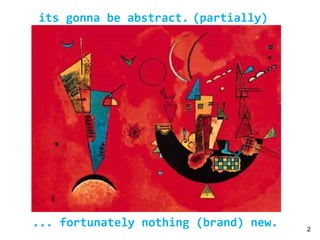
Kandinsky its gonna be abstract.  (partially) ... fortunately nothing (brand) new.
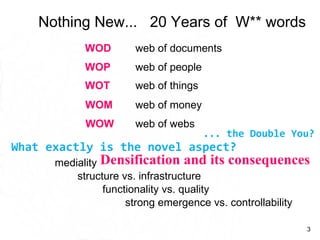
Nothing New...  20 Years of  W** words Densification and its consequences strong emergence vs. controllability functionality vs. quality structure vs. infrastructure What exactly is the novel aspect?  web of things  web of people  WOP WOT web of documents  WOD web of money  WOM web of webs WOW mediality ... the Double You?
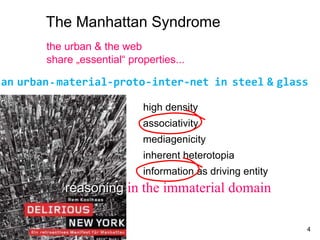
The Manhattan Syndrome an   urban -  material -proto -inter -net   in   steel   &   glass the urban & the web share „essential“ properties... associativity inherent heterotopia information as driving entity high density  mediagenicity  reasoning  in the immaterial domain
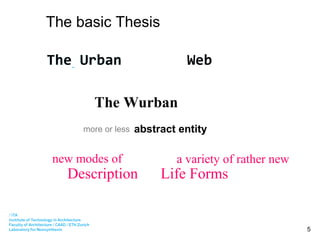
The basic Thesis Description City Life Forms a variety of rather new  abstract entity   Web The Urban more or less Web The Urban The Wurban new modes of
Part 1: Information Why How gap between practice and theory weak theory influences practice to speak about it?  to conceive it?  „ mathematical information“ became  a dogma  pure syntactic approach
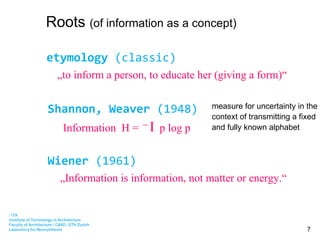
Roots  (of information as a concept) Shannon, Weaver  (1948) etymology  (classic) Wiener  (1961) „ to inform a person, to educate her (giving a form)“ „ Information is information, not matter or energy.“ measure for uncertainty in the context of transmitting a fixed and fully known alphabet Information  H =    p log p _
Heterogeneity of the Concept Warren Weaver, 1948 technical (Shannon's theory)  semantic (meaning and truth) “ influential” (impact and effectiveness on human behaviour) tripartite analysis of information these aspects could not be separated from each other  W.Weaver also thought that
What is info  What  is  information? How to conceive of it ? „  “
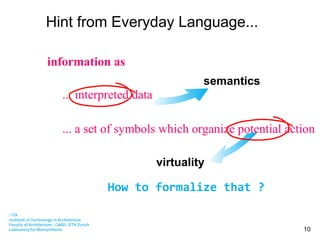
Hint from Everyday Language... virtuality information as  ... interpreted data  ... a set of symbols which organize potential action  semantics How to formalize that ?
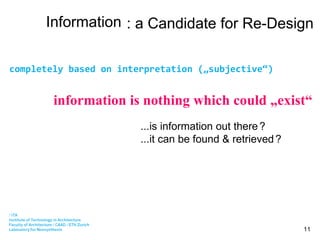
Information completely based on interpretation („subjective“) information is nothing which could „exist“ ...is information out there   ?  ...it can be found & retrieved   ? : a Candidate for Re-Design
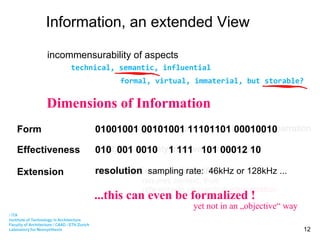
Information, an extended View  Dimensions of Information  Form  Effectiveness  Extension  bytes – words – images – music – behavior – narration reliability, certainty, relative completeness  strictness of encoding/decoding  requires context, thus:  reference to convention,  interpretation incommensurability of aspects technical, semantic, influential formal, virtual, immaterial, but storable? 01001001 00101001 11101101 00010010  010  001 0010  1 111  101 00012 10  resolution  sampling rate:  46kHz or 128kHz ... ...this can even be formalized ! yet not in an „objective“ way
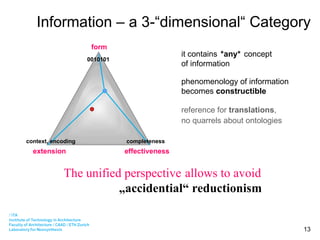
Information – a 3-“dimensional“ Category reference for  translations , no quarrels about ontologies phenomenology of information becomes  constructible it contains   *any*   concept  of information The unified perspective  „ accidential“ reductionism allows to avoid  extension  effectiveness form context, encoding  0010101  completeness
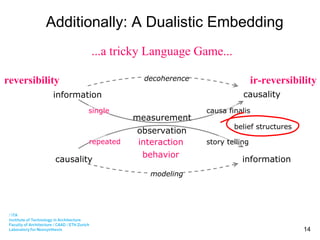
Additionally: A Dualistic Embedding  I- information D- causality S- causality E- information measurement observation single repeated interaction behavior ...a tricky Language Game... reversibility ir-reversibility modeling decoherence story telling causa finalis belief structures
Part 2:  Networks & Associativity
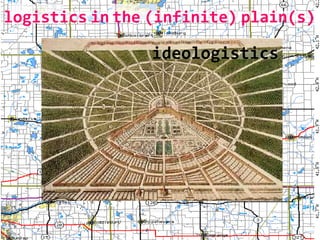
map logistics   in   the   (infinite)   plain(s)   ideologistics
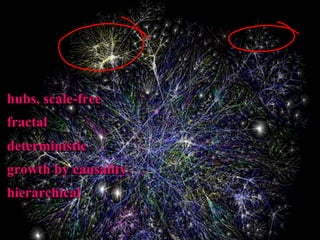
internet hubs, scale-free   hierarchical fractal deterministic growth by causality
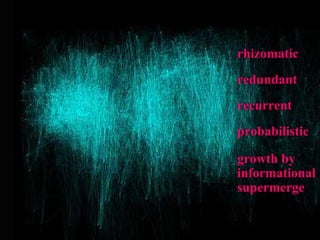
random density rhizomatic growth by   informational  supermerge redundant recurrent probabilistic
Logistic  Networks Logistic Networks  are the great Optimizers  of  identified  Relations
Associative  Networks are the great Inducers and Inventors  of  potential   Relations    yet to be constructed Associative Networks  Randolations   Rando mized Re lation
SOM self-organizing map (SOM)   mapping of n-dimensional descriptions  onto a 2-dimensional map
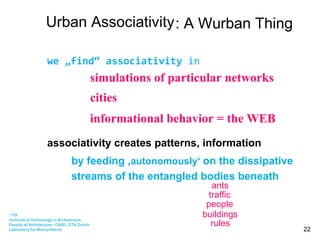
Urban Associativity traffic people buildings simulations of particular networks  we „find“ associativity  in  cities informational behavior = the WEB : A Wurban Thing associativity creates patterns, information  by feeding ‚ autonomously‘  on the dissipative streams of the entangled bodies beneath  ants rules
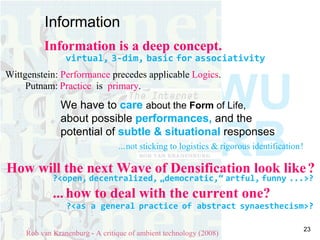
Information  Rob van Kranenburg - A critique of ambient technology (2008) How will the next Wave of Densification look like   ? ?<open,   decentralized,   „democratic,“   artful,   funny   ...>? ...   how to deal with the current one? ?<as a general   practice   of abstract   synaesthecism>? Information is a deep concept. virtual,   3-dim,   basic   for   associativity   Wittgenstein:  Performance  precedes applicable  Logics .  Putnam:   Practice   is  primary .  We have to  care   about  the  Form  of Life,   about possible  performances,  and the  potential of  subtle & situational   responses ...   not sticking to logistics & rigorous identification   ! WURB
The limiting borders of my language are   the limiting borders of my world. Wittgenstein   For the world of information we   (probably) have now an extension.
Merci! Fin  et

Associativity and other Wurban Things

  • 1.
    Aspects of UrbanEntanglements Information & Associativity as v1.14, 29.11.2010 Klaus Wassermann [email_address] Associativity and other Wurban Things for powerpoint only! Please switch to presentation mode!
  • 2.
    Kandinsky its gonnabe abstract. (partially) ... fortunately nothing (brand) new.
  • 3.
    Nothing New... 20 Years of W** words Densification and its consequences strong emergence vs. controllability functionality vs. quality structure vs. infrastructure What exactly is the novel aspect? web of things web of people WOP WOT web of documents WOD web of money WOM web of webs WOW mediality ... the Double You?
  • 4.
    The Manhattan Syndromean urban - material -proto -inter -net in steel & glass the urban & the web share „essential“ properties... associativity inherent heterotopia information as driving entity high density mediagenicity reasoning in the immaterial domain
  • 5.
    The basic ThesisDescription City Life Forms a variety of rather new abstract entity Web The Urban more or less Web The Urban The Wurban new modes of
  • 6.
    Part 1: InformationWhy How gap between practice and theory weak theory influences practice to speak about it? to conceive it? „ mathematical information“ became a dogma pure syntactic approach
  • 7.
    Roots (ofinformation as a concept) Shannon, Weaver (1948) etymology (classic) Wiener (1961) „ to inform a person, to educate her (giving a form)“ „ Information is information, not matter or energy.“ measure for uncertainty in the context of transmitting a fixed and fully known alphabet Information H =  p log p _
  • 8.
    Heterogeneity of theConcept Warren Weaver, 1948 technical (Shannon's theory) semantic (meaning and truth) “ influential” (impact and effectiveness on human behaviour) tripartite analysis of information these aspects could not be separated from each other W.Weaver also thought that
  • 9.
    What is info What is information? How to conceive of it ? „ “
  • 10.
    Hint from EverydayLanguage... virtuality information as ... interpreted data ... a set of symbols which organize potential action semantics How to formalize that ?
  • 11.
    Information completely basedon interpretation („subjective“) information is nothing which could „exist“ ...is information out there ? ...it can be found & retrieved ? : a Candidate for Re-Design
  • 12.
    Information, an extendedView Dimensions of Information Form Effectiveness Extension bytes – words – images – music – behavior – narration reliability, certainty, relative completeness strictness of encoding/decoding requires context, thus: reference to convention, interpretation incommensurability of aspects technical, semantic, influential formal, virtual, immaterial, but storable? 01001001 00101001 11101101 00010010 010 001 0010 1 111 101 00012 10 resolution sampling rate: 46kHz or 128kHz ... ...this can even be formalized ! yet not in an „objective“ way
  • 13.
    Information – a3-“dimensional“ Category reference for translations , no quarrels about ontologies phenomenology of information becomes constructible it contains *any* concept of information The unified perspective „ accidential“ reductionism allows to avoid extension effectiveness form context, encoding 0010101 completeness
  • 14.
    Additionally: A DualisticEmbedding I- information D- causality S- causality E- information measurement observation single repeated interaction behavior ...a tricky Language Game... reversibility ir-reversibility modeling decoherence story telling causa finalis belief structures
  • 15.
    Part 2: Networks & Associativity
  • 16.
    map logistics in the (infinite) plain(s) ideologistics
  • 17.
    internet hubs, scale-free hierarchical fractal deterministic growth by causality
  • 18.
    random density rhizomaticgrowth by informational supermerge redundant recurrent probabilistic
  • 19.
    Logistic NetworksLogistic Networks are the great Optimizers of identified Relations
  • 20.
    Associative Networksare the great Inducers and Inventors of potential Relations yet to be constructed Associative Networks Randolations Rando mized Re lation
  • 21.
    SOM self-organizing map(SOM) mapping of n-dimensional descriptions onto a 2-dimensional map
  • 22.
    Urban Associativity trafficpeople buildings simulations of particular networks we „find“ associativity in cities informational behavior = the WEB : A Wurban Thing associativity creates patterns, information by feeding ‚ autonomously‘ on the dissipative streams of the entangled bodies beneath ants rules
  • 23.
    Information Robvan Kranenburg - A critique of ambient technology (2008) How will the next Wave of Densification look like ? ?<open, decentralized, „democratic,“ artful, funny ...>? ... how to deal with the current one? ?<as a general practice of abstract synaesthecism>? Information is a deep concept. virtual, 3-dim, basic for associativity Wittgenstein: Performance precedes applicable Logics . Putnam: Practice is primary . We have to care about the Form of Life, about possible performances, and the potential of subtle & situational responses ... not sticking to logistics & rigorous identification ! WURB
  • 24.
    The limiting bordersof my language are the limiting borders of my world. Wittgenstein For the world of information we (probably) have now an extension.
  • 25.

Editor's Notes

  • #2 Pietro Maria Bardi’s rationalist polemics from the late 1930s: Engineers are the direct and immediate agents of human progress to a greater extent that any other social category. So I am glad that I am.... well, a part-time engineer else: Lyotard: modernism tried to conquer space, postmodernism is trying to conquer time
  • #12 Dretske&apos;s (1981, p. 63-64) theory of semantic information is based on the distinction between information and meaning. [For Dretske,] Information does not require an interpretive process, although it is a necessary condition for acquiring knowledge das ist natürlich Quatsch. Ein und dieselbe Situation kann ich verschieden interpretieren und verschiedene Information daraus gewinnen, verschiedene Personen können annähernd (je nach fixierung) die gleiche info daraus ziehen, aber es gilt auch, dass ich Info daraus ziehen kann ohne dass ich mein “Wissen” “vergrössere”. nämlich genau dann, wenn mir der PLAN des gegenüber verborgen bleibt. Auch hier schlägt allzuoft der physikalistische Reduktionismus wieder zu. Dretske: Computers have, at least so far, no capability of using information. It means nothing to them. They can only manipulate symbols (Dretske, 1986). -&gt; What does “using” here mean??? -&gt;&gt; QQQ !!! about behavior and communication: Brent Ruben 1983 -&gt; 1993, 3 books relationship between information and behavior is a fundamental one This is the anthropologists&apos; dilemma: In Schopenhauer&apos;s words, &amp;quot;What Peter tells me about Paul tells me more about Peter than it does about Paul.&amp;quot;
  • #13 The form would tell us whether information is given in bits (like in bytes or language) or more as a whole (like an image) from which we have to extract parts, the effectiveness tells us about its reliability or certainty, Syntactic completeness simply describes the fact whether there are recognizable gaps, say white spots, cut holes, etc. or not and to which extent. the extension is about the strictness of its encoding. Strictness is related to the resolution of the encoding process ------------- auch das Capurro trilemma löst sich auf in ein scheinproblem # The same reference in all contexts, such that qualitative changes are not grasped. -&gt; univok # Similar aspects between the references. In this case there a question arises about the primary or basic reference to which analogical concepts refer. analog # Finally, qualitatively distinct references may exist. In this case the concepts of information are equivocal. äquivok
  • #14 the many concepts of information correspond to the disciplinary perspectives on causality, which is different for physics, biology, medicine, sociology, literature, politics, etc. no „origin“ = no neutral point note, that the „borders“ of the 3-dimensional dependency diagram are not „borders“. Actually they do not exist in a practical way, they are singularities, much like a pole in functional analysis in mathematics. It is not possible to reach them They also do not have a structure, and they do not need one!, because the the structure is implicitly given by the metric per base point (the „corners“) The dimensions thus have no fixed angle between them, and the larger the distance of a 3d point is to one of its base points, the more the metric gets compressed, since we are in a hyperbolic spce (but hyperbolic space is not a necessity, we just use it here as a condition to ensure positive values. The corners are somewhat idealistic projections, hence it is reasonable to conceive of the „fields“ as platonic solids. If we approach infinite number of dimensions, we approach also a sphere. There is however hardly a „real“ system which needs an infinite number of dimensions. More than 30-50 dimensions (or even 100) would render the dependencies from dimensions indistinguishable, hence appearing as random, and at the same time, always appearing as nearly orthogonal to each other. ??? The problem of trust It quite evident that in constructing or arranging information Storing means (1) to relax the dimension of the extension as far as possible, and (2) to fix the the dimension of effectiveness to a certain value. From that it follows directly, that storing the information can be achieved in different ways, serving different levels of effectiveness. if we stick to a binary code, i.e. the most prominent form, we loose any possibility to evalute both extension (context) and effectiveness (reliability) If we want to design a 100% reliable information, we have to use an infinite number of different forms and different encodiings. That is, the value of redundancy in information becomes immediately and clearly visible. We could also define an operationalization for that complete measure of redundancy, ( inversely: we can use existent measures of redundancy to ???) From this complementary deficiencies (and the possible isolines around the basepoints) directly follows, that a particular message system should always allow to provide the same message (intention) in different informational forms. Only then we can develop „trust“ into the content of the message, the sender and our capability to decode and interpret. Thus, human / animal behavior uses always different channels to encode the same message. Thus we can distinguish at least two different kinds of redundance: intrinsical and extrinsical redundance (with respect to the message), i.e. either repetition of the items (which does NOT create trust) OR telling the same story using a different channel However, this game opens a completely new game: gaming, jokes and humor Putnams naturalized Semantics ???
  • #15 I-information = invoked information, E-information = evoked information, S-causality = causality accessed through sampling, D‑causality = causality constructed by decoherence.
  • #17 Palma nova, Karlsruhe, Nova Huta, München
  • #18 William Mitchell attack on language: intelligent workplaces.... just reconfigurable, thus to be used by several people ....