Association Rule Mining
Ayesha Ali
Association Analysis
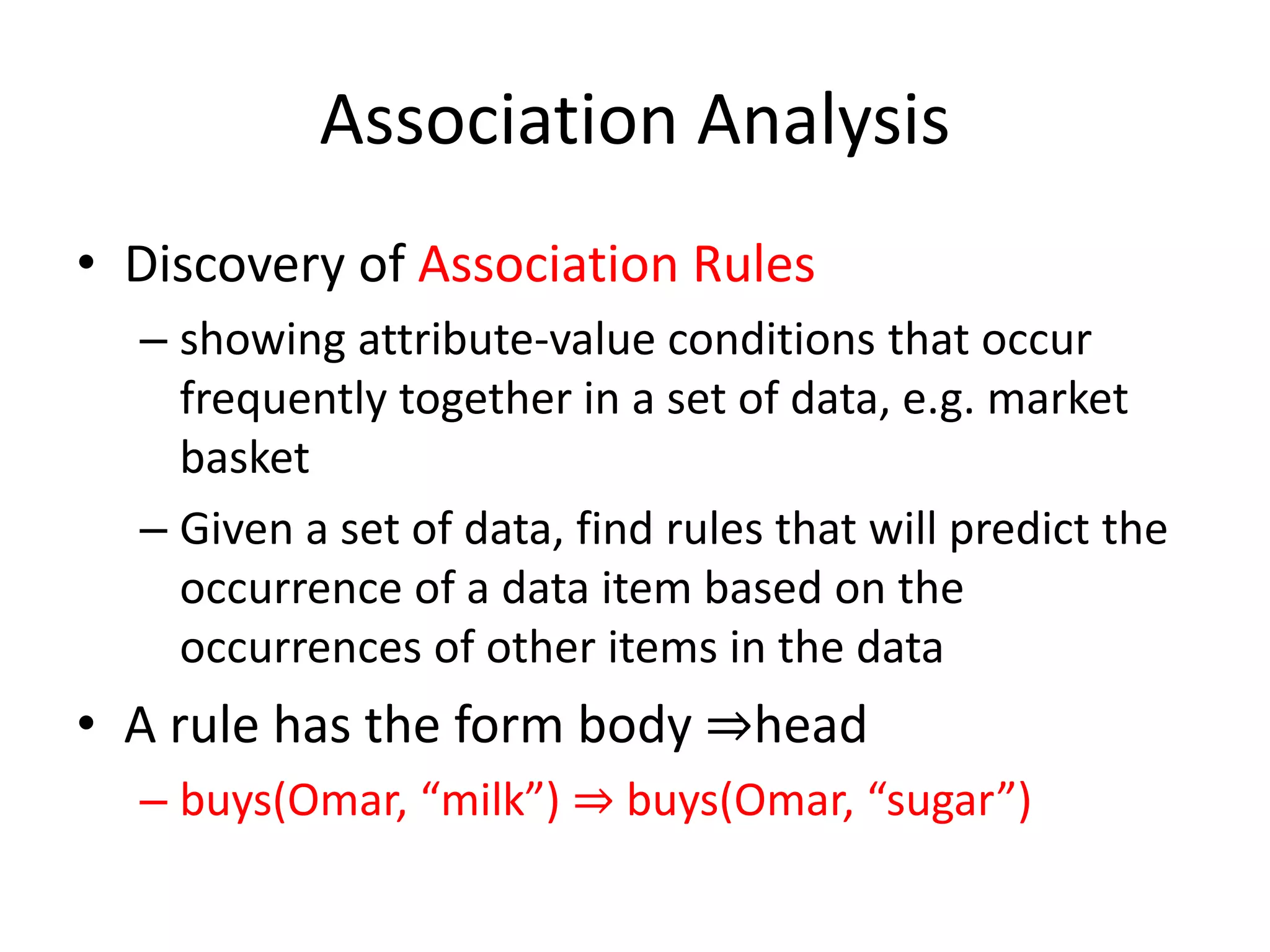
• Discovery of Association Rules
– showing attribute-value conditions that occur
frequently together in a set of data, e.g. market
basket
– Given a set of data, find rules that will predict the
occurrence of a data item based on the
occurrences of other items in the data
• A rule has the form body ⇒head
– buys(Omar, “milk”) ⇒ buys(Omar, “sugar”)
Association Analysis
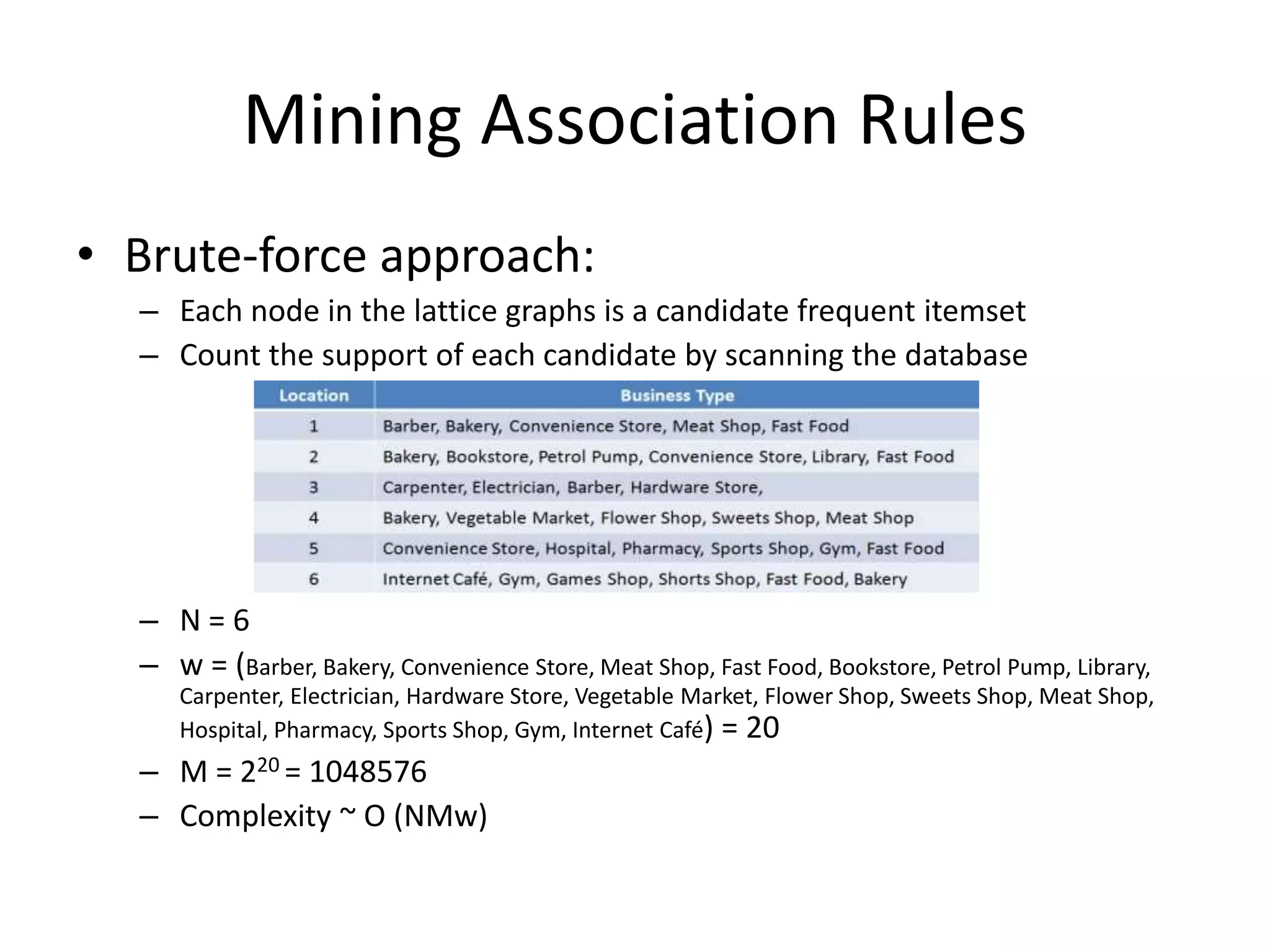
Location Business Type
1 Barber, Bakery, Convenience Store, Meat Shop, Fast Food
2 Bakery, Bookstore, Petrol Pump, Convenience Store, Library, Fast Food
3 Carpenter, Electrician, Barber, Hardware Store,
4 Bakery, Vegetable Market, Flower Shop, Sweets Shop, Meat Shop
5 Convenience Store, Hospital, Pharmacy, Sports Shop, Gym, Fast Food
6 Internet Café, Gym, Games Shop, Shorts Shop, Fast Food, Bakery
Association Rule: X Y ; (Fast Food, Bakery)  (Convenience Store)
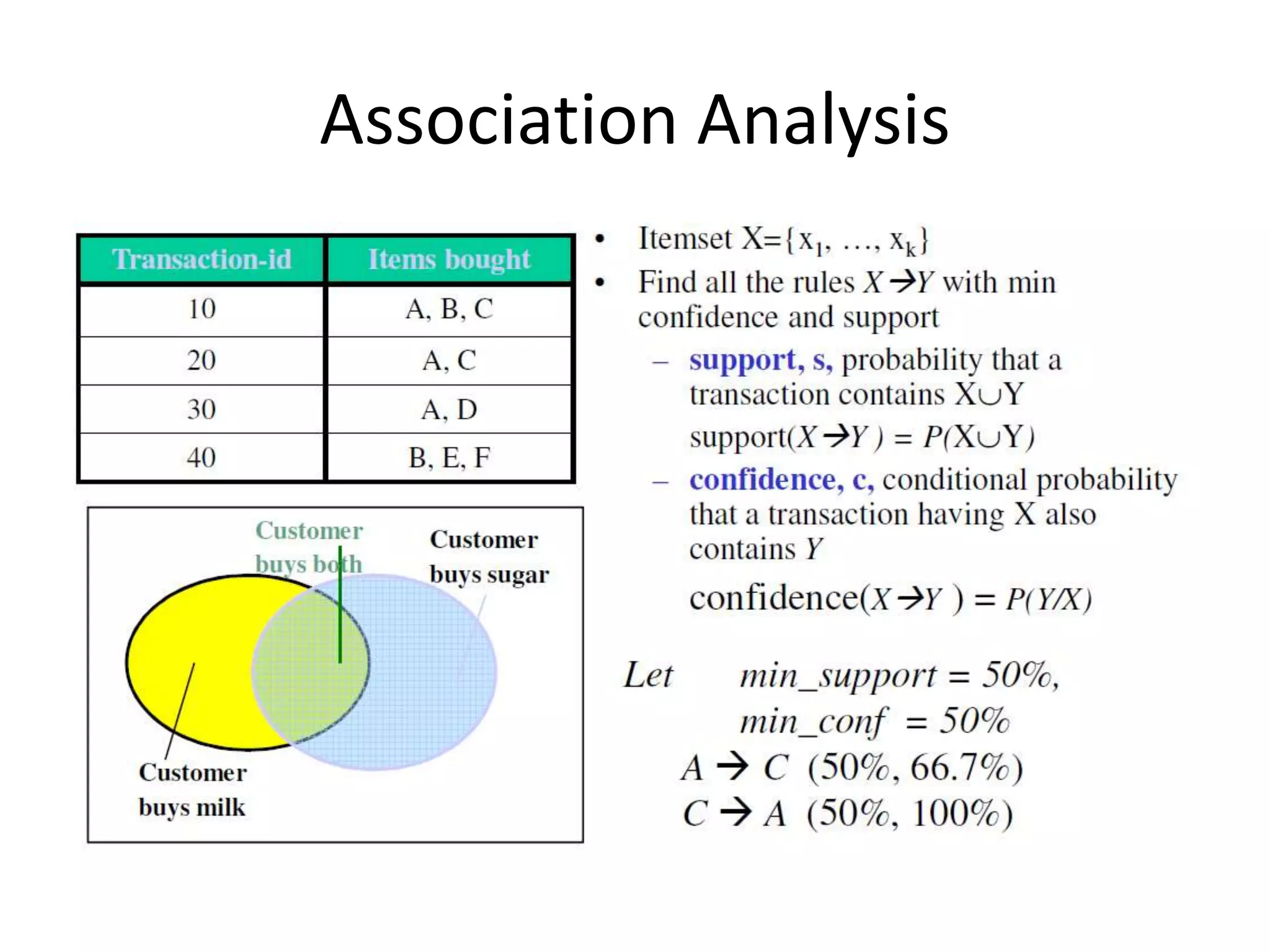
Support S: Fraction of items that contain both X and Y = P(X U Y)
S(Fast Food, Bakery, Convenience Store) = 2/6 = .33
Confidence C: how often items in Y appear in locations that contain X = P(X U Y)
C[(Fast Food, Bakery)  (Convenience Store)] = P(X U Y) / P(X)
= 0.33/0.50 = .66
Association Analysis
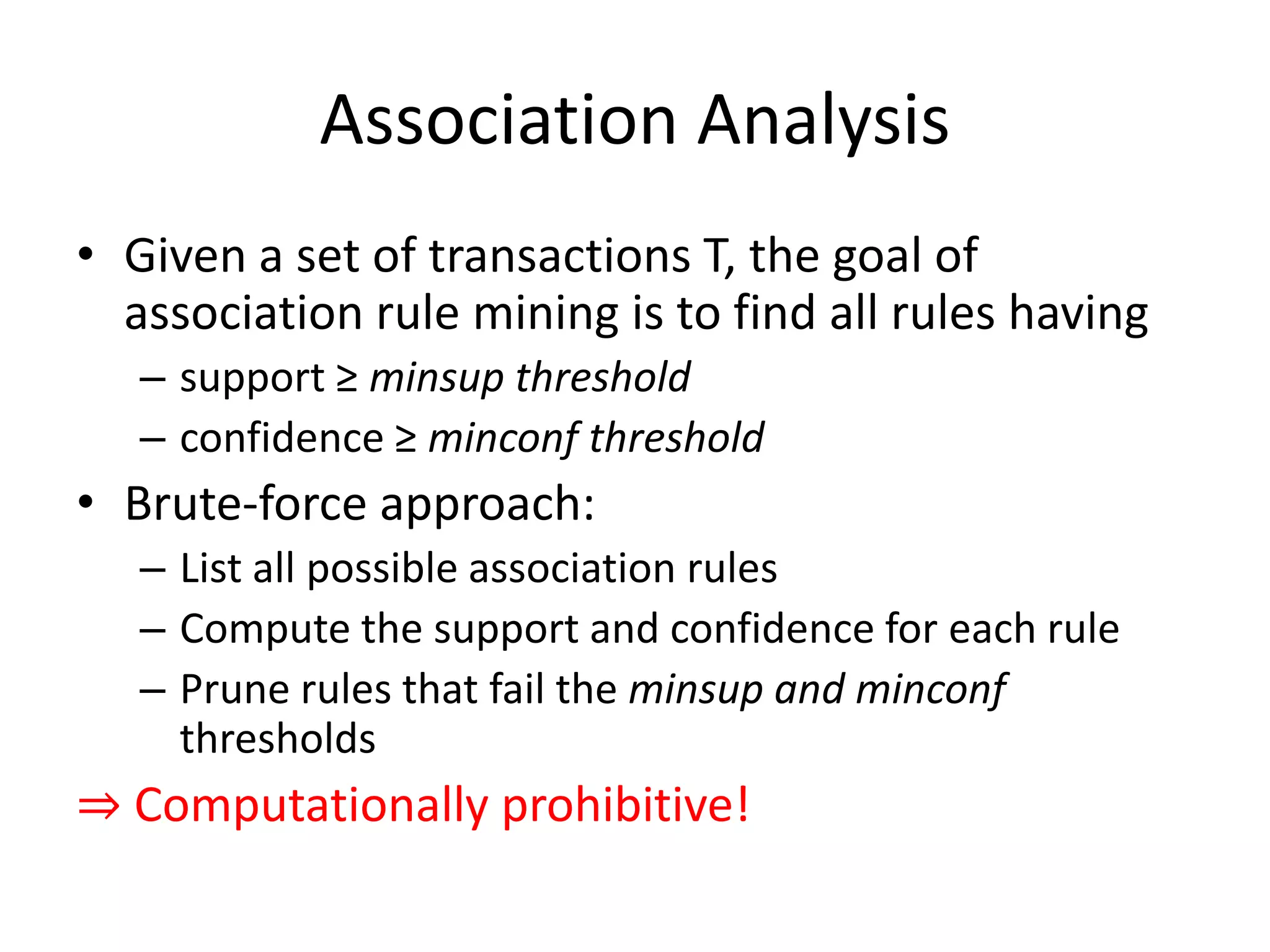
• Given a set of transactions T, the goal of
association rule mining is to find all rules having
– support ≥ minsup threshold
– confidence ≥ minconf threshold
• Brute-force approach:
– List all possible association rules
– Compute the support and confidence for each rule
– Prune rules that fail the minsup and minconf
thresholds
⇒ Computationally prohibitive!
Association Analysis
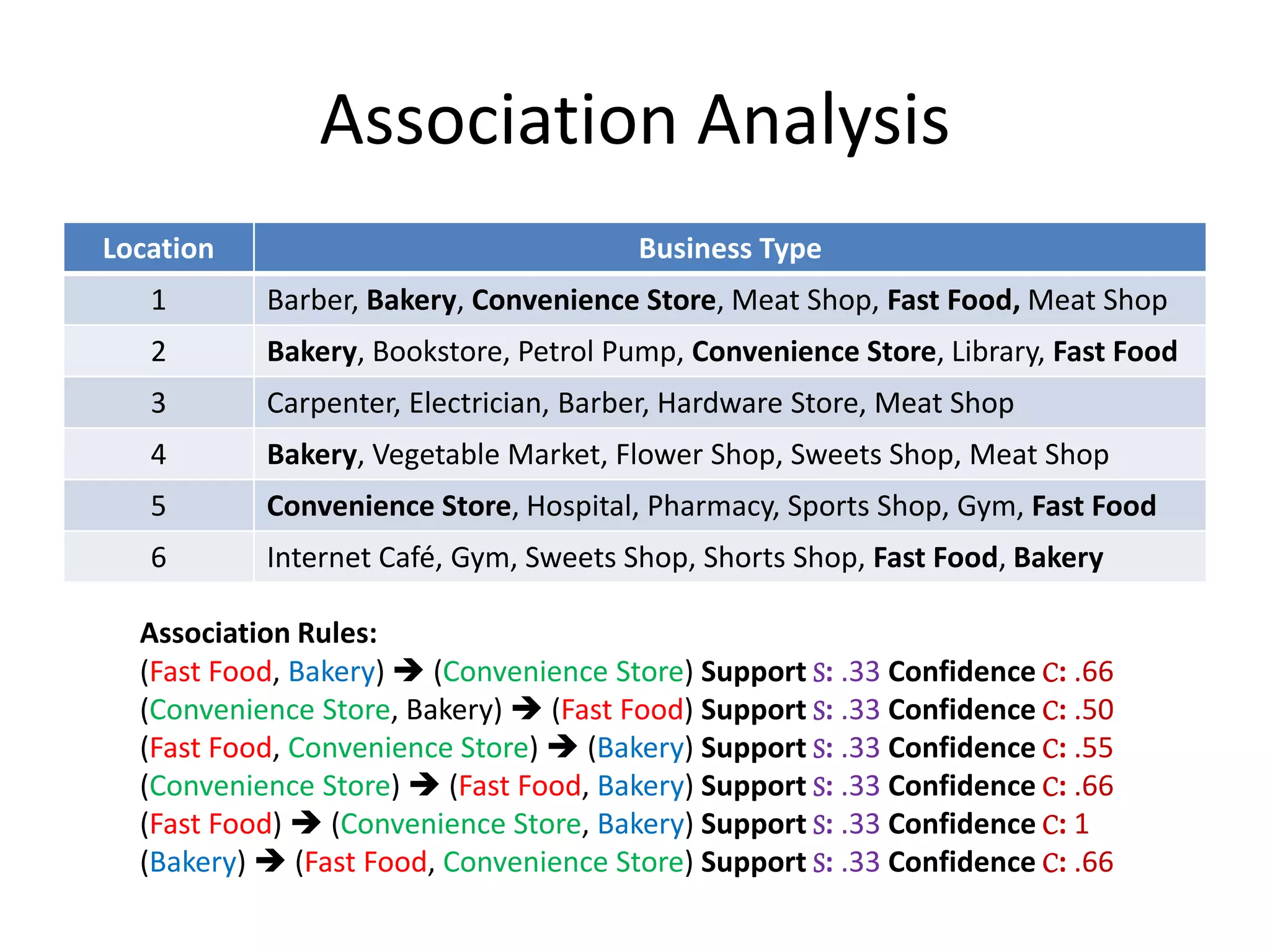
Location Business Type
1 Barber, Bakery, Convenience Store, Meat Shop, Fast Food, Meat Shop
2 Bakery, Bookstore, Petrol Pump, Convenience Store, Library, Fast Food
3 Carpenter, Electrician, Barber, Hardware Store, Meat Shop
4 Bakery, Vegetable Market, Flower Shop, Sweets Shop, Meat Shop
5 Convenience Store, Hospital, Pharmacy, Sports Shop, Gym, Fast Food
6 Internet Café, Gym, Sweets Shop, Shorts Shop, Fast Food, Bakery
Association Rules:
(Fast Food, Bakery)  (Convenience Store) Support S: .33 Confidence C: .66
(Convenience Store, Bakery)  (Fast Food) Support S: .33 Confidence C: .50
(Fast Food, Convenience Store)  (Bakery) Support S: .33 Confidence C: .55
(Convenience Store)  (Fast Food, Bakery) Support S: .33 Confidence C: .66
(Fast Food)  (Convenience Store, Bakery) Support S: .33 Confidence C: 1
(Bakery)  (Fast Food, Convenience Store) Support S: .33 Confidence C: .66
Association Analysis
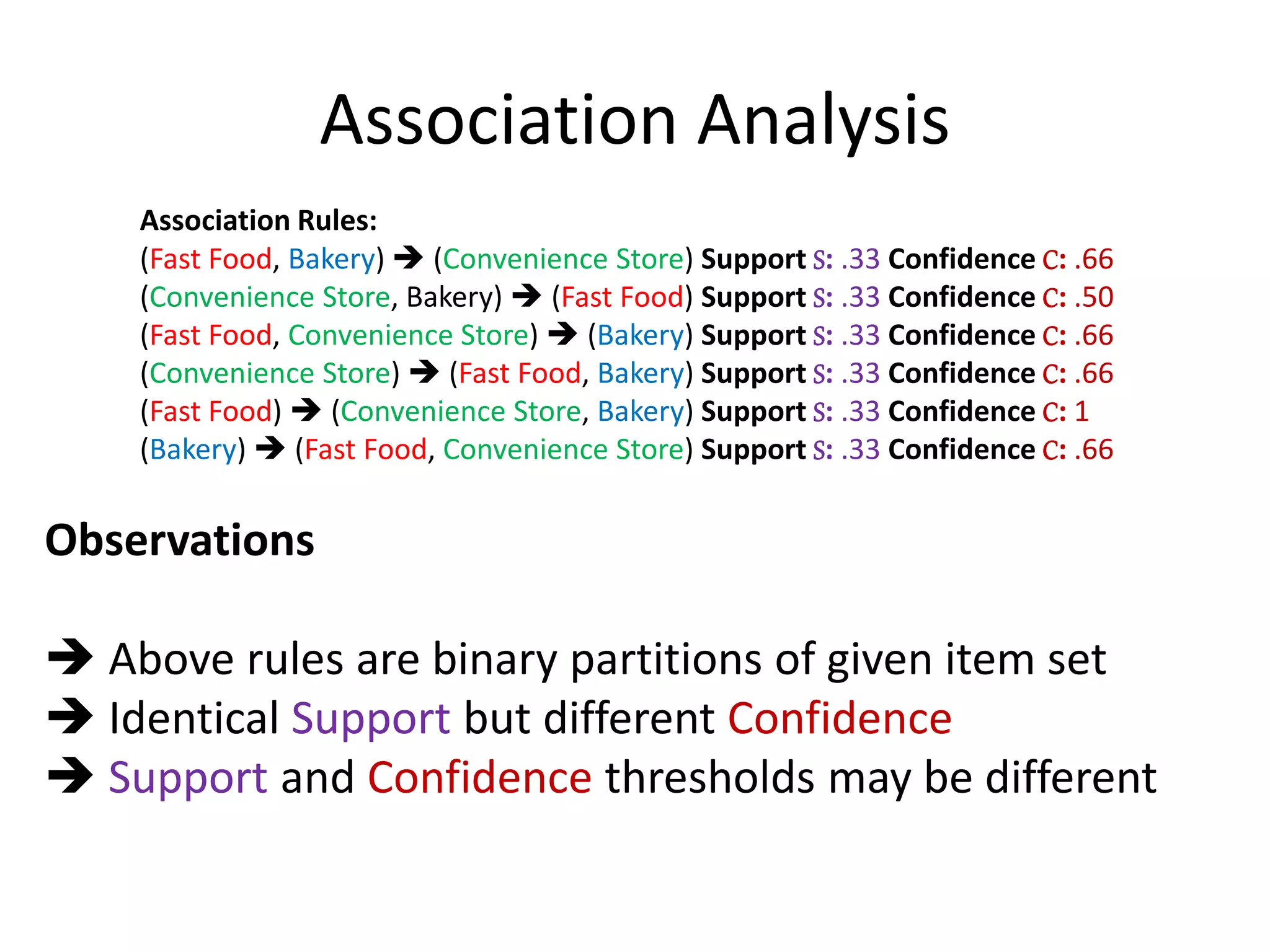
Association Rules:
(Fast Food, Bakery)  (Convenience Store) Support S: .33 Confidence C: .66
(Convenience Store, Bakery)  (Fast Food) Support S: .33 Confidence C: .50
(Fast Food, Convenience Store)  (Bakery) Support S: .33 Confidence C: .66
(Convenience Store)  (Fast Food, Bakery) Support S: .33 Confidence C: .66
(Fast Food)  (Convenience Store, Bakery) Support S: .33 Confidence C: 1
(Bakery)  (Fast Food, Convenience Store) Support S: .33 Confidence C: .66
Observations
 Above rules are binary partitions of given item set
 Identical Support but different Confidence
 Support and Confidence thresholds may be different
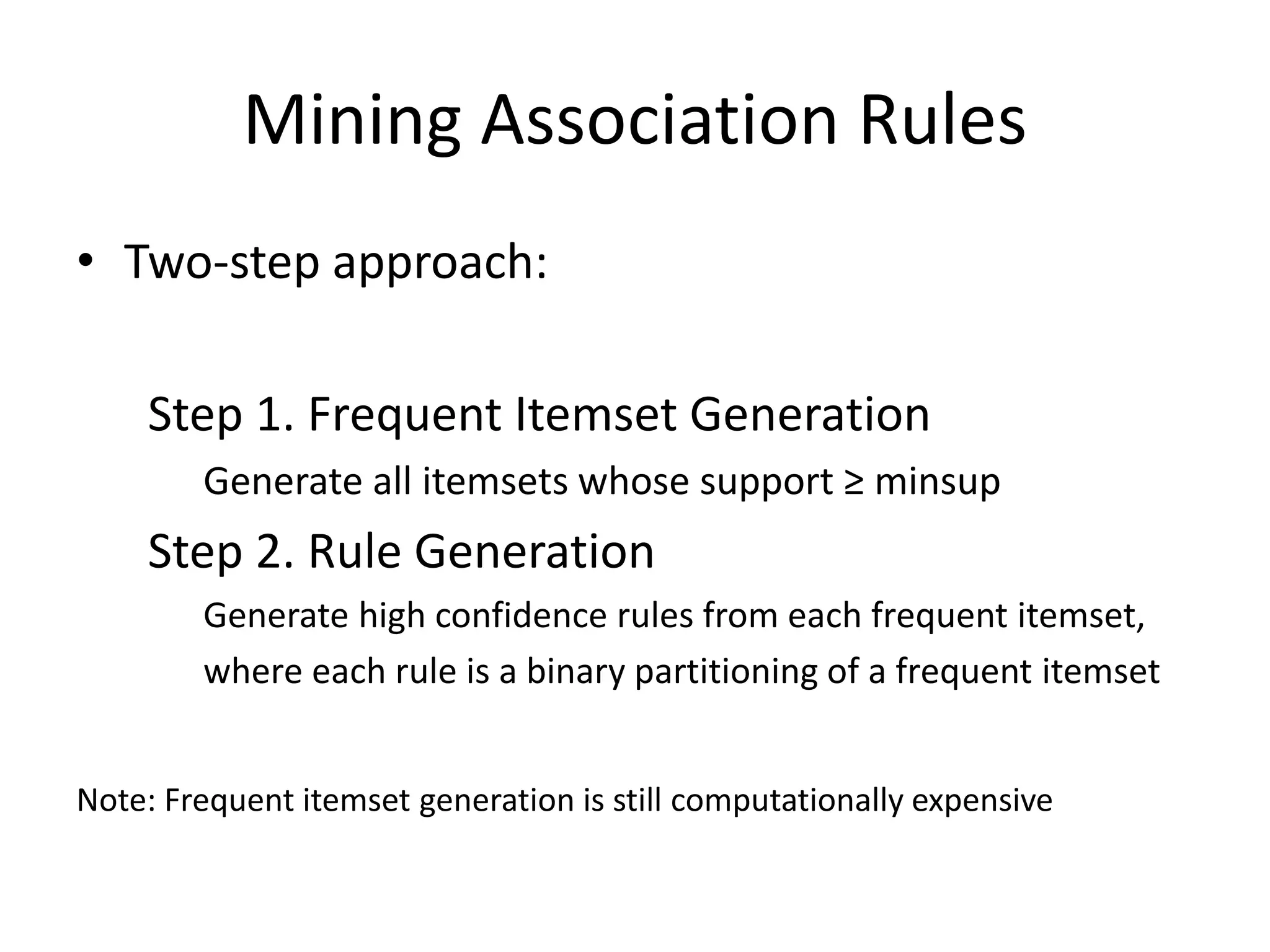
Mining Association Rules
• Two-step approach:
Step 1. Frequent Itemset Generation
Generate all itemsets whose support ≥ minsup
Step 2. Rule Generation
Generate high confidence rules from each frequent itemset,
where each rule is a binary partitioning of a frequent itemset
Note: Frequent itemset generation is still computationally expensive
Mining Association Rules
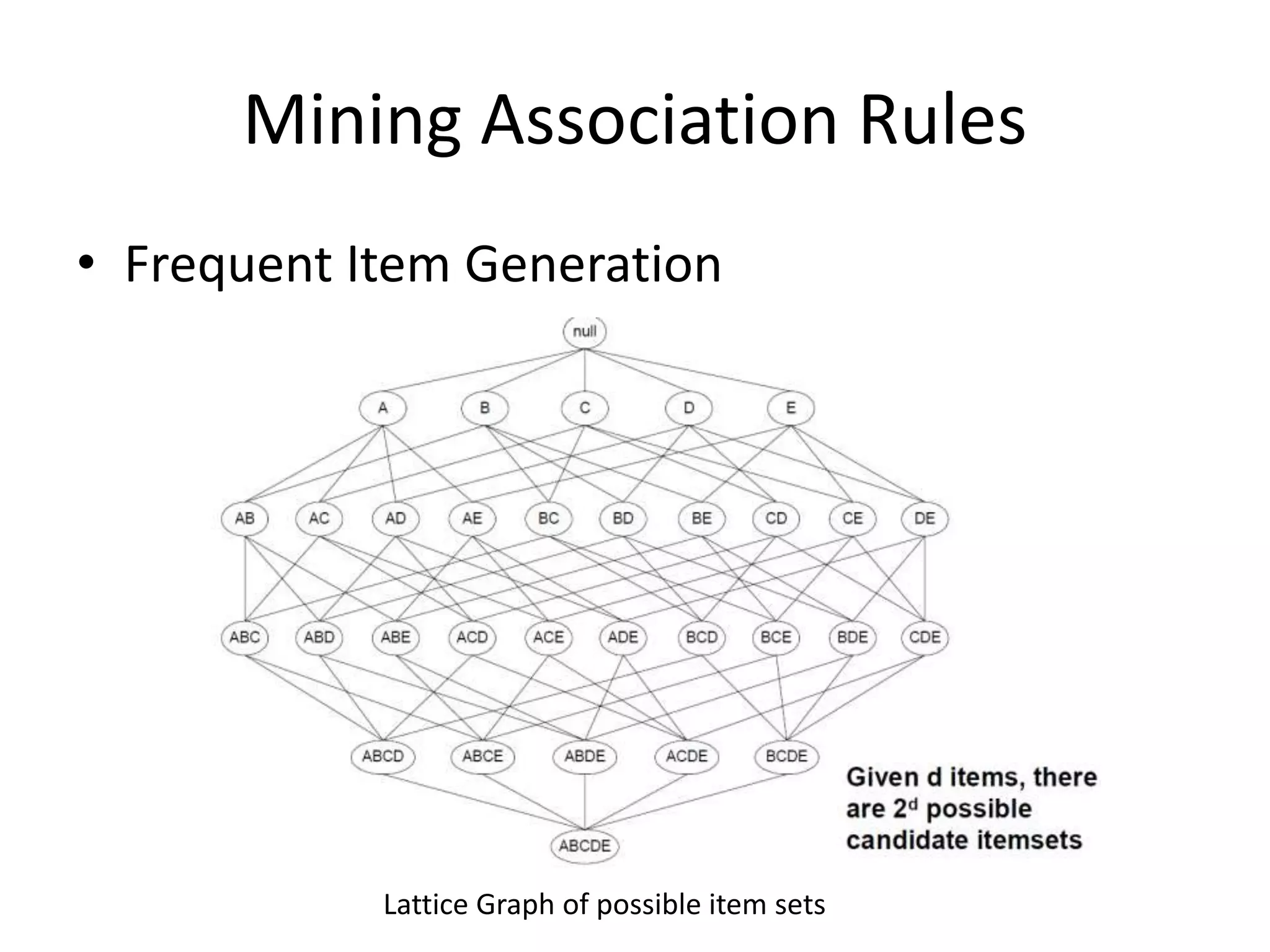
• Frequent Item Generation
Lattice Graph of possible item sets
Mining Association Rules
• Brute-force approach:
– Each node in the lattice graphs is a candidate frequent itemset
– Count the support of each candidate by scanning the database
– N = 6
– w = (Barber, Bakery, Convenience Store, Meat Shop, Fast Food, Bookstore, Petrol Pump, Library,
Carpenter, Electrician, Hardware Store, Vegetable Market, Flower Shop, Sweets Shop, Meat Shop,
Hospital, Pharmacy, Sports Shop, Gym, Internet Café) = 20
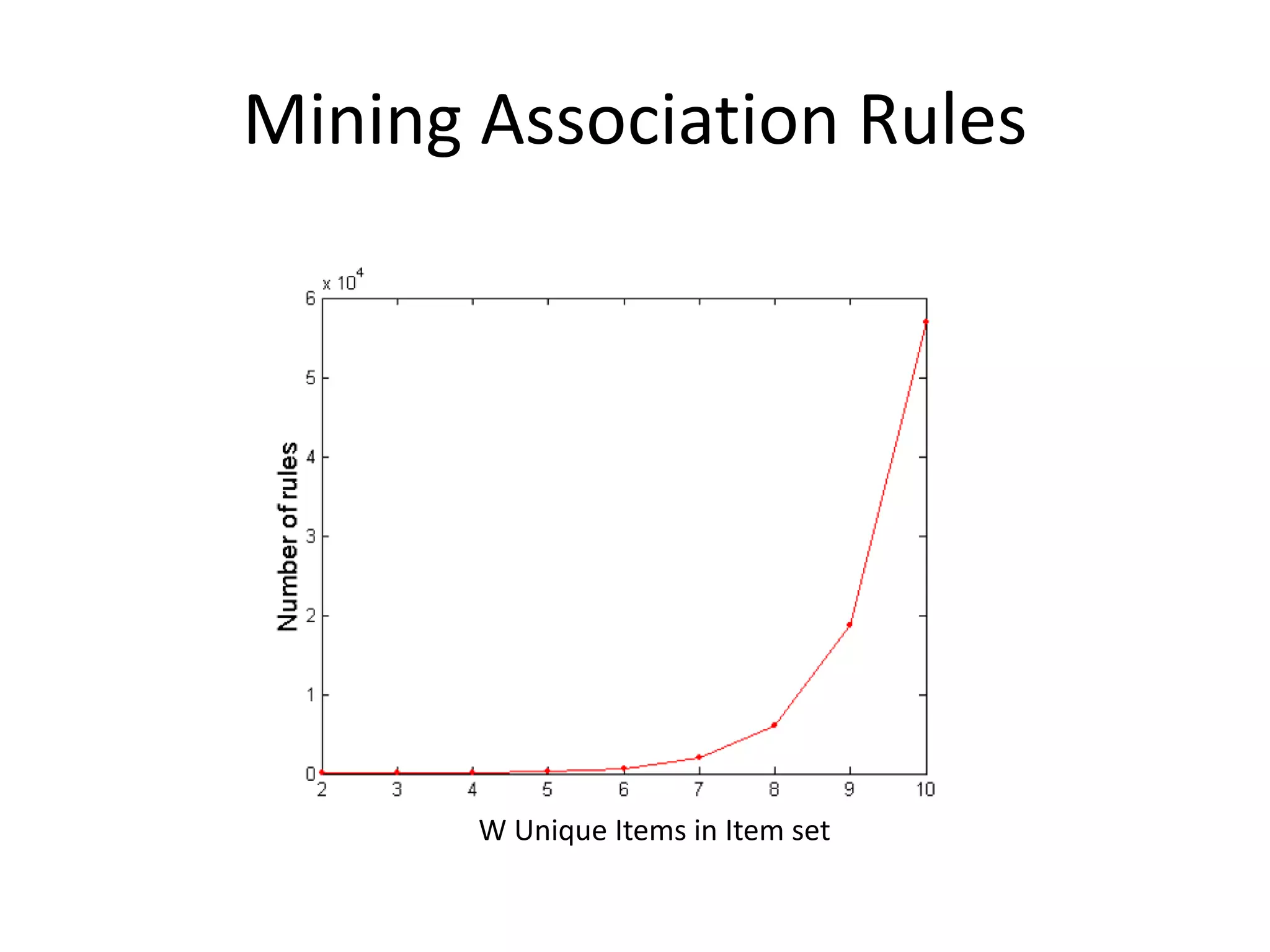
– M = 220 = 1048576
– Complexity ~ O (NMw)
Mining Association Rules
W Unique Items in Item set
Mining Association Rules
• Frequent Itemset Generation
– Reduce the number of candidates (M)
– Reduce the number of transactions/locations (N)
– Reduce the number of comparisons (NM)
• Use efficient data structures to store the candidates
• No need to match every candidate against every
transaction/location
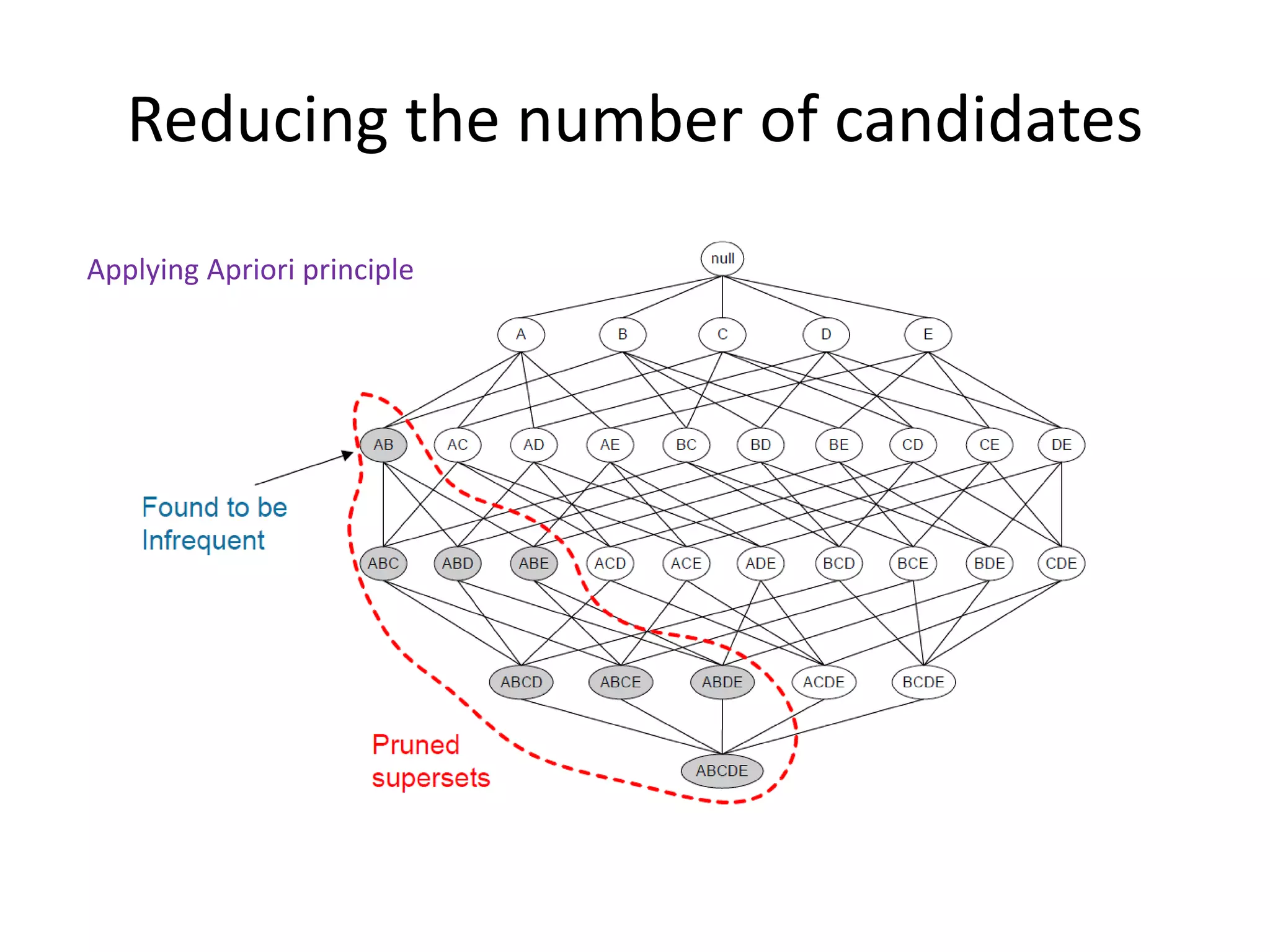
Reducing the number of candidates
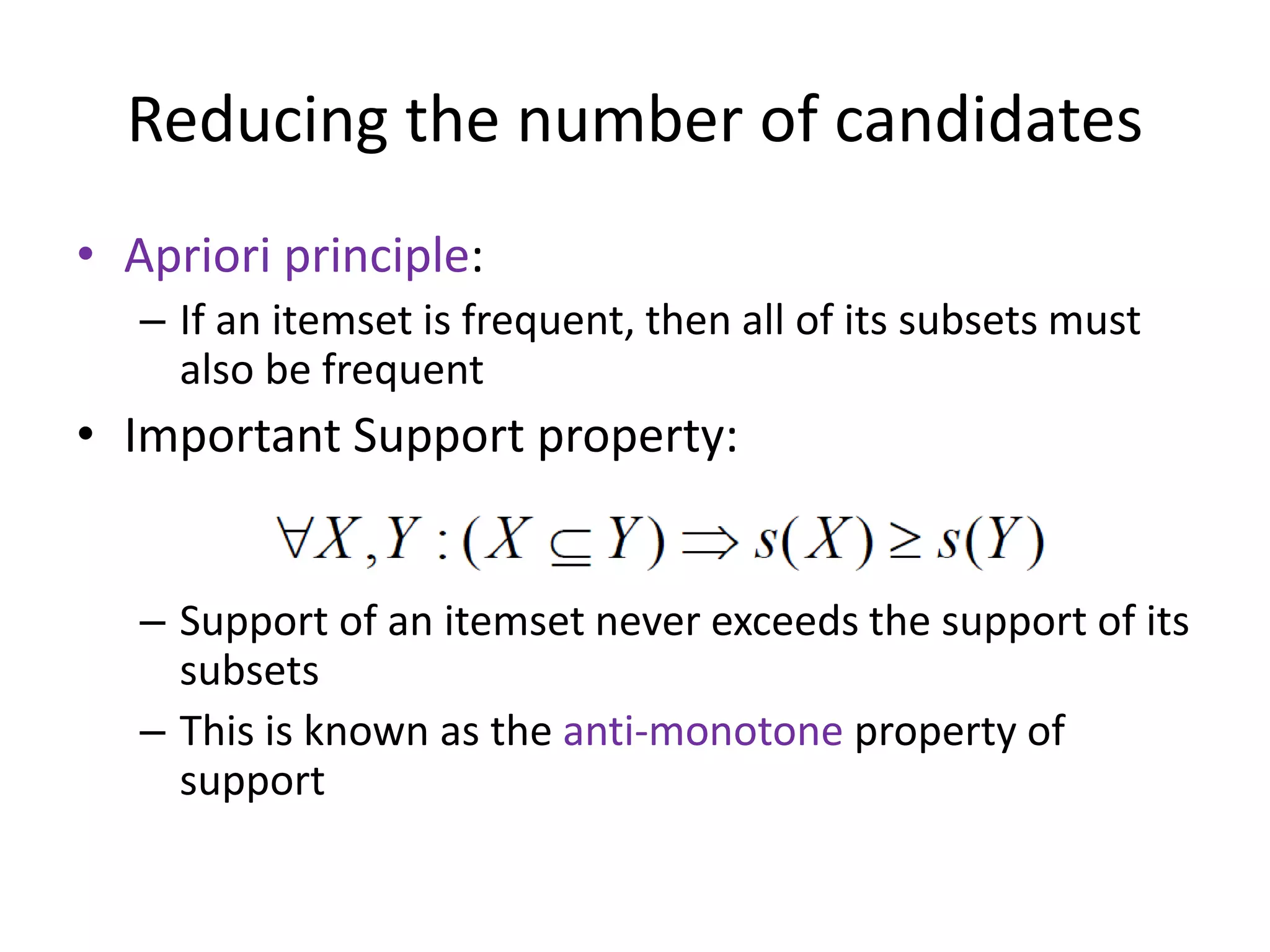
• Apriori principle:
– If an itemset is frequent, then all of its subsets must
also be frequent
• Important Support property:
– Support of an itemset never exceeds the support of its
subsets
– This is known as the anti-monotone property of
support
Reducing the number of candidates
Applying Apriori principle
Reducing the number of candidates
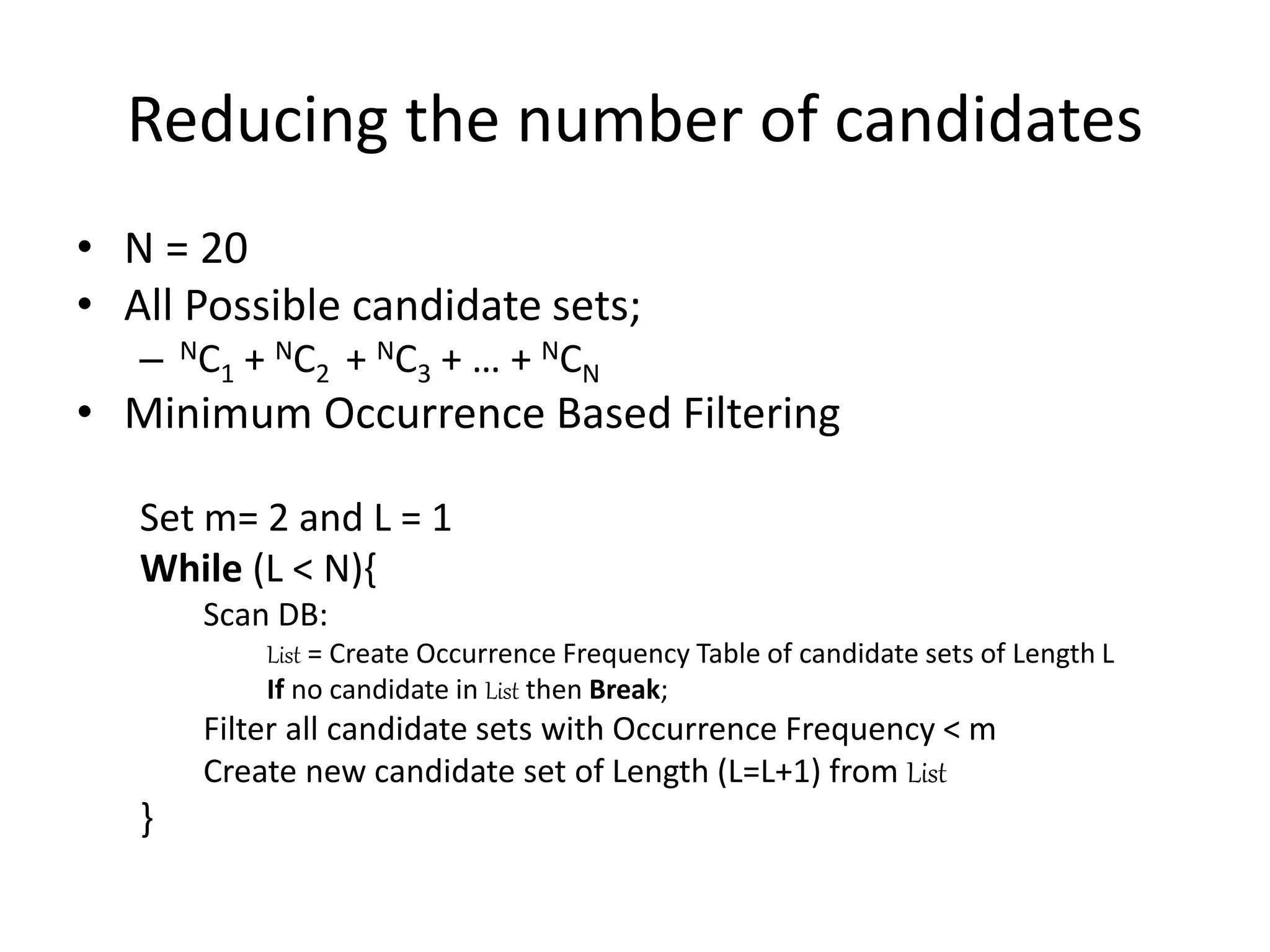
• N = 20
• All Possible candidate sets;
– NC1 + NC2 + NC3 + … + NCN
• Minimum Occurrence Based Filtering
Set m= 2 and L = 1
While (L < N){
Scan DB:
List = Create Occurrence Frequency Table of candidate sets of Length L
If no candidate in List then Break;
Filter all candidate sets with Occurrence Frequency < m
Create new candidate set of Length (L=L+1) from List
}
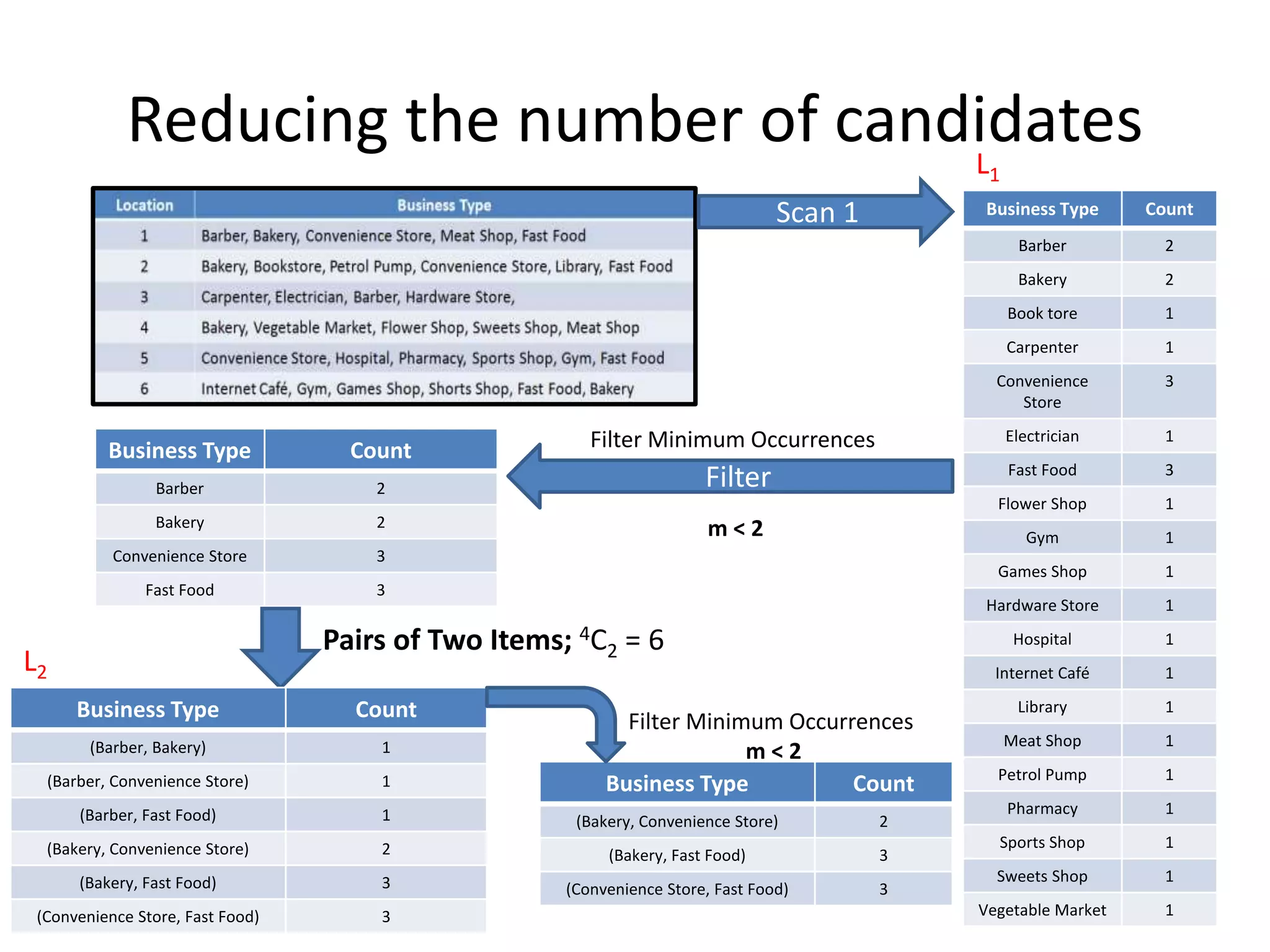
Filter Minimum Occurrences
m < 2
Reducing the number of candidates
Business Type Count
Barber 2
Bakery 2
Book tore 1
Carpenter 1
Convenience
Store
3
Electrician 1
Fast Food 3
Flower Shop 1
Gym 1
Games Shop 1
Hardware Store 1
Hospital 1
Internet Café 1
Library 1
Meat Shop 1
Petrol Pump 1
Pharmacy 1
Sports Shop 1
Sweets Shop 1
Vegetable Market 1
Business Type Count
Barber 2
Bakery 2
Convenience Store 3
Fast Food 3
Filter
Scan 1
Business Type Count
(Barber, Bakery) 1
(Barber, Convenience Store) 1
(Barber, Fast Food) 1
(Bakery, Convenience Store) 2
(Bakery, Fast Food) 3
(Convenience Store, Fast Food) 3
Pairs of Two Items; 4C2 = 6
Business Type Count
(Bakery, Convenience Store) 2
(Bakery, Fast Food) 3
(Convenience Store, Fast Food) 3
Filter Minimum Occurrences
m < 2
L1
L2

Association Rule Mining in Data Mining

  • 1.
  • 2.
    Association Analysis • Discoveryof Association Rules – showing attribute-value conditions that occur frequently together in a set of data, e.g. market basket – Given a set of data, find rules that will predict the occurrence of a data item based on the occurrences of other items in the data • A rule has the form body ⇒head – buys(Omar, “milk”) ⇒ buys(Omar, “sugar”)
  • 3.
  • 4.
    Association Analysis Location BusinessType 1 Barber, Bakery, Convenience Store, Meat Shop, Fast Food 2 Bakery, Bookstore, Petrol Pump, Convenience Store, Library, Fast Food 3 Carpenter, Electrician, Barber, Hardware Store, 4 Bakery, Vegetable Market, Flower Shop, Sweets Shop, Meat Shop 5 Convenience Store, Hospital, Pharmacy, Sports Shop, Gym, Fast Food 6 Internet Café, Gym, Games Shop, Shorts Shop, Fast Food, Bakery Association Rule: X Y ; (Fast Food, Bakery)  (Convenience Store) Support S: Fraction of items that contain both X and Y = P(X U Y) S(Fast Food, Bakery, Convenience Store) = 2/6 = .33 Confidence C: how often items in Y appear in locations that contain X = P(X U Y) C[(Fast Food, Bakery)  (Convenience Store)] = P(X U Y) / P(X) = 0.33/0.50 = .66
  • 5.
    Association Analysis • Givena set of transactions T, the goal of association rule mining is to find all rules having – support ≥ minsup threshold – confidence ≥ minconf threshold • Brute-force approach: – List all possible association rules – Compute the support and confidence for each rule – Prune rules that fail the minsup and minconf thresholds ⇒ Computationally prohibitive!
  • 6.
    Association Analysis Location BusinessType 1 Barber, Bakery, Convenience Store, Meat Shop, Fast Food, Meat Shop 2 Bakery, Bookstore, Petrol Pump, Convenience Store, Library, Fast Food 3 Carpenter, Electrician, Barber, Hardware Store, Meat Shop 4 Bakery, Vegetable Market, Flower Shop, Sweets Shop, Meat Shop 5 Convenience Store, Hospital, Pharmacy, Sports Shop, Gym, Fast Food 6 Internet Café, Gym, Sweets Shop, Shorts Shop, Fast Food, Bakery Association Rules: (Fast Food, Bakery)  (Convenience Store) Support S: .33 Confidence C: .66 (Convenience Store, Bakery)  (Fast Food) Support S: .33 Confidence C: .50 (Fast Food, Convenience Store)  (Bakery) Support S: .33 Confidence C: .55 (Convenience Store)  (Fast Food, Bakery) Support S: .33 Confidence C: .66 (Fast Food)  (Convenience Store, Bakery) Support S: .33 Confidence C: 1 (Bakery)  (Fast Food, Convenience Store) Support S: .33 Confidence C: .66
  • 7.
    Association Analysis Association Rules: (FastFood, Bakery)  (Convenience Store) Support S: .33 Confidence C: .66 (Convenience Store, Bakery)  (Fast Food) Support S: .33 Confidence C: .50 (Fast Food, Convenience Store)  (Bakery) Support S: .33 Confidence C: .66 (Convenience Store)  (Fast Food, Bakery) Support S: .33 Confidence C: .66 (Fast Food)  (Convenience Store, Bakery) Support S: .33 Confidence C: 1 (Bakery)  (Fast Food, Convenience Store) Support S: .33 Confidence C: .66 Observations  Above rules are binary partitions of given item set  Identical Support but different Confidence  Support and Confidence thresholds may be different
  • 8.
    Mining Association Rules •Two-step approach: Step 1. Frequent Itemset Generation Generate all itemsets whose support ≥ minsup Step 2. Rule Generation Generate high confidence rules from each frequent itemset, where each rule is a binary partitioning of a frequent itemset Note: Frequent itemset generation is still computationally expensive
  • 9.
    Mining Association Rules •Frequent Item Generation Lattice Graph of possible item sets
  • 10.
    Mining Association Rules •Brute-force approach: – Each node in the lattice graphs is a candidate frequent itemset – Count the support of each candidate by scanning the database – N = 6 – w = (Barber, Bakery, Convenience Store, Meat Shop, Fast Food, Bookstore, Petrol Pump, Library, Carpenter, Electrician, Hardware Store, Vegetable Market, Flower Shop, Sweets Shop, Meat Shop, Hospital, Pharmacy, Sports Shop, Gym, Internet Café) = 20 – M = 220 = 1048576 – Complexity ~ O (NMw)
  • 11.
    Mining Association Rules WUnique Items in Item set
  • 12.
    Mining Association Rules •Frequent Itemset Generation – Reduce the number of candidates (M) – Reduce the number of transactions/locations (N) – Reduce the number of comparisons (NM) • Use efficient data structures to store the candidates • No need to match every candidate against every transaction/location
  • 13.
    Reducing the numberof candidates • Apriori principle: – If an itemset is frequent, then all of its subsets must also be frequent • Important Support property: – Support of an itemset never exceeds the support of its subsets – This is known as the anti-monotone property of support
  • 14.
    Reducing the numberof candidates Applying Apriori principle
  • 15.
    Reducing the numberof candidates • N = 20 • All Possible candidate sets; – NC1 + NC2 + NC3 + … + NCN • Minimum Occurrence Based Filtering Set m= 2 and L = 1 While (L < N){ Scan DB: List = Create Occurrence Frequency Table of candidate sets of Length L If no candidate in List then Break; Filter all candidate sets with Occurrence Frequency < m Create new candidate set of Length (L=L+1) from List }
  • 16.
    Filter Minimum Occurrences m< 2 Reducing the number of candidates Business Type Count Barber 2 Bakery 2 Book tore 1 Carpenter 1 Convenience Store 3 Electrician 1 Fast Food 3 Flower Shop 1 Gym 1 Games Shop 1 Hardware Store 1 Hospital 1 Internet Café 1 Library 1 Meat Shop 1 Petrol Pump 1 Pharmacy 1 Sports Shop 1 Sweets Shop 1 Vegetable Market 1 Business Type Count Barber 2 Bakery 2 Convenience Store 3 Fast Food 3 Filter Scan 1 Business Type Count (Barber, Bakery) 1 (Barber, Convenience Store) 1 (Barber, Fast Food) 1 (Bakery, Convenience Store) 2 (Bakery, Fast Food) 3 (Convenience Store, Fast Food) 3 Pairs of Two Items; 4C2 = 6 Business Type Count (Bakery, Convenience Store) 2 (Bakery, Fast Food) 3 (Convenience Store, Fast Food) 3 Filter Minimum Occurrences m < 2 L1 L2