Assisting information practice:
From information intermediary
to digital proxy
Cruickshank, Webster and Ryan
ISIC 2020 - From information intermediary to digital proxy - Cruickshank, Webster, Ryan - @spartakan30 Sep 20 2
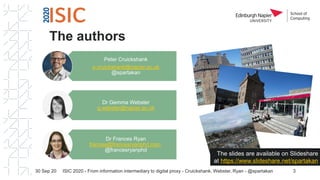
The authors
30 Sep 20 ISIC 2020 - From information intermediary to digital proxy - Cruickshank, Webster, Ryan - @spartakan 3
Peter Cruickshank
p.cruickshank@napier.ac.uk
@spartakan
Dr Gemma Webster
g.webster@napier.ac.uk
Dr Frances Ryan
frances@francesryanphd.com
@francesryanphd
The slides are available on Slideshare
at https://www.slideshare.net/spartakan
ISIC 2020 - From information intermediary to digital proxy - Cruickshank, Webster, Ryan - @spartakan
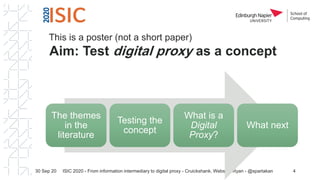
Aim: Test digital proxy as a concept
The themes
in the
literature
Testing the
concept
What is a
Digital
Proxy?
What next
30 Sep 20
This is a poster (not a short paper)
4
Initial analysis
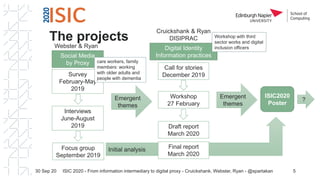
The projects
30 Sep 20 5
Social Media
by Proxy
Survey
February-May
2019
Interviews
June-August
2019
Focus group
September 2019
Emergent
themes
Digital Identity
Information practices
Workshop
27 February
Draft report
March 2020
Final report
March 2020
Call for stories
December 2019
ISIC2020
Poster
Emergent
themes
Cruickshank & Ryan
DISIPRAC
?
ISIC 2020 - From information intermediary to digital proxy - Cruickshank, Webster, Ryan - @spartakan
care workers, family
members: working
with older adults and
people with dementia
Workshop with third
sector works and digital
inclusion officersWebster & Ryan
ISIC 2020 - From information intermediary to digital proxy - Cruickshank, Webster, Ryan - @spartakan
Same words, different meanings
Law Digital Social
Service user Principal Account holder Person / Service user
Identity (Birth) Certificates
Incorporation
Digital id. Individual.
Fixed (authentication)
Constructed / contextual /
changing
Trust Fiduciary duty
Contract
Proof based: Yes/No
(authorisation)
Conditional Fuzzy
Two-way
Proxy Principal vs agent
Guardianship
Delegation rules Proxy, or Information
intermediary…?
Notes Long history, many
precedents
Varies between
legal systems
Outcomes are binary,
often lacking in legal
support, and not
reflecting social reality.
Supported by PKI,
blockchain… confuses
identifier with identity
Goffman…
Fuzzy, constantly
changing, generally co-
constructed/ negotiated
30 Sep 20 6
Identifier: A record id in
an information system
Identity: Who you are
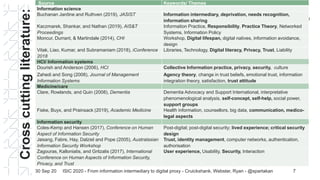
Crosscuttingliterature:
Source Keywords/ Themes
Information science
Buchanan Jardine and Ruthven (2019), JASIST Information intermediary, deprivation, needs recognition,
information sharing
Kaczmarek, Shankar, and Nathan (2019), AIS&T
Proceedings
Information Practice, Responsibility, Practice Theory, Networked
Systems, Information Policy
Moncur, Durrant, & Martindale (2014), CHI Workshop, Digital lifespan, digital natives, information avoidance,
design
Vitak, Liao, Kumar, and Subramaniam (2018), iConference
2018
Libraries, Technology, Digital literacy, Privacy, Trust, Liability
HCI/ Information systems
Dourish and Anderson (2006), HCI Collective Information practice, privacy, security, culture
Zahedi and Song (2008), Journal of Management
Information Systems
Agency theory, change in trust beliefs, emotional trust, information
integration theory, satisfaction, trust attitude
Medicine/care
Clare, Rowlands, and Quin (2008), Dementia Dementia Advocacy and Support International, interpretative
phenomenological analysis, self-concept, self-help, social power,
support groups
Fiske, Buyx, and Prainsack (2019), Academic Medicine Health information, counsellors, big data, communication, medico-
legal aspects
Information security
Coles-Kemp and Hansen (2017), Conference on Human
Aspect of Information Security
Post-digital; post-digital security; lived experience; critical security
design
Jøsang, Fabre, Hay, Dalziel and Pope (2005), Australasian
Information Security Workshop
Trust, identity management, computer networks, authentication,
authorisation
Zagouras, Kalloniatis, and Gritzalis (2017), International
Conference on Human Aspects of Information Security,
Privacy, and Trust
User experience, Usability, Security, Interaction
30 Sep 20 7ISIC 2020 - From information intermediary to digital proxy - Cruickshank, Webster, Ryan - @spartakan
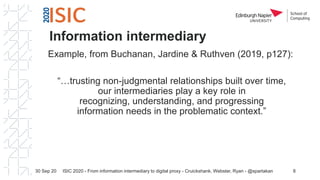
Information intermediary
Example, from Buchanan, Jardine & Ruthven (2019, p127):
“…trusting non-judgmental relationships built over time,
our intermediaries play a key role in
recognizing, understanding, and progressing
information needs in the problematic context.”
30 Sep 20 8ISIC 2020 - From information intermediary to digital proxy - Cruickshank, Webster, Ryan - @spartakan
30 Sep 20 9
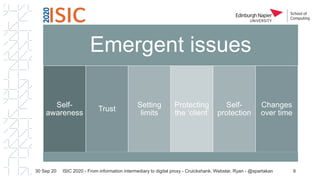
Emergent issues
Self-
awareness
Trust
Setting
limits
Protecting
the ‘client’
Self-
protection
Changes
over time
ISIC 2020 - From information intermediary to digital proxy - Cruickshank, Webster, Ryan - @spartakan
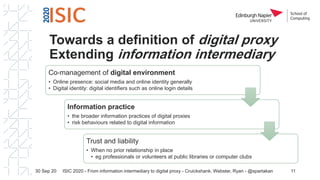
Towards a definition of digital proxy
Extending information intermediary
Co-management of digital environment
• Online presence: social media and online identity generally
• Digital identity: digital identifiers such as online login details
Information practice
• the broader information practices of digital proxies
• risk behaviours related to digital information
Trust and liability
• When no prior relationship in place
• eg professionals or volunteers at public libraries or computer clubs
30 Sep 20 11ISIC 2020 - From information intermediary to digital proxy - Cruickshank, Webster, Ryan - @spartakan
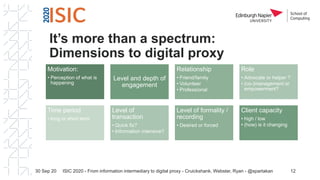
It’s more than a spectrum:
Dimensions to digital proxy
Motivation:
• Perception of what is
happening
Level and depth of
engagement
Relationship
• Friend/family
• Volunteer
• Professional
Role
• Advocate or helper ?
• (co-)management or
empowerment?
Time period
• long or short term
Level of
transaction
• Quick fix?
• Information intensive?
Level of formality /
recording
• Desired or forced
Client capacity
• high / low
• (how) is it changing
30 Sep 20 12ISIC 2020 - From information intermediary to digital proxy - Cruickshank, Webster, Ryan - @spartakan
Possible directions for future research
▪ What are the underlying concepts, and issues with, the term digital proxy?
▪ How do proxies and account holders define terms or determine the scope
of the help to be provided (e.g. on a practical or legal basis)?
▪ What information practices do digital proxies undertake for the people
they support?
▪ How is risk and trust handled within the proxy relationship, and in what
manner does the proxy relationship change over time?
▪ Application to developing digital identity infrastructures, such as
self-sovereign identity
30 Sep 20 ISIC 2020 - From information intermediary to digital proxy - Cruickshank, Webster, Ryan - @spartakan 13
More info
▪ DISIPRAC
▪ Funding: Edinburgh Napier University
▪ Report
▪ https://www.napier.ac.uk/research-and-innovation/research-
search/outputs/workshop-report-for-disiprac-digital-identity-security-
information-practices-of-citizens
▪ Blog posts:
▪ http://www.francesryanphd.com/2020/01/registrations-open-disiprac/
▪ http://www.francesryanphd.com/2020/04/workshop-report-for-disiprac/
▪ Social Media by Proxy
▪ Funding: The Carnegie Trust (RIG007767)
30 Sep 20 ISIC 2020 - From information intermediary to digital proxy - Cruickshank, Webster, Ryan - @spartakan 14
References
Buchanan, S., Jardine, C., & Ruthven, I. (2019). Information behaviors in disadvantaged and dependent circumstances and the role of
information intermediaries. Journal of the Association for Information Science and Technology, 70(2), 117–129.
https://doi.org/10.1002/asi.24110
Clare, L., Rowlands, J. M., & Quin, R. (2008). Collective strength: The impact of developing a shared social identity in early-stage dementia.
Dementia, 7(1), 9–30. https://doi.org/10.1177/1471301207085365
Coles-Kemp, L., & Hansen, R. R. (2017). Walking the Line: The Everyday Security Ties that Bind. In T. Tryfonas (Ed.), HAS 2017:
International Conference on Human Aspects of Information Security, Privacy, and Trust (pp. 464–480). https://doi.org/10.1007/978-3-
319-58460-7_32
Dourish, P., & Anderson, K. (2006). Collective Information Practice: Exploring Privacy and Security as Social and Cultural Phenomena.
Human-Computer Interaction, 21(3), 319–342. https://doi.org/10.1207/s15327051hci2103_2
Fiske, A., Buyx, A., & Prainsack, B. (2019). Health Information Counselors. Academic Medicine, 94(1), 37–41.
https://doi.org/10.1097/ACM.0000000000002395
Jøsang, A., Fabre, J., Hay, B., Dalziel, J., & Pope, S. (2005). Trust requirements in identity management. Conferences in Research and
Practice in Information Technology Series, 44, 99–108.
Kaczmarek, M., Shankar, S., & Nathan, L. P. (2019). Information practice, responsibility, and the ability to respond. Proceedings of the
Association for Information Science and Technology, 55(1), 837–838. https://doi.org/10.1002/pra2.2018.14505501138
Moncur, W., Durrant, A., & Martindale, S. (2014). An introduction to charting the digital lifespan. Paper presented at CHI 2014 Workshop on
Designing Technology for Major Life Events, Toronto, Canada.
Vitak, J., Liao, Y., Kumar, P., & Subramaniam, M. (2018). Librarians as Information Intermediaries: Navigating Tensions Between Being
Helpful and Being Liable. In Lecture Notes in Computer Science: Vol. 10766 LNCS (pp. 693–702). https://doi.org/10.1007/978-3-319-
78105-1_80
Zagouras, P., Kalloniatis, C., & Gritzalis, S. (2017). Managing User Experience: Usability and Security in a New Era of Software Supremacy.
In T. Tryfonas (Ed.), HAS 2017: International Conference on Human Aspects of Information Security, Privacy, and Trust (pp. 174–188).
https://doi.org/10.1007/978-3-319-58460-7_12
Zahedi, F., & Song, J. (2008). Dynamics of Trust Revision: Using Health Infomediaries. Journal of Management Information Systems, 24(4),
225-248. Retrieved April 3, 2020, from www.jstor.org/stable/40398918
30 Sep 20 ISIC 2020 - From information intermediary to digital proxy - Cruickshank, Webster, Ryan - @spartakan 15
p.cruickshank@napier.ac.uk
Further questions:
16

Assisting information practice: from information intermediary to digital proxy

  • 1.
    Assisting information practice: Frominformation intermediary to digital proxy Cruickshank, Webster and Ryan
  • 2.
    ISIC 2020 -From information intermediary to digital proxy - Cruickshank, Webster, Ryan - @spartakan30 Sep 20 2
  • 3.
    The authors 30 Sep20 ISIC 2020 - From information intermediary to digital proxy - Cruickshank, Webster, Ryan - @spartakan 3 Peter Cruickshank p.cruickshank@napier.ac.uk @spartakan Dr Gemma Webster g.webster@napier.ac.uk Dr Frances Ryan frances@francesryanphd.com @francesryanphd The slides are available on Slideshare at https://www.slideshare.net/spartakan
  • 4.
    ISIC 2020 -From information intermediary to digital proxy - Cruickshank, Webster, Ryan - @spartakan Aim: Test digital proxy as a concept The themes in the literature Testing the concept What is a Digital Proxy? What next 30 Sep 20 This is a poster (not a short paper) 4
  • 5.
    Initial analysis The projects 30Sep 20 5 Social Media by Proxy Survey February-May 2019 Interviews June-August 2019 Focus group September 2019 Emergent themes Digital Identity Information practices Workshop 27 February Draft report March 2020 Final report March 2020 Call for stories December 2019 ISIC2020 Poster Emergent themes Cruickshank & Ryan DISIPRAC ? ISIC 2020 - From information intermediary to digital proxy - Cruickshank, Webster, Ryan - @spartakan care workers, family members: working with older adults and people with dementia Workshop with third sector works and digital inclusion officersWebster & Ryan
  • 6.
    ISIC 2020 -From information intermediary to digital proxy - Cruickshank, Webster, Ryan - @spartakan Same words, different meanings Law Digital Social Service user Principal Account holder Person / Service user Identity (Birth) Certificates Incorporation Digital id. Individual. Fixed (authentication) Constructed / contextual / changing Trust Fiduciary duty Contract Proof based: Yes/No (authorisation) Conditional Fuzzy Two-way Proxy Principal vs agent Guardianship Delegation rules Proxy, or Information intermediary…? Notes Long history, many precedents Varies between legal systems Outcomes are binary, often lacking in legal support, and not reflecting social reality. Supported by PKI, blockchain… confuses identifier with identity Goffman… Fuzzy, constantly changing, generally co- constructed/ negotiated 30 Sep 20 6 Identifier: A record id in an information system Identity: Who you are
  • 7.
    Crosscuttingliterature: Source Keywords/ Themes Informationscience Buchanan Jardine and Ruthven (2019), JASIST Information intermediary, deprivation, needs recognition, information sharing Kaczmarek, Shankar, and Nathan (2019), AIS&T Proceedings Information Practice, Responsibility, Practice Theory, Networked Systems, Information Policy Moncur, Durrant, & Martindale (2014), CHI Workshop, Digital lifespan, digital natives, information avoidance, design Vitak, Liao, Kumar, and Subramaniam (2018), iConference 2018 Libraries, Technology, Digital literacy, Privacy, Trust, Liability HCI/ Information systems Dourish and Anderson (2006), HCI Collective Information practice, privacy, security, culture Zahedi and Song (2008), Journal of Management Information Systems Agency theory, change in trust beliefs, emotional trust, information integration theory, satisfaction, trust attitude Medicine/care Clare, Rowlands, and Quin (2008), Dementia Dementia Advocacy and Support International, interpretative phenomenological analysis, self-concept, self-help, social power, support groups Fiske, Buyx, and Prainsack (2019), Academic Medicine Health information, counsellors, big data, communication, medico- legal aspects Information security Coles-Kemp and Hansen (2017), Conference on Human Aspect of Information Security Post-digital; post-digital security; lived experience; critical security design Jøsang, Fabre, Hay, Dalziel and Pope (2005), Australasian Information Security Workshop Trust, identity management, computer networks, authentication, authorisation Zagouras, Kalloniatis, and Gritzalis (2017), International Conference on Human Aspects of Information Security, Privacy, and Trust User experience, Usability, Security, Interaction 30 Sep 20 7ISIC 2020 - From information intermediary to digital proxy - Cruickshank, Webster, Ryan - @spartakan
  • 8.
    Information intermediary Example, fromBuchanan, Jardine & Ruthven (2019, p127): “…trusting non-judgmental relationships built over time, our intermediaries play a key role in recognizing, understanding, and progressing information needs in the problematic context.” 30 Sep 20 8ISIC 2020 - From information intermediary to digital proxy - Cruickshank, Webster, Ryan - @spartakan
  • 9.
    30 Sep 209 Emergent issues Self- awareness Trust Setting limits Protecting the ‘client’ Self- protection Changes over time ISIC 2020 - From information intermediary to digital proxy - Cruickshank, Webster, Ryan - @spartakan
  • 10.
    Towards a definitionof digital proxy Extending information intermediary Co-management of digital environment • Online presence: social media and online identity generally • Digital identity: digital identifiers such as online login details Information practice • the broader information practices of digital proxies • risk behaviours related to digital information Trust and liability • When no prior relationship in place • eg professionals or volunteers at public libraries or computer clubs 30 Sep 20 11ISIC 2020 - From information intermediary to digital proxy - Cruickshank, Webster, Ryan - @spartakan
  • 11.
    It’s more thana spectrum: Dimensions to digital proxy Motivation: • Perception of what is happening Level and depth of engagement Relationship • Friend/family • Volunteer • Professional Role • Advocate or helper ? • (co-)management or empowerment? Time period • long or short term Level of transaction • Quick fix? • Information intensive? Level of formality / recording • Desired or forced Client capacity • high / low • (how) is it changing 30 Sep 20 12ISIC 2020 - From information intermediary to digital proxy - Cruickshank, Webster, Ryan - @spartakan
  • 12.
    Possible directions forfuture research ▪ What are the underlying concepts, and issues with, the term digital proxy? ▪ How do proxies and account holders define terms or determine the scope of the help to be provided (e.g. on a practical or legal basis)? ▪ What information practices do digital proxies undertake for the people they support? ▪ How is risk and trust handled within the proxy relationship, and in what manner does the proxy relationship change over time? ▪ Application to developing digital identity infrastructures, such as self-sovereign identity 30 Sep 20 ISIC 2020 - From information intermediary to digital proxy - Cruickshank, Webster, Ryan - @spartakan 13
  • 13.
    More info ▪ DISIPRAC ▪Funding: Edinburgh Napier University ▪ Report ▪ https://www.napier.ac.uk/research-and-innovation/research- search/outputs/workshop-report-for-disiprac-digital-identity-security- information-practices-of-citizens ▪ Blog posts: ▪ http://www.francesryanphd.com/2020/01/registrations-open-disiprac/ ▪ http://www.francesryanphd.com/2020/04/workshop-report-for-disiprac/ ▪ Social Media by Proxy ▪ Funding: The Carnegie Trust (RIG007767) 30 Sep 20 ISIC 2020 - From information intermediary to digital proxy - Cruickshank, Webster, Ryan - @spartakan 14
  • 14.
    References Buchanan, S., Jardine,C., & Ruthven, I. (2019). Information behaviors in disadvantaged and dependent circumstances and the role of information intermediaries. Journal of the Association for Information Science and Technology, 70(2), 117–129. https://doi.org/10.1002/asi.24110 Clare, L., Rowlands, J. M., & Quin, R. (2008). Collective strength: The impact of developing a shared social identity in early-stage dementia. Dementia, 7(1), 9–30. https://doi.org/10.1177/1471301207085365 Coles-Kemp, L., & Hansen, R. R. (2017). Walking the Line: The Everyday Security Ties that Bind. In T. Tryfonas (Ed.), HAS 2017: International Conference on Human Aspects of Information Security, Privacy, and Trust (pp. 464–480). https://doi.org/10.1007/978-3- 319-58460-7_32 Dourish, P., & Anderson, K. (2006). Collective Information Practice: Exploring Privacy and Security as Social and Cultural Phenomena. Human-Computer Interaction, 21(3), 319–342. https://doi.org/10.1207/s15327051hci2103_2 Fiske, A., Buyx, A., & Prainsack, B. (2019). Health Information Counselors. Academic Medicine, 94(1), 37–41. https://doi.org/10.1097/ACM.0000000000002395 Jøsang, A., Fabre, J., Hay, B., Dalziel, J., & Pope, S. (2005). Trust requirements in identity management. Conferences in Research and Practice in Information Technology Series, 44, 99–108. Kaczmarek, M., Shankar, S., & Nathan, L. P. (2019). Information practice, responsibility, and the ability to respond. Proceedings of the Association for Information Science and Technology, 55(1), 837–838. https://doi.org/10.1002/pra2.2018.14505501138 Moncur, W., Durrant, A., & Martindale, S. (2014). An introduction to charting the digital lifespan. Paper presented at CHI 2014 Workshop on Designing Technology for Major Life Events, Toronto, Canada. Vitak, J., Liao, Y., Kumar, P., & Subramaniam, M. (2018). Librarians as Information Intermediaries: Navigating Tensions Between Being Helpful and Being Liable. In Lecture Notes in Computer Science: Vol. 10766 LNCS (pp. 693–702). https://doi.org/10.1007/978-3-319- 78105-1_80 Zagouras, P., Kalloniatis, C., & Gritzalis, S. (2017). Managing User Experience: Usability and Security in a New Era of Software Supremacy. In T. Tryfonas (Ed.), HAS 2017: International Conference on Human Aspects of Information Security, Privacy, and Trust (pp. 174–188). https://doi.org/10.1007/978-3-319-58460-7_12 Zahedi, F., & Song, J. (2008). Dynamics of Trust Revision: Using Health Infomediaries. Journal of Management Information Systems, 24(4), 225-248. Retrieved April 3, 2020, from www.jstor.org/stable/40398918 30 Sep 20 ISIC 2020 - From information intermediary to digital proxy - Cruickshank, Webster, Ryan - @spartakan 15
  • 15.