Visit https://testbankmall.com to download the full version and
explore more testbank or solutions manual
Test Bank for Environmental Science, 15th Edition
_____ Click the link below to download _____
https://testbankmall.com/product/test-bank-for-
environmental-science-15th-edition/
Explore and download more testbank or solutions manual at testbankmall.com
Here are some recommended products that we believe you will be
interested in. You can click the link to download.
Test Bank for Environmental Science, 15th Edition, Eldon
Enger, Bradley Smith
https://testbankmall.com/product/test-bank-for-environmental-
science-15th-edition-eldon-enger-bradley-smith/
Environmental Science 14th Edition Miller Test Bank
https://testbankmall.com/product/environmental-science-14th-edition-
miller-test-bank/
Test Bank for Environmental Science, 12th Edition: Enger
https://testbankmall.com/product/test-bank-for-environmental-
science-12th-edition-enger/
Test bank for Environmental Science 12th 0321811291 /
9780321811295
https://testbankmall.com/product/test-bank-for-environmental-
science-12th-0321811291-9780321811295/
Test Bank Friedland Relyea Environmental Science For AP
https://testbankmall.com/product/test-bank-friedland-relyea-
environmental-science-for-ap/
Test Bank for Friedland Relyea Environmental Science for
AP
https://testbankmall.com/product/test-bank-for-friedland-relyea-
environmental-science-for-ap/
Solution manual for Environmental Engineering Science
Nazaroff
https://testbankmall.com/product/solution-manual-for-environmental-
engineering-science-nazaroff/
Test Bank for Principles of Environmental Science 9th
Edition Cunningham
https://testbankmall.com/product/test-bank-for-principles-of-
environmental-science-9th-edition-cunningham/
Test Bank for Environmental Science, 14th Edition, William
Cunningham, Mary Cunningham
https://testbankmall.com/product/test-bank-for-environmental-
science-14th-edition-william-cunningham-mary-cunningham/
Chapter 02 - Science - Matter - and Energy
Copyright Cengage Learning. Powered by Cognero. Page
2
5. Logic and critical thinking are more important tools in science than imagination and creativity.
a. True
b. False
ANSWER: False
DIFFICULTY: BLOOM’S: Understand
REFERENCES: 2.1 What Do Scientists Do?
Chapter 02 - Science - Matter - and Energy
Copyright Cengage Learning. Powered by Cognero. Page
3
QUESTION TYPE: True / False
LEARNING OBJECTIVES: ENVS.MLSP.16.2.1.1 - Outline the nine necessary steps to develop a scientific theory.
6. When matter undergoes physical changes, the chemical composition also changes.
a. True
b. False
ANSWER: False
DIFFICULTY: BLOOM’S: Remember
REFERENCES: 2.2 What Is Matter and What Happens When It Undergoes Change?
QUESTION TYPE: True / False
LEARNING OBJECTIVES: ENVS.MLSP.16.2.2 - Explain what matter is made of and the law governing changes in
matter.
7. Hydrocarbons are organic compounds.
a. True
b. False
ANSWER: True
DIFFICULTY: BLOOM’S: Remember
REFERENCES: 2.2 What Is Matter and What Happens When It Undergoes Change?
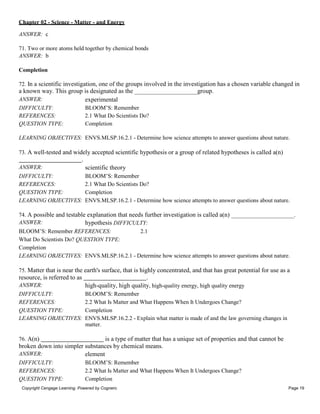
QUESTION TYPE: True / False
LEARNING OBJECTIVES: ENVS.MLSP.16.2.2.3 - Distinguish the organic compounds based on their chemical formula.
8. Peer review involves scientists openly publishing details of the methods they used, the results of their
experiments, and the reasoning behind their hypotheses for other scientists working in the same field to
evaluate.
a. True
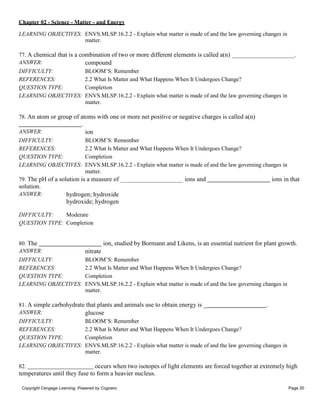
b. False
ANSWER: True
DIFFICULTY: BLOOM’S: Remember
REFERENCES: 2.1 What Do Scientists Do?
QUESTION TYPE: True / False
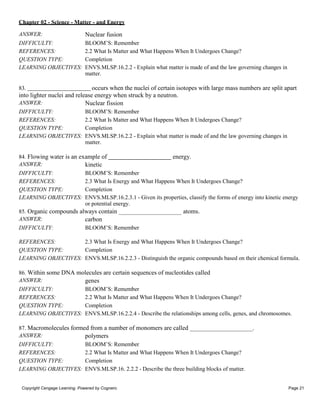
LEARNING OBJECTIVES: ENVS.MLSP.16.2.1 - Determine how science attempts to answer questions about nature.
9. A positive feedback loop causes a system to change in the opposite direction from which it is moving.
a. True
b. False
ANSWER: False
DIFFICULTY: BLOOM’S: Remember
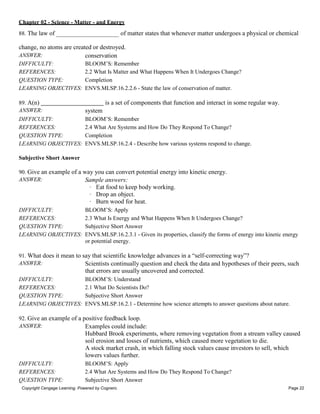
REFERENCES: 2.4 What Are Systems and How Do They Respond To Change?
QUESTION TYPE: True / False
LEARNING OBJECTIVES: ENVS.MLSP.16.2.4 - Describe how various systems respond to change.
10. When energy changes from one form to another, it always goes from a more useful to a less useful form.
a. True
b. False
Chapter 02 - Science - Matter - and Energy
Copyright Cengage Learning. Powered by Cognero. Page
4
ANSWER: True
DIFFICULTY: BLOOM’S: Remember
REFERENCES: 2.3 What Is Energy and What Happens When It Undergoes Change?
QUESTION TYPE: True / False
LEARNING OBJECTIVES: ENVS.MLSP.16.2.3.3 - Explain the two scientific laws of thermodynamics.
11. The idea that all elements are made up of molecules is called the atomic theory.
a. True
b. False
ANSWER: False
DIFFICULTY: BLOOM’S: Remember
REFERENCES: 2.2 What Is Matter and What Happens When It Undergoes Change?
QUESTION TYPE: True / False
LEARNING OBJECTIVES: ENVS.MLSP.16.2.2 - Explain what matter is made of and the law governing changes in
matter.
12. Two or more different elements can combine to form isotopes.
a. True
b. False
ANSWER: False
DIFFICULTY: BLOOM’S: Remember
REFERENCES: 2.2 What Is Matter and What Happens When It Undergoes Change?
QUESTION TYPE: True / False
LEARNING OBJECTIVES: ENVS.MLSP.16.2.2 - Explain what matter is made of and the law governing changes in
matter.
13. Thousands of genes make up a single chromosome.
a. True
b. False
ANSWER: True
DIFFICULTY: BLOOM’S: Remember
REFERENCES: 2.2 What Is Matter and What Happens When It Undergoes Change?
QUESTION TYPE: True / False
LEARNING OBJECTIVES: ENVS.MLSP.16.2.2.4 - Describe the relationships among cells, genes, and chromosomes.
14. Radioactive decay occurs when the nuclei of unstable isotopes spontaneously emit fast-moving chunks of
matter (alpha particles or beta particles), high-energy radiation (gamma rays), or both at a fixed rate.
a. True
b. False
ANSWER: True
DIFFICULTY: BLOOM’S: Understand
REFERENCES: 2.2 What Is Matter and What Happens When It Undergoes Change?
QUESTION TYPE: True / False
LEARNING OBJECTIVES: ENVS.MLSP.16.2.2 - Explain what matter is made of and the law governing changes in
matter.
Chapter 02 - Science - Matter - and Energy
Copyright Cengage Learning. Powered by Cognero. Page
5
15. A scientific hypothesis must be testable.
a. True
b. False
ANSWER: True
DIFFICULTY: BLOOM’S: Remember
REFERENCES: 2.1 What Do Scientists Do?
QUESTION TYPE: True / False
LEARNING OBJECTIVES: ENVS.MLSP.16.2.1 - Determine how science attempts to answer questions about nature.
Multiple Choice
16. Recall the Bormann-Likens controlled experiment in the forested valleys of New Hampshire. Which
statement best describes the effects of water flowing out of deforested areas into undisturbed areas?
a. The amount of water flowing out of the deforested valley following rain increased by 30-40%, and
soil erosion increased.
b. The amount of water flowing out of the deforested valley decreased by 10-20%, and soil erosion
decreased.
c. The flow of water did not change, but soil erosion increased.
d. Other types of plants took the place of the trees, preventing deforestation from affecting the flow of
water.
e. Eroding soil dammed up the river, preventing the flow of water.
ANSWER: a
DIFFICULTY: BLOOM’S: Understand
REFERENCES: Core Case Study: How Do Scientists Learn about Nature? Experimenting with a Forest
QUESTION TYPE: Multiple Choice
LEARNING OBJECTIVES: ENVS.MLSP.16.2.1 - Determine how science attempts to answer questions about nature.
17. The Bormann-Likens study in the Hubbard Brook Experimental Forest in New Hampshire can be described
as .
a. a comparison of a control site with an experimental site in nature
b. a study using computer model simulations of a complex natural system
c. an experiment in which too many factors were varied to draw a conclusion from the results
d. missing a baseline for comparison, making it difficult to draw a conclusion from the results
e. an observational study that attempted not to interfere with a natural system
ANSWER: a
DIFFICULTY: BLOOM’S: Understand
REFERENCES: Core Case Study: How Do Scientists Learn about Nature? Experimenting with a Forest
QUESTION TYPE: Multiple Choice
LEARNING OBJECTIVES: ENVS.MLSP.16.2.1 - Determine how science attempts to answer questions about nature.
18. Science is .
a. a field in which observations are rarely tested
b. never investigated using statistical tools and models
Chapter 02 - Science - Matter - and Energy
Copyright Cengage Learning. Powered by Cognero. Page
6
c. best described as a collection of opinions
d. supported by small amounts of evidence
e. a broad field of study focused on discovering how nature works
ANSWER: e
DIFFICULTY: BLOOM’S: Remember
REFERENCES: 2.1 What Do Scientists Do?
QUESTION TYPE: Multiple Choice
LEARNING OBJECTIVES: ENVS.MLSP.16.2.1.4 - Distinguish between scientific theories and laws.
19. A(n) is an approximate representation or simulation of a system.
a. model
b. datum
c. projection
d. experiment
e. peer review
ANSWER: a
DIFFICULTY: BLOOM’S: Remember
REFERENCES: 2.1 What Do Scientists Do?
QUESTION TYPE: Multiple Choice
LEARNING OBJECTIVES: ENVS.MLSP.16.2.1 - Determine how science attempts to answer questions about nature.
20. Scientific hypotheses differ from scientific theories in that they are _.
a. widely accepted descriptions of what we find happening over and over in nature
b. possible, but not yet well-tested, explanations of data
c. not able to be tested
d. arrived at after extensive mathematical modeling
e. facts rather than opinions
ANSWER: b
DIFFICULTY: BLOOM’S: Remember
REFERENCES: 2.1 What Do Scientists Do?
QUESTION TYPE: Multiple Choice
LEARNING OBJECTIVES: ENVS.MLSP.16.2.1 - Determine how science attempts to answer questions about nature.
21. A classmate tells you that a statement heard on the news about an environmental process noted in a local
ecosystem cannot be true because it has not been scientifically proven. You realize that .
a. this classmate is misinformed because science cannot prove anything, but it can disprove events
conclusively
b. this classmate is misinformed because science cannot prove or disprove anything absolutely
c. this classmate is misinformed because the environmental process in question actually has been
proven scientifically
d. this classmate is correct
e. this classmate has confused scientific theories and scientific laws
ANSWER: b
Chapter 02 - Science - Matter - and Energy
Copyright Cengage Learning. Powered by Cognero. Page
7
DIFFICULTY: BLOOM’S: Understand
REFERENCES: 2.1 What Do Scientists Do?
QUESTION TYPE: Multiple Choice
LEARNING OBJECTIVES: ENVS.MLSP.16.2.1 - Determine how science attempts to answer questions about nature.
22. Which list describes the sequence scientists typically follow in the beginning stages of their investigations
about how nature works?
a. analyze data → search literature → perform experiment → identify a problem → ask a question
b. ask a question → search literature → perform experiment → analyze data → identify a problem
c. search literature → ask a question → identify a problem → analyze data → perform experiment
d. identify a problem → search literature → ask a question → perform experiment → analyze data
e. ask a question → search literature → identify a problem → perform experiment → analyze data
ANSWER: d
DIFFICULTY: BLOOM’S: Remember
REFERENCES: 2.1 What Do Scientists Do?
QUESTION TYPE: Multiple Choice
LEARNING OBJECTIVES: ENVS.MLSP.16.2.1.1 - Outline the nine necessary steps to develop a scientific theory.
23. Because there is often no way to measure every instance of a phenomenon around the entire world, scientists
.
a. can do little more than guess at what’s happening
b. do not even attempt to do so
c. pick one instance and assume it’s perfectly representative
d. use statistical sampling and mathematical models to make estimates
e. use computer simulations instead
ANSWER: d
DIFFICULTY: BLOOM’S: Remember
REFERENCES: 2.1 What Do Scientists Do?
QUESTION TYPE: Multiple Choice
LEARNING OBJECTIVES: ENVS.MLSP.16.2.1.6 - State three important limitations of science.
Narrative: (questions 9 and 10)
A tiny, tawny colored butterfly called the Carson Wandering Skipper was always known for its small and very
localized populations. Typically, it was found along the western Nevada and eastern California high desert
areas. It was always located close to hot springs and other wet areas that supported salt grass, the host plant it
depended on.
Recently, the populations went into a steep decline, and a last hold-out area was threatened by imminent
construction of a freeway bypass. Biologists became alarmed and began an intensive search for populations in
locations other than the spot designated for the freeway bypass. They began their search by identifying all
known locations of hot springs, in hopes of finding small populations of the Carson Wandering Skipper close
by.
24. The biologists’ observations that the Carson Wandering Skipper populations had declined is an example of
.
Chapter 02 - Science - Matter - and Energy
Copyright Cengage Learning. Powered by Cognero. Page
8
a. reporting a conclusion
b. identifying a problem
c. performing an experiment
d. proposing a hypothesis
e. making testable predictions
ANSWER: b
DIFFICULTY: BLOOM’S: Understand
REFERENCES: 2.1 What Do Scientists Do?
QUESTION TYPE: Multiple Choice
PREFACE NAME: Narrative
LEARNING OBJECTIVES: ENVS.MLSP.16.2.1.1 - Outline the nine necessary steps to develop a scientific theory.
25. As biologists searched for previously unknown populations of the Carson Wandering Skipper, biologists
wondered if hot springs were absolutely essential to its survival. This phase of the investigation is .
a. finding out what is known and asking a question
b. analyzing data and asking a question
c. asking a question and testing predictions
d. accepting their hypothesis and analyzing data
e. accepting their hypothesis and asking a question
ANSWER: a
DIFFICULTY: BLOOM’S: Understand
REFERENCES: 2.1 What Do Scientists Do?
QUESTION TYPE: Multiple Choice
PREFACE NAME: Narrative
LEARNING OBJECTIVES: ENVS.MLSP.16.2.1.1 - Outline the nine necessary steps to develop a scientific theory.
26. Scientific hypotheses and results that have not undergone the rigors of peer review, or that have been
discarded as a result of peer review or additional research, are considered to be .
a. limited but accurate
b. scientific laws
c. scientific theories
d. unreliable science
e. reliable science
ANSWER: d
DIFFICULTY: BLOOM’S: Remember
REFERENCES: 2.1 What Do Scientists Do?
QUESTION TYPE: Multiple Choice
LEARNING OBJECTIVES: ENVS.MLSP.16.2.1 - Determine how science attempts to answer questions about nature.
27. Critical thinking includes _.
a. knowing that everything you read or hear is wrong
b. only looking for information that supports your opinions
c. learning how to argue persuasively that you are right
Chapter 02 - Science - Matter - and Energy
Copyright Cengage Learning. Powered by Cognero. Page
9
d. knowing what the right answer should be, and finding an explanation for any results that disagree
e. identifying and evaluating your personal assumptions, biases, and beliefs, being careful to distinguish
between facts and opinions
ANSWER: e
DIFFICULTY: BLOOM’S: Remember
REFERENCES: 2.1 What Do Scientists Do?
QUESTION TYPE: Multiple Choice
LEARNING OBJECTIVES: ENVS.MLSP.16.2.1.3 - List the four important steps of critical thinking.
28. A scientific law .
a. is a hypothesis that has been proven
b. is what a theory becomes when it passes experimental tests
c. is called that because there are consequences when it is broken
d. is a well-tested and widely accepted description of what we find happening repeatedly and in the
same way in nature
e. determines the series of steps that should be followed when designing an experiment to test a
hypothesis
ANSWER: d
DIFFICULTY: BLOOM’S: Remember
REFERENCES: 2.1 What Do Scientists Do?
QUESTION TYPE: Multiple Choice
LEARNING OBJECTIVES: ENVS.MLSP.16.2.1.4 - Distinguish between scientific theories and laws.
29. Matter is best described as .
a. thermodynamic
b. something that has the capacity to do work
c. positively charged
d. something that can produce change
e. anything that has mass and takes up space
ANSWER: e
DIFFICULTY: BLOOM’S: Remember
REFERENCES: 2.2 What Is Matter And What Happens When It Undergoes Change?
QUESTION TYPE: Multiple Choice
LEARNING OBJECTIVES: ENVS.MLSP.16.2.2 - Explain what matter is made of and the law governing changes in
matter.
30. Atomic theory, the idea that all elements are made of up atoms, _.
a. is a scientific theory
b. is a scientific law
c. is tentative science
d. is no longer considered to be correct
e. violates the law of conservation of matter
ANSWER: a
Chapter 02 - Science - Matter - and Energy
Copyright Cengage Learning. Powered by Cognero. Page
10
DIFFICULTY: BLOOM’S: Understand
REFERENCES: 2.2 What Is Matter And What Happens When It Undergoes Change?
QUESTION TYPE: Multiple Choice
LEARNING OBJECTIVES: ENVS.MLSP.16.2.1.4 - Distinguish between scientific theories and laws.
31. The atomic number of an element is the number of .
a. atoms in a molecule
b. protons in an atom
c. nuclei in a molecule
d. electrons in an atom
e. protons and neutrons in an atom
ANSWER: b
DIFFICULTY: BLOOM’S: Remember
REFERENCES: 2.2 What Is Matter And What Happens When It Undergoes Change?
QUESTION TYPE: Multiple Choice
LEARNING OBJECTIVES: ENVS.MLSP.16.2.2 - Explain what matter is made of and the law governing changes in
matter.
32. Protons, neutrons, and electrons are all .
a. forms of energy
b. equal in mass
c. subatomic particles
d. negative ions
e. charged particles
ANSWER: c
DIFFICULTY: BLOOM’S: Remember
REFERENCES: 2.2 What Is Matter and What Happens When It Undergoes Change?
QUESTION TYPE: Multiple Choice
LEARNING OBJECTIVES: ENVS.MLSP.16.2.2.2 - Describe the three building blocks of matter.
33. An atom's mass number is equal to the total number of .
a. neutrons and isotopes
b. neutrons and electrons
c. neutrons and protons
d. protons, neutrons, and electrons
e. protons only
ANSWER: c
DIFFICULTY: BLOOM’S: Remember
REFERENCES: 2.2 What Is Matter and What Happens When It Undergoes Change?
QUESTION TYPE: Multiple Choice
LEARNING OBJECTIVES: ENVS.MLSP.16.2.2 - Explain what matter is made of and the law governing changes in
matter.
Chapter 02 - Science - Matter - and Energy
Copyright Cengage Learning. Powered by Cognero. Page 10
34. An element .
a. can combine with protons to make an atom
b. is made up of compounds
c. can combine with one or more other elements to make a compound
d. is defined by the number of electrons it has
e. can only be organic
ANSWER: c
DIFFICULTY: BLOOM’S: Remember
REFERENCES: 2.2 What Is Matter and What Happens When It Undergoes Change?
QUESTION TYPE: Multiple Choice
LEARNING OBJECTIVES: ENVS.MLSP.16.2.2 - Explain what matter is made of and the law governing changes in
matter.
35. The most common form of the carbon atom is sometimes referred to as 12
C. An isotope of this atom is called
14
C. 14
C must have a different number of than 12
C.
a. ions
b. protons
c. atoms
d. neutrons
e. electrons
ANSWER: d
DIFFICULTY: BLOOM’S: Remember
REFERENCES: 2.2 What Is Matter and What Happens When It Undergoes Change?
QUESTION TYPE: Multiple Choice
LEARNING OBJECTIVES: ENVS.MLSP.16.2.2 - Explain what matter is made of and the law governing changes in
matter.
36. Ions are atoms or groups of atoms that have _ .
a. gained or lost electrons
b. gained or lost protons
c. gained or lost neutrons
d. undergone radioactive decay
e. different numbers of protons and neutrons in the same atom
ANSWER: a
DIFFICULTY: BLOOM’S: Remember
REFERENCES: 2.2 What Is Matter and What Happens When It Undergoes Change?
QUESTION TYPE: Multiple Choice
LEARNING OBJECTIVES: ENVS.MLSP.16.2.2 - Explain what matter is made of and the law governing changes in
matter.
37. Which list of items contains only ions?
a. CO2, H2O, Na+
, H-
Chapter 02 - Science - Matter - and Energy
Copyright Cengage Learning. Powered by Cognero. Page 11
b. Na+
, H-
, Pb, Hg
c. Pb, Hg, CO2,NaCl
d. Cl-
, Na+
, Ca2+
, NO3
-
e. NaCl, NO, CO, NaOH
ANSWER: d
DIFFICULTY: BLOOM’S: Understand
REFERENCES: 2.2 What Is Matter and What Happens When It Undergoes Change?
QUESTION TYPE: Multiple Choice
LEARNING OBJECTIVES: ENVS.MLSP.16.2.2 - Explain what matter is made of and the law governing changes in
matter.
38. An acidic solution would have .
a. more hydroxide ions than hydrogen ions and a pH greater than 7
b. more hydrogen ions than hydroxide ions and a pH greater than 7
c. more hydroxide ions than hydrogen ions and a pH less than 7
d. more hydroxide ions than hydrogen ions and a pH of 7
e. more hydrogen ions than hydroxide ions and a pH less than 7
ANSWER: e
DIFFICULTY: BLOOM’S: Remember
REFERENCES: 2.2 What Is Matter and What Happens When It Undergoes Change?
QUESTION TYPE: Multiple Choice
LEARNING OBJECTIVES: ENVS.MLSP.16.2.2 - Explain what matter is made of and the law governing changes in
matter.
39. All organic compounds are characterized by the presence of _.
a. carbon
b. hydrogen
c. oxygen
d. nitrogen
e. phosphorus
ANSWER: a
DIFFICULTY: BLOOM’S: Remember
REFERENCES: 2.2 What Is Matter and What Happens When It Undergoes Change?
QUESTION TYPE: Multiple Choice
LEARNING OBJECTIVES: ENVS.MLSP.16.2.2.3 - Distinguish the organic compounds based on their chemical formula.
40. The compound represented by the formula CH4 is .
a. calcium carbonate
b. carbon dioxide
c. methane, a hydrocarbon
d. sodium chloride
e. glucose, a simple carbohydrate
Chapter 02 - Science - Matter - and Energy
Copyright Cengage Learning. Powered by Cognero. Page 12
ANSWER: c
DIFFICULTY: BLOOM’S: Remember
REFERENCES: 2.2 What Is Matter and What Happens When It Undergoes Change?
QUESTION TYPE: Multiple Choice
LEARNING OBJECTIVES: ENVS.MLSP.16.2.2 - Explain what matter is made of and the law governing changes in
matter.
41. Which of the following contains all of the others?
a. chromosomes
b. genes
c. cells
d. DNA molecules
e. cell nuclei
ANSWER: c
DIFFICULTY: BLOOM’S: Understand
REFERENCES: 2.2 What Is Matter and What Happens When It Undergoes Change?
QUESTION TYPE: Multiple Choice
LEARNING OBJECTIVES: ENVS.MLSP.16.2.2.4 - Describe the relationships among cells, genes, and chromosomes.
42. are the fundamental structural and functional units of life.
a. Ions
b. Atoms
c. Compounds
d. Molecules
e. Cells
ANSWER: e
DIFFICULTY: BLOOM’S: Remember
REFERENCES: 2.2 What Is Matter and What Happens When It Undergoes Change?
QUESTION TYPE: Multiple Choice
LEARNING OBJECTIVES: ENVS.MLSP.16.2.2.4 - Describe the relationships among cells, genes, and chromosomes.
43. Simple organic molecules called monomers can be linked together by chemical bonds to form _ .
a. chromosomes
b. lipids
c. polymers
d. hydrocarbons
e. elements
ANSWER: c
DIFFICULTY: BLOOM’S: Remember
REFERENCES: 2.2 What Is Matter and What Happens When It Undergoes Change?
QUESTION TYPE: Multiple Choice
LEARNING OBJECTIVES: ENVS.MLSP.16.2.2 - Explain what matter is made of and the law governing changes in
matter.
Chapter 02 - Science - Matter - and Energy
Copyright Cengage Learning. Powered by Cognero. Page 13
44. Genes are composed of sequences of .
a. ions
b. chromosomes
c. cells
d. nucleotides
e. proteins
ANSWER: d
DIFFICULTY: BLOOM’S: Remember
REFERENCES: 2.2 What Is Matter and What Happens When It Undergoes Change?
QUESTION TYPE: Multiple Choice
LEARNING OBJECTIVES: ENVS.MLSP.16.2.2.4 - Describe the relationships among cells, genes, and chromosomes.
45. The law of conservation of matter states that whenever matter undergoes a physical or chemical change,
.
a. atoms can be created
b. atoms can be destroyed
c. atoms cannot be created or destroyed
d. atoms can be destroyed if we compost them
e. atoms can be created by reactions between organic compounds
ANSWER: c
DIFFICULTY: BLOOM’S: Remember
REFERENCES: 2.2 What Is Matter and What Happens When It Undergoes Change?
QUESTION TYPE: Multiple Choice
LEARNING OBJECTIVES: ENVS.MLSP.16.2.2.6 - State the law of conservation of matter.
46. If a carbon atom combines with oxygen atoms to form CO2, this would be described as .
a. a physical change
b. a chemical change
c. both a physical and chemical change
d. first a physical change, but then it becomes a chemical change
e. neither a physical change or a chemical change, but a scientific change
ANSWER: b
DIFFICULTY: BLOOM’S: Understand
REFERENCES: 2.2 What Is Matter and What Happens When It Undergoes Change?
QUESTION TYPE: Multiple Choice
LEARNING OBJECTIVES: ENVS.MLSP.16.2.2 - Explain what matter is made of and the law governing changes in
matter.
47. Energy can be formally defined as the .
a. velocity of any moving object
b. heat generated by atoms losing electrons
c. capacity to do work
d. displacement of heat from the sun to the earth
Chapter 02 - Science - Matter - and Energy
Copyright Cengage Learning. Powered by Cognero. Page 14
e. process of moving objects
ANSWER: c
DIFFICULTY: BLOOM’S: Remember
REFERENCES: 2.3 What Is Energy and What Happens When It Undergoes Change?
QUESTION TYPE: Multiple Choice
LEARNING OBJECTIVES: ENVS.MLSP.16.2.3 - Discuss energy and the laws that govern it.
48. Most forms of energy can be classified as either .
a. chemical or physical
b. kinetic or mechanical
c. potential or mechanical
d. chemical or kinetic
e. potential or kinetic
ANSWER: e
DIFFICULTY: BLOOM’S: Remember
REFERENCES: 2.3 What Is Energy and What Happens When It Undergoes Change?
QUESTION TYPE: Multiple Choice
LEARNING OBJECTIVES: ENVS.MLSP.16.2.3.1 - Given its properties, classify the forms of energy into kinetic energy
or potential energy.
49. Kinetic energy is energy associated with .
a. chemical reactions
b. motion
c. food
d. coal
e. elevation differences
ANSWER: b
DIFFICULTY: BLOOM’S: Remember
REFERENCES: 2.3 What Is Energy and What Happens When It Undergoes Change?
QUESTION TYPE: Multiple Choice
LEARNING OBJECTIVES: ENVS.MLSP.16.2.3.1 - Given its properties, classify the forms of energy into kinetic energy
or potential energy.
50. An example of potential energy is .
a. electricity flowing through a wire
b. the chemical energy in a candy bar
c. a bullet fired at high velocity
d. the falling of a leaf from a tree
e. the flowing of water
ANSWER: b
DIFFICULTY: BLOOM’S: Understand
REFERENCES: 2.3 What Is Energy and What Happens When It Undergoes Change?
QUESTION TYPE: Multiple Choice
Chapter 02 - Science - Matter - and Energy
Copyright Cengage Learning. Powered by Cognero. Page 15
LEARNING OBJECTIVES: ENVS.MLSP.16.2.3.1 - Given its properties, classify the forms of energy into kinetic energy
or potential energy.
51. Which statement best describes the first law of thermodynamics?
a. Atoms cannot be created or destroyed.
b. Energy can neither be created nor destroyed.
c. Heat is a form of kinetic energy.
d. Solar energy is converted into chemical energy in living systems.
e. When energy is used up, it’s gone.
ANSWER: b
DIFFICULTY: BLOOM’S: Remember
REFERENCES: 2.3 What Is Energy and What Happens When It Undergoes Change?
QUESTION TYPE: Multiple Choice
LEARNING OBJECTIVES: ENVS.MLSP.16.2.3.3 - Explain the two scientific laws of thermodynamics.
52. Wind farms are viable options for supplying more of our energy needs in the future because .
a. high-speed wind is a form of medium-quality energy
b. high-speed wind is a form of high-quality energy
c. high-speed wind is a form of low-quality energy
d. wind continuously moves at great speeds around the globe
e. wind is potential energy
ANSWER: b
DIFFICULTY: BLOOM’S: Understand
REFERENCES: 2.3 What Is Energy and What Happens When It Undergoes Change?
QUESTION TYPE: Multiple Choice
LEARNING OBJECTIVES: ENVS.MLSP.16.2.3.2 - Contrast high-quality to low-quality energy.
53. The second law of thermodynamics says that whenever energy is converted from one form to another in a
physical or chemical change, .
a. more energy will be present in the second form
b. heat is absorbed
c. light is produced
d. we end up with lower-quality or less useable energy than we started with
e. the second form of energy will always be kinetic
ANSWER: d
DIFFICULTY: BLOOM’S: Remember
REFERENCES: 2.3 What Is Energy and What Happens When It Undergoes Change?
QUESTION TYPE: Multiple Choice
LEARNING OBJECTIVES: ENVS.MLSP.16.2.3.3 - Explain the two scientific laws of thermodynamics.
54. is a measure of the amount of energy available to do useful work.
a. Energy quality
b. Energy effectiveness
Chapter 02 - Science - Matter - and Energy
Copyright Cengage Learning. Powered by Cognero. Page 16
c. Energy conservation
d. Energy efficiency e.
Energy radiation ANSWER:
a
DIFFICULTY: BLOOM’S: Remember
REFERENCES: 2.3 What Is Energy and What Happens When It Undergoes Change?
QUESTION TYPE: Multiple Choice
LEARNING OBJECTIVES: ENVS.MLSP.16.2.3.2 - Contrast high-quality to low-quality energy.
55. Which of the following energy forms is low-quality?
a. the energy released by burning coal
b. the heat dispersed in the ocean
c. concentrated sunlight
d. high-speed wind
e. the energy released by burning wood
ANSWER: b
DIFFICULTY: BLOOM’S: Understand
REFERENCES: 2.3 What Is Energy and What Happens When It Undergoes Change?
QUESTION TYPE: Multiple Choice
LEARNING OBJECTIVES: ENVS.MLSP.16.2.3.2 - Contrast high-quality to low-quality energy.
56. A positive feedback loop .
a. increases a change to a system
b. always results in a beneficial change to a system
c. decreases a change to a system
d. never results in a beneficial change to a system
e. stabilizes a system
ANSWER: a
DIFFICULTY: BLOOM’S: Remember
REFERENCES: 2.4 What Are Systems and How Do They Respond To Change?
QUESTION TYPE: Multiple Choice
LEARNING OBJECTIVES: ENVS.MLSP.16.2.3 - Discuss energy and the laws that govern it.
57. A thermostat set to 62 °F turns on the furnace when a house cools below that temperature, and shuts the
furnace off when a house warms above that temperature. This is an example of a simple .
a. positive feedback loop
b. negative feedback loop
c. system loop
d. tipping point
e. thermodynamic loop
ANSWER: b
DIFFICULTY: BLOOM’S: Understand
REFERENCES: 2.4 What Are Systems and How Do They Respond To Change?
Chapter 02 - Science - Matter - and Energy
Copyright Cengage Learning. Powered by Cognero. Page 17
QUESTION TYPE: Multiple Choice
LEARNING OBJECTIVES: ENVS.MLSP.16.2.3 - Discuss energy and the laws that govern it.
58. A form of kinetic energy that travels in the form of a wave as a result of changes in electrical and magnetic
fields is .
a. wind
b. electromagnetic radiation
c. waterfalls
d. electricity
e. heat energy
ANSWER: b
DIFFICULTY: BLOOM’S: Remember
REFERENCES: 2.3 What Is Energy and What Happens When It Undergoes Change?
QUESTION TYPE: Multiple Choice
LEARNING OBJECTIVES: ENVS.MLSP.16.2.3 - Discuss energy and the laws that govern it.
59. Which form of electromagnetic radiation has the shortest wavelength?
a. infrared radiation
b. radio waves
c. visible light
d. ultraviolet (UV) radiation
e. microwaves
ANSWER: d
DIFFICULTY: BLOOM’S: Understand
REFERENCES: 2.3 What Is Energy and What Happens When It Undergoes Change?
QUESTION TYPE: Multiple Choice
LEARNING OBJECTIVES: ENVS.MLSP.16.2.3 - Discuss energy and the laws that govern it.
60. Most living systems can be described as having inputs, _, and outputs.
a. thermodynamics
b. positive transfers
c. throughputs
d. kinetics
e. creations
ANSWER: c
DIFFICULTY: BLOOM’S: Remember
REFERENCES: 2.4 What Are Systems and How Do They Respond To Change?
QUESTION TYPE: Multiple Choice
LEARNING OBJECTIVES: ENVS.MLSP.16.2.3 - Discuss energy and the laws that govern it.
Matching
Match items with their appropriate chemical description.
Chapter 02 - Science - Matter - and Energy
Copyright Cengage Learning. Powered by Cognero. Page 18
a. NH4
+
b. molecule
c. electron
d. proton
e. neutron
f. pH
g. Ca
h. P
i. mass number
j. NO3
-
k. C6H12O6
DIFFICULTY: BLOOM’S: Remember
REFERENCES: 2.2 What Is Matter and What Happens When It Undergoes Change?
QUESTION TYPE: Matching
LEARNING OBJECTIVES: ENVS.MLSP.16.2.2 - Explain what matter is made of and the law governing changes in
matter.
ENVS.MLSP.16.2.2.2 - Describe the three building blocks of matter.
61. The chemical symbol for the element calcium
ANSWER: g
62. A subatomic particle with no net electrical charge
ANSWER: e
63. The nitrate ion
ANSWER: j
64. The chemical symbol for the element phosphorus
ANSWER: h
65. The total number of protons and neutrons in an atom’s nucleus
ANSWER: i
66. Subatomic particle with a positive charge
ANSWER: d
67. The ammonium ion
ANSWER: a
68. The scale used to measure acidity
ANSWER: f
69. The chemical formula for glucose
ANSWER: k
70. Subatomic particle with a negative charge
Chapter 02 - Science - Matter - and Energy
Copyright Cengage Learning. Powered by Cognero. Page 19
ANSWER: c
71. Two or more atoms held together by chemical bonds
ANSWER: b
Completion
72. In a scientific investigation, one of the groups involved in the investigation has a chosen variable changed in
a known way. This group is designated as the
ANSWER: experimental
DIFFICULTY: BLOOM’S: Remember
REFERENCES: 2.1 What Do Scientists Do?
QUESTION TYPE: Completion
group.
LEARNING OBJECTIVES: ENVS.MLSP.16.2.1 - Determine how science attempts to answer questions about nature.
73. A well-tested and widely accepted scientific hypothesis or a group of related hypotheses is called a(n)
.
ANSWER: scientific theory
DIFFICULTY: BLOOM’S: Remember
REFERENCES: 2.1 What Do Scientists Do?
QUESTION TYPE: Completion
LEARNING OBJECTIVES: ENVS.MLSP.16.2.1 - Determine how science attempts to answer questions about nature.
74. A possible and testable explanation that needs further investigation is called a(n) .
ANSWER: hypothesis DIFFICULTY:
BLOOM’S: Remember REFERENCES: 2.1
What Do Scientists Do? QUESTION TYPE:
Completion
LEARNING OBJECTIVES: ENVS.MLSP.16.2.1 - Determine how science attempts to answer questions about nature.
75. Matter that is near the earth's surface, that is highly concentrated, and that has great potential for use as a
resource, is referred to as .
ANSWER: high-quality, high quality, high-quality energy, high quality energy
DIFFICULTY: BLOOM’S: Remember
REFERENCES: 2.2 What Is Matter and What Happens When It Undergoes Change?
QUESTION TYPE: Completion
LEARNING OBJECTIVES: ENVS.MLSP.16.2.2 - Explain what matter is made of and the law governing changes in
matter.
76. A(n) is a type of matter that has a unique set of properties and that cannot be
broken down into simpler substances by chemical means.
ANSWER: element
DIFFICULTY: BLOOM’S: Remember
REFERENCES: 2.2 What Is Matter and What Happens When It Undergoes Change?
QUESTION TYPE: Completion
Chapter 02 - Science - Matter - and Energy
Copyright Cengage Learning. Powered by Cognero. Page 20
LEARNING OBJECTIVES: ENVS.MLSP.16.2.2 - Explain what matter is made of and the law governing changes in
matter.
77. A chemical that is a combination of two or more different elements is called a(n) .
ANSWER: compound
DIFFICULTY: BLOOM’S: Remember
REFERENCES: 2.2 What Is Matter and What Happens When It Undergoes Change?
QUESTION TYPE: Completion
LEARNING OBJECTIVES: ENVS.MLSP.16.2.2 - Explain what matter is made of and the law governing changes in
matter.
78. An atom or group of atoms with one or more net positive or negative charges is called a(n)
.
ANSWER: ion
DIFFICULTY: BLOOM’S: Remember
REFERENCES: 2.2 What Is Matter and What Happens When It Undergoes Change?
QUESTION TYPE: Completion
LEARNING OBJECTIVES: ENVS.MLSP.16.2.2 - Explain what matter is made of and the law governing changes in
matter.
79. The pH of a solution is a measure of
solution.
ANSWER: hydrogen; hydroxide
hydroxide; hydrogen
DIFFICULTY: Moderate
QUESTION TYPE: Completion
ions and ions in that
80. The ion, studied by Bormann and Likens, is an essential nutrient for plant growth.
ANSWER: nitrate
DIFFICULTY: BLOOM’S: Remember
REFERENCES: 2.2 What Is Matter and What Happens When It Undergoes Change?
QUESTION TYPE: Completion
LEARNING OBJECTIVES: ENVS.MLSP.16.2.2 - Explain what matter is made of and the law governing changes in
matter.
81. A simple carbohydrate that plants and animals use to obtain energy is _ .
ANSWER: glucose
DIFFICULTY: BLOOM’S: Remember
REFERENCES: 2.2 What Is Matter and What Happens When It Undergoes Change?
QUESTION TYPE: Completion
LEARNING OBJECTIVES: ENVS.MLSP.16.2.2 - Explain what matter is made of and the law governing changes in
matter.
82. occurs when two isotopes of light elements are forced together at extremely high
temperatures until they fuse to form a heavier nucleus.
Chapter 02 - Science - Matter - and Energy
Copyright Cengage Learning. Powered by Cognero. Page 21
ANSWER: Nuclear fusion
DIFFICULTY: BLOOM’S: Remember
REFERENCES: 2.2 What Is Matter and What Happens When It Undergoes Change?
QUESTION TYPE: Completion
LEARNING OBJECTIVES: ENVS.MLSP.16.2.2 - Explain what matter is made of and the law governing changes in
matter.
83. occurs when the nuclei of certain isotopes with large mass numbers are split apart
into lighter nuclei and release energy when struck by a neutron.
ANSWER: Nuclear fission
DIFFICULTY: BLOOM’S: Remember
REFERENCES: 2.2 What Is Matter and What Happens When It Undergoes Change?
QUESTION TYPE: Completion
LEARNING OBJECTIVES: ENVS.MLSP.16.2.2 - Explain what matter is made of and the law governing changes in
matter.
84. Flowing water is an example of energy.
ANSWER: kinetic
DIFFICULTY: BLOOM’S: Remember
REFERENCES: 2.3 What Is Energy and What Happens When It Undergoes Change?
QUESTION TYPE: Completion
LEARNING OBJECTIVES: ENVS.MLSP.16.2.3.1 - Given its properties, classify the forms of energy into kinetic energy
or potential energy.
85. Organic compounds always contain
ANSWER: carbon
DIFFICULTY: BLOOM’S: Remember
atoms.
REFERENCES: 2.3 What Is Energy and What Happens When It Undergoes Change?
QUESTION TYPE: Completion
LEARNING OBJECTIVES: ENVS.MLSP.16.2.2.3 - Distinguish the organic compounds based on their chemical formula.
86. Within some DNA molecules are certain sequences of nucleotides called
ANSWER: genes
DIFFICULTY: BLOOM’S: Remember
REFERENCES: 2.2 What Is Matter and What Happens When It Undergoes Change?
QUESTION TYPE: Completion
LEARNING OBJECTIVES: ENVS.MLSP.16.2.2.4 - Describe the relationships among cells, genes, and chromosomes.
87. Macromolecules formed from a number of monomers are called .
ANSWER: polymers
DIFFICULTY: BLOOM’S: Remember
REFERENCES: 2.2 What Is Matter and What Happens When It Undergoes Change?
QUESTION TYPE: Completion
LEARNING OBJECTIVES: ENVS.MLSP.16. 2.2.2 - Describe the three building blocks of matter.
Chapter 02 - Science - Matter - and Energy
Copyright Cengage Learning. Powered by Cognero. Page 22
88. The law of of matter states that whenever matter undergoes a physical or chemical
change, no atoms are created or destroyed.
ANSWER: conservation
DIFFICULTY: BLOOM’S: Remember
REFERENCES: 2.2 What Is Matter and What Happens When It Undergoes Change?
QUESTION TYPE: Completion
LEARNING OBJECTIVES: ENVS.MLSP.16.2.2.6 - State the law of conservation of matter.
89. A(n) is a set of components that function and interact in some regular way.
ANSWER: system
DIFFICULTY: BLOOM’S: Remember
REFERENCES: 2.4 What Are Systems and How Do They Respond To Change?
QUESTION TYPE: Completion
LEARNING OBJECTIVES: ENVS.MLSP.16.2.4 - Describe how various systems respond to change.
Subjective Short Answer
90. Give an example of a way you can convert potential energy into kinetic energy.
ANSWER: Sample answers:
· Eat food to keep body working.
· Drop an object.
· Burn wood for heat.
DIFFICULTY: BLOOM’S: Apply
REFERENCES: 2.3 What Is Energy and What Happens When It Undergoes Change?
QUESTION TYPE: Subjective Short Answer
LEARNING OBJECTIVES: ENVS.MLSP.16.2.3.1 - Given its properties, classify the forms of energy into kinetic energy
or potential energy.
91. What does it mean to say that scientific knowledge advances in a “self-correcting way”?
ANSWER: Scientists continually question and check the data and hypotheses of their peers, such
that errors are usually uncovered and corrected.
DIFFICULTY: BLOOM’S: Understand
REFERENCES: 2.1 What Do Scientists Do?
QUESTION TYPE: Subjective Short Answer
LEARNING OBJECTIVES: ENVS.MLSP.16.2.1 - Determine how science attempts to answer questions about nature.
92. Give an example of a positive feedback loop.
ANSWER: Examples could include:
Hubbard Brook experiments, where removing vegetation from a stream valley caused
soil erosion and losses of nutrients, which caused more vegetation to die.
A stock market crash, in which falling stock values cause investors to sell, which
lowers values further.
DIFFICULTY: BLOOM’S: Apply
REFERENCES: 2.4 What Are Systems and How Do They Respond To Change?
QUESTION TYPE: Subjective Short Answer
Chapter 02 - Science - Matter - and Energy
Copyright Cengage Learning. Powered by Cognero. Page 23
LEARNING OBJECTIVES: ENVS.MLSP.16.2.4 - Describe how various systems respond to change.
93. What are the physical states and chemical forms of matter?
ANSWER: Matter has three physical states: solid, liquid and gas. It has two chemical forms:
elements and compounds.
DIFFICULTY: BLOOM’S: Understand
REFERENCES: 2.2 What Is Matter and What Happens When It Undergoes Change?
QUESTION TYPE: Subjective Short Answer
LEARNING OBJECTIVES: ENVS.MLSP.16.2.2 - Explain what matter is made of and the law governing changes in
matter.
Essay
94. Explain why the Bormann-Likens scientific investigation of clear-cutting forest watersheds is considered
reliable science.
ANSWER: It has been subjected to peer review, and other scientists have repeated the study and
produced similar results. Reliable science consists of data, hypotheses, models,
theories, and laws that are widely accepted by all or most of the scientists who are
considered experts in the field under study.
DIFFICULTY: BLOOM’S: Apply
REFERENCES: 2.1 What Do Scientists Do?
QUESTION TYPE: Essay
LEARNING OBJECTIVES: ENVS.MLSP.16.2.1.5 - Differentiate among tentative, reliable, and unreliable science.
95. List an example of each of the following terms: element, compound, ion, organic compound, simple
carbohydrate.
ANSWER: Possible answers:
Element — carbon
Compound — carbon dioxide
Ion — nitrate ion
Organic compound — hydrocarbons
Simple carbohydrate — glucose
DIFFICULTY: BLOOM’S: Apply
REFERENCES: 2.2 What Is Matter and What Happens When It Undergoes Change?
QUESTION TYPE: Essay
LEARNING OBJECTIVES: ENVS.MLSP.16.2.2 - Explain what matter is made of and the law governing changes in
matter.
96. Explain how genes, traits, and chromosomes are related.
ANSWER: Traits, or characteristics, are encoded in units of genetic information called genes.
Chromosomes are long strings of thousands of genes present in the nucleus of a cell.
DIFFICULTY: BLOOM’S: Understand
REFERENCES: 2.2 What Is Matter and What Happens When It Undergoes Change?
QUESTION TYPE: Essay
LEARNING OBJECTIVES: ENVS.MLSP.16.2.2.4 - Describe the relationships among cells, genes, and chromosomes.
Chapter 02 - Science - Matter - and Energy
Copyright Cengage Learning. Powered by Cognero. Page 24
97. Why do scientists not talk about “proof” when discussing scientific research?
ANSWER: Scientists cannot prove or disprove anything absolutely, because there is always some
degree of uncertainty in scientific measurements, observations, and models.
DIFFICULTY: BLOOM’S: Understand
REFERENCES: 2.1 What Do Scientists Do?
QUESTION TYPE: Essay
LEARNING OBJECTIVES: ENVS.MLSP.16.2.1 - Determine how science attempts to answer questions about nature.
98. Explain why it is incorrect to say that scientific theories are unreliable because they are not scientific laws.
ANSWER: Scientific laws are descriptions of what we find happening repeatedly and in the same
way in nature, such as the law of gravity. A scientific theory is a well-tested and
widely accepted scientific hypothesis or group of related hypotheses. Theories cannot
become laws.
DIFFICULTY: BLOOM’S: Understand
REFERENCES: 2.1 What Do Scientists Do?
QUESTION TYPE: Essay
LEARNING OBJECTIVES: ENVS.MLSP.16.2.1.4 - Distinguish between scientific theories and laws.
99. Describe three limitations of science in general (as well as environmental science).
ANSWER: 1. Scientists cannot prove or disprove anything absolutely because there is always
some degree of uncertainty in scientific measurements, observations and models.
2. Scientists are humans and thus are not totally free of bias about their own results
and hypotheses.
3. Many systems in the natural world involve a huge number of variables with
complex interactions.
DIFFICULTY: BLOOM’S: Understand
REFERENCES: 2.1 What Do Scientists Do?
QUESTION TYPE: Essay
LEARNING OBJECTIVES: ENVS.MLSP.16.2.1.4 - Distinguish between scientific theories and laws.
Exploring the Variety of Random
Documents with Different Content
presently they come up to the surface and pour out the mold which
they have swallowed in the form of what we call a worm-cast, after
which they go down again and swallow more, and so on until the
burrow is sufficiently deep.
You will be surprised, we think, to hear how much earth is
swallowed by the worms in this way. Just think of it. Every year, in
every acre of agricultural land all over the country, worms bring up
from below, on an average, and spread over the surface in the form
of worm-casts, no less than fourteen tons of earth, or about seven
large cartloads!
This is why worms are such useful creatures. They are always, as
it were, digging and plowing the soil. After a time the earth at the
surface becomes exhausted. Nearly all the nourishment is sucked
out of it by the roots of the plants. But the worms are always
bringing up fresh, rich, unused soil from below, and spreading it over
the surface in the form of what farmers call a top-dressing. They are
doing, in fact, exactly what we do when we dig our gardens or plow
our fields—burying the used-up soil that it may rest, and bringing up
fresh mold to take its place.
But, besides turning the soil over, they manure it; for almost
every night from early spring to late autumn worms are busy
dragging down leaves into their burrows. With some of these leaves
they line their tunnels, with some they close the entrances, and on
some they feed. And most of them decay before very long and turn
into leaf-mold, which is just about the very best manure that there
is. So you see, the worms do not merely turn the soil over, they
enrich it as well, and help very largely indeed to keep it in such a
condition that plants can continue to grow in it.
The Lugworm
The similar lugworm lives in sandy mud on the sea-shore; and
when the tide is out you may often see its casts in thousands. It is
very largely used by fishermen as bait. When it is carefully washed it
is really quite a handsome creature, for sometimes it is deep crimson
in color, and sometimes dark green, while on its back are twenty-six
little scarlet tufts, arranged in pairs, which are really the gills by
which the worm breathes.
The burrows of the lugworm are not quite like those of the
earthworm, for as its tunnels through the sand it pours out a kind of
glue-like liquid, which very soon hardens and lines the walls, so as to
form a kind of tube and prevent the sides from falling in.
The Terebella
This worm forms very much stronger tubes. It is common on
many parts of our coasts. But it is not very easily found, for at the
slightest alarm it retreats to the very bottom of its burrow, which
nearly always runs under large stones and rocks.
The terebella makes its tube by means of the little feelers, or
tentacles, which spring from the front part of its body. These have a
most wonderful power of grasp, and one after another little grains of
sand are seized by them, and carefully arranged in position. And
when the tube is quite finished, the animal constructs a little tuft of
sandy threads, so to speak, round the entrance, which you may
often see in the pools left among the rocks by the retreating tide.
The Sea-Mouse
Looking far more like a hairy slug than a worm, the sea-mouse
also belongs to the class of the annelids. You can easily find this
creature by hunting in muddy pools among the rocks just above low-
water mark; and most likely you will consider it as one of the
dingiest and most unattractive-looking animals that you have ever
seen. But if you rinse it two or three times over in clean water till
every atom of mud has been washed out of its bristly coat, you may
change your opinion. For now you will see all the colors of the
rainbow playing over it—crimson, purple, orange, blue, and vivid
green—just as if every hair were a prism. It would be difficult,
indeed, to find any creature more beautiful in the waters of the sea.
This bristly coat is really a kind of filter, which strains out the mud
from the water that passes to the gills.
Leeches
Leeches, too, are annelids, living in fresh water instead of salt
water. They are famous for their blood-sucking habits, and when we
examine their mouths through a microscope we find that they are
provided with three sets of very small saw-like teeth, which are set
in the form of a triangle. When a leech wants to suck the blood of an
animal, it fastens itself to the skin of its victim by means of its
sucker-like lips, and then saws out a tiny triangular piece of skin.
That is why it is so difficult to stop the bleeding after a leech has
bitten one. An actual hole is left in the skin, which does not heal
over for some little time. And a great deal of blood is generally taken
by the leech itself, which will go on sucking away until its body is
stretched out to at least double its former size.
That is rather a big meal to take, isn't it? But then such meals
come very seldom. Indeed, when a leech has once gorged itself
thoroughly with blood, it will often take no more food at all for a
whole year afterward!
Leeches lay their eggs in little masses, called cocoons, which
they place in the clay-banks of the pools in which they live. In each
of these cocoons there are from six to sixteen eggs.
We now come to the last great class of animals about which we
shall be able to tell you—that of the cœlenterates. It contains three
most interesting groups of creatures.
Jellyfishes
You may have seen plenty of jellyfishes if at any time you have
been staying at the seaside, for they are often flung up on the beach
by the retreating tide. But if you were to go and look for them two
or three hours after seeing them, on a bright sunny day, you would
find that they had disappeared. All that would be left of them would
be a number of ring-like marks in the sand, with just a few threads
of animal matter in the middle of each. The reason would be that
they had evaporated! That sounds rather strange, doesn't it? But the
fact is that the greater part of the body of a jellyfish is nothing but
water! It is quite true that if you cut it in half the water does not run
away. But then that is equally true of a cucumber; and cucumbers,
too, are made almost entirely of water. The reason is the same in
both cases. The water is contained in a very large number of tiny
cells; and when you cut either the animal or the vegetable across,
only a few of these cells are divided, and only a small quantity of the
water escapes.
Round the edge of the disk of a jellyfish which has just been
flung up by the waves you will find a number of long, slender
threads. These are its fishing-lines, with which it captures its prey,
and they are made in a very curious manner. All the way along they
are set with a double row of very tiny cells, in each of which is coiled
up an extremely sharp and slender dart. These cells are so formed
that at the very slightest touch they fly open, and the little darts
spring out; and, besides this, the darts are poisoned. So as soon as
any small creature swims up against these threads a number of the
venomed darts bury themselves in its body, and the poison acts so
quickly that in a very few seconds it is dead. Then other threads
come closing in all round it, and in a very short time it is forced into
the mouth and swallowed.
Some jellyfishes are so poisonous that they are most dangerous
even to man. Only one of these, however, is found in the North
Atlantic, almost all the jellyfishes that one finds lying about on the
beach being perfectly harmless. But if, when you are bathing, you
see a yellowish-brown jellyfish about as big as a soup-plate
swimming near you in the water, be sure to get out of its way as fast
as you possibly can; for if its threads should touch any part of your
body, you are almost sure to be very badly stung. There is very little
doubt, indeed, that many swimmers have been killed by these
creatures; while thousands of unwary bathers have been laid up for
days, or even weeks, from the effects of their poison.
Sea-Anemones
What beautiful creatures are these—just like flowers growing
under the sea! Some are like dahlias, some like chrysanthemums,
and some like daisies, of all shades of crimson, and purple, and
orange, and green, and it is very hard to believe that they are really
living animals.
The tentacles of these creatures, which look so like the petals of
flowers, are set with little cells containing poisoned darts, just like
the fishing-threads of the jellyfishes. They can be spread out or
drawn back into the body at will, and when they have all been
withdrawn the anemone seems to be nothing more than a shapeless
lump of colored jelly.
Anemones spend the greater part of their lives clinging to the
surface of a rock at the bottom of the water, the broad base of the
body acting just like a big sucker. They can crawl about, however, at
will, and sometimes they will rise to the surface of the sea, turn
upside down, hollow their bodies into the form of little boats, and
then float away, perhaps for quite a long distance.
But few sea-anemones are seen on our eastern coast, because,
except in the cool north, there are few rocks. On the warmer and
rockier shores of California and northward, however, these lovely
creatures occur in great variety.
Corals
Last upon our list come those most wonderful little creatures
which are known as corals.
These are often called coral insects, but that is a great mistake.
For they have nothing to do with insects at all, and are as different
from them in every way as they can possibly be. They are properly
called polyps, and we can best describe them, perhaps as very small
sea-anemones. But they have one property which the anemones do
not possess, namely, the power of extracting lime out of the sea-
water and building it up round themselves in the form of coral.
These creatures may be roughly divided into two groups, the one
consisting of the simple corals, which only live together in very small
numbers, and the other of the reef-builders, which live in vast
colonies, and build up masses of coral of enormous size. The latter
are by far the more interesting, and the way in which they build up
immense banks of coral is very wonderful indeed.
Remember, first of all, that these animals multiply in two different
ways—sometimes by eggs, and sometimes by little buds, so to
speak, which grow out of the body of the parent. The polyps which
hatch out from eggs swim about for some little time quite freely. But
after a few days they fasten themselves down to the surface of a
submerged rock, and after that they never move again. Other polyps
soon come and settle down by them, and before very long there will
be thousands upon thousands of the little animals all growing, as it
were, close together, and all gradually building up coral underneath
and round the margins of their bodies.
When they reach their full size they begin to multiply by
"budding." Baby polyps sprout out all over their bodies, and these,
instead of swimming about for a few days like those which are
hatched from eggs, remain fixed where they are for the whole of
their lives. Then they, in their turn, begin to deposit coral, and as
they have nowhere else to put it they place it on the bodies of their
parents, which before very long are completely covered in. Now, you
see, there is a second layer of coral on the top of the first. Then in
due course of time a third layer is formed upon the second, and a
fourth layer upon the third, each generation being built in by the one
that comes after it, till at last the coral bank rises above the surface
of the water. Then the work has to stop; for these little creatures
cannot live unless the waves can constantly break over them. But
although the bank cannot be raised higher it can still be extended on
all sides; and so the little polyps go working on, year after year, till
at last the results of their labor are almost too wonderful to realize.
Coral Banks
These coral banks take three different forms.
First, there are the fringing reefs. These are great banks of coral
surrounding the shores of a tropical island, or running for long
distances on the coasts of the mainland. The island of Mauritius, for
example, is entirely surrounded by a fringing reef. These reefs often
spread out for miles into the sea, and they are only broken here and
there by narrow passages, where some river or stream is flowing
out. For the polyps cannot live in fresh water.
Next, there are barrier reefs. These are great walls of coral at a
distance from the shore, with deep water between the two. For the
polyps are unable to work at a greater depth than about thirty
fathoms, or one hundred and eighty feet, below the surface; and it
often happens that while there is deep water close to the shores of a
tropical island, there is shallow water farther out. In such a case the
polyps have to build out at sea, instead of close into the land, and
there is a kind of moat between the coral bank and the shore. In this
case the bank is called a barrier reef, and sometimes it is of
enormous size. The Great Barrier Reef, for instance, runs for no less
than 1250 miles along the northeast coast of Australia.
Then, thirdly, there are coral islands, or atolls. There are
thousands of these wonderful islands in the Pacific and the Indian
oceans, and others are still being slowly pushed up out of the sea.
They always take the form of more or less circular rings, in the
center of which is a lake of sea-water called a lagoon. The coral
bank of which they consist is seldom more than a few hundred feet
wide, but sometimes the islands are very large indeed. The biggest
of all is ninety miles long and sixty miles broad, while several others
are not very much smaller. Soon after they rise to the surface of the
sea a kind of soil is deposited upon them, made up partly of
powdered coral, ground up by the action of the waves, and partly of
decaying vegetable matter which has been flung up on them. Then
sea-birds bring mud upon their feet from the mainland, or from
another island at a distance, and leave some of it behind them when
they settle down to rest; and in that mud are seeds of plants, which
soon begin to sprout and grow. So in a very few years the island is
covered with low vegetation. Then one day, perhaps, a floating
cocoanut is flung up, and that, too, takes root and grows, so that in
course of time there is a palm-tree. Other palm-trees, of course,
follow; and the result is that the first glimpse which a traveler gets
of a coral island is nearly always that of a row of palm-trees upon
the horizon.
The simple corals live in almost all parts of the ocean. Some of
them are occasionally dredged up off our coasts, and can live in very
cold water. But the reef-builders are only found in warm seas, and
are never found working far outside the boundaries of the tropics.
How wonderful it seems that tiny creatures such as these polyps,
which really do not appear to be much more than little lumps of
living jelly, should be able to build up these vast masses of coral
from out of the depths of the sea! One cannot help wondering what
the results of their work will be if the world should last for a few
thousand years longer. It would really seem that by that time the
tropical seas will be choked up with coral islands, and the lagoons
inside them will be filled up with coral too; so that not merely
islands, but continents, will have been raised from the ocean by
some of the smallest and weakest and most insignificant of all living
animals!
NORTH AMERICAN SEED-EATING SONG-BIRDS
1. Scarlet Tanager, or Black-
winged Redbird.
2. Song Sparrow. 3. Baltimore
Oriole.
4. Rose-breasted
Grosbeak.
5. Cowbird. 6. Cardinal
Grosbeak.
7. Purple
Finch.
8. Indigo Finch.
All are adult
males.
WALKS WITH A NATURALIST
Suggestions for Teacher and Pupil in Nature Study
I
SPRING
Let us suppose that we are taking four country walks together,
and trying to use, in actual experience in the field, the information
we have been reading. The first shall be in the spring, the second in
summer, the third when autumn leaves are falling, and the last in
midwinter. We will go along the field-path, follow the lane through
the woods to the creek, then down the stream to the road, and so
homeward.
There is plenty to be seen, this bright spring morning. The birds
are very busy, of course, for they have nests to build, and eggs to
lay, and little ones to take care of; so they are hard at work from the
very first thing in the morning till the very last thing at night. Almost
every sparrow that we see has a feather or a piece of straw in its
beak, and the robin which has just flown out of that tree with a
terrified squall has already finished building, and was most likely
sitting upon her eggs. Yes, there is her nest, you see, right on the
lowest limb, with four greenish blue eggs.
See that catbird, all lead-color, with a black cap. See her dodge
into that bush just beyond us. It is just the place for her nest; and,
sure enough, here it is. It is a rough affair, but she mews as pitifully
at us as if it were the finest of homes, and half a dozen other birds
are already screaming their sympathy. Let us just look at the eggs,
and remember that they are a deep polished green, and then walk
on, for the poor mother is very unhappy. We have no use for the
eggs, and it would be shameful to rob her; and, besides, we should
thus destroy the coming lives of four catbirds, who will be too useful
as insect-hunters in our gardens to be wasted.
This path is dusty, and we notice a great many pinhole doors of
the little black ants. The ants are running in and out of them, and if
we should carefully dig up the ground we would find a labyrinth of
narrow passages, here and there widening into chambers, and so
learn that these tiny holes are entrances to an ant-city whose streets
are all subways.
Here are some larger ants—three times as big—a regular
procession of them going and coming out from under that half-
buried stone, winding through the grass, and then trotting up and
down this tree-trunk. A lot of them go out along that low limb. Let
us climb upon the fence, and try to see what it is that attracts them.
Ah! This is the secret. Clustered thickly on the bark are hundreds of
minute green creatures, smaller than pinheads. They are busily
sucking the sap from the bark, and seem to interest the ants greatly,
for they are stroking these bark-lice (aphids) with their feelers, and if
we had a magnifying-glass we could see that they were licking up a
honey-like liquid which oozes out of two short tubes on the back of
each aphid.
A little distance beyond the ant's apple-tree a young maple
stretches one of its branches out to the sunlight just above our
heads, where the sharp eyes which young naturalists must keep
wide open when they walk abroad will notice a bird's nest hung
under the shelter of its broad outermost leaves. It is one of the
loveliest nests in the world. A slim, graceful, olive-green little bird
glides out from beneath the maple-leaves as we approach, perches
near by and watches us silently. Though she does not mew and
scream as did the catbird, she is just as anxious, you may be sure.
Be easy, dear little vireo—for we know your name—we shall not ruin
your home. Let us pull the branch gently down a little. Now we can
see that the nest is a round hammock, woven of grapevine bark and
spider-web, and hung by its edges. It seems too fragile to hold the
weight of the mother, slight as she is; and in it are three white eggs
with a circle of pink and purple dots around their larger ends. But
here is also a fourth egg, much larger, grayish white, and speckled
all over with brown.
That is the egg of the cowbird, a sort of purple, brown-headed
blackbird which you may almost always see in pastures where there
are cattle. The cowbirds, like the European cuckoos, never build any
nests of their own, but put their eggs into those of other birds, and
leave them to be hatched. And they are very fond of choosing the
nest of a vireo. One would think that the mother would notice at
once that a strange egg had been placed in her nest, and would
throw it out. But she never seems to do so, but sits on the cowbird
egg as well as on her own, so that in course of time she hatches out
three or four little vireos and one young cowbird. Then what do you
think the stranger does? Why, as soon as the mother vireo goes out
to look for caterpillars for food, it begins to wriggle underneath the
other little birds, and soon shoves them out of the nest, one after
another. Still more strange is it, that when the vireo comes back she
never seems to care that her own little ones are all lying dead on the
ground below, but gives all the food that they would have eaten to
the cowbird. And the greedy cowbird eats it all! Until it is fledged
she feeds it in this way, and takes the greatest care of it, and even
after it has left the nest and is able to fly about she will come and
put caterpillars into its beak.
Look at the trunk of this tree. Why has so much of the bark fallen
away from the wood? And what is this curious pattern engraved, as
it were, upon the wood—a broad groove running downward, and a
number of smaller grooves branching out from this on each side?
Ah! that is the work of a very odd little beetle, with a black head
and reddish-brown wing-cases. About eighteen months ago,
probably, a mother beetle came flying along, settled on the tree, and
bored a hole through the bark, just big enough for her to pass
through. Then she began to burrow downward between the bark
and the wood, cutting the central groove which you see in the
pattern. As she did so she kept on laying eggs, first on one side of
the groove and then on the other, in the short branch-tunnels, which
she cut out as she went along. In this way she laid, perhaps, eighty
or ninety eggs altogether. When the last had been laid she turned
round, climbed up her burrow again, passed into the hole by which
she came in, and—died in it! And by so doing she blocked up her
burrow with her dead body, and so prevented centipedes and other
hungry creatures from getting in and eating up her eggs.
Early in the following spring all the eggs hatched, and out came a
number of hungry little grubs with hard, horny heads and strong,
sharp little jaws. Every one of these grubs at once began to make a
burrow of its own, boring away at right angles to the groove made
by the mother beetle, and cutting away the fibers which bind the
bark to the wood. The consequence was, of course, that by the time
they were fully grown quite a big piece of bark had been cut away.
And very likely if we were to come and look at the tree again in two
years' time we should find that the whole of the trunk had been
completely stripped.
"Then these little beetles are very mischievous?" Oh, no, they are
not; for they never touch a healthy tree. They only attack those
trees which are sickly or diseased.
Here we are on the banks of the stream. Let us make our way
home by the path which lies beside it.
Ah! Did you see that flash of blue and white and orange that
went darting by, almost like a streak of many-colored light, sounding
a loud rattling call as he flew? It was a kingfisher, and if we stand
quite still for a minute or two, without moving so much as a finger,
we shall very likely see him again. Yes, there he is, sitting on that
branch overhanging the stream, and peering down into the water
beneath. He is watching for little fishes, upon which he feeds. There,
he has caught sight of one, and down he drops into the water,
splashes about for a moment or two, and then rises with a minnow
in his beak. Back he flies to his perch, slaps the little fish against the
branch once or twice to kill it, jerks it up into the air, catches it head
foremost as it falls, and then swallows it with one big gulp. A
moment later he is peering down into the water again on the lookout
for another.
That hole in the face of the steep bank across the stream is the
doorway of the kingfisher's home. If we could get there, and should
try to dig it, we would find it a hard task; for from that round door a
tunnel runs into the ground probably six or eight feet, and ends in a
chamber where lie half a dozen pure white eggs, resting upon the
bones of fishes and scraps of every sort, which make a very ill-
smelling place for the young kingfishers to be born in; but they do
not mind that.
The butterfly that has just floated by is a small tortoise-shell, and
it has lived through the winter, which kills nearly all of the butterfly
tribe. That is why its wings are faded and chipped, for it had six or
eight weeks of active life before it hid itself away, last of all, in a
hollow tree, and entered upon a six-months' slumber. Sometimes, on
a warmer day than usual, these and certain other butterflies will be
roused up, and will flutter about in the sunshine, so that now and
then you may capture a tortoise-shell even in the Christmas
holidays.
The warm May sunshine is enticing out many a minute insect—
gnats and flies especially. Dancing companies of small sulphur yellow
and other companies of blue butterflies whirl about one another over
the rapidly growing grass.
Have you noticed among the May flowers how many are yellow?
There are dandelions, and yellow violets, and the modest fivefinger
low in the herbage, while above them tower great tufts of wild
mustard and indigo, the buttercups, the marsh-marigold, and many
another.
The frogs and toads are less noisy than a month ago, and one
sees fewer masses and strings of eggs in the roadside ditches than
in April; but in their place the pools swarm with tadpoles, and it will
be well worth your while to keep watch of their growth. Try to find
out what they eat, and what eats them. Observe when the tail
begins to disappear, and how it is lost; when the legs begin to
appear, and which pair first shows itself. You may learn a lot of
interesting facts about frogs and toads before the summer is done, if
you are diligent.
In this stream are a few turtles. Can you tell when and where
they lay their eggs? Keep careful watch of the little sandy beaches,
and perhaps you may see one digging a hole in which to bury her
set of sixty or so, leaving the sun to supply a better warmth than she
could give them.
May is a month of activity for snakes. They have thrown off the
stiffness and drowsiness of their long winter torpidity, and, grown
thin after five months of fasting, are running about in search of food.
Let the frogs and toads, the beetles and young ground-sparrows and
mice—also weak from their winter trials—take heed, for the swift
blacksnake or sly garter, or rapacious water-snake will seize them
before they have time to squeal!
The water in the stream is still cool, but the fishes are struggling
up the current, pickerel are spawning in the weedy shallows, and
among the pebbles of the bottom a host of young creatures are
beginning to grow vigorous.
None among them is more active than the larval caddis-flies, or
case-worms, as anglers call them. Here is a caddis-fly now, its gauzy
wings folded tentwise over its back. All its earlier life was spent in
the water, and when it was a grub it lived in a very curious case,
which it made by cutting up a rush into short lengths, and sticking
them together by means of a kind of natural glue. When once a
caddis-grub has made one of these cases it never gets out of it
again, but drags it about wherever it goes. And if you try to pull it
out you will find that you cannot do so without killing it. For at the
end of its body it has a pair of strong little pincers, with which it
holds on so firmly and so doggedly to its case that you might
actually pull it in two without forcing it to loose its hold.
There are different kinds of caddis-flies, however, and the grub of
one kind fastens grains of sand together to make a case, while that
of another sticks two dead leaves face to face, and lives between
them.
It would be an interesting task for a boy or girl to see how many
different kinds of caddis-flies, judging by their cases, lived in the
stream, and to keep them alive in an aquarium, and watch their
behavior and changes.
II
SUMMER
A walk in midsummer is a stroll through what seems a quiet
world compared with the noise and brightness of May. Then every
leaf was green and crisp, every bird in full song, and the world
seemed to have an air of gay youth, like a vigorous boy or girl full of
eagerness and activity.
Now as July draws toward its end the eagerness has subsided
and the year, like a lad grown a little older and more serious, has
settled down to regular work. Had our walk been taken before
breakfast, we should have heard no end of birds singing, it is true;
but about the time the dew dried from the grass most of them
ceased their music. One reason, besides the noonday heat, is that
they are too busy to sing, for the husband and father—and he is the
singer of the family—must now help his mate feed her young. We
fear, however, he is not a very good provider after the fledglings quit
the nest, leaving most of their support and schooling to the mother.
At this season one may often come upon and watch a little family
group of this kind, and perhaps we may do so.
Meanwhile let us sit down for a moment on this grassy bank—not
too near that fence-post, for do you not see twined about it that
vine with the reddish hairy stem, and the shining leaves in groups of
threes? That is the poison-ivy, which may cause an itching rash to
break out upon your skin if you touch it. You must learn to recognize
and avoid this "ivy"—which is not a true ivy, but a kind of climbing
sumach—before you go poking around in the fields, or you will be
sorry. Do you notice the delicious beeswax-like odor in the air? That
comes from the big yellow branches of blossoms on another and
perfectly harmless kind of sumach—that scraggly sort of bush just
beyond the fence.
See how the bees are humming about it—some of them honey-
bees from a farmer's hive, others big bumblebees and small
burrowing kinds. All are in search of the minute drops of sweet liquid
which each of the tiny flowers in the blossom-head contains, and
which turns into honey after it has been carried a little while in the
insect's crop, or lower part of the throat, where it lodges. Then it is
suitable to be really swallowed, or to be coughed up and fed to the
young bees at home, or stored away in the cells of such bees as
store up honey, for many wild bees do not make such stores.
Besides its nectar, however, every flower contains a quantity of
small particles, like dust, which are produced in the heads of the
little thread-like interior parts of the blossom called the stamens; and
in order that the flower shall turn to a seed it is needful that some
grains of this dust, or pollen, shall fall upon another hollow part
called the pistil, and so pass down into its base. It is much better
that the pollen of one flower shall get into the pistil of another than
into its own. The wind manages this to some extent—especially for
the grasses—by shaking or blowing the loose pollen out of one
flower and into another.
But the bees help this process greatly, and so may be said to pay
for the sweets they use. Watch this one buzzing in front of that
clump of jewelweed. Suddenly the loud humming ceases, and the
bee crowds herself into the hanging, bell-like blossom, searching for
the nectar. Now she is backing slowly out, and you may see how her
furry body is half-powdered with yellow dust. That is pollen; and
when she dives into another "jewel" she will brush some of it off
against the pistil there, which is right in her way, and is very glad to
accept her gift. So the bees and other insects humming about the
flowers in this hot sunshine are not only getting their living but
helping the plants to keep vigorous and produce lots of healthy
seed.
Now let us move on. The sky is filled with swallows. There are
the fork-tailed ones that make their nests inside the barn; the
square-tailed ones that form their curious bottle-shaped nests of
mud on the outside, under the eaves; and the purple martins that
live in our bird-house in the garden. They are darting and dashing
and skimming about in mid-air as though they did not know what it
is to be tired; and if only they were a little closer we should see that
every one of them has its mouth wide open. The reason is that
these birds have very sticky tongues, and that all the time they are
in the air they are chasing flying insects, bothersome gnats and
mosquitoes among the rest. As soon as one of these insects is
touched by the tongue, it sticks to it. Then, without swallowing it,
the bird tucks it away in the upper part of its throat, and goes off to
hunt for another. After a time it has quite a ball of little bugs packed
away in this curious manner, and can carry no more; so it flies off to
its nest, and divides them among its little ones.
Do you see that small olive-green bird sitting very erect on that
fence-post? There—it suddenly springs into the air, flutters up and
down for just half a moment, and then returns to the post. It is a
flycatcher, and for hours together it will go on catching insects just in
that same way. As it alights it tells us its name, calling Phœ-e-be,
Phœ-e-be in a sad sort of voice, though there is no reason to think it
is sorrowful at all. If we should go down to that bridge over the
stream in the valley we would find its solid nest of moss and mud
among the stones of one of the piers.
The woodland path is not so good a place for birds as are more
open spaces; but one hears here the distant cooing of a dove, the
chip-chur-r-r shout of the scarlet tanager, as red as fire everywhere
except on its black wings and tail, and often the tapping of a
woodpecker. There is one at work now on that tall dead stub. If you
want to see him you must keep perfectly still, for if he notices that
he is watched he begins to think some harm may follow, and either
flies away or stops work, scrambling around the trunk and peering
out from behind it with one eye to see what you mean to do next.
See how firmly he clings to the trunk. If you were close enough you
could see that two of the large-clawed toes at the end of his short
strong legs and feet were straight forward and two straight
backward; and that he is also propping himself up by means of his
short stiff little tail, which is bent inward, and really serves as a kind
of natural camp-stool! Now he is pecking away at the bark with his
strong chisel-like beak, and making the chips fly in all directions.
Most likely the grub of some burrowing beetle is lying hidden in the
wood below, and he is trying to dig it out. But he will not have to dig
down to the very bottom of its tunnel, for he has a very long slender
tongue with a brush-like tip; and this tip is very sticky. And with this,
after he has enlarged the mouth of the burrow, he will lick out the
little grub which is lying hidden away within it.
Now let us make our way to the path by the side of the stream.
What a number of galls there are on these oak-trees—some on
the leaves, some hanging down from the twigs in clusters, like
currants, and some growing on the twigs themselves! Do you know
what causes them?
Well, a very tiny fly pricks a hole in a leaf, or a young shoot, by
means of a kind of sharp sting at the end of her body, and in that
hole she places an egg, together with a very small drop of a peculiar
liquid. This liquid has an irritating effect on the leaf, or twig, and
causes a swelling to grow; and when this has reached its full size,
and become what we call a gall, a little grub hatches out of the egg,
and begins to feed upon it. Sometimes there are several grubs in
one gall. If we were to cut one of those large red and white "oak-
apples" to pieces, probably we should find as many as a dozen, each
lying curled up in a hollow which it had eaten out.
If a naturalist had to choose some one place in which to carry on
his outdoor studies, he could find none better than the course of a
small rural river, and a year's work would not exhaust it. Just now, in
midsummer, he would be most interested in the nesting of the
sunfish and minnows. Let us steal quietly to the brink, where the
turf forms a little bank, a foot or so high, to which the bottom slopes
up in clear sand and gravel, with here and there a clump of
bulrushes. Let us lie down and scan this bottom through the clear
water rippling gently by, keeping very quiet, so as not to alarm any
fishes which may swim near, for they are the very fellows we wish to
see.
Here comes a little one—a common shiner—no, a golden one—
stealing cautiously toward an open space. A much smaller fish—not
so big as your little finger—shoots past him and stops as suddenly as
if it had run against a wall, then an instant later is off again so
swiftly you can hardly see it move. No wonder it is called Johnny
Darter! Meanwhile the shiner, a minnow in a scale-armor of
burnished gold, moves slowly on. Where is he aiming? Ah! look over
there. Do you see that low ring of sand, about as large as a dinner-
plate, running about some clear gravel, as though the plate were
strewn with small pebbles?
That is a nest of a sunfish; and look! did you see the swoop of
that gray shadow from the bulrushes? The shiner turned and fled
like a bright streak through the water; and now the gray shadow is
poised over the dish-like nest, and we see that it is the blue-eared
sunfish, or "punkin-seed," as you say the boys call it when they go
a-fishing.
See how with its breast-fins it fans the gravel among which its
eggs are lying. They are so small and transparent that we cannot
see them, but they are there, and must be kept clean. So the fish
stirs the water and the current sweeps away everything which may
have lodged there while the owner was away for a few minutes. But
he never goes far, for he must guard his treasures against enemies
like the shiner and other fishes, salamanders, water-bugs, and the
like, which would eat them if they dared.
Butterflies innumerable greet us and dance along the roadside,
as if to see us safely home. Many are small and yellow, or white and
yellow, with handsomely bordered wings, and they are greatly
interested in the clover. Then we see plenty of little blues, very
regular in outline, and with them various coppers, distinguished by
their orange and brown colors, each with a coppery tinge and set off
by black markings. The hair-streaks are brown, too, with delicate
stripes for ornaments on the lower surface, which are shown neatly
when the wings are closed upright above the back. Did you know
this was one of the distinctive marks of a butterfly? A moth never
holds its wings on high in that fashion.
But it is the larger butterflies that first catch the eye, such as the
monarch and the viceroy, the fritillaries, fox-red and black, with
trimmings of silver; the red admiral, and other anglewings, beautiful
in outline as well as in colors; the delicately pretty meadow-browns,
and the magnificent swallowtails and mourning-cloaks.
Don't you think it would be interesting and delightful to study
these exquisite creatures?
III
AUTUMN
It is a bright warm day in October; and once more, as we go for
our ramble, everything seems changed. The autumn flowers are
blooming, the autumn tints are in the leaves; and again there are
different animals, and different birds, and different insects almost
everywhere around us.
We hardly take ten steps before there is a sudden commotion in
a clump of tall grass by the path, and a red-backed mouse leaps
almost over our toes and dives down a little hole which otherwise we
should not have noticed. Doubtless he carried a mouthful of grass-
seeds to add to his granary under ground. All over the country mice
and gophers and squirrels are doing the same thing. There's a big
gray squirrel, now, scratching a hole in the ground as busily as a
terrier who thinks he smells a mole. Suddenly he stops, drops a
hickory-nut into the little grave, paws the dirt and leaves over it,
pats them down, and canters away. All day he is burying nuts so
that when, next winter, the trees are bare, he may dig them up and
feed upon their meat. Sometimes he doesn't need to, or forgets, and
then a tree may spring up. Many a fine hickory or chestnut was
planted in this way by squirrels.
CHICKADEE AND WHITE-BREASTED NUTHATCH.
What is that red squirrel doing under the chestnut-tree by the
side of the lane? He is hard at work collecting chestnuts, stuffing his
big cheeks with them and carrying them away to hide for use next
winter. He seems to realize that although he will sleep in his bed
under the stone fence almost the whole time from Thanksgiving to
Easter, he will wake up now and then, on warm days, and will feel
dreadfully hungry. But then there will be little to be found in the way
of food. So he is now gathering nuts and acorns and dry
mushrooms, and hiding them away so as to be prepared. Some he
puts in a hole in the trunk of a tree, others in crevices in the stone
wall; others he takes into his hole underground, where his cousin,
the saucy chipmunk, stores all of his savings.
Notice how the pretty little animal uses his bushy tail as he
scampers along a branch. Do you see that he holds it stretched out
behind him, and keeps on turning it slightly first to one side and
then to the other? The fact is that it helps him to keep his balance.
When a man walks upon the tight rope he generally carries in his
hands a long pole, which is weighted at each end with lead. Then if
he feels that he is losing his balance, he can almost always recover it
again by tilting up his pole. The squirrel's tail serves him as a sort of
balancing-pole, and by turning it a little bit to one side, or a little bit
to the other, he can run along the slenderest branches at full speed
without any danger of falling.
Everywhere we go we hear the whirring of grasshoppers, the
chirping of black crickets, and the shrill declarations of the katydids.
A blind man who could not see the scarlet of the maples, the deep
crimson and purple of sumachs, the pepperidge and the blackberry
thickets, or the golden glow in the birches as the sunlight strikes
through them, would know the season of the year by the sounds.
How do the insects make their noise—for one can hardly call it
singing? That will be a good subject for you to look up in your
books. The air is filled with the droning and humming of other
insects; how are these sounds produced?
We notice the insect-noises more, perhaps, because other
animals are so quiet. It is rare to hear the croak of a frog, or the
piping of a tree-toad or the note of a bird. What has become of the
birds? When we see a few they are in flocks, and seem very intent
on traveling somewhere. The truth is they are gathering in
companies and journeying away to the south, where winter, with its
cold and snow and hunger, cannot follow them. Next spring they will
come back again, to spend the summer with us.
Only those birds remain which can live upon seeds, or pick up
rough fare along the sea-shore. A band of small winged friends are
flitting about among the weeds ahead of us. Do you not know them?
Look closely. Aren't the canary-like form and black wings familiar?
You would say they were goldfinches if they were more yellow,
wouldn't you? Now you see that that is what they are, but in an olive
dress. The fact is that all birds molt their feathers twice a year. In
spring the new feathers come out in bright colors, and in autumn
there worn gay coats are lost, and feathers of duller hue take their
place. Thus the brilliant yellow and black goldfinch of summer
becomes a quiet Quaker in winter. Such a change is very
advantageous to the birds—how, you may study out for yourselves.
Butterflies are scarce, too, but these have died, not run away, as
the birds are doing. One sees a good many sluggish caterpillars,
however; and sharp eyes may begin to find cocoons hanging from
the bushes, or tucked into crevices of bark, or plastered against
rocks and the boards of old fences. If you were to keep account of
all the different kinds you could find, you would soon have a long
list; and if you were to learn how to keep them properly and care for
the butterflies and moths which will come out of them in the spring,
you could start an admirable cabinet.
Here is a patch of milkweed. Examine each plant thoroughly
because there may be a gift for you hidden among the leaves. You
have found "something pretty," you say? What is it like? "Like a
green thimble, with rows of gold buttons on it." That is a pretty
accurate description; only your thimble is closed at the top, where it
hangs by a short thread, and it is heavy and alive, for it is the lovely
chrysalis of the milkweed butterfly. Next summer you must learn the
appearance of that species, which you can easily do, for it is one of
our largest and commonest ones.
Where the milkweeds grow you are pretty sure to see also
masses of goldenrod, and towering high above them the great,
flowering pillars of joepye-weed. Such clumps are good hunting-
places for autumnal insects. There gather the soldier-beetles,
brilliant in uniforms of yellow and black. They are sometimes so
numerous as to bend down the plants by their weight, and are in
constant motion, crawling about the blossoms, or flying from spray
to spray. Here, too, come locust-boring beetles, black with a line of
yellow V's on the back, whose eggs are laid in the soft inner bark of
locust-trees; and fat short-winged blister-beetles, or oil-beetles,
which leave such a bad odor on the hands when touched. This is
due to an acrid oil which oozes out of the joints of the beetle's legs
when it is handled and thinks itself in danger. It is a protection, for it
both smells and tastes so nasty that no bird will ever attempt to eat
an oil-beetle. And its body is so very big because it lays such an
enormous number of eggs. How many eggs do you think an oil-
beetle will lay? Why, something like thirty thousand! She lays them
in batches in little holes in the ground, and a few days afterward a
tiny little grub hatches out of each egg, and begins to hunt about for
some flower that bees are likely to visit. When it finds one, it climbs
up the stem, hides among the petals, and waits. Then as soon as a
bee settles upon the flower it springs upon her and clings to her
hairy body. The bee is very busy collecting nectar and pollen, and
the grub is very tiny; so she never seems to notice that the long-
legged little creature is clinging to her, and carries it back with her to
her nest. Then the grub lets go, and proceeds to eat all the "bee-
bread" which the bee had stored up so carefully for her own little
ones.
How is it that all the trees, bushes, and plants are covered with
threads of spider's silk, which often annoys us by getting on our
hands or faces? Let us help you to an answer. This is the time of
year when spiders are most numerous and most active; and many a
spider trails behind it a thread of gossamer wherever it goes, and
leaves it there. On many of the plants, bushes, trees, and fences you
may see, if you look closely, very small spiders resting. Those little
spiders have been taking a journey through the air—a sort of balloon
trip. During the summer a number of spiders, all living near one
another, had big families—a hundred or more in each. Perhaps you
noticed in July and August spiders dragging about large white
bundles: they were packets of eggs from which the young hatched.
So many coming into the world together made it difficult to find
food. So, one by one, the little spiders climbed low bushes or tall
plants, and perched themselves on the tips of the topmost leaves.
Then each poured out from the end of its body a slender thread of
silk, which floated straight up in the warm air rising from the heated
ground.
At last each little spider had seven or eight feet of thread rising
up into the air above it. Then suddenly it loosed its hold of the leaf,
and mounted into the air at the end of its own thread, higher, and
higher, and higher, till it had risen several hundreds of feet into the
air. Then it met a gentle breeze traveling slowly overhead, and
traveled along with it, mile after mile, still resting on its thread. And
when it wanted to come down, all that it had to do was to roll up the
thread till there was not quite enough left to support it, and so it
came floating gently down to the ground below. Then, having no
more use for the thread, it broke loose from it and left it lying like a
fallen telegraph wire across the tops of the bushes and fences and
other things, where our faces brush against it.
What a pretty green fly this is sitting upon the fence, with
delicate gauzy wings looking like the most delicate lacework!
Yes, that is a lacewing fly. Just notice what wonderful eyes it has.
They look like little globes of crimson fire, and it is quite difficult to
believe that a tiny lamp is not alight inside the head. This fly lays its
eggs in a most curious way. Settling on a twig, she pours out a drop
of a kind of thick gum from the end of her body. Then, jerking her
body suddenly upward, she draws out this gum into a slender
thread, which hardens as soon as it comes into contact with the air;
and just as she lets go she fastens an egg to the tip. She then lays
another egg in the same manner, and then another, and then
another, and so she goes on till she has laid quite a little cluster of
eggs—perhaps ninety or a hundred altogether. You would not think
that they were eggs if you were to see them. You would be almost
sure to think that the little cluster was a tuft of moss. Indeed, for a
great many years even botanists thought that these eggs were a
kind of moss, and put pictures of them in books of botany
accordingly!
Look at these odd little black and white spiders. How jerkily they
run; never moving more than an inch or so at a time, then stopping
to rest, and then generally darting off again in a different direction.
They are hunting-spiders, and are so called because they hunt for
insects instead of trying to catch them in a web. You may see one of
these spiders "stalking" a fly very much as a cat creeps up to a bird,
and then suddenly springing upon it and leaping into the air with its
victim firm in its grip.
Slowly the days grow shorter, the rains come more frequently,
flowers wither, and the herbage shrivels. Insects die off, the birds
one by one disappear quietly, or gather in flocks to journey
southward, and the woods grow quiet and gray.
IV
WINTER
As we look out of the window on a landscape of snow, or of half-
bare earth, frozen roads, and leafless trees, the world seems lifeless.
But one who starts out for a walk, anxious to discover whether all
nature is really dead, will soon find that it is very much alive, though
much of it is buried in slumber. Let us test it.
As we take the well-accustomed path we cannot but contrast the
bareness and silence with the activity and color and cheerful noise
about us when a few weeks ago we strolled this way. The thought
saddens and discourages us a little, when suddenly there comes to
our ears
"Chick-chick-a-dee-dee! Saucy note,
Out of sound heart and merry throat,
As if it said: 'Good day, good sir!
Fine afternoon, old passenger!
Happy to meet you in these places
Where January brings few faces.'"
There is the singer—half a dozen of them in fact—fluffy little
gray, black-capped birds not much bigger than a man's thumb,
dodging busily about the limbs of that old apple-tree, swinging with
desperate clutch at the tip of a twig, hanging head downward to get
at a morsel on the under side of the bough, and chattering all the
time as though cold weather were no hardship at all.
What do they find to eat? Keep your eyes on one, and see if you
cannot guess. He is pecking here and there at the bark, and
swallowing something so minute we cannot recognize it. But do you
not remember how, last summer, we watched the procession of ants
climbing this very tree to get honey from a "herd" of aphids on the
branches? Those bark-lice are still there, each hidden under a sort of
scale, like a winter blanket; and it is these that the chickadees are
pulling off and eating. It takes a great many of them to make a
meal, and the birds must keep very busy. Perhaps that is one reason
why they seem so happy. A busy person is usually a cheerful one.
When you meet a winter group of these merry tomtits it is well to
wait quietly for a little while, since you are pretty sure to find others
following them. There! do you hear that sharp tapping? Turn your
head and you will see a small woodpecker with its checkered black
and white coat, and a broad white stripe down the back, hewing
away at the thick bark of that oak. He is tremendously in earnest,
and let us hope he finds a good fat grub.
Gliding down the next tree-trunk comes something which for an
instant we take for a mouse—it is so bluish and furtive; but it is a
bird—a nuthatch—which has a straight slender bill almost like a
woodpecker's, and which digs into the cracks and crannies for eggs
and hiding grubs of small insects, now and then smashing a thin-
shelled acorn for the wormy meal it contains, or tearing to pieces
the fuzzy cocoon of a tussock-moth. It has an odd habit of working
almost always head downward, and now and then lifts its head and
squeaks out a sharp nee-nee-nee, as though it said "Never-mind-
me. 'Tain't cold!"
Quite likely on the next tree a brown creeper—sedate brown little
lady of a bird—is gliding about the trunk, very daintily picking and
searching with her long slender and curving beak for similar hidden
food. She is a dear little creature.
Even prettier are the kinglets that often form one of this little
company of winter workers. They are the smallest of all American
birds except the hummers, and are olive green with tiny crowns of
gold and rubies, as one might say. They have the activity and
nimbleness of the chickadees, and toward spring cheer us with a
brilliant song. These lovely pygmies are cousins of the wrens; and
one may sometimes see flitting about the brush a real wren, which
in summer flies away to the far north, letting us hear for a few days
in March, before he leaves, specimens of the exquisite song with
which he will make the Canadian woods ring when next June he
meets his mate and builds his nest among the great pines and
spruces.
Most of our birds, you know, flee southward, when cold weather
approaches, but some, like the crow, many birds of prey, as hawks
and owls, some game-birds, such as Bob White and the grouse,
several of the seed-eating sparrow tribe, and some others, such as
the little fellows we have been watching, stay with us, because they
find plenty of food. If we should go out every day of the winter we
could make a long list of these by the time All Fools' day came
around. To it might be added a goodly list of birds whose proper
home is in Northern Canada, but which in midwinter come south to a
country which is less snowy if not less cold. The snowbirds, with
their satiny feet and ivory bills, dressed like gentlemen in lead-
colored coats and white vests, to which you toss crumbs from the
breakfast table every morning, are in this class. Doubtless we shall
see others as we turn down the wooded lane that leads to the creek.
Here among these bushes is a good place to look for cocoons of
moths and butterflies. One is pretty sure to see at once a few of
those of the big Promethea moth folded within a large leaf, the stem
of which is lashed by silk threads to its twig so that it will not fall or
be blown away. Very likely on the same bush will hang a similar big
cocoon, but this one fastened all along the under side of the twig, so
that it is hammock-shaped. Search about among the heaped-up
leaves beneath the bush, and you may find the cocoons of the great
Polyphemus silkworm-moth and of that exquisite pale-green luna-
moth which flits like a ghost to our lighted windows on summer
nights.
But these are the giants of their race. Hundreds of smaller
cocoons and chrysalids—papery, fuzzy, leathery, or naked and
varnished to keep out the damp, may be discovered in the crevices
of the old fence, upon and beneath the rough bark of trees, rolled
up in leaves little and big, and buried in the ground, where the
moles hunt for them when the ground is not frozen too hard, and
the skunks dig them up.
How about the moles and the skunks? Well, the moles are by no
means as active as in summer, though they move around somewhat
under the frozen layer of top-soil, in search of the earthworms which
have been driven deep down by the frost. As for the skunks, they,
like the woodchucks, the chipmunks, and the red squirrels, are
deeply sleeping in underground beds; but plenty of four-foots are
wide awake. See how that gray squirrel is making the snow fly as he
paws his way down to the nut he buried three months ago! Only the
tip of the plume of his tail waves above the drift.
Do you see that double row of holes punched in the snow? Every
country boy knows them as the track of a rabbit, and would tell you
how fast the rabbit was going. But what embroidered on the
glistening snow-sheet this lovely chain that extends wavily from this
tree to that stone wall? A weasel. Little cares he for cold, in his white
ermine coat; and many's the careless sparrow, and snugly tucked-in
mouse that falls to his quick spring and sharp white teeth. The
weasel's nearest cousin, the mink, is working for his living, too,
these winter days, haunting the warm spring-holes in hope of
catching eels or other fish. Perhaps we shall see some signs of his
work along the creek.
And now we have come to the end of the last of our rambles. But
don't think that we have seen nearly all that there is to be seen. If
we had been able to spend a little more time in the fields, or the
lane, or the wood, or on the banks of the stream, we should have
noticed a great many more animals and birds and reptiles and
insects, quite as curious and quite as interesting as any of those
which we have met with. And if we had taken a dozen rambles
together instead of only four, each time we should have found fresh
creatures to look at, and fresh marvels to wonder at, and fresh
beauties to admire. For wherever we go nature always has
something new to show us; and the world is full of wonderful sights
for every one who has eyes to see.
NATURE-STUDY AT THE SEASIDE
Introduction
Many very curious and interesting creatures are to be found on
the seashore, and we dare say you would like to know something
about them. So let us take, in thought, four rambles along the shore
together. First we will go for a stroll on the sandy beach, which is left
quite dry for some little time when the tide goes down. Next, we will
pay a visit to the stretches of mud just above low-tide mark, left
bare in the coves for perhaps a couple of hours twice each day. For
our third ramble we will wander about among the rocks, and
examine the creatures which are crawling about on them, or
burrowing into them, or hiding underneath the great masses of
seaweed with which they are covered. And then, lastly, we will
search in the pools which lie between the rocks, where we shall
probably find some of the most interesting animals of all.
We will suppose that these walks are on our Atlantic coast, for
we have not time now to explore the shores of the Pacific and
describe its animals, many of which are very different from those of
the Eastern coast.
I
ALONG THE SANDY BEACH
As all the coast of the United States south of New York, and Cape
Cod and Long Island besides, are formed of soil and pebbles ground
off the tops and sides of the Appalachian ranges of mountains, the
ocean beaches and the bottom of the sea near shore are all of sand,
constantly swept by currents, and moved by storms. On such a plain
of shifting sand not many plants or animals can live save those
which are able to swim or to bury themselves; and not nearly so
long a list can be made as among the rocks which give root-hold and
shelter, or where the bottom is muddy, as we shall see later; yet a
walk will enable us to find a good many things about which you
ought to know something.
Here, for instance, are a lot of shells, the hard outer coats of the
soft boneless creatures we call mollusks, such as you know very well
on land as snails. When you have filled your little basket, if we asked
you to sort them into two kinds, you would be almost sure to put
those which consist of two pieces, attached together, into one pile,
and those which are in one solid piece, and more or less twisted like
a snail, into the other. This would mark a real division, for the first
heap would have the clam-like mollusks which we call bivalves, and
the second would have those coiled gastropod mollusks that we may
call sea-snails.
The bivalves scattered along the beach are all dead and mostly
broken, for they have been washed up from muddy places; but
many of the sea-snails may be found alive and belong here on the
sand, and so we may look first at them.
Here is a big one to begin with which the southern fishermen call
a conch and the northern oystermen a winkle. It is shaped like a
pear, and pushing out of its shell a very tough muscular part of its
body called the foot, it plows along in the sand, or even burrows into
it, small end first, searching for food, which consists of animal
matter, either dead or alive. It finds this by its sense of smell, and
when it comes to it, thrusts out of its head, near the forward end of
the foot, a long ribbon-like tongue, covered with hundreds of minute
flinty teeth, and rasps away the flesh. Winkles are numerous
everywhere and are of great service in devouring dead fish, etc.,
which would pollute the water; but they also eat a great quantity of
oysters, as we shall see presently. You will find two kinds, and
should note how their shells differ.
Very likely you will find among the long rows of dead eel-grass
and drift-stuff marking the reach of high tides a twisted string of
most curious objects, each about as big as a cent, feeling as if made
of yellow paper and strung together like a necklace on a stiff cord.
These are the eggs of a conch, or more truly, the egg-cases, for in
each cent-like capsule was placed an egg. You can prove it by
opening some of them. In the dry ones you will probably find only
dead young shells, hardly bigger than pin-heads, which have
hatched from the eggs; but now and then you may pick up a soft
and elastic set, and in these, which are alive, or have only lately
been torn from the weeds in deep water and thrown upon the
beach, you will find much larger baby conchs, which by and by
would have found a way out and begun to travel about.
We have already picked up several different sorts of slender,
twisted sea-snails of small size, and a few as big as a walnut and
almost as round, save for the circular opening out of which the
animal pushes its foot. His name is Natica, and he is one of the
worst foes of the clam, whose shell he bores. Here, half buried in
the wet sand at the edge of the gentle surf, is a living one, and we
can see the grooved trail behind him showing where he has traveled.
We will pick him up, and see how hastily he shrinks back into the
armor of his shell, and shuts his door with a plate growing upon the
tip-end of his foot. All these sea-snails have such a plate, sometimes
thin and horny like this one, sometimes thick and shell-like; and if
you try to pry it away you will have to tear it to pieces, for the
frightened animal will not let go its strong hold. He knows better
than to open his door and let you pick him out. Even if you did you
would have to tear his body out piecemeal, for he would by no
means uncoil it from around the central post of his house and let
himself be dragged out whole. This door is a good protection, then,
against the claws of crabs and the nibbling teeth of fishes and
various small parasites which would like to get at him. It is called an
operculum.
Just lift up some of that seaweed and stuff which the waves have
piled up. Why, the sand underneath it is simply alive with

Test Bank for Environmental Science, 15th Edition

  • 1.
    Visit https://testbankmall.com todownload the full version and explore more testbank or solutions manual Test Bank for Environmental Science, 15th Edition _____ Click the link below to download _____ https://testbankmall.com/product/test-bank-for- environmental-science-15th-edition/ Explore and download more testbank or solutions manual at testbankmall.com
  • 2.
    Here are somerecommended products that we believe you will be interested in. You can click the link to download. Test Bank for Environmental Science, 15th Edition, Eldon Enger, Bradley Smith https://testbankmall.com/product/test-bank-for-environmental- science-15th-edition-eldon-enger-bradley-smith/ Environmental Science 14th Edition Miller Test Bank https://testbankmall.com/product/environmental-science-14th-edition- miller-test-bank/ Test Bank for Environmental Science, 12th Edition: Enger https://testbankmall.com/product/test-bank-for-environmental- science-12th-edition-enger/ Test bank for Environmental Science 12th 0321811291 / 9780321811295 https://testbankmall.com/product/test-bank-for-environmental- science-12th-0321811291-9780321811295/
  • 3.
    Test Bank FriedlandRelyea Environmental Science For AP https://testbankmall.com/product/test-bank-friedland-relyea- environmental-science-for-ap/ Test Bank for Friedland Relyea Environmental Science for AP https://testbankmall.com/product/test-bank-for-friedland-relyea- environmental-science-for-ap/ Solution manual for Environmental Engineering Science Nazaroff https://testbankmall.com/product/solution-manual-for-environmental- engineering-science-nazaroff/ Test Bank for Principles of Environmental Science 9th Edition Cunningham https://testbankmall.com/product/test-bank-for-principles-of- environmental-science-9th-edition-cunningham/ Test Bank for Environmental Science, 14th Edition, William Cunningham, Mary Cunningham https://testbankmall.com/product/test-bank-for-environmental- science-14th-edition-william-cunningham-mary-cunningham/
  • 5.
    Chapter 02 -Science - Matter - and Energy Copyright Cengage Learning. Powered by Cognero. Page 2 5. Logic and critical thinking are more important tools in science than imagination and creativity. a. True b. False ANSWER: False DIFFICULTY: BLOOM’S: Understand REFERENCES: 2.1 What Do Scientists Do?
  • 6.
    Chapter 02 -Science - Matter - and Energy Copyright Cengage Learning. Powered by Cognero. Page 3 QUESTION TYPE: True / False LEARNING OBJECTIVES: ENVS.MLSP.16.2.1.1 - Outline the nine necessary steps to develop a scientific theory. 6. When matter undergoes physical changes, the chemical composition also changes. a. True b. False ANSWER: False DIFFICULTY: BLOOM’S: Remember REFERENCES: 2.2 What Is Matter and What Happens When It Undergoes Change? QUESTION TYPE: True / False LEARNING OBJECTIVES: ENVS.MLSP.16.2.2 - Explain what matter is made of and the law governing changes in matter. 7. Hydrocarbons are organic compounds. a. True b. False ANSWER: True DIFFICULTY: BLOOM’S: Remember REFERENCES: 2.2 What Is Matter and What Happens When It Undergoes Change? QUESTION TYPE: True / False LEARNING OBJECTIVES: ENVS.MLSP.16.2.2.3 - Distinguish the organic compounds based on their chemical formula. 8. Peer review involves scientists openly publishing details of the methods they used, the results of their experiments, and the reasoning behind their hypotheses for other scientists working in the same field to evaluate. a. True b. False ANSWER: True DIFFICULTY: BLOOM’S: Remember REFERENCES: 2.1 What Do Scientists Do? QUESTION TYPE: True / False LEARNING OBJECTIVES: ENVS.MLSP.16.2.1 - Determine how science attempts to answer questions about nature. 9. A positive feedback loop causes a system to change in the opposite direction from which it is moving. a. True b. False ANSWER: False DIFFICULTY: BLOOM’S: Remember REFERENCES: 2.4 What Are Systems and How Do They Respond To Change? QUESTION TYPE: True / False LEARNING OBJECTIVES: ENVS.MLSP.16.2.4 - Describe how various systems respond to change. 10. When energy changes from one form to another, it always goes from a more useful to a less useful form. a. True b. False
  • 7.
    Chapter 02 -Science - Matter - and Energy Copyright Cengage Learning. Powered by Cognero. Page 4 ANSWER: True DIFFICULTY: BLOOM’S: Remember REFERENCES: 2.3 What Is Energy and What Happens When It Undergoes Change? QUESTION TYPE: True / False LEARNING OBJECTIVES: ENVS.MLSP.16.2.3.3 - Explain the two scientific laws of thermodynamics. 11. The idea that all elements are made up of molecules is called the atomic theory. a. True b. False ANSWER: False DIFFICULTY: BLOOM’S: Remember REFERENCES: 2.2 What Is Matter and What Happens When It Undergoes Change? QUESTION TYPE: True / False LEARNING OBJECTIVES: ENVS.MLSP.16.2.2 - Explain what matter is made of and the law governing changes in matter. 12. Two or more different elements can combine to form isotopes. a. True b. False ANSWER: False DIFFICULTY: BLOOM’S: Remember REFERENCES: 2.2 What Is Matter and What Happens When It Undergoes Change? QUESTION TYPE: True / False LEARNING OBJECTIVES: ENVS.MLSP.16.2.2 - Explain what matter is made of and the law governing changes in matter. 13. Thousands of genes make up a single chromosome. a. True b. False ANSWER: True DIFFICULTY: BLOOM’S: Remember REFERENCES: 2.2 What Is Matter and What Happens When It Undergoes Change? QUESTION TYPE: True / False LEARNING OBJECTIVES: ENVS.MLSP.16.2.2.4 - Describe the relationships among cells, genes, and chromosomes. 14. Radioactive decay occurs when the nuclei of unstable isotopes spontaneously emit fast-moving chunks of matter (alpha particles or beta particles), high-energy radiation (gamma rays), or both at a fixed rate. a. True b. False ANSWER: True DIFFICULTY: BLOOM’S: Understand REFERENCES: 2.2 What Is Matter and What Happens When It Undergoes Change? QUESTION TYPE: True / False LEARNING OBJECTIVES: ENVS.MLSP.16.2.2 - Explain what matter is made of and the law governing changes in matter.
  • 8.
    Chapter 02 -Science - Matter - and Energy Copyright Cengage Learning. Powered by Cognero. Page 5 15. A scientific hypothesis must be testable. a. True b. False ANSWER: True DIFFICULTY: BLOOM’S: Remember REFERENCES: 2.1 What Do Scientists Do? QUESTION TYPE: True / False LEARNING OBJECTIVES: ENVS.MLSP.16.2.1 - Determine how science attempts to answer questions about nature. Multiple Choice 16. Recall the Bormann-Likens controlled experiment in the forested valleys of New Hampshire. Which statement best describes the effects of water flowing out of deforested areas into undisturbed areas? a. The amount of water flowing out of the deforested valley following rain increased by 30-40%, and soil erosion increased. b. The amount of water flowing out of the deforested valley decreased by 10-20%, and soil erosion decreased. c. The flow of water did not change, but soil erosion increased. d. Other types of plants took the place of the trees, preventing deforestation from affecting the flow of water. e. Eroding soil dammed up the river, preventing the flow of water. ANSWER: a DIFFICULTY: BLOOM’S: Understand REFERENCES: Core Case Study: How Do Scientists Learn about Nature? Experimenting with a Forest QUESTION TYPE: Multiple Choice LEARNING OBJECTIVES: ENVS.MLSP.16.2.1 - Determine how science attempts to answer questions about nature. 17. The Bormann-Likens study in the Hubbard Brook Experimental Forest in New Hampshire can be described as . a. a comparison of a control site with an experimental site in nature b. a study using computer model simulations of a complex natural system c. an experiment in which too many factors were varied to draw a conclusion from the results d. missing a baseline for comparison, making it difficult to draw a conclusion from the results e. an observational study that attempted not to interfere with a natural system ANSWER: a DIFFICULTY: BLOOM’S: Understand REFERENCES: Core Case Study: How Do Scientists Learn about Nature? Experimenting with a Forest QUESTION TYPE: Multiple Choice LEARNING OBJECTIVES: ENVS.MLSP.16.2.1 - Determine how science attempts to answer questions about nature. 18. Science is . a. a field in which observations are rarely tested b. never investigated using statistical tools and models
  • 9.
    Chapter 02 -Science - Matter - and Energy Copyright Cengage Learning. Powered by Cognero. Page 6 c. best described as a collection of opinions d. supported by small amounts of evidence e. a broad field of study focused on discovering how nature works ANSWER: e DIFFICULTY: BLOOM’S: Remember REFERENCES: 2.1 What Do Scientists Do? QUESTION TYPE: Multiple Choice LEARNING OBJECTIVES: ENVS.MLSP.16.2.1.4 - Distinguish between scientific theories and laws. 19. A(n) is an approximate representation or simulation of a system. a. model b. datum c. projection d. experiment e. peer review ANSWER: a DIFFICULTY: BLOOM’S: Remember REFERENCES: 2.1 What Do Scientists Do? QUESTION TYPE: Multiple Choice LEARNING OBJECTIVES: ENVS.MLSP.16.2.1 - Determine how science attempts to answer questions about nature. 20. Scientific hypotheses differ from scientific theories in that they are _. a. widely accepted descriptions of what we find happening over and over in nature b. possible, but not yet well-tested, explanations of data c. not able to be tested d. arrived at after extensive mathematical modeling e. facts rather than opinions ANSWER: b DIFFICULTY: BLOOM’S: Remember REFERENCES: 2.1 What Do Scientists Do? QUESTION TYPE: Multiple Choice LEARNING OBJECTIVES: ENVS.MLSP.16.2.1 - Determine how science attempts to answer questions about nature. 21. A classmate tells you that a statement heard on the news about an environmental process noted in a local ecosystem cannot be true because it has not been scientifically proven. You realize that . a. this classmate is misinformed because science cannot prove anything, but it can disprove events conclusively b. this classmate is misinformed because science cannot prove or disprove anything absolutely c. this classmate is misinformed because the environmental process in question actually has been proven scientifically d. this classmate is correct e. this classmate has confused scientific theories and scientific laws ANSWER: b
  • 10.
    Chapter 02 -Science - Matter - and Energy Copyright Cengage Learning. Powered by Cognero. Page 7 DIFFICULTY: BLOOM’S: Understand REFERENCES: 2.1 What Do Scientists Do? QUESTION TYPE: Multiple Choice LEARNING OBJECTIVES: ENVS.MLSP.16.2.1 - Determine how science attempts to answer questions about nature. 22. Which list describes the sequence scientists typically follow in the beginning stages of their investigations about how nature works? a. analyze data → search literature → perform experiment → identify a problem → ask a question b. ask a question → search literature → perform experiment → analyze data → identify a problem c. search literature → ask a question → identify a problem → analyze data → perform experiment d. identify a problem → search literature → ask a question → perform experiment → analyze data e. ask a question → search literature → identify a problem → perform experiment → analyze data ANSWER: d DIFFICULTY: BLOOM’S: Remember REFERENCES: 2.1 What Do Scientists Do? QUESTION TYPE: Multiple Choice LEARNING OBJECTIVES: ENVS.MLSP.16.2.1.1 - Outline the nine necessary steps to develop a scientific theory. 23. Because there is often no way to measure every instance of a phenomenon around the entire world, scientists . a. can do little more than guess at what’s happening b. do not even attempt to do so c. pick one instance and assume it’s perfectly representative d. use statistical sampling and mathematical models to make estimates e. use computer simulations instead ANSWER: d DIFFICULTY: BLOOM’S: Remember REFERENCES: 2.1 What Do Scientists Do? QUESTION TYPE: Multiple Choice LEARNING OBJECTIVES: ENVS.MLSP.16.2.1.6 - State three important limitations of science. Narrative: (questions 9 and 10) A tiny, tawny colored butterfly called the Carson Wandering Skipper was always known for its small and very localized populations. Typically, it was found along the western Nevada and eastern California high desert areas. It was always located close to hot springs and other wet areas that supported salt grass, the host plant it depended on. Recently, the populations went into a steep decline, and a last hold-out area was threatened by imminent construction of a freeway bypass. Biologists became alarmed and began an intensive search for populations in locations other than the spot designated for the freeway bypass. They began their search by identifying all known locations of hot springs, in hopes of finding small populations of the Carson Wandering Skipper close by. 24. The biologists’ observations that the Carson Wandering Skipper populations had declined is an example of .
  • 11.
    Chapter 02 -Science - Matter - and Energy Copyright Cengage Learning. Powered by Cognero. Page 8 a. reporting a conclusion b. identifying a problem c. performing an experiment d. proposing a hypothesis e. making testable predictions ANSWER: b DIFFICULTY: BLOOM’S: Understand REFERENCES: 2.1 What Do Scientists Do? QUESTION TYPE: Multiple Choice PREFACE NAME: Narrative LEARNING OBJECTIVES: ENVS.MLSP.16.2.1.1 - Outline the nine necessary steps to develop a scientific theory. 25. As biologists searched for previously unknown populations of the Carson Wandering Skipper, biologists wondered if hot springs were absolutely essential to its survival. This phase of the investigation is . a. finding out what is known and asking a question b. analyzing data and asking a question c. asking a question and testing predictions d. accepting their hypothesis and analyzing data e. accepting their hypothesis and asking a question ANSWER: a DIFFICULTY: BLOOM’S: Understand REFERENCES: 2.1 What Do Scientists Do? QUESTION TYPE: Multiple Choice PREFACE NAME: Narrative LEARNING OBJECTIVES: ENVS.MLSP.16.2.1.1 - Outline the nine necessary steps to develop a scientific theory. 26. Scientific hypotheses and results that have not undergone the rigors of peer review, or that have been discarded as a result of peer review or additional research, are considered to be . a. limited but accurate b. scientific laws c. scientific theories d. unreliable science e. reliable science ANSWER: d DIFFICULTY: BLOOM’S: Remember REFERENCES: 2.1 What Do Scientists Do? QUESTION TYPE: Multiple Choice LEARNING OBJECTIVES: ENVS.MLSP.16.2.1 - Determine how science attempts to answer questions about nature. 27. Critical thinking includes _. a. knowing that everything you read or hear is wrong b. only looking for information that supports your opinions c. learning how to argue persuasively that you are right
  • 12.
    Chapter 02 -Science - Matter - and Energy Copyright Cengage Learning. Powered by Cognero. Page 9 d. knowing what the right answer should be, and finding an explanation for any results that disagree e. identifying and evaluating your personal assumptions, biases, and beliefs, being careful to distinguish between facts and opinions ANSWER: e DIFFICULTY: BLOOM’S: Remember REFERENCES: 2.1 What Do Scientists Do? QUESTION TYPE: Multiple Choice LEARNING OBJECTIVES: ENVS.MLSP.16.2.1.3 - List the four important steps of critical thinking. 28. A scientific law . a. is a hypothesis that has been proven b. is what a theory becomes when it passes experimental tests c. is called that because there are consequences when it is broken d. is a well-tested and widely accepted description of what we find happening repeatedly and in the same way in nature e. determines the series of steps that should be followed when designing an experiment to test a hypothesis ANSWER: d DIFFICULTY: BLOOM’S: Remember REFERENCES: 2.1 What Do Scientists Do? QUESTION TYPE: Multiple Choice LEARNING OBJECTIVES: ENVS.MLSP.16.2.1.4 - Distinguish between scientific theories and laws. 29. Matter is best described as . a. thermodynamic b. something that has the capacity to do work c. positively charged d. something that can produce change e. anything that has mass and takes up space ANSWER: e DIFFICULTY: BLOOM’S: Remember REFERENCES: 2.2 What Is Matter And What Happens When It Undergoes Change? QUESTION TYPE: Multiple Choice LEARNING OBJECTIVES: ENVS.MLSP.16.2.2 - Explain what matter is made of and the law governing changes in matter. 30. Atomic theory, the idea that all elements are made of up atoms, _. a. is a scientific theory b. is a scientific law c. is tentative science d. is no longer considered to be correct e. violates the law of conservation of matter ANSWER: a
  • 13.
    Chapter 02 -Science - Matter - and Energy Copyright Cengage Learning. Powered by Cognero. Page 10 DIFFICULTY: BLOOM’S: Understand REFERENCES: 2.2 What Is Matter And What Happens When It Undergoes Change? QUESTION TYPE: Multiple Choice LEARNING OBJECTIVES: ENVS.MLSP.16.2.1.4 - Distinguish between scientific theories and laws. 31. The atomic number of an element is the number of . a. atoms in a molecule b. protons in an atom c. nuclei in a molecule d. electrons in an atom e. protons and neutrons in an atom ANSWER: b DIFFICULTY: BLOOM’S: Remember REFERENCES: 2.2 What Is Matter And What Happens When It Undergoes Change? QUESTION TYPE: Multiple Choice LEARNING OBJECTIVES: ENVS.MLSP.16.2.2 - Explain what matter is made of and the law governing changes in matter. 32. Protons, neutrons, and electrons are all . a. forms of energy b. equal in mass c. subatomic particles d. negative ions e. charged particles ANSWER: c DIFFICULTY: BLOOM’S: Remember REFERENCES: 2.2 What Is Matter and What Happens When It Undergoes Change? QUESTION TYPE: Multiple Choice LEARNING OBJECTIVES: ENVS.MLSP.16.2.2.2 - Describe the three building blocks of matter. 33. An atom's mass number is equal to the total number of . a. neutrons and isotopes b. neutrons and electrons c. neutrons and protons d. protons, neutrons, and electrons e. protons only ANSWER: c DIFFICULTY: BLOOM’S: Remember REFERENCES: 2.2 What Is Matter and What Happens When It Undergoes Change? QUESTION TYPE: Multiple Choice LEARNING OBJECTIVES: ENVS.MLSP.16.2.2 - Explain what matter is made of and the law governing changes in matter.
  • 14.
    Chapter 02 -Science - Matter - and Energy Copyright Cengage Learning. Powered by Cognero. Page 10 34. An element . a. can combine with protons to make an atom b. is made up of compounds c. can combine with one or more other elements to make a compound d. is defined by the number of electrons it has e. can only be organic ANSWER: c DIFFICULTY: BLOOM’S: Remember REFERENCES: 2.2 What Is Matter and What Happens When It Undergoes Change? QUESTION TYPE: Multiple Choice LEARNING OBJECTIVES: ENVS.MLSP.16.2.2 - Explain what matter is made of and the law governing changes in matter. 35. The most common form of the carbon atom is sometimes referred to as 12 C. An isotope of this atom is called 14 C. 14 C must have a different number of than 12 C. a. ions b. protons c. atoms d. neutrons e. electrons ANSWER: d DIFFICULTY: BLOOM’S: Remember REFERENCES: 2.2 What Is Matter and What Happens When It Undergoes Change? QUESTION TYPE: Multiple Choice LEARNING OBJECTIVES: ENVS.MLSP.16.2.2 - Explain what matter is made of and the law governing changes in matter. 36. Ions are atoms or groups of atoms that have _ . a. gained or lost electrons b. gained or lost protons c. gained or lost neutrons d. undergone radioactive decay e. different numbers of protons and neutrons in the same atom ANSWER: a DIFFICULTY: BLOOM’S: Remember REFERENCES: 2.2 What Is Matter and What Happens When It Undergoes Change? QUESTION TYPE: Multiple Choice LEARNING OBJECTIVES: ENVS.MLSP.16.2.2 - Explain what matter is made of and the law governing changes in matter. 37. Which list of items contains only ions? a. CO2, H2O, Na+ , H-
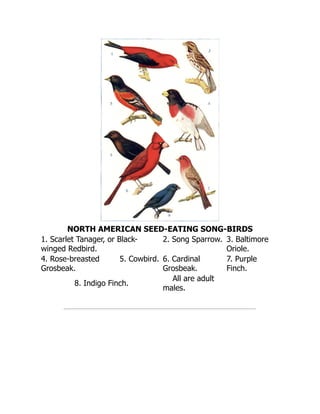
  • 15.
    Chapter 02 -Science - Matter - and Energy Copyright Cengage Learning. Powered by Cognero. Page 11 b. Na+ , H- , Pb, Hg c. Pb, Hg, CO2,NaCl d. Cl- , Na+ , Ca2+ , NO3 - e. NaCl, NO, CO, NaOH ANSWER: d DIFFICULTY: BLOOM’S: Understand REFERENCES: 2.2 What Is Matter and What Happens When It Undergoes Change? QUESTION TYPE: Multiple Choice LEARNING OBJECTIVES: ENVS.MLSP.16.2.2 - Explain what matter is made of and the law governing changes in matter. 38. An acidic solution would have . a. more hydroxide ions than hydrogen ions and a pH greater than 7 b. more hydrogen ions than hydroxide ions and a pH greater than 7 c. more hydroxide ions than hydrogen ions and a pH less than 7 d. more hydroxide ions than hydrogen ions and a pH of 7 e. more hydrogen ions than hydroxide ions and a pH less than 7 ANSWER: e DIFFICULTY: BLOOM’S: Remember REFERENCES: 2.2 What Is Matter and What Happens When It Undergoes Change? QUESTION TYPE: Multiple Choice LEARNING OBJECTIVES: ENVS.MLSP.16.2.2 - Explain what matter is made of and the law governing changes in matter. 39. All organic compounds are characterized by the presence of _. a. carbon b. hydrogen c. oxygen d. nitrogen e. phosphorus ANSWER: a DIFFICULTY: BLOOM’S: Remember REFERENCES: 2.2 What Is Matter and What Happens When It Undergoes Change? QUESTION TYPE: Multiple Choice LEARNING OBJECTIVES: ENVS.MLSP.16.2.2.3 - Distinguish the organic compounds based on their chemical formula. 40. The compound represented by the formula CH4 is . a. calcium carbonate b. carbon dioxide c. methane, a hydrocarbon d. sodium chloride e. glucose, a simple carbohydrate
  • 16.
    Chapter 02 -Science - Matter - and Energy Copyright Cengage Learning. Powered by Cognero. Page 12 ANSWER: c DIFFICULTY: BLOOM’S: Remember REFERENCES: 2.2 What Is Matter and What Happens When It Undergoes Change? QUESTION TYPE: Multiple Choice LEARNING OBJECTIVES: ENVS.MLSP.16.2.2 - Explain what matter is made of and the law governing changes in matter. 41. Which of the following contains all of the others? a. chromosomes b. genes c. cells d. DNA molecules e. cell nuclei ANSWER: c DIFFICULTY: BLOOM’S: Understand REFERENCES: 2.2 What Is Matter and What Happens When It Undergoes Change? QUESTION TYPE: Multiple Choice LEARNING OBJECTIVES: ENVS.MLSP.16.2.2.4 - Describe the relationships among cells, genes, and chromosomes. 42. are the fundamental structural and functional units of life. a. Ions b. Atoms c. Compounds d. Molecules e. Cells ANSWER: e DIFFICULTY: BLOOM’S: Remember REFERENCES: 2.2 What Is Matter and What Happens When It Undergoes Change? QUESTION TYPE: Multiple Choice LEARNING OBJECTIVES: ENVS.MLSP.16.2.2.4 - Describe the relationships among cells, genes, and chromosomes. 43. Simple organic molecules called monomers can be linked together by chemical bonds to form _ . a. chromosomes b. lipids c. polymers d. hydrocarbons e. elements ANSWER: c DIFFICULTY: BLOOM’S: Remember REFERENCES: 2.2 What Is Matter and What Happens When It Undergoes Change? QUESTION TYPE: Multiple Choice LEARNING OBJECTIVES: ENVS.MLSP.16.2.2 - Explain what matter is made of and the law governing changes in matter.
  • 17.
    Chapter 02 -Science - Matter - and Energy Copyright Cengage Learning. Powered by Cognero. Page 13 44. Genes are composed of sequences of . a. ions b. chromosomes c. cells d. nucleotides e. proteins ANSWER: d DIFFICULTY: BLOOM’S: Remember REFERENCES: 2.2 What Is Matter and What Happens When It Undergoes Change? QUESTION TYPE: Multiple Choice LEARNING OBJECTIVES: ENVS.MLSP.16.2.2.4 - Describe the relationships among cells, genes, and chromosomes. 45. The law of conservation of matter states that whenever matter undergoes a physical or chemical change, . a. atoms can be created b. atoms can be destroyed c. atoms cannot be created or destroyed d. atoms can be destroyed if we compost them e. atoms can be created by reactions between organic compounds ANSWER: c DIFFICULTY: BLOOM’S: Remember REFERENCES: 2.2 What Is Matter and What Happens When It Undergoes Change? QUESTION TYPE: Multiple Choice LEARNING OBJECTIVES: ENVS.MLSP.16.2.2.6 - State the law of conservation of matter. 46. If a carbon atom combines with oxygen atoms to form CO2, this would be described as . a. a physical change b. a chemical change c. both a physical and chemical change d. first a physical change, but then it becomes a chemical change e. neither a physical change or a chemical change, but a scientific change ANSWER: b DIFFICULTY: BLOOM’S: Understand REFERENCES: 2.2 What Is Matter and What Happens When It Undergoes Change? QUESTION TYPE: Multiple Choice LEARNING OBJECTIVES: ENVS.MLSP.16.2.2 - Explain what matter is made of and the law governing changes in matter. 47. Energy can be formally defined as the . a. velocity of any moving object b. heat generated by atoms losing electrons c. capacity to do work d. displacement of heat from the sun to the earth
  • 18.
    Chapter 02 -Science - Matter - and Energy Copyright Cengage Learning. Powered by Cognero. Page 14 e. process of moving objects ANSWER: c DIFFICULTY: BLOOM’S: Remember REFERENCES: 2.3 What Is Energy and What Happens When It Undergoes Change? QUESTION TYPE: Multiple Choice LEARNING OBJECTIVES: ENVS.MLSP.16.2.3 - Discuss energy and the laws that govern it. 48. Most forms of energy can be classified as either . a. chemical or physical b. kinetic or mechanical c. potential or mechanical d. chemical or kinetic e. potential or kinetic ANSWER: e DIFFICULTY: BLOOM’S: Remember REFERENCES: 2.3 What Is Energy and What Happens When It Undergoes Change? QUESTION TYPE: Multiple Choice LEARNING OBJECTIVES: ENVS.MLSP.16.2.3.1 - Given its properties, classify the forms of energy into kinetic energy or potential energy. 49. Kinetic energy is energy associated with . a. chemical reactions b. motion c. food d. coal e. elevation differences ANSWER: b DIFFICULTY: BLOOM’S: Remember REFERENCES: 2.3 What Is Energy and What Happens When It Undergoes Change? QUESTION TYPE: Multiple Choice LEARNING OBJECTIVES: ENVS.MLSP.16.2.3.1 - Given its properties, classify the forms of energy into kinetic energy or potential energy. 50. An example of potential energy is . a. electricity flowing through a wire b. the chemical energy in a candy bar c. a bullet fired at high velocity d. the falling of a leaf from a tree e. the flowing of water ANSWER: b DIFFICULTY: BLOOM’S: Understand REFERENCES: 2.3 What Is Energy and What Happens When It Undergoes Change? QUESTION TYPE: Multiple Choice
  • 19.
    Chapter 02 -Science - Matter - and Energy Copyright Cengage Learning. Powered by Cognero. Page 15 LEARNING OBJECTIVES: ENVS.MLSP.16.2.3.1 - Given its properties, classify the forms of energy into kinetic energy or potential energy. 51. Which statement best describes the first law of thermodynamics? a. Atoms cannot be created or destroyed. b. Energy can neither be created nor destroyed. c. Heat is a form of kinetic energy. d. Solar energy is converted into chemical energy in living systems. e. When energy is used up, it’s gone. ANSWER: b DIFFICULTY: BLOOM’S: Remember REFERENCES: 2.3 What Is Energy and What Happens When It Undergoes Change? QUESTION TYPE: Multiple Choice LEARNING OBJECTIVES: ENVS.MLSP.16.2.3.3 - Explain the two scientific laws of thermodynamics. 52. Wind farms are viable options for supplying more of our energy needs in the future because . a. high-speed wind is a form of medium-quality energy b. high-speed wind is a form of high-quality energy c. high-speed wind is a form of low-quality energy d. wind continuously moves at great speeds around the globe e. wind is potential energy ANSWER: b DIFFICULTY: BLOOM’S: Understand REFERENCES: 2.3 What Is Energy and What Happens When It Undergoes Change? QUESTION TYPE: Multiple Choice LEARNING OBJECTIVES: ENVS.MLSP.16.2.3.2 - Contrast high-quality to low-quality energy. 53. The second law of thermodynamics says that whenever energy is converted from one form to another in a physical or chemical change, . a. more energy will be present in the second form b. heat is absorbed c. light is produced d. we end up with lower-quality or less useable energy than we started with e. the second form of energy will always be kinetic ANSWER: d DIFFICULTY: BLOOM’S: Remember REFERENCES: 2.3 What Is Energy and What Happens When It Undergoes Change? QUESTION TYPE: Multiple Choice LEARNING OBJECTIVES: ENVS.MLSP.16.2.3.3 - Explain the two scientific laws of thermodynamics. 54. is a measure of the amount of energy available to do useful work. a. Energy quality b. Energy effectiveness
  • 20.
    Chapter 02 -Science - Matter - and Energy Copyright Cengage Learning. Powered by Cognero. Page 16 c. Energy conservation d. Energy efficiency e. Energy radiation ANSWER: a DIFFICULTY: BLOOM’S: Remember REFERENCES: 2.3 What Is Energy and What Happens When It Undergoes Change? QUESTION TYPE: Multiple Choice LEARNING OBJECTIVES: ENVS.MLSP.16.2.3.2 - Contrast high-quality to low-quality energy. 55. Which of the following energy forms is low-quality? a. the energy released by burning coal b. the heat dispersed in the ocean c. concentrated sunlight d. high-speed wind e. the energy released by burning wood ANSWER: b DIFFICULTY: BLOOM’S: Understand REFERENCES: 2.3 What Is Energy and What Happens When It Undergoes Change? QUESTION TYPE: Multiple Choice LEARNING OBJECTIVES: ENVS.MLSP.16.2.3.2 - Contrast high-quality to low-quality energy. 56. A positive feedback loop . a. increases a change to a system b. always results in a beneficial change to a system c. decreases a change to a system d. never results in a beneficial change to a system e. stabilizes a system ANSWER: a DIFFICULTY: BLOOM’S: Remember REFERENCES: 2.4 What Are Systems and How Do They Respond To Change? QUESTION TYPE: Multiple Choice LEARNING OBJECTIVES: ENVS.MLSP.16.2.3 - Discuss energy and the laws that govern it. 57. A thermostat set to 62 °F turns on the furnace when a house cools below that temperature, and shuts the furnace off when a house warms above that temperature. This is an example of a simple . a. positive feedback loop b. negative feedback loop c. system loop d. tipping point e. thermodynamic loop ANSWER: b DIFFICULTY: BLOOM’S: Understand REFERENCES: 2.4 What Are Systems and How Do They Respond To Change?
  • 21.
    Chapter 02 -Science - Matter - and Energy Copyright Cengage Learning. Powered by Cognero. Page 17 QUESTION TYPE: Multiple Choice LEARNING OBJECTIVES: ENVS.MLSP.16.2.3 - Discuss energy and the laws that govern it. 58. A form of kinetic energy that travels in the form of a wave as a result of changes in electrical and magnetic fields is . a. wind b. electromagnetic radiation c. waterfalls d. electricity e. heat energy ANSWER: b DIFFICULTY: BLOOM’S: Remember REFERENCES: 2.3 What Is Energy and What Happens When It Undergoes Change? QUESTION TYPE: Multiple Choice LEARNING OBJECTIVES: ENVS.MLSP.16.2.3 - Discuss energy and the laws that govern it. 59. Which form of electromagnetic radiation has the shortest wavelength? a. infrared radiation b. radio waves c. visible light d. ultraviolet (UV) radiation e. microwaves ANSWER: d DIFFICULTY: BLOOM’S: Understand REFERENCES: 2.3 What Is Energy and What Happens When It Undergoes Change? QUESTION TYPE: Multiple Choice LEARNING OBJECTIVES: ENVS.MLSP.16.2.3 - Discuss energy and the laws that govern it. 60. Most living systems can be described as having inputs, _, and outputs. a. thermodynamics b. positive transfers c. throughputs d. kinetics e. creations ANSWER: c DIFFICULTY: BLOOM’S: Remember REFERENCES: 2.4 What Are Systems and How Do They Respond To Change? QUESTION TYPE: Multiple Choice LEARNING OBJECTIVES: ENVS.MLSP.16.2.3 - Discuss energy and the laws that govern it. Matching Match items with their appropriate chemical description.
  • 22.
    Chapter 02 -Science - Matter - and Energy Copyright Cengage Learning. Powered by Cognero. Page 18 a. NH4 + b. molecule c. electron d. proton e. neutron f. pH g. Ca h. P i. mass number j. NO3 - k. C6H12O6 DIFFICULTY: BLOOM’S: Remember REFERENCES: 2.2 What Is Matter and What Happens When It Undergoes Change? QUESTION TYPE: Matching LEARNING OBJECTIVES: ENVS.MLSP.16.2.2 - Explain what matter is made of and the law governing changes in matter. ENVS.MLSP.16.2.2.2 - Describe the three building blocks of matter. 61. The chemical symbol for the element calcium ANSWER: g 62. A subatomic particle with no net electrical charge ANSWER: e 63. The nitrate ion ANSWER: j 64. The chemical symbol for the element phosphorus ANSWER: h 65. The total number of protons and neutrons in an atom’s nucleus ANSWER: i 66. Subatomic particle with a positive charge ANSWER: d 67. The ammonium ion ANSWER: a 68. The scale used to measure acidity ANSWER: f 69. The chemical formula for glucose ANSWER: k 70. Subatomic particle with a negative charge
  • 23.
    Chapter 02 -Science - Matter - and Energy Copyright Cengage Learning. Powered by Cognero. Page 19 ANSWER: c 71. Two or more atoms held together by chemical bonds ANSWER: b Completion 72. In a scientific investigation, one of the groups involved in the investigation has a chosen variable changed in a known way. This group is designated as the ANSWER: experimental DIFFICULTY: BLOOM’S: Remember REFERENCES: 2.1 What Do Scientists Do? QUESTION TYPE: Completion group. LEARNING OBJECTIVES: ENVS.MLSP.16.2.1 - Determine how science attempts to answer questions about nature. 73. A well-tested and widely accepted scientific hypothesis or a group of related hypotheses is called a(n) . ANSWER: scientific theory DIFFICULTY: BLOOM’S: Remember REFERENCES: 2.1 What Do Scientists Do? QUESTION TYPE: Completion LEARNING OBJECTIVES: ENVS.MLSP.16.2.1 - Determine how science attempts to answer questions about nature. 74. A possible and testable explanation that needs further investigation is called a(n) . ANSWER: hypothesis DIFFICULTY: BLOOM’S: Remember REFERENCES: 2.1 What Do Scientists Do? QUESTION TYPE: Completion LEARNING OBJECTIVES: ENVS.MLSP.16.2.1 - Determine how science attempts to answer questions about nature. 75. Matter that is near the earth's surface, that is highly concentrated, and that has great potential for use as a resource, is referred to as . ANSWER: high-quality, high quality, high-quality energy, high quality energy DIFFICULTY: BLOOM’S: Remember REFERENCES: 2.2 What Is Matter and What Happens When It Undergoes Change? QUESTION TYPE: Completion LEARNING OBJECTIVES: ENVS.MLSP.16.2.2 - Explain what matter is made of and the law governing changes in matter. 76. A(n) is a type of matter that has a unique set of properties and that cannot be broken down into simpler substances by chemical means. ANSWER: element DIFFICULTY: BLOOM’S: Remember REFERENCES: 2.2 What Is Matter and What Happens When It Undergoes Change? QUESTION TYPE: Completion
  • 24.
    Chapter 02 -Science - Matter - and Energy Copyright Cengage Learning. Powered by Cognero. Page 20 LEARNING OBJECTIVES: ENVS.MLSP.16.2.2 - Explain what matter is made of and the law governing changes in matter. 77. A chemical that is a combination of two or more different elements is called a(n) . ANSWER: compound DIFFICULTY: BLOOM’S: Remember REFERENCES: 2.2 What Is Matter and What Happens When It Undergoes Change? QUESTION TYPE: Completion LEARNING OBJECTIVES: ENVS.MLSP.16.2.2 - Explain what matter is made of and the law governing changes in matter. 78. An atom or group of atoms with one or more net positive or negative charges is called a(n) . ANSWER: ion DIFFICULTY: BLOOM’S: Remember REFERENCES: 2.2 What Is Matter and What Happens When It Undergoes Change? QUESTION TYPE: Completion LEARNING OBJECTIVES: ENVS.MLSP.16.2.2 - Explain what matter is made of and the law governing changes in matter. 79. The pH of a solution is a measure of solution. ANSWER: hydrogen; hydroxide hydroxide; hydrogen DIFFICULTY: Moderate QUESTION TYPE: Completion ions and ions in that 80. The ion, studied by Bormann and Likens, is an essential nutrient for plant growth. ANSWER: nitrate DIFFICULTY: BLOOM’S: Remember REFERENCES: 2.2 What Is Matter and What Happens When It Undergoes Change? QUESTION TYPE: Completion LEARNING OBJECTIVES: ENVS.MLSP.16.2.2 - Explain what matter is made of and the law governing changes in matter. 81. A simple carbohydrate that plants and animals use to obtain energy is _ . ANSWER: glucose DIFFICULTY: BLOOM’S: Remember REFERENCES: 2.2 What Is Matter and What Happens When It Undergoes Change? QUESTION TYPE: Completion LEARNING OBJECTIVES: ENVS.MLSP.16.2.2 - Explain what matter is made of and the law governing changes in matter. 82. occurs when two isotopes of light elements are forced together at extremely high temperatures until they fuse to form a heavier nucleus.
  • 25.
    Chapter 02 -Science - Matter - and Energy Copyright Cengage Learning. Powered by Cognero. Page 21 ANSWER: Nuclear fusion DIFFICULTY: BLOOM’S: Remember REFERENCES: 2.2 What Is Matter and What Happens When It Undergoes Change? QUESTION TYPE: Completion LEARNING OBJECTIVES: ENVS.MLSP.16.2.2 - Explain what matter is made of and the law governing changes in matter. 83. occurs when the nuclei of certain isotopes with large mass numbers are split apart into lighter nuclei and release energy when struck by a neutron. ANSWER: Nuclear fission DIFFICULTY: BLOOM’S: Remember REFERENCES: 2.2 What Is Matter and What Happens When It Undergoes Change? QUESTION TYPE: Completion LEARNING OBJECTIVES: ENVS.MLSP.16.2.2 - Explain what matter is made of and the law governing changes in matter. 84. Flowing water is an example of energy. ANSWER: kinetic DIFFICULTY: BLOOM’S: Remember REFERENCES: 2.3 What Is Energy and What Happens When It Undergoes Change? QUESTION TYPE: Completion LEARNING OBJECTIVES: ENVS.MLSP.16.2.3.1 - Given its properties, classify the forms of energy into kinetic energy or potential energy. 85. Organic compounds always contain ANSWER: carbon DIFFICULTY: BLOOM’S: Remember atoms. REFERENCES: 2.3 What Is Energy and What Happens When It Undergoes Change? QUESTION TYPE: Completion LEARNING OBJECTIVES: ENVS.MLSP.16.2.2.3 - Distinguish the organic compounds based on their chemical formula. 86. Within some DNA molecules are certain sequences of nucleotides called ANSWER: genes DIFFICULTY: BLOOM’S: Remember REFERENCES: 2.2 What Is Matter and What Happens When It Undergoes Change? QUESTION TYPE: Completion LEARNING OBJECTIVES: ENVS.MLSP.16.2.2.4 - Describe the relationships among cells, genes, and chromosomes. 87. Macromolecules formed from a number of monomers are called . ANSWER: polymers DIFFICULTY: BLOOM’S: Remember REFERENCES: 2.2 What Is Matter and What Happens When It Undergoes Change? QUESTION TYPE: Completion LEARNING OBJECTIVES: ENVS.MLSP.16. 2.2.2 - Describe the three building blocks of matter.
  • 26.
    Chapter 02 -Science - Matter - and Energy Copyright Cengage Learning. Powered by Cognero. Page 22 88. The law of of matter states that whenever matter undergoes a physical or chemical change, no atoms are created or destroyed. ANSWER: conservation DIFFICULTY: BLOOM’S: Remember REFERENCES: 2.2 What Is Matter and What Happens When It Undergoes Change? QUESTION TYPE: Completion LEARNING OBJECTIVES: ENVS.MLSP.16.2.2.6 - State the law of conservation of matter. 89. A(n) is a set of components that function and interact in some regular way. ANSWER: system DIFFICULTY: BLOOM’S: Remember REFERENCES: 2.4 What Are Systems and How Do They Respond To Change? QUESTION TYPE: Completion LEARNING OBJECTIVES: ENVS.MLSP.16.2.4 - Describe how various systems respond to change. Subjective Short Answer 90. Give an example of a way you can convert potential energy into kinetic energy. ANSWER: Sample answers: · Eat food to keep body working. · Drop an object. · Burn wood for heat. DIFFICULTY: BLOOM’S: Apply REFERENCES: 2.3 What Is Energy and What Happens When It Undergoes Change? QUESTION TYPE: Subjective Short Answer LEARNING OBJECTIVES: ENVS.MLSP.16.2.3.1 - Given its properties, classify the forms of energy into kinetic energy or potential energy. 91. What does it mean to say that scientific knowledge advances in a “self-correcting way”? ANSWER: Scientists continually question and check the data and hypotheses of their peers, such that errors are usually uncovered and corrected. DIFFICULTY: BLOOM’S: Understand REFERENCES: 2.1 What Do Scientists Do? QUESTION TYPE: Subjective Short Answer LEARNING OBJECTIVES: ENVS.MLSP.16.2.1 - Determine how science attempts to answer questions about nature. 92. Give an example of a positive feedback loop. ANSWER: Examples could include: Hubbard Brook experiments, where removing vegetation from a stream valley caused soil erosion and losses of nutrients, which caused more vegetation to die. A stock market crash, in which falling stock values cause investors to sell, which lowers values further. DIFFICULTY: BLOOM’S: Apply REFERENCES: 2.4 What Are Systems and How Do They Respond To Change? QUESTION TYPE: Subjective Short Answer
  • 27.
    Chapter 02 -Science - Matter - and Energy Copyright Cengage Learning. Powered by Cognero. Page 23 LEARNING OBJECTIVES: ENVS.MLSP.16.2.4 - Describe how various systems respond to change. 93. What are the physical states and chemical forms of matter? ANSWER: Matter has three physical states: solid, liquid and gas. It has two chemical forms: elements and compounds. DIFFICULTY: BLOOM’S: Understand REFERENCES: 2.2 What Is Matter and What Happens When It Undergoes Change? QUESTION TYPE: Subjective Short Answer LEARNING OBJECTIVES: ENVS.MLSP.16.2.2 - Explain what matter is made of and the law governing changes in matter. Essay 94. Explain why the Bormann-Likens scientific investigation of clear-cutting forest watersheds is considered reliable science. ANSWER: It has been subjected to peer review, and other scientists have repeated the study and produced similar results. Reliable science consists of data, hypotheses, models, theories, and laws that are widely accepted by all or most of the scientists who are considered experts in the field under study. DIFFICULTY: BLOOM’S: Apply REFERENCES: 2.1 What Do Scientists Do? QUESTION TYPE: Essay LEARNING OBJECTIVES: ENVS.MLSP.16.2.1.5 - Differentiate among tentative, reliable, and unreliable science. 95. List an example of each of the following terms: element, compound, ion, organic compound, simple carbohydrate. ANSWER: Possible answers: Element — carbon Compound — carbon dioxide Ion — nitrate ion Organic compound — hydrocarbons Simple carbohydrate — glucose DIFFICULTY: BLOOM’S: Apply REFERENCES: 2.2 What Is Matter and What Happens When It Undergoes Change? QUESTION TYPE: Essay LEARNING OBJECTIVES: ENVS.MLSP.16.2.2 - Explain what matter is made of and the law governing changes in matter. 96. Explain how genes, traits, and chromosomes are related. ANSWER: Traits, or characteristics, are encoded in units of genetic information called genes. Chromosomes are long strings of thousands of genes present in the nucleus of a cell. DIFFICULTY: BLOOM’S: Understand REFERENCES: 2.2 What Is Matter and What Happens When It Undergoes Change? QUESTION TYPE: Essay LEARNING OBJECTIVES: ENVS.MLSP.16.2.2.4 - Describe the relationships among cells, genes, and chromosomes.
  • 28.
    Chapter 02 -Science - Matter - and Energy Copyright Cengage Learning. Powered by Cognero. Page 24 97. Why do scientists not talk about “proof” when discussing scientific research? ANSWER: Scientists cannot prove or disprove anything absolutely, because there is always some degree of uncertainty in scientific measurements, observations, and models. DIFFICULTY: BLOOM’S: Understand REFERENCES: 2.1 What Do Scientists Do? QUESTION TYPE: Essay LEARNING OBJECTIVES: ENVS.MLSP.16.2.1 - Determine how science attempts to answer questions about nature. 98. Explain why it is incorrect to say that scientific theories are unreliable because they are not scientific laws. ANSWER: Scientific laws are descriptions of what we find happening repeatedly and in the same way in nature, such as the law of gravity. A scientific theory is a well-tested and widely accepted scientific hypothesis or group of related hypotheses. Theories cannot become laws. DIFFICULTY: BLOOM’S: Understand REFERENCES: 2.1 What Do Scientists Do? QUESTION TYPE: Essay LEARNING OBJECTIVES: ENVS.MLSP.16.2.1.4 - Distinguish between scientific theories and laws. 99. Describe three limitations of science in general (as well as environmental science). ANSWER: 1. Scientists cannot prove or disprove anything absolutely because there is always some degree of uncertainty in scientific measurements, observations and models. 2. Scientists are humans and thus are not totally free of bias about their own results and hypotheses. 3. Many systems in the natural world involve a huge number of variables with complex interactions. DIFFICULTY: BLOOM’S: Understand REFERENCES: 2.1 What Do Scientists Do? QUESTION TYPE: Essay LEARNING OBJECTIVES: ENVS.MLSP.16.2.1.4 - Distinguish between scientific theories and laws.
  • 29.
    Exploring the Varietyof Random Documents with Different Content
  • 30.
    presently they comeup to the surface and pour out the mold which they have swallowed in the form of what we call a worm-cast, after which they go down again and swallow more, and so on until the burrow is sufficiently deep. You will be surprised, we think, to hear how much earth is swallowed by the worms in this way. Just think of it. Every year, in every acre of agricultural land all over the country, worms bring up from below, on an average, and spread over the surface in the form of worm-casts, no less than fourteen tons of earth, or about seven large cartloads! This is why worms are such useful creatures. They are always, as it were, digging and plowing the soil. After a time the earth at the surface becomes exhausted. Nearly all the nourishment is sucked out of it by the roots of the plants. But the worms are always bringing up fresh, rich, unused soil from below, and spreading it over the surface in the form of what farmers call a top-dressing. They are doing, in fact, exactly what we do when we dig our gardens or plow our fields—burying the used-up soil that it may rest, and bringing up fresh mold to take its place. But, besides turning the soil over, they manure it; for almost every night from early spring to late autumn worms are busy dragging down leaves into their burrows. With some of these leaves they line their tunnels, with some they close the entrances, and on some they feed. And most of them decay before very long and turn into leaf-mold, which is just about the very best manure that there is. So you see, the worms do not merely turn the soil over, they enrich it as well, and help very largely indeed to keep it in such a condition that plants can continue to grow in it. The Lugworm The similar lugworm lives in sandy mud on the sea-shore; and when the tide is out you may often see its casts in thousands. It is very largely used by fishermen as bait. When it is carefully washed it is really quite a handsome creature, for sometimes it is deep crimson
  • 31.
    in color, andsometimes dark green, while on its back are twenty-six little scarlet tufts, arranged in pairs, which are really the gills by which the worm breathes. The burrows of the lugworm are not quite like those of the earthworm, for as its tunnels through the sand it pours out a kind of glue-like liquid, which very soon hardens and lines the walls, so as to form a kind of tube and prevent the sides from falling in. The Terebella This worm forms very much stronger tubes. It is common on many parts of our coasts. But it is not very easily found, for at the slightest alarm it retreats to the very bottom of its burrow, which nearly always runs under large stones and rocks. The terebella makes its tube by means of the little feelers, or tentacles, which spring from the front part of its body. These have a most wonderful power of grasp, and one after another little grains of sand are seized by them, and carefully arranged in position. And when the tube is quite finished, the animal constructs a little tuft of sandy threads, so to speak, round the entrance, which you may often see in the pools left among the rocks by the retreating tide. The Sea-Mouse Looking far more like a hairy slug than a worm, the sea-mouse also belongs to the class of the annelids. You can easily find this creature by hunting in muddy pools among the rocks just above low- water mark; and most likely you will consider it as one of the dingiest and most unattractive-looking animals that you have ever seen. But if you rinse it two or three times over in clean water till every atom of mud has been washed out of its bristly coat, you may change your opinion. For now you will see all the colors of the rainbow playing over it—crimson, purple, orange, blue, and vivid green—just as if every hair were a prism. It would be difficult, indeed, to find any creature more beautiful in the waters of the sea.
  • 32.
    This bristly coatis really a kind of filter, which strains out the mud from the water that passes to the gills. Leeches Leeches, too, are annelids, living in fresh water instead of salt water. They are famous for their blood-sucking habits, and when we examine their mouths through a microscope we find that they are provided with three sets of very small saw-like teeth, which are set in the form of a triangle. When a leech wants to suck the blood of an animal, it fastens itself to the skin of its victim by means of its sucker-like lips, and then saws out a tiny triangular piece of skin. That is why it is so difficult to stop the bleeding after a leech has bitten one. An actual hole is left in the skin, which does not heal over for some little time. And a great deal of blood is generally taken by the leech itself, which will go on sucking away until its body is stretched out to at least double its former size. That is rather a big meal to take, isn't it? But then such meals come very seldom. Indeed, when a leech has once gorged itself thoroughly with blood, it will often take no more food at all for a whole year afterward! Leeches lay their eggs in little masses, called cocoons, which they place in the clay-banks of the pools in which they live. In each of these cocoons there are from six to sixteen eggs. We now come to the last great class of animals about which we shall be able to tell you—that of the cœlenterates. It contains three most interesting groups of creatures. Jellyfishes You may have seen plenty of jellyfishes if at any time you have been staying at the seaside, for they are often flung up on the beach by the retreating tide. But if you were to go and look for them two or three hours after seeing them, on a bright sunny day, you would find that they had disappeared. All that would be left of them would be a number of ring-like marks in the sand, with just a few threads
  • 33.
    of animal matterin the middle of each. The reason would be that they had evaporated! That sounds rather strange, doesn't it? But the fact is that the greater part of the body of a jellyfish is nothing but water! It is quite true that if you cut it in half the water does not run away. But then that is equally true of a cucumber; and cucumbers, too, are made almost entirely of water. The reason is the same in both cases. The water is contained in a very large number of tiny cells; and when you cut either the animal or the vegetable across, only a few of these cells are divided, and only a small quantity of the water escapes. Round the edge of the disk of a jellyfish which has just been flung up by the waves you will find a number of long, slender threads. These are its fishing-lines, with which it captures its prey, and they are made in a very curious manner. All the way along they are set with a double row of very tiny cells, in each of which is coiled up an extremely sharp and slender dart. These cells are so formed that at the very slightest touch they fly open, and the little darts spring out; and, besides this, the darts are poisoned. So as soon as any small creature swims up against these threads a number of the venomed darts bury themselves in its body, and the poison acts so quickly that in a very few seconds it is dead. Then other threads come closing in all round it, and in a very short time it is forced into the mouth and swallowed. Some jellyfishes are so poisonous that they are most dangerous even to man. Only one of these, however, is found in the North Atlantic, almost all the jellyfishes that one finds lying about on the beach being perfectly harmless. But if, when you are bathing, you see a yellowish-brown jellyfish about as big as a soup-plate swimming near you in the water, be sure to get out of its way as fast as you possibly can; for if its threads should touch any part of your body, you are almost sure to be very badly stung. There is very little doubt, indeed, that many swimmers have been killed by these creatures; while thousands of unwary bathers have been laid up for days, or even weeks, from the effects of their poison.
  • 34.
    Sea-Anemones What beautiful creaturesare these—just like flowers growing under the sea! Some are like dahlias, some like chrysanthemums, and some like daisies, of all shades of crimson, and purple, and orange, and green, and it is very hard to believe that they are really living animals. The tentacles of these creatures, which look so like the petals of flowers, are set with little cells containing poisoned darts, just like the fishing-threads of the jellyfishes. They can be spread out or drawn back into the body at will, and when they have all been withdrawn the anemone seems to be nothing more than a shapeless lump of colored jelly. Anemones spend the greater part of their lives clinging to the surface of a rock at the bottom of the water, the broad base of the body acting just like a big sucker. They can crawl about, however, at will, and sometimes they will rise to the surface of the sea, turn upside down, hollow their bodies into the form of little boats, and then float away, perhaps for quite a long distance. But few sea-anemones are seen on our eastern coast, because, except in the cool north, there are few rocks. On the warmer and rockier shores of California and northward, however, these lovely creatures occur in great variety. Corals Last upon our list come those most wonderful little creatures which are known as corals. These are often called coral insects, but that is a great mistake. For they have nothing to do with insects at all, and are as different from them in every way as they can possibly be. They are properly called polyps, and we can best describe them, perhaps as very small sea-anemones. But they have one property which the anemones do not possess, namely, the power of extracting lime out of the sea- water and building it up round themselves in the form of coral.
  • 35.
    These creatures maybe roughly divided into two groups, the one consisting of the simple corals, which only live together in very small numbers, and the other of the reef-builders, which live in vast colonies, and build up masses of coral of enormous size. The latter are by far the more interesting, and the way in which they build up immense banks of coral is very wonderful indeed. Remember, first of all, that these animals multiply in two different ways—sometimes by eggs, and sometimes by little buds, so to speak, which grow out of the body of the parent. The polyps which hatch out from eggs swim about for some little time quite freely. But after a few days they fasten themselves down to the surface of a submerged rock, and after that they never move again. Other polyps soon come and settle down by them, and before very long there will be thousands upon thousands of the little animals all growing, as it were, close together, and all gradually building up coral underneath and round the margins of their bodies. When they reach their full size they begin to multiply by "budding." Baby polyps sprout out all over their bodies, and these, instead of swimming about for a few days like those which are hatched from eggs, remain fixed where they are for the whole of their lives. Then they, in their turn, begin to deposit coral, and as they have nowhere else to put it they place it on the bodies of their parents, which before very long are completely covered in. Now, you see, there is a second layer of coral on the top of the first. Then in due course of time a third layer is formed upon the second, and a fourth layer upon the third, each generation being built in by the one that comes after it, till at last the coral bank rises above the surface of the water. Then the work has to stop; for these little creatures cannot live unless the waves can constantly break over them. But although the bank cannot be raised higher it can still be extended on all sides; and so the little polyps go working on, year after year, till at last the results of their labor are almost too wonderful to realize. Coral Banks
  • 36.
    These coral bankstake three different forms. First, there are the fringing reefs. These are great banks of coral surrounding the shores of a tropical island, or running for long distances on the coasts of the mainland. The island of Mauritius, for example, is entirely surrounded by a fringing reef. These reefs often spread out for miles into the sea, and they are only broken here and there by narrow passages, where some river or stream is flowing out. For the polyps cannot live in fresh water. Next, there are barrier reefs. These are great walls of coral at a distance from the shore, with deep water between the two. For the polyps are unable to work at a greater depth than about thirty fathoms, or one hundred and eighty feet, below the surface; and it often happens that while there is deep water close to the shores of a tropical island, there is shallow water farther out. In such a case the polyps have to build out at sea, instead of close into the land, and there is a kind of moat between the coral bank and the shore. In this case the bank is called a barrier reef, and sometimes it is of enormous size. The Great Barrier Reef, for instance, runs for no less than 1250 miles along the northeast coast of Australia. Then, thirdly, there are coral islands, or atolls. There are thousands of these wonderful islands in the Pacific and the Indian oceans, and others are still being slowly pushed up out of the sea. They always take the form of more or less circular rings, in the center of which is a lake of sea-water called a lagoon. The coral bank of which they consist is seldom more than a few hundred feet wide, but sometimes the islands are very large indeed. The biggest of all is ninety miles long and sixty miles broad, while several others are not very much smaller. Soon after they rise to the surface of the sea a kind of soil is deposited upon them, made up partly of powdered coral, ground up by the action of the waves, and partly of decaying vegetable matter which has been flung up on them. Then sea-birds bring mud upon their feet from the mainland, or from another island at a distance, and leave some of it behind them when they settle down to rest; and in that mud are seeds of plants, which soon begin to sprout and grow. So in a very few years the island is
  • 37.
    covered with lowvegetation. Then one day, perhaps, a floating cocoanut is flung up, and that, too, takes root and grows, so that in course of time there is a palm-tree. Other palm-trees, of course, follow; and the result is that the first glimpse which a traveler gets of a coral island is nearly always that of a row of palm-trees upon the horizon. The simple corals live in almost all parts of the ocean. Some of them are occasionally dredged up off our coasts, and can live in very cold water. But the reef-builders are only found in warm seas, and are never found working far outside the boundaries of the tropics. How wonderful it seems that tiny creatures such as these polyps, which really do not appear to be much more than little lumps of living jelly, should be able to build up these vast masses of coral from out of the depths of the sea! One cannot help wondering what the results of their work will be if the world should last for a few thousand years longer. It would really seem that by that time the tropical seas will be choked up with coral islands, and the lagoons inside them will be filled up with coral too; so that not merely islands, but continents, will have been raised from the ocean by some of the smallest and weakest and most insignificant of all living animals!
  • 38.
    NORTH AMERICAN SEED-EATINGSONG-BIRDS 1. Scarlet Tanager, or Black- winged Redbird. 2. Song Sparrow. 3. Baltimore Oriole. 4. Rose-breasted Grosbeak. 5. Cowbird. 6. Cardinal Grosbeak. 7. Purple Finch. 8. Indigo Finch. All are adult males.
  • 39.
    WALKS WITH ANATURALIST Suggestions for Teacher and Pupil in Nature Study I SPRING Let us suppose that we are taking four country walks together, and trying to use, in actual experience in the field, the information we have been reading. The first shall be in the spring, the second in summer, the third when autumn leaves are falling, and the last in midwinter. We will go along the field-path, follow the lane through the woods to the creek, then down the stream to the road, and so homeward. There is plenty to be seen, this bright spring morning. The birds are very busy, of course, for they have nests to build, and eggs to lay, and little ones to take care of; so they are hard at work from the very first thing in the morning till the very last thing at night. Almost every sparrow that we see has a feather or a piece of straw in its beak, and the robin which has just flown out of that tree with a terrified squall has already finished building, and was most likely sitting upon her eggs. Yes, there is her nest, you see, right on the lowest limb, with four greenish blue eggs. See that catbird, all lead-color, with a black cap. See her dodge into that bush just beyond us. It is just the place for her nest; and, sure enough, here it is. It is a rough affair, but she mews as pitifully at us as if it were the finest of homes, and half a dozen other birds are already screaming their sympathy. Let us just look at the eggs, and remember that they are a deep polished green, and then walk
  • 40.
    on, for thepoor mother is very unhappy. We have no use for the eggs, and it would be shameful to rob her; and, besides, we should thus destroy the coming lives of four catbirds, who will be too useful as insect-hunters in our gardens to be wasted. This path is dusty, and we notice a great many pinhole doors of the little black ants. The ants are running in and out of them, and if we should carefully dig up the ground we would find a labyrinth of narrow passages, here and there widening into chambers, and so learn that these tiny holes are entrances to an ant-city whose streets are all subways. Here are some larger ants—three times as big—a regular procession of them going and coming out from under that half- buried stone, winding through the grass, and then trotting up and down this tree-trunk. A lot of them go out along that low limb. Let us climb upon the fence, and try to see what it is that attracts them. Ah! This is the secret. Clustered thickly on the bark are hundreds of minute green creatures, smaller than pinheads. They are busily sucking the sap from the bark, and seem to interest the ants greatly, for they are stroking these bark-lice (aphids) with their feelers, and if we had a magnifying-glass we could see that they were licking up a honey-like liquid which oozes out of two short tubes on the back of each aphid. A little distance beyond the ant's apple-tree a young maple stretches one of its branches out to the sunlight just above our heads, where the sharp eyes which young naturalists must keep wide open when they walk abroad will notice a bird's nest hung under the shelter of its broad outermost leaves. It is one of the loveliest nests in the world. A slim, graceful, olive-green little bird glides out from beneath the maple-leaves as we approach, perches near by and watches us silently. Though she does not mew and scream as did the catbird, she is just as anxious, you may be sure. Be easy, dear little vireo—for we know your name—we shall not ruin your home. Let us pull the branch gently down a little. Now we can see that the nest is a round hammock, woven of grapevine bark and spider-web, and hung by its edges. It seems too fragile to hold the
  • 41.
    weight of themother, slight as she is; and in it are three white eggs with a circle of pink and purple dots around their larger ends. But here is also a fourth egg, much larger, grayish white, and speckled all over with brown. That is the egg of the cowbird, a sort of purple, brown-headed blackbird which you may almost always see in pastures where there are cattle. The cowbirds, like the European cuckoos, never build any nests of their own, but put their eggs into those of other birds, and leave them to be hatched. And they are very fond of choosing the nest of a vireo. One would think that the mother would notice at once that a strange egg had been placed in her nest, and would throw it out. But she never seems to do so, but sits on the cowbird egg as well as on her own, so that in course of time she hatches out three or four little vireos and one young cowbird. Then what do you think the stranger does? Why, as soon as the mother vireo goes out to look for caterpillars for food, it begins to wriggle underneath the other little birds, and soon shoves them out of the nest, one after another. Still more strange is it, that when the vireo comes back she never seems to care that her own little ones are all lying dead on the ground below, but gives all the food that they would have eaten to the cowbird. And the greedy cowbird eats it all! Until it is fledged she feeds it in this way, and takes the greatest care of it, and even after it has left the nest and is able to fly about she will come and put caterpillars into its beak. Look at the trunk of this tree. Why has so much of the bark fallen away from the wood? And what is this curious pattern engraved, as it were, upon the wood—a broad groove running downward, and a number of smaller grooves branching out from this on each side? Ah! that is the work of a very odd little beetle, with a black head and reddish-brown wing-cases. About eighteen months ago, probably, a mother beetle came flying along, settled on the tree, and bored a hole through the bark, just big enough for her to pass through. Then she began to burrow downward between the bark and the wood, cutting the central groove which you see in the pattern. As she did so she kept on laying eggs, first on one side of
  • 42.
    the groove andthen on the other, in the short branch-tunnels, which she cut out as she went along. In this way she laid, perhaps, eighty or ninety eggs altogether. When the last had been laid she turned round, climbed up her burrow again, passed into the hole by which she came in, and—died in it! And by so doing she blocked up her burrow with her dead body, and so prevented centipedes and other hungry creatures from getting in and eating up her eggs. Early in the following spring all the eggs hatched, and out came a number of hungry little grubs with hard, horny heads and strong, sharp little jaws. Every one of these grubs at once began to make a burrow of its own, boring away at right angles to the groove made by the mother beetle, and cutting away the fibers which bind the bark to the wood. The consequence was, of course, that by the time they were fully grown quite a big piece of bark had been cut away. And very likely if we were to come and look at the tree again in two years' time we should find that the whole of the trunk had been completely stripped. "Then these little beetles are very mischievous?" Oh, no, they are not; for they never touch a healthy tree. They only attack those trees which are sickly or diseased. Here we are on the banks of the stream. Let us make our way home by the path which lies beside it. Ah! Did you see that flash of blue and white and orange that went darting by, almost like a streak of many-colored light, sounding a loud rattling call as he flew? It was a kingfisher, and if we stand quite still for a minute or two, without moving so much as a finger, we shall very likely see him again. Yes, there he is, sitting on that branch overhanging the stream, and peering down into the water beneath. He is watching for little fishes, upon which he feeds. There, he has caught sight of one, and down he drops into the water, splashes about for a moment or two, and then rises with a minnow in his beak. Back he flies to his perch, slaps the little fish against the branch once or twice to kill it, jerks it up into the air, catches it head foremost as it falls, and then swallows it with one big gulp. A
  • 43.
    moment later heis peering down into the water again on the lookout for another. That hole in the face of the steep bank across the stream is the doorway of the kingfisher's home. If we could get there, and should try to dig it, we would find it a hard task; for from that round door a tunnel runs into the ground probably six or eight feet, and ends in a chamber where lie half a dozen pure white eggs, resting upon the bones of fishes and scraps of every sort, which make a very ill- smelling place for the young kingfishers to be born in; but they do not mind that. The butterfly that has just floated by is a small tortoise-shell, and it has lived through the winter, which kills nearly all of the butterfly tribe. That is why its wings are faded and chipped, for it had six or eight weeks of active life before it hid itself away, last of all, in a hollow tree, and entered upon a six-months' slumber. Sometimes, on a warmer day than usual, these and certain other butterflies will be roused up, and will flutter about in the sunshine, so that now and then you may capture a tortoise-shell even in the Christmas holidays. The warm May sunshine is enticing out many a minute insect— gnats and flies especially. Dancing companies of small sulphur yellow and other companies of blue butterflies whirl about one another over the rapidly growing grass. Have you noticed among the May flowers how many are yellow? There are dandelions, and yellow violets, and the modest fivefinger low in the herbage, while above them tower great tufts of wild mustard and indigo, the buttercups, the marsh-marigold, and many another. The frogs and toads are less noisy than a month ago, and one sees fewer masses and strings of eggs in the roadside ditches than in April; but in their place the pools swarm with tadpoles, and it will be well worth your while to keep watch of their growth. Try to find out what they eat, and what eats them. Observe when the tail begins to disappear, and how it is lost; when the legs begin to
  • 44.
    appear, and whichpair first shows itself. You may learn a lot of interesting facts about frogs and toads before the summer is done, if you are diligent. In this stream are a few turtles. Can you tell when and where they lay their eggs? Keep careful watch of the little sandy beaches, and perhaps you may see one digging a hole in which to bury her set of sixty or so, leaving the sun to supply a better warmth than she could give them. May is a month of activity for snakes. They have thrown off the stiffness and drowsiness of their long winter torpidity, and, grown thin after five months of fasting, are running about in search of food. Let the frogs and toads, the beetles and young ground-sparrows and mice—also weak from their winter trials—take heed, for the swift blacksnake or sly garter, or rapacious water-snake will seize them before they have time to squeal! The water in the stream is still cool, but the fishes are struggling up the current, pickerel are spawning in the weedy shallows, and among the pebbles of the bottom a host of young creatures are beginning to grow vigorous. None among them is more active than the larval caddis-flies, or case-worms, as anglers call them. Here is a caddis-fly now, its gauzy wings folded tentwise over its back. All its earlier life was spent in the water, and when it was a grub it lived in a very curious case, which it made by cutting up a rush into short lengths, and sticking them together by means of a kind of natural glue. When once a caddis-grub has made one of these cases it never gets out of it again, but drags it about wherever it goes. And if you try to pull it out you will find that you cannot do so without killing it. For at the end of its body it has a pair of strong little pincers, with which it holds on so firmly and so doggedly to its case that you might actually pull it in two without forcing it to loose its hold. There are different kinds of caddis-flies, however, and the grub of one kind fastens grains of sand together to make a case, while that
  • 45.
    of another stickstwo dead leaves face to face, and lives between them. It would be an interesting task for a boy or girl to see how many different kinds of caddis-flies, judging by their cases, lived in the stream, and to keep them alive in an aquarium, and watch their behavior and changes. II SUMMER A walk in midsummer is a stroll through what seems a quiet world compared with the noise and brightness of May. Then every leaf was green and crisp, every bird in full song, and the world seemed to have an air of gay youth, like a vigorous boy or girl full of eagerness and activity. Now as July draws toward its end the eagerness has subsided and the year, like a lad grown a little older and more serious, has settled down to regular work. Had our walk been taken before breakfast, we should have heard no end of birds singing, it is true; but about the time the dew dried from the grass most of them ceased their music. One reason, besides the noonday heat, is that they are too busy to sing, for the husband and father—and he is the singer of the family—must now help his mate feed her young. We fear, however, he is not a very good provider after the fledglings quit the nest, leaving most of their support and schooling to the mother. At this season one may often come upon and watch a little family group of this kind, and perhaps we may do so. Meanwhile let us sit down for a moment on this grassy bank—not too near that fence-post, for do you not see twined about it that vine with the reddish hairy stem, and the shining leaves in groups of threes? That is the poison-ivy, which may cause an itching rash to break out upon your skin if you touch it. You must learn to recognize and avoid this "ivy"—which is not a true ivy, but a kind of climbing
  • 46.
    sumach—before you gopoking around in the fields, or you will be sorry. Do you notice the delicious beeswax-like odor in the air? That comes from the big yellow branches of blossoms on another and perfectly harmless kind of sumach—that scraggly sort of bush just beyond the fence. See how the bees are humming about it—some of them honey- bees from a farmer's hive, others big bumblebees and small burrowing kinds. All are in search of the minute drops of sweet liquid which each of the tiny flowers in the blossom-head contains, and which turns into honey after it has been carried a little while in the insect's crop, or lower part of the throat, where it lodges. Then it is suitable to be really swallowed, or to be coughed up and fed to the young bees at home, or stored away in the cells of such bees as store up honey, for many wild bees do not make such stores. Besides its nectar, however, every flower contains a quantity of small particles, like dust, which are produced in the heads of the little thread-like interior parts of the blossom called the stamens; and in order that the flower shall turn to a seed it is needful that some grains of this dust, or pollen, shall fall upon another hollow part called the pistil, and so pass down into its base. It is much better that the pollen of one flower shall get into the pistil of another than into its own. The wind manages this to some extent—especially for the grasses—by shaking or blowing the loose pollen out of one flower and into another. But the bees help this process greatly, and so may be said to pay for the sweets they use. Watch this one buzzing in front of that clump of jewelweed. Suddenly the loud humming ceases, and the bee crowds herself into the hanging, bell-like blossom, searching for the nectar. Now she is backing slowly out, and you may see how her furry body is half-powdered with yellow dust. That is pollen; and when she dives into another "jewel" she will brush some of it off against the pistil there, which is right in her way, and is very glad to accept her gift. So the bees and other insects humming about the flowers in this hot sunshine are not only getting their living but
  • 47.
    helping the plantsto keep vigorous and produce lots of healthy seed. Now let us move on. The sky is filled with swallows. There are the fork-tailed ones that make their nests inside the barn; the square-tailed ones that form their curious bottle-shaped nests of mud on the outside, under the eaves; and the purple martins that live in our bird-house in the garden. They are darting and dashing and skimming about in mid-air as though they did not know what it is to be tired; and if only they were a little closer we should see that every one of them has its mouth wide open. The reason is that these birds have very sticky tongues, and that all the time they are in the air they are chasing flying insects, bothersome gnats and mosquitoes among the rest. As soon as one of these insects is touched by the tongue, it sticks to it. Then, without swallowing it, the bird tucks it away in the upper part of its throat, and goes off to hunt for another. After a time it has quite a ball of little bugs packed away in this curious manner, and can carry no more; so it flies off to its nest, and divides them among its little ones. Do you see that small olive-green bird sitting very erect on that fence-post? There—it suddenly springs into the air, flutters up and down for just half a moment, and then returns to the post. It is a flycatcher, and for hours together it will go on catching insects just in that same way. As it alights it tells us its name, calling Phœ-e-be, Phœ-e-be in a sad sort of voice, though there is no reason to think it is sorrowful at all. If we should go down to that bridge over the stream in the valley we would find its solid nest of moss and mud among the stones of one of the piers. The woodland path is not so good a place for birds as are more open spaces; but one hears here the distant cooing of a dove, the chip-chur-r-r shout of the scarlet tanager, as red as fire everywhere except on its black wings and tail, and often the tapping of a woodpecker. There is one at work now on that tall dead stub. If you want to see him you must keep perfectly still, for if he notices that he is watched he begins to think some harm may follow, and either flies away or stops work, scrambling around the trunk and peering
  • 48.
    out from behindit with one eye to see what you mean to do next. See how firmly he clings to the trunk. If you were close enough you could see that two of the large-clawed toes at the end of his short strong legs and feet were straight forward and two straight backward; and that he is also propping himself up by means of his short stiff little tail, which is bent inward, and really serves as a kind of natural camp-stool! Now he is pecking away at the bark with his strong chisel-like beak, and making the chips fly in all directions. Most likely the grub of some burrowing beetle is lying hidden in the wood below, and he is trying to dig it out. But he will not have to dig down to the very bottom of its tunnel, for he has a very long slender tongue with a brush-like tip; and this tip is very sticky. And with this, after he has enlarged the mouth of the burrow, he will lick out the little grub which is lying hidden away within it. Now let us make our way to the path by the side of the stream. What a number of galls there are on these oak-trees—some on the leaves, some hanging down from the twigs in clusters, like currants, and some growing on the twigs themselves! Do you know what causes them? Well, a very tiny fly pricks a hole in a leaf, or a young shoot, by means of a kind of sharp sting at the end of her body, and in that hole she places an egg, together with a very small drop of a peculiar liquid. This liquid has an irritating effect on the leaf, or twig, and causes a swelling to grow; and when this has reached its full size, and become what we call a gall, a little grub hatches out of the egg, and begins to feed upon it. Sometimes there are several grubs in one gall. If we were to cut one of those large red and white "oak- apples" to pieces, probably we should find as many as a dozen, each lying curled up in a hollow which it had eaten out. If a naturalist had to choose some one place in which to carry on his outdoor studies, he could find none better than the course of a small rural river, and a year's work would not exhaust it. Just now, in midsummer, he would be most interested in the nesting of the sunfish and minnows. Let us steal quietly to the brink, where the turf forms a little bank, a foot or so high, to which the bottom slopes
  • 49.
    up in clearsand and gravel, with here and there a clump of bulrushes. Let us lie down and scan this bottom through the clear water rippling gently by, keeping very quiet, so as not to alarm any fishes which may swim near, for they are the very fellows we wish to see. Here comes a little one—a common shiner—no, a golden one— stealing cautiously toward an open space. A much smaller fish—not so big as your little finger—shoots past him and stops as suddenly as if it had run against a wall, then an instant later is off again so swiftly you can hardly see it move. No wonder it is called Johnny Darter! Meanwhile the shiner, a minnow in a scale-armor of burnished gold, moves slowly on. Where is he aiming? Ah! look over there. Do you see that low ring of sand, about as large as a dinner- plate, running about some clear gravel, as though the plate were strewn with small pebbles? That is a nest of a sunfish; and look! did you see the swoop of that gray shadow from the bulrushes? The shiner turned and fled like a bright streak through the water; and now the gray shadow is poised over the dish-like nest, and we see that it is the blue-eared sunfish, or "punkin-seed," as you say the boys call it when they go a-fishing. See how with its breast-fins it fans the gravel among which its eggs are lying. They are so small and transparent that we cannot see them, but they are there, and must be kept clean. So the fish stirs the water and the current sweeps away everything which may have lodged there while the owner was away for a few minutes. But he never goes far, for he must guard his treasures against enemies like the shiner and other fishes, salamanders, water-bugs, and the like, which would eat them if they dared. Butterflies innumerable greet us and dance along the roadside, as if to see us safely home. Many are small and yellow, or white and yellow, with handsomely bordered wings, and they are greatly interested in the clover. Then we see plenty of little blues, very regular in outline, and with them various coppers, distinguished by their orange and brown colors, each with a coppery tinge and set off
  • 50.
    by black markings.The hair-streaks are brown, too, with delicate stripes for ornaments on the lower surface, which are shown neatly when the wings are closed upright above the back. Did you know this was one of the distinctive marks of a butterfly? A moth never holds its wings on high in that fashion. But it is the larger butterflies that first catch the eye, such as the monarch and the viceroy, the fritillaries, fox-red and black, with trimmings of silver; the red admiral, and other anglewings, beautiful in outline as well as in colors; the delicately pretty meadow-browns, and the magnificent swallowtails and mourning-cloaks. Don't you think it would be interesting and delightful to study these exquisite creatures? III AUTUMN It is a bright warm day in October; and once more, as we go for our ramble, everything seems changed. The autumn flowers are blooming, the autumn tints are in the leaves; and again there are different animals, and different birds, and different insects almost everywhere around us. We hardly take ten steps before there is a sudden commotion in a clump of tall grass by the path, and a red-backed mouse leaps almost over our toes and dives down a little hole which otherwise we should not have noticed. Doubtless he carried a mouthful of grass- seeds to add to his granary under ground. All over the country mice and gophers and squirrels are doing the same thing. There's a big gray squirrel, now, scratching a hole in the ground as busily as a terrier who thinks he smells a mole. Suddenly he stops, drops a hickory-nut into the little grave, paws the dirt and leaves over it, pats them down, and canters away. All day he is burying nuts so that when, next winter, the trees are bare, he may dig them up and feed upon their meat. Sometimes he doesn't need to, or forgets, and
  • 51.
    then a treemay spring up. Many a fine hickory or chestnut was planted in this way by squirrels. CHICKADEE AND WHITE-BREASTED NUTHATCH. What is that red squirrel doing under the chestnut-tree by the side of the lane? He is hard at work collecting chestnuts, stuffing his big cheeks with them and carrying them away to hide for use next winter. He seems to realize that although he will sleep in his bed under the stone fence almost the whole time from Thanksgiving to Easter, he will wake up now and then, on warm days, and will feel dreadfully hungry. But then there will be little to be found in the way of food. So he is now gathering nuts and acorns and dry mushrooms, and hiding them away so as to be prepared. Some he puts in a hole in the trunk of a tree, others in crevices in the stone wall; others he takes into his hole underground, where his cousin, the saucy chipmunk, stores all of his savings.
  • 52.
    Notice how thepretty little animal uses his bushy tail as he scampers along a branch. Do you see that he holds it stretched out behind him, and keeps on turning it slightly first to one side and then to the other? The fact is that it helps him to keep his balance. When a man walks upon the tight rope he generally carries in his hands a long pole, which is weighted at each end with lead. Then if he feels that he is losing his balance, he can almost always recover it again by tilting up his pole. The squirrel's tail serves him as a sort of balancing-pole, and by turning it a little bit to one side, or a little bit to the other, he can run along the slenderest branches at full speed without any danger of falling. Everywhere we go we hear the whirring of grasshoppers, the chirping of black crickets, and the shrill declarations of the katydids. A blind man who could not see the scarlet of the maples, the deep crimson and purple of sumachs, the pepperidge and the blackberry thickets, or the golden glow in the birches as the sunlight strikes through them, would know the season of the year by the sounds. How do the insects make their noise—for one can hardly call it singing? That will be a good subject for you to look up in your books. The air is filled with the droning and humming of other insects; how are these sounds produced? We notice the insect-noises more, perhaps, because other animals are so quiet. It is rare to hear the croak of a frog, or the piping of a tree-toad or the note of a bird. What has become of the birds? When we see a few they are in flocks, and seem very intent on traveling somewhere. The truth is they are gathering in companies and journeying away to the south, where winter, with its cold and snow and hunger, cannot follow them. Next spring they will come back again, to spend the summer with us. Only those birds remain which can live upon seeds, or pick up rough fare along the sea-shore. A band of small winged friends are flitting about among the weeds ahead of us. Do you not know them? Look closely. Aren't the canary-like form and black wings familiar? You would say they were goldfinches if they were more yellow, wouldn't you? Now you see that that is what they are, but in an olive
  • 53.
    dress. The factis that all birds molt their feathers twice a year. In spring the new feathers come out in bright colors, and in autumn there worn gay coats are lost, and feathers of duller hue take their place. Thus the brilliant yellow and black goldfinch of summer becomes a quiet Quaker in winter. Such a change is very advantageous to the birds—how, you may study out for yourselves. Butterflies are scarce, too, but these have died, not run away, as the birds are doing. One sees a good many sluggish caterpillars, however; and sharp eyes may begin to find cocoons hanging from the bushes, or tucked into crevices of bark, or plastered against rocks and the boards of old fences. If you were to keep account of all the different kinds you could find, you would soon have a long list; and if you were to learn how to keep them properly and care for the butterflies and moths which will come out of them in the spring, you could start an admirable cabinet. Here is a patch of milkweed. Examine each plant thoroughly because there may be a gift for you hidden among the leaves. You have found "something pretty," you say? What is it like? "Like a green thimble, with rows of gold buttons on it." That is a pretty accurate description; only your thimble is closed at the top, where it hangs by a short thread, and it is heavy and alive, for it is the lovely chrysalis of the milkweed butterfly. Next summer you must learn the appearance of that species, which you can easily do, for it is one of our largest and commonest ones. Where the milkweeds grow you are pretty sure to see also masses of goldenrod, and towering high above them the great, flowering pillars of joepye-weed. Such clumps are good hunting- places for autumnal insects. There gather the soldier-beetles, brilliant in uniforms of yellow and black. They are sometimes so numerous as to bend down the plants by their weight, and are in constant motion, crawling about the blossoms, or flying from spray to spray. Here, too, come locust-boring beetles, black with a line of yellow V's on the back, whose eggs are laid in the soft inner bark of locust-trees; and fat short-winged blister-beetles, or oil-beetles, which leave such a bad odor on the hands when touched. This is
  • 54.
    due to anacrid oil which oozes out of the joints of the beetle's legs when it is handled and thinks itself in danger. It is a protection, for it both smells and tastes so nasty that no bird will ever attempt to eat an oil-beetle. And its body is so very big because it lays such an enormous number of eggs. How many eggs do you think an oil- beetle will lay? Why, something like thirty thousand! She lays them in batches in little holes in the ground, and a few days afterward a tiny little grub hatches out of each egg, and begins to hunt about for some flower that bees are likely to visit. When it finds one, it climbs up the stem, hides among the petals, and waits. Then as soon as a bee settles upon the flower it springs upon her and clings to her hairy body. The bee is very busy collecting nectar and pollen, and the grub is very tiny; so she never seems to notice that the long- legged little creature is clinging to her, and carries it back with her to her nest. Then the grub lets go, and proceeds to eat all the "bee- bread" which the bee had stored up so carefully for her own little ones. How is it that all the trees, bushes, and plants are covered with threads of spider's silk, which often annoys us by getting on our hands or faces? Let us help you to an answer. This is the time of year when spiders are most numerous and most active; and many a spider trails behind it a thread of gossamer wherever it goes, and leaves it there. On many of the plants, bushes, trees, and fences you may see, if you look closely, very small spiders resting. Those little spiders have been taking a journey through the air—a sort of balloon trip. During the summer a number of spiders, all living near one another, had big families—a hundred or more in each. Perhaps you noticed in July and August spiders dragging about large white bundles: they were packets of eggs from which the young hatched. So many coming into the world together made it difficult to find food. So, one by one, the little spiders climbed low bushes or tall plants, and perched themselves on the tips of the topmost leaves. Then each poured out from the end of its body a slender thread of silk, which floated straight up in the warm air rising from the heated ground.
  • 55.
    At last eachlittle spider had seven or eight feet of thread rising up into the air above it. Then suddenly it loosed its hold of the leaf, and mounted into the air at the end of its own thread, higher, and higher, and higher, till it had risen several hundreds of feet into the air. Then it met a gentle breeze traveling slowly overhead, and traveled along with it, mile after mile, still resting on its thread. And when it wanted to come down, all that it had to do was to roll up the thread till there was not quite enough left to support it, and so it came floating gently down to the ground below. Then, having no more use for the thread, it broke loose from it and left it lying like a fallen telegraph wire across the tops of the bushes and fences and other things, where our faces brush against it. What a pretty green fly this is sitting upon the fence, with delicate gauzy wings looking like the most delicate lacework! Yes, that is a lacewing fly. Just notice what wonderful eyes it has. They look like little globes of crimson fire, and it is quite difficult to believe that a tiny lamp is not alight inside the head. This fly lays its eggs in a most curious way. Settling on a twig, she pours out a drop of a kind of thick gum from the end of her body. Then, jerking her body suddenly upward, she draws out this gum into a slender thread, which hardens as soon as it comes into contact with the air; and just as she lets go she fastens an egg to the tip. She then lays another egg in the same manner, and then another, and then another, and so she goes on till she has laid quite a little cluster of eggs—perhaps ninety or a hundred altogether. You would not think that they were eggs if you were to see them. You would be almost sure to think that the little cluster was a tuft of moss. Indeed, for a great many years even botanists thought that these eggs were a kind of moss, and put pictures of them in books of botany accordingly! Look at these odd little black and white spiders. How jerkily they run; never moving more than an inch or so at a time, then stopping to rest, and then generally darting off again in a different direction. They are hunting-spiders, and are so called because they hunt for insects instead of trying to catch them in a web. You may see one of
  • 56.
    these spiders "stalking"a fly very much as a cat creeps up to a bird, and then suddenly springing upon it and leaping into the air with its victim firm in its grip. Slowly the days grow shorter, the rains come more frequently, flowers wither, and the herbage shrivels. Insects die off, the birds one by one disappear quietly, or gather in flocks to journey southward, and the woods grow quiet and gray. IV WINTER As we look out of the window on a landscape of snow, or of half- bare earth, frozen roads, and leafless trees, the world seems lifeless. But one who starts out for a walk, anxious to discover whether all nature is really dead, will soon find that it is very much alive, though much of it is buried in slumber. Let us test it. As we take the well-accustomed path we cannot but contrast the bareness and silence with the activity and color and cheerful noise about us when a few weeks ago we strolled this way. The thought saddens and discourages us a little, when suddenly there comes to our ears "Chick-chick-a-dee-dee! Saucy note, Out of sound heart and merry throat, As if it said: 'Good day, good sir! Fine afternoon, old passenger! Happy to meet you in these places Where January brings few faces.'" There is the singer—half a dozen of them in fact—fluffy little gray, black-capped birds not much bigger than a man's thumb, dodging busily about the limbs of that old apple-tree, swinging with desperate clutch at the tip of a twig, hanging head downward to get
  • 57.
    at a morselon the under side of the bough, and chattering all the time as though cold weather were no hardship at all. What do they find to eat? Keep your eyes on one, and see if you cannot guess. He is pecking here and there at the bark, and swallowing something so minute we cannot recognize it. But do you not remember how, last summer, we watched the procession of ants climbing this very tree to get honey from a "herd" of aphids on the branches? Those bark-lice are still there, each hidden under a sort of scale, like a winter blanket; and it is these that the chickadees are pulling off and eating. It takes a great many of them to make a meal, and the birds must keep very busy. Perhaps that is one reason why they seem so happy. A busy person is usually a cheerful one. When you meet a winter group of these merry tomtits it is well to wait quietly for a little while, since you are pretty sure to find others following them. There! do you hear that sharp tapping? Turn your head and you will see a small woodpecker with its checkered black and white coat, and a broad white stripe down the back, hewing away at the thick bark of that oak. He is tremendously in earnest, and let us hope he finds a good fat grub. Gliding down the next tree-trunk comes something which for an instant we take for a mouse—it is so bluish and furtive; but it is a bird—a nuthatch—which has a straight slender bill almost like a woodpecker's, and which digs into the cracks and crannies for eggs and hiding grubs of small insects, now and then smashing a thin- shelled acorn for the wormy meal it contains, or tearing to pieces the fuzzy cocoon of a tussock-moth. It has an odd habit of working almost always head downward, and now and then lifts its head and squeaks out a sharp nee-nee-nee, as though it said "Never-mind- me. 'Tain't cold!" Quite likely on the next tree a brown creeper—sedate brown little lady of a bird—is gliding about the trunk, very daintily picking and searching with her long slender and curving beak for similar hidden food. She is a dear little creature.
  • 58.
    Even prettier arethe kinglets that often form one of this little company of winter workers. They are the smallest of all American birds except the hummers, and are olive green with tiny crowns of gold and rubies, as one might say. They have the activity and nimbleness of the chickadees, and toward spring cheer us with a brilliant song. These lovely pygmies are cousins of the wrens; and one may sometimes see flitting about the brush a real wren, which in summer flies away to the far north, letting us hear for a few days in March, before he leaves, specimens of the exquisite song with which he will make the Canadian woods ring when next June he meets his mate and builds his nest among the great pines and spruces. Most of our birds, you know, flee southward, when cold weather approaches, but some, like the crow, many birds of prey, as hawks and owls, some game-birds, such as Bob White and the grouse, several of the seed-eating sparrow tribe, and some others, such as the little fellows we have been watching, stay with us, because they find plenty of food. If we should go out every day of the winter we could make a long list of these by the time All Fools' day came around. To it might be added a goodly list of birds whose proper home is in Northern Canada, but which in midwinter come south to a country which is less snowy if not less cold. The snowbirds, with their satiny feet and ivory bills, dressed like gentlemen in lead- colored coats and white vests, to which you toss crumbs from the breakfast table every morning, are in this class. Doubtless we shall see others as we turn down the wooded lane that leads to the creek. Here among these bushes is a good place to look for cocoons of moths and butterflies. One is pretty sure to see at once a few of those of the big Promethea moth folded within a large leaf, the stem of which is lashed by silk threads to its twig so that it will not fall or be blown away. Very likely on the same bush will hang a similar big cocoon, but this one fastened all along the under side of the twig, so that it is hammock-shaped. Search about among the heaped-up leaves beneath the bush, and you may find the cocoons of the great Polyphemus silkworm-moth and of that exquisite pale-green luna-
  • 59.
    moth which flitslike a ghost to our lighted windows on summer nights. But these are the giants of their race. Hundreds of smaller cocoons and chrysalids—papery, fuzzy, leathery, or naked and varnished to keep out the damp, may be discovered in the crevices of the old fence, upon and beneath the rough bark of trees, rolled up in leaves little and big, and buried in the ground, where the moles hunt for them when the ground is not frozen too hard, and the skunks dig them up. How about the moles and the skunks? Well, the moles are by no means as active as in summer, though they move around somewhat under the frozen layer of top-soil, in search of the earthworms which have been driven deep down by the frost. As for the skunks, they, like the woodchucks, the chipmunks, and the red squirrels, are deeply sleeping in underground beds; but plenty of four-foots are wide awake. See how that gray squirrel is making the snow fly as he paws his way down to the nut he buried three months ago! Only the tip of the plume of his tail waves above the drift. Do you see that double row of holes punched in the snow? Every country boy knows them as the track of a rabbit, and would tell you how fast the rabbit was going. But what embroidered on the glistening snow-sheet this lovely chain that extends wavily from this tree to that stone wall? A weasel. Little cares he for cold, in his white ermine coat; and many's the careless sparrow, and snugly tucked-in mouse that falls to his quick spring and sharp white teeth. The weasel's nearest cousin, the mink, is working for his living, too, these winter days, haunting the warm spring-holes in hope of catching eels or other fish. Perhaps we shall see some signs of his work along the creek. And now we have come to the end of the last of our rambles. But don't think that we have seen nearly all that there is to be seen. If we had been able to spend a little more time in the fields, or the lane, or the wood, or on the banks of the stream, we should have noticed a great many more animals and birds and reptiles and insects, quite as curious and quite as interesting as any of those
  • 60.
    which we havemet with. And if we had taken a dozen rambles together instead of only four, each time we should have found fresh creatures to look at, and fresh marvels to wonder at, and fresh beauties to admire. For wherever we go nature always has something new to show us; and the world is full of wonderful sights for every one who has eyes to see.
  • 61.
    NATURE-STUDY AT THESEASIDE Introduction Many very curious and interesting creatures are to be found on the seashore, and we dare say you would like to know something about them. So let us take, in thought, four rambles along the shore together. First we will go for a stroll on the sandy beach, which is left quite dry for some little time when the tide goes down. Next, we will pay a visit to the stretches of mud just above low-tide mark, left bare in the coves for perhaps a couple of hours twice each day. For our third ramble we will wander about among the rocks, and examine the creatures which are crawling about on them, or burrowing into them, or hiding underneath the great masses of seaweed with which they are covered. And then, lastly, we will search in the pools which lie between the rocks, where we shall probably find some of the most interesting animals of all. We will suppose that these walks are on our Atlantic coast, for we have not time now to explore the shores of the Pacific and describe its animals, many of which are very different from those of the Eastern coast. I ALONG THE SANDY BEACH As all the coast of the United States south of New York, and Cape Cod and Long Island besides, are formed of soil and pebbles ground off the tops and sides of the Appalachian ranges of mountains, the
  • 62.
    ocean beaches andthe bottom of the sea near shore are all of sand, constantly swept by currents, and moved by storms. On such a plain of shifting sand not many plants or animals can live save those which are able to swim or to bury themselves; and not nearly so long a list can be made as among the rocks which give root-hold and shelter, or where the bottom is muddy, as we shall see later; yet a walk will enable us to find a good many things about which you ought to know something. Here, for instance, are a lot of shells, the hard outer coats of the soft boneless creatures we call mollusks, such as you know very well on land as snails. When you have filled your little basket, if we asked you to sort them into two kinds, you would be almost sure to put those which consist of two pieces, attached together, into one pile, and those which are in one solid piece, and more or less twisted like a snail, into the other. This would mark a real division, for the first heap would have the clam-like mollusks which we call bivalves, and the second would have those coiled gastropod mollusks that we may call sea-snails. The bivalves scattered along the beach are all dead and mostly broken, for they have been washed up from muddy places; but many of the sea-snails may be found alive and belong here on the sand, and so we may look first at them. Here is a big one to begin with which the southern fishermen call a conch and the northern oystermen a winkle. It is shaped like a pear, and pushing out of its shell a very tough muscular part of its body called the foot, it plows along in the sand, or even burrows into it, small end first, searching for food, which consists of animal matter, either dead or alive. It finds this by its sense of smell, and when it comes to it, thrusts out of its head, near the forward end of the foot, a long ribbon-like tongue, covered with hundreds of minute flinty teeth, and rasps away the flesh. Winkles are numerous everywhere and are of great service in devouring dead fish, etc., which would pollute the water; but they also eat a great quantity of oysters, as we shall see presently. You will find two kinds, and should note how their shells differ.
  • 63.
    Very likely youwill find among the long rows of dead eel-grass and drift-stuff marking the reach of high tides a twisted string of most curious objects, each about as big as a cent, feeling as if made of yellow paper and strung together like a necklace on a stiff cord. These are the eggs of a conch, or more truly, the egg-cases, for in each cent-like capsule was placed an egg. You can prove it by opening some of them. In the dry ones you will probably find only dead young shells, hardly bigger than pin-heads, which have hatched from the eggs; but now and then you may pick up a soft and elastic set, and in these, which are alive, or have only lately been torn from the weeds in deep water and thrown upon the beach, you will find much larger baby conchs, which by and by would have found a way out and begun to travel about. We have already picked up several different sorts of slender, twisted sea-snails of small size, and a few as big as a walnut and almost as round, save for the circular opening out of which the animal pushes its foot. His name is Natica, and he is one of the worst foes of the clam, whose shell he bores. Here, half buried in the wet sand at the edge of the gentle surf, is a living one, and we can see the grooved trail behind him showing where he has traveled. We will pick him up, and see how hastily he shrinks back into the armor of his shell, and shuts his door with a plate growing upon the tip-end of his foot. All these sea-snails have such a plate, sometimes thin and horny like this one, sometimes thick and shell-like; and if you try to pry it away you will have to tear it to pieces, for the frightened animal will not let go its strong hold. He knows better than to open his door and let you pick him out. Even if you did you would have to tear his body out piecemeal, for he would by no means uncoil it from around the central post of his house and let himself be dragged out whole. This door is a good protection, then, against the claws of crabs and the nibbling teeth of fishes and various small parasites which would like to get at him. It is called an operculum. Just lift up some of that seaweed and stuff which the waves have piled up. Why, the sand underneath it is simply alive with