Announcements
Next Event: Thursday, July 13, 2017, 6:00 to 8:30 pm ---- Millard Hawk Primary School Central
Square
TOPIC: How to Maximize Intervention Time: Tips for Instructional Efficiency
Presenters:
Andrea Farrow (Instructional Specialist - West Genesee)
Jessica Pasik (Special Educator - Fulton)
Individual Reading Assessment
What Is It, Who Does It, How Does It Happen, and What Does It Mean?
(Everything you never knew you always wanted to know!)
May 11, 2017
Morgan Road Elementary – Liverpool School District
Sheila Clonan, Ph.D., Educational Solutions CNY
Michelle Storie, Ph.D, Central Square CSD; Educational Solutions CNY
Presentation Agenda:
Why, what, when, who, how?
• Why: Ensure progress, make decisions, design interventions
• What: Progress monitoring, eligibility assessment, disability
assessment
• When: On-going, whenever there is a concern!
• Who (Part 1): Who refers? Educator, parent, others
• Who (Part 2): Who evaluates? School staff, private evaluators
• How: What tests are commonly used and what do they measure?
Quiz Time!
• Let’s assess your current understanding of these issues.
• Circle True/False for each question.
• Later, as you listen, see if there are any answers you
would change.
• At the end of the night, we’ll go through and review all
of the answers-- can you get them all correct?
TRUE AND FALSE QUIZ:
Indicate True or False for each question. The answers will be
given at the end of the presentation.
1) School districts can refuse to test because the student has not had academic intervention services (AIS).
2) School districts can refuse to test a student because his grades are passing.
3) School districts can refuse to test because my child is “too young.”
4) A parent cannot request testing within 60 days from the end of the school year or over the summer.
5) Dyslexia can be diagnosed in the school.
6) School districts can limit the amount they will spend on an independent educational evaluation. 7) School districts can specify the
providers/evaluators for an independent educational evaluation.
8) Schools have to complete the full response-to-intervention (RTI) process before evaluating a student.
9) A student who has been diagnosed with dyslexia automatically qualifies for special education services.
10) You must have testing completed in order to obtain a 504 Accommodation Plan.
11) Dyslexia is very rare.
12) Dyslexia is not a disability under special education law.
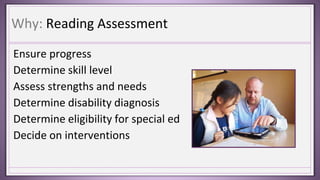
Why: Reading Assessment
Ensure progress
Determine skill level
Assess strengths and needs
Determine disability diagnosis
Determine eligibility for special ed
Decide on interventions
What: Eligibility and/or
Disability Assessment
Under IDEA, the term “a child with a disability” means:
• A child evaluated according to IDEA as having mental retardation, a hearing impairment
including deafness, a speech or language impairment, a visual impairment including blindness,
emotional disturbance, an orthopedic impairment, autism, traumatic brain injury, other health
impairment, a specific learning disability, deaf-blindness, or multiple disabilities, and
• Who, by reason thereof, needs special education and related services.
• Section 1401: subsection 30 Specific Learning Disability
A) In General. The term ‘specific learning disability’ means a disorder in 1 or more of the basic
psychological processes involved in understanding or in using language, spoken or written, which
disorder may manifest itself in the imperfect ability to listen, think, speak, read, write, spell, or do
mathematical calculations.
B) Such tem includes such conditions as perceptual disabilities, brain injury, minimal brain
dysfunction, dyslexia, and developmental aphasia.
Process for Determining
Learning Disability Using RtI Data
• While data collected through an RtI process may be used as part of a student’s
individual evaluation to determine if a student has a learning disability, it may not
be the sole source of information to make this determination.
• A student suspected of having a learning disability must receive a comprehensive
multidisciplinary evaluation. Consistent with section 200.4(b) of the Regulations of
the Commissioner of Education, the individual evaluation must include a variety of
assessment tools and strategies including a physical examination, a social history,
other appropriate assessments as necessary, an individual psychological evaluation
and an observation.
• Data should include...data that demonstrates that the student was provided
appropriate instruction delivered by qualified personnel including research-based
instruction in reading
http://www.wrightslaw.com/idea/art/rti.hale.pdf
Some additional points
about RtI…
•Many reasons why children may not respond
•Lack of training in research-based instructional techniques
•Measures used to assess may not have adequate validity and
reliability: http://www.intensiveintervention.org/chart/progress-
monitoring
•Vague guidelines regarding what constitutes “responding” and
lack of response/lack of “unified standards”
http://www.wrightslaw.com/idea/art/rti.hale.pdf
NYS Criteria for Determining
a Learning Disability
•In making a determination of eligibility for special education, the CSE must determine that
underachievement of the student is not due to lack of appropriate instruction in reading (including the five
essential components), mathematics or limited English proficiency. The data from RtI can help to document
that the reason for a student’s poor performance or underachievement is not due to lack of appropriate
instruction or limited English proficiency.
•When determining if a student has a learning disability, the data from multiple sources indicates that the
student, when provided appropriate instruction:
•does not adequately achieve grade level standards in the areas of reading and/or mathematics; and
•(a) is not making sufficient progress toward meeting those standards when provided with appropriate
instruction consistent with an RtI model; or
(b) exhibits a pattern of strengths and weaknesses in performance and/or achievement relative to age or
grade level standards as found relevant by the CSE
Exclusions
Before dyslexia, or any learning disability, can be diagnosed, a number of criteria
must be ruled out. Under the Individuals with Disabilities Act (IDEA), the exclusion
list includes:
•Has the child received appropriate instruction in reading?
•Does the child have a vision, hearing, or motor disability?
•Does the child come from a home with environmental or economic
disadvantages?
•Is English the student's second language or are there other cultural factors
affecting the student's ability to fully achieve?
http://www.handinhandhomeschool.com/sped/diagnosing-ld-exclusions.php
WHEN and WHERE
should a child be referred?
• When data show lack of adequate progress (i.e., RTI)
• When someone is concerned about a child’s skills or progress
• As a teacher:
• RTI, intervention, or student support team
• As a parent:
• Depends on your goal/desired outcome:
• Teacher, intervention team, principal, special education director
WHAT is the process for
getting a student evaluated?
•A referral is made (teacher, parent, RtI)
•Assessments are given
•Collaboration about results
•Educational decisions made
Advantages/disadvantages of “waiting” vs. testing as soon as
there is a concern
•Importance of effective Tier 1
•What RTI is supposed to do vs. what actually happens in most schools
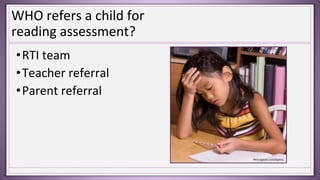
WHO refers a child for
reading assessment?
•RTI team
•Teacher referral
•Parent referral
Teacher: WHAT is my role
in the referral process?
Know and understand:
• The law/s (IDEA, 504)
• Building culture/norms
• To whom you are primarily
responsible
• What you can do when these
responsibilities are in conflict
Parent: WHAT is my role
in the referral process?
• Consider history, progress, grades, areas of strength/weakness
• Observe, document, support (but not too much!)
• Speak with teacher
• Consider “level” of
concern/referral:
• Teacher
• Intervention team
• Principal/special education
director
• Written: Do not pass go…
Cosby Show (1989)
https://www.youtube.com/watch?v=xxYjKDxYH2U
What did they portray accurately?
What is inaccurate?
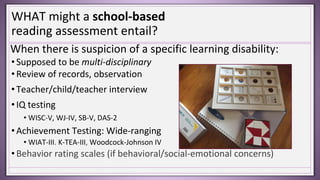
WHAT might a school-based
reading assessment entail?
When there is suspicion of a specific learning disability:
• Supposed to be multi-disciplinary
• Review of records, observation
• Teacher/child/teacher interview
• IQ testing
• WISC-V, WJ-IV, SB-V, DAS-2
• Achievement Testing: Wide-ranging
• WIAT-III. K-TEA-III, Woodcock-Johnson IV
• Behavior rating scales (if behavioral/social-emotional concerns)
WHAT do all those tests measure &
WHAT do the results mean?
• Brief overview
• Norm-referenced, standardized tests, and scores
• IQ testing
• “Wide range” achievement tests
• What do they tell us, what don’t they tell us, how are they
interpreted?
• Overview reading-specific tests
• What they tell us?
• How are they interpreted
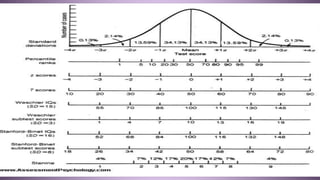
Interpretation of Scores
•Scaled scores (mean of 10, SD of 3)
•Standard scores (mean of 100, SD of 15)
•Percentile ranks (a score at or above __% of other students who
took the test measure)
•Stanines (range of 1-9)
•Grade/age equivalents (psychometric concerns; be wary due to
limited validity and reliability)
What: Eligibility and/or
Disability Assessment
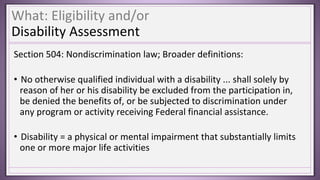
Section 504: Nondiscrimination law; Broader definitions:
• No otherwise qualified individual with a disability ... shall solely by
reason of her or his disability be excluded from the participation in,
be denied the benefits of, or be subjected to discrimination under
any program or activity receiving Federal financial assistance.
• Disability = a physical or mental impairment that substantially limits
one or more major life activities
What: Disability Assessment
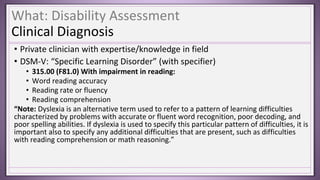
Clinical Diagnosis
• Private clinician with expertise/knowledge in field
• DSM-V: “Specific Learning Disorder” (with specifier)
• 315.00 (F81.0) With impairment in reading:
• Word reading accuracy
• Reading rate or fluency
• Reading comprehension
“Note: Dyslexia is an alternative term used to refer to a pattern of learning difficulties
characterized by problems with accurate or fluent word recognition, poor decoding, and
poor spelling abilities. If dyslexia is used to specify this particular pattern of difficulties, it is
important also to specify any additional difficulties that are present, such as difficulties
with reading comprehension or math reasoning.”
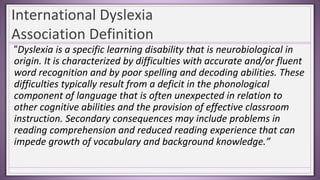
International Dyslexia
Association Definition
“Dyslexia is a specific learning disability that is neurobiological in
origin. It is characterized by difficulties with accurate and/or fluent
word recognition and by poor spelling and decoding abilities. These
difficulties typically result from a deficit in the phonological
component of language that is often unexpected in relation to
other cognitive abilities and the provision of effective classroom
instruction. Secondary consequences may include problems in
reading comprehension and reduced reading experience that can
impede growth of vocabulary and background knowledge.”
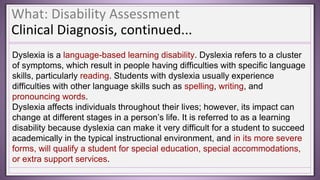
What: Disability Assessment
Clinical Diagnosis, continued...
Dyslexia is a language-based learning disability. Dyslexia refers to a cluster
of symptoms, which result in people having difficulties with specific language
skills, particularly reading. Students with dyslexia usually experience
difficulties with other language skills such as spelling, writing, and
pronouncing words.
Dyslexia affects individuals throughout their lives; however, its impact can
change at different stages in a person’s life. It is referred to as a learning
disability because dyslexia can make it very difficult for a student to succeed
academically in the typical instructional environment, and in its more severe
forms, will qualify a student for special education, special accommodations,
or extra support services.
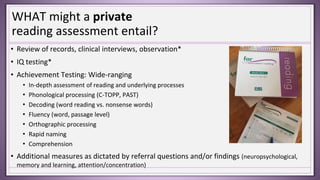
WHAT might a private
reading assessment entail?
• Review of records, clinical interviews, observation*
• IQ testing*
• Achievement Testing: Wide-ranging
• In-depth assessment of reading and underlying processes
• Phonological processing (C-TOPP, PAST)
• Decoding (word reading vs. nonsense words)
• Fluency (word, passage level)
• Orthographic processing
• Rapid naming
• Comprehension
• Additional measures as dictated by referral questions and/or findings (neuropsychological,
memory and learning, attention/concentration)
Common differences between
school and private evaluations
•Focus
•Eligibility vs. diagnostic
•Depth
•Level of analysis
•Specificity of intervention suggestions
WHEN is a private evaluation
“worth it?”
•The clinician has expertise in the area of need
•You want an “unbiased”/ outside opinion
•Your child has been “falling between the cracks”
HOW can a private
evaluation be financed?
• Private pay
• Private insurance
• Independent evaluation at district expense
• When/how/why to request
• Advantages and disadvantages?
• Other low cost options
• University-based clinics
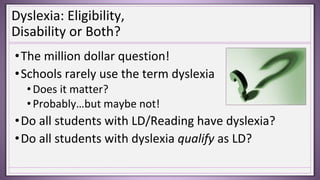
Dyslexia: Eligibility,
Disability or Both?
•The million dollar question!
•Schools rarely use the term dyslexia
•Does it matter?
•Probably…but maybe not!
•Do all students with LD/Reading have dyslexia?
•Do all students with dyslexia qualify as LD?
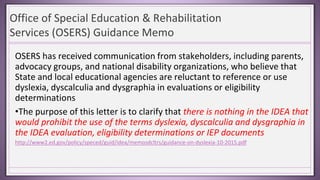
Office of Special Education & Rehabilitation
Services (OSERS) Guidance Memo
OSERS has received communication from stakeholders, including parents,
advocacy groups, and national disability organizations, who believe that
State and local educational agencies are reluctant to reference or use
dyslexia, dyscalculia and dysgraphia in evaluations or eligibility
determinations
•The purpose of this letter is to clarify that there is nothing in the IDEA that
would prohibit the use of the terms dyslexia, dyscalculia and dysgraphia in
the IDEA evaluation, eligibility determinations or IEP documents
http://www2.ed.gov/policy/speced/guid/idea/memosdcltrs/guidance-on-dyslexia-10-2015.pdf
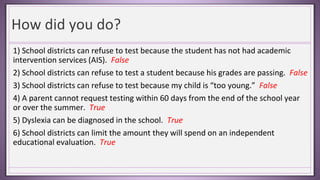
How did you do?
1) School districts can refuse to test because the student has not had academic
intervention services (AIS). False
2) School districts can refuse to test a student because his grades are passing. False
3) School districts can refuse to test because my child is “too young.” False
4) A parent cannot request testing within 60 days from the end of the school year
or over the summer. True
5) Dyslexia can be diagnosed in the school. True
6) School districts can limit the amount they will spend on an independent
educational evaluation. True
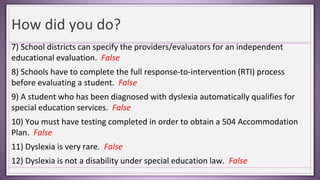
How did you do?
7) School districts can specify the providers/evaluators for an independent
educational evaluation. False
8) Schools have to complete the full response-to-intervention (RTI) process
before evaluating a student. False
9) A student who has been diagnosed with dyslexia automatically qualifies for
special education services. False
10) You must have testing completed in order to obtain a 504 Accommodation
Plan. False
11) Dyslexia is very rare. False
12) Dyslexia is not a disability under special education law. False
Thank you!
Contact us at:
sheilaclonan@gmail.com
mstorie@gmail.com
Phone: 315-320-6404
Website: http://www.educationalsolutionscny.com/

The Reading League: Reading Assessment; May 11, 2017

  • 1.
    Announcements Next Event: Thursday,July 13, 2017, 6:00 to 8:30 pm ---- Millard Hawk Primary School Central Square TOPIC: How to Maximize Intervention Time: Tips for Instructional Efficiency Presenters: Andrea Farrow (Instructional Specialist - West Genesee) Jessica Pasik (Special Educator - Fulton)
  • 2.
    Individual Reading Assessment WhatIs It, Who Does It, How Does It Happen, and What Does It Mean? (Everything you never knew you always wanted to know!) May 11, 2017 Morgan Road Elementary – Liverpool School District Sheila Clonan, Ph.D., Educational Solutions CNY Michelle Storie, Ph.D, Central Square CSD; Educational Solutions CNY
  • 3.
    Presentation Agenda: Why, what,when, who, how? • Why: Ensure progress, make decisions, design interventions • What: Progress monitoring, eligibility assessment, disability assessment • When: On-going, whenever there is a concern! • Who (Part 1): Who refers? Educator, parent, others • Who (Part 2): Who evaluates? School staff, private evaluators • How: What tests are commonly used and what do they measure?
  • 4.
    Quiz Time! • Let’sassess your current understanding of these issues. • Circle True/False for each question. • Later, as you listen, see if there are any answers you would change. • At the end of the night, we’ll go through and review all of the answers-- can you get them all correct?
  • 5.
    TRUE AND FALSEQUIZ: Indicate True or False for each question. The answers will be given at the end of the presentation. 1) School districts can refuse to test because the student has not had academic intervention services (AIS). 2) School districts can refuse to test a student because his grades are passing. 3) School districts can refuse to test because my child is “too young.” 4) A parent cannot request testing within 60 days from the end of the school year or over the summer. 5) Dyslexia can be diagnosed in the school. 6) School districts can limit the amount they will spend on an independent educational evaluation. 7) School districts can specify the providers/evaluators for an independent educational evaluation. 8) Schools have to complete the full response-to-intervention (RTI) process before evaluating a student. 9) A student who has been diagnosed with dyslexia automatically qualifies for special education services. 10) You must have testing completed in order to obtain a 504 Accommodation Plan. 11) Dyslexia is very rare. 12) Dyslexia is not a disability under special education law.
  • 6.
    Why: Reading Assessment Ensureprogress Determine skill level Assess strengths and needs Determine disability diagnosis Determine eligibility for special ed Decide on interventions
  • 7.
    What: Eligibility and/or DisabilityAssessment Under IDEA, the term “a child with a disability” means: • A child evaluated according to IDEA as having mental retardation, a hearing impairment including deafness, a speech or language impairment, a visual impairment including blindness, emotional disturbance, an orthopedic impairment, autism, traumatic brain injury, other health impairment, a specific learning disability, deaf-blindness, or multiple disabilities, and • Who, by reason thereof, needs special education and related services. • Section 1401: subsection 30 Specific Learning Disability A) In General. The term ‘specific learning disability’ means a disorder in 1 or more of the basic psychological processes involved in understanding or in using language, spoken or written, which disorder may manifest itself in the imperfect ability to listen, think, speak, read, write, spell, or do mathematical calculations. B) Such tem includes such conditions as perceptual disabilities, brain injury, minimal brain dysfunction, dyslexia, and developmental aphasia.
  • 8.
    Process for Determining LearningDisability Using RtI Data • While data collected through an RtI process may be used as part of a student’s individual evaluation to determine if a student has a learning disability, it may not be the sole source of information to make this determination. • A student suspected of having a learning disability must receive a comprehensive multidisciplinary evaluation. Consistent with section 200.4(b) of the Regulations of the Commissioner of Education, the individual evaluation must include a variety of assessment tools and strategies including a physical examination, a social history, other appropriate assessments as necessary, an individual psychological evaluation and an observation. • Data should include...data that demonstrates that the student was provided appropriate instruction delivered by qualified personnel including research-based instruction in reading http://www.wrightslaw.com/idea/art/rti.hale.pdf
  • 9.
    Some additional points aboutRtI… •Many reasons why children may not respond •Lack of training in research-based instructional techniques •Measures used to assess may not have adequate validity and reliability: http://www.intensiveintervention.org/chart/progress- monitoring •Vague guidelines regarding what constitutes “responding” and lack of response/lack of “unified standards” http://www.wrightslaw.com/idea/art/rti.hale.pdf
  • 10.
    NYS Criteria forDetermining a Learning Disability •In making a determination of eligibility for special education, the CSE must determine that underachievement of the student is not due to lack of appropriate instruction in reading (including the five essential components), mathematics or limited English proficiency. The data from RtI can help to document that the reason for a student’s poor performance or underachievement is not due to lack of appropriate instruction or limited English proficiency. •When determining if a student has a learning disability, the data from multiple sources indicates that the student, when provided appropriate instruction: •does not adequately achieve grade level standards in the areas of reading and/or mathematics; and •(a) is not making sufficient progress toward meeting those standards when provided with appropriate instruction consistent with an RtI model; or (b) exhibits a pattern of strengths and weaknesses in performance and/or achievement relative to age or grade level standards as found relevant by the CSE
  • 11.
    Exclusions Before dyslexia, orany learning disability, can be diagnosed, a number of criteria must be ruled out. Under the Individuals with Disabilities Act (IDEA), the exclusion list includes: •Has the child received appropriate instruction in reading? •Does the child have a vision, hearing, or motor disability? •Does the child come from a home with environmental or economic disadvantages? •Is English the student's second language or are there other cultural factors affecting the student's ability to fully achieve? http://www.handinhandhomeschool.com/sped/diagnosing-ld-exclusions.php
  • 12.
    WHEN and WHERE shoulda child be referred? • When data show lack of adequate progress (i.e., RTI) • When someone is concerned about a child’s skills or progress • As a teacher: • RTI, intervention, or student support team • As a parent: • Depends on your goal/desired outcome: • Teacher, intervention team, principal, special education director
  • 13.
    WHAT is theprocess for getting a student evaluated? •A referral is made (teacher, parent, RtI) •Assessments are given •Collaboration about results •Educational decisions made Advantages/disadvantages of “waiting” vs. testing as soon as there is a concern •Importance of effective Tier 1 •What RTI is supposed to do vs. what actually happens in most schools
  • 14.
    WHO refers achild for reading assessment? •RTI team •Teacher referral •Parent referral
  • 15.
    Teacher: WHAT ismy role in the referral process? Know and understand: • The law/s (IDEA, 504) • Building culture/norms • To whom you are primarily responsible • What you can do when these responsibilities are in conflict
  • 16.
    Parent: WHAT ismy role in the referral process? • Consider history, progress, grades, areas of strength/weakness • Observe, document, support (but not too much!) • Speak with teacher • Consider “level” of concern/referral: • Teacher • Intervention team • Principal/special education director • Written: Do not pass go…
  • 17.
    Cosby Show (1989) https://www.youtube.com/watch?v=xxYjKDxYH2U Whatdid they portray accurately? What is inaccurate?
  • 18.
    WHAT might aschool-based reading assessment entail? When there is suspicion of a specific learning disability: • Supposed to be multi-disciplinary • Review of records, observation • Teacher/child/teacher interview • IQ testing • WISC-V, WJ-IV, SB-V, DAS-2 • Achievement Testing: Wide-ranging • WIAT-III. K-TEA-III, Woodcock-Johnson IV • Behavior rating scales (if behavioral/social-emotional concerns)
  • 19.
    WHAT do allthose tests measure & WHAT do the results mean? • Brief overview • Norm-referenced, standardized tests, and scores • IQ testing • “Wide range” achievement tests • What do they tell us, what don’t they tell us, how are they interpreted? • Overview reading-specific tests • What they tell us? • How are they interpreted
  • 20.
    Interpretation of Scores •Scaledscores (mean of 10, SD of 3) •Standard scores (mean of 100, SD of 15) •Percentile ranks (a score at or above __% of other students who took the test measure) •Stanines (range of 1-9) •Grade/age equivalents (psychometric concerns; be wary due to limited validity and reliability)
  • 22.
    What: Eligibility and/or DisabilityAssessment Section 504: Nondiscrimination law; Broader definitions: • No otherwise qualified individual with a disability ... shall solely by reason of her or his disability be excluded from the participation in, be denied the benefits of, or be subjected to discrimination under any program or activity receiving Federal financial assistance. • Disability = a physical or mental impairment that substantially limits one or more major life activities
  • 23.
    What: Disability Assessment ClinicalDiagnosis • Private clinician with expertise/knowledge in field • DSM-V: “Specific Learning Disorder” (with specifier) • 315.00 (F81.0) With impairment in reading: • Word reading accuracy • Reading rate or fluency • Reading comprehension “Note: Dyslexia is an alternative term used to refer to a pattern of learning difficulties characterized by problems with accurate or fluent word recognition, poor decoding, and poor spelling abilities. If dyslexia is used to specify this particular pattern of difficulties, it is important also to specify any additional difficulties that are present, such as difficulties with reading comprehension or math reasoning.”
  • 24.
    International Dyslexia Association Definition “Dyslexiais a specific learning disability that is neurobiological in origin. It is characterized by difficulties with accurate and/or fluent word recognition and by poor spelling and decoding abilities. These difficulties typically result from a deficit in the phonological component of language that is often unexpected in relation to other cognitive abilities and the provision of effective classroom instruction. Secondary consequences may include problems in reading comprehension and reduced reading experience that can impede growth of vocabulary and background knowledge.”
  • 25.
    What: Disability Assessment ClinicalDiagnosis, continued... Dyslexia is a language-based learning disability. Dyslexia refers to a cluster of symptoms, which result in people having difficulties with specific language skills, particularly reading. Students with dyslexia usually experience difficulties with other language skills such as spelling, writing, and pronouncing words. Dyslexia affects individuals throughout their lives; however, its impact can change at different stages in a person’s life. It is referred to as a learning disability because dyslexia can make it very difficult for a student to succeed academically in the typical instructional environment, and in its more severe forms, will qualify a student for special education, special accommodations, or extra support services.
  • 26.
    WHAT might aprivate reading assessment entail? • Review of records, clinical interviews, observation* • IQ testing* • Achievement Testing: Wide-ranging • In-depth assessment of reading and underlying processes • Phonological processing (C-TOPP, PAST) • Decoding (word reading vs. nonsense words) • Fluency (word, passage level) • Orthographic processing • Rapid naming • Comprehension • Additional measures as dictated by referral questions and/or findings (neuropsychological, memory and learning, attention/concentration)
  • 27.
    Common differences between schooland private evaluations •Focus •Eligibility vs. diagnostic •Depth •Level of analysis •Specificity of intervention suggestions
  • 28.
    WHEN is aprivate evaluation “worth it?” •The clinician has expertise in the area of need •You want an “unbiased”/ outside opinion •Your child has been “falling between the cracks”
  • 29.
    HOW can aprivate evaluation be financed? • Private pay • Private insurance • Independent evaluation at district expense • When/how/why to request • Advantages and disadvantages? • Other low cost options • University-based clinics
  • 30.
    Dyslexia: Eligibility, Disability orBoth? •The million dollar question! •Schools rarely use the term dyslexia •Does it matter? •Probably…but maybe not! •Do all students with LD/Reading have dyslexia? •Do all students with dyslexia qualify as LD?
  • 31.
    Office of SpecialEducation & Rehabilitation Services (OSERS) Guidance Memo OSERS has received communication from stakeholders, including parents, advocacy groups, and national disability organizations, who believe that State and local educational agencies are reluctant to reference or use dyslexia, dyscalculia and dysgraphia in evaluations or eligibility determinations •The purpose of this letter is to clarify that there is nothing in the IDEA that would prohibit the use of the terms dyslexia, dyscalculia and dysgraphia in the IDEA evaluation, eligibility determinations or IEP documents http://www2.ed.gov/policy/speced/guid/idea/memosdcltrs/guidance-on-dyslexia-10-2015.pdf
  • 32.
    How did youdo? 1) School districts can refuse to test because the student has not had academic intervention services (AIS). False 2) School districts can refuse to test a student because his grades are passing. False 3) School districts can refuse to test because my child is “too young.” False 4) A parent cannot request testing within 60 days from the end of the school year or over the summer. True 5) Dyslexia can be diagnosed in the school. True 6) School districts can limit the amount they will spend on an independent educational evaluation. True
  • 33.
    How did youdo? 7) School districts can specify the providers/evaluators for an independent educational evaluation. False 8) Schools have to complete the full response-to-intervention (RTI) process before evaluating a student. False 9) A student who has been diagnosed with dyslexia automatically qualifies for special education services. False 10) You must have testing completed in order to obtain a 504 Accommodation Plan. False 11) Dyslexia is very rare. False 12) Dyslexia is not a disability under special education law. False
  • 34.
    Thank you! Contact usat: sheilaclonan@gmail.com mstorie@gmail.com Phone: 315-320-6404 Website: http://www.educationalsolutionscny.com/