Assessment in the
Affective Domain
PRESENTER NAME
9/3/20XX Presentation Title 1
“Certain people
are ‘schooled’
but not
‘educated’”
9/3/20XX Presentation Title 2
Affective
Domain
9/3/20XX Presentation Title 3
Describes learning
objectives that
emphasize a feeling,
tone, an emotion, or a
degree of acceptance or
rejection
9/3/20XX Presentation Title 4
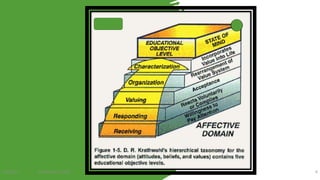
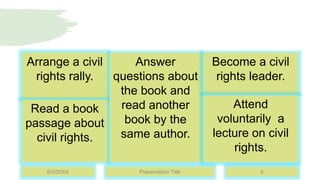
Arrange a civil
rights rally.
Read a book
passage about
civil rights.
Answer
questions about
the book and
read another
book by the
same author.
Become a civil
rights leader.
Attend
voluntarily a
lecture on civil
rights.
9/3/20XX Presentation Title 5
Affective Learning Competencies
• Instructional objectives are specific, measurable, short-term,
observable student behaviors
• The purpose is not to restrict spontaneity or constraint the vision
of education but to ensure that learning is focused clearly
enough that both students and teacher know what is going on,
and so learning can be objectively measured.
Presentation Title
Why study
attitudes?
9/3/20XX Presentation Title 7
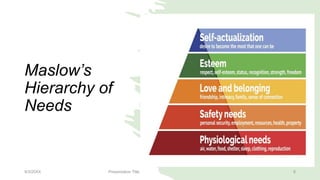
Maslow’s
Hierarchy of
Needs
9/3/20XX Presentation Title 8
Herzberg’s
Two Factor
Theory
9/3/20XX Presentation Title 9
Attitudes
• Cognitions – beliefs, theories,
beliefs, expectancies, cause-
and-effect beliefs, and
perceptions relative to the focal
object
• Affect – a feeling with respect to
the focal object
• Behavioral Intentions – goals,
aspirations, and expected
responses to the attitude
• Evaluation – imputation of some
degree of goodness or badness
to an attitude object
Mental predisposition
to act that is
expressed by
evaluating a
particular entity with
some degree of favor
or disfavor
9/3/20XX Presentation Title 10
Development of Assessment Tools
•Self Report (written reflections)
•Rating Scales
•Semantic Differential Scales
•Thurstone and Likert Scales
•Checklists
9/3/20XX Presentation Title 11
CLASSROOM TASK
•Develop a learning competency for each
level of affective domain (progression of
activities)
9/3/20XX Presentation Title 12
TAKE HOME TASKS:
• Construct a rating scale on the following situations:
• Motivation to study
• Measuring attitude towards language studies
• Measuring attitude towards Mathematics
• Construct a checklist for:
• Good interpersonal checklist
• Checklist for behavior demonstrating good manners and right conduct
9/3/20XX Presentation Title 13

Assessment-in--Affective-Domain (1).pptx

  • 1.
    Assessment in the AffectiveDomain PRESENTER NAME 9/3/20XX Presentation Title 1
  • 2.
    “Certain people are ‘schooled’ butnot ‘educated’” 9/3/20XX Presentation Title 2
  • 3.
    Affective Domain 9/3/20XX Presentation Title3 Describes learning objectives that emphasize a feeling, tone, an emotion, or a degree of acceptance or rejection
  • 4.
  • 5.
    Arrange a civil rightsrally. Read a book passage about civil rights. Answer questions about the book and read another book by the same author. Become a civil rights leader. Attend voluntarily a lecture on civil rights. 9/3/20XX Presentation Title 5
  • 6.
    Affective Learning Competencies •Instructional objectives are specific, measurable, short-term, observable student behaviors • The purpose is not to restrict spontaneity or constraint the vision of education but to ensure that learning is focused clearly enough that both students and teacher know what is going on, and so learning can be objectively measured. Presentation Title
  • 7.
  • 8.
  • 9.
  • 10.
    Attitudes • Cognitions –beliefs, theories, beliefs, expectancies, cause- and-effect beliefs, and perceptions relative to the focal object • Affect – a feeling with respect to the focal object • Behavioral Intentions – goals, aspirations, and expected responses to the attitude • Evaluation – imputation of some degree of goodness or badness to an attitude object Mental predisposition to act that is expressed by evaluating a particular entity with some degree of favor or disfavor 9/3/20XX Presentation Title 10
  • 11.
    Development of AssessmentTools •Self Report (written reflections) •Rating Scales •Semantic Differential Scales •Thurstone and Likert Scales •Checklists 9/3/20XX Presentation Title 11
  • 12.
    CLASSROOM TASK •Develop alearning competency for each level of affective domain (progression of activities) 9/3/20XX Presentation Title 12
  • 13.
    TAKE HOME TASKS: •Construct a rating scale on the following situations: • Motivation to study • Measuring attitude towards language studies • Measuring attitude towards Mathematics • Construct a checklist for: • Good interpersonal checklist • Checklist for behavior demonstrating good manners and right conduct 9/3/20XX Presentation Title 13