HOMEROOM
GUIDANCE
PROGRAM
MARIA LUTZ B. DUALLO
Resource Speaker
Assessment 01
of Learning
for
Homeroom
Guidance
Program
Assessment
of Learning
HOMEROOM GUIDANCE PROGRAM
refers to strategies designed to confirm what students know,
demonstrate whether or not they have met curriculum
outcomes or the goals of their individualized programs, or
certify proficiency and make decisions about students’
future programs or placements. It is designed to provide
evidence of achievement to parents, other educators, the
students themselves, and sometimes to outside groups (e.g.,
employers, and other educational institutions).
02
HOMEROOM GUIDANCE PROGRAM
02
Assessment
Method
Test and
Examinations
Products and
Demonstrations
Portfolios
Exhibitions
Performances
Presentations
Simulations
Multimedia Projects
Diagnostic
Formative
Summative
Interim
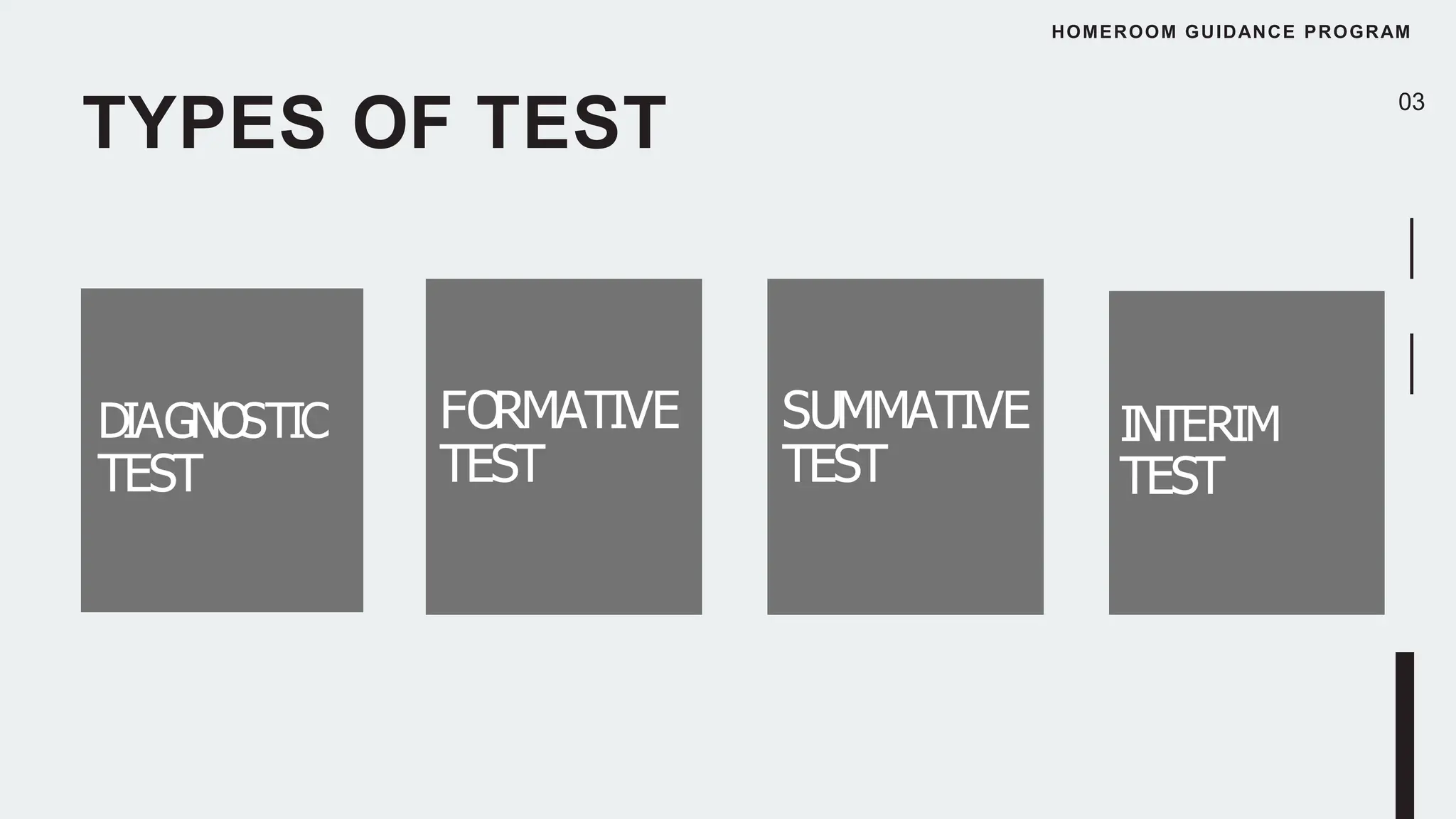
TYPES OF TEST
03
DIAGNO
STIC
TEST
INTERIM
TEST
SUMMATIVE
TEST
FORMATIVE
TEST
HOMEROOM GUIDANCE PROGRAM
Diagnostic Assessment
04
Why diagnose?
“Educational diagnosis is the process of determining the
causes of educational difficulties.”
HOMEROOM GUIDANCE PROGRAM
Diagnostic Assessment
05
-intended to help teachers identify what
students know and can do in different domains
to support their learning.
- help teachers determine what students
understand in order to build on the student’s
strengths and address their specific needs
HOMEROOM GUIDANCE PROGRAM
Diagnostic Assessment
06
Common benefits…
 Assess students’ readiness and prior knowledge
 Can provide personalized learning paths for learners
 Assess the homogeneity of learners based on capabilities
 Good reference for instructional design and methodology
 Assess achievement in the prior levels of learning
HOMEROOM GUIDANCE PROGRAM
Diagnostic Assessment
07
“ The diagnostic assessment tool is CRUCIAL in the process.”
HOMEROOM GUIDANCE PROGRAM
Diagnostic Assessment
08
Thorndike and Hagen (1970)
suggested that a diagnostic test
should provide a detailed picture
of the strengths and weaknesses
of a learner in a particular area.
HOMEROOM GUIDANCE PROGRAM
Phases in DT
preparation
09
Planning
Reviewing the Test
Preparing Directions and
Scoring
Assembling Test
Item Writing
HOMEROOM GUIDANCE PROGRAM
Preparing the Test Specifications 10
What type of
test should be
administered
to the
learners?
What should
be included in
the test?
How long
should the
test be?
How easy or
difficult
should the
test items be?
HOMEROOM GUIDANCE PROGRAM
11
HOMEROOM GUIDANCE PROGRAM
12
DT Specifications
MELC Remembering Understanding Applying Analyzing Evaluating Creating Total Items
Q1
Q2
Q3
Q4
13
HOMEROOM GUIDANCE PROGRAM
Key points to consider 14
1. DT is not the same as the achievement test.
2. Test questions should not be very difficult.
3. Language used must be easy to understand.
4. The test should not be too long.
5. While not all competencies covered, sampling
from the MELCS should be carefully studied.
HOMEROOM GUIDANCE PROGRAM
HOMEROOM
GUIDANCE
PROGRAM
MARIA LUTZ B. DUALLO
Resource Speaker
Designing & 01
Writing
Diagnostic
MCQ Test
Items
What we will cover 02
1. A take on Birenbaum’s 4 levels of
diagnosis
2. Design for Diagnostic Multiple-Choice
Items
3. Taxonomy for Option Rationale
4. Tips for MCQs
HOMEROOM GUIDANCE PROGRAM
03
HOMEROOM GUIDANCE PROGRAM
Birenbaum’s 4 Levels of Diagnosis
Did the student master the competency?
Which competency have not been
mastered?
How did students come-up with an incorrect
response?
Why did students come-up with an incorrect
response?
04
HOMEROOM GUIDANCE PROGRAM
The Cognitive Rule (Behind each Response)
Cognitive Rules are social
constructs that convey beliefs and
reasons for thought. They do not
have to be “correct” but may be
believed to be so.
05
HOMEROOM GUIDANCE PROGRAM
Interpretability of Cognitive Rules
A
B
C
D
06
HOMEROOM GUIDANCE PROGRAM
1
2
+
1
3
=?
Add the numerators and
denominators
𝑎 + 𝑏
𝑐 + 𝑑
5
6
Find the LCD and convert to
similar fractions then add
𝑎 × 𝑛
𝑐 × 𝑛
+
𝑏 × 𝑚
𝑑 × 𝑚
𝑎 𝑥 𝑑
𝑏 𝑥 𝑐
2
5
3
2
3
10
Just cross multiply
No Rule
07
HOMEROOM GUIDANCE PROGRAM
A Design for a Diagnostic MCQ
Task
Mother Stem: Main
Problem or Text
Stem: Questions/
Items
Interpretable Response
Level 1 Cognitive Rule
Level 2 Cognitive Rule
Level 3 Cognitive Rule
Level 4 (Correct) Rule
08
HOMEROOM GUIDANCE PROGRAM
A Taxonomy of Option Rationale (Based from King., et al, 2004)
Level 1
Conceptual Errors and
Misunderstandings
Level 2
Initial Understanding
Level 3 Weak or Inconsistent Reasoning
Level 4 Correct and complete answer
09
HOMEROOM GUIDANCE PROGRAM
Conceptual Errors and
Misunderstandings
• Commits errors in decoding, retrieving,
and processing information (from the
tasks)
• Answers using some prior knowledge
unrelated to the problem
• Implements strategies & reasoning not
related to the task
Level 1
10
HOMEROOM GUIDANCE PROGRAM
Initial Understanding
• May correctly understand the given information
but tends to be too literal or focus on superficial
connections
• Knows the operations to solve a problem, but
does not have a clear framework to address it
(as a result, implements a flawed strategy)
• Misapplies a valid framework of reasoning
Level 2
11
HOMEROOM GUIDANCE PROGRAM
Weak or Inconsistent Reasoning
• Uses a correct method or framework of reasoning
but comes up with a weak or incomplete answer
• Responses are too narrow or too broad
• Uses inconsistent reasoning that results in “almost”
having the answer correct
• Tends to commit errors by being careless or being
inconsistent
Level 3
12
HOMEROOM GUIDANCE PROGRAM
Correct and Complete answer
Level 4
13
HOMEROOM GUIDANCE PROGRAM
Response Level and Differentiated Instruction
Level 1
Conceptual Errors and
Misunderstandings
Level 2 Initial Understanding
Level 3
Weak or Inconsistent
Reasoning
Level 4
Correct and complete
answer
Re-teaching/ Re-learning
Guided Instruction/
Reciprocal or
Collaborative Learning
Drills, Practice and
Feedback
Self-paced
learning activities
13
HOMEROOM GUIDANCE PROGRAM
8. Bakit itinuturing na bukod tangi at pinakamahalagang gampanin ng
magulang ang pagbibigay ng edukasyon para sa mga anak?
Sapagkat ito ang:
a. humuhubog sa lahat ng aspeto ng isang tao
Taxonomy of Option Rationale
4
b. basihan ng pagiging isang respetadong indibidwal 3
c. kwalipikasyon sa paghanap ng magandang trabaho 2
d. nauuso sa ngayon na dapat makapagtapos ng pag-aaral 1
14
HOMEROOM GUIDANCE PROGRAM
Tips for Better Options
Do not use “All of the above” and “None of the above”
HOMEROOM GUIDANCE PROGRAM

Assessment of learning PPT- With Notes - Copy.pptx

  • 1.
    HOMEROOM GUIDANCE PROGRAM MARIA LUTZ B.DUALLO Resource Speaker Assessment 01 of Learning for Homeroom Guidance Program
  • 2.
    Assessment of Learning HOMEROOM GUIDANCEPROGRAM refers to strategies designed to confirm what students know, demonstrate whether or not they have met curriculum outcomes or the goals of their individualized programs, or certify proficiency and make decisions about students’ future programs or placements. It is designed to provide evidence of achievement to parents, other educators, the students themselves, and sometimes to outside groups (e.g., employers, and other educational institutions). 02
  • 3.
    HOMEROOM GUIDANCE PROGRAM 02 Assessment Method Testand Examinations Products and Demonstrations Portfolios Exhibitions Performances Presentations Simulations Multimedia Projects Diagnostic Formative Summative Interim
  • 4.
  • 5.
    Diagnostic Assessment 04 Why diagnose? “Educationaldiagnosis is the process of determining the causes of educational difficulties.” HOMEROOM GUIDANCE PROGRAM
  • 6.
    Diagnostic Assessment 05 -intended tohelp teachers identify what students know and can do in different domains to support their learning. - help teachers determine what students understand in order to build on the student’s strengths and address their specific needs HOMEROOM GUIDANCE PROGRAM
  • 7.
    Diagnostic Assessment 06 Common benefits… Assess students’ readiness and prior knowledge  Can provide personalized learning paths for learners  Assess the homogeneity of learners based on capabilities  Good reference for instructional design and methodology  Assess achievement in the prior levels of learning HOMEROOM GUIDANCE PROGRAM
  • 8.
    Diagnostic Assessment 07 “ Thediagnostic assessment tool is CRUCIAL in the process.” HOMEROOM GUIDANCE PROGRAM
  • 9.
    Diagnostic Assessment 08 Thorndike andHagen (1970) suggested that a diagnostic test should provide a detailed picture of the strengths and weaknesses of a learner in a particular area. HOMEROOM GUIDANCE PROGRAM
  • 10.
    Phases in DT preparation 09 Planning Reviewingthe Test Preparing Directions and Scoring Assembling Test Item Writing HOMEROOM GUIDANCE PROGRAM
  • 11.
    Preparing the TestSpecifications 10 What type of test should be administered to the learners? What should be included in the test? How long should the test be? How easy or difficult should the test items be? HOMEROOM GUIDANCE PROGRAM
  • 12.
  • 13.
    12 DT Specifications MELC RememberingUnderstanding Applying Analyzing Evaluating Creating Total Items Q1 Q2 Q3 Q4
  • 14.
  • 15.
    Key points toconsider 14 1. DT is not the same as the achievement test. 2. Test questions should not be very difficult. 3. Language used must be easy to understand. 4. The test should not be too long. 5. While not all competencies covered, sampling from the MELCS should be carefully studied. HOMEROOM GUIDANCE PROGRAM
  • 16.
    HOMEROOM GUIDANCE PROGRAM MARIA LUTZ B.DUALLO Resource Speaker Designing & 01 Writing Diagnostic MCQ Test Items
  • 17.
    What we willcover 02 1. A take on Birenbaum’s 4 levels of diagnosis 2. Design for Diagnostic Multiple-Choice Items 3. Taxonomy for Option Rationale 4. Tips for MCQs HOMEROOM GUIDANCE PROGRAM
  • 18.
    03 HOMEROOM GUIDANCE PROGRAM Birenbaum’s4 Levels of Diagnosis Did the student master the competency? Which competency have not been mastered? How did students come-up with an incorrect response? Why did students come-up with an incorrect response?
  • 19.
    04 HOMEROOM GUIDANCE PROGRAM TheCognitive Rule (Behind each Response) Cognitive Rules are social constructs that convey beliefs and reasons for thought. They do not have to be “correct” but may be believed to be so.
  • 20.
  • 21.
    06 HOMEROOM GUIDANCE PROGRAM 1 2 + 1 3 =? Addthe numerators and denominators 𝑎 + 𝑏 𝑐 + 𝑑 5 6 Find the LCD and convert to similar fractions then add 𝑎 × 𝑛 𝑐 × 𝑛 + 𝑏 × 𝑚 𝑑 × 𝑚 𝑎 𝑥 𝑑 𝑏 𝑥 𝑐 2 5 3 2 3 10 Just cross multiply No Rule
  • 22.
    07 HOMEROOM GUIDANCE PROGRAM ADesign for a Diagnostic MCQ Task Mother Stem: Main Problem or Text Stem: Questions/ Items Interpretable Response Level 1 Cognitive Rule Level 2 Cognitive Rule Level 3 Cognitive Rule Level 4 (Correct) Rule
  • 23.
    08 HOMEROOM GUIDANCE PROGRAM ATaxonomy of Option Rationale (Based from King., et al, 2004) Level 1 Conceptual Errors and Misunderstandings Level 2 Initial Understanding Level 3 Weak or Inconsistent Reasoning Level 4 Correct and complete answer
  • 24.
    09 HOMEROOM GUIDANCE PROGRAM ConceptualErrors and Misunderstandings • Commits errors in decoding, retrieving, and processing information (from the tasks) • Answers using some prior knowledge unrelated to the problem • Implements strategies & reasoning not related to the task Level 1
  • 25.
    10 HOMEROOM GUIDANCE PROGRAM InitialUnderstanding • May correctly understand the given information but tends to be too literal or focus on superficial connections • Knows the operations to solve a problem, but does not have a clear framework to address it (as a result, implements a flawed strategy) • Misapplies a valid framework of reasoning Level 2
  • 26.
    11 HOMEROOM GUIDANCE PROGRAM Weakor Inconsistent Reasoning • Uses a correct method or framework of reasoning but comes up with a weak or incomplete answer • Responses are too narrow or too broad • Uses inconsistent reasoning that results in “almost” having the answer correct • Tends to commit errors by being careless or being inconsistent Level 3
  • 27.
    12 HOMEROOM GUIDANCE PROGRAM Correctand Complete answer Level 4
  • 28.
    13 HOMEROOM GUIDANCE PROGRAM ResponseLevel and Differentiated Instruction Level 1 Conceptual Errors and Misunderstandings Level 2 Initial Understanding Level 3 Weak or Inconsistent Reasoning Level 4 Correct and complete answer Re-teaching/ Re-learning Guided Instruction/ Reciprocal or Collaborative Learning Drills, Practice and Feedback Self-paced learning activities
  • 29.
    13 HOMEROOM GUIDANCE PROGRAM 8.Bakit itinuturing na bukod tangi at pinakamahalagang gampanin ng magulang ang pagbibigay ng edukasyon para sa mga anak? Sapagkat ito ang: a. humuhubog sa lahat ng aspeto ng isang tao Taxonomy of Option Rationale 4 b. basihan ng pagiging isang respetadong indibidwal 3 c. kwalipikasyon sa paghanap ng magandang trabaho 2 d. nauuso sa ngayon na dapat makapagtapos ng pag-aaral 1
  • 30.
    14 HOMEROOM GUIDANCE PROGRAM Tipsfor Better Options Do not use “All of the above” and “None of the above”
  • 31.

Editor's Notes

  • #2 My respect to our schools division superintendent Sir Reynante A. Solitario, CID Chief Sir Janwario Yamota, Education Program Supervisor in EsP at the same time the program owner Sir Elden Orbeta,Division Guidance Coordinator Maam Juliet Raganas,to the members of the technical working group, my fellow HG coordinators good afternoon! Thank you so much for joining us today. I am so happy to have you here even it’s Saturday. For sure this is an opportunity for us to learn together and grow together. Well, I was tasked to discuss the topic Assessment of Learning for Homeroom Guidance Program. As homeroom guidance coordinators, we knew already that HG is a comprehensive, developmental, and proactive program design to equip Kto12 learners with their life skills on three domains namely: academic development, personal and social development and career development. So, we will focus on these three domains in assessing the learning of our students.
  • #3 So, with this given definition, assessment of learning is the assessment that becomes public and results in statements or it can be in symbols about how well our students are learning. Basically, this will serve as our basis to determine the extent to which the instructional goals have been achieved. The homeroom guidance program, as we all know that it is different from other learning areas but still we have competencies introduced to our students that helps develops their life skills which are very essential for them to become holistic individual. In fact, 1 session in a week that is equivalent to 60 minutes is allocated to all grade levels for homeroom guidance. So as implementers, it is really our role to assess the learning of our students of course to have direction in the teaching-learning process.
  • #4 We have two assessment methods, these are the test and examinations and products and demonstrations. In homeroom guidance program, we can have it all! (Adlib)
  • #6 So I will just focus on crafting diagnostic assessment, Now, Why diagnose? Why do we need to diagnose? The main purpose of having a diagnostic assessment is to collect enough data about what students already know about the topic. The teacher uses this data to create a realistic roadmap that addresses any gaps of knowledge. Diagnostic assessments help us, teachers, by providing a baseline for teaching. (Q) With that, we can reflect or plan for interventions in coping with those difficulties among students.
  • #8 If we really administer a diagnostic test to our learners and conduct data analysis of the results after, then we can have all these benefits. This will serve as our roadmap in achieving our objectives.
  • #9 It is said that Diagnostic assessment tool is crucial in the process. If we will relate this to other fields like medicine, doctors must be attentive and careful in conducting a diagnosis of a certain health condition of a patient. They must follow standard procedures to avoid misdiagnosis. Also, for them to know the right treatment. Likewise, in education, we as teachers we should know the level of learning of our students for us to know also what interventions we are going to apply to them. And this diagnostic assessment would somehow help us.
  • #11 There are five phases in the preparation of Diagnostic Test, First is Planning, in here, we need our MELCS as our basis. We can unpack the learning competencies without omitting any points. Next is the Item Writing, in here, we are going to make a Table of Specifications and formulate questions. Next assembling test where we are going to finalize the questions. Next preparing directions and scoring, instructions clear and precise, should also be provided with a scoring key. Lastly, reviewing the test, before printing the test, it should be carefully edited and reviewed. This ensures that any inadvertent errors are eliminated.
  • #19 Dapat ma.address ni sya na mga questions after administering the test and conducting data analysis after noh to plan for effective strategies and interventions for our students.
  • #20 We must apply cognitive rule in writing choices. In MCQ test we have 4 choices of answers, 1 is correct