Assessment in competitive programming 
assignments 
Manuel Palomo-Duarte
Table of contents 
● Introduction 
● Issues in competitive assessment 
● Case study 
● First proposal 
● Second proposal 
● Conclusions
Introduction 
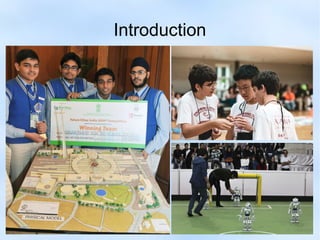
● Real life is competitive 
● Competition is “being the best” … candidate for a 
job / finding the best partner 
● … but also comparing (rankings, Am I doing well?) 
● Some educational systems use global rankings 
of students 
● You are among the “10% of the best students” 
● Even some courses use competitions for 
assessment 
● It is an extra motivation for students
Introduction
Issues in competitive assessment 
● But it also has a “dark side” 
● For every 1st place, you have a last place 
● For every one in the top ten, you have other one in 
the lowest ten 
● You can try to hide (only show details on the top 
half), but those students not there will probably feel 
down 
● How do you feel when competing in learning? 
● In psychology, positive rewards work much better 
than negative ones 
● The Case Against Competition, by Alfie Kohn
Issues in competitive assessment 
● Even more, there is a “legal” issue 
● For example, in a multiple-choice exam, each 
student can get any grade. No matter how well/bad 
the rest of mates performed 
● But in a competition … 
– full of bright students, an average one could get D 
– full of poor students, the same average one could get A+ 
● Competition is a comparative grading (not skills) 
● Grading for achievements could be a solution … 
– but falls into gamification, not direct competition
Issues in competitive assessment 
● Let's suppose a two-tournament competition 
● First a round-robin league (each team vs all others) 
– 5 point for beating a naive sparring team 
– 1 point for beating any other team 
– 1 point for the half-top 
– 1 point for winning 
● Secondly, a play-off (only the winner keeps playing) 
– 1 point for getting in the second round 
– 1 point for winning 
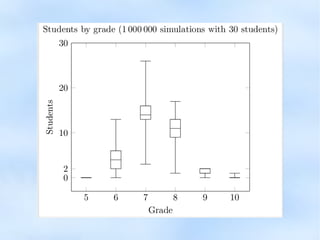
● Mathematically, the problem is that we have a 
limited amount of grades to divide into students
WL 
8 
ML 
7 
DO 
6 
DS 
5 
WP 
8 
WLRP 
9 
RP 
7 
[n, n] 
[n, n] 
[n, n] 
[n - 2^l, 2^l] 
where 
l = floor(log2(n)) 
1 unique token 
per student 
[n, n] 
[n, n] 
[n, n] 
[n, n] 
[n, n] [n, n] 
[1, 1] 
[1, 1] 
[floor(n/2), n] 
MLRP 
8 
WLWP 
10 
MLWP 
9 
que puede 
una entrada 
cada una de 
de tokens, 
recibido. "[n/2, n]" 
que tiene, 
nota es 
tokens en cada 
haya llegado
Case study 
● In University of Cadiz (Spain) we offered an 
elective course on Video Game Design 
● For students of Computer Science: 3rd (last) year 
● Prerequisites included several compulsory 
programming courses 
● No knowledge on artificial intelligence (AI) needed 
● It followed a project-based learning approach 
● Except for AI lesson (8 hour), where they competed
Case study 
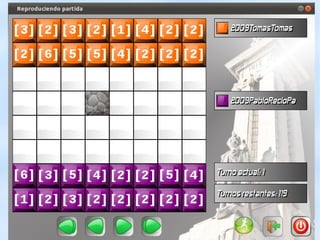
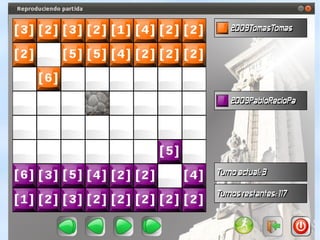
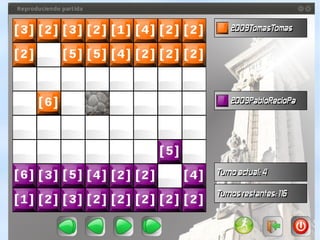
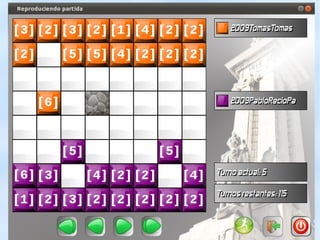
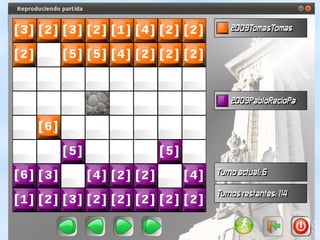
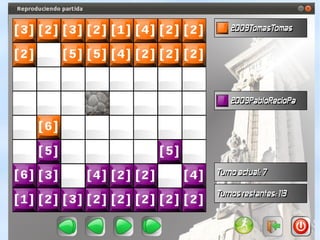
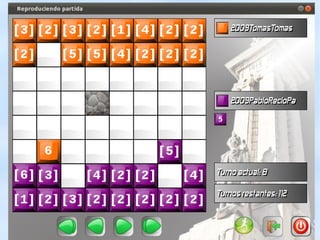
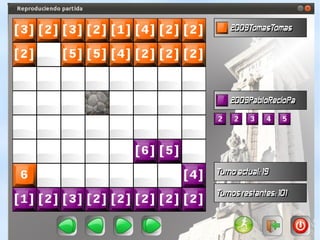
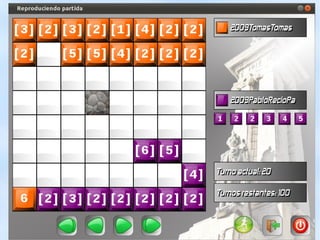
● In the AI lesson, students programmed IA 
strategies for a simplified version of Stratego 
● Partial knowledge of the world: no best strategy 
● Ideal for (rule-based) expert system programming 
● Their expert systems (ES) are composed by: 
● A set of prioritized (non-deterministic) if-then rules 
● An initial setting for the pieces 
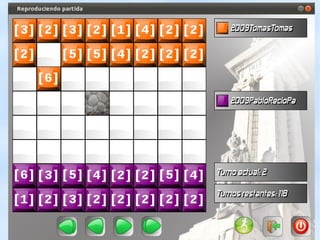
● We implemented and environment for playing 
batch of matches, replaying, human control, etc
Fist proposal 
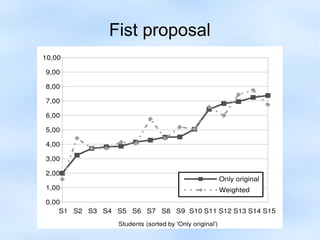
● We took advantage of the nature of software 
artifacts to solve this issue 
● While developing (and assessing) critical thinking 
● We let students refine their AI strategies after 
seeing the first competition 
● Refining an ES is easy: 
– Removing / adding / re-priorizing rules 
– And can lead to very different behavior 
● We assessed according to its improvement
Fist proposal 
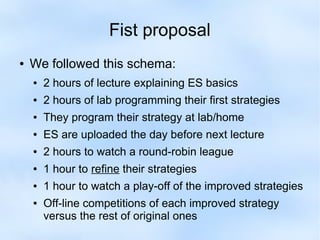
● We followed this schema: 
● 2 hours of lecture explaining ES basics 
● 2 hours of lab programming their first strategies 
● They program their strategy at lab/home 
● ES are uploaded the day before next lecture 
● 2 hours to watch a round-robin league 
● 1 hour to refine their strategies 
● 1 hour to watch a play-off of the improved strategies 
● Off-line competitions of each improved strategy 
versus the rest of original ones
Fist proposal
Second proposal 
● Ok, students can refine, but there is other issue 
● There is no “clear goal” in the task: beating an 
unknown enemy depends on having good strategy 
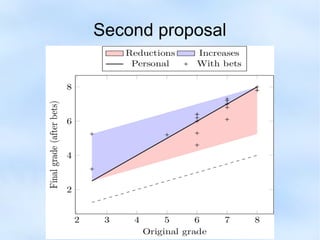
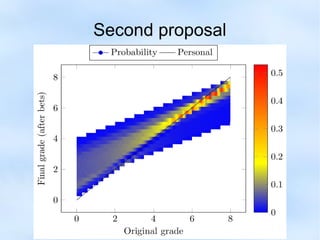
● Solution: we added a “betting system” 
● The schema now includes: 
● Strategies uploaded by students are available to 
mates a few days before the competition 
– But not initial settings, so they cannot play in advance 
– Students can check colleagues' strategies 
● In the competition, each student bets 10% to 50% 
of his grade for other ES
Second proposal 
● Now the grades can be more evenly distributed 
● If that is the case 
● Students do not only critically analyze their 
code for the second competition 
● But also previously analyzed code written by others 
… that can be incorporated in the refined strategy 
● Students who did not have bright ideas for the 
strategy can have high grades 
● If they are good at detecting the best strategies 
(code review skill)
Second proposal
Second proposal
Second proposal 
● Reviewing the code written by others needs 
time 
● Some students informally acknowledged that they 
really paid more attention to the author of the code 
than to the code itself 
● Question: is it fair rewarding higher grade for 
the student whose team received more bets?
Conclusions 
● Briefing: 
● Used a video game competition to learn artificial 
intelligence programming in just 8 hours 
● Made students critically analyze their own work 
● Made students read and analyze code written by 
others (transferable skill) 
● Future work 
● Applying analysis tools to the logs obtained in the 
competitions 
● Studying the relation between grades in previous 
courses and ES programming skills
References 
● Manuel Palomo-Duarte, Juan Manuel Dodero, Antonio 
García-Domínguez: Betting system for formative code 
review in educational competitions. Expert Systems with 
Applications 41(5): 2222-2230 (2014) 
● Manuel Palomo-Duarte, Juan Manuel Dodero, Antonio 
García-Domínguez: Competitive assessment in computer 
engineering scenarios. International Journal of 
Engineering Education. Special Issue in Current Trends 
of E-Learning in Engineering Education (to be published 
2014) 
● Website: http://code.google.com/p/gsiege (GPL)
Thank you for your attention 
Questions? 
manuel.palomo@uca.es 
This work has been supported by the Proyecto de Innovación Educativa Universitaria del Personal Docente e 
Investigador ``La competitividad y el análisis crítico en la evaluación'' (CIE44) , funded by the Consejería de 
Innovación, Ciencia y Empresa of the Junta de Andalucía and the University of Cádiz (Spain)

Assessment in programming competitive assignments

  • 1.
    Assessment in competitiveprogramming assignments Manuel Palomo-Duarte
  • 2.
    Table of contents ● Introduction ● Issues in competitive assessment ● Case study ● First proposal ● Second proposal ● Conclusions
  • 3.
    Introduction ● Reallife is competitive ● Competition is “being the best” … candidate for a job / finding the best partner ● … but also comparing (rankings, Am I doing well?) ● Some educational systems use global rankings of students ● You are among the “10% of the best students” ● Even some courses use competitions for assessment ● It is an extra motivation for students
  • 4.
  • 5.
    Issues in competitiveassessment ● But it also has a “dark side” ● For every 1st place, you have a last place ● For every one in the top ten, you have other one in the lowest ten ● You can try to hide (only show details on the top half), but those students not there will probably feel down ● How do you feel when competing in learning? ● In psychology, positive rewards work much better than negative ones ● The Case Against Competition, by Alfie Kohn
  • 6.
    Issues in competitiveassessment ● Even more, there is a “legal” issue ● For example, in a multiple-choice exam, each student can get any grade. No matter how well/bad the rest of mates performed ● But in a competition … – full of bright students, an average one could get D – full of poor students, the same average one could get A+ ● Competition is a comparative grading (not skills) ● Grading for achievements could be a solution … – but falls into gamification, not direct competition
  • 7.
    Issues in competitiveassessment ● Let's suppose a two-tournament competition ● First a round-robin league (each team vs all others) – 5 point for beating a naive sparring team – 1 point for beating any other team – 1 point for the half-top – 1 point for winning ● Secondly, a play-off (only the winner keeps playing) – 1 point for getting in the second round – 1 point for winning ● Mathematically, the problem is that we have a limited amount of grades to divide into students
  • 8.
    WL 8 ML 7 DO 6 DS 5 WP 8 WLRP 9 RP 7 [n, n] [n, n] [n, n] [n - 2^l, 2^l] where l = floor(log2(n)) 1 unique token per student [n, n] [n, n] [n, n] [n, n] [n, n] [n, n] [1, 1] [1, 1] [floor(n/2), n] MLRP 8 WLWP 10 MLWP 9 que puede una entrada cada una de de tokens, recibido. "[n/2, n]" que tiene, nota es tokens en cada haya llegado
  • 10.
    Case study ●In University of Cadiz (Spain) we offered an elective course on Video Game Design ● For students of Computer Science: 3rd (last) year ● Prerequisites included several compulsory programming courses ● No knowledge on artificial intelligence (AI) needed ● It followed a project-based learning approach ● Except for AI lesson (8 hour), where they competed
  • 11.
    Case study ●In the AI lesson, students programmed IA strategies for a simplified version of Stratego ● Partial knowledge of the world: no best strategy ● Ideal for (rule-based) expert system programming ● Their expert systems (ES) are composed by: ● A set of prioritized (non-deterministic) if-then rules ● An initial setting for the pieces ● We implemented and environment for playing batch of matches, replaying, human control, etc
  • 22.
    Fist proposal ●We took advantage of the nature of software artifacts to solve this issue ● While developing (and assessing) critical thinking ● We let students refine their AI strategies after seeing the first competition ● Refining an ES is easy: – Removing / adding / re-priorizing rules – And can lead to very different behavior ● We assessed according to its improvement
  • 23.
    Fist proposal ●We followed this schema: ● 2 hours of lecture explaining ES basics ● 2 hours of lab programming their first strategies ● They program their strategy at lab/home ● ES are uploaded the day before next lecture ● 2 hours to watch a round-robin league ● 1 hour to refine their strategies ● 1 hour to watch a play-off of the improved strategies ● Off-line competitions of each improved strategy versus the rest of original ones
  • 24.
  • 25.
    Second proposal ●Ok, students can refine, but there is other issue ● There is no “clear goal” in the task: beating an unknown enemy depends on having good strategy ● Solution: we added a “betting system” ● The schema now includes: ● Strategies uploaded by students are available to mates a few days before the competition – But not initial settings, so they cannot play in advance – Students can check colleagues' strategies ● In the competition, each student bets 10% to 50% of his grade for other ES
  • 26.
    Second proposal ●Now the grades can be more evenly distributed ● If that is the case ● Students do not only critically analyze their code for the second competition ● But also previously analyzed code written by others … that can be incorporated in the refined strategy ● Students who did not have bright ideas for the strategy can have high grades ● If they are good at detecting the best strategies (code review skill)
  • 27.
  • 28.
  • 29.
    Second proposal ●Reviewing the code written by others needs time ● Some students informally acknowledged that they really paid more attention to the author of the code than to the code itself ● Question: is it fair rewarding higher grade for the student whose team received more bets?
  • 30.
    Conclusions ● Briefing: ● Used a video game competition to learn artificial intelligence programming in just 8 hours ● Made students critically analyze their own work ● Made students read and analyze code written by others (transferable skill) ● Future work ● Applying analysis tools to the logs obtained in the competitions ● Studying the relation between grades in previous courses and ES programming skills
  • 31.
    References ● ManuelPalomo-Duarte, Juan Manuel Dodero, Antonio García-Domínguez: Betting system for formative code review in educational competitions. Expert Systems with Applications 41(5): 2222-2230 (2014) ● Manuel Palomo-Duarte, Juan Manuel Dodero, Antonio García-Domínguez: Competitive assessment in computer engineering scenarios. International Journal of Engineering Education. Special Issue in Current Trends of E-Learning in Engineering Education (to be published 2014) ● Website: http://code.google.com/p/gsiege (GPL)
  • 32.
    Thank you foryour attention Questions? manuel.palomo@uca.es This work has been supported by the Proyecto de Innovación Educativa Universitaria del Personal Docente e Investigador ``La competitividad y el análisis crítico en la evaluación'' (CIE44) , funded by the Consejería de Innovación, Ciencia y Empresa of the Junta de Andalucía and the University of Cádiz (Spain)