Assessment and what to assess
Prepared and presented by
Ahmed Gendy
Central Senior Supervisor
Giza Educational Directorate
Professional Diploma(Ain Shams University)
Teaching Adolescent Learners Diploma(The AUC)
Assessment and what to assess
Definition in education
"It is the systematic collection,review, and use
of information about educational programs
undertaken for the purpose of improving
student learning and development. "
Simply
It is part of instruction and it determines
whether or not the goals of education are
being met
What are assessment essentials?
Planning
Implementing
Improving assessment in
higher education by Palomba and
Banta 1999)
What are areas of assessment?
knowledge
skills
behaviour
attitude
values
Assessment Taxonomy
This means
knowledge
skills
behaviour
attitude
values
Should be included in learning objectives as
much as possible
Objectives also include
Applying and using
Thinking critically
Giving opinion
Some educators think that assessment is done
only after work is finished, but it should be
done in advance.
It is recommended that teachers ask "what
am I going to assess?What is evidence of the
goal I have in mind?”
What are the two most common methods of
assessment?
Assessment of learning(summative)
Assessment for learning(formative)
Advantages of summative assessment:
1.Its existence (learners will need to be aware of
it from the start) provides motivation and helps
create an appropriate learning environment.
2.Positive results give the trainees a boost in
confidence .
3.The results provide a measurable way of
determining the success of the training
programme, directly comparable to the previous
and the next.
4.Trainers can identify those areas where results
are consistently lower and can then consider
alternative delivery methods – helping to develop
the training for future events.
The advantages of formative assessment
● Clarity of goals
● Effectiveness of feedback
● Motivating learners to improve
● Encouraging self and peer assessment
● Involving teachers,students and parents reflecting
on evidence.
Examples of formative assessment questions
Drawing a map for understanding
A quiz
A puzzle
A game
Dividing a passage on groups
Submitting two sentences for identifying a main topic
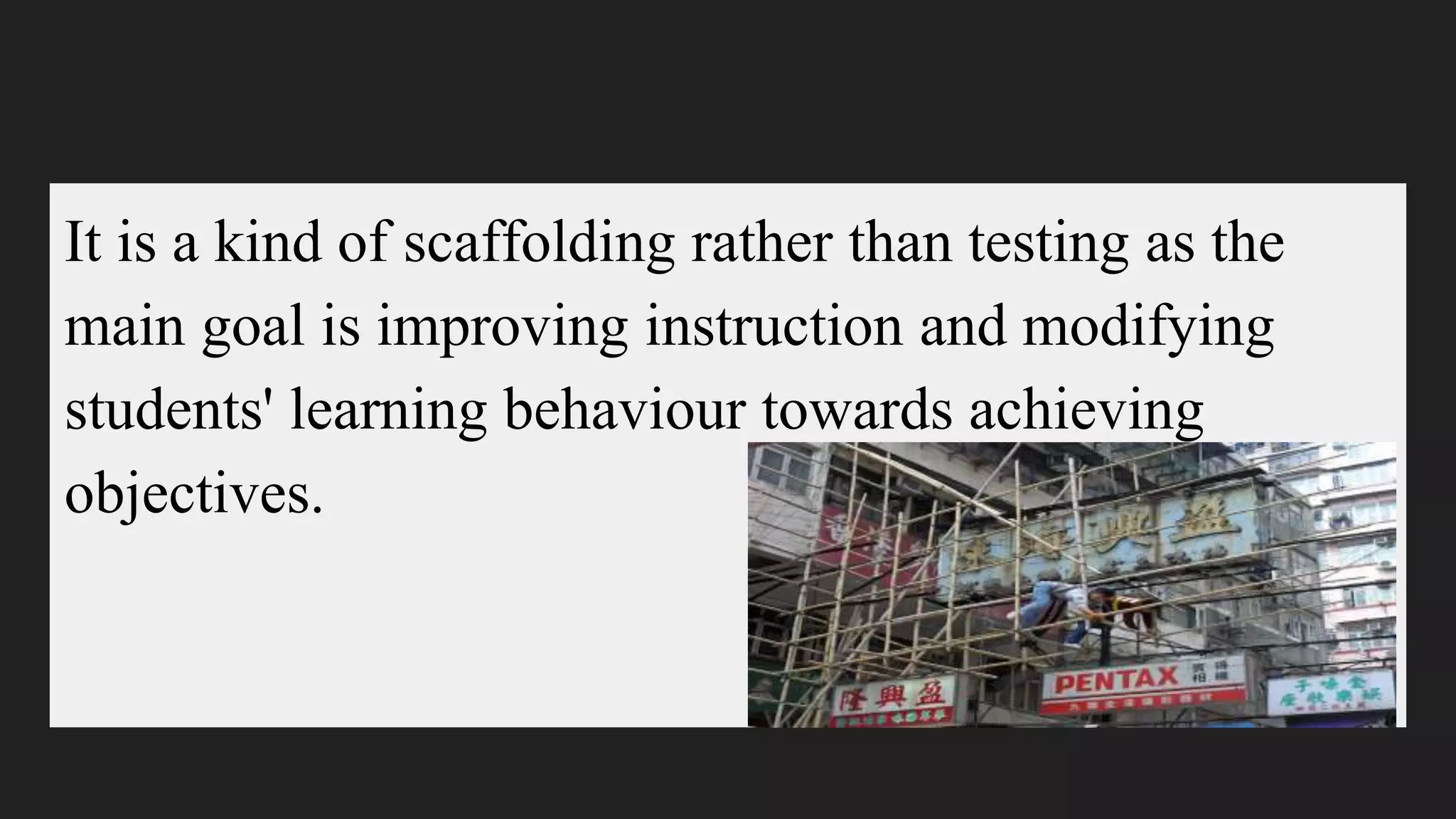
It is a kind of scaffolding rather than testing as the
main goal is improving instruction and modifying
students' learning behaviour towards achieving
objectives.
Scaffolding strategies
Graphic organizers,
Intentional small groups,
Modelling and gestures
Visuals and realia and connecting to background
knowledge
Matching and filling in the gaps
On the other hand, midterm exams,a final project, a
paper and a monthly test are examples of summative
assessment.Monthly tests or midterm tests can include
filling in the gaps or matching questions too.
This can cause confusion to some educators.Multiple
choice questions can appear in both too
What is the main separating line
between both?
Giving feedback
Effective feedback is
specific
Constructive
focusing on the activity quality rather than quantity
providing opportunities for self assessment and
reflection during learning process.
Feedback could either be oral or written.It could be
done individually,in pairs or peers as a collaborative
work
Case study
Sara is a 5 year old girl. She is excellent at school;
however, she suffers in English grammar exams.
Whenever she gets her monthly record, she finds
that she is below the excellent level just in English.
Sara is frustrated and she hardly likes English
classes. She even thinks of quitting her class and
joining another class.
Her mother visited school to investigate the reason for her
frustration. She met her English teacher. Her newly graduate
English teacher told her mother that she was excellent at the
four skills, but she needed extra curricula activities in
grammar especially her monthly exams and midterm exams.
Mother asked to see Sara's exam papers. Mother consulted
the English supervisor at school. The questions were written
as follows:
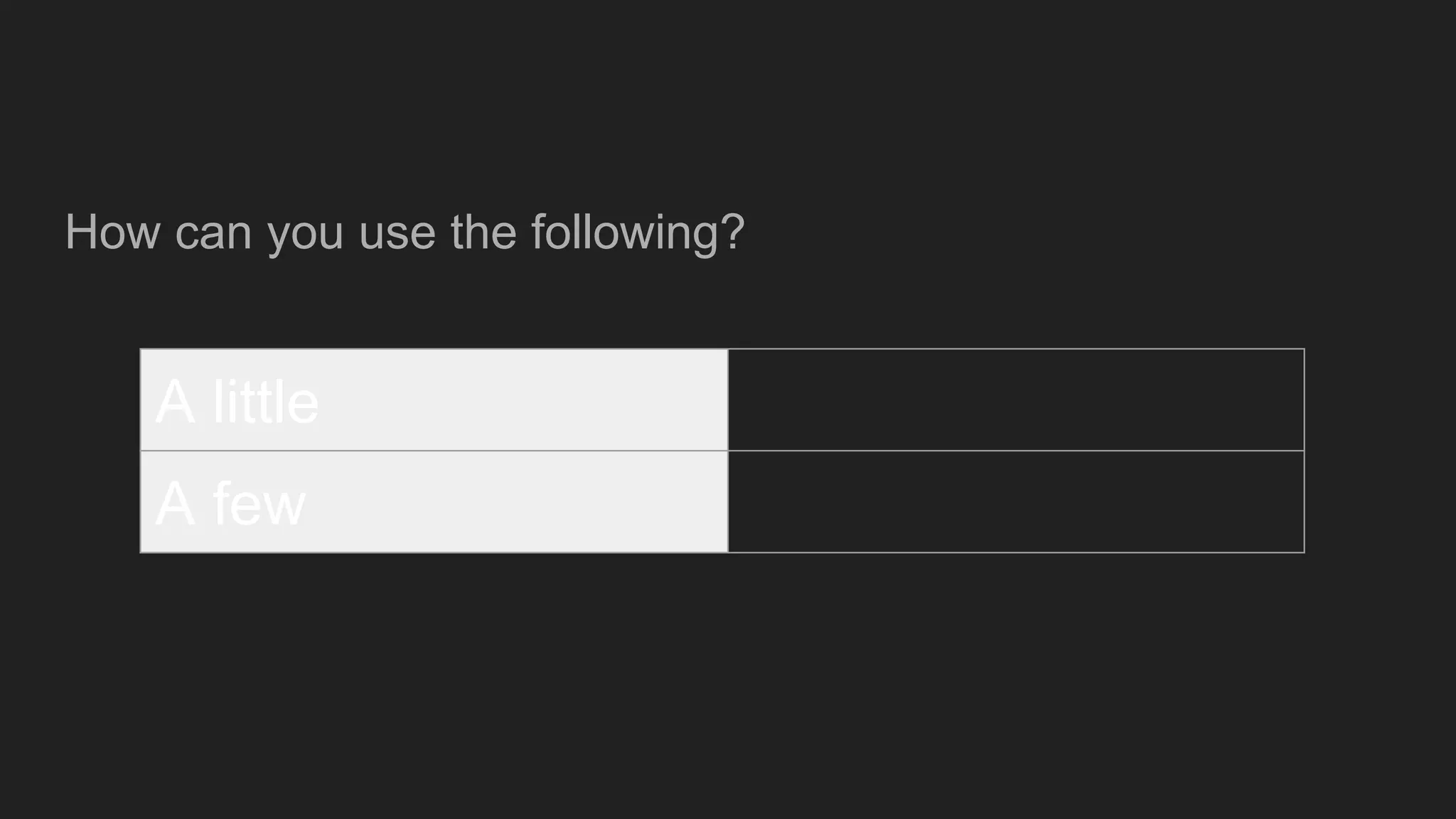
How can you use the following?
A little
A few
The supervisor told Sara's mother that he would
take care of the matter. He sat with the teacher
to tell her how to use scaffolding strategies and
formative assessment.
This was one of the strategies that were
recommended
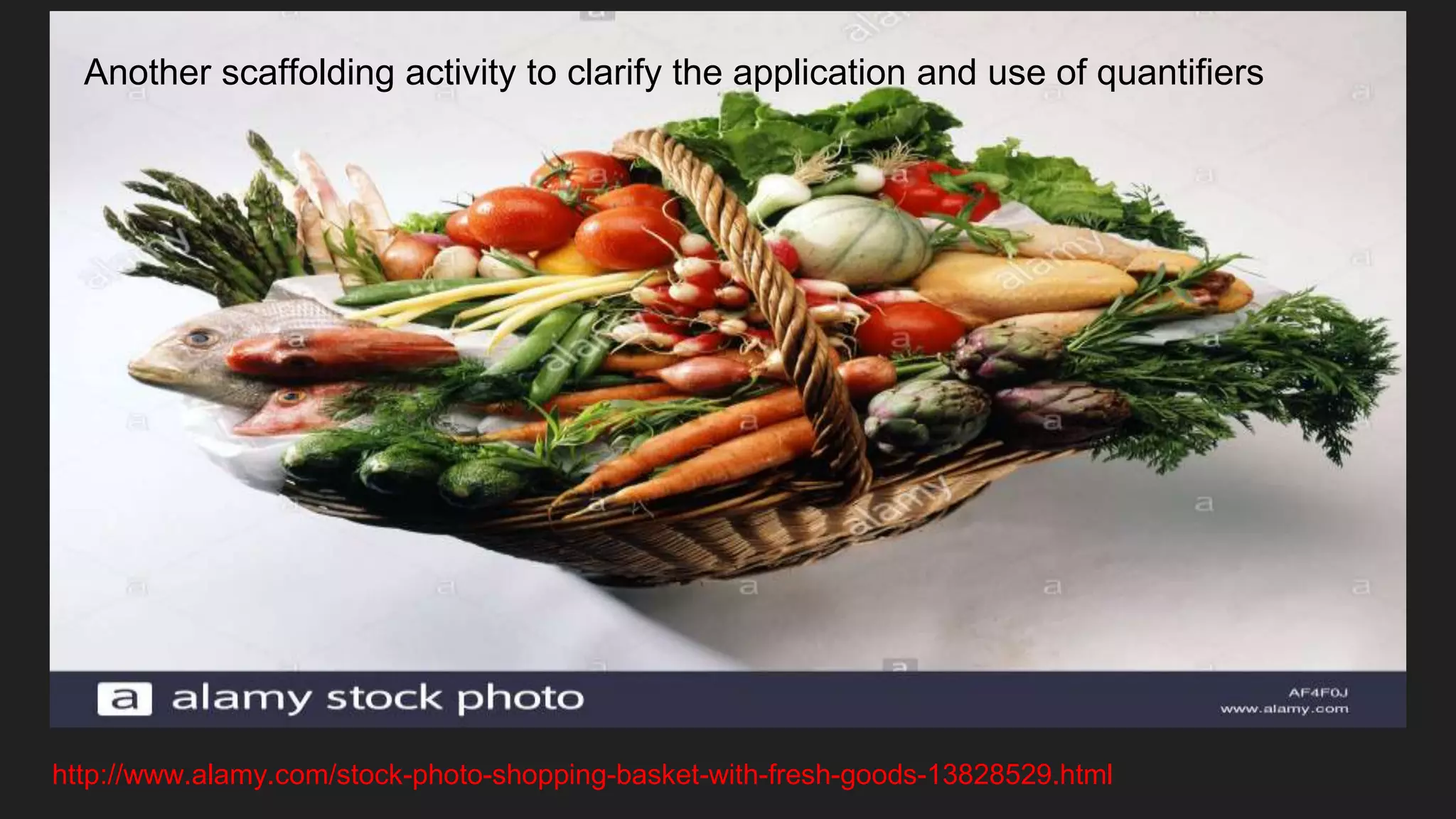
Shopping Run
In this memory game, students use 'a few' and 'a little' with countable and
uncountable shopping items. The students sit in a circle. The first student
completes the sentence 'I went to the supermarket and bought a few...' (with
a countable noun like oranges) The second student must repeat the first
student’s sentence and add an uncountable noun preceded by a little, e.g. I
went to the supermarket and bought a few oranges and a little chocolate.
The students have to remember all of the items mentioned by the other
students and correctly use a few and a little. If a student cannot remember
all the preceding items or uses a little or a few incorrectly, they are out of
http://www.alamy.com/stock-photo-shopping-basket-with-fresh-goods-13828529.html
Another scaffolding activity to clarify the application and use of quantifiers
Also, he advised the newly graduated teacher to use
MCQ, matching and other games and activities for
feedback.He also asked the teacher to help students to
comment on their learning and thus reveals their learning
styles too. Mother discovered that her daughter
improved and she became as top in grammar as all other
subjects.
,So
Be the cook ,not the customer
Assessment and what to assess

Assessment and what to assess

  • 2.
    Assessment and whatto assess Prepared and presented by Ahmed Gendy Central Senior Supervisor Giza Educational Directorate Professional Diploma(Ain Shams University) Teaching Adolescent Learners Diploma(The AUC)
  • 3.
  • 4.
    Definition in education "Itis the systematic collection,review, and use of information about educational programs undertaken for the purpose of improving student learning and development. "
  • 5.
    Simply It is partof instruction and it determines whether or not the goals of education are being met
  • 6.
  • 7.
    Planning Implementing Improving assessment in highereducation by Palomba and Banta 1999)
  • 8.
    What are areasof assessment?
  • 9.
  • 10.
  • 11.
    This means knowledge skills behaviour attitude values Should beincluded in learning objectives as much as possible
  • 12.
    Objectives also include Applyingand using Thinking critically Giving opinion
  • 13.
    Some educators thinkthat assessment is done only after work is finished, but it should be done in advance.
  • 14.
    It is recommendedthat teachers ask "what am I going to assess?What is evidence of the goal I have in mind?”
  • 15.
    What are thetwo most common methods of assessment?
  • 16.
  • 17.
    Advantages of summativeassessment: 1.Its existence (learners will need to be aware of it from the start) provides motivation and helps create an appropriate learning environment.
  • 18.
    2.Positive results givethe trainees a boost in confidence .
  • 19.
    3.The results providea measurable way of determining the success of the training programme, directly comparable to the previous and the next.
  • 20.
    4.Trainers can identifythose areas where results are consistently lower and can then consider alternative delivery methods – helping to develop the training for future events.
  • 21.
    The advantages offormative assessment ● Clarity of goals ● Effectiveness of feedback ● Motivating learners to improve ● Encouraging self and peer assessment ● Involving teachers,students and parents reflecting on evidence.
  • 22.
    Examples of formativeassessment questions Drawing a map for understanding A quiz A puzzle A game Dividing a passage on groups Submitting two sentences for identifying a main topic
  • 23.
    It is akind of scaffolding rather than testing as the main goal is improving instruction and modifying students' learning behaviour towards achieving objectives.
  • 24.
    Scaffolding strategies Graphic organizers, Intentionalsmall groups, Modelling and gestures Visuals and realia and connecting to background knowledge Matching and filling in the gaps
  • 25.
    On the otherhand, midterm exams,a final project, a paper and a monthly test are examples of summative assessment.Monthly tests or midterm tests can include filling in the gaps or matching questions too.
  • 26.
    This can causeconfusion to some educators.Multiple choice questions can appear in both too
  • 27.
    What is themain separating line between both?
  • 28.
  • 29.
    Effective feedback is specific Constructive focusingon the activity quality rather than quantity providing opportunities for self assessment and reflection during learning process.
  • 30.
    Feedback could eitherbe oral or written.It could be done individually,in pairs or peers as a collaborative work
  • 31.
    Case study Sara isa 5 year old girl. She is excellent at school; however, she suffers in English grammar exams. Whenever she gets her monthly record, she finds that she is below the excellent level just in English. Sara is frustrated and she hardly likes English classes. She even thinks of quitting her class and joining another class.

  • 32.
    Her mother visitedschool to investigate the reason for her frustration. She met her English teacher. Her newly graduate English teacher told her mother that she was excellent at the four skills, but she needed extra curricula activities in grammar especially her monthly exams and midterm exams. Mother asked to see Sara's exam papers. Mother consulted the English supervisor at school. The questions were written as follows:
  • 33.
    How can youuse the following? A little A few
  • 34.
    The supervisor toldSara's mother that he would take care of the matter. He sat with the teacher to tell her how to use scaffolding strategies and formative assessment. This was one of the strategies that were recommended
  • 35.
    Shopping Run In thismemory game, students use 'a few' and 'a little' with countable and uncountable shopping items. The students sit in a circle. The first student completes the sentence 'I went to the supermarket and bought a few...' (with a countable noun like oranges) The second student must repeat the first student’s sentence and add an uncountable noun preceded by a little, e.g. I went to the supermarket and bought a few oranges and a little chocolate. The students have to remember all of the items mentioned by the other students and correctly use a few and a little. If a student cannot remember all the preceding items or uses a little or a few incorrectly, they are out of
  • 36.
  • 37.
    Also, he advisedthe newly graduated teacher to use MCQ, matching and other games and activities for feedback.He also asked the teacher to help students to comment on their learning and thus reveals their learning styles too. Mother discovered that her daughter improved and she became as top in grammar as all other subjects.
  • 38.
    ,So Be the cook,not the customer

Editor's Notes

  • #21 Summative assessments can serve as a guide to improve teaching methods. We all use different teaching methodology within the classroom. Summative assessments can help us collaborate and improve teaching methods from year to year. Summative assessments help teachers and administrators alike, in improving curriculum and curriculum planning.