



Self-Analysis is Very Specific to each PersonSituational Analysis Shares some Common Themes1Assess Yourself and Your Situation
Self-ANalysisWhat Went Wrong?Make Sure You Know What You WantWhat Next?Transition Options?2Self Assessment
Personality testsRecommended Read: Type Talk at Work3Self-AnalysisSelf Assessment Websites on Internet
Information about yourself:Wants from a job:ValuesSkillsPersonality traitsInterestsWhat You Liked About Previous work experience, and include:Part time jobsVolunteer workBetter pay Personal growth potential Location Company reputation Opportunity to drive change Entrepreneurial environnentImproved work/life balancePromotion/advancementJob securityBetter cultureIndustry growthBroaden skillsReporting relationship4Self-Analysis: Prioritize Your Needs
Analyze Yourself Against Skills Valued By Most Employers5TeamworkProblem solvingInitiativeDesire to learn new skillsInterpersonal skillsIndependenceCommunicationOral and WrittenEffective or Persuasive?FlexibilityAsk others in your Inner Circle for candid feedback
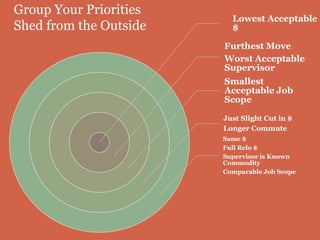
6Group Your PrioritiesShed from the Outside
Don’t Worry, But Do AnalyzeWhy are you “un”employed?What Went Wrong?7
It Probably Wasn’t Your Fault8That doesn’t Mean You Can’t Influence in the Future or spot warning signs, or be better preparedTruth is:Job Transience is the Now the Norm Executives Can Be Short Of Loyalty To A CompanyDecision-maker Loyalty Gap can extend to employees“Employees Are Our Greatest Asset…Because They Are The Easiest To Liquidate”This Recession has been and Remains Severe
Job Transience Is Now the Norm 9People changed employers every 3.4 years(Source: Bureau of Labor Stats. Of the U.S. Dept. of Labor)Average Job in America Lasts only 2.1 years (Dave Ramsey)Chart Data from ExecuNet
What Went Wrong?Field?Are you in a field that suits you? Your lifestyle?Is your field cyclical? Subject to downturn?Is your field simply in decline?  What other fields interest you?Industry?Is your Industry cyclical? In decline? Moving overseas?  Morphing into something else?Do you want to follow? Leave?   What sectors, or sister industries are doing better and would value your experience?Company?Was your company too big, too small, too rigid, too greedy, too bureaucratic?  What was right and wrong about the culture?Boss?Would you welcome the opportunity to work for this person again?  Why or why not?  What characteristics should you be looking for in your next boss?10
Consider making changesWhat Next?11
Consider Prudent Changes12
Switching Industries13According to ExecuNet's2009 Executive Job Market Intelligence Report Corporate HR Departments in 2003 reported hiring 14.5% from outside their industry, and that number grew to 21.3% by 2008.The same report indicated Search Firms only placed 12.1% in a new industry.Conclusions:Better to contact companies directly if seeking to switch industries than to go through a Search FirmOpportunity to switch industry is improving Best to look into growing Industries – What are they?
14
Top Functions15
Many People Use the Phrase “In Transition” when they are actually just unemployedYou are not “In Transition” until you are In School, Volunteering, Working Temporary, Working Part-Time, or Working Full-Time in a job that is undersized for your skillsTransition Options16
Why Do Anything But Look for a New Job?Don’t I Deserve Time Off?  Some Job Hunters React as if Job Hunting should be a full time + effort, so why do anything else? It’s better to:Avoid Job Search BurnoutNO!Some Job Hunters find every excuse to procrastinate – you need a steady, balanced approach.  Filling Your Time with other activities Can generate New Job Leads, Can keep you Sharp, and Looks better on your resume (especially the next time you are looking)17Avoid the Extremes
Transition OptionsTemporary Fulltime WorkSub-Consulting / ContractingPart-time WorkSub-Consulting / ContractingTraining Others / Teaching CoursesImprove Credentials (Severance Funding?)Continuing Ed / Certifications / University Courses (Speeds Unemployment Insurance in NC)VolunteerCan become a problem if you need the moneyFull-time Undersized JobHazard: Can become a rut, demoralize, not look good on your resumeBenefit: Can be a launch pad to something better, provide insights to other opportunities, and is usually better on your resume than a blank18
Temporary Work19If you are looking for a full-time job but are having trouble finding one, consider temporary work. In addition to providing you with an income while you search for permanent employment, “temping” or “sub-consulting” can help you:Gain work experience in a variety of environments;Develop or enhance your skills; andExplore career fields.
Age Bias is Real, But Deal with It 2044 percent of senior-level executives surveyed by ExecuNet were in strong agreement that their age will affect their ability to land their next position — up from 33 percent last yearDespite increased awareness and federal protection, charges of age bias have escalated. In fiscal year 2008, the US Equal Employment Opportunity Commission logged more than 24,000 charges of age discrimination and recovered $82.8 million in monetary benefits. That’s a sharp increase over the previous year’s 19,103 charges and $66.8 million recovery.www.ExecuNet.com Survey
Consulting for the Over-50 Group21If you're in career transition and over 50, consider a solo- or sub-consulting role.  Such work can serve as a confidence-booster as you further expand your skills and knowledge, and enable you to make valuable network connections that can help you find your next permanent positionSub- or Solo-Consulting can be a great response to the question, 'What have you been doing?', and it can lead to an enhanced skill set and more confidence.While the rewards can be far-reaching, you need appropriate skills to be a successful consultant.  Consulting requires good listening and communication, openness, excellent problem-solving, tolerance for ambiguity and high cognitive complexity. You should be realistic about whether you have the requisite skills.
Part-Time/ Temporary Jobs22	Part-time or temporary jobs can help you while you are seeking full time employment. These jobs are stop-gaps in that you have no intention of remaining in them for an extended period of time.The Optimumpart-time or temporary jobs can offer:Adequate income on a regular basis to help you to financially; Near immediate entry and exit from it (So you can take that better Full-time opportunity when it comes); Moderate demand on your working time so that you can continue to explore a permanent career area; andAfford you continual contact with a wide variety of people so that you can make contacts during your work time that might be helpful in your career exploration.
Examples of Part-time/ Temporary Jobs23Advertising space salespersonBartenderCab/bus/train driverCall CenterCensus takerComparison shopperDomestic / house cleanerEmployment agency interviewerGolf caddieHandymanMail carrierMarketing research interviewerMuseum guardOf CounselOpinion poll interviewerPainterPhotographer’s assistantReceptionistRecruiterRetail store clerkSecurity guardShort order cookSub-ConsultantTemporary office workerTrainer / InstructorTravel agentWaitress/waiterWebmaster / Website Designer
Temporary Service Firms24Finding the Right Temp Firm:Does the firm offer any individualized training programs?Does the firm perform adequate screening tests?Will the coordinator place you in jobs that meet your needs? Investigate the Firm’s ReputationGet recommendations from the current “temps” as well as from client companies.Don’t Assume there are no Temp Firms in your specialtyDon’t Assume Temp firms only deal with non-exempt level positions
Go Back to School?25Can help a change in function, field, or career direction – not as needed for an industry changeThink about professional continuing education and certification programsConsider online and night school options so that you can quickly return to work without interrupting classes
Volunteering26Think about organizations that can use your skillsNon-profitsEducationGovernment Agencies
Are You Still on the Payroll?Have You Been Offered Severance?What Are Your Financial Realities?27Assess Your Situation
Can You GET Happy?28If You Are Unhappy
Satisfaction by Function29
Top Reasons For Dissatisfaction301. Limited advancement opportunities2. Lack of challenge/personal growth3. Compensation4. Stress level4. (tied) Job security While stress and job security concerns are mounting, boredom and a shortage of opportunities for advancement remain key drivers of voluntary turnover
What do Employees Need to be Happy?31The need for trust. Expecting the company and management to deliver on its promises, to be honest and open in all communication with you, to invest in you, to treat you fairly and to compensate you in a fair and timely manner.The need to have hope. Believing you will be able to grow, develop your skills and have the opportunity for advancement or career progress.The need to feel a sense of worth. Feeling confident that if you work hard, do your best, demonstrate commitment and make meaningful contributions, you will be recognized and rewarded accordingly.The need to feel competent. Expecting you will be matched to a job that aligns with your talents and your desire for a challenge.
2006 Gallup Poll: Unhappily Employed32
Goal is to Get Happy, But Be Careful33Happy in the same jobHappy in the same company, new jobHappy in a new company
Happy in the Same Job34Keep a To Do List – Scratching off accomplished tasks is a positive feelingFind the Humor – See the funny side of situations (but don’t get sarcastic)Just say no -  Eliminate activities that aren't necessary and that you don't enjoyListen to music while you work - RespectfullyAvoid unproductive meetingsFind and Work on something you're passionate aboutPursue Personal Development GoalsLearn New Skills (Prepare for a New Job)Meet New People (Network)
Happy in the Same Company, New Job35Ask for more responsibilityTake More Responsibility: Work Comes to Those Who Do ItBuild Your Internal Company Network
Get Prepared!Start Looking!RISK: Self Fulfilling Prophecy36Un-Confidently Employed
While You’re Still on the Payroll2nd Mortgage / Credit LineCredit UnionTuition BenefitsHealth BenefitsMedical / Child Care Spending AccountsProfessional Certifications / Continuing EdNetwork / Contacts37
Prep Before Make sure resume / LinkedIn profile is updated and current.Talk to co-workers and colleagues before you leave for their contact information.Talk to vendors / customers / contacts outside the company for their contact information.Don’t download confidential business informationIf you won’t be taking your computer or cell phone with you, get the numbers out well in advance.38
Things You Should ConsiderIf You Have Been Offered Severance39
If You’ve Been Offered SeveranceOver 40? – Employers are Legally Required to Give You 21 days to Review AgreementsNegotiate TermsWrongful Termination?Incompetent Boss or Management is not grounds for claiming Wrongful TerminationLetting You Go for No Reason is not grounds for claiming Wrongful TerminationHarassing you about things related to the job is not grounds for claiming Wrongful TerminationRetaliationRacial, Religious, or Sexual HarassmentAge?Military Service?Family Medical Leave?40
USERRAUniformed Services Employment and  Reemployment Rights ActPrevents Veterans from being discriminated against as a result of military serviceAdministered by the U.S. Dept of Labor, Veterans Employment & Training Service (VETS)For further information/assistance, http://www.dol.gov/vets/programs/userraor call:  860-263-649041
NegotiateRecognize that Employers have No Requirement to Pay ANY SeveranceRecognize that your best time to Negotiate is as close to notice of termination as possibleMoney is not the only thing on the tableConsider value to You versus Cost to CompanyOutplacement?Timing of Severance Payments / Tax Year IssuesSeverance up to $35K can be NC Income Tax Free Office Use?Keep Phone / Blackberry / Laptop / Phone Number?Contingent Additional SeveranceContinuing Education / Classes?42
Most of us work for the money and when the work stops the spending must be managed more closelyFinancial Reality Check43
Invest – Don’t ConsumeChange Your  Behavior Quickly – It’s EasyChanging Your Family’s Behavior May Be More DifficultStop Eating Out Except lunch or coffee for Networking – and learn to Eat Cheap – (Water is free and better for you)Reduce and Delay Spending Where PossibleBudget – Plan Your SpendingFocus on Improving What You Can Control – Don’t Worry about What Can’t be ChangedAccept Charity with Grace44
Health BenefitsMaintaining Continuity of Coverage Can be Critical for Pre-existing ConditionsCan Insurance Shift to a Spouse?COBRARecovery Act Includes COBRA Subsidy45
Taxes and SeveranceNorth Carolina G.S. 105-134.6(b)(11) reads as follows:Severance wages received by a taxpayer from an employer as the result of the taxpayer's permanent, involuntary termination from employment through no fault of the employee. The amount of severance wages deducted as the result of the same termination may not exceed thirty-five thousand dollars ($35,000) for all taxable years in which the wages are received.See http://www.dornc.com/practitioner/individual/directives/pd-98-1.htmlfor additional information.46
Taxes and Job-Search Expenses47If you itemize, job-search expenses are deductible up to a limit which equals 2% of your adjusted gross income. You can deduct certain expenses you have in looking for a new job in your present occupation, even if you do not get a new job. Employment and Outplacement Agency FeesYou can deduct employment and outplacement agency fees you pay in looking for a new job in your present occupation.  This includes fees to online services. ResumeYou can deduct amounts you spend for typing, printing, and mailing copies of a resume to prospective employers if you are looking for a new job in your present occupation.You cannot deduct these expenses if: You are looking for a job in a new occupation, There was a substantial break between the ending of your last job and when you began looking for a new one, or You are looking for a job for the first time.

2. Assessing Yourself And Your Situation

  • 1.
    Self-Analysis is VerySpecific to each PersonSituational Analysis Shares some Common Themes1Assess Yourself and Your Situation
  • 2.
    Self-ANalysisWhat Went Wrong?MakeSure You Know What You WantWhat Next?Transition Options?2Self Assessment
  • 3.
    Personality testsRecommended Read:Type Talk at Work3Self-AnalysisSelf Assessment Websites on Internet
  • 4.
    Information about yourself:Wantsfrom a job:ValuesSkillsPersonality traitsInterestsWhat You Liked About Previous work experience, and include:Part time jobsVolunteer workBetter pay Personal growth potential Location Company reputation Opportunity to drive change Entrepreneurial environnentImproved work/life balancePromotion/advancementJob securityBetter cultureIndustry growthBroaden skillsReporting relationship4Self-Analysis: Prioritize Your Needs
  • 5.
    Analyze Yourself AgainstSkills Valued By Most Employers5TeamworkProblem solvingInitiativeDesire to learn new skillsInterpersonal skillsIndependenceCommunicationOral and WrittenEffective or Persuasive?FlexibilityAsk others in your Inner Circle for candid feedback
  • 6.
  • 7.
    Don’t Worry, ButDo AnalyzeWhy are you “un”employed?What Went Wrong?7
  • 8.
    It Probably Wasn’tYour Fault8That doesn’t Mean You Can’t Influence in the Future or spot warning signs, or be better preparedTruth is:Job Transience is the Now the Norm Executives Can Be Short Of Loyalty To A CompanyDecision-maker Loyalty Gap can extend to employees“Employees Are Our Greatest Asset…Because They Are The Easiest To Liquidate”This Recession has been and Remains Severe
  • 9.
    Job Transience IsNow the Norm 9People changed employers every 3.4 years(Source: Bureau of Labor Stats. Of the U.S. Dept. of Labor)Average Job in America Lasts only 2.1 years (Dave Ramsey)Chart Data from ExecuNet
  • 10.
    What Went Wrong?Field?Areyou in a field that suits you? Your lifestyle?Is your field cyclical? Subject to downturn?Is your field simply in decline? What other fields interest you?Industry?Is your Industry cyclical? In decline? Moving overseas? Morphing into something else?Do you want to follow? Leave? What sectors, or sister industries are doing better and would value your experience?Company?Was your company too big, too small, too rigid, too greedy, too bureaucratic? What was right and wrong about the culture?Boss?Would you welcome the opportunity to work for this person again? Why or why not? What characteristics should you be looking for in your next boss?10
  • 11.
  • 12.
  • 13.
    Switching Industries13According toExecuNet's2009 Executive Job Market Intelligence Report Corporate HR Departments in 2003 reported hiring 14.5% from outside their industry, and that number grew to 21.3% by 2008.The same report indicated Search Firms only placed 12.1% in a new industry.Conclusions:Better to contact companies directly if seeking to switch industries than to go through a Search FirmOpportunity to switch industry is improving Best to look into growing Industries – What are they?
  • 14.
  • 15.
  • 16.
    Many People Usethe Phrase “In Transition” when they are actually just unemployedYou are not “In Transition” until you are In School, Volunteering, Working Temporary, Working Part-Time, or Working Full-Time in a job that is undersized for your skillsTransition Options16
  • 17.
    Why Do AnythingBut Look for a New Job?Don’t I Deserve Time Off? Some Job Hunters React as if Job Hunting should be a full time + effort, so why do anything else? It’s better to:Avoid Job Search BurnoutNO!Some Job Hunters find every excuse to procrastinate – you need a steady, balanced approach. Filling Your Time with other activities Can generate New Job Leads, Can keep you Sharp, and Looks better on your resume (especially the next time you are looking)17Avoid the Extremes
  • 18.
    Transition OptionsTemporary FulltimeWorkSub-Consulting / ContractingPart-time WorkSub-Consulting / ContractingTraining Others / Teaching CoursesImprove Credentials (Severance Funding?)Continuing Ed / Certifications / University Courses (Speeds Unemployment Insurance in NC)VolunteerCan become a problem if you need the moneyFull-time Undersized JobHazard: Can become a rut, demoralize, not look good on your resumeBenefit: Can be a launch pad to something better, provide insights to other opportunities, and is usually better on your resume than a blank18
  • 19.
    Temporary Work19If youare looking for a full-time job but are having trouble finding one, consider temporary work. In addition to providing you with an income while you search for permanent employment, “temping” or “sub-consulting” can help you:Gain work experience in a variety of environments;Develop or enhance your skills; andExplore career fields.
  • 20.
    Age Bias isReal, But Deal with It 2044 percent of senior-level executives surveyed by ExecuNet were in strong agreement that their age will affect their ability to land their next position — up from 33 percent last yearDespite increased awareness and federal protection, charges of age bias have escalated. In fiscal year 2008, the US Equal Employment Opportunity Commission logged more than 24,000 charges of age discrimination and recovered $82.8 million in monetary benefits. That’s a sharp increase over the previous year’s 19,103 charges and $66.8 million recovery.www.ExecuNet.com Survey
  • 21.
    Consulting for theOver-50 Group21If you're in career transition and over 50, consider a solo- or sub-consulting role. Such work can serve as a confidence-booster as you further expand your skills and knowledge, and enable you to make valuable network connections that can help you find your next permanent positionSub- or Solo-Consulting can be a great response to the question, 'What have you been doing?', and it can lead to an enhanced skill set and more confidence.While the rewards can be far-reaching, you need appropriate skills to be a successful consultant. Consulting requires good listening and communication, openness, excellent problem-solving, tolerance for ambiguity and high cognitive complexity. You should be realistic about whether you have the requisite skills.
  • 22.
    Part-Time/ Temporary Jobs22 Part-timeor temporary jobs can help you while you are seeking full time employment. These jobs are stop-gaps in that you have no intention of remaining in them for an extended period of time.The Optimumpart-time or temporary jobs can offer:Adequate income on a regular basis to help you to financially; Near immediate entry and exit from it (So you can take that better Full-time opportunity when it comes); Moderate demand on your working time so that you can continue to explore a permanent career area; andAfford you continual contact with a wide variety of people so that you can make contacts during your work time that might be helpful in your career exploration.
  • 23.
    Examples of Part-time/Temporary Jobs23Advertising space salespersonBartenderCab/bus/train driverCall CenterCensus takerComparison shopperDomestic / house cleanerEmployment agency interviewerGolf caddieHandymanMail carrierMarketing research interviewerMuseum guardOf CounselOpinion poll interviewerPainterPhotographer’s assistantReceptionistRecruiterRetail store clerkSecurity guardShort order cookSub-ConsultantTemporary office workerTrainer / InstructorTravel agentWaitress/waiterWebmaster / Website Designer
  • 24.
    Temporary Service Firms24Findingthe Right Temp Firm:Does the firm offer any individualized training programs?Does the firm perform adequate screening tests?Will the coordinator place you in jobs that meet your needs? Investigate the Firm’s ReputationGet recommendations from the current “temps” as well as from client companies.Don’t Assume there are no Temp Firms in your specialtyDon’t Assume Temp firms only deal with non-exempt level positions
  • 25.
    Go Back toSchool?25Can help a change in function, field, or career direction – not as needed for an industry changeThink about professional continuing education and certification programsConsider online and night school options so that you can quickly return to work without interrupting classes
  • 26.
    Volunteering26Think about organizationsthat can use your skillsNon-profitsEducationGovernment Agencies
  • 27.
    Are You Stillon the Payroll?Have You Been Offered Severance?What Are Your Financial Realities?27Assess Your Situation
  • 28.
    Can You GETHappy?28If You Are Unhappy
  • 29.
  • 30.
    Top Reasons ForDissatisfaction301. Limited advancement opportunities2. Lack of challenge/personal growth3. Compensation4. Stress level4. (tied) Job security While stress and job security concerns are mounting, boredom and a shortage of opportunities for advancement remain key drivers of voluntary turnover
  • 31.
    What do EmployeesNeed to be Happy?31The need for trust. Expecting the company and management to deliver on its promises, to be honest and open in all communication with you, to invest in you, to treat you fairly and to compensate you in a fair and timely manner.The need to have hope. Believing you will be able to grow, develop your skills and have the opportunity for advancement or career progress.The need to feel a sense of worth. Feeling confident that if you work hard, do your best, demonstrate commitment and make meaningful contributions, you will be recognized and rewarded accordingly.The need to feel competent. Expecting you will be matched to a job that aligns with your talents and your desire for a challenge.
  • 32.
    2006 Gallup Poll:Unhappily Employed32
  • 33.
    Goal is toGet Happy, But Be Careful33Happy in the same jobHappy in the same company, new jobHappy in a new company
  • 34.
    Happy in theSame Job34Keep a To Do List – Scratching off accomplished tasks is a positive feelingFind the Humor – See the funny side of situations (but don’t get sarcastic)Just say no - Eliminate activities that aren't necessary and that you don't enjoyListen to music while you work - RespectfullyAvoid unproductive meetingsFind and Work on something you're passionate aboutPursue Personal Development GoalsLearn New Skills (Prepare for a New Job)Meet New People (Network)
  • 35.
    Happy in theSame Company, New Job35Ask for more responsibilityTake More Responsibility: Work Comes to Those Who Do ItBuild Your Internal Company Network
  • 36.
    Get Prepared!Start Looking!RISK:Self Fulfilling Prophecy36Un-Confidently Employed
  • 37.
    While You’re Stillon the Payroll2nd Mortgage / Credit LineCredit UnionTuition BenefitsHealth BenefitsMedical / Child Care Spending AccountsProfessional Certifications / Continuing EdNetwork / Contacts37
  • 38.
    Prep Before Makesure resume / LinkedIn profile is updated and current.Talk to co-workers and colleagues before you leave for their contact information.Talk to vendors / customers / contacts outside the company for their contact information.Don’t download confidential business informationIf you won’t be taking your computer or cell phone with you, get the numbers out well in advance.38
  • 39.
    Things You ShouldConsiderIf You Have Been Offered Severance39
  • 40.
    If You’ve BeenOffered SeveranceOver 40? – Employers are Legally Required to Give You 21 days to Review AgreementsNegotiate TermsWrongful Termination?Incompetent Boss or Management is not grounds for claiming Wrongful TerminationLetting You Go for No Reason is not grounds for claiming Wrongful TerminationHarassing you about things related to the job is not grounds for claiming Wrongful TerminationRetaliationRacial, Religious, or Sexual HarassmentAge?Military Service?Family Medical Leave?40
  • 41.
    USERRAUniformed Services Employmentand Reemployment Rights ActPrevents Veterans from being discriminated against as a result of military serviceAdministered by the U.S. Dept of Labor, Veterans Employment & Training Service (VETS)For further information/assistance, http://www.dol.gov/vets/programs/userraor call: 860-263-649041
  • 42.
    NegotiateRecognize that Employershave No Requirement to Pay ANY SeveranceRecognize that your best time to Negotiate is as close to notice of termination as possibleMoney is not the only thing on the tableConsider value to You versus Cost to CompanyOutplacement?Timing of Severance Payments / Tax Year IssuesSeverance up to $35K can be NC Income Tax Free Office Use?Keep Phone / Blackberry / Laptop / Phone Number?Contingent Additional SeveranceContinuing Education / Classes?42
  • 43.
    Most of uswork for the money and when the work stops the spending must be managed more closelyFinancial Reality Check43
  • 44.
    Invest – Don’tConsumeChange Your Behavior Quickly – It’s EasyChanging Your Family’s Behavior May Be More DifficultStop Eating Out Except lunch or coffee for Networking – and learn to Eat Cheap – (Water is free and better for you)Reduce and Delay Spending Where PossibleBudget – Plan Your SpendingFocus on Improving What You Can Control – Don’t Worry about What Can’t be ChangedAccept Charity with Grace44
  • 45.
    Health BenefitsMaintaining Continuityof Coverage Can be Critical for Pre-existing ConditionsCan Insurance Shift to a Spouse?COBRARecovery Act Includes COBRA Subsidy45
  • 46.
    Taxes and SeveranceNorthCarolina G.S. 105-134.6(b)(11) reads as follows:Severance wages received by a taxpayer from an employer as the result of the taxpayer's permanent, involuntary termination from employment through no fault of the employee. The amount of severance wages deducted as the result of the same termination may not exceed thirty-five thousand dollars ($35,000) for all taxable years in which the wages are received.See http://www.dornc.com/practitioner/individual/directives/pd-98-1.htmlfor additional information.46
  • 47.
    Taxes and Job-SearchExpenses47If you itemize, job-search expenses are deductible up to a limit which equals 2% of your adjusted gross income. You can deduct certain expenses you have in looking for a new job in your present occupation, even if you do not get a new job. Employment and Outplacement Agency FeesYou can deduct employment and outplacement agency fees you pay in looking for a new job in your present occupation. This includes fees to online services. ResumeYou can deduct amounts you spend for typing, printing, and mailing copies of a resume to prospective employers if you are looking for a new job in your present occupation.You cannot deduct these expenses if: You are looking for a job in a new occupation, There was a substantial break between the ending of your last job and when you began looking for a new one, or You are looking for a job for the first time.

Editor's Notes

  • #33 12 January 2006:12 January 2006 Gallup Study: Feeling Good Matters in the Workplace @ http://gmj.gallup.com/content/20770/Gallup-Study-Feeling-Good-Matters-in-the.aspx
  • #34 My Be Careful Story: Had a guy contact me to be my “Career Coach” and help me “realize my full potential.” We dialogued a few weeks and he told me I needed to assert myself with my boss and lay out a number of simple changes in the company (that had been previously agreed to, but not implemented) that needed to happen to help me be successful at my job. I did that one Thursday and it seemed to go very well with my boss, but the following Tuesday I got notice I was being laid-off. When I called my Career Coach, he wasn’t in and I left a message telling him what happened. He never called me back. Ever.
  • #47 Q: Does a taxpayer who is terminated from a job outside of North Carolina and who then moves into North Carolina qualify for the deduction for severance wages paid after becoming a resident of North Carolina?A: Yes. Q: If a taxpayer receives $20,000 of qualifying severance wages while a resident and another $20,000 while a nonresident, what deduction may the taxpayer take?A: Because the entire amount of severance wages received will be included in federal taxable income, the allowable deduction claimed on line 40 of the return in this case would be $35,000. In determining the percentage of income taxable to North Carolina (lines 42 through 46), the taxpayer must reduce line 42 by $20,000 since that amount was paid while the taxpayerwas a resident. Severance wages paid to a nonresident are not taxable by North Carolina even if paid in connection with a job in North Carolina; consequently, neither the income nor deduction should be considered in completing lines 42 or 43. Total income on line 45 should be reduced by the total amount of qualifying severance wages, not to exceed $35,000.Q: If both spouses receive severance wages that qualify for the deduction, may each spouse claim a deduction of up to $35,000 if they file a joint return or is the total deduction for both spouses limited to $35,000?A: Each spouse is entitled to a deduction of up to $35,000 for qualifying severance wages received during the taxable year. Q: If an employee is offered a different job with new responsibilities or at a reduced salary and the employee declines the offer and is terminated, is the termination considered involuntary?A: No.Q: If an employer relocates and the employee is terminated because the employee elects not to relocate, is the termination considered involuntary?A: Yes.If you have questions about this directive, you may call the Personal Taxes Division of the North Carolina Department of Revenue at (919)733-3565.