UNCLASSIFIED / NON CLASSIFIÉ
Implementing the One-for-One Rule
Background, mechanics, results and lessons
1
Regulatory Affairs Sector
February 2017
UNCLASSIFIED / NON CLASSIFIÉ
2
Background: Origin of the One-for-One Rule
The Red Tape Reduction Commission (RTRC) set up in 2011 to provide advice to the
Government of Canada on how to reduce “red tape” on business
– There were then about 2,600 federal regulations in place
The RTRC concluded:
– The total administrative burden of existing regulations and regulatory program
activities is too large (and regulators are unaware of it)
– Although the existing stock of regulatory requirements is the main problem,
administrative burden continues to increase with every new regulation and its
associated program and activities
The RTRC recommended:
– Legislate a One-for-One Rule to reduce regulatory administrative burden
– Every time the Government proposes a new regulation with administrative burden, it
must eliminate at least one existing regulation as well as the equivalent costs in
administrative burden so as to ensure a zero net sum approach
The Rule was implemented as a policy in 2012 and legislated in 2015
UNCLASSIFIED / NON CLASSIFIÉ
3
Background: How the Rule works
Control the growth of administrative burden cost
– New administrative costs imposed must be offset, within 24 months (required by
legislation), by a reduction in administrative costs from the existing stock of
regulations within a portfolio (required by policy)
Control the growth of the volume of regulations
– Each time a new regulation is introduced that imposes new administrative burden
on business, an existing one, within a portfolio, must be removed within 24 months
Exempt selected categories of regulations where compliance would compromise
public safety, health or the economy
– Exemptions cover three categories of regulations: tax administration; international
or legal obligations; and emergency, unique or exceptional circumstances
Report on performance and assess departmental compliance with the Rule
– The President of the Treasury Board must make public each year a report on the
application of the Rule
– The Treasury Board Secretariat (TBS) annually assesses departments and agencies
on compliance with reconciliation and reporting requirements under the Rule
UNCLASSIFIED / NON CLASSIFIÉ
4
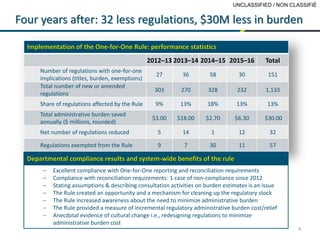
Four years after: 32 less regulations, $30M less in burden
Implementation of the One-for-One Rule: performance statistics
2012–13 2013–14 2014–15 2015–16 Total
Number of regulations with one-for-one
implications (titles, burden, exemptions)
27 36 58 30 151
Total number of new or amended
regulations
303 270 328 232 1,133
Share of regulations affected by the Rule 9% 13% 18% 13% 13%
Total administrative burden saved
annually ($ millions, rounded)
$3.00 $18.00 $2.70 $6.30 $30.00
Net number of regulations reduced 5 14 1 12 32
Regulations exempted from the Rule 9 7 30 11 57
Departmental compliance results and system-wide benefits of the rule
– Excellent compliance with One-for-One reporting and reconciliation requirements
– Compliance with reconciliation requirements: 1 case of non-compliance since 2012
– Stating assumptions & describing consultation activities on burden estimates is an issue
– The Rule created an opportunity and a mechanism for cleaning up the regulatory stock
– The Rule increased awareness about the need to minimize administrative burden
– The Rule provided a measure of incremental regulatory administrative burden cost/relief
– Anecdotal evidence of cultural change i.e., redesigning regulations to minimize
administrative burden cost
UNCLASSIFIED / NON CLASSIFIÉ
5
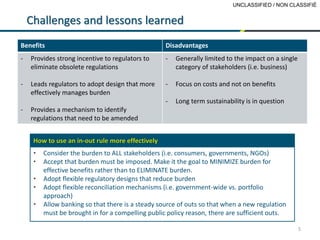
Challenges and lessons learned
Benefits Disadvantages
- Provides strong incentive to regulators to
eliminate obsolete regulations
- Leads regulators to adopt design that more
effectively manages burden
- Provides a mechanism to identify
regulations that need to be amended
- Generally limited to the impact on a single
category of stakeholders (i.e. business)
- Focus on costs and not on benefits
- Long term sustainability is in question
• Consider the burden to ALL stakeholders (i.e. consumers, governments, NGOs)
• Accept that burden must be imposed. Make it the goal to MINIMIZE burden for
effective benefits rather than to ELIMINATE burden.
• Adopt flexible regulatory designs that reduce burden
• Adopt flexible reconciliation mechanisms (i.e. government-wide vs. portfolio
approach)
• Allow banking so that there is a steady source of outs so that when a new regulation
must be brought in for a compelling public policy reason, there are sufficient outs.
How to use an in-out rule more effectively
UNCLASSIFIED / NON CLASSIFIÉ
6
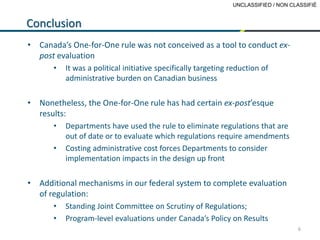
Conclusion
• Canada’s One-for-One rule was not conceived as a tool to conduct ex-
post evaluation
• It was a political initiative specifically targeting reduction of
administrative burden on Canadian business
• Nonetheless, the One-for-One rule has had certain ex-post’esque
results:
• Departments have used the rule to eliminate regulations that are
out of date or to evaluate which regulations require amendments
• Costing administrative cost forces Departments to consider
implementation impacts in the design up front
• Additional mechanisms in our federal system to complete evaluation
of regulation:
• Standing Joint Committee on Scrutiny of Regulations;
• Program-level evaluations under Canada’s Policy on Results
UNCLASSIFIED / NON CLASSIFIÉ
7
Appendices
UNCLASSIFIED / NON CLASSIFIÉ
8
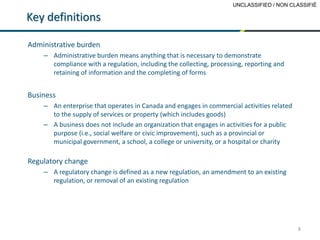
Key definitions
Administrative burden
– Administrative burden means anything that is necessary to demonstrate
compliance with a regulation, including the collecting, processing, reporting and
retaining of information and the completing of forms
Business
– An enterprise that operates in Canada and engages in commercial activities related
to the supply of services or property (which includes goods)
– A business does not include an organization that engages in activities for a public
purpose (i.e., social welfare or civic improvement), such as a provincial or
municipal government, a school, a college or university, or a hospital or charity
Regulatory change
– A regulatory change is defined as a new regulation, an amendment to an existing
regulation, or removal of an existing regulation
UNCLASSIFIED / NON CLASSIFIÉ
9
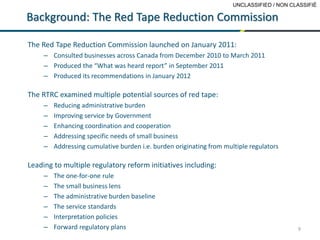
Background: The Red Tape Reduction Commission
The Red Tape Reduction Commission launched on January 2011:
– Consulted businesses across Canada from December 2010 to March 2011
– Produced the “What was heard report” in September 2011
– Produced its recommendations in January 2012
The RTRC examined multiple potential sources of red tape:
– Reducing administrative burden
– Improving service by Government
– Enhancing coordination and cooperation
– Addressing specific needs of small business
– Addressing cumulative burden i.e. burden originating from multiple regulators
Leading to multiple regulatory reform initiatives including:
– The one-for-one rule
– The small business lens
– The administrative burden baseline
– The service standards
– Interpretation policies
– Forward regulatory plans
UNCLASSIFIED / NON CLASSIFIÉ
10
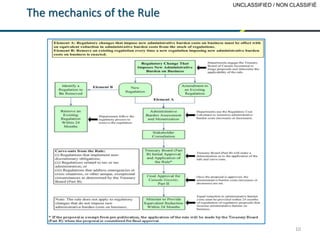
The mechanics of the Rule
UNCLASSIFIED / NON CLASSIFIÉ
11
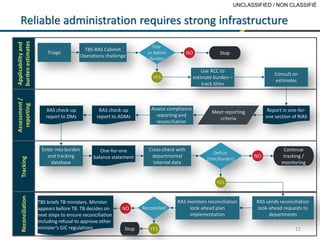
Reliable administration requires strong infrastructure
NO
TBS-RAS Cabinet
Operations challenge
Title
or Admin
Burden
YES
Applicabilityand
burdenestimates
Assessment/
reporting
Tracking
Report in one-for-
one section of RIAS
Reconciliation
RAS check-up
report to ADMs
RAS check-up
report to DMs
One-for-one
balance statement
Deficit
(title/burden)
NO
Continue
tracking /
monitoring
YES
ReconciledNO
YES
TBS briefs TB ministers. Minister
appears before TB. TB decides on
next steps to ensure reconciliation
including refusal to approve other
minister’s GIC regulations
Stop
Stop
Triage
Consult on
estimates
Enter into burden
and tracking
database
Use RCC to
estimate burden –
track titles
Meet reporting
criteria
Assess compliance
reporting and
reconciliation
RAS monitors reconciliation
look-ahead plan
implementation
RAS sends reconciliation
look-ahead requests to
departments
Cross-check with
departmental
internal data
UNCLASSIFIED / NON CLASSIFIÉ
12
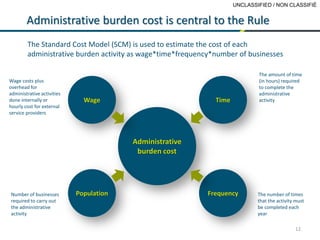
Administrative burden cost is central to the Rule
Administrative
burden cost
Population Frequency
Wage Time
Wage costs plus
overhead for
administrative activities
done internally or
hourly cost for external
service providers
The amount of time
(in hours) required
to complete the
administrative
activity
The number of times
that the activity must
be completed each
year
Number of businesses
required to carry out
the administrative
activity
The Standard Cost Model (SCM) is used to estimate the cost of each
administrative burden activity as wage*time*frequency*number of businesses
UNCLASSIFIED / NON CLASSIFIÉ
13
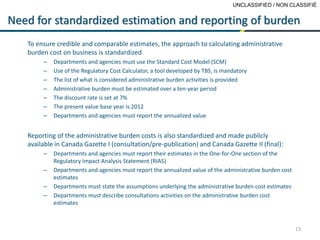
Need for standardized estimation and reporting of burden
To ensure credible and comparable estimates, the approach to calculating administrative
burden cost on business is standardized
– Departments and agencies must use the Standard Cost Model (SCM)
– Use of the Regulatory Cost Calculator, a tool developed by TBS, is mandatory
– The list of what is considered administrative burden activities is provided
– Administrative burden must be estimated over a ten-year period
– The discount rate is set at 7%
– The present value base year is 2012
– Departments and agencies must report the annualized value
Reporting of the administrative burden costs is also standardized and made publicly
available in Canada Gazette I (consultation/pre-publication) and Canada Gazette II (final):
– Departments and agencies must report their estimates in the One-for-One section of the
Regulatory Impact Analysis Statement (RIAS)
– Departments and agencies must report the annualized value of the administrative burden cost
estimates
– Departments must state the assumptions underlying the administrative burden cost estimates
– Departments must describe consultations activities on the administrative burden cost
estimates
UNCLASSIFIED / NON CLASSIFIÉ
14
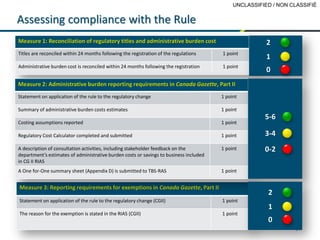
Assessing compliance with the Rule
Measure 1: Reconciliation of regulatory titles and administrative burden cost
Titles are reconciled within 24 months following the registration of the regulations 1 point
Administrative burden cost is reconciled within 24 months following the registration 1 point
Measure 3: Reporting requirements for exemptions in Canada Gazette, Part II
Statement on application of the rule to the regulatory change (CGII) 1 point
The reason for the exemption is stated in the RIAS (CGII) 1 point
Measure 2: Administrative burden reporting requirements in Canada Gazette, Part II
Statement on application of the rule to the regulatory change 1 point
Summary of administrative burden costs estimates 1 point
Costing assumptions reported 1 point
Regulatory Cost Calculator completed and submitted 1 point
A description of consultation activities, including stakeholder feedback on the
department’s estimates of administrative burden costs or savings to business included
in CG II RIAS
1 point
A One for-One summary sheet (Appendix D) is submitted to TBS-RAS 1 point
2
0
1
2
0
1
5-6
0-2
3-4
UNCLASSIFIED / NON CLASSIFIÉ
15
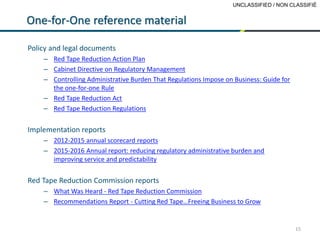
One-for-One reference material
Policy and legal documents
– Red Tape Reduction Action Plan
– Cabinet Directive on Regulatory Management
– Controlling Administrative Burden That Regulations Impose on Business: Guide for
the one-for-one Rule
– Red Tape Reduction Act
– Red Tape Reduction Regulations
Implementation reports
– 2012-2015 annual scorecard reports
– 2015-2016 Annual report: reducing regulatory administrative burden and
improving service and predictability
Red Tape Reduction Commission reports
– What Was Heard - Red Tape Reduction Commission
– Recommendations Report - Cutting Red Tape…Freeing Business to Grow

Implementing the One-for-One Rule: Background, Mechanics, Results and Lessons

  • 1.
    UNCLASSIFIED / NONCLASSIFIÉ Implementing the One-for-One Rule Background, mechanics, results and lessons 1 Regulatory Affairs Sector February 2017
  • 2.
    UNCLASSIFIED / NONCLASSIFIÉ 2 Background: Origin of the One-for-One Rule The Red Tape Reduction Commission (RTRC) set up in 2011 to provide advice to the Government of Canada on how to reduce “red tape” on business – There were then about 2,600 federal regulations in place The RTRC concluded: – The total administrative burden of existing regulations and regulatory program activities is too large (and regulators are unaware of it) – Although the existing stock of regulatory requirements is the main problem, administrative burden continues to increase with every new regulation and its associated program and activities The RTRC recommended: – Legislate a One-for-One Rule to reduce regulatory administrative burden – Every time the Government proposes a new regulation with administrative burden, it must eliminate at least one existing regulation as well as the equivalent costs in administrative burden so as to ensure a zero net sum approach The Rule was implemented as a policy in 2012 and legislated in 2015
  • 3.
    UNCLASSIFIED / NONCLASSIFIÉ 3 Background: How the Rule works Control the growth of administrative burden cost – New administrative costs imposed must be offset, within 24 months (required by legislation), by a reduction in administrative costs from the existing stock of regulations within a portfolio (required by policy) Control the growth of the volume of regulations – Each time a new regulation is introduced that imposes new administrative burden on business, an existing one, within a portfolio, must be removed within 24 months Exempt selected categories of regulations where compliance would compromise public safety, health or the economy – Exemptions cover three categories of regulations: tax administration; international or legal obligations; and emergency, unique or exceptional circumstances Report on performance and assess departmental compliance with the Rule – The President of the Treasury Board must make public each year a report on the application of the Rule – The Treasury Board Secretariat (TBS) annually assesses departments and agencies on compliance with reconciliation and reporting requirements under the Rule
  • 4.
    UNCLASSIFIED / NONCLASSIFIÉ 4 Four years after: 32 less regulations, $30M less in burden Implementation of the One-for-One Rule: performance statistics 2012–13 2013–14 2014–15 2015–16 Total Number of regulations with one-for-one implications (titles, burden, exemptions) 27 36 58 30 151 Total number of new or amended regulations 303 270 328 232 1,133 Share of regulations affected by the Rule 9% 13% 18% 13% 13% Total administrative burden saved annually ($ millions, rounded) $3.00 $18.00 $2.70 $6.30 $30.00 Net number of regulations reduced 5 14 1 12 32 Regulations exempted from the Rule 9 7 30 11 57 Departmental compliance results and system-wide benefits of the rule – Excellent compliance with One-for-One reporting and reconciliation requirements – Compliance with reconciliation requirements: 1 case of non-compliance since 2012 – Stating assumptions & describing consultation activities on burden estimates is an issue – The Rule created an opportunity and a mechanism for cleaning up the regulatory stock – The Rule increased awareness about the need to minimize administrative burden – The Rule provided a measure of incremental regulatory administrative burden cost/relief – Anecdotal evidence of cultural change i.e., redesigning regulations to minimize administrative burden cost
  • 5.
    UNCLASSIFIED / NONCLASSIFIÉ 5 Challenges and lessons learned Benefits Disadvantages - Provides strong incentive to regulators to eliminate obsolete regulations - Leads regulators to adopt design that more effectively manages burden - Provides a mechanism to identify regulations that need to be amended - Generally limited to the impact on a single category of stakeholders (i.e. business) - Focus on costs and not on benefits - Long term sustainability is in question • Consider the burden to ALL stakeholders (i.e. consumers, governments, NGOs) • Accept that burden must be imposed. Make it the goal to MINIMIZE burden for effective benefits rather than to ELIMINATE burden. • Adopt flexible regulatory designs that reduce burden • Adopt flexible reconciliation mechanisms (i.e. government-wide vs. portfolio approach) • Allow banking so that there is a steady source of outs so that when a new regulation must be brought in for a compelling public policy reason, there are sufficient outs. How to use an in-out rule more effectively
  • 6.
    UNCLASSIFIED / NONCLASSIFIÉ 6 Conclusion • Canada’s One-for-One rule was not conceived as a tool to conduct ex- post evaluation • It was a political initiative specifically targeting reduction of administrative burden on Canadian business • Nonetheless, the One-for-One rule has had certain ex-post’esque results: • Departments have used the rule to eliminate regulations that are out of date or to evaluate which regulations require amendments • Costing administrative cost forces Departments to consider implementation impacts in the design up front • Additional mechanisms in our federal system to complete evaluation of regulation: • Standing Joint Committee on Scrutiny of Regulations; • Program-level evaluations under Canada’s Policy on Results
  • 7.
    UNCLASSIFIED / NONCLASSIFIÉ 7 Appendices
  • 8.
    UNCLASSIFIED / NONCLASSIFIÉ 8 Key definitions Administrative burden – Administrative burden means anything that is necessary to demonstrate compliance with a regulation, including the collecting, processing, reporting and retaining of information and the completing of forms Business – An enterprise that operates in Canada and engages in commercial activities related to the supply of services or property (which includes goods) – A business does not include an organization that engages in activities for a public purpose (i.e., social welfare or civic improvement), such as a provincial or municipal government, a school, a college or university, or a hospital or charity Regulatory change – A regulatory change is defined as a new regulation, an amendment to an existing regulation, or removal of an existing regulation
  • 9.
    UNCLASSIFIED / NONCLASSIFIÉ 9 Background: The Red Tape Reduction Commission The Red Tape Reduction Commission launched on January 2011: – Consulted businesses across Canada from December 2010 to March 2011 – Produced the “What was heard report” in September 2011 – Produced its recommendations in January 2012 The RTRC examined multiple potential sources of red tape: – Reducing administrative burden – Improving service by Government – Enhancing coordination and cooperation – Addressing specific needs of small business – Addressing cumulative burden i.e. burden originating from multiple regulators Leading to multiple regulatory reform initiatives including: – The one-for-one rule – The small business lens – The administrative burden baseline – The service standards – Interpretation policies – Forward regulatory plans
  • 10.
    UNCLASSIFIED / NONCLASSIFIÉ 10 The mechanics of the Rule
  • 11.
    UNCLASSIFIED / NONCLASSIFIÉ 11 Reliable administration requires strong infrastructure NO TBS-RAS Cabinet Operations challenge Title or Admin Burden YES Applicabilityand burdenestimates Assessment/ reporting Tracking Report in one-for- one section of RIAS Reconciliation RAS check-up report to ADMs RAS check-up report to DMs One-for-one balance statement Deficit (title/burden) NO Continue tracking / monitoring YES ReconciledNO YES TBS briefs TB ministers. Minister appears before TB. TB decides on next steps to ensure reconciliation including refusal to approve other minister’s GIC regulations Stop Stop Triage Consult on estimates Enter into burden and tracking database Use RCC to estimate burden – track titles Meet reporting criteria Assess compliance reporting and reconciliation RAS monitors reconciliation look-ahead plan implementation RAS sends reconciliation look-ahead requests to departments Cross-check with departmental internal data
  • 12.
    UNCLASSIFIED / NONCLASSIFIÉ 12 Administrative burden cost is central to the Rule Administrative burden cost Population Frequency Wage Time Wage costs plus overhead for administrative activities done internally or hourly cost for external service providers The amount of time (in hours) required to complete the administrative activity The number of times that the activity must be completed each year Number of businesses required to carry out the administrative activity The Standard Cost Model (SCM) is used to estimate the cost of each administrative burden activity as wage*time*frequency*number of businesses
  • 13.
    UNCLASSIFIED / NONCLASSIFIÉ 13 Need for standardized estimation and reporting of burden To ensure credible and comparable estimates, the approach to calculating administrative burden cost on business is standardized – Departments and agencies must use the Standard Cost Model (SCM) – Use of the Regulatory Cost Calculator, a tool developed by TBS, is mandatory – The list of what is considered administrative burden activities is provided – Administrative burden must be estimated over a ten-year period – The discount rate is set at 7% – The present value base year is 2012 – Departments and agencies must report the annualized value Reporting of the administrative burden costs is also standardized and made publicly available in Canada Gazette I (consultation/pre-publication) and Canada Gazette II (final): – Departments and agencies must report their estimates in the One-for-One section of the Regulatory Impact Analysis Statement (RIAS) – Departments and agencies must report the annualized value of the administrative burden cost estimates – Departments must state the assumptions underlying the administrative burden cost estimates – Departments must describe consultations activities on the administrative burden cost estimates
  • 14.
    UNCLASSIFIED / NONCLASSIFIÉ 14 Assessing compliance with the Rule Measure 1: Reconciliation of regulatory titles and administrative burden cost Titles are reconciled within 24 months following the registration of the regulations 1 point Administrative burden cost is reconciled within 24 months following the registration 1 point Measure 3: Reporting requirements for exemptions in Canada Gazette, Part II Statement on application of the rule to the regulatory change (CGII) 1 point The reason for the exemption is stated in the RIAS (CGII) 1 point Measure 2: Administrative burden reporting requirements in Canada Gazette, Part II Statement on application of the rule to the regulatory change 1 point Summary of administrative burden costs estimates 1 point Costing assumptions reported 1 point Regulatory Cost Calculator completed and submitted 1 point A description of consultation activities, including stakeholder feedback on the department’s estimates of administrative burden costs or savings to business included in CG II RIAS 1 point A One for-One summary sheet (Appendix D) is submitted to TBS-RAS 1 point 2 0 1 2 0 1 5-6 0-2 3-4
  • 15.
    UNCLASSIFIED / NONCLASSIFIÉ 15 One-for-One reference material Policy and legal documents – Red Tape Reduction Action Plan – Cabinet Directive on Regulatory Management – Controlling Administrative Burden That Regulations Impose on Business: Guide for the one-for-one Rule – Red Tape Reduction Act – Red Tape Reduction Regulations Implementation reports – 2012-2015 annual scorecard reports – 2015-2016 Annual report: reducing regulatory administrative burden and improving service and predictability Red Tape Reduction Commission reports – What Was Heard - Red Tape Reduction Commission – Recommendations Report - Cutting Red Tape…Freeing Business to Grow