Instructional Services Librarian 2000-2005
        School Librarian 2005-2012
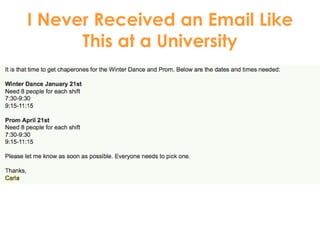
I Never Received an Email Like
      This at a University
Librarians have used a variety of methods to
      assess student learning, some of which include
      pre- and post-tests, citation analysis, and search
      strategy analyses. Assessment activities were
      given a great boost in 2000 when ACRL
      developed its “Information Literacy Competency
      Standards for Education.”


              Diller and Phelps, 2008
“Learning Outcomes, Portfolios, and Rubrics, Oh My!”
Many librarians excel at formative assessment
    activities such as one-to-one feedback,
    miniconferencing, and teachable moments.
    Summative assessment—giving a grade or
    points at the end of a project—often asks us to
    put our heart aside and score with our heads
    instead.


               Fontichiaro, 2011
“Nudging Toward Inquiry: Summative Assessment”
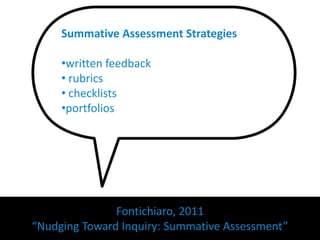
Summative Assessment Strategies

     •written feedback
     • rubrics
     • checklists
     •portfolios


               Fontichiaro, 2011
“Nudging Toward Inquiry: Summative Assessment”
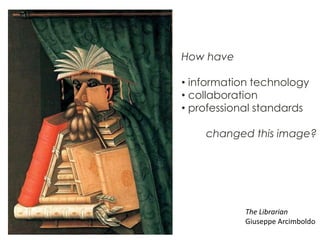
How have

• information technology
• collaboration
• professional standards

    changed this image?


            The Librarian
            Giuseppe Arcimboldo
SYNTHESIS
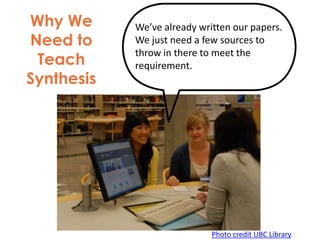
Why We      We’ve already written our papers.
Need to     We just need a few sources to
            throw in there to meet the
 Teach      requirement.
Synthesis


                             Photo credit UBC Library
Many of the students only summarised
            the scholarly sources specified by their
            professor’s bibliographic requirements
            then went on to make assertions about
            their topics without making any
            connection to the scholarly literature so
            carefully accumulated.


                          Rosenblatt, 2010
    “They Can Find It, but They Don’t Know What to Do with It:
Describing the use of scholarly literature by undergraduate students”
Shouldn’t we, as instructional librarians, be
          concerned about students’ abilities to use
          the information they have discovered?


                          Rosenblatt, 2010
    “They Can Find It, but They Don’t Know What to Do with It:
Describing the use of scholarly literature by undergraduate students”
Time previously spent on ensuring that
        students practice keyword searching will in
        future be allocated to modeling the
        synthesis of disparate sources and to
        dissecting the work of experts to see the
        purpose the literature serves in scholarly
        work.


                        Rosenblatt, 2010
   “They Can Find It, but They Don’t Know What to Do with It:
Describing the Use of Scholarly Literature by Undergraduate Students”
When are we reaching for the same goal?
agrading tool that describes how an
        assignment will be assessed. It is a form of
        criterion-referenced assessment,
        consisting of criteria that “divide the
        assignment into its component parts and
        provide[s] a detailed description of what
        constitutes acceptable or unacceptable
        levels of performance for each of those
        parts”


                         Rubric Definition


                        Rosenblatt, 2010
   “They Can Find It, but They Don’t Know What to Do with It:
Describing the Use of Scholarly Literature by Undergraduate Students”
Benefits of Rubrics

         •Makes grading consistent

         •Students have better understanding of
         instructors’ expectations

         •“librarians and their collaborators are forced to
         reflect on and articulate their instructional goals”


                        Rosenblatt, 2010
   “They Can Find It, but They Don’t Know What to Do with It:
Describing the Use of Scholarly Literature by Undergraduate Students”
Rubric Concerns

    • Can be time consuming to create

    •“Be careful not to bundle criteria
    together, as this makes scoring along
    the continuum difficult”


               Fontichiaro, 2011
“Nudging Toward Inquiry: Summative Assessment”
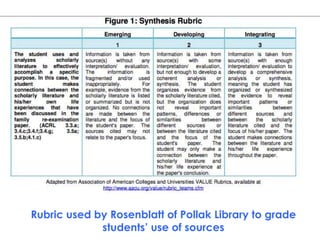
Rubric used by Rosenblatt of Pollak Library to grade
             students’ use of sources
Finding Sample Rubrics
• American Association of Colleges and
  Universities VALUE Rubrics
• Search Merlot for Rubrics for more resources
• Kathy Schrock’s Guide for Educators
  Assessment and Rubric Information
Thanks!
Jeanine Akers
Assistant Library Director
St. Mary’s Episcopal School
jakers@stmarysschool.org

Links to resources available at:
http://bit.ly/y8WNvo

Assessing Learning

  • 2.
    Instructional Services Librarian2000-2005 School Librarian 2005-2012
  • 3.
    I Never Receivedan Email Like This at a University
  • 5.
    Librarians have useda variety of methods to assess student learning, some of which include pre- and post-tests, citation analysis, and search strategy analyses. Assessment activities were given a great boost in 2000 when ACRL developed its “Information Literacy Competency Standards for Education.” Diller and Phelps, 2008 “Learning Outcomes, Portfolios, and Rubrics, Oh My!”
  • 6.
    Many librarians excelat formative assessment activities such as one-to-one feedback, miniconferencing, and teachable moments. Summative assessment—giving a grade or points at the end of a project—often asks us to put our heart aside and score with our heads instead. Fontichiaro, 2011 “Nudging Toward Inquiry: Summative Assessment”
  • 7.
    Summative Assessment Strategies •written feedback • rubrics • checklists •portfolios Fontichiaro, 2011 “Nudging Toward Inquiry: Summative Assessment”
  • 8.
    How have • informationtechnology • collaboration • professional standards changed this image? The Librarian Giuseppe Arcimboldo
  • 9.
  • 10.
    Why We We’ve already written our papers. Need to We just need a few sources to throw in there to meet the Teach requirement. Synthesis Photo credit UBC Library
  • 11.
    Many of thestudents only summarised the scholarly sources specified by their professor’s bibliographic requirements then went on to make assertions about their topics without making any connection to the scholarly literature so carefully accumulated. Rosenblatt, 2010 “They Can Find It, but They Don’t Know What to Do with It: Describing the use of scholarly literature by undergraduate students”
  • 12.
    Shouldn’t we, asinstructional librarians, be concerned about students’ abilities to use the information they have discovered? Rosenblatt, 2010 “They Can Find It, but They Don’t Know What to Do with It: Describing the use of scholarly literature by undergraduate students”
  • 13.
    Time previously spenton ensuring that students practice keyword searching will in future be allocated to modeling the synthesis of disparate sources and to dissecting the work of experts to see the purpose the literature serves in scholarly work. Rosenblatt, 2010 “They Can Find It, but They Don’t Know What to Do with It: Describing the Use of Scholarly Literature by Undergraduate Students”
  • 16.
    When are wereaching for the same goal?
  • 17.
    agrading tool thatdescribes how an assignment will be assessed. It is a form of criterion-referenced assessment, consisting of criteria that “divide the assignment into its component parts and provide[s] a detailed description of what constitutes acceptable or unacceptable levels of performance for each of those parts” Rubric Definition Rosenblatt, 2010 “They Can Find It, but They Don’t Know What to Do with It: Describing the Use of Scholarly Literature by Undergraduate Students”
  • 18.
    Benefits of Rubrics •Makes grading consistent •Students have better understanding of instructors’ expectations •“librarians and their collaborators are forced to reflect on and articulate their instructional goals” Rosenblatt, 2010 “They Can Find It, but They Don’t Know What to Do with It: Describing the Use of Scholarly Literature by Undergraduate Students”
  • 19.
    Rubric Concerns • Can be time consuming to create •“Be careful not to bundle criteria together, as this makes scoring along the continuum difficult” Fontichiaro, 2011 “Nudging Toward Inquiry: Summative Assessment”
  • 21.
    Rubric used byRosenblatt of Pollak Library to grade students’ use of sources
  • 22.
    Finding Sample Rubrics •American Association of Colleges and Universities VALUE Rubrics • Search Merlot for Rubrics for more resources • Kathy Schrock’s Guide for Educators Assessment and Rubric Information
  • 23.
    Thanks! Jeanine Akers Assistant LibraryDirector St. Mary’s Episcopal School jakers@stmarysschool.org Links to resources available at: http://bit.ly/y8WNvo

Editor's Notes

  • #3 Preparing to speak today has been a very useful reflective process for me. I am a person who likes to measure my life in change—in before and after. For example, I always consider myself a northerner and when I was twenty-six-years-old I realized I’d lived in the South longer than I’d ever lived in Michigan – could I really call myself a Yankee still? Well this year I will have been a school librarian longer than I was an academic librarian. Humph, that’s a hard one for me. In library school I wanted nothing but to work in an academic library – and there is a big part of me that still considers myself truly an academic librarian, just masquerading as a school librarian for now (kind of like the Yankee in me hiding behind all of my yawls). In many ways academic and school librarians are not so different – the basic goals are the same, many of the concepts I teach are the same and taught in very similar ways. In other ways it is very different. I certainly never had to chaperone a dance at UNC—Wilmington, Arkansas State or University of Memphis. But when I think about how my work life is different at St. Mary’s than it was in any of the universities where I worked, there is one major and obvious difference and that is GRADING. As an instructional services/reference librarian I never had to grade – and now I do quite a bit of it – and I wouldn’t have it any other way.
  • #5 Assessment is not new to librarians, but working toward authentic, summative assessment is.
  • #6 In the article “Learning Outcomes, Portfolios, and Rubrics, Oh My!” Diller and Phelps have a literature review that traces assessment of student learning back to the Middle Ages. They explain that  Librarians have used a variety of methods to assess student learning, some of which include pre- and post-tests, citation analysis, and search strategy analyses. Assessment acitivites were given a great boost in 2000 when ACRL developed its “Information Literacy Competency Standards for Education.”  As an instruction librarian, these were the kinds of assessment I was always trying to do. As a school librarian that has changed.
  • #7 In the “Into the Curriculum” column in the April 2011 issue of School Library Monthly Kristin Fontichiaro, a professor at the University of Michigan and a former teacher at my school wrote: Many librarians excel at formative assessment activities such as one-to-one feedback, microconferencing, and teachable moments. Summative assessment—giving a grade or points at the end of a project—often asks us to put our heart aside and score with our heads instead.
  • #8 I agree with Fontichiaro—historically librarians have not been asked to provide summative assessment of student work – but that is changing and I think not just for schools.
  • #9 I think there are several reasons for this shift in librarians’ roles. First, I think it grew out of a change in the information landscape – as it has become easier for students to connect with sources it has become more important to devote time to making sure that they can actually use the sources. Please don’t hear me say that we don’t need to teach students to locate and evalute sources anymore. I just think that is step 1. Using sources also needs to be emphasized. Secondly I think as librarians have had more useful collaborations with instructors and have become more embedded in the courses, conversations about what was needed have evolved. Finally, I think the standards that guide our professions (The ACRL Information Literacy Competency Standards for Higher Education and the AASL Standards for the 21st Century Learner both emphasize information use and as we try to live up to the standards, we have seen the using information effectively/sharing knowledge as more a part of our job.
  • #10 The shift from finding sources to using sources has made the word synthesis very important to my life. Perhaps the biggest aspect of the shift: from search to use.1
  • #11 How many of you have ever been on a reference desk and had a student say, “I’ve already written my paper, I just need some sources to throw in.”
  • #12 In the article”They Can Find It, but Can They Don’t Know What To Do with It: Describing the Use of Scholarly Literature by Undergraduate Students” from the Journal of Information Literacy, Rosenblatt describes a two-part research study. First it looked at students ability to find reliable sources. While looking at essays, they determined that students could find reliable sources, even if they hadn’t attended library instruction. But they discovered that the students could not use the sources well. That brought about the second part of the study in which the essays were looked at for use of the scholarly sources. In my experience, they have difficulty reading and understanding and summarizing accurately, in addition to failing to synthesize information rather than just throwing it in randomly.
  • #13 In the article”They Can Find It, but Can They Don’t Know What To Do with It: Describing the Use of Scholarly Literature by Undergraduate Students” from the Journal of Information Literacy, Rosenblatt describes a two-part research study. First it looked at students ability to find reliable sources. While looking at essays, they determined that students could find reliable sources, even if they hadn’t attended library instruction. But they discovered that the students could not use the sources well. That brought about the second part of the study in which the essays were looked at for use of the scholarly sources. In my experience, they have difficulty reading and understanding and summarizing accurately, in addition to failing to synthesize information rather than just throwing it in randomly.
  • #14 In the article ”They Can Find It, but Can They Don’t Know What To Do with It: Describing the Use of Scholarly Literature by Undergraduate Students” from the Journal of Information Literacy, Rosenblatt describes a two-part research study. First it looked at students ability to find reliable sources. While looking at essays, they determined that students could find reliable sources, even if they hadn’t attended library instruction. But they discovered that the students could not use the sources well. That brought about the second part of the study in which the essays were looked at for use of the scholarly sources. In my experience, they have difficulty reading and understanding and summarizing accurately, in addition to failing to synthesize information rather than just throwing it in randomly.
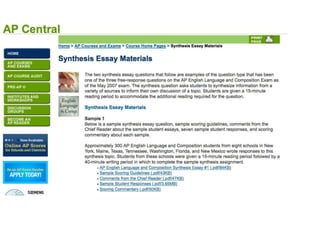
  • #15 Finally the thing that made this particularly important is that in 2007 AP began including a “synthesis essay” on the exam. This essay “The synthesis question asks students to synthesize information from a variety of sources to inform their own discussion of a topic.” Since then, the 11th grade English teacher and I have been working together to ensure students’ ability to synthesize information. She has really allowed me to become a co-teacher in her class.
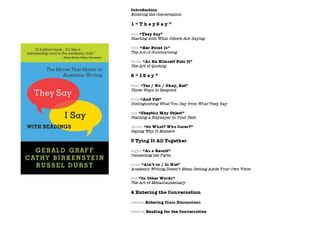
  • #16 We use the book They Say/I Say to guide students through the process of entering scholarly conversations. We spend about four weeks talking about summarizing, quoting, responding, distinguishing your words from others’, planting naysayers, explaining why it matters, connecting everything, and metacommentary. In the process of this I also teach search skills, evaluation skills, note taking, organization, outlining and avoiding plagiarism. We then collaborate with the 11th grade history teacher to transfer these skills outside of English and into history write a major research paper on a historical topic. Finally, we give a mid-term exam that requires sutdents to write a synthesis essay, much like the AP exame, but where AP gives students the resources they will be required to use, we have the students find sources as part of the grade they will receive in the course. Throughout all of this I provide feedback on source selection, integration and ethical use. Point out the synthesis essay exam sample in the packet.  I also help students make connections with their sources. In the process, I sometimes have to help students with synthesis, and the English teacher sometimes has to help the students understand history. We are “all hands on deck” to help them have real understanding.
  • #17 This convergence of goals has been crucial. When I attended my first ACRL conference in Denver in 2001, I remember that the National Council of Teachers of English was meeting in Denver at the same time and one of the presenters joked that “we should have had a mixer.” When I was working on a 2nd masters (before my daughter was born), I was working on a degree first in Critical Literacy and then English. I realize now that it was my attempt to have a mixer—I’d party by myself if I had to. The connection of goals just seemed so clear to me. I need to work harder to find a convergance of goals with colleauge’s in other disciplines.
  • #18 Is anyone using rubrics?This is the main form of assessment I use now. Most frequently, I classroom teachers and I create rubrics together.
  • #19 Makes grading consistentStudents have better understanding of instructors’ expectations“librarians and their collaborators are forced to reflect on and articulate their instructional goals” (Rosenblatt)I would argue that we would want to focus on student learning goals, but the idea is the same. This
  • #20 “Be careful not to bundle criteria together, as this makes scoring along the continuum difficult” (Fontichairo)Can be time-consuming to create (Fontichiaro)Need to be written in a language others (including students) can understandAdditionally, Diller and Phelps cited several problems with rubrics that were created by a faculty/staff committee and then used by several instructors. Understanding and applying the rubric criteria after only one training session proved very difficult for assessors.
  • #21 Not only do rubrics help us ensure that information skills are included into assignments (instructor buy-in) and that they are given a grade/point value (studenty buy-in), but they also give us the opportunity to authentically assess a students process, not just final product. Anyone can get lucky or be given a good source. Someone could not really do very good research, but end up actually writing a good paper. A rubric that sets criteria at the process allows us to ensure that students know how to do the steps along the way and holds them accountable in the final product.  It is no longer ok for an instructor to ask you to help her students find some info on blank. He needs to be able to truly articulate the goal of the assignment for you. (Of course, that doesn’t always happen, but I’ve learned to celebrate the little victories). For example, in the “They Can Find It” article said that the instructor’s main goal for the course was that “students begin thinking like sociologists.” A rubric would force him to define what he meant by that and find the right information skills required to meet that goal.  
  • #22 This rubric was adapted from the American Association of Colleges and Universities VALUE rubrics
  • #23 Look at the finding articles rubric for a very traditional skill rubric, Look at the synthesis essay rubric for a collaborative rubricVALUE rubrics could potentially be a good place to find converging goals.