Assessing ADS real-life performance:
Uniting real data, AI and optimization
for scenario-driven design validation
and optimization
Alexandre Mugnai
Business Development Manager
ESTECO
The Challenge
ADAS & AD Validation Approach
Conclusions
What have we learned?
Agenda
The Proposition
ESTECO
© 2021 ESTECO SpA
ESTECO is an independent
software company, highly
specialized in numerical
optimization and simulation
process and data management.
© 2021 ESTECO SpA
Our products
The leading software solution for
simulation process automation and
design optimization
The innovative enterprise platform for
Simulation Process and Data Management
(SPDM) and design optimization
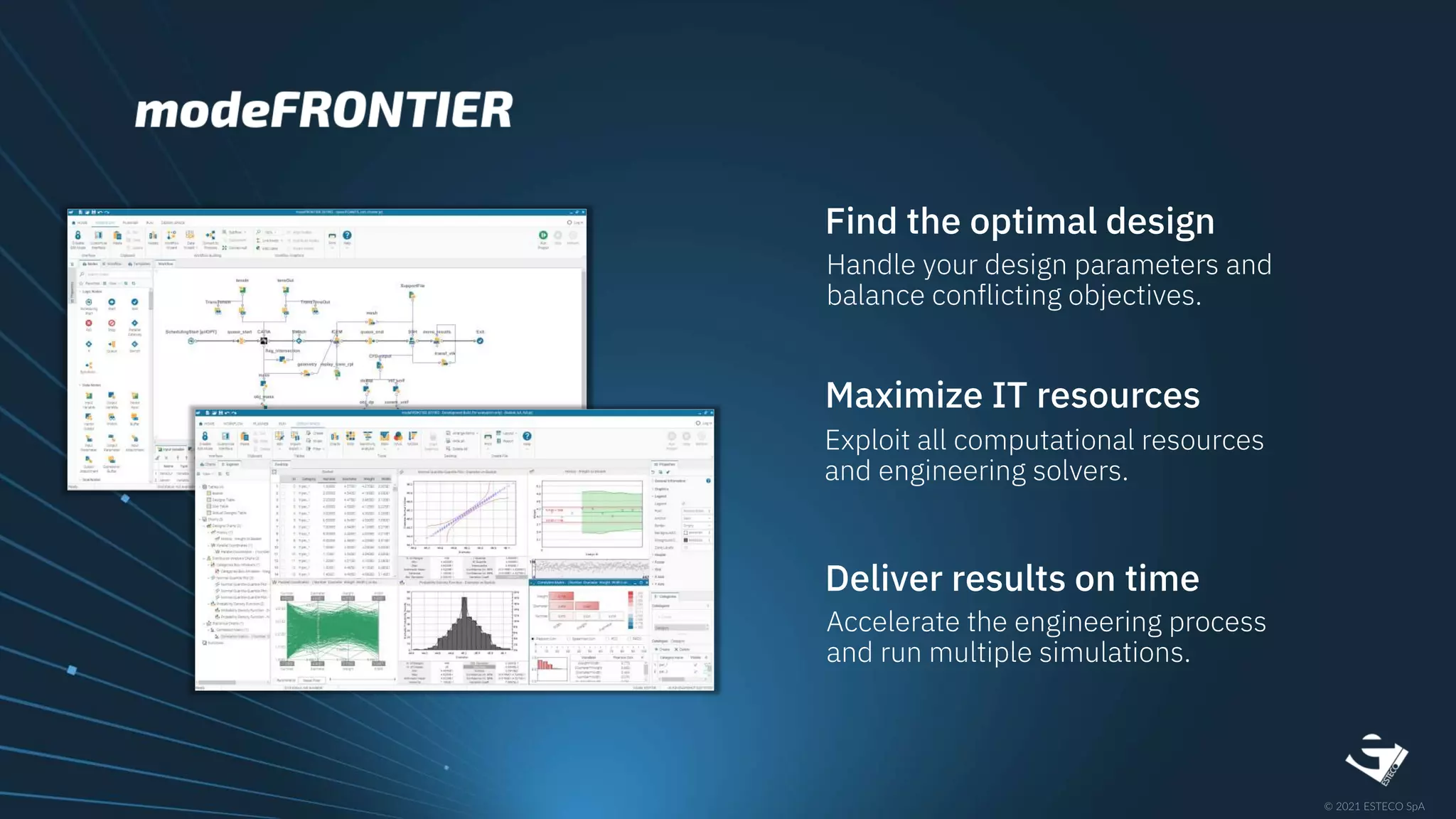
Find the optimal design
Handle your design parameters and
balance conflicting objectives.
Maximize IT resources
Exploit all computational resources
and engineering solvers.
Deliver results on time
Accelerate the engineering process
and run multiple simulations.
Make simulation data accessible
Expand the usage of engineering
simulation across teams.
Reduce time-to-market
Fast deliver the best product by applying
intelligent algorithms to the simulation
process.
Lower costs
Maximize the investment in
engineering solvers and IT resources.
© 2021 ESTECO SpA
Our customers and industries
Embraer
Leonardo
Lockheed Martin
Bombardier
FCA
Ford
Honda
PSA Group
Toyota
Volvo Cars
Corporation
Mahindra
TAFE
Volvo Trucks
ABB
Bajaj
BASF
Cummins
FAW
Whirlpool
Sony
Automotive and
Ground Transportation
Aerospace Architecture, Engineering
and Construction
Manufacturing and
Industrial Equipment
Marine Energy
Healthcare Consumer Goods Electronics
The challenge
© 2021 ESTECO SpA
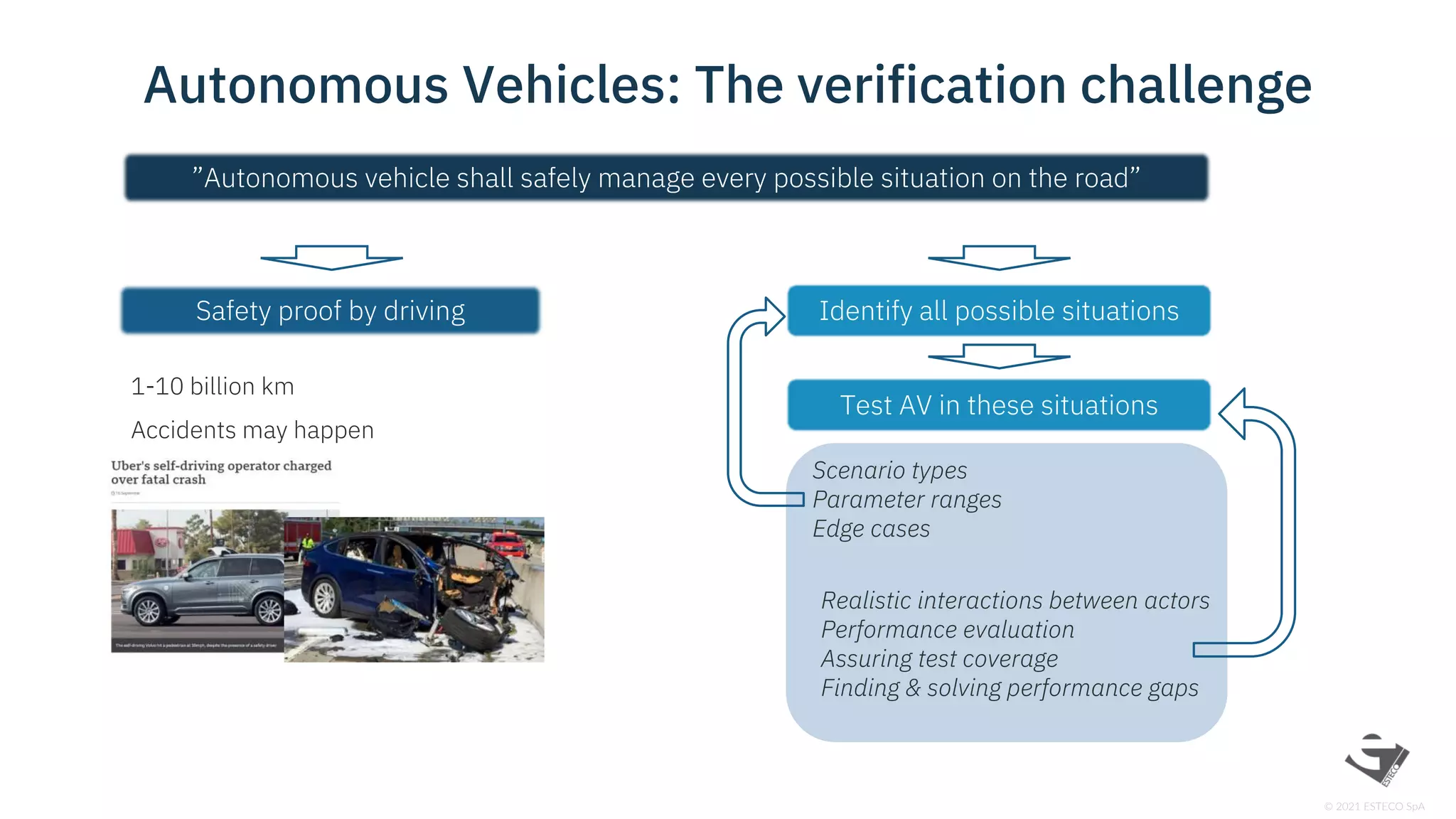
Autonomous Vehicles: The verification challenge
”Autonomous vehicle shall safely manage every possible situation on the road”
Safety proof by driving Identify all possible situations
Test AV in these situations
1-10 billion km
Accidents may happen
Scenario types
Parameter ranges
Edge cases
Realistic interactions between actors
Performance evaluation
Assuring test coverage
Finding & solving performance gaps
© 2021 ESTECO SpA
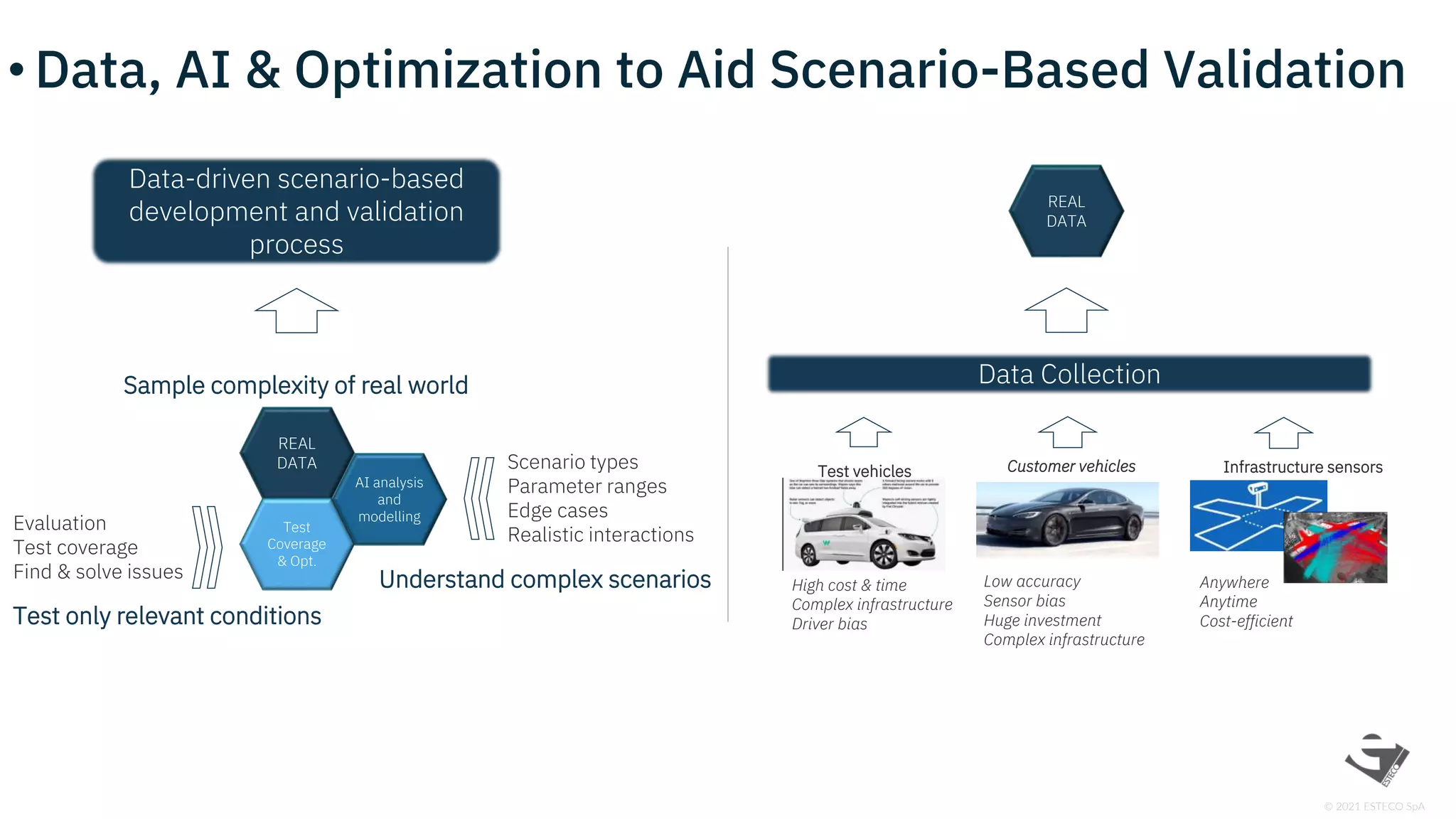
• Data, AI & Optimization to Aid Scenario-Based Validation
REAL
DATA
AI analysis
and
modelling
Test
Coverage
& Opt.
Evaluation
Test coverage
Find & solve issues
Scenario types
Parameter ranges
Edge cases
Realistic interactions
Understand complex scenarios
Test only relevant conditions
Sample complexity of real world
Data-driven scenario-based
development and validation
process
REAL
DATA
Data Collection
Test vehicles
High cost & time
Complex infrastructure
Driver bias
Customer vehicles
Low accuracy
Sensor bias
Huge investment
Complex infrastructure
Infrastructure sensors
Anywhere
Anytime
Cost-efficient
The proposition
© 2021 ESTECO SpA
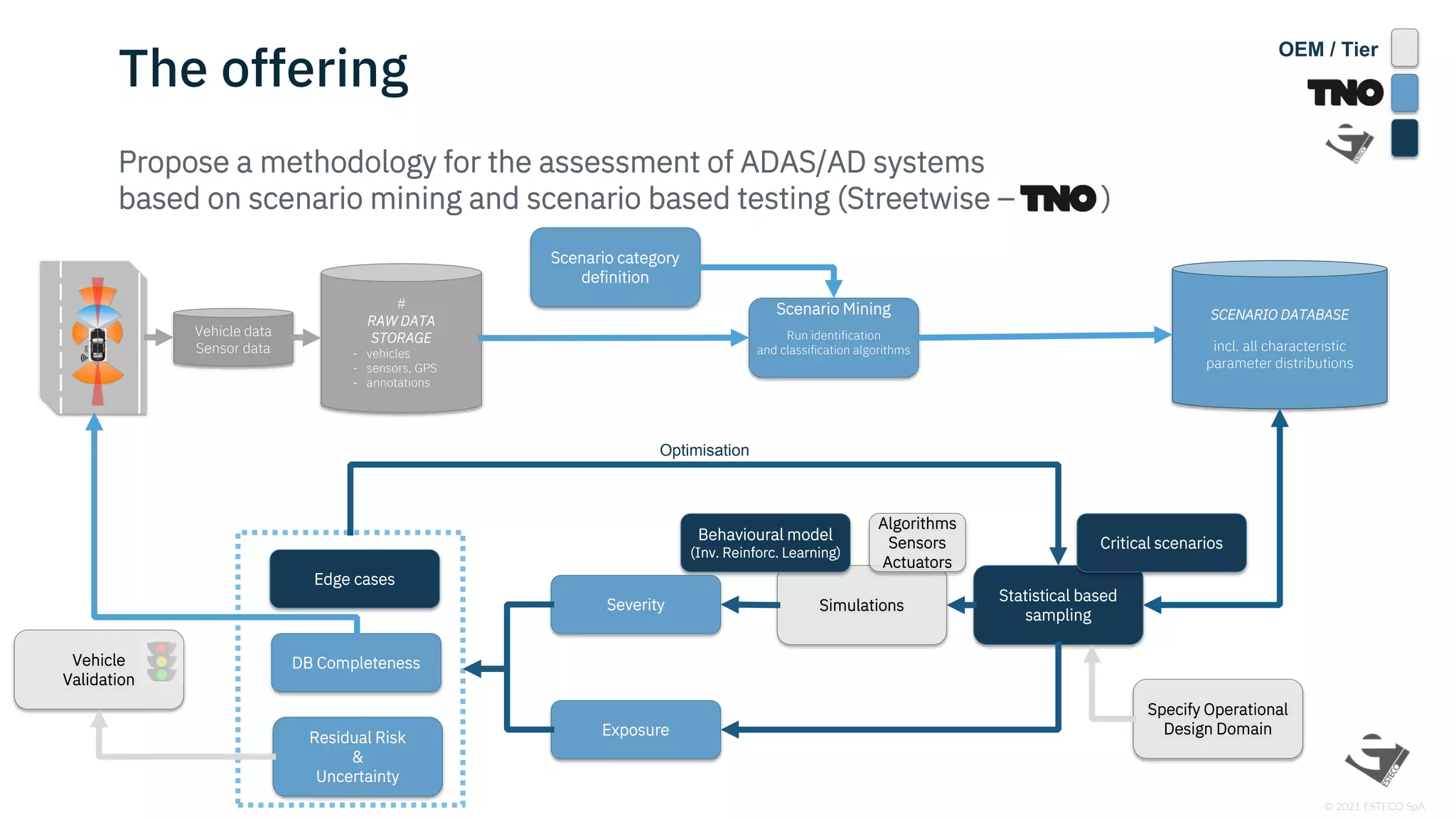
Vehicle data
Sensor data
#
RAW DATA
STORAGE
- vehicles
- sensors, GPS
- annotations
Scenario category
definition
Scenario Mining
Run identification
and classification algorithms
SCENARIO DATABASE
incl. all characteristic
parameter distributions
Specify Operational
Design Domain
Statistical based
sampling
Simulations
Residual Risk
&
Uncertainty
Vehicle
Validation
Behavioural model
(Inv. Reinforc. Learning)
Critical scenarios
Algorithms
Sensors
Actuators
DB Completeness
Edge cases
Severity
Exposure
Optimisation
Propose a methodology for the assessment of ADAS/AD systems
based on scenario mining and scenario based testing (Streetwise – )
The offering
OEM / Tier
Validation Approach Applied To
ACC Function
© 2021 ESTECO SpA
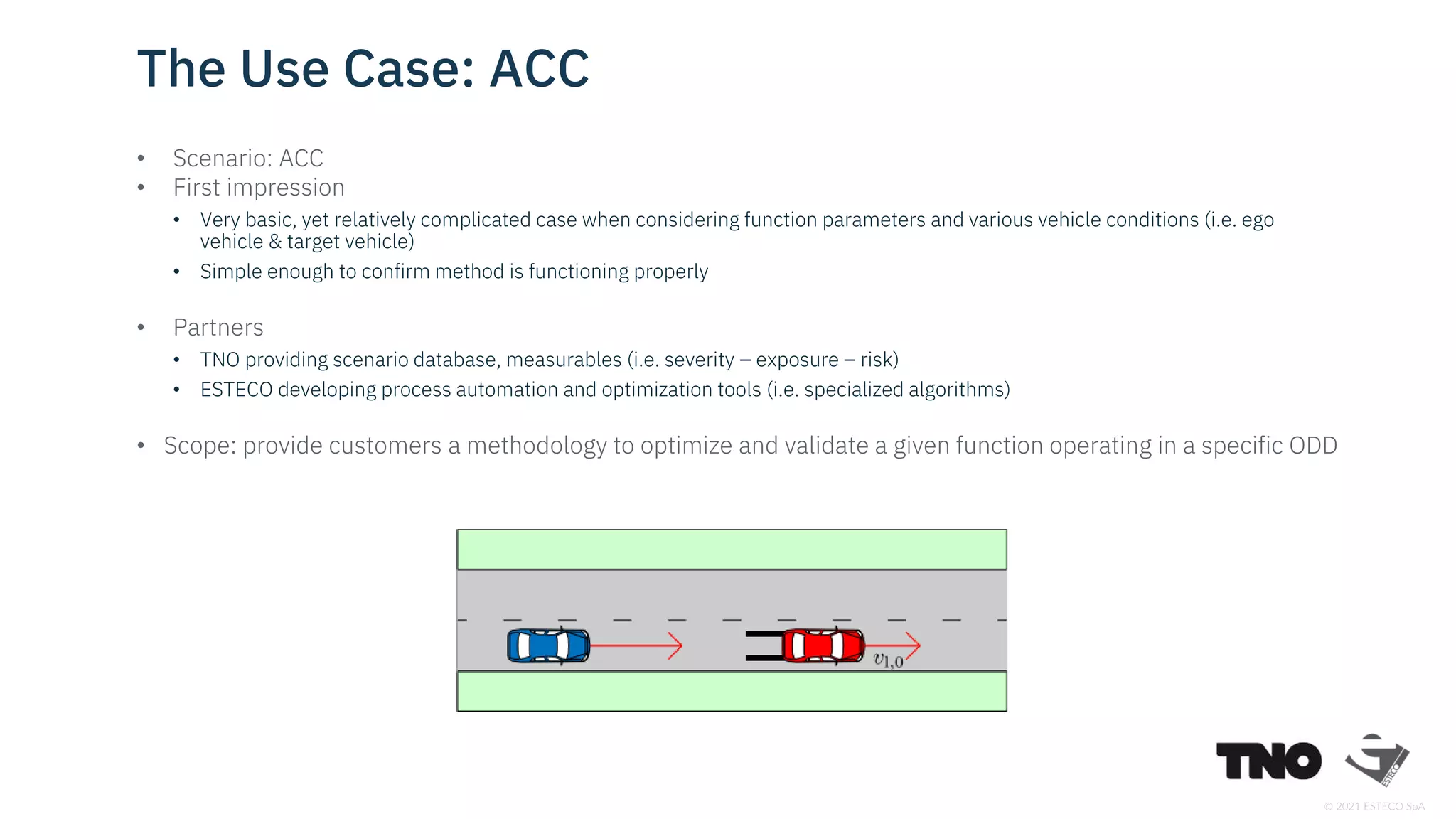
• Scenario: ACC
• First impression
• Very basic, yet relatively complicated case when considering function parameters and various vehicle conditions (i.e. ego
vehicle & target vehicle)
• Simple enough to confirm method is functioning properly
• Partners
• TNO providing scenario database, measurables (i.e. severity – exposure – risk)
• ESTECO developing process automation and optimization tools (i.e. specialized algorithms)
• Scope: provide customers a methodology to optimize and validate a given function operating in a specific ODD
The Use Case: ACC
© 2021 ESTECO SpA
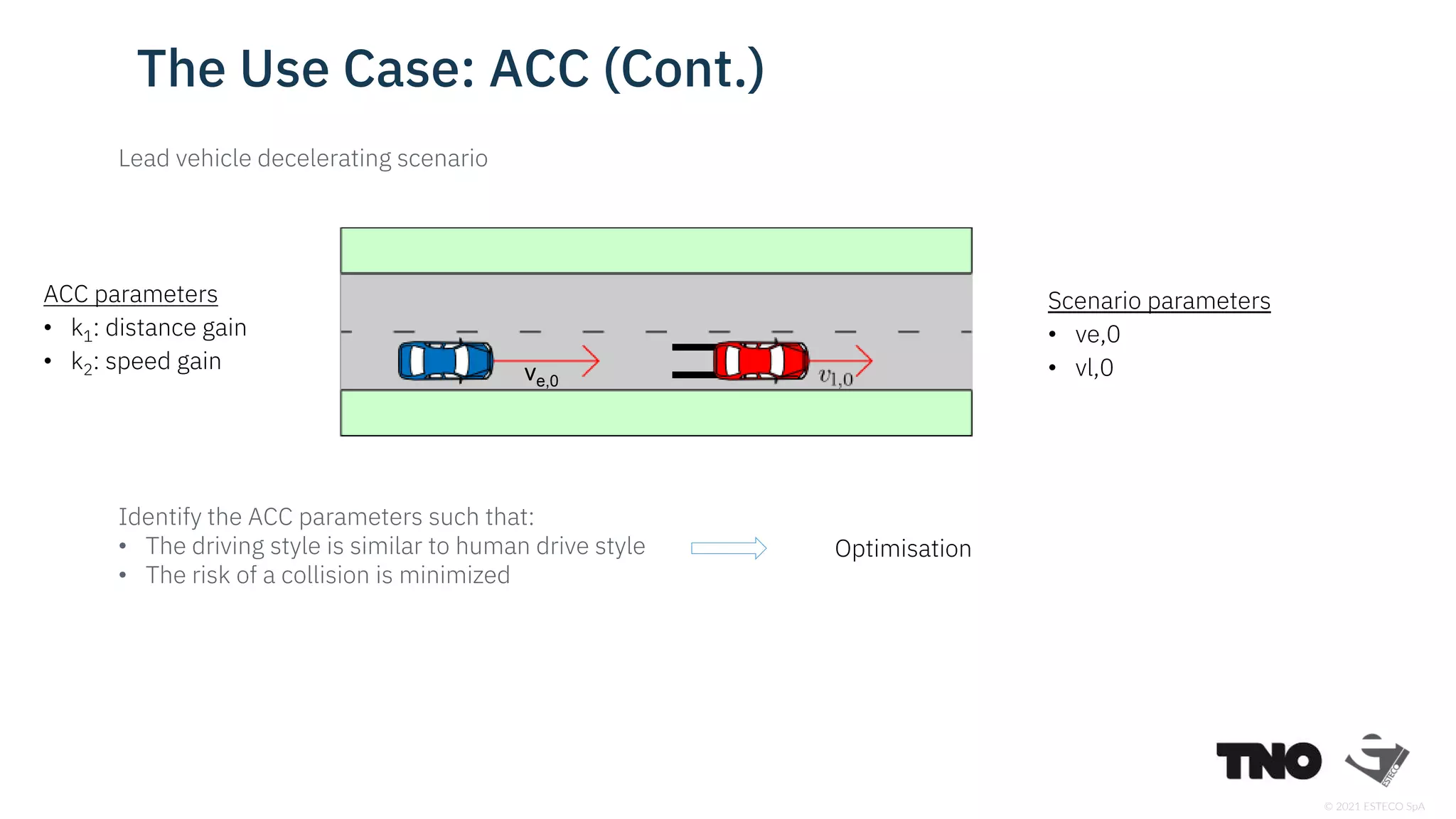
Lead vehicle decelerating scenario
The Use Case: ACC (Cont.)
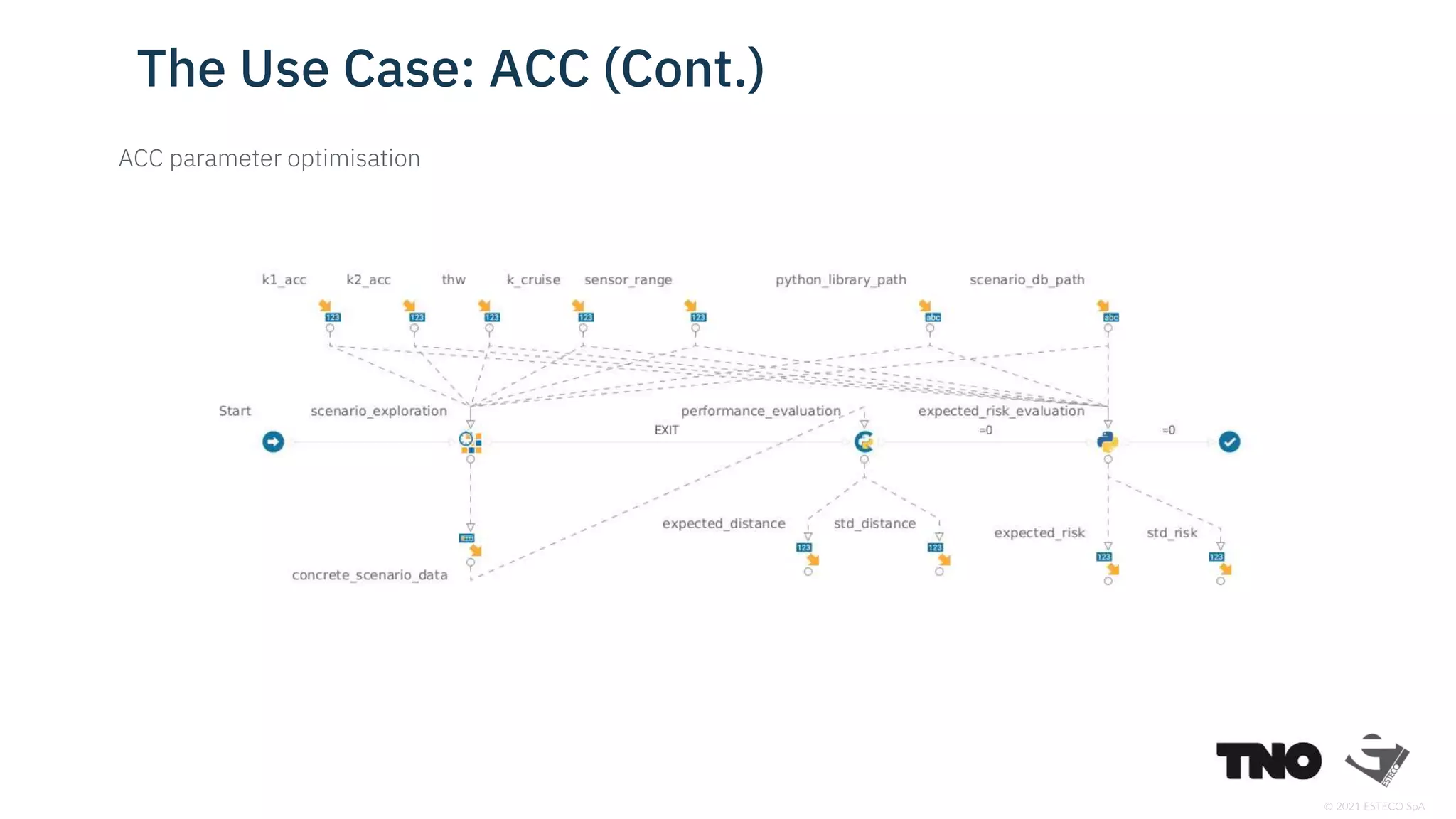
ACC parameters
• k1: distance gain
• k2: speed gain ve,0
Scenario parameters
• ve,0
• vl,0
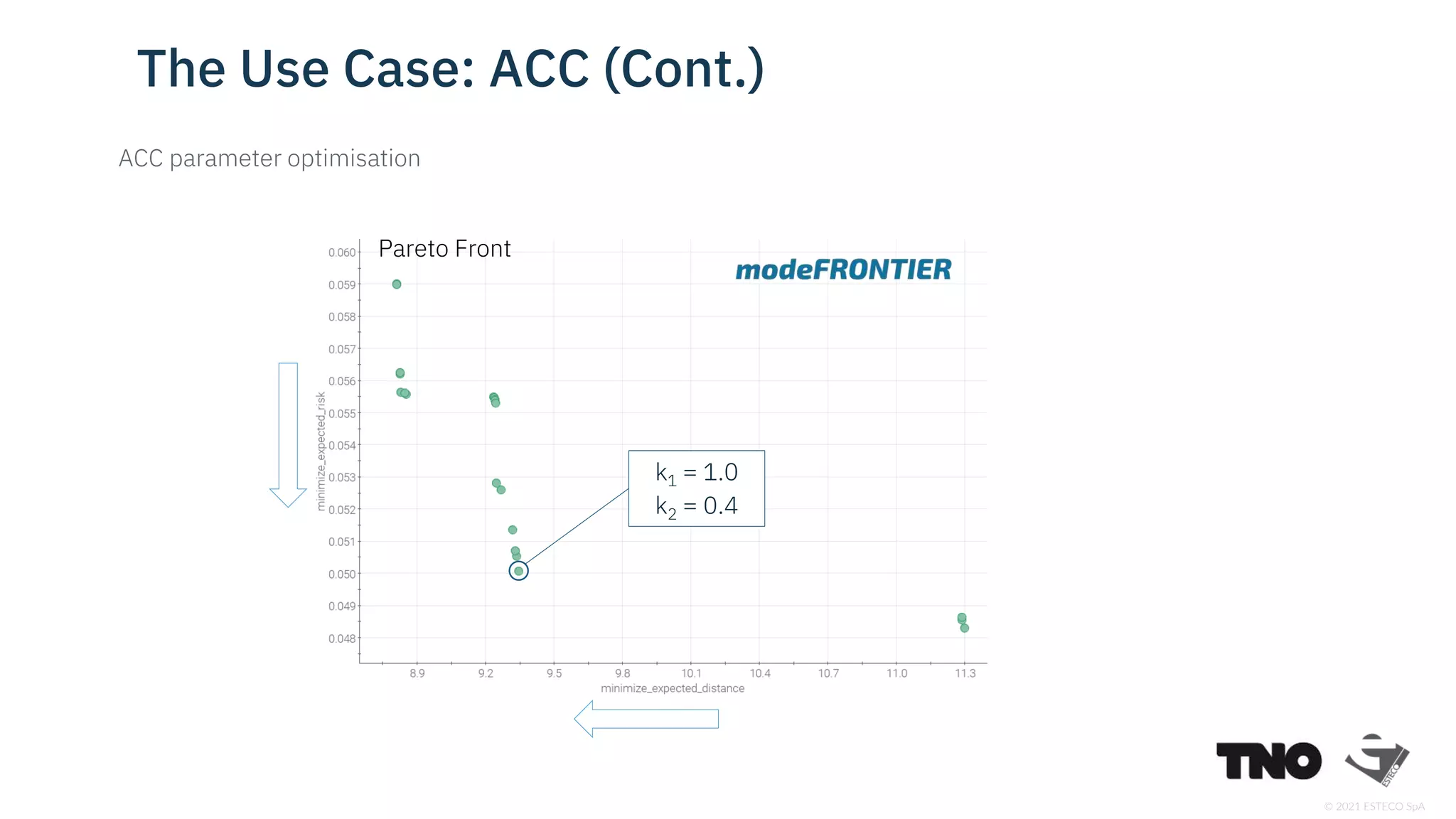
Identify the ACC parameters such that:
• The driving style is similar to human drive style
• The risk of a collision is minimized
Optimisation
© 2021 ESTECO SpA
The Use Case: ACC (Cont.)
ACC parameter optimisation
© 2021 ESTECO SpA
The Use Case: ACC (Cont.)
k1 = 1.0
k2 = 0.4
Pareto Front
ACC parameter optimisation
© 2021 ESTECO SpA
The Use Case: ACC (Cont.)
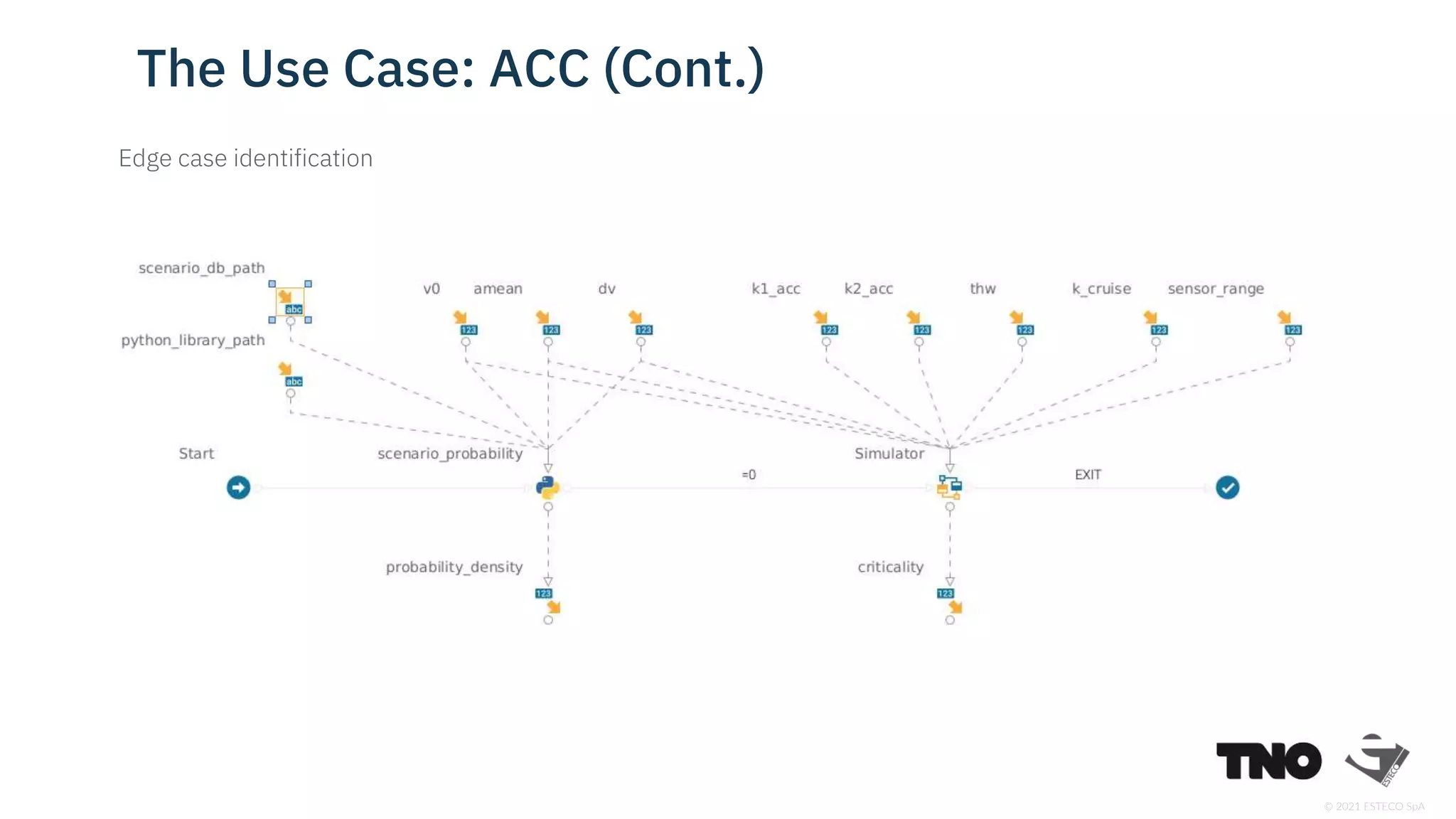
Edge case identification
© 2021 ESTECO SpA
The Use Case: ACC (Cont.)
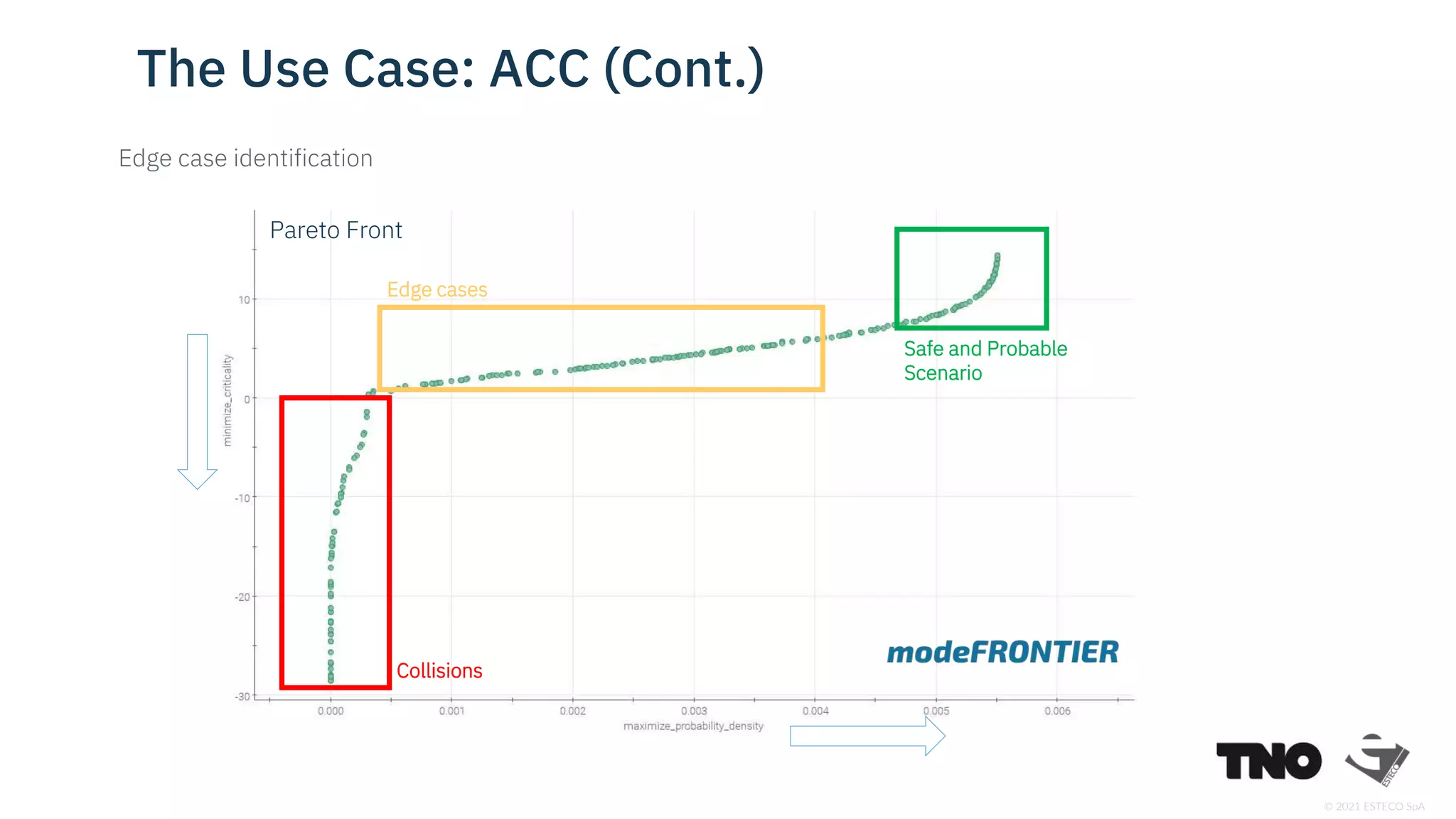
Edge case identification
Pareto Front
Safe and Probable
Scenario
Edge cases
Collisions
Conclusion
© 2021 ESTECO SpA
• By using cutting-edge AI to understand and model the real-world data, and by bringing these
AI models into simulation and optimization, the approach optimizes and validates the function
and its operational design domain (ODD)
• Gather real-life unbiased scenario data in relevant locations and time
• Produce a catalogue of parametrized scenarios with parameter distributions
• Identify most critical cases for the validation of a function
• Objectively quantify a system function and allow studies on:
• Sensor positions
• Sensor selection
• Algorithm parameter tuning for function optimization
Conclusion
What have we learned?
© 2021 ESTECO SpA
• The proposed approach has proven to work on an ACC study and can be extended to
various ADS functions that need to be developed, optimized and validated.
• The method can be applied for any domain in which vehicle requires best performance to
be identified in any real-life condition
• Automate process to simplify system assessment and optimization
• Algorithms play a significant role
• Building statistical understanding on the environment in which system needs to operate
• Identifying edge cases which challenge system performance
• Optimizing system performance
• Identify possible challenges ground truth system is facing
• Design a system that is not over spec-ed (i.e. excessive sensors) understanding its
strengths and weaknesses
• Provide safety argumentation, based on right real-life data
Take Away Ideas
esteco.com
Read the ESTECO Copyright Policy
Thank you!
Alexandre Mugnai
mugnai@esteco.com
+31 6 27392381

ASSESSING ADAS/AD FOR SCENARIO-DRIVEN DESIGN VALIDATION AND OPTIMIZATION

  • 1.
    Assessing ADS real-lifeperformance: Uniting real data, AI and optimization for scenario-driven design validation and optimization Alexandre Mugnai Business Development Manager
  • 2.
    ESTECO The Challenge ADAS &AD Validation Approach Conclusions What have we learned? Agenda The Proposition
  • 3.
  • 4.
    © 2021 ESTECOSpA ESTECO is an independent software company, highly specialized in numerical optimization and simulation process and data management.
  • 5.
    © 2021 ESTECOSpA Our products The leading software solution for simulation process automation and design optimization The innovative enterprise platform for Simulation Process and Data Management (SPDM) and design optimization
  • 6.
    Find the optimaldesign Handle your design parameters and balance conflicting objectives. Maximize IT resources Exploit all computational resources and engineering solvers. Deliver results on time Accelerate the engineering process and run multiple simulations.
  • 7.
    Make simulation dataaccessible Expand the usage of engineering simulation across teams. Reduce time-to-market Fast deliver the best product by applying intelligent algorithms to the simulation process. Lower costs Maximize the investment in engineering solvers and IT resources.
  • 8.
    © 2021 ESTECOSpA Our customers and industries Embraer Leonardo Lockheed Martin Bombardier FCA Ford Honda PSA Group Toyota Volvo Cars Corporation Mahindra TAFE Volvo Trucks ABB Bajaj BASF Cummins FAW Whirlpool Sony Automotive and Ground Transportation Aerospace Architecture, Engineering and Construction Manufacturing and Industrial Equipment Marine Energy Healthcare Consumer Goods Electronics
  • 9.
  • 10.
    © 2021 ESTECOSpA Autonomous Vehicles: The verification challenge ”Autonomous vehicle shall safely manage every possible situation on the road” Safety proof by driving Identify all possible situations Test AV in these situations 1-10 billion km Accidents may happen Scenario types Parameter ranges Edge cases Realistic interactions between actors Performance evaluation Assuring test coverage Finding & solving performance gaps
  • 11.
    © 2021 ESTECOSpA • Data, AI & Optimization to Aid Scenario-Based Validation REAL DATA AI analysis and modelling Test Coverage & Opt. Evaluation Test coverage Find & solve issues Scenario types Parameter ranges Edge cases Realistic interactions Understand complex scenarios Test only relevant conditions Sample complexity of real world Data-driven scenario-based development and validation process REAL DATA Data Collection Test vehicles High cost & time Complex infrastructure Driver bias Customer vehicles Low accuracy Sensor bias Huge investment Complex infrastructure Infrastructure sensors Anywhere Anytime Cost-efficient
  • 12.
  • 13.
    © 2021 ESTECOSpA Vehicle data Sensor data # RAW DATA STORAGE - vehicles - sensors, GPS - annotations Scenario category definition Scenario Mining Run identification and classification algorithms SCENARIO DATABASE incl. all characteristic parameter distributions Specify Operational Design Domain Statistical based sampling Simulations Residual Risk & Uncertainty Vehicle Validation Behavioural model (Inv. Reinforc. Learning) Critical scenarios Algorithms Sensors Actuators DB Completeness Edge cases Severity Exposure Optimisation Propose a methodology for the assessment of ADAS/AD systems based on scenario mining and scenario based testing (Streetwise – ) The offering OEM / Tier
  • 14.
  • 15.
    © 2021 ESTECOSpA • Scenario: ACC • First impression • Very basic, yet relatively complicated case when considering function parameters and various vehicle conditions (i.e. ego vehicle & target vehicle) • Simple enough to confirm method is functioning properly • Partners • TNO providing scenario database, measurables (i.e. severity – exposure – risk) • ESTECO developing process automation and optimization tools (i.e. specialized algorithms) • Scope: provide customers a methodology to optimize and validate a given function operating in a specific ODD The Use Case: ACC
  • 16.
    © 2021 ESTECOSpA Lead vehicle decelerating scenario The Use Case: ACC (Cont.) ACC parameters • k1: distance gain • k2: speed gain ve,0 Scenario parameters • ve,0 • vl,0 Identify the ACC parameters such that: • The driving style is similar to human drive style • The risk of a collision is minimized Optimisation
  • 17.
    © 2021 ESTECOSpA The Use Case: ACC (Cont.) ACC parameter optimisation
  • 18.
    © 2021 ESTECOSpA The Use Case: ACC (Cont.) k1 = 1.0 k2 = 0.4 Pareto Front ACC parameter optimisation
  • 19.
    © 2021 ESTECOSpA The Use Case: ACC (Cont.) Edge case identification
  • 20.
    © 2021 ESTECOSpA The Use Case: ACC (Cont.) Edge case identification Pareto Front Safe and Probable Scenario Edge cases Collisions
  • 21.
  • 22.
    © 2021 ESTECOSpA • By using cutting-edge AI to understand and model the real-world data, and by bringing these AI models into simulation and optimization, the approach optimizes and validates the function and its operational design domain (ODD) • Gather real-life unbiased scenario data in relevant locations and time • Produce a catalogue of parametrized scenarios with parameter distributions • Identify most critical cases for the validation of a function • Objectively quantify a system function and allow studies on: • Sensor positions • Sensor selection • Algorithm parameter tuning for function optimization Conclusion
  • 23.
    What have welearned?
  • 24.
    © 2021 ESTECOSpA • The proposed approach has proven to work on an ACC study and can be extended to various ADS functions that need to be developed, optimized and validated. • The method can be applied for any domain in which vehicle requires best performance to be identified in any real-life condition • Automate process to simplify system assessment and optimization • Algorithms play a significant role • Building statistical understanding on the environment in which system needs to operate • Identifying edge cases which challenge system performance • Optimizing system performance • Identify possible challenges ground truth system is facing • Design a system that is not over spec-ed (i.e. excessive sensors) understanding its strengths and weaknesses • Provide safety argumentation, based on right real-life data Take Away Ideas
  • 25.
    esteco.com Read the ESTECOCopyright Policy Thank you! Alexandre Mugnai mugnai@esteco.com +31 6 27392381