Session.Clear() removes all values from the current session but maintains the session, while Session.Abandon() destroys the entire session, triggering Session_End and creating a new session on the next request.
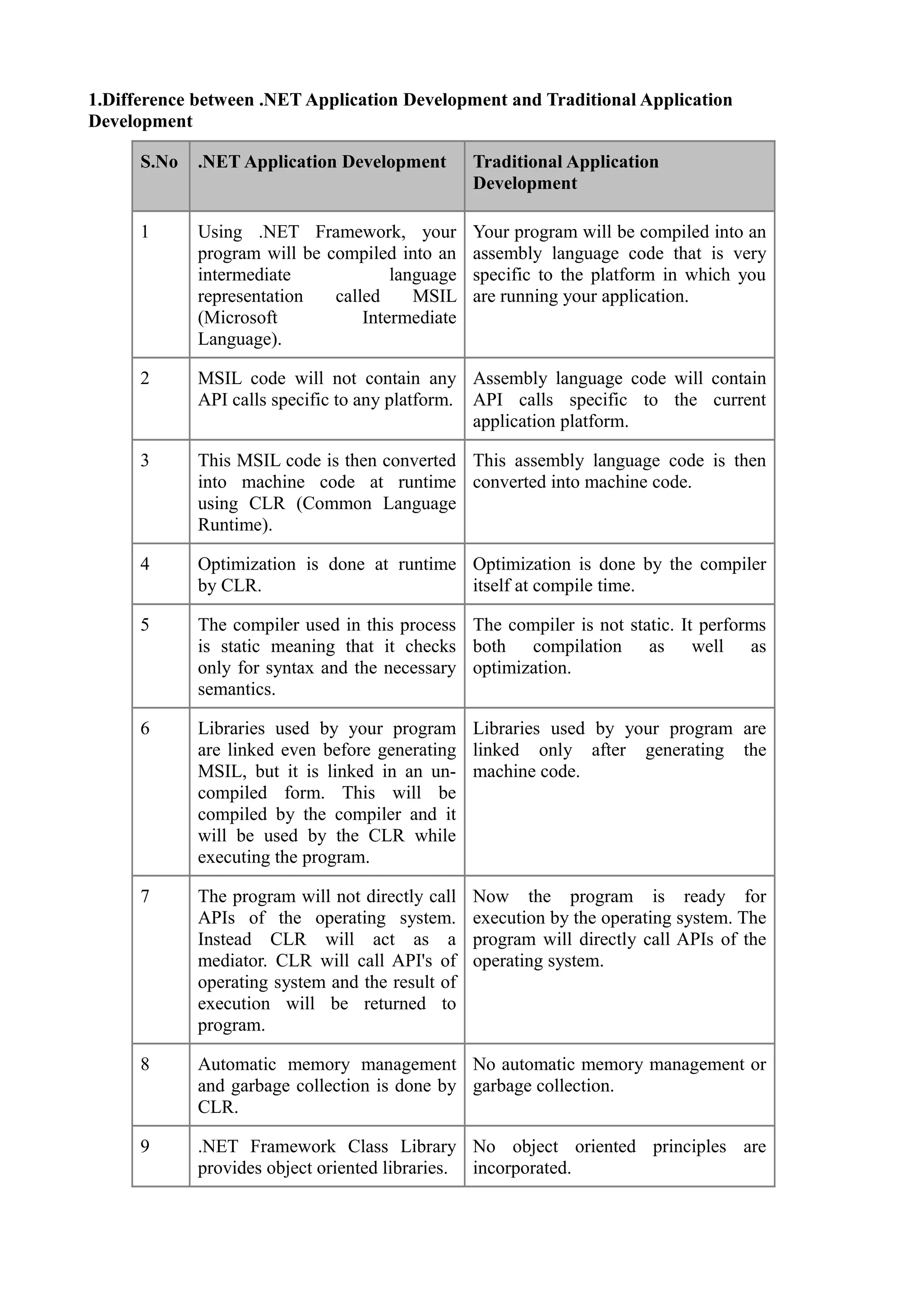
1.Difference between .NETApplication Development and Traditional Application
Development
S.No .NET Application Development Traditional Application
Development
1 Using .NET Framework, your Your program will be compiled into an
program will be compiled into an assembly language code that is very
intermediate language specific to the platform in which you
representation called MSIL are running your application.
(Microsoft Intermediate
Language).
2 MSIL code will not contain any Assembly language code will contain
API calls specific to any platform. API calls specific to the current
application platform.
3 This MSIL code is then converted This assembly language code is then
into machine code at runtime converted into machine code.
using CLR (Common Language
Runtime).
4 Optimization is done at runtime Optimization is done by the compiler
by CLR. itself at compile time.
5 The compiler used in this process The compiler is not static. It performs
is static meaning that it checks both compilation as well as
only for syntax and the necessary optimization.
semantics.
6 Libraries used by your program Libraries used by your program are
are linked even before generating linked only after generating the
MSIL, but it is linked in an un- machine code.
compiled form. This will be
compiled by the compiler and it
will be used by the CLR while
executing the program.
7 The program will not directly call Now the program is ready for
APIs of the operating system. execution by the operating system. The
Instead CLR will act as a program will directly call APIs of the
mediator. CLR will call API's of operating system.
operating system and the result of
execution will be returned to
program.
8 Automatic memory management No automatic memory management or
and garbage collection is done by garbage collection.
CLR.
9 .NET Framework Class Library No object oriented principles are
provides object oriented libraries. incorporated.
2.
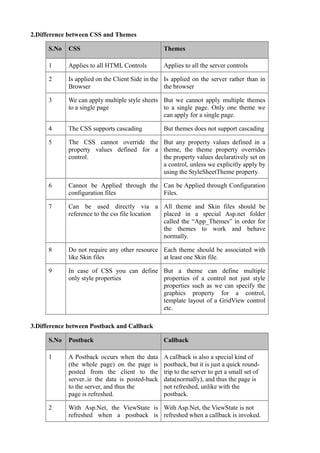
2.Difference between CSSand Themes
S.No CSS Themes
1 Applies to all HTML Controls Applies to all the server controls
2 Is applied on the Client Side in the Is applied on the server rather than in
Browser the browser
3 We can apply multiple style sheets But we cannot apply multiple themes
to a single page to a single page. Only one theme we
can apply for a single page.
4 The CSS supports cascading But themes does not support cascading
5 The CSS cannot override the But any property values defined in a
property values defined for a theme, the theme property overrides
control. the property values declaratively set on
a control, unless we explicitly apply by
using the StyleSheetTheme property.
6 Cannot be Applied through the Can be Applied through Configuration
configuration files Files.
7 Can be used directly via a All theme and Skin files should be
reference to the css file location placed in a special Asp.net folder
called the “App_Themes” in order for
the themes to work and behave
normally.
8 Do not require any other resource Each theme should be associated with
like Skin files at least one Skin file.
9 In case of CSS you can define But a theme can define multiple
only style properties properties of a control not just style
properties such as we can specify the
graphics property for a control,
template layout of a GridView control
etc.
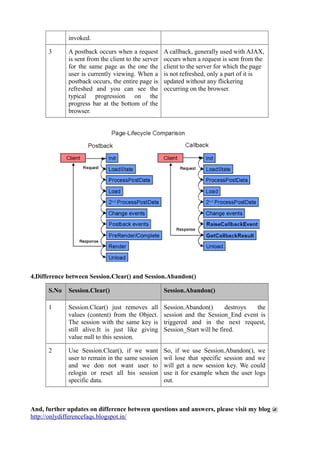
3.Difference between Postback and Callback
S.No Postback Callback
1 A Postback occurs when the data A callback is also a special kind of
(the whole page) on the page is postback, but it is just a quick round-
posted from the client to the trip to the server to get a small set of
server..ie the data is posted-back data(normally), and thus the page is
to the server, and thus the not refreshed, unlike with the
page is refreshed. postback.
2 With Asp.Net, the ViewState is With Asp.Net, the ViewState is not
refreshed when a postback is refreshed when a callback is invoked.
3.
invoked.
3 A postback occurs when a request A callback, generally used with AJAX,
is sent from the client to the server occurs when a request is sent from the
for the same page as the one the client to the server for which the page
user is currently viewing. When a is not refreshed, only a part of it is
postback occurs, the entire page is updated without any flickering
refreshed and you can see the occurring on the browser.
typical progression on the
progress bar at the bottom of the
browser.
4.Difference between Session.Clear() and Session.Abandon()
S.No Session.Clear() Session.Abandon()
1 Session.Clear() just removes all Session.Abandon() destroys the
values (content) from the Object. session and the Session_End event is
The session with the same key is triggered and in the next request,
still alive.It is just like giving Session_Start will be fired.
value null to this session.
2 Use Session.Clear(), if we want So, if we use Session.Abandon(), we
user to remain in the same session wil lose that specific session and we
and we don not want user to will get a new session key. We could
relogin or reset all his session use it for example when the user logs
specific data. out.
And, further updates on difference between questions and answers, please visit my blog @
http://onlydifferencefaqs.blogspot.in/