PRESENTED BY: GROUP 3
Adion, Mae G.
Cardinal, John Pandolf G.
Castanaday, Jovie
Fernando, Marc John
Fronda, Nikka Angela O.
Razalan, Rhina Camille D.
Sembrano, Aaron
SHRAE
Overview
The American Society of Heating, Refrigerating and
Air-Conditioning Engineers (ASHRAE) plays a critical role in
shaping the landscape of mechanical engineering
through its involvement in developing codes and
standards.
These standards ensure that mechanical systems are
designed, installed, and operated in a manner that
prioritizes safety, sustainability, and optimal performance.
Governments use ASHRAE's rules to make laws about
building safety.
•Mechanical systems
are designed and
operated in a way that
minimizes risks like fire
hazards or exposure to
harmful contaminants.
SAFETY
•Indoor environments are
maintained with proper
ventilation and
temperature control for
occupant comfort and
well-being.
HEALTH
•Buildings use energy
resources more efficiently,
reducing operational
costs and environmental
impact.
ENERGY
EFFICIENCY
ASHRAE's role in setting codes and standards is
fundamental to the practice of mechanical engineering.
Objectives
Lorem ipsum dolor sit amet, consectetur adipiscing elit. Nullam
laoreet risus fringilla, egestas elit a, consequat augue. Phasellus
sollicitudin felis mi, quis egestas ex ornare sed.
ASHRAE ROLES IN SETTING STANDARDS INCLUDES:
Widely Adopted
Establishes minimum
requirements and best
practices for mechanical
systems in buildings (HVAC,
refrigeration etc.).
Develops Industry Standards
ASHRAE standards often
form the basis for local
building codes enforced
by governments.
Influences Building Codes
It is used by design
professionals,
manufacturers, and
regulatory bodies,
providing a common
language for the industry.
ASHRAE's significance
in ensuring ethical and
legal compliance in
mechanical
engineering projects
SETTING BENCHMARKS: These
standards act as ethical guideposts,
ensuring engineers prioritize public
well-being. Following them promotes
responsible design decisions
throughout a project's lifecycle.
01
REDUCING LEGAL RISKS: Adherence
to ASHRAE standards minimizes the
risk of legal issues arising from non-
compliant designs. They often form
the basis for building codes,
demonstrating due diligence in the
design process.
02
ASHRAE's significance
in ensuring ethical and
legal compliance in
mechanical
engineering projects
Promoting Best Practices: While
establishing minimums, ASHRAE also
encourages exceeding them. This
fosters innovation and ethical
decision-making that prioritizes
sustainability, efficiency, and
occupant comfort.
03
TRANSPARENCY & ACCOUNTABILITY:
Following these standards promotes
transparency. Stakeholders can be
confident that designs meet industry
expectations and established codes.
This builds trust and ensures projects
are executed ethically and
responsibly.
04
EXAMPLES OF ASHRAE STANDARDS AND LEGAL
COMPLIANCE
Following this standard not only
reduces energy consumption but
also helps projects comply with
local energy codes, a legal
requirement in many jurisdictions.
ASHRAE 90.1
(ENERGY EFFICIENCY)
This standard ensures proper
ventilation, minimizing health risks
and aligning with legal
requirements for occupant safety.
ASHRAE 62.1
(INDOOR AIR QUALITY)
Alignment of ASHRAE Standards
with Mechanical Engineering
Regulations
The Philippine Mechanical Engineering Act (RA 8495), also referred to as
the “Philippine Mechanical engineering Act of 1998,” lays down the rules
and regulations governing the practice and regulation of mechanical
engineering throughout the Philippines.
RA 8495 lays down the qualifications and duties of mechanical engineers
in the Philippines, lays down the licensing process for mechanical
engineers, and defines the scope of the mechanical engineering practice
within the country.
The ASHRAE standards and guidelines for
mechanical engineering can cross-referenced with
RA 8485 in several ways, especially in the following
areas:
Heating, ventilation, and air conditioning (HVAC)
systems and construction design
ASHRAE Standards: Guiding Mechanical
Engineers in the Philippines
RA 8495 requires mechanical engineers to follow the
standards and technical specifications to carry out their
duties.
Professional Practice Standard Technical Reference
ASHRAE serves as industry- recognized standards and
guidelines for the design and installation of HVAC
Systems. These standards are often used as best
practices in the mechanical engineering industry
worldwide, including Philippines.
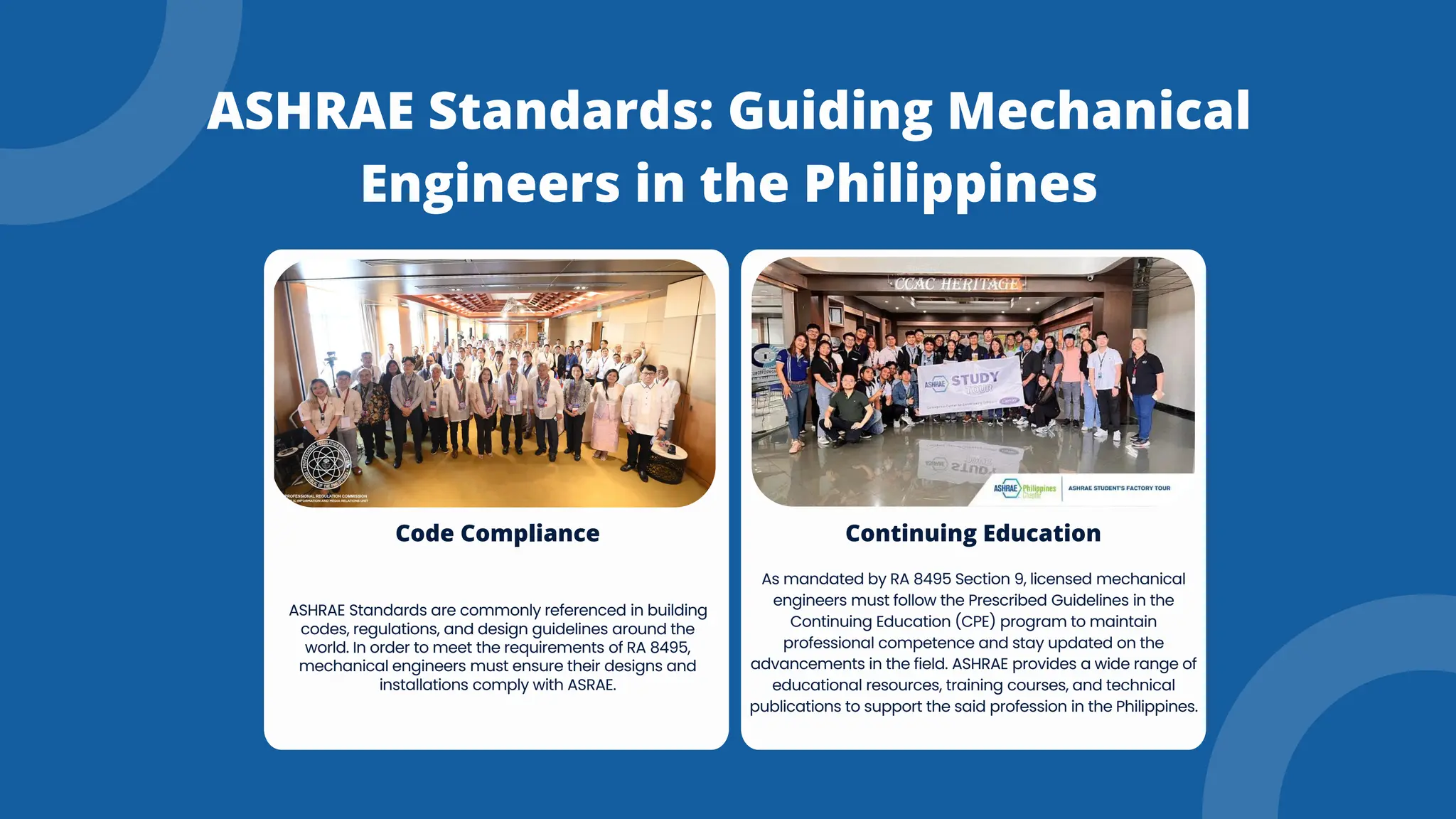
As mandated by RA 8495 Section 9, licensed mechanical
engineers must follow the Prescribed Guidelines in the
Continuing Education (CPE) program to maintain
professional competence and stay updated on the
advancements in the field. ASHRAE provides a wide range of
educational resources, training courses, and technical
publications to support the said profession in the Philippines.
Code Compliance Continuing Education
ASHRAE Standards are commonly referenced in building
codes, regulations, and design guidelines around the
world. In order to meet the requirements of RA 8495,
mechanical engineers must ensure their designs and
installations comply with ASRAE.
ASHRAE Standards: Guiding Mechanical
Engineers in the Philippines
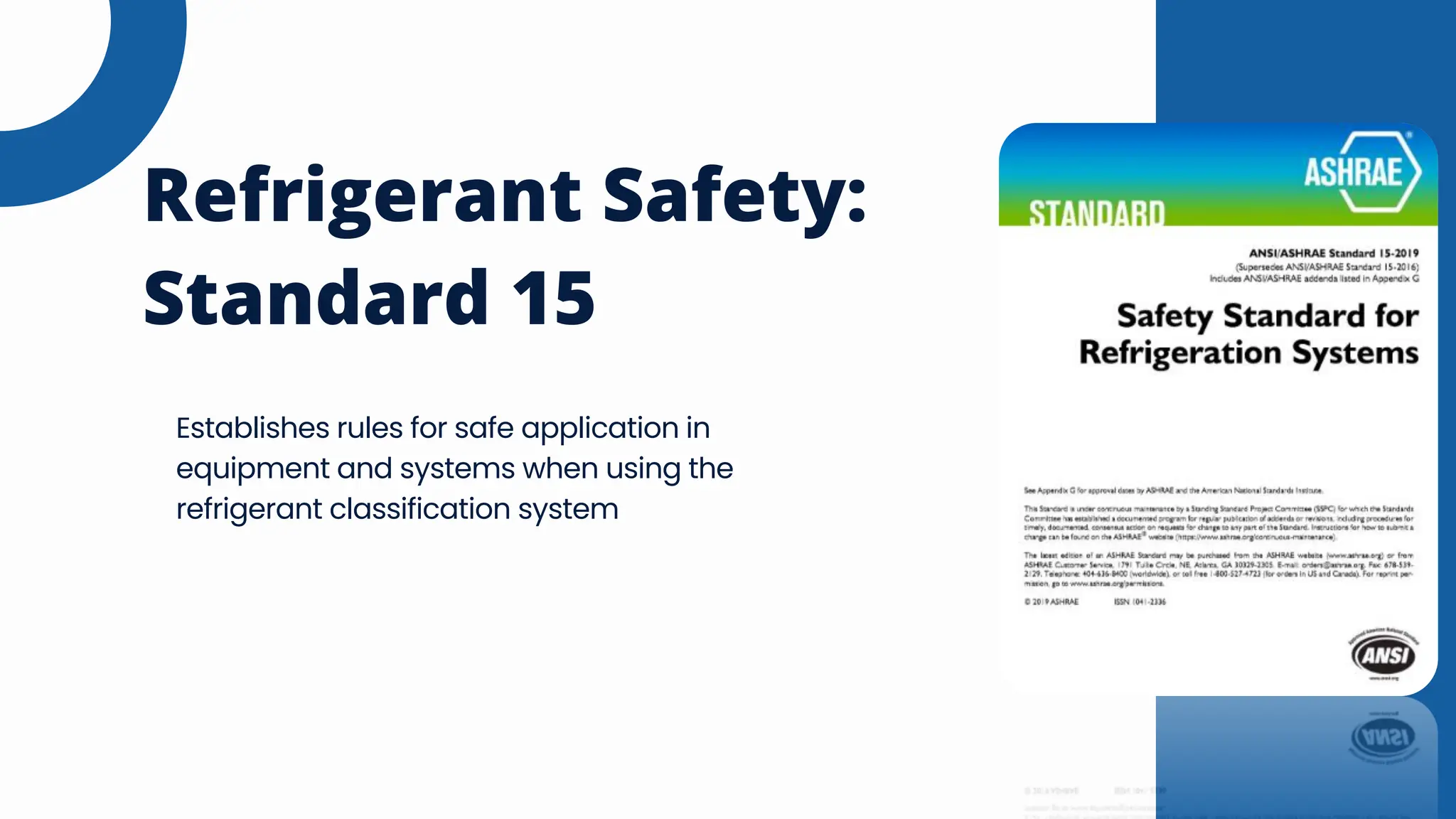
Refrigerant Safety:
Standard 15
Establishes rules for safe application in
equipment and systems when using the
refrigerant classification system
Refrigeration
Safety: Standard 34
Nomenclature of refrigerants and assigns
safety classifications based on toxicity and
flammability data
Thermal Comfort:
Standard 55
Sets the standard for what are considered
"comfortable indoor conditions for 80s or
more of a building's occupants.
Settles the "too hot/too cold" debate at offices.
Ventilation and
IAQ: Standard 62.1
Specifies minimum ventilation rates and other
measures intended to provide indoor air quality
that is acceptable to human occupants and
minimizes adverse health effects
Applies to all indoor or enclosed spaces that
people may occupy, except where other
applicable standards and requirements dictate
larger amounts of ventilation
Residential and
IAQ: Standard 62.2
Defines roles of and minimum requirements for
mechanical and natural ventilation systems
and building envelope intended to provide
acceptable indoor air quality in low- rise
residential buildings
Limits sources of pollutants and requiring
enough mechanical ventilation to provide
dilution for unavoidable contaminants
Energy Efficiency:
Standard 90.1
Sets design requirements for the efficient.
Use of energy in buildings
*2013 version preliminarily referenced in the US
Federal Energy Conservation and Production
Act
39 states have adopted some version of 90.1 as
their energy code
Legionella:
Standard 188
Establishes minimum legionellosis risk
management requirements for building water
systems
Intended for use by owners and managers of
human-occupied buildings and those involved
in the design, construction, installation,
commissioning, operation, maintenance and
service of centralized building water systems
and components
Green Building:
Standard 189.1
The “Total Building Sustainability Package”
Compliance option of International Code
Council's International Green Construction
Code
Incorporated by U.S. Army, Navy and Air Force
into Unified Facilities Criteria for Energy and
Sustainability Building Requirements
ASHRAE Standards and Guidelines are important to keep optimal
indoor air quality and energy efficiency in buildings. ASHRAE
Standards are not only a legal requirement, but they are also a
critical part of building occupants’ comfort, safety, and productivity.
Ensuring Regulatory Compliance
with ASHRAE Guidelines
Non- compliance with ASHRAE Guidelines can result in poor indoor
air quality, higher energy consumption, increased operational costs,
and potential health hazards.
Building owners and operators must work closely with certified
professionals to ensure that all ASHRAE guidelines are met.
Regulatory
Compliance with
ASHRAE Standards
According to recent studies, buildings that
comply with ASHRAE guidelines experience:
Up to 30% reduction in energy
consumption
01
Improved indoor air quality by up
to 40%
02
Enhanced occupant comfort
and productivity
03
Extended lifespan of HVAC
equipment
04
CODES AND
STANDARDS
How ASHRAE standards impact different aspects of the mechanical engineering projects?
1. System Design and Equipment Selection:
ASHRAE 90.1 (Energy Standard for
Buildings Except Low-Rise
Residential Buildings) and
ASHRAE 62.1 (Ventilation for
Acceptable Indoor Air Quality) set
minimum requirements for
equipment capacities, ductwork
sizing, and ventilation rates. This
ensures your design meets basic
performance benchmarks
ASHRAE standards also offer
reference data on various HVAC
equipment. This helps you choose
components that meet project needs
and comply with efficiency standards.
For example, ASHRAE Standard 34
(Designation and Safety
Classification of Refrigerants)
classifies refrigerants based on
safety and environmental impact,
guiding your selection for specific
applications.
How ASHRAE standards impact different aspects of the mechanical engineering projects?
2. Thermal Comfort and Indoor Air Quality (IAQ):
ASHRAE Standard 55 (Thermal
Environmental Conditions for
Human Occupancy) defines
acceptable temperature and
humidity ranges for different
spaces. By adhering to these
standards, you ensure a
comfortable environment for
building occupants.
ASHRAE Standard 62.1 focuses on
maintaining good IAQ by
regulating minimum ventilation
requirements. This helps control
contaminants like CO2 and VOCs,
leading to a healthier indoor
environment.
How ASHRAE standards impact different aspects of the mechanical engineering projects?
3. Energy Efficiency:
ASHRAE 90.1 play a crucial role in
achieving energy efficiency in
building. This standard sets
minimum requirements for
building envelopes, HVAC
systems, service hot water, and
lighting. By following these
guidelines, you can design
systems that minimize energy
consumption and operational
costs
How ASHRAE standards impact different aspects of the mechanical engineering projects?
4. Safety Considerations:
ASHRAE Standard 15 (Safety
Standard for Refrigeration
Systems) provide safety protocols
for all stages of a refrigeration
system's lifecycle. This ensures
the safe design, installation,
operation, and maintenance of
these systems.
How ASHRAE standards impact different aspects of the mechanical engineering projects?
5. Project Commissioning:
ASHRAE Guideline 0 (The
Commissioning Process) offers a
framework for ensuring that
building systems, including your
HVAC design, are designed,
installed, and tested to meet the
owner's project requirements. This
helps identify and address any
potential issues before the system
becomes operational.
Mechanical engineers have both legal and ethical responsibilities when adhering to ASHRAE codes
and standards in their projects. Here's a breakdown of these aspects:
Building Codes: In most jurisdictions,
building codes reference or incorporate
ASHRAE standards by reference. This
means complying with ASHRAE
standards often becomes essential for
achieving code compliance. Failure to
do so could result in delays, project
stoppages, or even fines.
Legal Responsibilities:
Contractual Agreements: Engineering
contracts often specify adherence to
relevant ASHRAE standards for the
project. Not complying with these
contractual obligations could result in
legal disputes or financial penalties.
Standard of Care: It is legally required
of engineers to maintain a "standard of
care" in their work. This means providing
engineering services in compliance with
current industry norms. Following the
widely accepted ASHRAE standards is a
sign that an engineer has upheld this
standard of care in HVAC design. If an
engineer disregards pertinent ASHRAE
rules and it results in system breakdowns
or safety hazards, they may be held liable
for negligence.
Mechanical engineers have both legal and ethical responsibilities when adhering to ASHRAE codes
and standards in their projects. Here's a breakdown of these aspects:
Public Health and Safety: Mechanical
engineers have a moral and ethical
obligation to ensure that their designs
prioritize public health and safety.
ASHRAE standards address factors like
indoor air quality, ventilation, and
equipment safety, and adhering to them
helps mitigate potential health risks
associated with poorly designed HVAC
systems.
Ethical Responsibilities:
Client Interests: Engineers have an
ethical duty to act in their client's best
interests. ASHRAE standards can help
ensure that HVAC systems meet
performance expectations for energy
efficiency, comfort, and durability. By
adhering to these standards, engineers
safeguard their clients' investments in
their buildings.
Sustainability: ASHRAE standards
promote energy efficiency, which aligns
with the ethical responsibility of engineers
to consider the environmental impact of
their designs. Following these standards
helps minimize the environmental footprint
of buildings.

ASHRAE-Codes-and-Standards-Presentation.pdf

  • 1.
    PRESENTED BY: GROUP3 Adion, Mae G. Cardinal, John Pandolf G. Castanaday, Jovie Fernando, Marc John Fronda, Nikka Angela O. Razalan, Rhina Camille D. Sembrano, Aaron SHRAE
  • 2.
    Overview The American Societyof Heating, Refrigerating and Air-Conditioning Engineers (ASHRAE) plays a critical role in shaping the landscape of mechanical engineering through its involvement in developing codes and standards. These standards ensure that mechanical systems are designed, installed, and operated in a manner that prioritizes safety, sustainability, and optimal performance. Governments use ASHRAE's rules to make laws about building safety.
  • 3.
    •Mechanical systems are designedand operated in a way that minimizes risks like fire hazards or exposure to harmful contaminants. SAFETY •Indoor environments are maintained with proper ventilation and temperature control for occupant comfort and well-being. HEALTH •Buildings use energy resources more efficiently, reducing operational costs and environmental impact. ENERGY EFFICIENCY ASHRAE's role in setting codes and standards is fundamental to the practice of mechanical engineering.
  • 4.
    Objectives Lorem ipsum dolorsit amet, consectetur adipiscing elit. Nullam laoreet risus fringilla, egestas elit a, consequat augue. Phasellus sollicitudin felis mi, quis egestas ex ornare sed. ASHRAE ROLES IN SETTING STANDARDS INCLUDES: Widely Adopted Establishes minimum requirements and best practices for mechanical systems in buildings (HVAC, refrigeration etc.). Develops Industry Standards ASHRAE standards often form the basis for local building codes enforced by governments. Influences Building Codes It is used by design professionals, manufacturers, and regulatory bodies, providing a common language for the industry.
  • 5.
    ASHRAE's significance in ensuringethical and legal compliance in mechanical engineering projects SETTING BENCHMARKS: These standards act as ethical guideposts, ensuring engineers prioritize public well-being. Following them promotes responsible design decisions throughout a project's lifecycle. 01 REDUCING LEGAL RISKS: Adherence to ASHRAE standards minimizes the risk of legal issues arising from non- compliant designs. They often form the basis for building codes, demonstrating due diligence in the design process. 02
  • 6.
    ASHRAE's significance in ensuringethical and legal compliance in mechanical engineering projects Promoting Best Practices: While establishing minimums, ASHRAE also encourages exceeding them. This fosters innovation and ethical decision-making that prioritizes sustainability, efficiency, and occupant comfort. 03 TRANSPARENCY & ACCOUNTABILITY: Following these standards promotes transparency. Stakeholders can be confident that designs meet industry expectations and established codes. This builds trust and ensures projects are executed ethically and responsibly. 04
  • 7.
    EXAMPLES OF ASHRAESTANDARDS AND LEGAL COMPLIANCE Following this standard not only reduces energy consumption but also helps projects comply with local energy codes, a legal requirement in many jurisdictions. ASHRAE 90.1 (ENERGY EFFICIENCY) This standard ensures proper ventilation, minimizing health risks and aligning with legal requirements for occupant safety. ASHRAE 62.1 (INDOOR AIR QUALITY)
  • 8.
    Alignment of ASHRAEStandards with Mechanical Engineering Regulations The Philippine Mechanical Engineering Act (RA 8495), also referred to as the “Philippine Mechanical engineering Act of 1998,” lays down the rules and regulations governing the practice and regulation of mechanical engineering throughout the Philippines. RA 8495 lays down the qualifications and duties of mechanical engineers in the Philippines, lays down the licensing process for mechanical engineers, and defines the scope of the mechanical engineering practice within the country.
  • 9.
    The ASHRAE standardsand guidelines for mechanical engineering can cross-referenced with RA 8485 in several ways, especially in the following areas: Heating, ventilation, and air conditioning (HVAC) systems and construction design
  • 10.
    ASHRAE Standards: GuidingMechanical Engineers in the Philippines RA 8495 requires mechanical engineers to follow the standards and technical specifications to carry out their duties. Professional Practice Standard Technical Reference ASHRAE serves as industry- recognized standards and guidelines for the design and installation of HVAC Systems. These standards are often used as best practices in the mechanical engineering industry worldwide, including Philippines.
  • 11.
    As mandated byRA 8495 Section 9, licensed mechanical engineers must follow the Prescribed Guidelines in the Continuing Education (CPE) program to maintain professional competence and stay updated on the advancements in the field. ASHRAE provides a wide range of educational resources, training courses, and technical publications to support the said profession in the Philippines. Code Compliance Continuing Education ASHRAE Standards are commonly referenced in building codes, regulations, and design guidelines around the world. In order to meet the requirements of RA 8495, mechanical engineers must ensure their designs and installations comply with ASRAE. ASHRAE Standards: Guiding Mechanical Engineers in the Philippines
  • 12.
    Refrigerant Safety: Standard 15 Establishesrules for safe application in equipment and systems when using the refrigerant classification system
  • 13.
    Refrigeration Safety: Standard 34 Nomenclatureof refrigerants and assigns safety classifications based on toxicity and flammability data
  • 14.
    Thermal Comfort: Standard 55 Setsthe standard for what are considered "comfortable indoor conditions for 80s or more of a building's occupants. Settles the "too hot/too cold" debate at offices.
  • 15.
    Ventilation and IAQ: Standard62.1 Specifies minimum ventilation rates and other measures intended to provide indoor air quality that is acceptable to human occupants and minimizes adverse health effects Applies to all indoor or enclosed spaces that people may occupy, except where other applicable standards and requirements dictate larger amounts of ventilation
  • 16.
    Residential and IAQ: Standard62.2 Defines roles of and minimum requirements for mechanical and natural ventilation systems and building envelope intended to provide acceptable indoor air quality in low- rise residential buildings Limits sources of pollutants and requiring enough mechanical ventilation to provide dilution for unavoidable contaminants
  • 17.
    Energy Efficiency: Standard 90.1 Setsdesign requirements for the efficient. Use of energy in buildings *2013 version preliminarily referenced in the US Federal Energy Conservation and Production Act 39 states have adopted some version of 90.1 as their energy code
  • 18.
    Legionella: Standard 188 Establishes minimumlegionellosis risk management requirements for building water systems Intended for use by owners and managers of human-occupied buildings and those involved in the design, construction, installation, commissioning, operation, maintenance and service of centralized building water systems and components
  • 19.
    Green Building: Standard 189.1 The“Total Building Sustainability Package” Compliance option of International Code Council's International Green Construction Code Incorporated by U.S. Army, Navy and Air Force into Unified Facilities Criteria for Energy and Sustainability Building Requirements
  • 20.
    ASHRAE Standards andGuidelines are important to keep optimal indoor air quality and energy efficiency in buildings. ASHRAE Standards are not only a legal requirement, but they are also a critical part of building occupants’ comfort, safety, and productivity. Ensuring Regulatory Compliance with ASHRAE Guidelines Non- compliance with ASHRAE Guidelines can result in poor indoor air quality, higher energy consumption, increased operational costs, and potential health hazards. Building owners and operators must work closely with certified professionals to ensure that all ASHRAE guidelines are met.
  • 21.
    Regulatory Compliance with ASHRAE Standards Accordingto recent studies, buildings that comply with ASHRAE guidelines experience: Up to 30% reduction in energy consumption 01 Improved indoor air quality by up to 40% 02 Enhanced occupant comfort and productivity 03 Extended lifespan of HVAC equipment 04
  • 22.
  • 23.
    How ASHRAE standardsimpact different aspects of the mechanical engineering projects? 1. System Design and Equipment Selection: ASHRAE 90.1 (Energy Standard for Buildings Except Low-Rise Residential Buildings) and ASHRAE 62.1 (Ventilation for Acceptable Indoor Air Quality) set minimum requirements for equipment capacities, ductwork sizing, and ventilation rates. This ensures your design meets basic performance benchmarks ASHRAE standards also offer reference data on various HVAC equipment. This helps you choose components that meet project needs and comply with efficiency standards. For example, ASHRAE Standard 34 (Designation and Safety Classification of Refrigerants) classifies refrigerants based on safety and environmental impact, guiding your selection for specific applications.
  • 24.
    How ASHRAE standardsimpact different aspects of the mechanical engineering projects? 2. Thermal Comfort and Indoor Air Quality (IAQ): ASHRAE Standard 55 (Thermal Environmental Conditions for Human Occupancy) defines acceptable temperature and humidity ranges for different spaces. By adhering to these standards, you ensure a comfortable environment for building occupants. ASHRAE Standard 62.1 focuses on maintaining good IAQ by regulating minimum ventilation requirements. This helps control contaminants like CO2 and VOCs, leading to a healthier indoor environment.
  • 25.
    How ASHRAE standardsimpact different aspects of the mechanical engineering projects? 3. Energy Efficiency: ASHRAE 90.1 play a crucial role in achieving energy efficiency in building. This standard sets minimum requirements for building envelopes, HVAC systems, service hot water, and lighting. By following these guidelines, you can design systems that minimize energy consumption and operational costs
  • 26.
    How ASHRAE standardsimpact different aspects of the mechanical engineering projects? 4. Safety Considerations: ASHRAE Standard 15 (Safety Standard for Refrigeration Systems) provide safety protocols for all stages of a refrigeration system's lifecycle. This ensures the safe design, installation, operation, and maintenance of these systems.
  • 27.
    How ASHRAE standardsimpact different aspects of the mechanical engineering projects? 5. Project Commissioning: ASHRAE Guideline 0 (The Commissioning Process) offers a framework for ensuring that building systems, including your HVAC design, are designed, installed, and tested to meet the owner's project requirements. This helps identify and address any potential issues before the system becomes operational.
  • 28.
    Mechanical engineers haveboth legal and ethical responsibilities when adhering to ASHRAE codes and standards in their projects. Here's a breakdown of these aspects: Building Codes: In most jurisdictions, building codes reference or incorporate ASHRAE standards by reference. This means complying with ASHRAE standards often becomes essential for achieving code compliance. Failure to do so could result in delays, project stoppages, or even fines. Legal Responsibilities: Contractual Agreements: Engineering contracts often specify adherence to relevant ASHRAE standards for the project. Not complying with these contractual obligations could result in legal disputes or financial penalties. Standard of Care: It is legally required of engineers to maintain a "standard of care" in their work. This means providing engineering services in compliance with current industry norms. Following the widely accepted ASHRAE standards is a sign that an engineer has upheld this standard of care in HVAC design. If an engineer disregards pertinent ASHRAE rules and it results in system breakdowns or safety hazards, they may be held liable for negligence.
  • 29.
    Mechanical engineers haveboth legal and ethical responsibilities when adhering to ASHRAE codes and standards in their projects. Here's a breakdown of these aspects: Public Health and Safety: Mechanical engineers have a moral and ethical obligation to ensure that their designs prioritize public health and safety. ASHRAE standards address factors like indoor air quality, ventilation, and equipment safety, and adhering to them helps mitigate potential health risks associated with poorly designed HVAC systems. Ethical Responsibilities: Client Interests: Engineers have an ethical duty to act in their client's best interests. ASHRAE standards can help ensure that HVAC systems meet performance expectations for energy efficiency, comfort, and durability. By adhering to these standards, engineers safeguard their clients' investments in their buildings. Sustainability: ASHRAE standards promote energy efficiency, which aligns with the ethical responsibility of engineers to consider the environmental impact of their designs. Following these standards helps minimize the environmental footprint of buildings.