Asexual Reproduction Tuesday, March 3, 2009
 
What is reproduction? Reproduction is the process by which organisms produce more of their own kind. Think-Pair-Share: Is reproduction necessary for the survival of an individual, species, or both? Explain.
Asexual Reproduction Only one parent is involved. Offspring are genetically identical to the parent. All cells come from a single cell (Psst!  They are all clones.)
Mitosis - Body Cells Is the exact duplication of the nucleus of a cell so that it forms two identical cells during cell division.
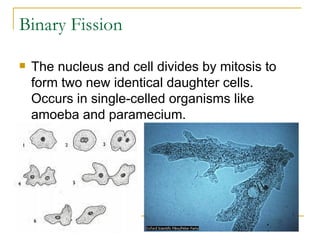
Binary Fission The nucleus and cell divides by mitosis to form two new identical daughter cells.  Occurs in single-celled organisms like amoeba and paramecium.
Budding The division of cytoplasm is unequal so that one daughter cell is larger than the other.  They can separate or remain attached.  Occurs in hydra and yeast.
Vegetative Propagation New plants develop from the roots, stems, or leaves of the parent plant.  Occurs only in plants (fruit trees, pineapples, etc.).
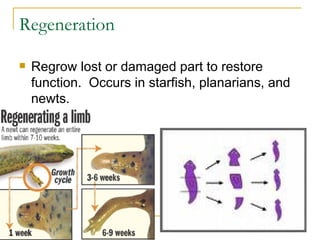
Regeneration Regrow lost or damaged part to restore function.  Occurs in starfish, planarians, and newts.
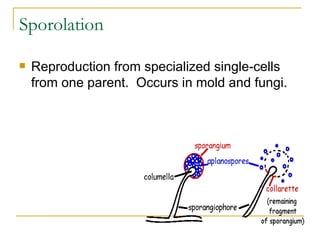
Sporolation Reproduction from specialized single-cells from one parent.  Occurs in mold and fungi.
Advantages and disadvantages BRAINSTORM: What are some potential benefits for organisms that reproduce asexually? BRAINSTORM: What are some potential disadvantages for this type of reproduction?

Asexual Reproduction

  • 1.
  • 2.
  • 3.
    What is reproduction?Reproduction is the process by which organisms produce more of their own kind. Think-Pair-Share: Is reproduction necessary for the survival of an individual, species, or both? Explain.
  • 4.
    Asexual Reproduction Onlyone parent is involved. Offspring are genetically identical to the parent. All cells come from a single cell (Psst! They are all clones.)
  • 5.
    Mitosis - BodyCells Is the exact duplication of the nucleus of a cell so that it forms two identical cells during cell division.
  • 6.
    Binary Fission Thenucleus and cell divides by mitosis to form two new identical daughter cells. Occurs in single-celled organisms like amoeba and paramecium.
  • 7.
    Budding The divisionof cytoplasm is unequal so that one daughter cell is larger than the other. They can separate or remain attached. Occurs in hydra and yeast.
  • 8.
    Vegetative Propagation Newplants develop from the roots, stems, or leaves of the parent plant. Occurs only in plants (fruit trees, pineapples, etc.).
  • 9.
    Regeneration Regrow lostor damaged part to restore function. Occurs in starfish, planarians, and newts.
  • 10.
    Sporolation Reproduction fromspecialized single-cells from one parent. Occurs in mold and fungi.
  • 11.
    Advantages and disadvantagesBRAINSTORM: What are some potential benefits for organisms that reproduce asexually? BRAINSTORM: What are some potential disadvantages for this type of reproduction?