See discussions, stats,and author profiles for this publication at: https://www.researchgate.net/publication/351667391
Building Information Modeling (BIM) Workflows for Construction Sequencing
and 4D-Planning of 3D-Printed ISRU Surface Habitats
Conference Paper · April 2021
DOI: 10.1061/9780784483374.128
CITATIONS
6
READS
1,115
12 authors, including:
Melodie Yashar
National Aeronautics and Space Administration
27 PUBLICATIONS 158 CITATIONS
SEE PROFILE
Christina Ciardullo
Yale University
10 PUBLICATIONS 92 CITATIONS
SEE PROFILE
Michael Morris
Pratt Institute
8 PUBLICATIONS 91 CITATIONS
SEE PROFILE
All content following this page was uploaded by Melodie Yashar on 11 November 2021.
The user has requested enhancement of the downloaded file.
2.
Building Information Modeling(BIM) Workflows for Construction Sequencing
& 4D-Planning of 3D-Printed ISRU Surface Habitats (Abstract 715110 )
M. Yashar1
, P. Michealsen2
, B. Hammond3
, J. Alvizar4
, C. Ciardullo5
, M. Morris6
, R.
Pailes-Friedman6
, G. Bell7
, R. Tucker7
, T. Shen7
, S. Austin8
, L. LeBlanc9
1
Team Leader SEArch+ / Apis Cor within 3DP Habitat Challenge, Co-Founder,
Space Exploration Architecture / SEArch+ LLC; email: info@spacexarch.com
2
LEED AP, VDC CP; Managing Principal, Modulus Consulting; email:
info@modulusconsulting.com
3
LEED AP; BIM Manager, Modulus Consulting; email:
info@modulusconsulting.com
4
Senior BIM Specialist, Modulus Consulting; email: info@modulusconsulting.com
5
Co-Founder, BIM Coordinator within 3DP Habitat Challenge, Space Exploration
Architecture / SEArch+ LLC; email: info@spacexarch.com
6
Co-Founder, Space Exploration Architecture / SEArch+ LLC; email:
info@spacexarch.com
7
Team Member, Space Exploration Architecture / SEArch+ LLC; email:
info@spacexarch.com
8
PhD; Principal Structural Engineer, CE America; email:
engineering@ceamerica.com
9
Owner, Blanc Design; MEP Specialist; email: lleblanc@blancdesign.us
ABSTRACT
Future autonomously constructed surface habitats on the Moon and Mars will
leverage the versatility of additive manufacturing technologies to create airtight and
durable structures which protect the crew from the harsh extraterrestrial environment.
BIM workflows present significant value in the design and engineering of many
space systems but particularly so for habitat facilities—which will include
pre-integrated hardware components such as ECLS, airlocks, suitports, as well as
hygiene modules. Synergies between BIM and construction management softwares
with robotic control and software systems for emplacement and for additive
manufacturing are yet to be realized—however there is no question that this research
will become a necessary milestone in the development of autonomously constructed
habitat systems. In particular, 4D-simulation in BIM software lends tremendous value
to mission planning and mission architectures which conceive the autonomous
robotic construction of a habitat system. In 2019 team SEArch+/Apis Cor won first
place in Virtual Construction (BIM) Level 2 (100% Design) within NASA’s Phase 3
Challenge for a 3D-Printed Habitat on Mars, which was judged on criteria such as:
BIM use functionality, Completeness of 3D model according to distinct levels of
development for retaining walls, MEP, and ECLSS, Realism of 4D Model, among
others. This paper will define the landscape of BIM use and simulation as it will
apply to the future robotic deployment of space habitats, followed by a description of
the project’s contribution to BIM workflows for the design of an ISRU surface
3.
habitat in theshort term (both for developing an appropriate mission architecture as
well as for full-scale construction prototyping on Earth), and concluding with
recommendations for next steps in advancing present research and construction
prototyping with such softwares.
INTRODUCTION
Future long duration exploration missions will benefit from robotic precursor
missions which autonomously construct surface infrastructure and habitat systems
prior to a crew’s arrival. For autonomously constructed habitats to successfully
deploy on the Moon and Mars, the construction sequence must consider: required site
conditions relevant to the foundation system, quantities of raw materials required at
the site for ISRU collection, feedstock storage and access to the mixing apparatus for
3D-printing, access to power sources, as well as many other environmental and
in-situ based resources necessary for autonomous deployment and construction of the
habitat. In SEArch+/Apis Cor’s submissions to NASA’s Phase 3 Centennial
Challenge for a 3D Printed Habitat on Mars, the team merged Building Information
Modeling (BIM) workflows between Rhino/Grasshopper, Autodesk Revit,
Navisworks, and a proprietary slicer software developed to estimate time to
completion for additive construction as well as material quantities for feedstock.
Uses of BIM in AEC. BIM is an essential component within the digital management
of construction projects. The advantages of BIM are that it enables a holistic
collection of linked building information, provision of data, and integration of
building models drawn from shared databases containing detailed information of the
building at every phase of its lifecycle. Central storage and planning with BIM can be
considered state-of-the-art, and software programs enable integration of data sources
and types with the building model itself. A major shift in philosophy in working with
BIM tools as opposed to other digital computer aided design (CAD) tools is the
conceptualization of every drawn element as not representative lines and geometry
but rather as a building element in itself. This fundamental re-conceptualization of
design as building object elements rather than representations has made it possible to
embed metadata into a project previously impossible in 2D and 3D CAD drawing.
BIM information ranges from proximity and location of objects to material
characterization and/or properties, quantity takeoff, assembly and sub-assembly
information, followed by time for construction. It provides a seamless platform for
real-time collaboration and sharing of information embedded within geometric
metadata associated with 3-dimensional building components. Within the
Architecture, Engineering, and Construction (AEC) industries BIM is used
extensively in project planning and execution for applications such as clash detection
of virtual geometries (Teizer, 2018). However, the uses of BIM span from early
project planning and design, to operational facilities management and lifecycle
analysis for completed projects.
-2-
Earth & Space Conf. Rev. 04/2018
4.
Interoperability is apillar of BIM because the information or metadata contained
within models needs to be exchanged (usually across different software) in order to
be useful. IFC (Industry Foundation Classes), a computer developing standard, is
often cited as the most common means by which BIM interoperability can be
achieved (Santos, 2010). A model can be converted into IFC data schema, which is a
text based structure representing all the data nested in a model such as geometry,
material type, existing family parameters (e.g. robots) and hierarchy of elements
along with project metadata (Davtalab, 2018). Despite the strengths of IFC and its
prominence within a number of design-build projects and examples within the field,
interoperability and the integration of BIM platforms with automated construction
systems remains an ongoing challenge.
Challenges of BIM-Integrated Frameworks for Automated Construction. While
BIM has been largely adopted on large-scale and complex building projects, and is
generally responsible for the development and integration of new computational
technologies and software within AEC, it has not followed with direct opportunities
for automation and/or the use of robotics in construction (Correa, 2016).
Implementation in full-scale automated building construction is still necessary. BIM
alone is not sufficient to accomplish directed planning of automated construction
processes on and off-site (Meschini, 2018). BIM within AEC has been traditionally
conceived as a tool for project planning and scheduling rather than an integrated
approach or framework for the coordination of automated construction
processes—suggesting that there is a lack of specific software to adequately represent
the complexity of modern buildings, and to plan and test automated construction
processes (Meschini, 2018). Information may certainly be shared and transferred
between BIM models and numerical control outputs, but the data acquisition, data
types, and organization are yet to be streamlined or addressed comprehensively for
automated and/or autonomous construction. This is in part, of course, because robotic
systems and platforms tend to be devised for a particular application or hardware
setup, in which, more often than not, software is designed specifically for the robotic
control system. Automation is appealing for construction because it can guarantee
work quality, reduce the cognitive load and burden on project management, achieve
greater labor efficiency, and ensure productivity without fatigue. Automation in
construction will also become more widely adopted as a necessity to meet the
growing demand for buildings while the supply of skilled labor continues to decline.
3D vs 4D BIM. BIM software frameworks provide a means of handling construction
schedules both in the planning and execution phases (Tauscher, 2014). 3D BIM
objects, containing valuable metadata, may be correlated to a construction schedule in
a fairly automatic and generative way, to produce a 4D construction visualization. 4D
planning and sequencing includes the simulation and control of detailed construction
site logistics processes, such as site layout planning, the inclusion and removal of
temporary equipment or materials, and more (“3D-Printed Habitat…Competition
Rules”). 4D BIM schedules assign construction tasks to building (geometry)
-3-
Earth & Space Conf. Rev. 04/2018
5.
elements, part ofthe underlying BIM, and derive a task order or sequence for the
construction tasks within a schedule.
The application of BIM within planning stages has been demonstrated and verified
within AEC industries as a means of simulating logistics and process workflows
within construction. In actual construction stages and progress monitoring during
building construction, many gaps remain in developing real-time updates to BIM to
capture deviations and anomalies that inevitably occur within construction processes.
One of BIM’s ongoing shortcoming is that of construction progress detection (Asadi,
2018). Errors and changes to design plans within as-built structures are rarely
captured within record models. Tools for efficient (automated) data collection on
construction sites and (near) real-time analysis are still missing (Teizer et al, 2017).
After completion of the construction phase, BIM is important as an integrated
representation for lifecycle analysis within operations and management.
BIM for Manufacturing. BIM enables software to convert virtual 3-dimensional
geometry into Computerized Numerical Control (CNC) codes which dictate the
3-dimensional positioning of a 3D-print head, robot arm, end effector, or any type of
additive deposition mechanism, generally speaking. In this way, BIM-based software
enables CAD to CAM production. The methodology of using BIM for fabrication
enables the assembly motion plans for CNC in robotic assembly and prototyping.
G-code is the most widely used and well-known numerical control programming
language for 3D-printing, used for many automation processes and manufacturing
tasks involving machine tools. G-code defines the speed, trajectory of motion (tool
path) and the selection of the specific tool. BIM methods extend traditional
CAD-based 3D modeling workflows, by seamlessly integrating metadata associated
with 3D geometries, in addition to other processes for planning, scheduling,
operations and maintenance (Teizer, 2018). While BIM could certainly function to
link data structures between CAD / CAM / CAE in mechanical engineering, it has not
functioned as such in professional practice to date and the examples of such
applications are very few (Correaa, 2016).
3D-Printing and BIM. Additive manufacturing has the potential to disrupt the status
quo for automation in construction today. Workflows from BIM to automated
additive construction will augment productivity marking a giant leap in the
efficiencies provided to automation within AEC. 3D printing is a disruptive
technology set to upturn construction practices, but many have yet to develop a strong
business case to be able to implement the technology. Given the risk-adverse nature
of the construction industry, in order for 3D-printing to become a field-ready
construction method, computer control of the manufacturing sequence will best
integrate with logistics for other aspects of a project including the integration of MEP
elements, materials schedules, and more.
BIM software, as developed for the AEC industry, has been organized to represent
largely planar geometries for wall, floor, and roof families functioning as
-4-
Earth & Space Conf. Rev. 04/2018
6.
multi-material sub-assemblies inconstruction management. While BIM tools in the
AEC industry can represent simplified geometries for additive manufacturing, the
representation of material extrusion through machine- and tool-paths would serve to
further integrate BIM tools and additive manufacturing construction methods. This
re-conceptualization would further make it possible to integrate a 4D BIM workflow
visualizing the continuous extrusion of material.
BIM for Habitat Design. In a majority of circumstances, integration from design to
production between BIM and robotics is achieved with the use of IFC Schema for the
BIM model with building design, and the representation of the printing process for
that design, and geometry within a STL file to be used with a 3D Printer (Correaa,
2016). Additionally, the 3D-printer itself will more likely than not be only one of
multiple robotically deployed elements at the construction site within a future mission
scenario. Site logistics including layout planning using required facilities for
automated construction will likewise be necessary to consider and integrate within a
unified control system. The integration of CAD and BIM softwares with robotic tools
such as Robot Operating System (ROS) could indeed represent the next step in
realizing automated construction processes in the AEC industries (Meschini et al,
2016). ROS is an open-source operating system for robots originally developed in
2007 by the Stanford Artificial Intelligence Laboratory.
System Architecture Logistics for Surface Site Infrastructure on Mars. Before
3D-printing is deployed for infrastructure development, site establishments will rely
on construction machinery for excavation, levelling, grading, and preparation of the
terrain. Space robotics will be an integral part of surface site preparation relevant to
ISRU for the construction of deep space infrastructure. Robots will assist in scouting
and surveying build and excavation sites, in addition to prospecting and processing
raw materials such as regolith. Tasks such as material transport, equipment
positioning and assembly will be managed by robot fleets on precursor missions
(Fong et al, 2005). Machinery for site preparation will not only need to mobilize
autonomously, but connect and integrate with other ISRU systems (such as for
power).
All the same, the design and planning of 4D construction sequencing for earth-based
construction and in deployment within a future Mars surface mission requires precise
knowledge from human operators and planners of available workspaces for
automated machines and robots, and requires knowledge of intelligent safety
solutions (such as a collision-free work environment based on real time location
sensing) for appropriate and intelligent human-machine interaction to occur (Teizer,
2018). Autonomous operations do not obviate systems engineers and designers from
having expert knowledge of additive manufacturing standards ensuring structural
integrity at the building scale, as an example, and the present need to have
construction crews monitoring construction automation activities (particularly so in
3D-printing) in real-time points to the great challenge of an autonomously deployed
robotic Mars precursor mission. Ensuring resilience and autonomy is a goal for many
-5-
Earth & Space Conf. Rev. 04/2018
7.
deployable mission architecturesfor future long-duration exploration missions.
Artificial intelligence combined with BIM will provide a useful reference for
decision-making as the degree of autonomy develops (Kang, 2018). Fault detection
and quality assurance in 3D-printing will likewise benefit from machine learning and
computer vision for recognition.
Construction Progress Through BIM. Because construction sites tend to be highly
dynamic and uncontrolled environments, achieving or simulating automation and
autonomous operations on-site and without human intervention has been a distinct
challenge. Robots operating autonomously in unstructured environments will require
precise methods to locate building components on-site, and object detection
mechanisms are to-date not well suited to construction applications (Dawod, 2019).
The challenges that come with adopting robotics within building construction
highlights why industrial applications in closed environments with repeated tasks
have been better-suited to robotic applications. BIM models not only contain
databases relevant to 3-dimensional object recognition for vision systems, but also
provides the physical and mechanical specification about the object and their spatial
relation with other elements in the design, which helps in robot guidance and pose
estimation.
Realizing Autonomous Construction through BIM. Vision capabilities and
perception systems are essential for robotics to adapt to continuously changing site
conditions and enable accurate object recognition and estimation on construction sites
(Dawod, 2019). Efforts in computer vision have focused on extracting geometry and
element information from static BIM models (Ferguson, 2019). Moreover, creating
and maintaining a dynamically updated model of the building environment remains a
difficult challenge (Ferguson, 2019). The full extent to which BIM models can
function as a “digital twin” of as-built or in-progress construction sites and buildings
to automatically update a large-scale geometric BIM model in real-time will continue
to be examined in current research. Automated data capture methods are likely to
improve surveying systems in the AEC industries. Advancements in computer vision
and 3D object recognition will certainly bridge gaps in information and data transfer
for BIM models and how they can how they capture or represent activity at
constructions sites in real-time. BIM databases will thus be able to represent not only
design configurations and schedules, but also deviations and changes.
NASA’s Centennial Challenge for a 3D-Printed Habitat on Mars. The 3D-Printed
Habitat Challenge is part of NASA’s Centennial Challenges Program and focuses on
both habitat design as well as technology development of large-scale additive
construction systems capable of fabricating structures from in situ materials (such as
regolith) and/or mission recyclables (such as plastic packaging) (Prater et al, 2018).
The Centennial Challenge program issued solicitations in 2015 and 2018 for virtual
designs relevant to building information modeling (BIM) for additive construction.
The Phase 2 Challenge asked teams to develop material mixtures and 3D-printing
systems and produce test specimens (compression, flexure) and manufacture a small
-6-
Earth & Space Conf. Rev. 04/2018
8.
dome structure (Prateret al, 2018). The Phase 3 3D-Printed Habitat Competition was
subdivided into multiple Virtual Design as well as Construction submission levels,
with the ultimate intent of advancing the applicability of BIM to large-scale additive
manufacturing projects in space. SEArch+ / Apis Cor’s participation within NASA’s
Phase 3 3D-Printed Habitat Challenge enabled the team to contribute and advance
this area of research.
Virtual Construction Levels of NASA’s 3D-Printed Habitat Challenge. In the
Virtual Construction levels of NASA’s competition, teams were asked to create BIM
models of autonomously constructed habitat structures and provide detailed
information on materials, design, and construction sequencing (Prater et al, 2018).
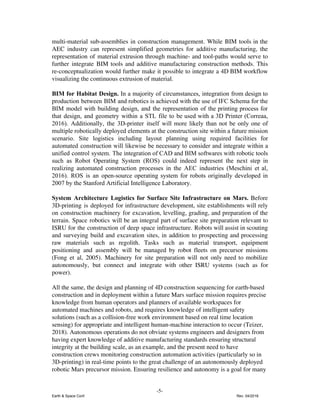
Mars X-House by team SEArch+ / Apis Cor won first place within Final Virtual
Design (100% Design) within the Phase 3 NASA 3D-Printed Habitat Challenge (see
Figure 3 below). Mars X-House celebrates innovation in radiation shielding
techniques while allowing natural light to penetrate the structure, supporting the
astronauts’ physiological and psychological well-being in a long-duration mission
(Yashar et al, 2019). Our human-centered approach prioritizes safety, redundancy,
and the wellbeing of the crew. Considerations such as tensile loading, printability as
well as simulation of an appropriate construction sequence given a mobile printing
apparatus factored into the design decisions made for the habitat.
Figure 1. Mars X-House Exterior View.
Requirements. The habitat designs required a pressure-retaining living space of at
least 93 m2
with the intent of supporting four astronauts for one year. Teams were
asked to deliver a BIM model as well as a 4D construction sequence simulating all
autonomous activities at the site including: construction machinery, additive
manufacturing, and emplacement of pre-integrated components (ECLS, airlocks, etc).
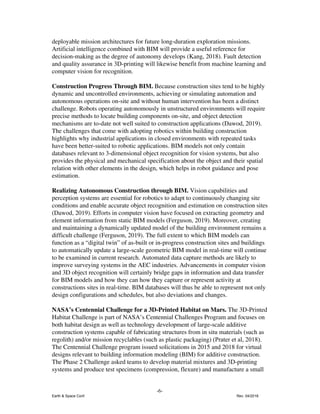
Teams were asked to incorporate (at minimum) a suit hatch, a view port, an
equipment/rover hatch, and two combined communications-power-instrumentation
penetrations within the habitat design and structure (“3D-Printed Habitat Challenge
Rules,” 2018). These elements were used to score submissions based on “Missing
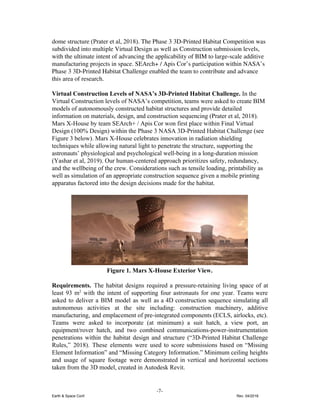
Element Information” and “Missing Category Information.” Minimum ceiling heights
and usage of square footage were demonstrated in vertical and horizontal sections
taken from the 3D model, created in Autodesk Revit.
-7-
Earth & Space Conf. Rev. 04/2018
9.
Figure 2. Requiredsuit hatches, view port, equipment/rover hatch, and
comms-power-inst penetrations within the Virtual Construction models
Figure 3. Required minimum ceiling heights demonstrated within BIM
The 100% Virtual Construction (BIM) Level 2 submission was required to have MEP
and ECLSS design progressed to a Level of Development (LOD) 200 and the
structural and pressure retaining walls and components progressed to LOD 400
(“3D-Printed…, 2018). The BIM Forum 2018 LOD Specification defines LOD 200
as a general model where elements are modeled with approximate quantities, size,
shape, location, and orientation. LOD 400 defines model elements as specific
assemblies, with complete fabrication and detailing information in order to derive full
constructability from the model.
The competition asked teams to consider 3D BIM Habitat Modeling in order to
“depict an accurate representation of physical conditions, printing environment, and
assets” of the construction site, 4D BIM Construction Sequencing to “graphically
represent both permanent and temporary facilities on site during multiple phases of
the construction process,” Equipment and Material Flow “to demonstrate the
movements of construction methods including, but not limited to 3D-printers,
material handling, and all autonomous systems on site,” and finally a Virtual Mockup
of the building model and construction process, or “the model used to design and
analyze the construction of the facility components to improve their planning and
constructability” (“3D-Printed Habitat... Competition Rules”). Scoring points were
assigned based on the aforementioned criteria.
-8-
Earth & Space Conf. Rev. 04/2018
10.
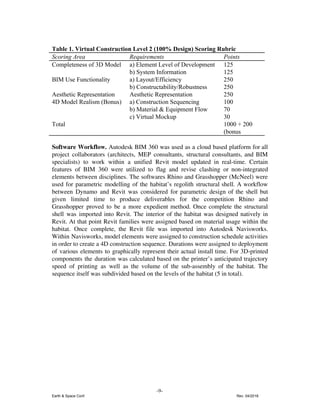
Table 1. VirtualConstruction Level 2 (100% Design) Scoring Rubric
Scoring Area Requirements Points
Completeness of 3D Model a) Element Level of Development
b) System Information
125
125
BIM Use Functionality a) Layout/Efficiency
b) Constructability/Robustness
250
250
Aesthetic Representation Aesthetic Representation 250
4D Model Realism (Bonus) a) Construction Sequencing
b) Material & Equipment Flow
c) Virtual Mockup
100
70
30
Total 1000 + 200
(bonus
Software Workflow. Autodesk BIM 360 was used as a cloud based platform for all
project collaborators (architects, MEP consultants, structural consultants, and BIM
specialists) to work within a unified Revit model updated in real-time. Certain
features of BIM 360 were utilized to flag and revise clashing or non-integrated
elements between disciplines. The softwares Rhino and Grasshopper (McNeel) were
used for parametric modelling of the habitat’s regolith structural shell. A workflow
between Dynamo and Revit was considered for parametric design of the shell but
given limited time to produce deliverables for the competition Rhino and
Grasshopper proved to be a more expedient method. Once complete the structural
shell was imported into Revit. The interior of the habitat was designed natively in
Revit. At that point Revit families were assigned based on material usage within the
habitat. Once complete, the Revit file was imported into Autodesk Navisworks.
Within Navisworks, model elements were assigned to construction schedule activities
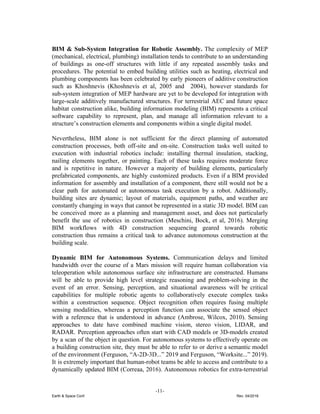
in order to create a 4D construction sequence. Durations were assigned to deployment
of various elements to graphically represent their actual install time. For 3D-printed
components the duration was calculated based on the printer’s anticipated trajectory
speed of printing as well as the volume of the sub-assembly of the habitat. The
sequence itself was subdivided based on the levels of the habitat (5 in total).
-9-
Earth & Space Conf. Rev. 04/2018
11.
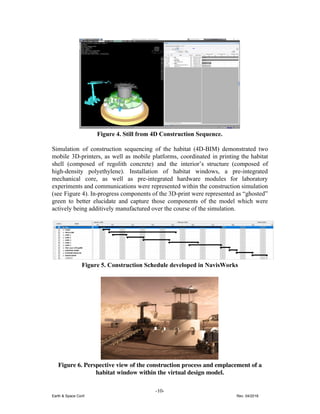
Figure 4. Stillfrom 4D Construction Sequence.
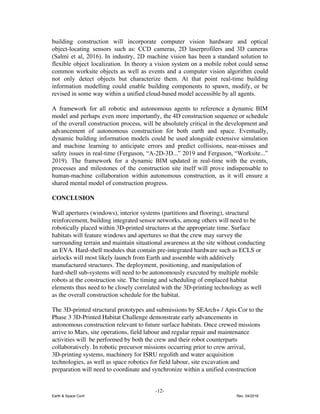
Simulation of construction sequencing of the habitat (4D-BIM) demonstrated two
mobile 3D-printers, as well as mobile platforms, coordinated in printing the habitat
shell (composed of regolith concrete) and the interior’s structure (composed of
high-density polyethylene). Installation of habitat windows, a pre-integrated
mechanical core, as well as pre-integrated hardware modules for laboratory
experiments and communications were represented within the construction simulation
(see Figure 4). In-progress components of the 3D-print were represented as “ghosted”
green to better elucidate and capture those components of the model which were
actively being additively manufactured over the course of the simulation.
Figure 5. Construction Schedule developed in NavisWorks
Figure 6. Perspective view of the construction process and emplacement of a
habitat window within the virtual design model.
-10-
Earth & Space Conf. Rev. 04/2018
12.
BIM & Sub-SystemIntegration for Robotic Assembly. The complexity of MEP
(mechanical, electrical, plumbing) installation tends to contribute to an understanding
of buildings as one-off structures with little if any repeated assembly tasks and
procedures. The potential to embed building utilities such as heating, electrical and
plumbing components has been celebrated by early pioneers of additive construction
such as Khoshnevis (Khoshnevis et al, 2005 and 2004), however standards for
sub-system integration of MEP hardware are yet to be developed for integration with
large-scale additively manufactured structures. For terrestrial AEC and future space
habitat construction alike, building information modeling (BIM) represents a critical
software capability to represent, plan, and manage all information relevant to a
structure’s construction elements and components within a single digital model.
Nevertheless, BIM alone is not sufficient for the direct planning of automated
construction processes, both off-site and on-site. Construction tasks well suited to
execution with industrial robotics include: installing thermal insulation, stacking,
nailing elements together, or painting. Each of these tasks requires moderate force
and is repetitive in nature. However a majority of building elements, particularly
prefabricated components, are highly customized products. Even if a BIM provided
information for assembly and installation of a component, there still would not be a
clear path for automated or autonomous task execution by a robot. Additionally,
building sites are dynamic; layout of materials, equipment paths, and weather are
constantly changing in ways that cannot be represented in a static 3D model. BIM can
be conceived more as a planning and management asset, and does not particularly
benefit the use of robotics in construction (Meschini, Bock, et al, 2016). Merging
BIM workflows with 4D construction sequencing geared towards robotic
construction thus remains a critical task to advance autonomous construction at the
building scale.
Dynamic BIM for Autonomous Systems. Communication delays and limited
bandwidth over the course of a Mars mission will require human collaboration via
teleoperation while autonomous surface site infrastructure are constructed. Humans
will be able to provide high level strategic reasoning and problem-solving in the
event of an error. Sensing, perception, and situational awareness will be critical
capabilities for multiple robotic agents to collaboratively execute complex tasks
within a construction sequence. Object recognition often requires fusing multiple
sensing modalities, whereas a perception function can associate the sensed object
with a reference that is understood in advance (Ambrose, Wilcox, 2010). Sensing
approaches to date have combined machine vision, stereo vision, LIDAR, and
RADAR. Perception approaches often start with CAD models or 3D-models created
by a scan of the object in question. For autonomous systems to effectively operate on
a building construction site, they must be able to refer to or derive a semantic model
of the environment (Ferguson, “A-2D-3D...” 2019 and Ferguson, “Worksite...” 2019).
It is extremely important that human-robot teams be able to access and contribute to a
dynamically updated BIM (Correaa, 2016). Autonomous robotics for extra-terrestrial
-11-
Earth & Space Conf. Rev. 04/2018
13.
building construction willincorporate computer vision hardware and optical
object-locating sensors such as: CCD cameras, 2D laserprofilers and 3D cameras
(Salmi et al, 2016). In industry, 2D machine vision has been a standard solution to
flexible object localization. In theory a vision system on a mobile robot could sense
common worksite objects as well as events and a computer vision algorithm could
not only detect objects but characterize them. At that point real-time building
information modelling could enable building components to spawn, modify, or be
revised in some way within a unified cloud-based model accessible by all agents.
A framework for all robotic and autonomous agents to reference a dynamic BIM
model and perhaps even more importantly, the 4D construction sequence or schedule
of the overall construction process, will be absolutely critical in the development and
advancement of autonomous construction for both earth and space. Eventually,
dynamic building information models could be used alongside extensive simulation
and machine learning to anticipate errors and predict collisions, near-misses and
safety issues in real-time (Ferguson, “A-2D-3D...” 2019 and Ferguson, “Worksite...”
2019). The framework for a dynamic BIM updated in real-time with the events,
processes and milestones of the construction site itself will prove indispensable to
human-machine collaboration within autonomous construction, as it will ensure a
shared mental model of construction progress.
CONCLUSION
Wall apertures (windows), interior systems (partitions and flooring), structural
reinforcement, building integrated sensor networks, among others will need to be
robotically placed within 3D-printed structures at the appropriate time. Surface
habitats will feature windows and apertures so that the crew may survey the
surrounding terrain and maintain situational awareness at the site without conducting
an EVA. Hard-shell modules that contain pre-integrated hardware such as ECLS or
airlocks will most likely launch from Earth and assemble with additively
manufactured structures. The deployment, positioning, and manipulation of
hard-shell sub-systems will need to be autonomously executed by multiple mobile
robots at the construction site. The timing and scheduling of emplaced habitat
elements thus need to be closely correlated with the 3D-printing technology as well
as the overall construction schedule for the habitat.
The 3D-printed structural prototypes and submissions by SEArch+ / Apis Cor to the
Phase 3 3D-Printed Habitat Challenge demonstrate early advancements in
autonomous construction relevant to future surface habitats. Once crewed missions
arrive to Mars, site operations, field labour and regular repair and maintenance
activities will be performed by both the crew and their robot counterparts
collaboratively. In robotic precursor missions occurring prior to crew arrival,
3D-printing systems, machinery for ISRU regolith and water acquisition
technologies, as well as space robotics for field labour, site excavation and
preparation will need to coordinate and synchronize within a unified construction
-12-
Earth & Space Conf. Rev. 04/2018
14.
sequence, or 4DBIM plan. Remote supervision and control by ground support will
occur with communications delays as well as limited bandwidth, further indicating
the need for construction robotics to function and solve problems autonomously,
while nonetheless consulting and conferring with mission control when help is
needed. Testing and validation of pressurized 3D-printed structures remains a
challenge still to be undertaken in large-scale earth-based additively manufactured
prototypes anticipating the autonomous construction of habitats in future Mars
mission scenarios.
REFERENCES
“3D-Printed Habitat Challenge – Phase III Competition Rules: Phase 3.” Bradley
University. <www.bradley.edu/sites/challenge/rules/> Accessed 16 January
2018.
Asadi, K., Han, K. (2018). “Real-Time Image-to-BIM Registration Using Perspective
Alignment for Automated Construction Monitoring.”
10.1061/9780784481264.038.
Ambrose, Wilcox, et al. NASA Technology Area 4 Roadmap: Robotics,
Tele-Robotics and Autonomous Systems, 2010.
Bock, T., Linner, T., “Construction Robots: Elementary Technologies and
Single-Task Construction Robots. Cambridge: Cambridge UP, 2016.
Bock, T. The future of construction automation: Technological disruption and the
upcoming ubiquity of robotics. Automation in Construction 59 (2015)
113–121
Correaa, F.R., “Robot-Oriented Design for Production in the context of Building
Information Modeling ” 33rd International Symposium on Automation and
Robotics in Construction (ISARC 2016)
Davtalab, O., Kazemian, A., Khoshnevis, B. “Perspectives on a BIM-integrated
software platform for robotic construction through Contour Crafting.”
Automation in Construction. 89. 2018, p 13-23
Dawod, M. & Hanna, S. “BIM-assisted object recognition for the on-site autonomous
robotic assembly of discrete structures” Constr Robot (2019).
https://doi.org/10.1007/s41693-019-00021-9
Ding, L., & Wei, R., & Che, H. (2014). “Development of a BIM-based Automated
Construction System.” Procedia Engineering. 85. 123-131.
10.1016/j.proeng.2014.10.536.
Edmunson, J., Fiske, M. R., Mueller, R. P., Alkhateb, H. S., Akhnoukh, A.K., Morris,
H. C., Townsend, I.I., Fikes, J. C., and Johnston, M. M., “Additive
Construction with Mobile Emplacement: Multifaceted Planetary Construction
Materials Development” ASCE Aerospace Division International Conference
on Engineering, Science, Construction, and Operations in Challenging
Environments (Earth & Space 2018), American Society of Civil Engineers,
2018.
-13-
Earth & Space Conf. Rev. 04/2018
15.
Ferguson, F., Kincho.L., "A 2D-3D Object Detection System for Updating Building
Information Models with Mobile Robots." IEEE Winter Conference on
Applications of Computer Vision (WACV). 2019.
Ferguson, M., Seongwoon, J., Law, K.H., "Worksite Object Characterization for
Automatically Updating Building Information Models.", ASCE International
Conference on Computing in Civil Engineering (i3CE). 2019.
Fiske, M.R., Edmunson, J.E., J. C. Fikes, “The Disruptive Technology That is
Additive Construction: System Development Lessons Learned for Terrestrial
and Planetary Applications” AIAA SPACE and Astronautics Forum and
Exposition, September 2018.
Fong, T., and Nourbakhsh, I., “Interaction challenges in human-robot space
exploration.” Interactions 12, 2 (March 2005), 42-45.
Howe, A.S., B. Sherwood, “Out of This World: The New Field of Space
Architecture,” Vernacular of Space Architecture, Vol. 1, AIAA, Reston,
Virginia, 1st ed., 2009, pp. 7–21.
Khoshnevis, B., Automated construction by contour crafting - related robotics and
information technologies, Autom. Constr. 13 (1) (2004) 5–19.
Khoshnevis, B., Bodiford, M.P., Burks, K.B., Ethridge, E., Tucker, D., Kim, W.,
Toutanji, H., and Fiske, M.R., “Lunar Contour Crafting – A Novel Technique
for ISRU-Based Habitat Development,” in proceedings of the 43rd AIAA
Aerospace Sciences Meeting and Exhibit, American Institute of Astronautics
and Aeronautics, Reston, VA, 2005, Paper AIAA-2005-0538.
Labonnote, N., Ronnquist, A., Manum, B., Ruther, P. (2016) “Additive construction:
State-of the-art, challenges and opportunities. Automation in Construction,
72(3), 347-366.
Li, X., Qureshi, A., Al-Hussein, M. “Developing a BIM-Based Integrated Model for
CAD to CAM Production Automation” 34th International Symposium on
Automation and Robotics in Construction (ISARC 2017) July 2017
Linner, T., Shrikathiresan, A., Vetrenko, M., Ellmann, B., & Bock, T. (2011).
Modeling and Operating Robotic Environments Using Gazebo/ROS.
10.22260/ISARC2011/0177.
Meschini, S., Iturralde, K., Linner, T., Bock, T., “Novel applications offered by
integration of
robotic tools in BIM-based design workflow for automation in construction
processes.” (2016)
Mueller, R. P., Howe, S., Kochmann, D., Ali, H., Andersen, C., Burgoyne, H.,
Chambers, W., Clinton, R., et al., “Automated Additive Construction (AAC)
for Earth and Space Using In-situ Resources.” ASCE Aerospace Division
International Conference on Engineering, Science, Construction, and
Operations in Challenging Environments (Earth & Space 2016), American
Society of Civil Engineers, Reston, Virginia, 2016.
Mueller, R.P., Fikes, J.C., Case, M.P., Khoshnevis, B., Fiske, M.R., Edmunson, J.E.,
Kelso, R., and Romo, R., “Additive Construction with Mobile Emplacement
(ACME),” 68th International Astronautical Congress (IAC), Adelaide,
Australia, 25-29 September 2017.
-14-
Earth & Space Conf. Rev. 04/2018
16.
Park, Jeewoong &Cho, Yong & Martínez, Diego. (2016). A BIM and UWB
integrated Mobile Robot Navigation System for Indoor Position Tracking
Applications. KICEM Journal of Construction Engineering and Project
Management. 6. 30-39. 10.6106/JCEPM.2016.6.2.030.
Prater, T.J., T. Kim, M. Roman, R. Mueller, “NASA’s Centennial Challenge for
3D-Printed Habitat: Phase II Outcomes and Phase III Competition Overview.”
AIAA SPACE and Astronautics Forum & Exposition, Orlando, Florida. 17-19
September 2018.
Quigley, M. & Gerkey, B. & Conley, K. & Faust, J. & Foote, T. & Leibs, J. &
Berger, E. & Wheeler, R. & Ng, A.. (2009). ROS: An open-source Robot
Operating System. ICRA Workshop on Open Source Software. 3. 1-6.
Tan, K. “The Framework of Combining Artificial Intelligence and Construction 3D
Printing in Civil Engineering” MATEC Web of Conferences 206, 01008
(2018) https://doi.org/10.1051/matecconf/201820601008, ICCEMS 2018
Teizer, J., Blickle, A., King, T., Leitzbach, O., Guenther, D.,Mattern, H., König, M.
(2018). “BIM for 3D Printing in Construction.” Technology Foundations and
Industry Practice. Springer. edited by André Borrmann, Markus König,
Christian Koch, Jakob Beetz
Teizer, J., Wolf, M., Golovina, O., Perschewski M., Propach, M., Neges, M., König,
M., “Internet of Things (IoT) for Integrating Environmental and Localization
Data in Building Information Modeling (BIM).” 34th International
Symposium on Automation and Robotics in Construction (ISARC 2017)
Salmi T., Ahola J.M., Heikkilä T., Kilpeläinen P., Malm T. (2018) Human-Robot
Collaboration and Sensor-Based Robots in Industrial Applications and
Construction. In: Bier H. (eds) Robotic Building. Springer Series in Adaptive
Environments. Springer, Cham
Van Den Bos, B., Strand, J., et al., “Robotic Inspection Solutions for Petrochemical
Pressure Vessels developed and tested in the PETROBOT project” 19th
World Conference on Non Destructive Testing 2016
Yashar, M. et al., “Mars X-House: Design Principles for an Autonomously
3D-Printed ISRU Surface Habitat.” 49th International Conference on
Environmental Systems (ICES), Boston, MA July 2019.
Zhang, X., Li, M., Hui, J., Weng, Y., Wei, Y., Tay, D., Pham, H., Pham, Q-C.
“Large-scale 3D printing by a team of mobile robots.” Automation in
Construction, Volume 95, November 2018, pp. 98-106
-15-
Earth & Space Conf. Rev. 04/2018
View publication stats