ASBANC
SUCCESS STORY
FINANCIAL
INCLUSION
FOR ALL
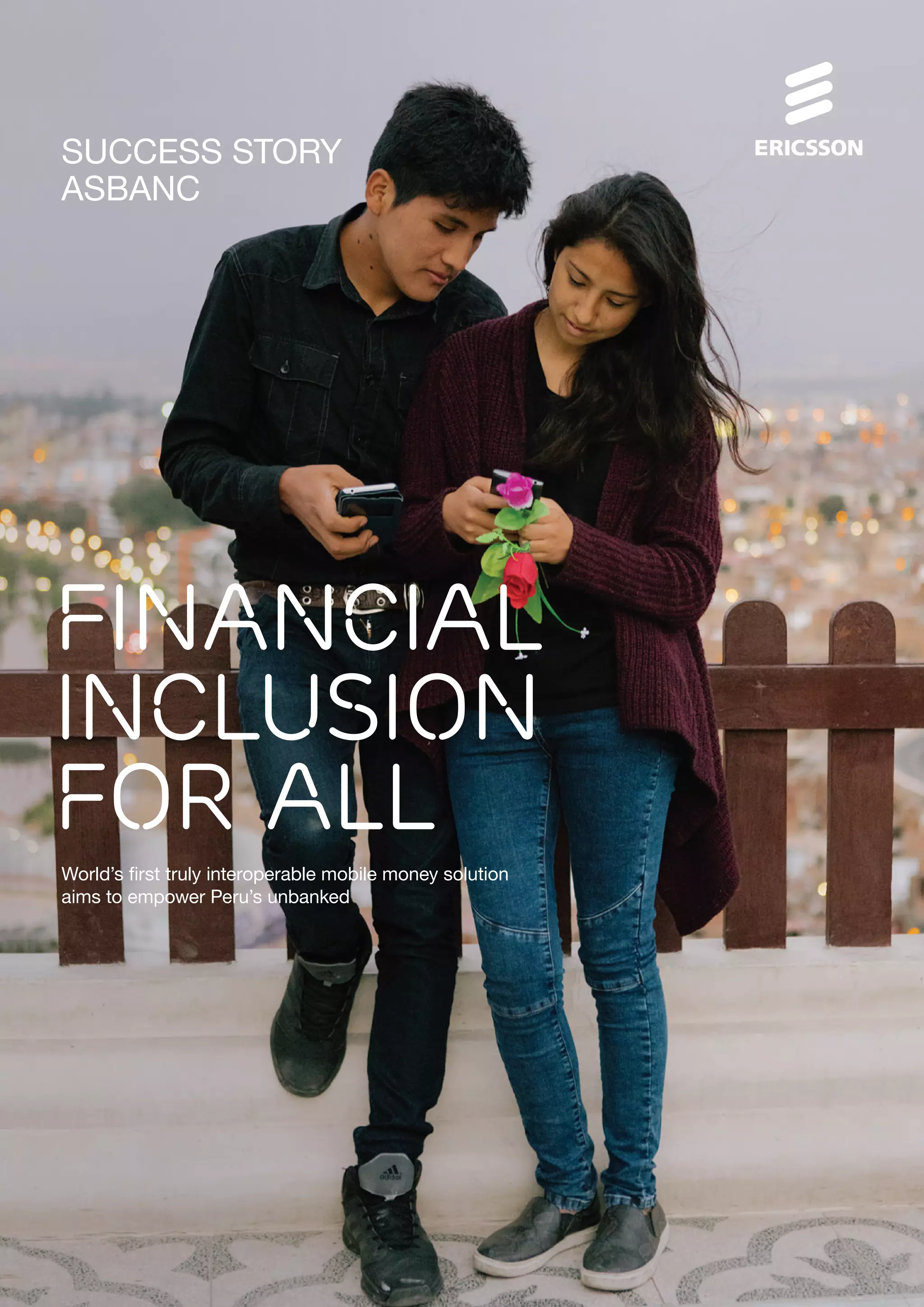
World’s first truly interoperable mobile money solution
aims to empower Peru’s unbanked
Peru is a fast-growing market
with four operators and an
estimated 33 million mobile
connections for a population of
approximately 31 million (Source:
GSMA, 2015). Despite high mobile
penetration and a supportive
regulatory environment, mobile
financial services had yet to take
off in the country. Early mobile
money deployments were largely
unsuccessful and estimates put
the number of banked people in
Peru as low as 30 percent.
Nearly half of the labor force is
casually employed in the service
sector or the agricultural and
fishing industries (Source: World
Bank, 2014). Thus, cash is the
most frequent method of payment
and concerns about security when
carrying, transporting, or handling
cash are widespread.
Challenges
Peru has more than 30,000
banking agents and nearly 11
million debit cards for a population
of approximately 31 million, yet its
complex topography – comprising
the high altitudes of the Andes and
the low-lying natural beauty of the
Amazon rainforest – is an obstacle
for people living in remote areas to
access financial services such as
microfinance or social payments.
Other reasons why so many
people in Peru lacked access to
formal banking services include
high degrees of poverty and low
levels of literacy – a common trend
found across Latin America.
Solution
The stakeholders involved in
Modelo Perú shared resources
and experience gained from
previous successful deployments
around the world to build a new
solution designed to reach scale,
ensure liquidity, and make mobile
financial services attractive to the
unbanked.
Ericsson enabled Peru’s financial
service providers to reuse existing
assets to bundle secure telecom
and financial services and is
currently providing PDP with
systems integration, learning
services, managed services
and support. Ericsson’s mobile
financial service offering includes
full-system integration into one
MOBILE FINANCIAL
SERVICES IN PERU
CUSTOMER PROFILE
Unprecedented collaboration led to the launch on February 16, 2016 of the world’s first truly interoperable mobile financial
services focused on financial inclusion. The Peruvian government, in a unique partnership with financial institutions, telcos
and other shareholders informally known as Modelo Perú, cooperated and shared resources to research, design and launch
Bim (short for billetera móvil or “mobile wallet” in Spanish).
Bim is operated by Peruvian Digital Payments (PDP), a new service provider co-owned by the Association of Banks of Peru
(ASBANC) as well as many of its member banks and electronic money issuers. For its part in this historic process, Ericsson
supplied its mobile financial service solution including the development of a mobile money platform, systems integration,
learning services, managed services and support.
www.asbanc.com.pe
2014
Ericsson is chosen by ASBANC to design and implement its
mobile money project, the country’s largest private initiative for
financial inclusion.
2015
Peruvian Digital Payments (PDP) conducts focus groups
designed to educate participants in basic mobile money
transactions such as cash in/out, P2P money transfers, and
verifying payments. Feedback gathered from the focus groups
was used to improve Bim’s system design.
Ericsson and ASBANC are recognized with a Global Telecoms
Business Innovation Award in the category of Business Service
Innovation.
2016
The official launch of Bim, the first fully interoperable national
payments platform, which is focused on driving financial
inclusion by extending services to Peru’s unbanked and
offering accessibility.
2019
ASBANC aims to include 2.1 million Peruvians with Bim by 2019.
Timeline
[Bim] will mean welfare for the country,
welfare for our population, and it
will improve their economic and
educational level.”
Oscar Rivera,
President of ASBANC
CUSTOMER
ASBANC
CHALLENGE
>> Reach large numbers of poor,
unbanked people – some in
remote areas of the country.
SOLUTION
>> A multi-stakeholder solution
powered by a mobile money
platform, systems integration,
learning services, managed
services and support.
RESULT
>> True interoperability across
the ecosystem and potentially
millions of poor people offered
secure, affordable mobile financial
services.
overview
platform capable of hosting all
services from different financial
and commercial institutions
to secure interoperability. The
resulting common mobile
payments platform bridges the
services of Banco de Crédito
del Perú (BCP), Interbank, BBVA
Continental, and Scotiabank,
as well serving the largest
public bank, Banco de la
Nación, several non-banking
formal financial institutions, and
telecommunications operators.
Today, Bim is accessible to
subscribers of Movistar, Claro,
and Entel mobile services – the
three companies that provide
the vast majority of mobile
connections in Peru. Bim operates
on smartphones and feature
phones, and end-users are not
required to have formal bank
accounts, internet access, or even
calling credit. Bim currently offers
subscribers the option to cash-in/
out, check account balances,
make person-to-person transfers,
and top-up mobile airtime in a fast
and convenient way.
The Peruvian Model
The Modelo Perú has become a
symbol of the potential to reach
large numbers of unbanked
people regardless of location
or digital literacy. Historic levels
of collaboration between the
stakeholders has led to the launch
of practical tools that simplify
day-to-day financial activity,
offering time savings, convenience,
and secure money management,
as well as a way to enter into the
formal economy. This will benefit
Peruvian society over time, and
is expected to eventually become
an integral part of the country’s
socio-economic development.
Ericsson
SE-164 83 Stockholm, Sweden
Telephone +46 10 719 0000
www.ericsson.com/m-commerce
287 01-FGB 101 0195 Uen
© Ericsson AB 2016
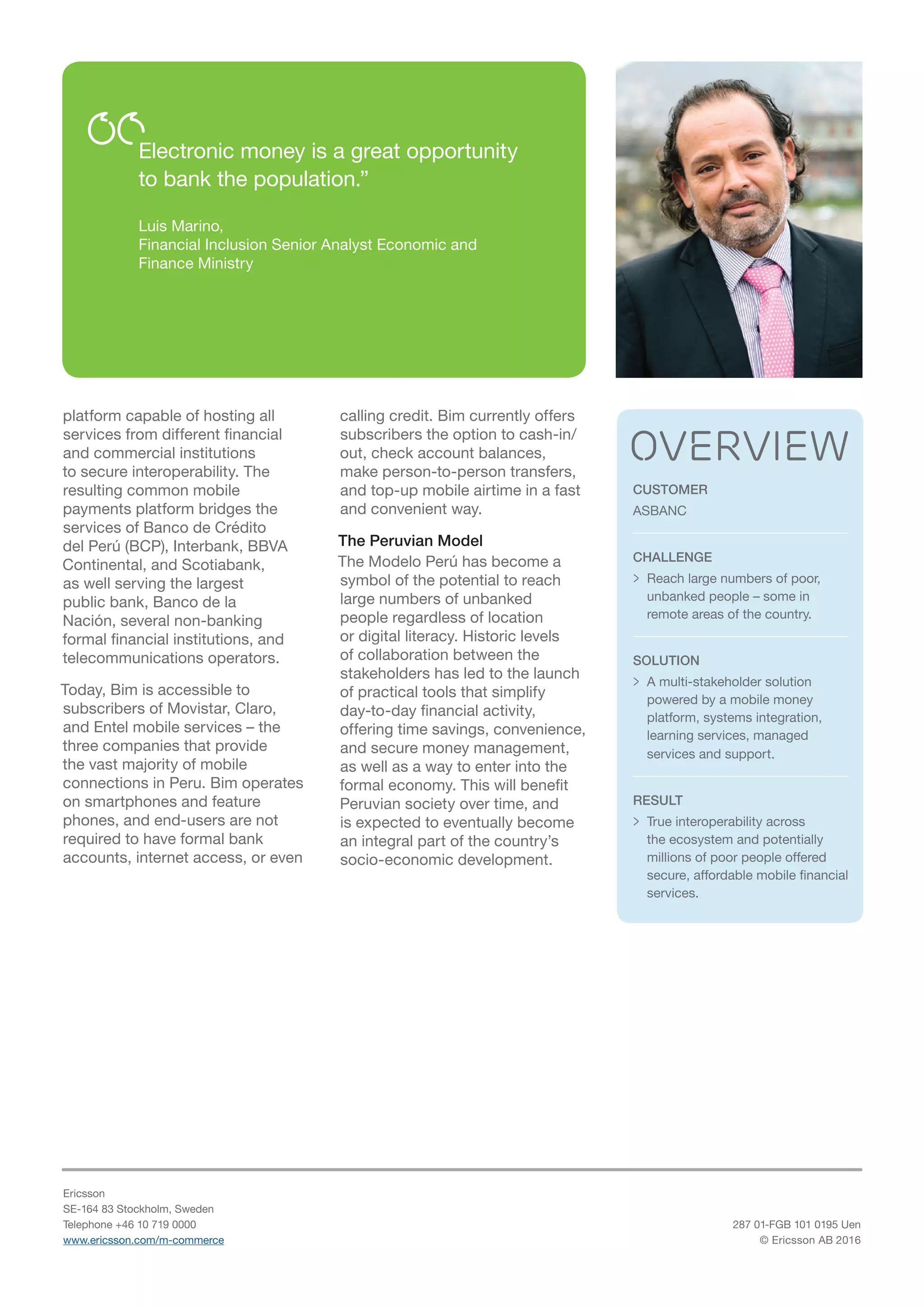
Electronic money is a great opportunity
to bank the population.”
Luis Marino,
Financial Inclusion Senior Analyst Economic and
Finance Ministry

asbanc-success-story

  • 1.
    ASBANC SUCCESS STORY FINANCIAL INCLUSION FOR ALL World’sfirst truly interoperable mobile money solution aims to empower Peru’s unbanked
  • 2.
    Peru is afast-growing market with four operators and an estimated 33 million mobile connections for a population of approximately 31 million (Source: GSMA, 2015). Despite high mobile penetration and a supportive regulatory environment, mobile financial services had yet to take off in the country. Early mobile money deployments were largely unsuccessful and estimates put the number of banked people in Peru as low as 30 percent. Nearly half of the labor force is casually employed in the service sector or the agricultural and fishing industries (Source: World Bank, 2014). Thus, cash is the most frequent method of payment and concerns about security when carrying, transporting, or handling cash are widespread. Challenges Peru has more than 30,000 banking agents and nearly 11 million debit cards for a population of approximately 31 million, yet its complex topography – comprising the high altitudes of the Andes and the low-lying natural beauty of the Amazon rainforest – is an obstacle for people living in remote areas to access financial services such as microfinance or social payments. Other reasons why so many people in Peru lacked access to formal banking services include high degrees of poverty and low levels of literacy – a common trend found across Latin America. Solution The stakeholders involved in Modelo Perú shared resources and experience gained from previous successful deployments around the world to build a new solution designed to reach scale, ensure liquidity, and make mobile financial services attractive to the unbanked. Ericsson enabled Peru’s financial service providers to reuse existing assets to bundle secure telecom and financial services and is currently providing PDP with systems integration, learning services, managed services and support. Ericsson’s mobile financial service offering includes full-system integration into one MOBILE FINANCIAL SERVICES IN PERU CUSTOMER PROFILE Unprecedented collaboration led to the launch on February 16, 2016 of the world’s first truly interoperable mobile financial services focused on financial inclusion. The Peruvian government, in a unique partnership with financial institutions, telcos and other shareholders informally known as Modelo Perú, cooperated and shared resources to research, design and launch Bim (short for billetera móvil or “mobile wallet” in Spanish). Bim is operated by Peruvian Digital Payments (PDP), a new service provider co-owned by the Association of Banks of Peru (ASBANC) as well as many of its member banks and electronic money issuers. For its part in this historic process, Ericsson supplied its mobile financial service solution including the development of a mobile money platform, systems integration, learning services, managed services and support. www.asbanc.com.pe 2014 Ericsson is chosen by ASBANC to design and implement its mobile money project, the country’s largest private initiative for financial inclusion. 2015 Peruvian Digital Payments (PDP) conducts focus groups designed to educate participants in basic mobile money transactions such as cash in/out, P2P money transfers, and verifying payments. Feedback gathered from the focus groups was used to improve Bim’s system design. Ericsson and ASBANC are recognized with a Global Telecoms Business Innovation Award in the category of Business Service Innovation. 2016 The official launch of Bim, the first fully interoperable national payments platform, which is focused on driving financial inclusion by extending services to Peru’s unbanked and offering accessibility. 2019 ASBANC aims to include 2.1 million Peruvians with Bim by 2019. Timeline
  • 3.
    [Bim] will meanwelfare for the country, welfare for our population, and it will improve their economic and educational level.” Oscar Rivera, President of ASBANC
  • 4.
    CUSTOMER ASBANC CHALLENGE >> Reach largenumbers of poor, unbanked people – some in remote areas of the country. SOLUTION >> A multi-stakeholder solution powered by a mobile money platform, systems integration, learning services, managed services and support. RESULT >> True interoperability across the ecosystem and potentially millions of poor people offered secure, affordable mobile financial services. overview platform capable of hosting all services from different financial and commercial institutions to secure interoperability. The resulting common mobile payments platform bridges the services of Banco de Crédito del Perú (BCP), Interbank, BBVA Continental, and Scotiabank, as well serving the largest public bank, Banco de la Nación, several non-banking formal financial institutions, and telecommunications operators. Today, Bim is accessible to subscribers of Movistar, Claro, and Entel mobile services – the three companies that provide the vast majority of mobile connections in Peru. Bim operates on smartphones and feature phones, and end-users are not required to have formal bank accounts, internet access, or even calling credit. Bim currently offers subscribers the option to cash-in/ out, check account balances, make person-to-person transfers, and top-up mobile airtime in a fast and convenient way. The Peruvian Model The Modelo Perú has become a symbol of the potential to reach large numbers of unbanked people regardless of location or digital literacy. Historic levels of collaboration between the stakeholders has led to the launch of practical tools that simplify day-to-day financial activity, offering time savings, convenience, and secure money management, as well as a way to enter into the formal economy. This will benefit Peruvian society over time, and is expected to eventually become an integral part of the country’s socio-economic development. Ericsson SE-164 83 Stockholm, Sweden Telephone +46 10 719 0000 www.ericsson.com/m-commerce 287 01-FGB 101 0195 Uen © Ericsson AB 2016 Electronic money is a great opportunity to bank the population.” Luis Marino, Financial Inclusion Senior Analyst Economic and Finance Ministry