Artificial Neural Networks
WHAT IS AN ARTIFICIAL NEURAL NETWORKS ?
•An artificial neural network consists of a
pool of simple processing units which
communicate by sending signals to each
other over a large number of weighted
connections.
COMPUTERS vs NEURAL NETWORKS
Standard Computers
• One CPU
• Fast processing unit
• Reliable unit
• Static Infrastructure
Neural Networks
• Highly parallel processing
• Slow processing units
• Unreliable unit
• Dynamic Infrastructure
Why Artificial Neural Networks?
• There are two basic reasons why we are interested in building
artificial neural networks (ANNs):
• Technical viewpoint: Some problems such as
character recognition or the prediction of future
states of a system require massively parallel and
adaptive processing.
• Biological viewpoint: ANNs can be used to
replicate and simulate components of the human
(or animal) brain, thereby giving us insight into
natural information processing.
NEURAL NETWORKS
• The “building blocks” of the neural networks is
called neurons.
• In technical terms, we also refer to them as units or nodes.
• Basically, each neuron
• Receives input from many other neurons.
• Changes its internal state(activation) based on the current
input.
• Sends one output signal to many other neurons, possibly
including its input neurons (recurrent network).
NEURAL NETWORKS
• Information is transmitted as a series of electric impulses, so-called
spikes.
• The frequency and phase of these spikes encodes the information.
• In biological systems, one neuron can be connected to as many as
10,000 other neurons.
• Usually, a neuron receives its information from other neurons in a
confined area, its so-called receptive field.
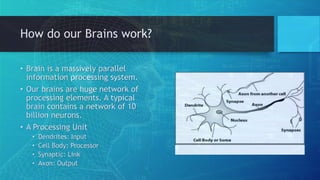
How do our Brains work?
• Brain is a massively parallel
information processing system.
• Our brains are huge network of
processing elements. A typical
brain contains a network of 10
billion neurons.
• A Processing Unit
• Dendrites: Input
• Cell Body: Processor
• Synaptic: Link
• Axon: Output
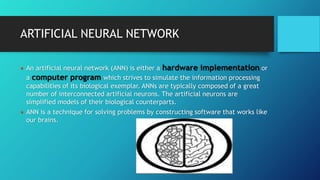
ARTIFICIAL NEURAL NETWORK
 An artificial neural network (ANN) is either a hardware implementation or
a computer program which strives to simulate the information processing
capabilities of its biological exemplar. ANNs are typically composed of a great
number of interconnected artificial neurons. The artificial neurons are
simplified models of their biological counterparts.
 ANN is a technique for solving problems by constructing software that works like
our brains.
How do ANNs work?
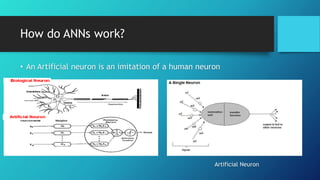
• An Artificial neuron is an imitation of a human neuron
Artificial Neuron
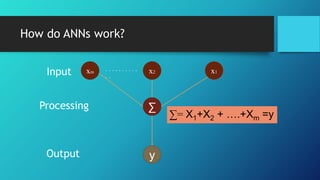
How do ANNs work?
Output
x1x2xm
∑
y
Processing
Input
∑= X1+X2 + ….+Xm =y
. . . . . . . . . .
. .
How do ANNs work?
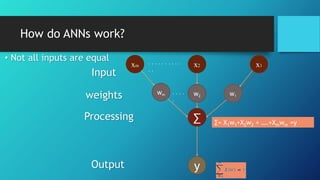
• Not all inputs are equal
Output
x1x2xm
∑
y
Processing
Input
∑= X1w1+X2w2 + ….+Xmwm =y
w1w2
wm
weights
. . . . . . . . . .
. .
. . . .
.
How do ANNs work?
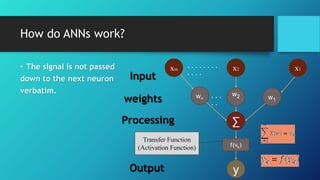
• The signal is not passed
down to the next neuron
verbatim.
Transfer Function
(Activation Function)
Output
x1x2xm
∑
y
Processing
Input
w1
w2wm
weights
. . . . . . . .
. . . .
f(vk)
. . .
. .
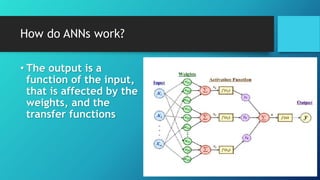
How do ANNs work?
• The output is a
function of the input,
that is affected by the
weights, and the
transfer functions
APPLICATIONS
● Pattern Recognition
● Investment Analysis
● Control Systems and analysis
● Mobile Computing
● Marketing and financial
analysis
● Forecasting - Sales, market,
research, meteorology
THANK YOU
YOU WANT TO KNOW MORE:
akash.ranjan1999@gmail.com
jaiswalaman97@gmail.com

Artificial neural networks

  • 1.
  • 2.
    WHAT IS ANARTIFICIAL NEURAL NETWORKS ? •An artificial neural network consists of a pool of simple processing units which communicate by sending signals to each other over a large number of weighted connections.
  • 3.
    COMPUTERS vs NEURALNETWORKS Standard Computers • One CPU • Fast processing unit • Reliable unit • Static Infrastructure Neural Networks • Highly parallel processing • Slow processing units • Unreliable unit • Dynamic Infrastructure
  • 4.
    Why Artificial NeuralNetworks? • There are two basic reasons why we are interested in building artificial neural networks (ANNs): • Technical viewpoint: Some problems such as character recognition or the prediction of future states of a system require massively parallel and adaptive processing. • Biological viewpoint: ANNs can be used to replicate and simulate components of the human (or animal) brain, thereby giving us insight into natural information processing.
  • 5.
    NEURAL NETWORKS • The“building blocks” of the neural networks is called neurons. • In technical terms, we also refer to them as units or nodes. • Basically, each neuron • Receives input from many other neurons. • Changes its internal state(activation) based on the current input. • Sends one output signal to many other neurons, possibly including its input neurons (recurrent network).
  • 6.
    NEURAL NETWORKS • Informationis transmitted as a series of electric impulses, so-called spikes. • The frequency and phase of these spikes encodes the information. • In biological systems, one neuron can be connected to as many as 10,000 other neurons. • Usually, a neuron receives its information from other neurons in a confined area, its so-called receptive field.
  • 7.
    How do ourBrains work? • Brain is a massively parallel information processing system. • Our brains are huge network of processing elements. A typical brain contains a network of 10 billion neurons. • A Processing Unit • Dendrites: Input • Cell Body: Processor • Synaptic: Link • Axon: Output
  • 8.
    ARTIFICIAL NEURAL NETWORK An artificial neural network (ANN) is either a hardware implementation or a computer program which strives to simulate the information processing capabilities of its biological exemplar. ANNs are typically composed of a great number of interconnected artificial neurons. The artificial neurons are simplified models of their biological counterparts.  ANN is a technique for solving problems by constructing software that works like our brains.
  • 9.
    How do ANNswork? • An Artificial neuron is an imitation of a human neuron Artificial Neuron
  • 10.
    How do ANNswork? Output x1x2xm ∑ y Processing Input ∑= X1+X2 + ….+Xm =y . . . . . . . . . . . .
  • 11.
    How do ANNswork? • Not all inputs are equal Output x1x2xm ∑ y Processing Input ∑= X1w1+X2w2 + ….+Xmwm =y w1w2 wm weights . . . . . . . . . . . . . . . . .
  • 12.
    How do ANNswork? • The signal is not passed down to the next neuron verbatim. Transfer Function (Activation Function) Output x1x2xm ∑ y Processing Input w1 w2wm weights . . . . . . . . . . . . f(vk) . . . . .
  • 13.
    How do ANNswork? • The output is a function of the input, that is affected by the weights, and the transfer functions
  • 14.
    APPLICATIONS ● Pattern Recognition ●Investment Analysis ● Control Systems and analysis ● Mobile Computing ● Marketing and financial analysis ● Forecasting - Sales, market, research, meteorology
  • 15.
    THANK YOU YOU WANTTO KNOW MORE: akash.ranjan1999@gmail.com jaiswalaman97@gmail.com