History of the Artificial Neural
Networks
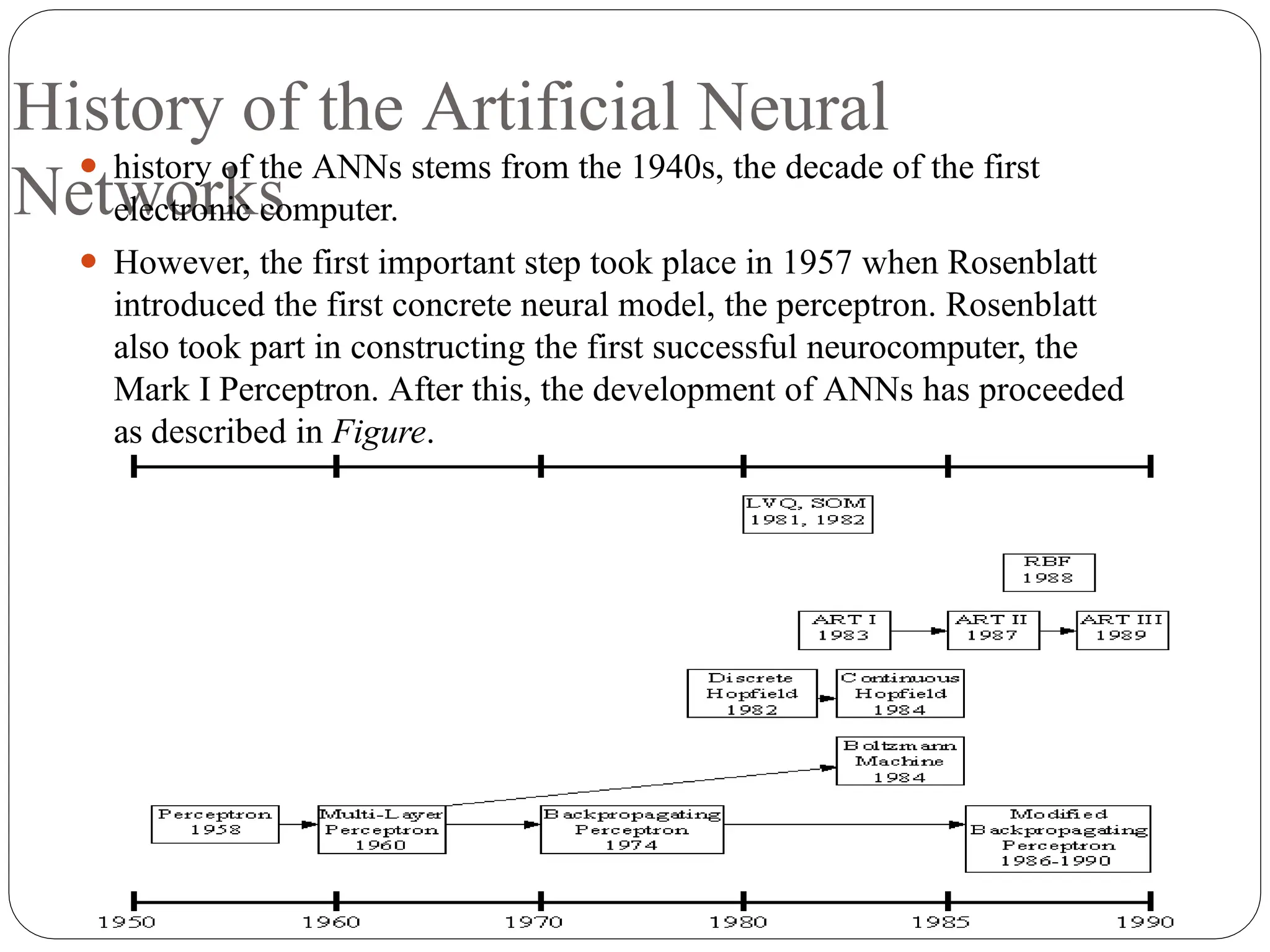
⚫ history of the ANNs stems from the 1940s, the decade of the first
electronic computer.
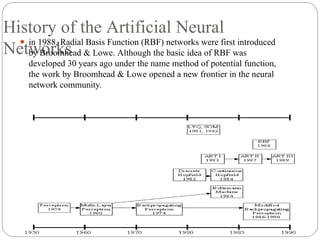
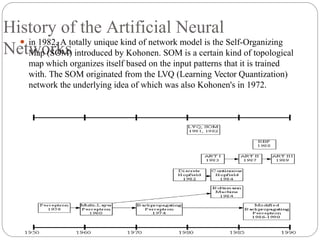
⚫ However, the first important step took place in 1957 when Rosenblatt
introduced the first concrete neural model, the perceptron. Rosenblatt
also took part in constructing the first successful neurocomputer, the
Mark I Perceptron. After this, the development of ANNs has proceeded
as described in Figure.
History of the Artificial Neural
Networks
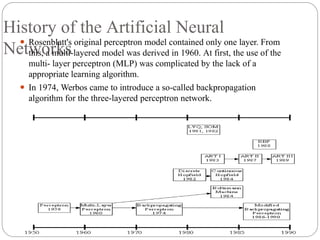
⚫ Rosenblatt's original perceptron model contained only one layer. From
this, a multi-layered model was derived in 1960. At first, the use of the
multi- layer perceptron (MLP) was complicated by the lack of a
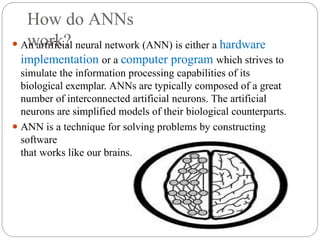
appropriate learning algorithm.
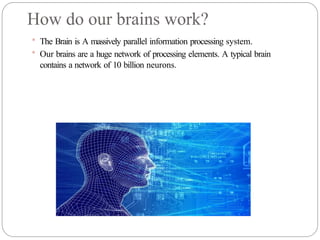
⚫ In 1974, Werbos came to introduce a so-called backpropagation
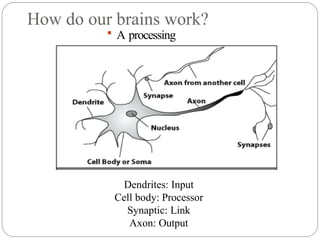
algorithm for the three-layered perceptron network.
History of the Artificial Neural
Networks
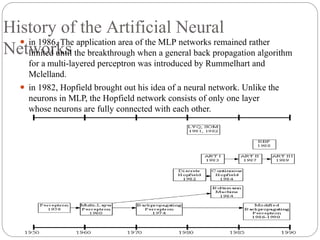
⚫ in 1986, The application area of the MLP networks remained rather
limited until the breakthrough when a general back propagation algorithm
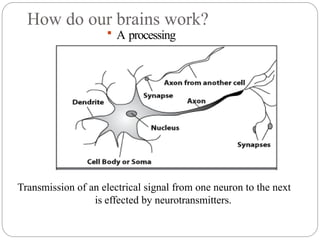
for a multi-layered perceptron was introduced by Rummelhart and
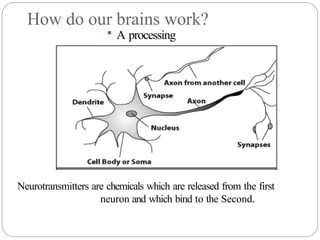
Mclelland.
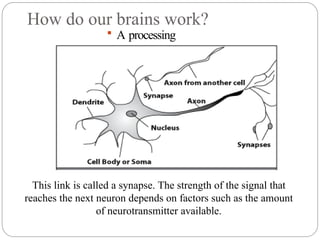
⚫ in 1982, Hopfield brought out his idea of a neural network. Unlike the
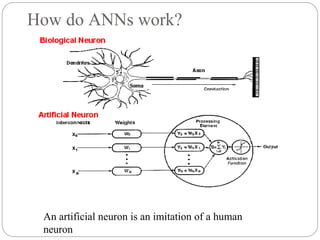
neurons in MLP, the Hopfield network consists of only one layer
whose neurons are fully connected with each other.
History of the Artificial Neural
Networks
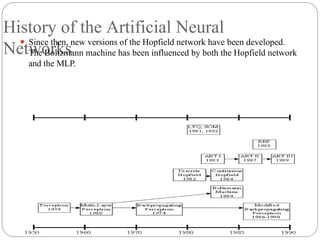
⚫ Since then, new versions of the Hopfield network have been developed.
The Boltzmann machine has been influenced by both the Hopfield network
and the MLP.
History of the Artificial Neural
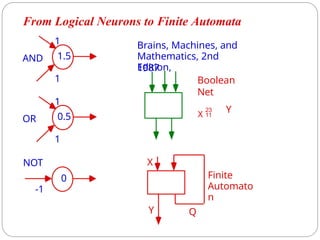
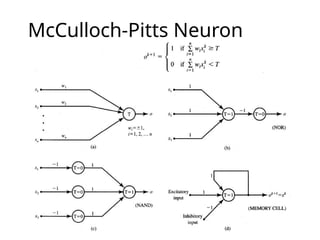
Networks
⚫ in 1988, Radial Basis Function (RBF) networks were first introduced
by Broomhead & Lowe. Although the basic idea of RBF was
developed 30 years ago under the name method of potential function,
the work by Broomhead & Lowe opened a new frontier in the neural
network community.
History of the Artificial Neural
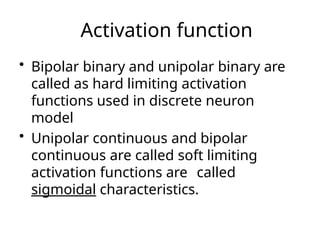
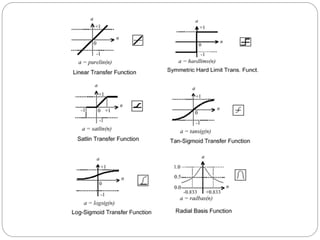
Networks
⚫ in 1982, A totally unique kind of network model is the Self-Organizing
Map (SOM) introduced by Kohonen. SOM is a certain kind of topological
map which organizes itself based on the input patterns that it is trained
with. The SOM originated from the LVQ (Learning Vector Quantization)
network the underlying idea of which was also Kohonen's in 1972.
History of Artificial Neural
Networks
Since then, research on artificial neural networks has
remained active, leading to many new network types, as
well as hybrid algorithms and hardware for neural
information processing.
Artificial Neural Network
⚫An artificial neural network consists of a pool of simple
processing units which communicate by sending signals
to each other over a large number of weighted
connections.
Artificial Neural Network
⚫ A set of major aspects of a parallel distributed model include:
 a set of processing units (cells).
 a state of activation for every unit, which equivalent to the output of
the unit.
 connections between the units. Generally each connection is defined by
a weight.
 a propagation rule, which determines the effective input of a unit from
its external inputs.
 an activation function, which determines the new level of activation
based
on the effective input and the current activation.
 an external input for each unit.
 a method for information gathering (the learning rule).
 an environment within which the system must operate, providing
input signals and _ if necessary _ error signals.
Computers vs. Neural Networks
“Standard” Computers Neural Networks
⚫ one CPU highly parallel
processing
⚫fast processing units slow processing units
⚫reliable units unreliable units
⚫static infrastructure dynamic infrastructure
Why Artificial Neural Networks?
⚫There are two basic reasons why we are interested in
building artificial neural networks (ANNs):
• Technical viewpoint: Some problems such as
character recognition or the prediction of future
states of a system require massively parallel and
adaptive processing.
• Biological viewpoint: ANNs can be used to
replicate and simulate components of the human
(or animal) brain, thereby giving us insight into
natural information processing.
Artificial Neural Networks
• The “building blocks” of neural networks are the
neurons.
• In technical systems, we also refer to them as units or
nodes.
• Basically, each neuron
⚫ receives input from many other neurons.
⚫ changes its internal state (activation) based on the
current input.
⚫ sends one output signal to many other neurons, possibly
including its input neurons (recurrent network).
Artificial Neural Networks
• Information is transmitted as a series of electric
impulses, so-called spikes.
• The frequency and phase of these spikes encodes the
information.
• In biological systems, one neuron can be connected to as
many as 10,000 other neurons.
• Usually, a neuron receives its information from other
neurons in a confined area, its so-called receptive field.
How do ANNs
work?
⚫ An artificial neural network (ANN) is either a hardware
implementation or a computer program which strives to
simulate the information processing capabilities of its
biological exemplar. ANNs are typically composed of a great
number of interconnected artificial neurons. The artificial
neurons are simplified models of their biological counterparts.
⚫ ANN is a technique for solving problems by constructing
software
that works like our brains.
How do our brains work?
 The Brain is A massively parallel information processing system.
 Our brains are a huge network of processing elements. A typical brain
contains a network of 10 billion neurons.
How do our brains work?
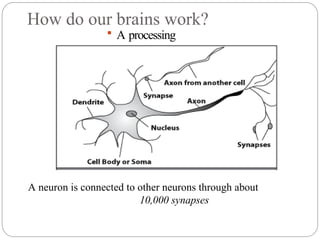
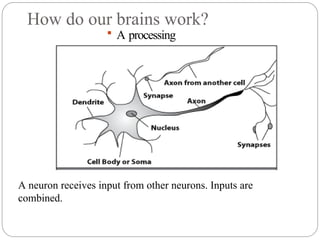
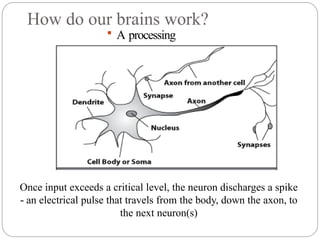
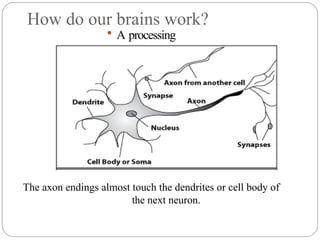
 A processing
element
Dendrites: Input
Cell body: Processor
Synaptic: Link
Axon: Output
How do our brains work?
 A processing
element
A neuron is connected to other neurons through about
10,000 synapses
How do our brains work?
 A processing
element
A neuron receives input from other neurons. Inputs are
combined.
How do our brains work?
 A processing
element
Once input exceeds a critical level, the neuron discharges a spike
‐ an electrical pulse that travels from the body, down the axon, to
the next neuron(s)
How do our brains work?
 A processing
element
The axon endings almost touch the dendrites or cell body of
the next neuron.
How do our brains work?
 A processing
element
Transmission of an electrical signal from one neuron to the next
is effected by neurotransmitters.
How do our brains work?
 A processing
element
Neurotransmitters are chemicals which are released from the first
neuron and which bind to the Second.
How do our brains work?
 A processing
element
This link is called a synapse. The strength of the signal that
reaches the next neuron depends on factors such as the amount
of neurotransmitter available.
How do ANNs work?
An artificial neuron is an imitation of a human
neuron
How do ANNs
work?
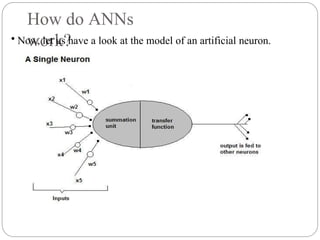
• Now, let us have a look at the model of an artificial neuron.
How do ANNs work?
Output
x1
x2
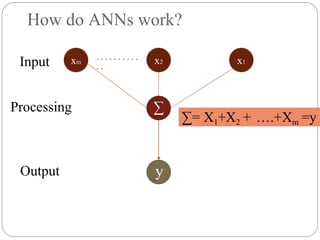
xm
∑
y
Processing
Input
∑= X1+X2 + ….+Xm =y
. . . . . . . . . .
. .
How do ANNs
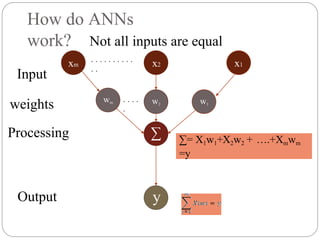
work? Not all inputs are equal
Output
x1
xm x2
∑
y
Input
∑= X1w1+X2w2 + ….+Xmwm
=y
w1
w2
wm
weights
Processing
. . . . . . . . . .
. .
. . . .
.
How do ANNs
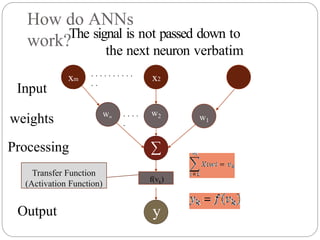
work?The signal is not passed down to
the next neuron verbatim
Transfer Function
(Activation Function)
Output
xm x2
x1
∑
y
Input
w1
w2
wm
weights
Processing
. . . . . . . . . .
. .
f(vk)
. . . .
.
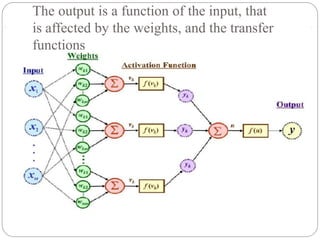
The output is a function of the input, that
is affected by the weights, and the transfer
functions
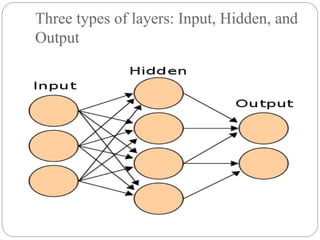
Three types of layers: Input, Hidden, and
Output
Artificial Neural Networks
⚫An ANN can:
1. compute any computable function, by the appropriate
selection of the network topology and weights values.
2. learn from experience!
 Specifically, by trial and error
‐ ‐
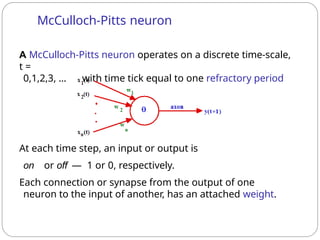
A McCulloch-Pitts neuron operates on a discrete time-scale,
t =
0,1,2,3, ... with time tick equal to one refractory period
At each time step, an input or output is
on or off — 1 or 0, respectively.
Each connection or synapse from the output of one
neuron to the input of another, has an attached weight.
McCulloch-Pitts neuron
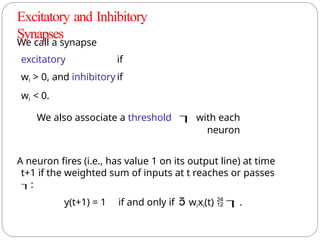
We call a synapse
excitatory if
wi > 0, and inhibitory if
wi < 0.
We also associate a threshold  with each
neuron
A neuron fires (i.e., has value 1 on its output line) at time
t+1 if the weighted sum of inputs at t reaches or passes
:
y(t+1) = 1 if and only if  wixi(t)  .
Excitatory and Inhibitory
Synapses
AND
1
1
1.5
NOT
-1
0
OR
1
1
0.5
Brains, Machines, and
Mathematics, 2nd
Edition,
1987
Y
X 
Boolean
Net
X
Y Q
Finite
Automato
n
From Logical Neurons to Finite Automata
McCulloch-Pitts Neuron
Model
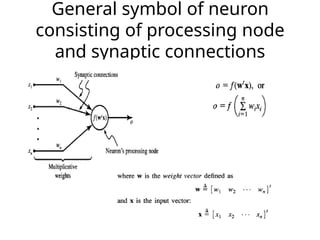
General symbol of neuron
consisting of processing node
and synaptic connections
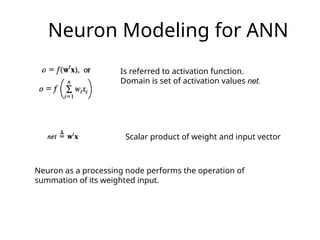
Neuron Modeling for ANN
Is referred to activation function.
Domain is set of activation values net.
Scalar product of weight and input vector
Neuron as a processing node performs the operation of
summation of its weighted input.
The McCulloch-Pitts neuron of 1943 is
important
as a basis for:


logical analysis of the neurally computable, and
current design of some neural devices (especially
when
augmented by learning rules to adjust synaptic
weights).
However, it is no longer considered a useful model for
making
contact with neurophysiological data concerning real
neurons.
Increasing the Realism of Neuron Models
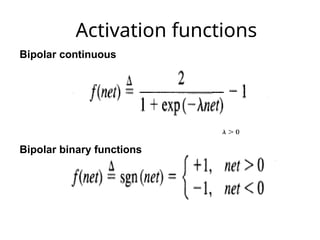
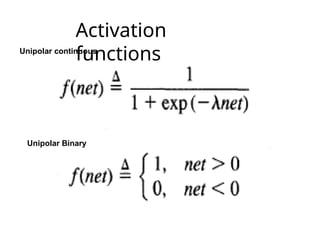
Activation function
• Bipolar binary and unipolar binary are
called as hard limiting activation
functions used in discrete neuron
model
• Unipolar continuous and bipolar
continuous are called soft limiting
activation functions are called
sigmoidal characteristics.
Activation functions
Bipolar continuous
Bipolar binary functions
Activation
functions
Unipolar continuous
Unipolar Binary
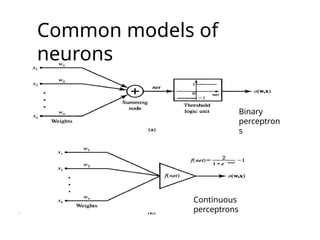
Common models of
neurons
Binary
perceptron
s
Continuous
perceptrons
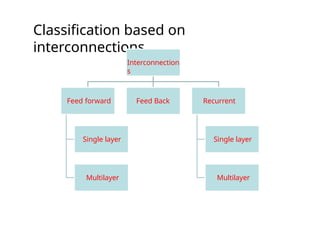
Classification based on
interconnections
Interconnection
s
Feed forward
Single layer
Multilayer
Feed Back Recurrent
Single layer
Multilayer
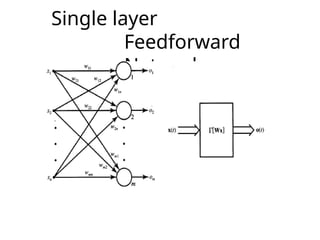
Single layer
Feedforward
Network
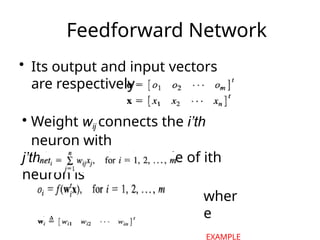
Feedforward Network
• Its output and input vectors
are respectively
• Weight wij connects the i’th
neuron with
j’th input. Activation rule of ith
neuron is
wher
e
EXAMPLE
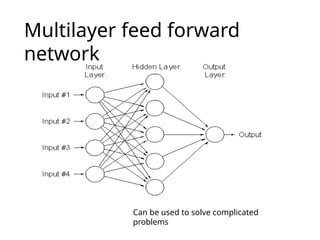
Multilayer feed forward
network
Can be used to solve complicated
problems
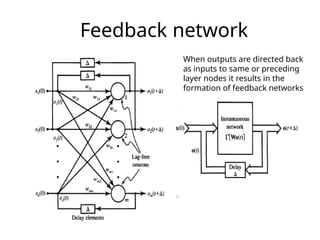
Feedback network
When outputs are directed back
as inputs to same or preceding
layer nodes it results in the
formation of feedback networks
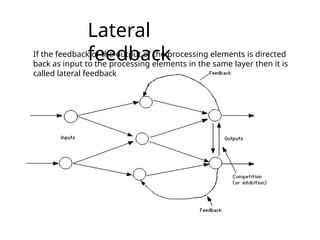
Lateral
feedback
If the feedback of the output of the processing elements is directed
back as input to the processing elements in the same layer then it is
called lateral feedback
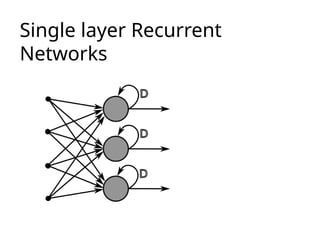
Single layer Recurrent
Networks
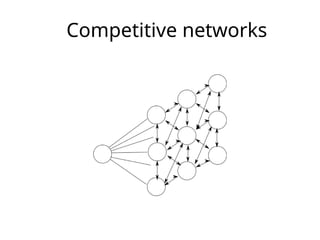
Competitive networks
Learning
• It’s a process by which a NN adapts
itself to a stimulus by making proper
parameter adjustments, resulting in
the production of desired response
• Two kinds of learning
– Parameter learning:- connection weights
are updated
– Structure Learning:- change in
network structure
Training
• The process of modifying the weights
in the connections between network
layers with the objective of achieving
the expected output is called training
a network.
• This is achieved through
– Supervised learning
– Unsupervised learning
– Reinforcement learning
Classification of learning
• Supervised learning
• Unsupervised
learning
• Reinforcement
learning
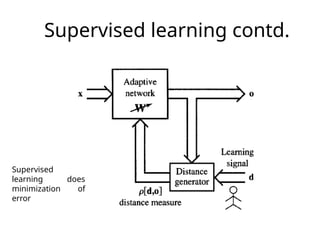
Supervised Learning
• Child learns from a teacher
• Each input vector requires a Corresponding
target vector.
• Training pair=[input vector, target vector]
Neural
Networ
k W
Error
Signal
Generato
r
X
(Input
)
Y
(Actual
output)
(Desired
Output)
Error
(D-Y)
sign
als
Supervised learning contd.
Supervised
learning does
minimization of
error
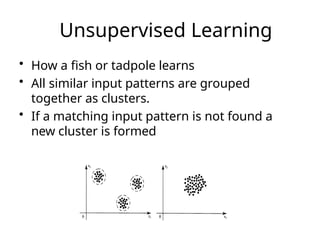
Unsupervised Learning
• How a fish or tadpole learns
• All similar input patterns are grouped
together as clusters.
• If a matching input pattern is not found a
new cluster is formed
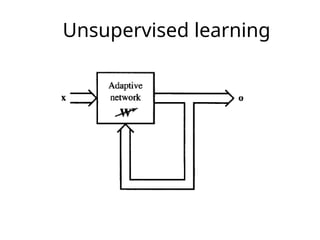
Unsupervised learning
Self-organizing
• In unsupervised learning there is
no feedback
• Network must discover patterns,
regularities, features for the input
data over the output
• While doing so the network might
change in parameters
• This process is called self-organizing
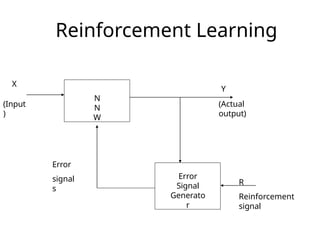
Reinforcement Learning
N
N
W
Error
Signal
Generato
r
X
(Input
)
Y
(Actual
output)
Error
signal
s
R
Reinforcement
signal
When Reinforcement learning
is used?
• If less information is available about
the target output values (critic
information)
• Learning based on this critic
information is called reinforcement
learning and the feedback sent is called
reinforcement signal
• Feedback in this case is only
evaluative and not instructive
Some learning algorithms we
will learn are
• Supervised:
• Adaline, Madaline
• Perceptron
• Back Propagation
• multilayer perceptrons
• Radial Basis Function
Networks
• Unsupervised
• Competitive Learning
• Kohenen self organizing map
• Learning vector quantization
• Hebbian learning
Neural processing
• Recall:- processing phase for a NN and
its objective is to retrieve the
information. The process of computing
o for a given x
• Basic forms of neural information
processing
– Auto association
– Hetero association
– Classification
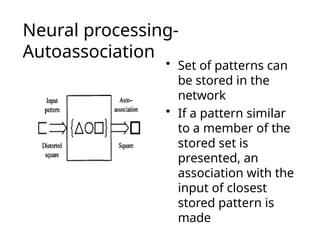
Neural processing-
Autoassociation
• Set of patterns can
be stored in the
network
• If a pattern similar
to a member of the
stored set is
presented, an
association with the
input of closest
stored pattern is
made
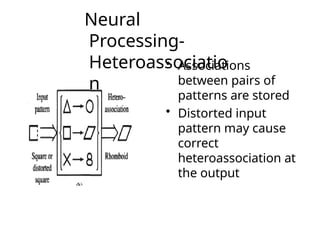
Neural
Processing-
Heteroassociatio
n
• Associations
between pairs of
patterns are stored
• Distorted input
pattern may cause
correct
heteroassociation at
the output
Neural processing-
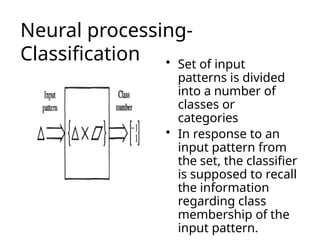
Classification • Set of input
patterns is divided
into a number of
classes or
categories
• In response to an
input pattern from
the set, the classifier
is supposed to recall
the information
regarding class
membership of the
input pattern.
Important terminologies of
ANNs
• Weights
• Bias
• Threshold
• Learning rate
• Momentum factor
• Vigilance parameter
• Notations used in
ANN
Weights
• Each neuron is connected to every
other neuron by means of directed
links
• Links are associated with weights
• Weights contain information about the
input signal and is represented as a
matrix
• Weight matrix also called
connection matrix
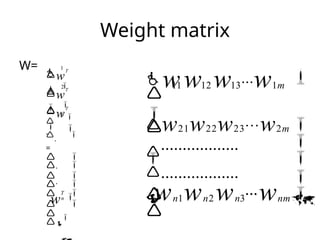
Weight matrix
W=
T
w
w
T


1

w
T


2

w
T



.

n

3


. 
=
 
. 
 
. 
. 
 


...
11 12 13 1m
n1 n2 n3 nm
w w w w
w w w ...w 


w21w22w23
...w2m


..................
..................
.





 
 
Weights
contd…
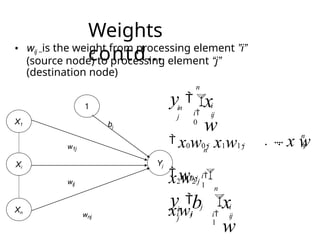
• wij –is the weight from processing element ”i”
(source node) to processing element “j”
(destination node)
X1
1
Xi
Yj
Xn
w1j
wij
wnj
bj
n
i
0
i
ij
in
j
n
nj
n
n

i
1
j i
ij
in
j
y x
w
y
i
1
 x0w0 j
 x1w1 j

x2w2 j
 .... x w
 w0 j
 
xiwi
j
b x
w

 

Activation Functions
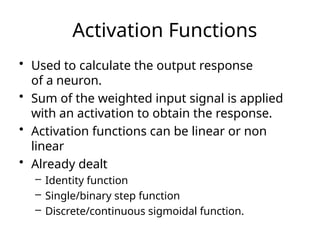
• Used to calculate the output response
of a neuron.
• Sum of the weighted input signal is applied
with an activation to obtain the response.
• Activation functions can be linear or non
linear
• Already dealt
– Identity function
– Single/binary step function
– Discrete/continuous sigmoidal function.
Bias
• Bias is like another weight. Its included
by adding a component x0=1 to the
input vector X.
• X=(1,X1,X2…Xi,…Xn)
• Bias is of two types
– Positive bias: increase the net input
– Negative bias: decrease the net input
Why Bias is required?
X Y
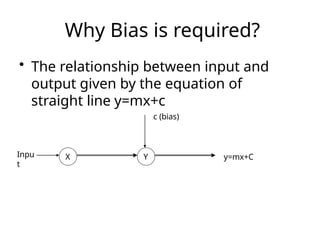
• The relationship between input and
output given by the equation of
straight line y=mx+c
c (bias)
Inpu
t
y=mx+C
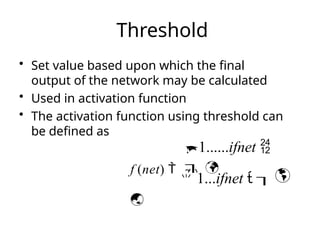
Threshold
• Set value based upon which the final
output of the network may be calculated
• Used in activation function
• The activation function using threshold can
be defined as
1......ifnet 
 


f (net)  
 1...ifnet  

Learning rate
• Denoted by α.
• Used to control the amount of
weight adjustment at each step of
training
• Learning rate ranging from 0 to 1
which determines the rate of
learning in each time step
Other terminologies
• Momentum factor:
– used for convergence when momentum
factor is added to weight updation process.
• Vigilance parameter:
– Denoted by ρ
– Used to control the degree of similarity
required for patterns to be assigned to
the same cluster
publication_3_19749_213.publicationpublication

publication_3_19749_213.publicationpublication

  • 1.
    History of theArtificial Neural Networks ⚫ history of the ANNs stems from the 1940s, the decade of the first electronic computer. ⚫ However, the first important step took place in 1957 when Rosenblatt introduced the first concrete neural model, the perceptron. Rosenblatt also took part in constructing the first successful neurocomputer, the Mark I Perceptron. After this, the development of ANNs has proceeded as described in Figure.
  • 2.
    History of theArtificial Neural Networks ⚫ Rosenblatt's original perceptron model contained only one layer. From this, a multi-layered model was derived in 1960. At first, the use of the multi- layer perceptron (MLP) was complicated by the lack of a appropriate learning algorithm. ⚫ In 1974, Werbos came to introduce a so-called backpropagation algorithm for the three-layered perceptron network.
  • 3.
    History of theArtificial Neural Networks ⚫ in 1986, The application area of the MLP networks remained rather limited until the breakthrough when a general back propagation algorithm for a multi-layered perceptron was introduced by Rummelhart and Mclelland. ⚫ in 1982, Hopfield brought out his idea of a neural network. Unlike the neurons in MLP, the Hopfield network consists of only one layer whose neurons are fully connected with each other.
  • 4.
    History of theArtificial Neural Networks ⚫ Since then, new versions of the Hopfield network have been developed. The Boltzmann machine has been influenced by both the Hopfield network and the MLP.
  • 5.
    History of theArtificial Neural Networks ⚫ in 1988, Radial Basis Function (RBF) networks were first introduced by Broomhead & Lowe. Although the basic idea of RBF was developed 30 years ago under the name method of potential function, the work by Broomhead & Lowe opened a new frontier in the neural network community.
  • 6.
    History of theArtificial Neural Networks ⚫ in 1982, A totally unique kind of network model is the Self-Organizing Map (SOM) introduced by Kohonen. SOM is a certain kind of topological map which organizes itself based on the input patterns that it is trained with. The SOM originated from the LVQ (Learning Vector Quantization) network the underlying idea of which was also Kohonen's in 1972.
  • 7.
    History of ArtificialNeural Networks Since then, research on artificial neural networks has remained active, leading to many new network types, as well as hybrid algorithms and hardware for neural information processing.
  • 8.
    Artificial Neural Network ⚫Anartificial neural network consists of a pool of simple processing units which communicate by sending signals to each other over a large number of weighted connections.
  • 9.
    Artificial Neural Network ⚫A set of major aspects of a parallel distributed model include:  a set of processing units (cells).  a state of activation for every unit, which equivalent to the output of the unit.  connections between the units. Generally each connection is defined by a weight.  a propagation rule, which determines the effective input of a unit from its external inputs.  an activation function, which determines the new level of activation based on the effective input and the current activation.  an external input for each unit.  a method for information gathering (the learning rule).  an environment within which the system must operate, providing input signals and _ if necessary _ error signals.
  • 10.
    Computers vs. NeuralNetworks “Standard” Computers Neural Networks ⚫ one CPU highly parallel processing ⚫fast processing units slow processing units ⚫reliable units unreliable units ⚫static infrastructure dynamic infrastructure
  • 11.
    Why Artificial NeuralNetworks? ⚫There are two basic reasons why we are interested in building artificial neural networks (ANNs): • Technical viewpoint: Some problems such as character recognition or the prediction of future states of a system require massively parallel and adaptive processing. • Biological viewpoint: ANNs can be used to replicate and simulate components of the human (or animal) brain, thereby giving us insight into natural information processing.
  • 12.
    Artificial Neural Networks •The “building blocks” of neural networks are the neurons. • In technical systems, we also refer to them as units or nodes. • Basically, each neuron ⚫ receives input from many other neurons. ⚫ changes its internal state (activation) based on the current input. ⚫ sends one output signal to many other neurons, possibly including its input neurons (recurrent network).
  • 13.
    Artificial Neural Networks •Information is transmitted as a series of electric impulses, so-called spikes. • The frequency and phase of these spikes encodes the information. • In biological systems, one neuron can be connected to as many as 10,000 other neurons. • Usually, a neuron receives its information from other neurons in a confined area, its so-called receptive field.
  • 14.
    How do ANNs work? ⚫An artificial neural network (ANN) is either a hardware implementation or a computer program which strives to simulate the information processing capabilities of its biological exemplar. ANNs are typically composed of a great number of interconnected artificial neurons. The artificial neurons are simplified models of their biological counterparts. ⚫ ANN is a technique for solving problems by constructing software that works like our brains.
  • 15.
    How do ourbrains work?  The Brain is A massively parallel information processing system.  Our brains are a huge network of processing elements. A typical brain contains a network of 10 billion neurons.
  • 16.
    How do ourbrains work?  A processing element Dendrites: Input Cell body: Processor Synaptic: Link Axon: Output
  • 17.
    How do ourbrains work?  A processing element A neuron is connected to other neurons through about 10,000 synapses
  • 18.
    How do ourbrains work?  A processing element A neuron receives input from other neurons. Inputs are combined.
  • 19.
    How do ourbrains work?  A processing element Once input exceeds a critical level, the neuron discharges a spike ‐ an electrical pulse that travels from the body, down the axon, to the next neuron(s)
  • 20.
    How do ourbrains work?  A processing element The axon endings almost touch the dendrites or cell body of the next neuron.
  • 21.
    How do ourbrains work?  A processing element Transmission of an electrical signal from one neuron to the next is effected by neurotransmitters.
  • 22.
    How do ourbrains work?  A processing element Neurotransmitters are chemicals which are released from the first neuron and which bind to the Second.
  • 23.
    How do ourbrains work?  A processing element This link is called a synapse. The strength of the signal that reaches the next neuron depends on factors such as the amount of neurotransmitter available.
  • 24.
    How do ANNswork? An artificial neuron is an imitation of a human neuron
  • 25.
    How do ANNs work? •Now, let us have a look at the model of an artificial neuron.
  • 26.
    How do ANNswork? Output x1 x2 xm ∑ y Processing Input ∑= X1+X2 + ….+Xm =y . . . . . . . . . . . .
  • 27.
    How do ANNs work?Not all inputs are equal Output x1 xm x2 ∑ y Input ∑= X1w1+X2w2 + ….+Xmwm =y w1 w2 wm weights Processing . . . . . . . . . . . . . . . . .
  • 28.
    How do ANNs work?Thesignal is not passed down to the next neuron verbatim Transfer Function (Activation Function) Output xm x2 x1 ∑ y Input w1 w2 wm weights Processing . . . . . . . . . . . . f(vk) . . . . .
  • 29.
    The output isa function of the input, that is affected by the weights, and the transfer functions
  • 30.
    Three types oflayers: Input, Hidden, and Output
  • 31.
    Artificial Neural Networks ⚫AnANN can: 1. compute any computable function, by the appropriate selection of the network topology and weights values. 2. learn from experience!  Specifically, by trial and error ‐ ‐
  • 32.
    A McCulloch-Pitts neuronoperates on a discrete time-scale, t = 0,1,2,3, ... with time tick equal to one refractory period At each time step, an input or output is on or off — 1 or 0, respectively. Each connection or synapse from the output of one neuron to the input of another, has an attached weight. McCulloch-Pitts neuron
  • 33.
    We call asynapse excitatory if wi > 0, and inhibitory if wi < 0. We also associate a threshold  with each neuron A neuron fires (i.e., has value 1 on its output line) at time t+1 if the weighted sum of inputs at t reaches or passes : y(t+1) = 1 if and only if  wixi(t)  . Excitatory and Inhibitory Synapses
  • 34.
    AND 1 1 1.5 NOT -1 0 OR 1 1 0.5 Brains, Machines, and Mathematics,2nd Edition, 1987 Y X  Boolean Net X Y Q Finite Automato n From Logical Neurons to Finite Automata
  • 35.
  • 36.
    General symbol ofneuron consisting of processing node and synaptic connections
  • 37.
    Neuron Modeling forANN Is referred to activation function. Domain is set of activation values net. Scalar product of weight and input vector Neuron as a processing node performs the operation of summation of its weighted input.
  • 38.
    The McCulloch-Pitts neuronof 1943 is important as a basis for:   logical analysis of the neurally computable, and current design of some neural devices (especially when augmented by learning rules to adjust synaptic weights). However, it is no longer considered a useful model for making contact with neurophysiological data concerning real neurons. Increasing the Realism of Neuron Models
  • 39.
    Activation function • Bipolarbinary and unipolar binary are called as hard limiting activation functions used in discrete neuron model • Unipolar continuous and bipolar continuous are called soft limiting activation functions are called sigmoidal characteristics.
  • 41.
  • 42.
  • 43.
  • 44.
    Classification based on interconnections Interconnection s Feedforward Single layer Multilayer Feed Back Recurrent Single layer Multilayer
  • 45.
  • 46.
    Feedforward Network • Itsoutput and input vectors are respectively • Weight wij connects the i’th neuron with j’th input. Activation rule of ith neuron is wher e EXAMPLE
  • 47.
    Multilayer feed forward network Canbe used to solve complicated problems
  • 48.
    Feedback network When outputsare directed back as inputs to same or preceding layer nodes it results in the formation of feedback networks
  • 49.
    Lateral feedback If the feedbackof the output of the processing elements is directed back as input to the processing elements in the same layer then it is called lateral feedback
  • 50.
  • 51.
  • 52.
    Learning • It’s aprocess by which a NN adapts itself to a stimulus by making proper parameter adjustments, resulting in the production of desired response • Two kinds of learning – Parameter learning:- connection weights are updated – Structure Learning:- change in network structure
  • 53.
    Training • The processof modifying the weights in the connections between network layers with the objective of achieving the expected output is called training a network. • This is achieved through – Supervised learning – Unsupervised learning – Reinforcement learning
  • 54.
    Classification of learning •Supervised learning • Unsupervised learning • Reinforcement learning
  • 55.
    Supervised Learning • Childlearns from a teacher • Each input vector requires a Corresponding target vector. • Training pair=[input vector, target vector] Neural Networ k W Error Signal Generato r X (Input ) Y (Actual output) (Desired Output) Error (D-Y) sign als
  • 56.
  • 57.
    Unsupervised Learning • Howa fish or tadpole learns • All similar input patterns are grouped together as clusters. • If a matching input pattern is not found a new cluster is formed
  • 58.
  • 59.
    Self-organizing • In unsupervisedlearning there is no feedback • Network must discover patterns, regularities, features for the input data over the output • While doing so the network might change in parameters • This process is called self-organizing
  • 60.
  • 61.
    When Reinforcement learning isused? • If less information is available about the target output values (critic information) • Learning based on this critic information is called reinforcement learning and the feedback sent is called reinforcement signal • Feedback in this case is only evaluative and not instructive
  • 62.
    Some learning algorithmswe will learn are • Supervised: • Adaline, Madaline • Perceptron • Back Propagation • multilayer perceptrons • Radial Basis Function Networks • Unsupervised • Competitive Learning • Kohenen self organizing map • Learning vector quantization • Hebbian learning
  • 63.
    Neural processing • Recall:-processing phase for a NN and its objective is to retrieve the information. The process of computing o for a given x • Basic forms of neural information processing – Auto association – Hetero association – Classification
  • 64.
    Neural processing- Autoassociation • Setof patterns can be stored in the network • If a pattern similar to a member of the stored set is presented, an association with the input of closest stored pattern is made
  • 65.
    Neural Processing- Heteroassociatio n • Associations between pairsof patterns are stored • Distorted input pattern may cause correct heteroassociation at the output
  • 66.
    Neural processing- Classification •Set of input patterns is divided into a number of classes or categories • In response to an input pattern from the set, the classifier is supposed to recall the information regarding class membership of the input pattern.
  • 67.
    Important terminologies of ANNs •Weights • Bias • Threshold • Learning rate • Momentum factor • Vigilance parameter • Notations used in ANN
  • 68.
    Weights • Each neuronis connected to every other neuron by means of directed links • Links are associated with weights • Weights contain information about the input signal and is represented as a matrix • Weight matrix also called connection matrix
  • 69.
    Weight matrix W= T w w T   1  w T   2  w T    .  n  3   .  =  .    .  .      ... 11 12 13 1m n1 n2 n3 nm w w w w w w w ...w    w21w22w23 ...w2m   .................. .................. .         
  • 70.
    Weights contd… • wij –isthe weight from processing element ”i” (source node) to processing element “j” (destination node) X1 1 Xi Yj Xn w1j wij wnj bj n i 0 i ij in j n nj n n  i 1 j i ij in j y x w y i 1  x0w0 j  x1w1 j  x2w2 j  .... x w  w0 j   xiwi j b x w    
  • 71.
    Activation Functions • Usedto calculate the output response of a neuron. • Sum of the weighted input signal is applied with an activation to obtain the response. • Activation functions can be linear or non linear • Already dealt – Identity function – Single/binary step function – Discrete/continuous sigmoidal function.
  • 72.
    Bias • Bias islike another weight. Its included by adding a component x0=1 to the input vector X. • X=(1,X1,X2…Xi,…Xn) • Bias is of two types – Positive bias: increase the net input – Negative bias: decrease the net input
  • 73.
    Why Bias isrequired? X Y • The relationship between input and output given by the equation of straight line y=mx+c c (bias) Inpu t y=mx+C
  • 74.
    Threshold • Set valuebased upon which the final output of the network may be calculated • Used in activation function • The activation function using threshold can be defined as 1......ifnet      f (net)    1...ifnet   
  • 75.
    Learning rate • Denotedby α. • Used to control the amount of weight adjustment at each step of training • Learning rate ranging from 0 to 1 which determines the rate of learning in each time step
  • 76.
    Other terminologies • Momentumfactor: – used for convergence when momentum factor is added to weight updation process. • Vigilance parameter: – Denoted by ρ – Used to control the degree of similarity required for patterns to be assigned to the same cluster