



Artificial
Intelligence
in Health
CSE 604: AI
TEAM AIMBOT
Tasmia
Zerin
BSSE 1128
Mustahid
Hasan
BSSE 1114
MD. Siam
BSSE 1104
Khalid Hasan
BSSE 1135
What is Artificial
Intelligence?
The development of computer system that are capable of
performing tasks. It normally requires human intelligence like
decision making, object detection, solving complex problems
and so on.
Why is it needed in
Health Care?
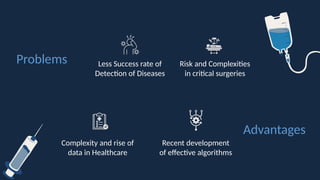
Complexity and rise of
data in Healthcare
Risk and Complexities
in critical surgeries
Less Success rate of
Detection of Diseases
Recent development
of effective algorithms
Problems
Advantages
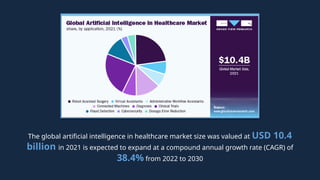
The global artificial intelligence in healthcare market size was valued at USD 10.4
billion in 2021 is expected to expand at a compound annual growth rate (CAGR) of
38.4% from 2022 to 2030
Use cases of AI in
Health Care
1
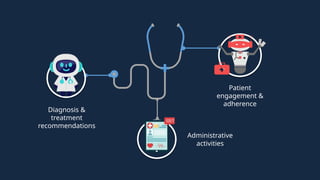
Diagnosis &
treatment
recommendations
Patient
engagement &
adherence
Administrative
activities
Diagnosis &
Treatment
Recommendatio
ns
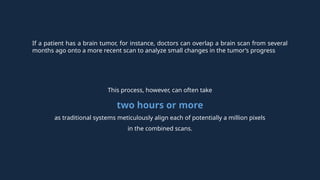
If a patient has a brain tumor, for instance, doctors can overlap a brain scan from several
months ago onto a more recent scan to analyze small changes in the tumor’s progress
This process, however, can often take
two hours or more
as traditional systems meticulously align each of potentially a million pixels
in the combined scans.
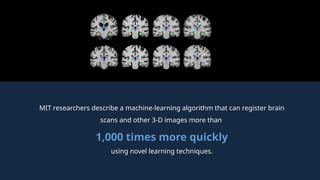
MIT researchers describe a machine-learning algorithm that can register brain
scans and other 3-D images more than
1,000 times more quickly
using novel learning techniques.
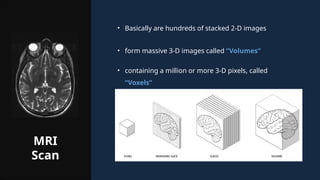
MRI
Scan
• Basically are hundreds of stacked 2-D images
• form massive 3-D images called “Volumes”
• containing a million or more 3-D pixels, called
“Voxels”
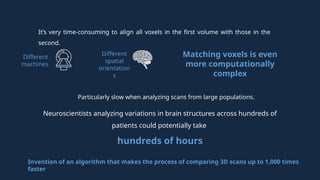
It’s very time-consuming to align all voxels in the first volume with those in the
second.
Matching voxels is even
more computationally
complex
Particularly slow when analyzing scans from large populations.
Neuroscientists analyzing variations in brain structures across hundreds of
patients could potentially take
hundreds of hours
Different
machines
Different
spatial
orientation
s
Invention of an algorithm that makes the process of comparing 3D scans up to 1,000 times
faster
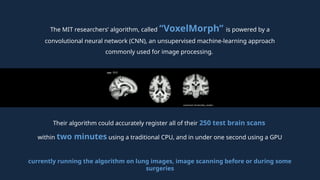
The MIT researchers’ algorithm, called “VoxelMorph” is powered by a
convolutional neural network (CNN), an unsupervised machine-learning approach
commonly used for image processing.
Their algorithm could accurately register all of their 250 test brain scans
within two minutes using a traditional CPU, and in under one second using a GPU
currently running the algorithm on lung images, image scanning before or during some
surgeries
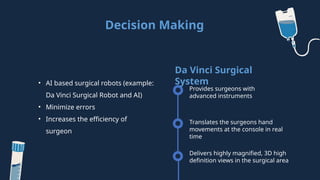
Decision Making
• AI based surgical robots (example:
Da Vinci Surgical Robot and AI)
• Minimize errors
• Increases the efficiency of
surgeon
Provides surgeons with
advanced instruments
Da Vinci Surgical
System
Translates the surgeons hand
movements at the console in real
time
Delivers highly magnified, 3D high
definition views in the surgical area
Patient
Engagement &
Adherence
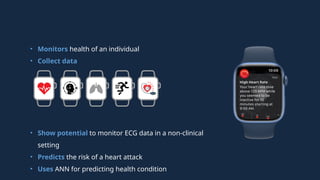
Apple
Watch
• Monitors health of an individual
• Collect data
• Show potential to monitor ECG data in a non-clinical
setting
• Predicts the risk of a heart attack
• Uses ANN for predicting health condition
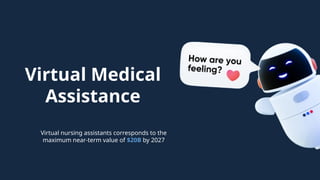
Virtual Medical
Assistance
Virtual nursing assistants corresponds to the
maximum near-term value of $20B by 2027
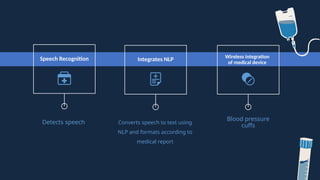
Speech Recognition
Detects speech
Integrates NLP
Converts speech to text using
NLP and formats according to
medical report
Wireless integration
of medical device
Blood pressure
cuffs
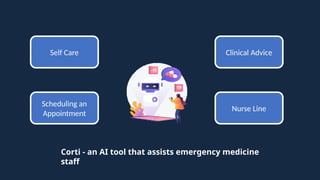
Self Care Clinical Advice
Scheduling an
Appointment
Nurse Line
Corti - an AI tool that assists emergency medicine
staff
Administrative
Activities
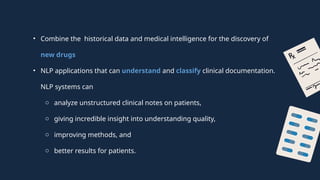
• Combine the historical data and medical intelligence for the discovery of
new drugs
• NLP applications that can understand and classify clinical documentation.
NLP systems can
o analyze unstructured clinical notes on patients,
o giving incredible insight into understanding quality,
o improving methods, and
o better results for patients.
2
Algorithms of AI in
Health Care
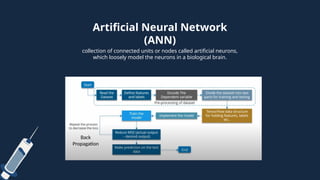
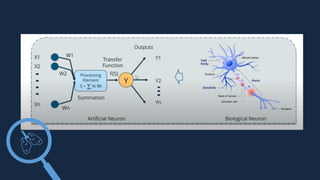
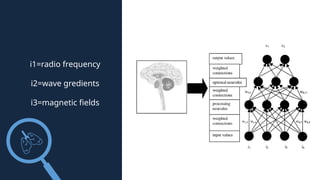
Artificial Neural Network
(ANN)
collection of connected units or nodes called artificial neurons,
which loosely model the neurons in a biological brain.
Back
Propagation
i1=radio frequency
i2=wave gredients
i3=magnetic fields
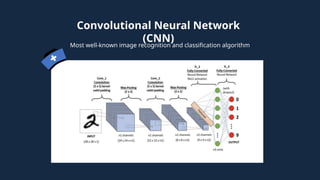
Convolutional Neural Network
(CNN)
Most well-known image recognition and classification algorithm
Using the technology in medical settings is controversial because of the
risk of accidental data release.
Many systems are owned and controlled by private companies, giving
them access to confidential patient data
-- and the responsibility for protecting it
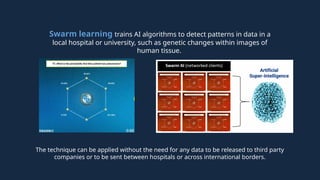
The technique can be applied without the need for any data to be released to third party
companies or to be sent between hospitals or across international borders.
Swarm learning trains AI algorithms to detect patterns in data in a
local hospital or university, such as genetic changes within images of
human tissue.
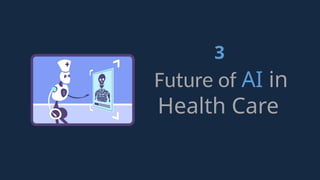
3
Future of AI in
Health Care
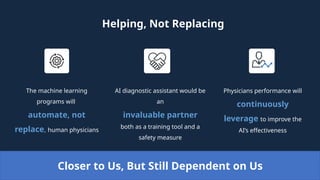
Helping, Not Replacing
The machine learning
programs will
automate, not
replace, human physicians
Physicians performance will
continuously
leverage to improve the
AI’s effectiveness
AI diagnostic assistant would be
an
invaluable partner
both as a training tool and a
safety measure
Closer to Us, But Still Dependent on Us
4
But, Ethical Issues
Remain
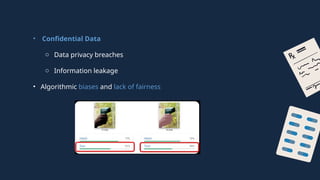
• Confidential Data
o Data privacy breaches
o Information leakage
• Algorithmic biases and lack of fairness
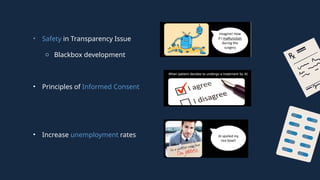
• Safety in Transparency Issue
o Blackbox development
• Principles of Informed Consent
• Increase unemployment rates
THANK YOU

Artificial Intelligence in Healthcare Sector

  • 1.
  • 2.
    TEAM AIMBOT Tasmia Zerin BSSE 1128 Mustahid Hasan BSSE1114 MD. Siam BSSE 1104 Khalid Hasan BSSE 1135
  • 3.
    What is Artificial Intelligence? Thedevelopment of computer system that are capable of performing tasks. It normally requires human intelligence like decision making, object detection, solving complex problems and so on.
  • 4.
    Why is itneeded in Health Care?
  • 5.
    Complexity and riseof data in Healthcare Risk and Complexities in critical surgeries Less Success rate of Detection of Diseases Recent development of effective algorithms Problems Advantages
  • 6.
    The global artificialintelligence in healthcare market size was valued at USD 10.4 billion in 2021 is expected to expand at a compound annual growth rate (CAGR) of 38.4% from 2022 to 2030
  • 7.
    Use cases ofAI in Health Care 1
  • 8.
  • 9.
  • 10.
    If a patienthas a brain tumor, for instance, doctors can overlap a brain scan from several months ago onto a more recent scan to analyze small changes in the tumor’s progress This process, however, can often take two hours or more as traditional systems meticulously align each of potentially a million pixels in the combined scans.
  • 11.
    MIT researchers describea machine-learning algorithm that can register brain scans and other 3-D images more than 1,000 times more quickly using novel learning techniques.
  • 12.
    MRI Scan • Basically arehundreds of stacked 2-D images • form massive 3-D images called “Volumes” • containing a million or more 3-D pixels, called “Voxels”
  • 13.
    It’s very time-consumingto align all voxels in the first volume with those in the second. Matching voxels is even more computationally complex Particularly slow when analyzing scans from large populations. Neuroscientists analyzing variations in brain structures across hundreds of patients could potentially take hundreds of hours Different machines Different spatial orientation s Invention of an algorithm that makes the process of comparing 3D scans up to 1,000 times faster
  • 14.
    The MIT researchers’algorithm, called “VoxelMorph” is powered by a convolutional neural network (CNN), an unsupervised machine-learning approach commonly used for image processing. Their algorithm could accurately register all of their 250 test brain scans within two minutes using a traditional CPU, and in under one second using a GPU currently running the algorithm on lung images, image scanning before or during some surgeries
  • 15.
    Decision Making • AIbased surgical robots (example: Da Vinci Surgical Robot and AI) • Minimize errors • Increases the efficiency of surgeon Provides surgeons with advanced instruments Da Vinci Surgical System Translates the surgeons hand movements at the console in real time Delivers highly magnified, 3D high definition views in the surgical area
  • 16.
  • 17.
  • 18.
    • Monitors healthof an individual • Collect data • Show potential to monitor ECG data in a non-clinical setting • Predicts the risk of a heart attack • Uses ANN for predicting health condition
  • 19.
    Virtual Medical Assistance Virtual nursingassistants corresponds to the maximum near-term value of $20B by 2027
  • 20.
    Speech Recognition Detects speech IntegratesNLP Converts speech to text using NLP and formats according to medical report Wireless integration of medical device Blood pressure cuffs
  • 21.
    Self Care ClinicalAdvice Scheduling an Appointment Nurse Line Corti - an AI tool that assists emergency medicine staff
  • 22.
  • 23.
    • Combine thehistorical data and medical intelligence for the discovery of new drugs • NLP applications that can understand and classify clinical documentation. NLP systems can o analyze unstructured clinical notes on patients, o giving incredible insight into understanding quality, o improving methods, and o better results for patients.
  • 24.
    2 Algorithms of AIin Health Care
  • 25.
    Artificial Neural Network (ANN) collectionof connected units or nodes called artificial neurons, which loosely model the neurons in a biological brain. Back Propagation
  • 27.
  • 28.
    Convolutional Neural Network (CNN) Mostwell-known image recognition and classification algorithm
  • 29.
    Using the technologyin medical settings is controversial because of the risk of accidental data release. Many systems are owned and controlled by private companies, giving them access to confidential patient data -- and the responsibility for protecting it
  • 30.
    The technique canbe applied without the need for any data to be released to third party companies or to be sent between hospitals or across international borders. Swarm learning trains AI algorithms to detect patterns in data in a local hospital or university, such as genetic changes within images of human tissue.
  • 31.
    3 Future of AIin Health Care
  • 32.
    Helping, Not Replacing Themachine learning programs will automate, not replace, human physicians Physicians performance will continuously leverage to improve the AI’s effectiveness AI diagnostic assistant would be an invaluable partner both as a training tool and a safety measure Closer to Us, But Still Dependent on Us
  • 33.
  • 34.
    • Confidential Data oData privacy breaches o Information leakage • Algorithmic biases and lack of fairness
  • 35.
    • Safety inTransparency Issue o Blackbox development • Principles of Informed Consent • Increase unemployment rates
  • 36.