Artificial Intelligence in
AutonomousVehicles
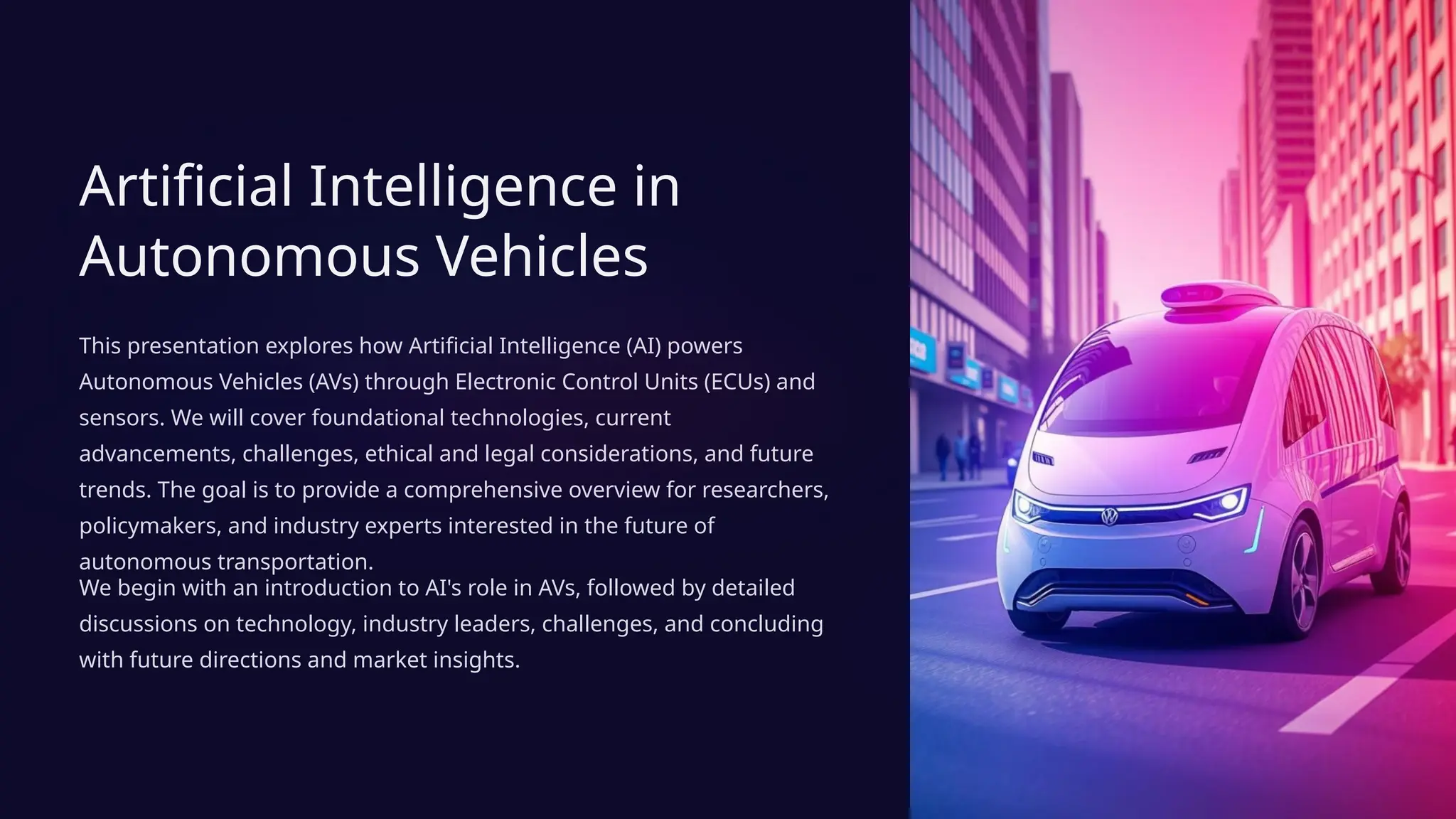
This presentation explores how Artificial Intelligence (AI) powers
Autonomous Vehicles (AVs) through Electronic Control Units (ECUs) and
sensors. We will cover foundational technologies, current
advancements, challenges, ethical and legal considerations, and future
trends. The goal is to provide a comprehensive overview for researchers,
policymakers, and industry experts interested in the future of
autonomous transportation.
We begin with an introduction to AI's role in AVs, followed by detailed
discussions on technology, industry leaders, challenges, and concluding
with future directions and market insights.
2.
Foundational Technologies inAutonomous
Vehicles
AI Algorithms & Machine Learning
Machine learning, including supervised, unsupervised, and
reinforcement learning, forms the core of AV technology.
These algorithms process large datasets to enable vehicles
to perceive and react to their environment.
Deep learning, a subset of machine learning, uses neural
networks for perception, localization, path planning,
motion control, and decision-making, enhancing AV
accuracy and reliability.
Computer Vision & Sensor Fusion
Computer vision enables AVs to interpret surroundings by
processing images and videos for object detection,
classification, and depth estimation.
Sensor fusion combines data from thousands of sensors
like lidar and radar, integrating inputs to create a
comprehensive environmental understanding for safer
navigation.
3.
Current State ofAutonomous
Vehicle Technology
Industry Leaders
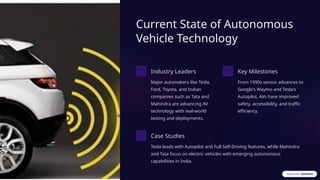
Major automakers like Tesla,
Ford, Toyota, and Indian
companies such as Tata and
Mahindra are advancing AV
technology with real-world
testing and deployments.
Key Milestones
From 1990s sensor advances to
Google's Waymo and Tesla's
Autopilot, AVs have improved
safety, accessibility, and traffic
efficiency.
Case Studies
Tesla leads with Autopilot and Full Self-Driving features, while Mahindra
and Tata focus on electric vehicles with emerging autonomous
capabilities in India.
4.
Simulation and Testingin AV
Development
Importance of Simulation
Simulations accelerate
development by safely testing
AV performance in virtual
environments, reducing costs
and generating valuable data.
Types of Simulation
• Virtual Simulation
• Hardware-in-the-Loop (HIL)
• Driver-in-the-Loop (DIL)
Testing Methodologies
• Functional Testing
• Integration Testing
• System and Validation Testing
5.
Challenges Faced byAI in Autonomous Vehicles
Technical Challenges
Ensuring safety and reliability involves overcoming
perception errors, hardware failures, software bugs, and
cybersecurity threats.
Advanced sensors, robust algorithms, redundancy, and
cybersecurity measures are essential to address these
issues.
Ethical & Legal Issues
AVs face ethical dilemmas like life-and-death decisions and
require transparent, accountable AI frameworks.
Legal challenges include liability, data privacy, evolving
regulations, and operational risks across global markets.
6.
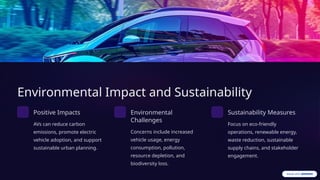
Environmental Impact andSustainability
Positive Impacts
AVs can reduce carbon
emissions, promote electric
vehicle adoption, and support
sustainable urban planning.
Environmental
Challenges
Concerns include increased
vehicle usage, energy
consumption, pollution,
resource depletion, and
biodiversity loss.
Sustainability Measures
Focus on eco-friendly
operations, renewable energy,
waste reduction, sustainable
supply chains, and stakeholder
engagement.
7.
History and Evolutionof Electronic Control Units
(ECU)
Origins
BMW introduced the first ECU in 1939 for aircraft engines.
Ford began mass production of engine control systems in
1975 using Toshiba microprocessors.
Bosch has been a key player in advancing ECU technology
in the automotive industry.
Drawbacks
Older ECUs had limited processing power and reliability
issues. Modern versions face complexity, cybersecurity
risks, cost, environmental impact, and dependence
challenges.
8.
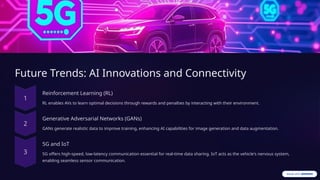
Future Trends: AIInnovations and Connectivity
Reinforcement Learning (RL)
RL enables AVs to learn optimal decisions through rewards and penalties by interacting with their environment.
Generative Adversarial Networks (GANs)
GANs generate realistic data to improve training, enhancing AI capabilities for image generation and data augmentation.
5G and IoT
5G offers high-speed, low-latency communication essential for real-time data sharing. IoT acts as the vehicle's nervous system,
enabling seamless sensor communication.
9.
Cross-Industry
Collaboration and Open-
SourcePlatforms
Collaboration
Benefits
Partnerships across
industries enhance
innovation, mitigate risks,
accelerate time-to-market,
and expand market reach.
Open-Source
Platforms
These platforms lower
barriers, foster knowledge
sharing, and build
communities that drive AV
technology forward.
Challenges
Issues include intellectual property protection, cultural
differences, data privacy, and governance complexities.
10.
Market Outlook andConclusion
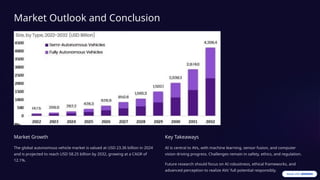
Market Growth
The global autonomous vehicle market is valued at USD 23.36 billion in 2024
and is projected to reach USD 58.25 billion by 2032, growing at a CAGR of
12.1%.
Key Takeaways
AI is central to AVs, with machine learning, sensor fusion, and computer
vision driving progress. Challenges remain in safety, ethics, and regulation.
Future research should focus on AI robustness, ethical frameworks, and
advanced perception to realize AVs' full potential responsibly.







![[DSC Europe 25] Velibor Ilic - Autonomous Driving - How AI Shapes Technical ...](https://cdn.slidesharecdn.com/ss_thumbnails/gwu9aqths9ovngsrhidc-3-velibor-ilic-autonomous-driving-how-ai-shapes-technical-challenges-251219150035-7436923a-thumbnail.jpg?width=640&height=640&fit=bounds)


