

Artificial Intelligence in Accounting Profession:
Implementation and Challenges
Being a Paper Presented at the International Accounting Day Organised by Association of National Accountants of
Nigeria (ANAN), Oyo State Branch 1 at The Polytechnic, Ibadan on Friday, November 10, 2023.
Prof. Godwin Emmanuel
Oyedokun
Professor of Accounting and Financial
Development
Department of Management & Accounting
Faculty of Management and Social Sciences
Lead City University, Ibadan, Nigeria
Principal Partner; Oyedokun Godwin Emmanuel &
Co
(Chartered Accountants, Tax Practitioners &
Forensic Auditors)
ND (Fin), HND (Acct.), BSc. (Acct. Ed), BSc (Fin.), LLB., LLM, MBA (Acct. & Fin.), MSc. (Acct.), MSc. (Bus &Econs), MSc. (Fin), MSc. (Econs), Ph.D.
(Acct), Ph.D. (Fin), Ph.D. (FA), CICA, CFA, CFE, CIPFA, CPFA, CertIFR, ACS, ACIS, ACIArb, ACAMS, ABR, IPA, IFA, MNIM, FCA, FCTI, FCIB, FCNA,
FCFIP, FCE, FERP, FFAR, FPD-CR, FSEAN, FNIOAIM, FCCrFA, FCCFI, JP
Artificial Intelligence in
Accounting Profession:
Implementation and
Challenges
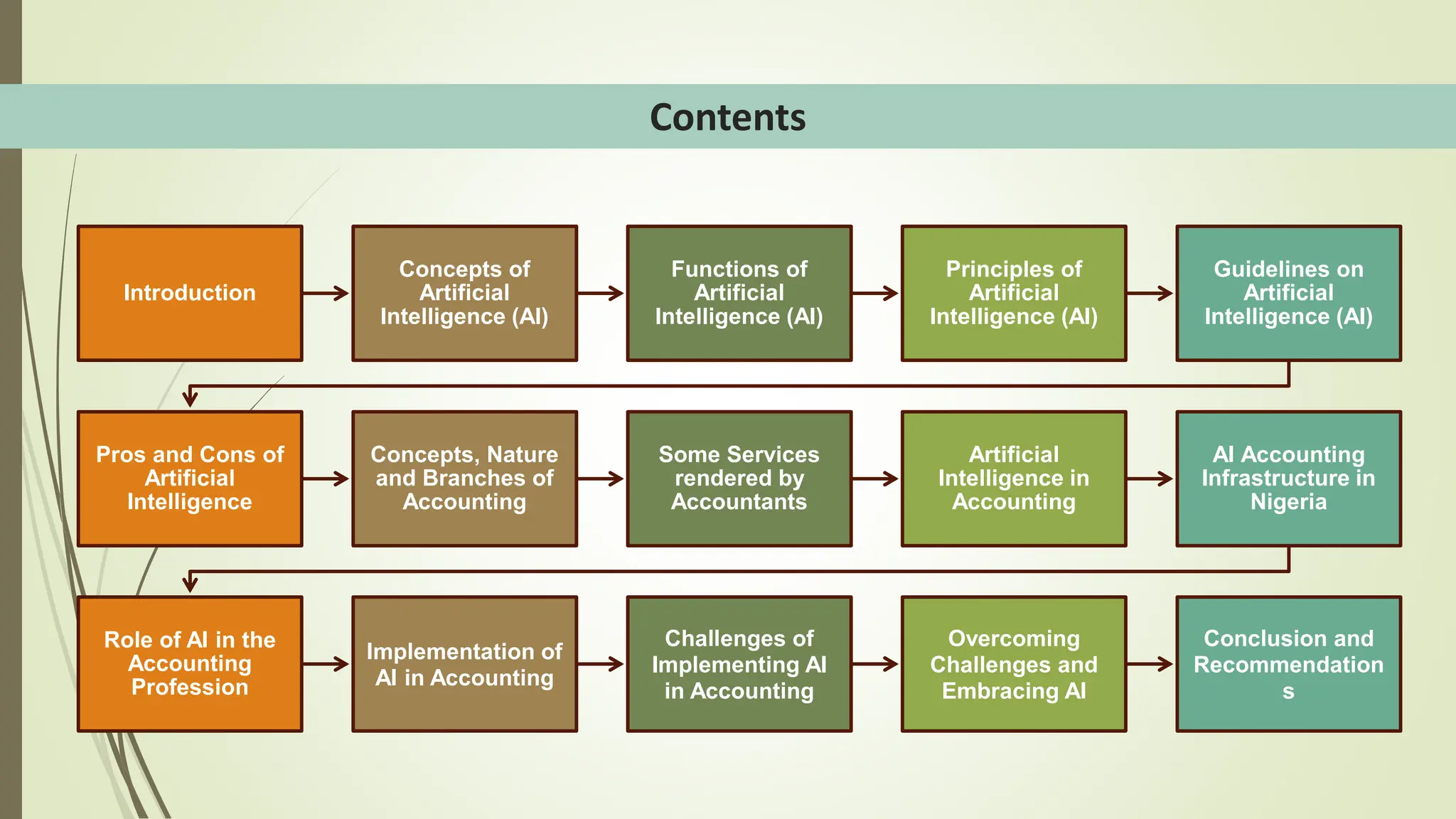
Contents
Introduction
Concepts of
Artificial
Intelligence (AI)
Functions of
Artificial
Intelligence (AI)
Principles of
Artificial
Intelligence (AI)
Guidelines on
Artificial
Intelligence (AI)
Pros and Cons of
Artificial
Intelligence
Concepts, Nature
and Branches of
Accounting
Some Services
rendered by
Accountants
Artificial
Intelligence in
Accounting
AI Accounting
Infrastructure in
Nigeria
Role of AI in the
Accounting
Profession
Implementation of
AI in Accounting
Challenges of
Implementing AI
in Accounting
Overcoming
Challenges and
Embracing AI
Conclusion and
Recommendation
s
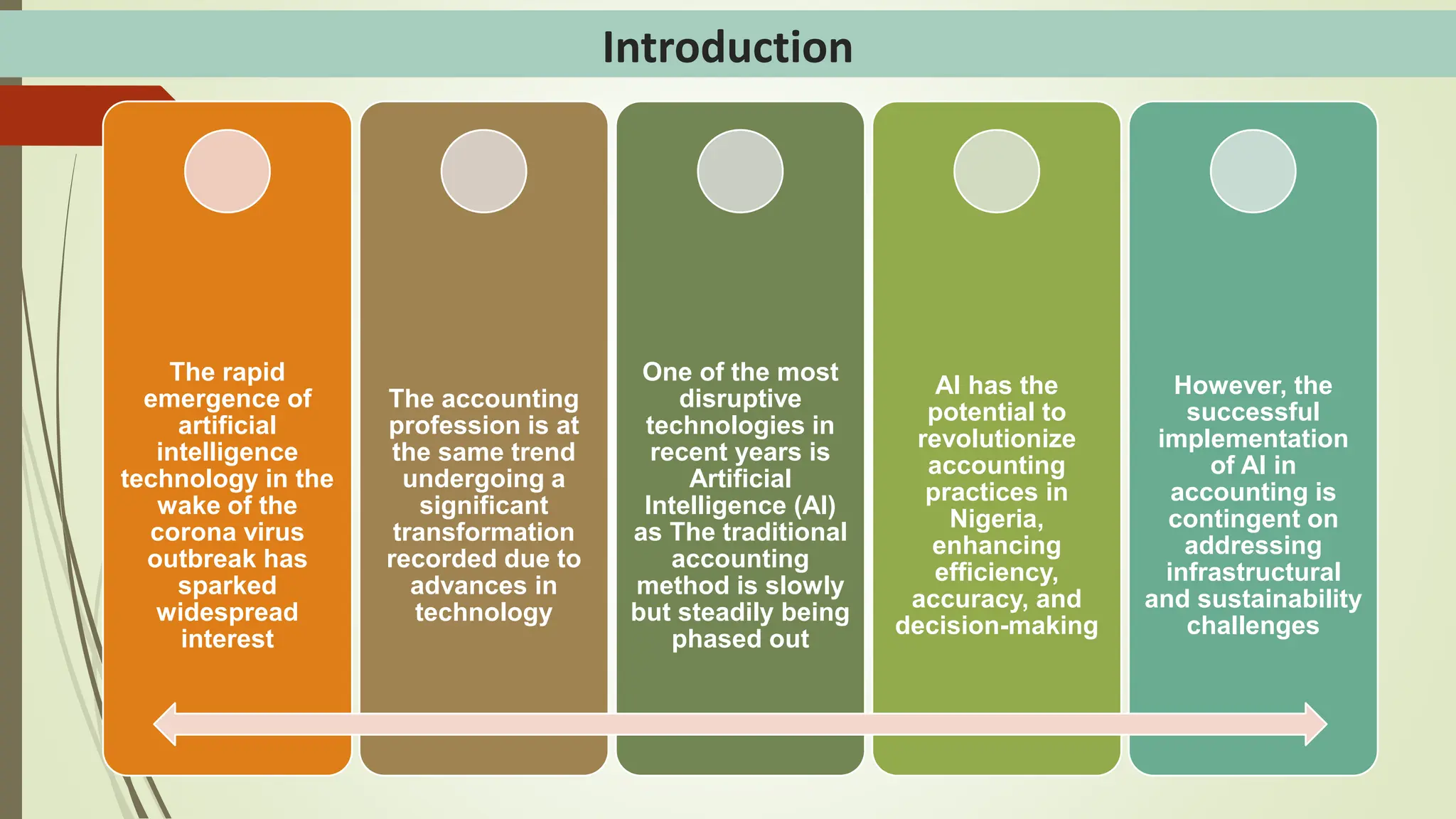
Introduction
The rapid
emergence of
artificial
intelligence
technology in the
wake of the
corona virus
outbreak has
sparked
widespread
interest
The accounting
profession is at
the same trend
undergoing a
significant
transformation
recorded due to
advances in
technology
One of the most
disruptive
technologies in
recent years is
Artificial
Intelligence (AI)
as The traditional
accounting
method is slowly
but steadily being
phased out
AI has the
potential to
revolutionize
accounting
practices in
Nigeria,
enhancing
efficiency,
accuracy, and
decision-making
However, the
successful
implementation
of AI in
accounting is
contingent on
addressing
infrastructural
and sustainability
challenges
Introduction
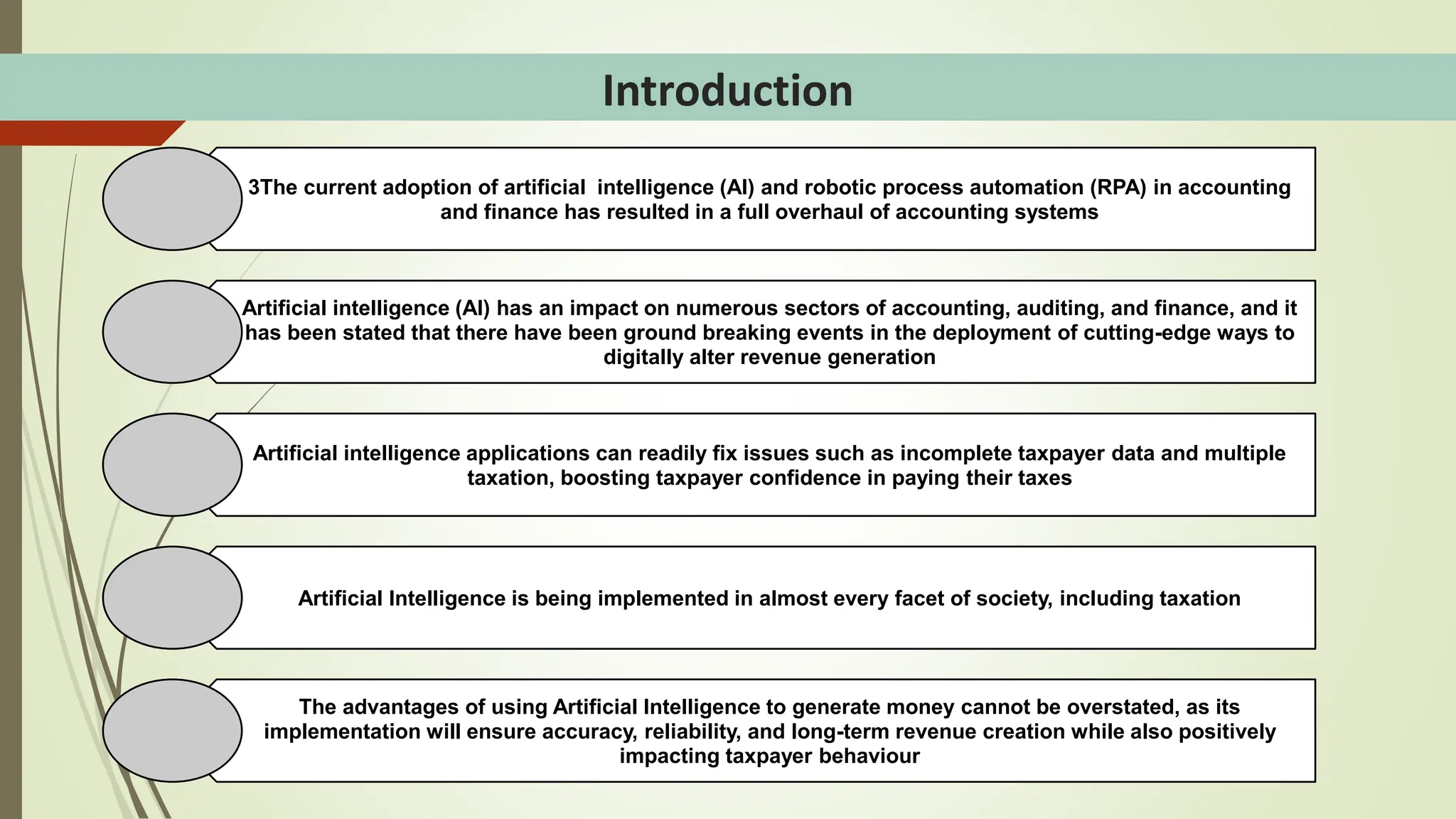
3The current adoption of artificial intelligence (AI) and robotic process automation (RPA) in accounting
and finance has resulted in a full overhaul of accounting systems
Artificial intelligence (AI) has an impact on numerous sectors of accounting, auditing, and finance, and it
has been stated that there have been ground breaking events in the deployment of cutting-edge ways to
digitally alter revenue generation
Artificial intelligence applications can readily fix issues such as incomplete taxpayer data and multiple
taxation, boosting taxpayer confidence in paying their taxes
Artificial Intelligence is being implemented in almost every facet of society, including taxation
The advantages of using Artificial Intelligence to generate money cannot be overstated, as its
implementation will ensure accuracy, reliability, and long-term revenue creation while also positively
impacting taxpayer behaviour
Concepts of Artificial Intelligence (AI)
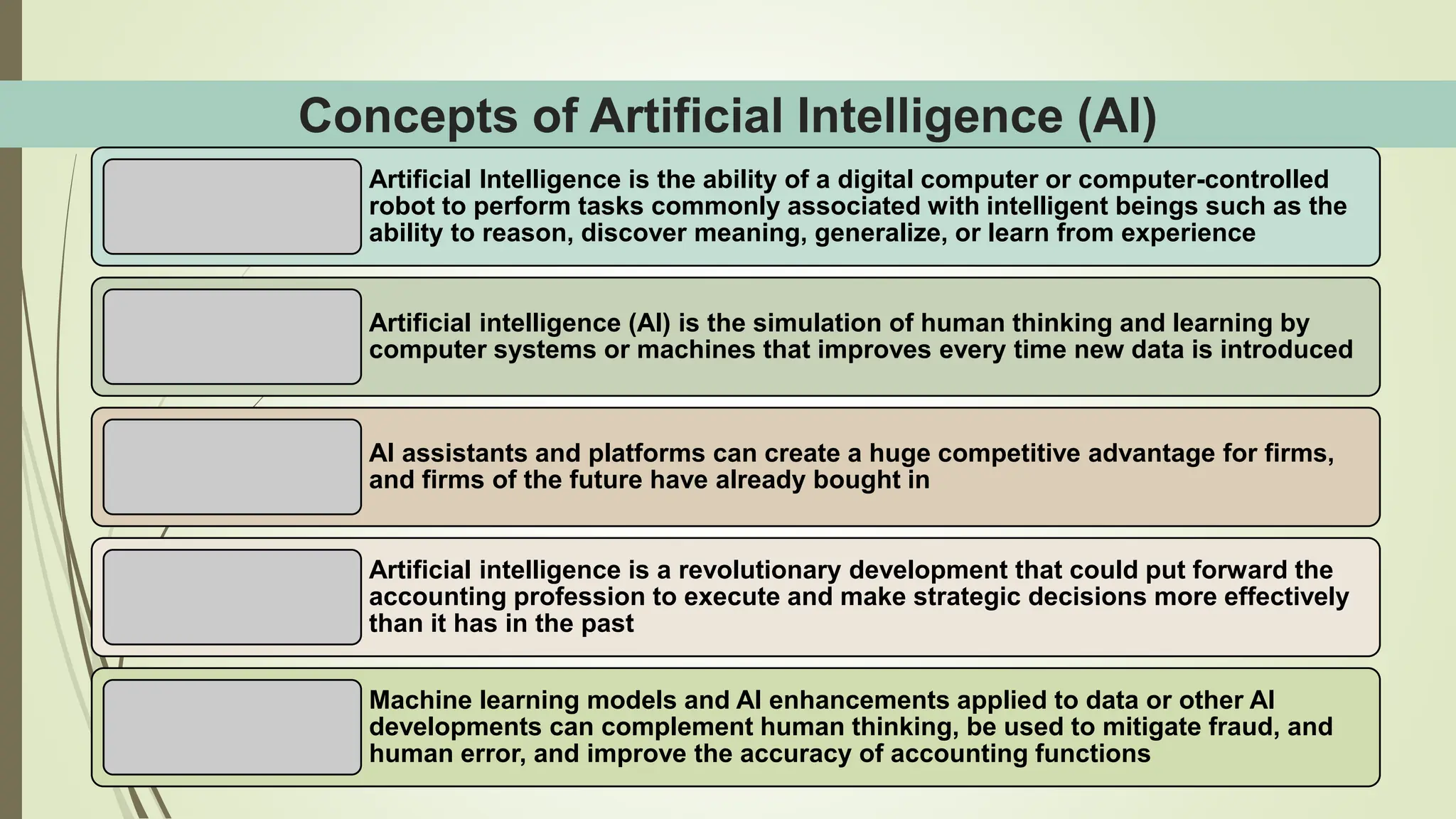
Artificial Intelligence is the ability of a digital computer or computer-controlled
robot to perform tasks commonly associated with intelligent beings such as the
ability to reason, discover meaning, generalize, or learn from experience
Artificial intelligence (AI) is the simulation of human thinking and learning by
computer systems or machines that improves every time new data is introduced
AI assistants and platforms can create a huge competitive advantage for firms,
and firms of the future have already bought in
Artificial intelligence is a revolutionary development that could put forward the
accounting profession to execute and make strategic decisions more effectively
than it has in the past
Machine learning models and AI enhancements applied to data or other AI
developments can complement human thinking, be used to mitigate fraud, and
human error, and improve the accuracy of accounting functions
Concepts of Artificial Intelligence (AI)
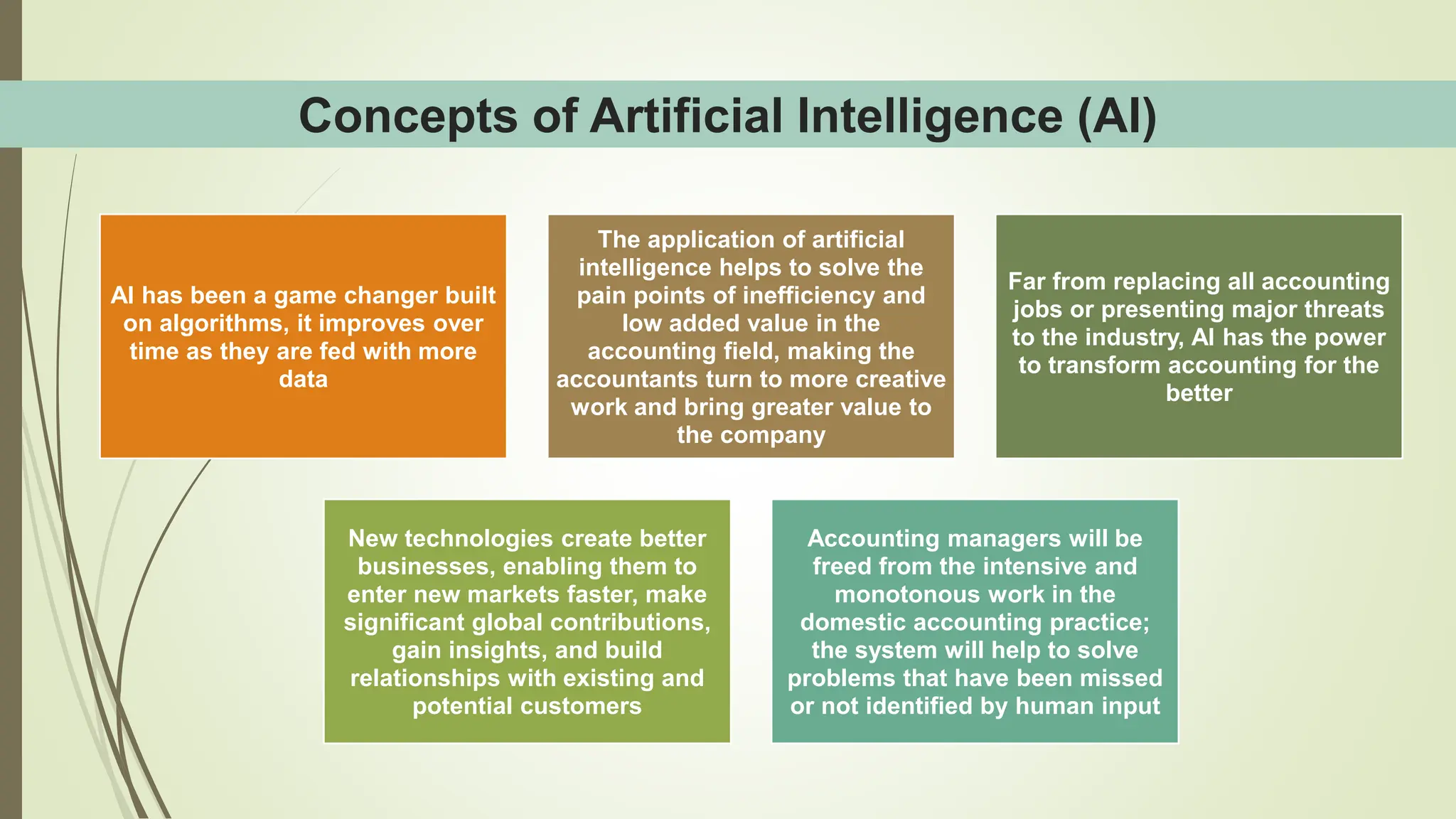
AI has been a game changer built
on algorithms, it improves over
time as they are fed with more
data
The application of artificial
intelligence helps to solve the
pain points of inefficiency and
low added value in the
accounting field, making the
accountants turn to more creative
work and bring greater value to
the company
Far from replacing all accounting
jobs or presenting major threats
to the industry, AI has the power
to transform accounting for the
better
New technologies create better
businesses, enabling them to
enter new markets faster, make
significant global contributions,
gain insights, and build
relationships with existing and
potential customers
Accounting managers will be
freed from the intensive and
monotonous work in the
domestic accounting practice;
the system will help to solve
problems that have been missed
or not identified by human input
Functions of Artificial Intelligence
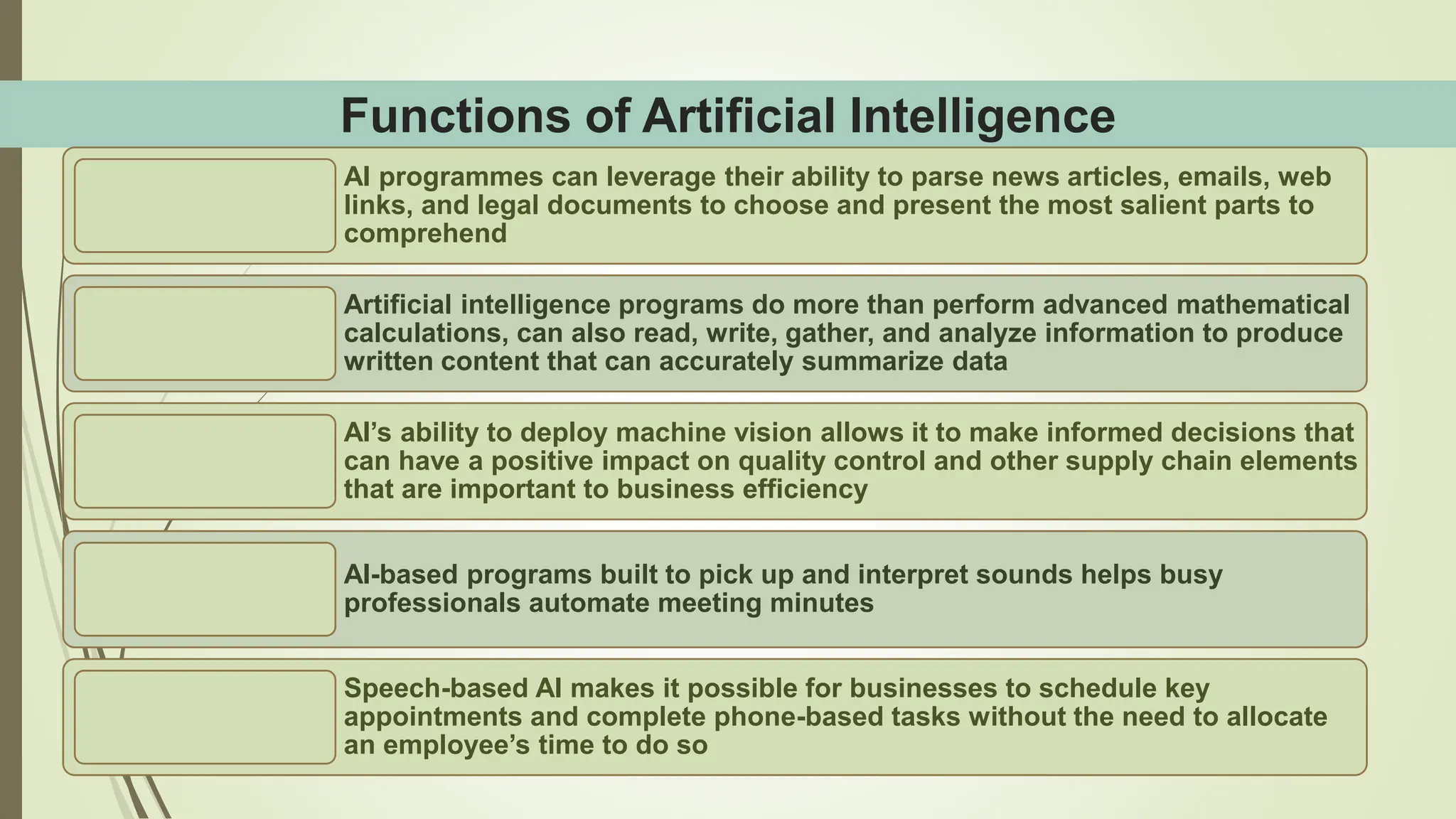
AI programmes can leverage their ability to parse news articles, emails, web
links, and legal documents to choose and present the most salient parts to
comprehend
Artificial intelligence programs do more than perform advanced mathematical
calculations, can also read, write, gather, and analyze information to produce
written content that can accurately summarize data
AI’s ability to deploy machine vision allows it to make informed decisions that
can have a positive impact on quality control and other supply chain elements
that are important to business efficiency
AI-based programs built to pick up and interpret sounds helps busy
professionals automate meeting minutes
Speech-based AI makes it possible for businesses to schedule key
appointments and complete phone-based tasks without the need to allocate
an employee’s time to do so
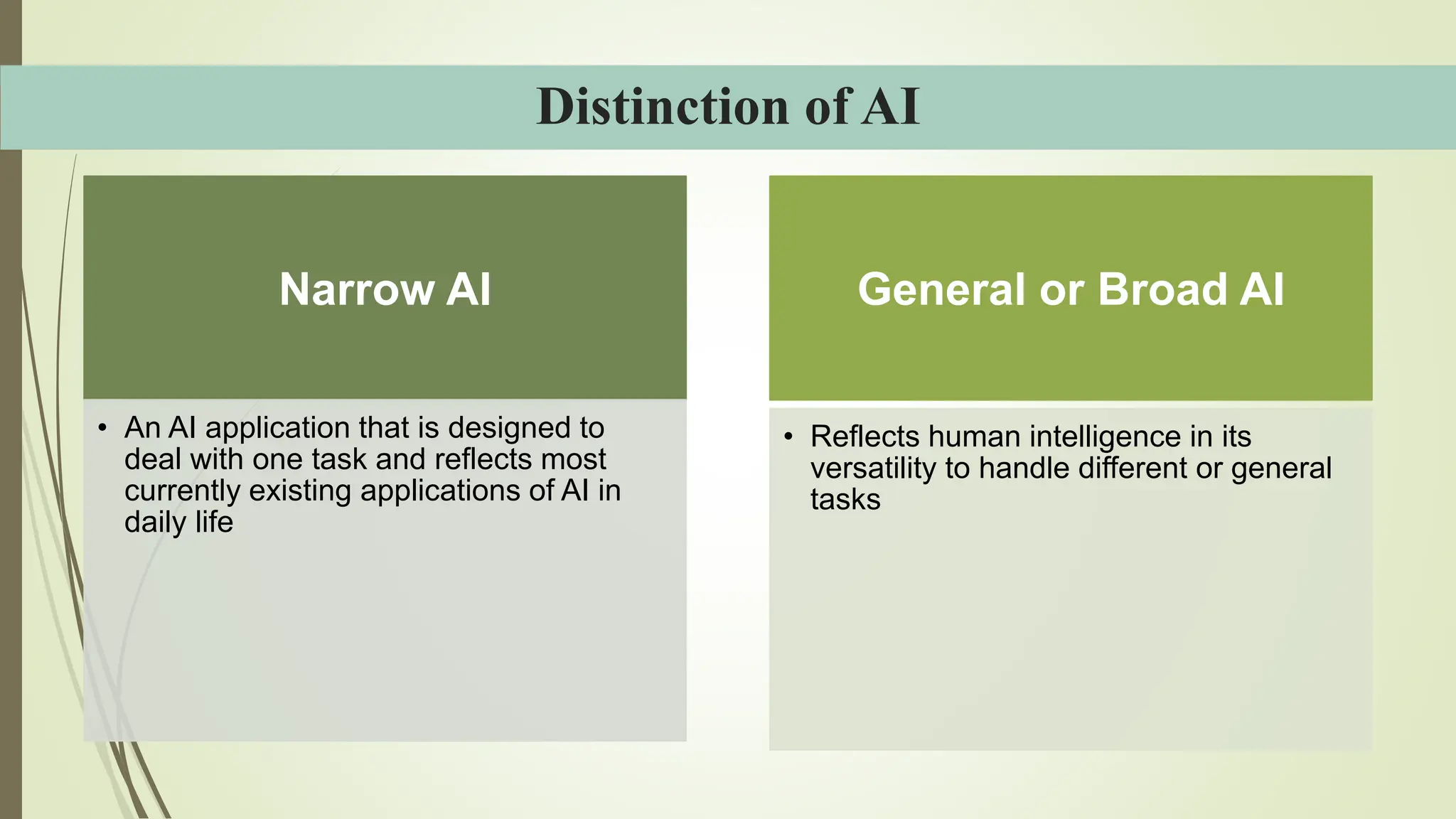
Distinction of AI
Narrow AI
• An AI application that is designed to
deal with one task and reflects most
currently existing applications of AI in
daily life
General or Broad AI
• Reflects human intelligence in its
versatility to handle different or general
tasks
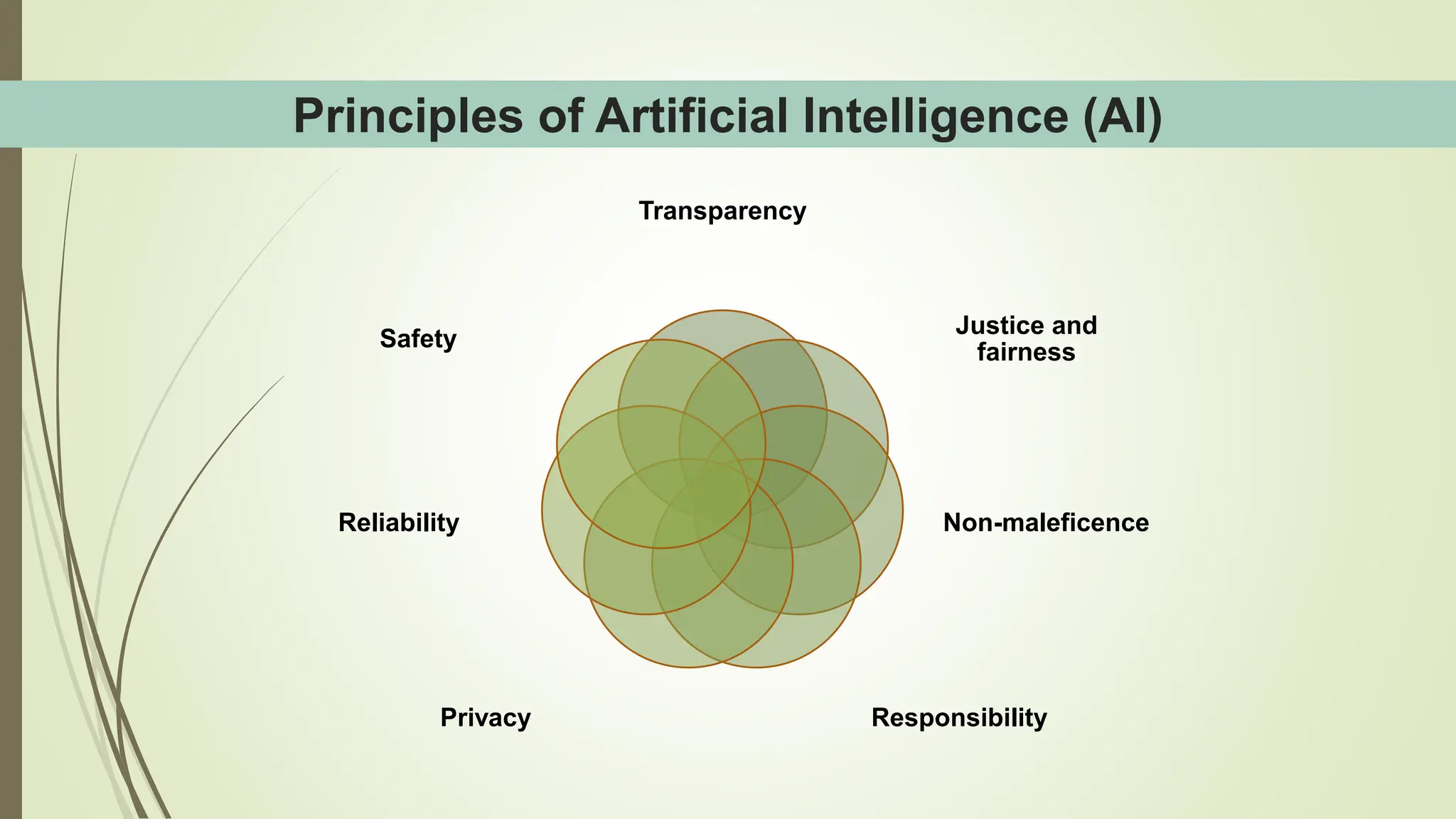
Principles of Artificial Intelligence (AI)
Transparency
Justice and
fairness
Non-maleficence
Responsibility
Privacy
Reliability
Safety
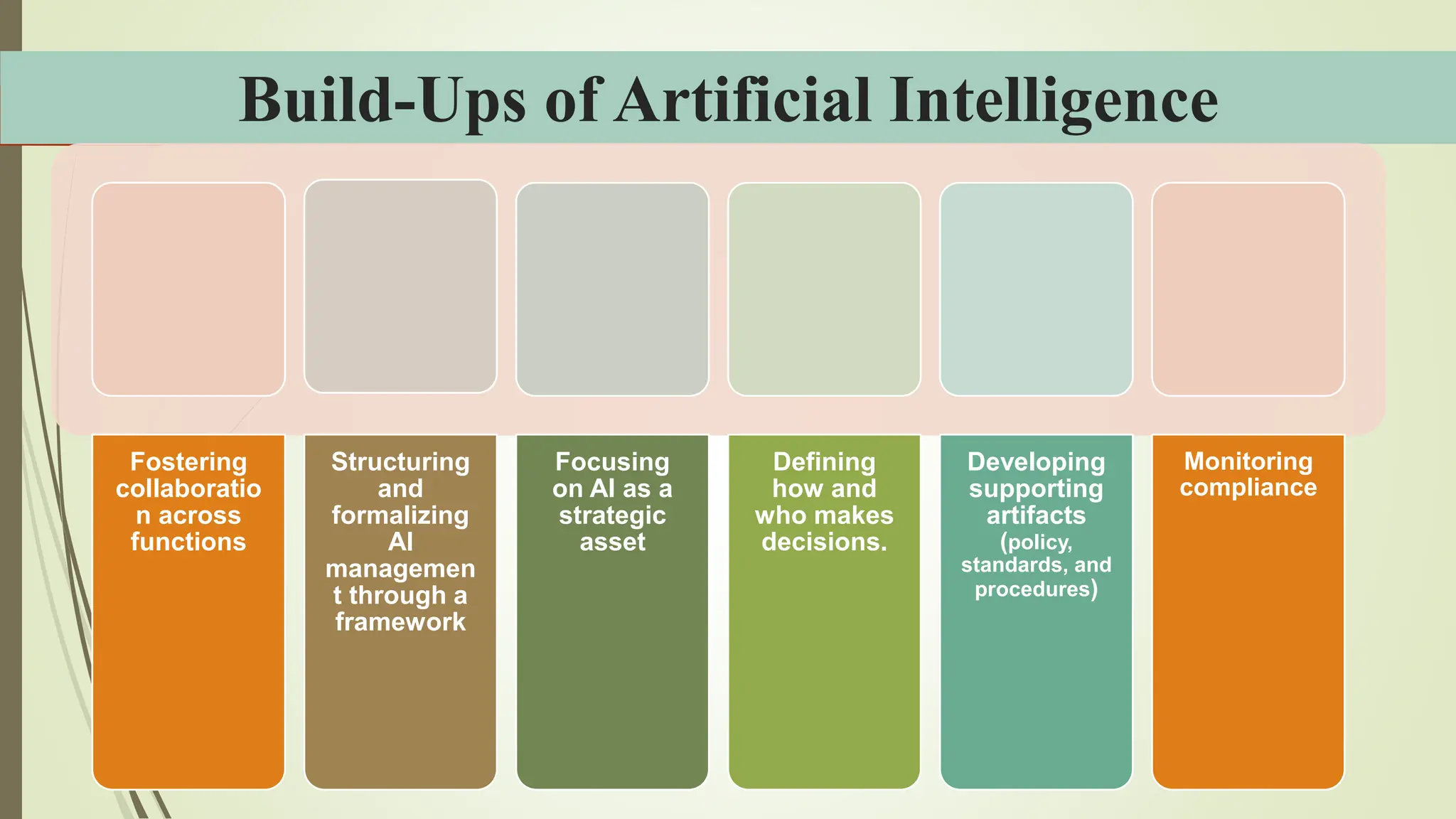
Build-Ups of Artificial Intelligence
Fostering
collaboratio
n across
functions
Structuring
and
formalizing
AI
managemen
t through a
framework
Focusing
on AI as a
strategic
asset
Defining
how and
who makes
decisions.
Developing
supporting
artifacts
(policy,
standards, and
procedures)
Monitoring
compliance
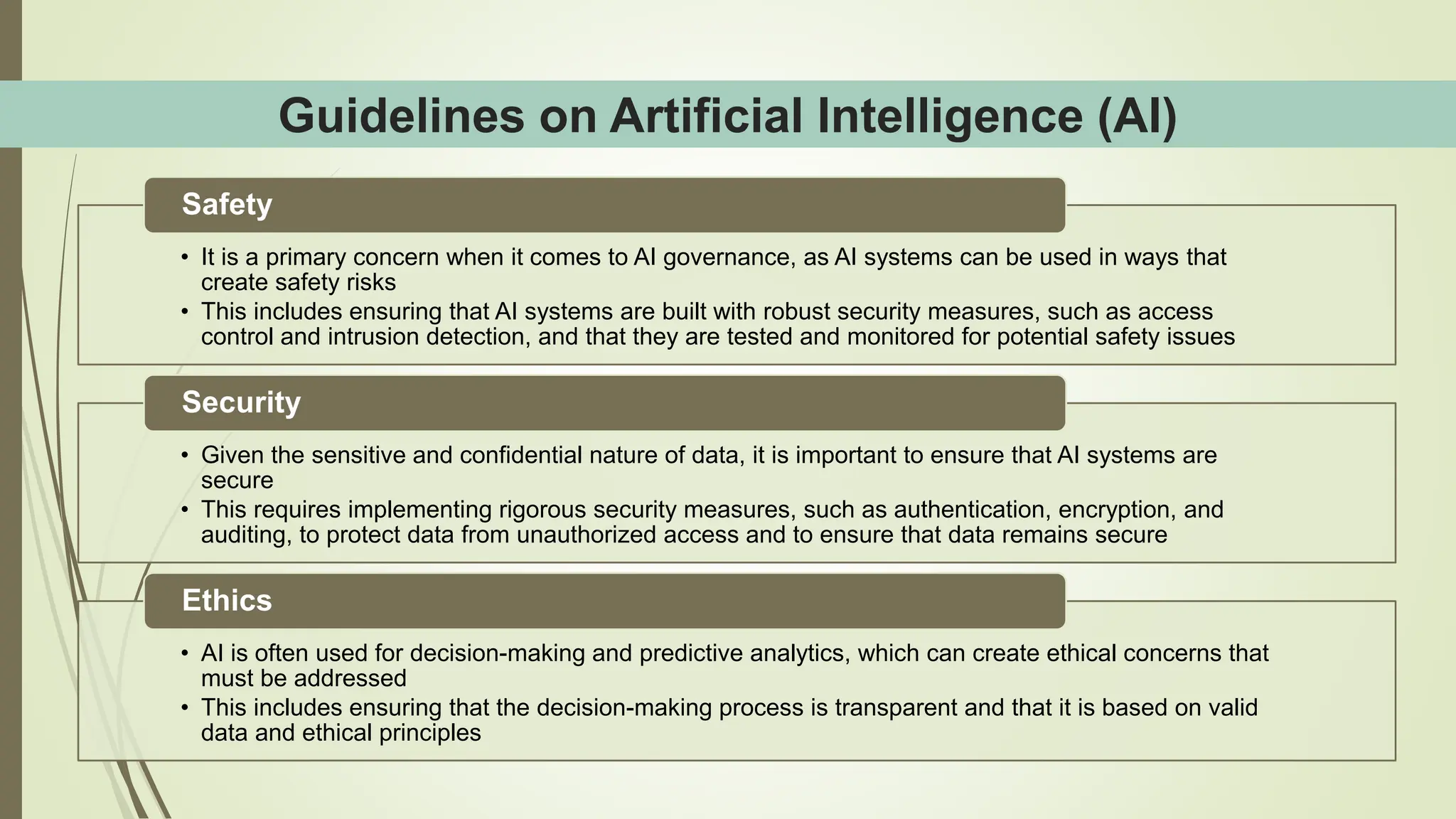
Guidelines on Artificial Intelligence (AI)
• It is a primary concern when it comes to AI governance, as AI systems can be used in ways that
create safety risks
• This includes ensuring that AI systems are built with robust security measures, such as access
control and intrusion detection, and that they are tested and monitored for potential safety issues
Safety
• Given the sensitive and confidential nature of data, it is important to ensure that AI systems are
secure
• This requires implementing rigorous security measures, such as authentication, encryption, and
auditing, to protect data from unauthorized access and to ensure that data remains secure
Security
• AI is often used for decision-making and predictive analytics, which can create ethical concerns that
must be addressed
• This includes ensuring that the decision-making process is transparent and that it is based on valid
data and ethical principles
Ethics
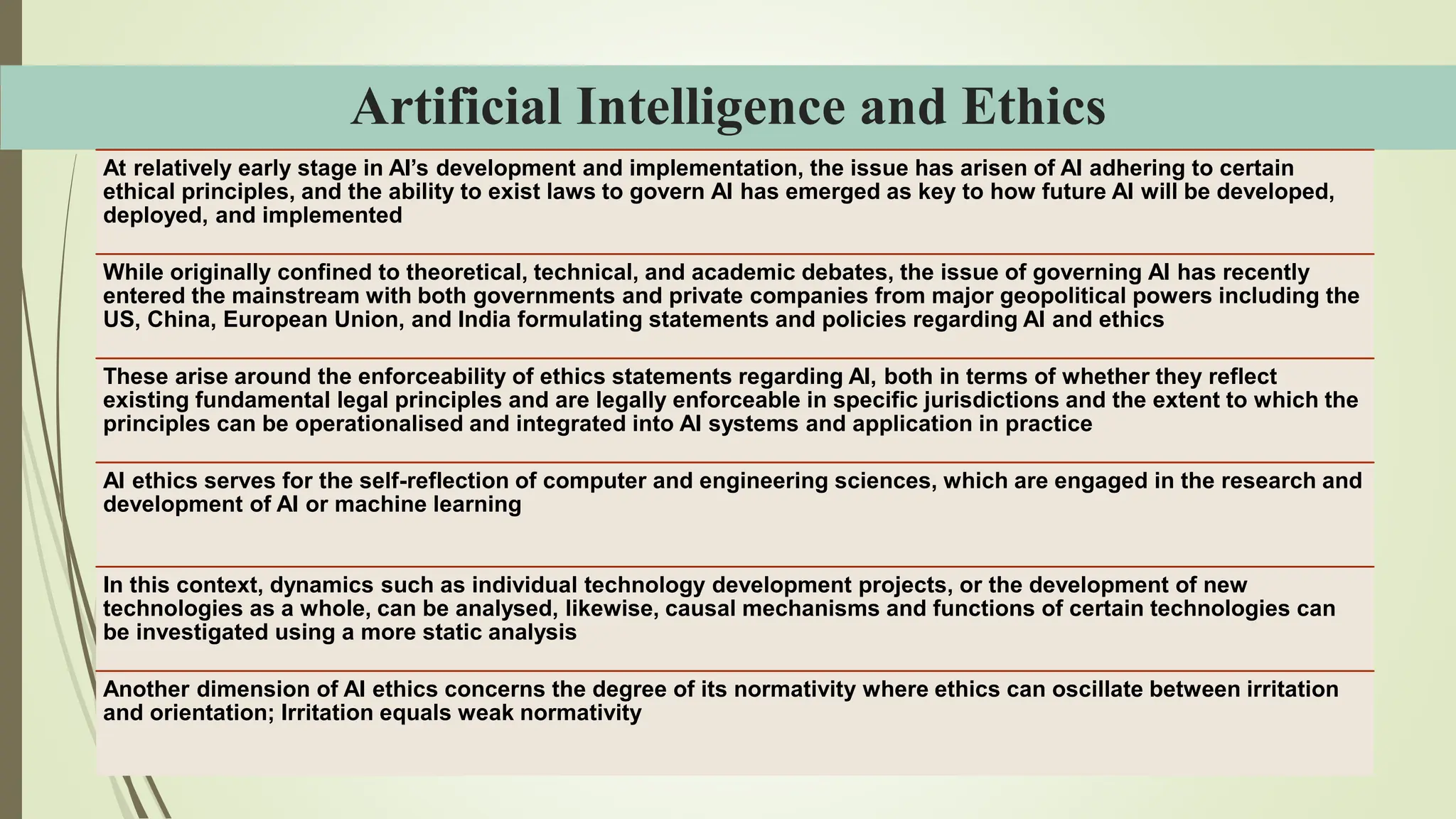
Artificial Intelligence and Ethics
At relatively early stage in AI’s development and implementation, the issue has arisen of AI adhering to certain
ethical principles, and the ability to exist laws to govern AI has emerged as key to how future AI will be developed,
deployed, and implemented
While originally confined to theoretical, technical, and academic debates, the issue of governing AI has recently
entered the mainstream with both governments and private companies from major geopolitical powers including the
US, China, European Union, and India formulating statements and policies regarding AI and ethics
These arise around the enforceability of ethics statements regarding AI, both in terms of whether they reflect
existing fundamental legal principles and are legally enforceable in specific jurisdictions and the extent to which the
principles can be operationalised and integrated into AI systems and application in practice
AI ethics serves for the self-reflection of computer and engineering sciences, which are engaged in the research and
development of AI or machine learning
In this context, dynamics such as individual technology development projects, or the development of new
technologies as a whole, can be analysed, likewise, causal mechanisms and functions of certain technologies can
be investigated using a more static analysis
Another dimension of AI ethics concerns the degree of its normativity where ethics can oscillate between irritation
and orientation; Irritation equals weak normativity
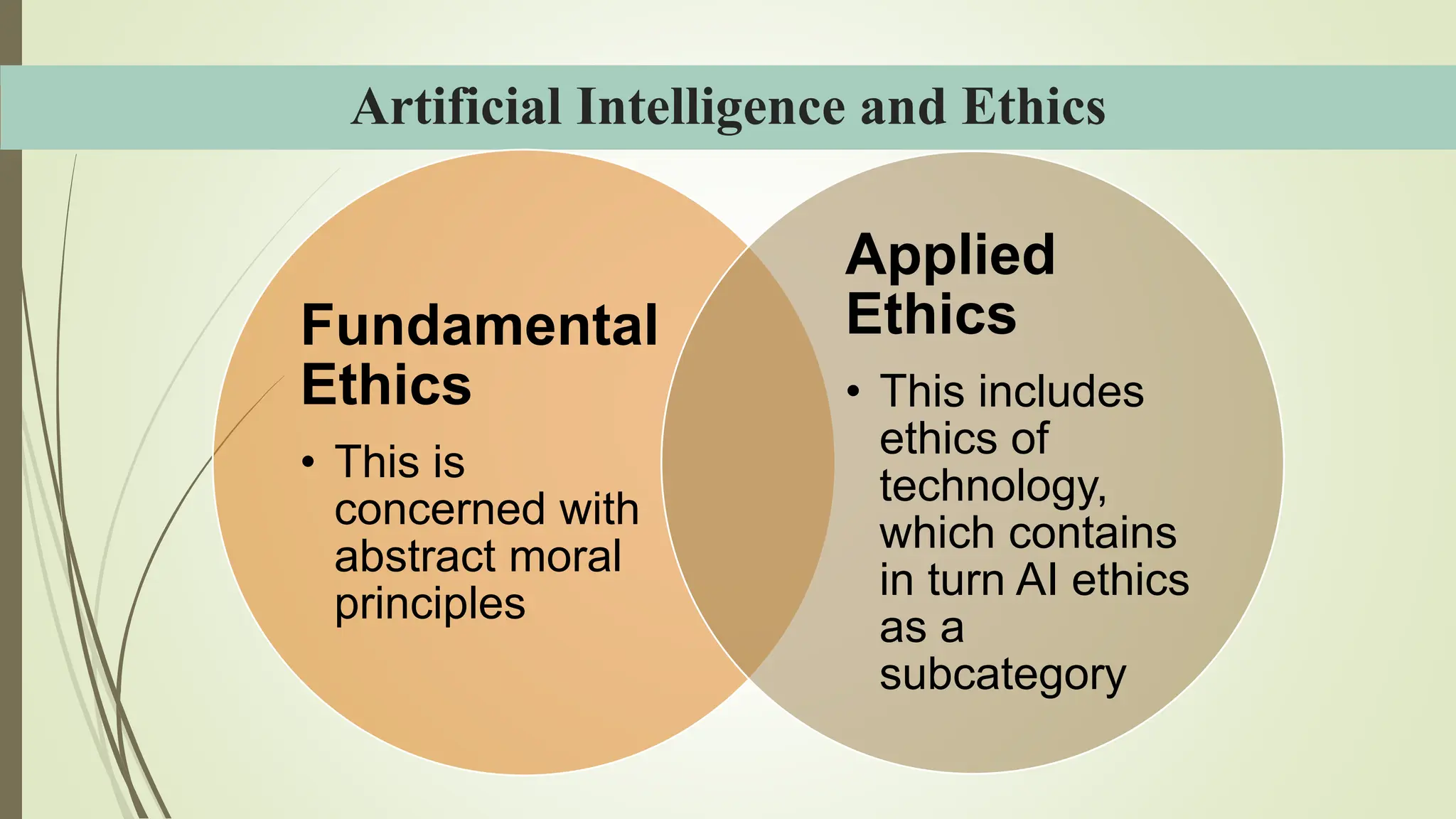
Artificial Intelligence and Ethics
Fundamental
Ethics
• This is
concerned with
abstract moral
principles
Applied
Ethics
• This includes
ethics of
technology,
which contains
in turn AI ethics
as a
subcategory
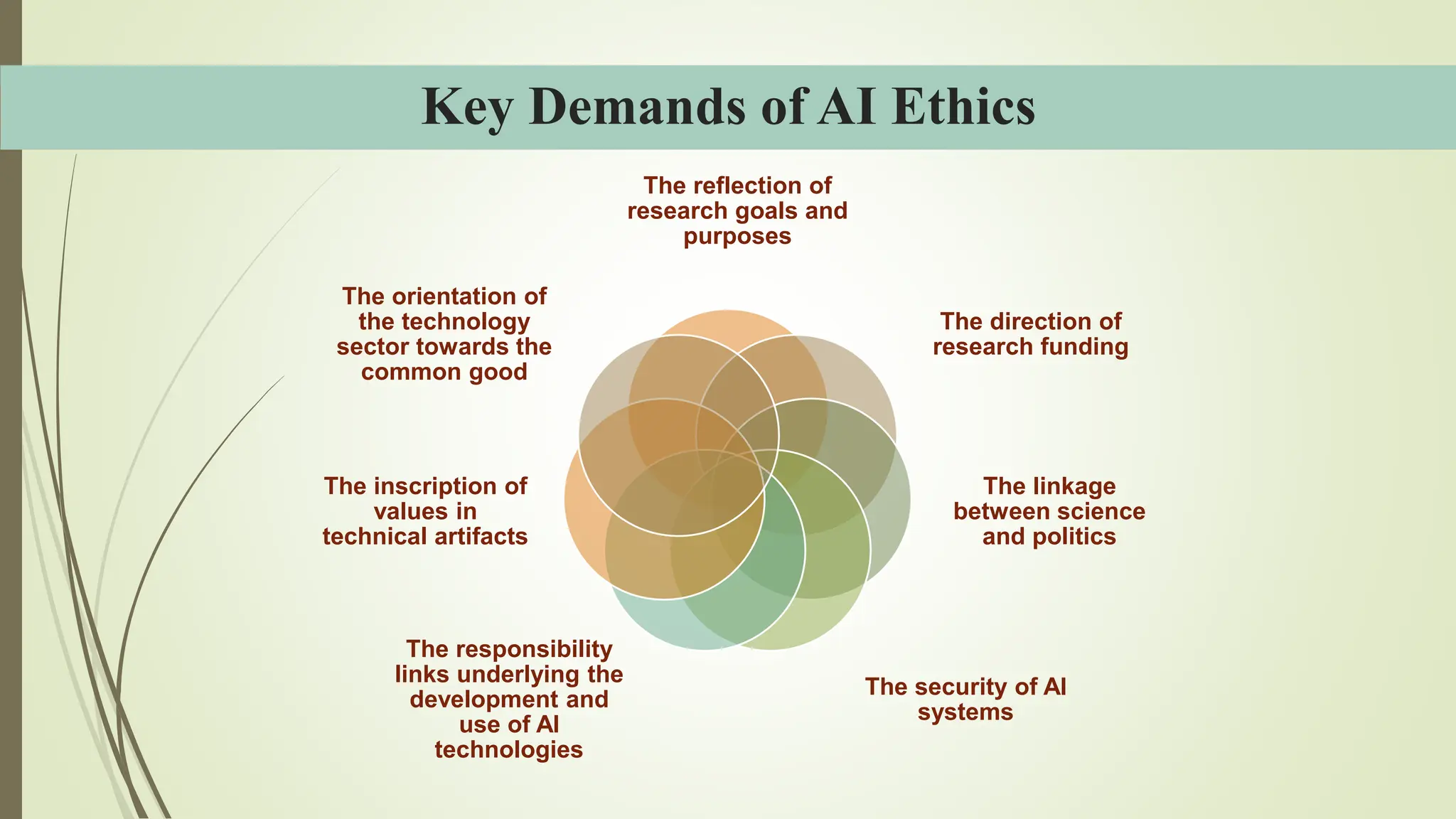
Key Demands of AI Ethics
The reflection of
research goals and
purposes
The direction of
research funding
The linkage
between science
and politics
The security of AI
systems
The responsibility
links underlying the
development and
use of AI
technologies
The inscription of
values in
technical artifacts
The orientation of
the technology
sector towards the
common good
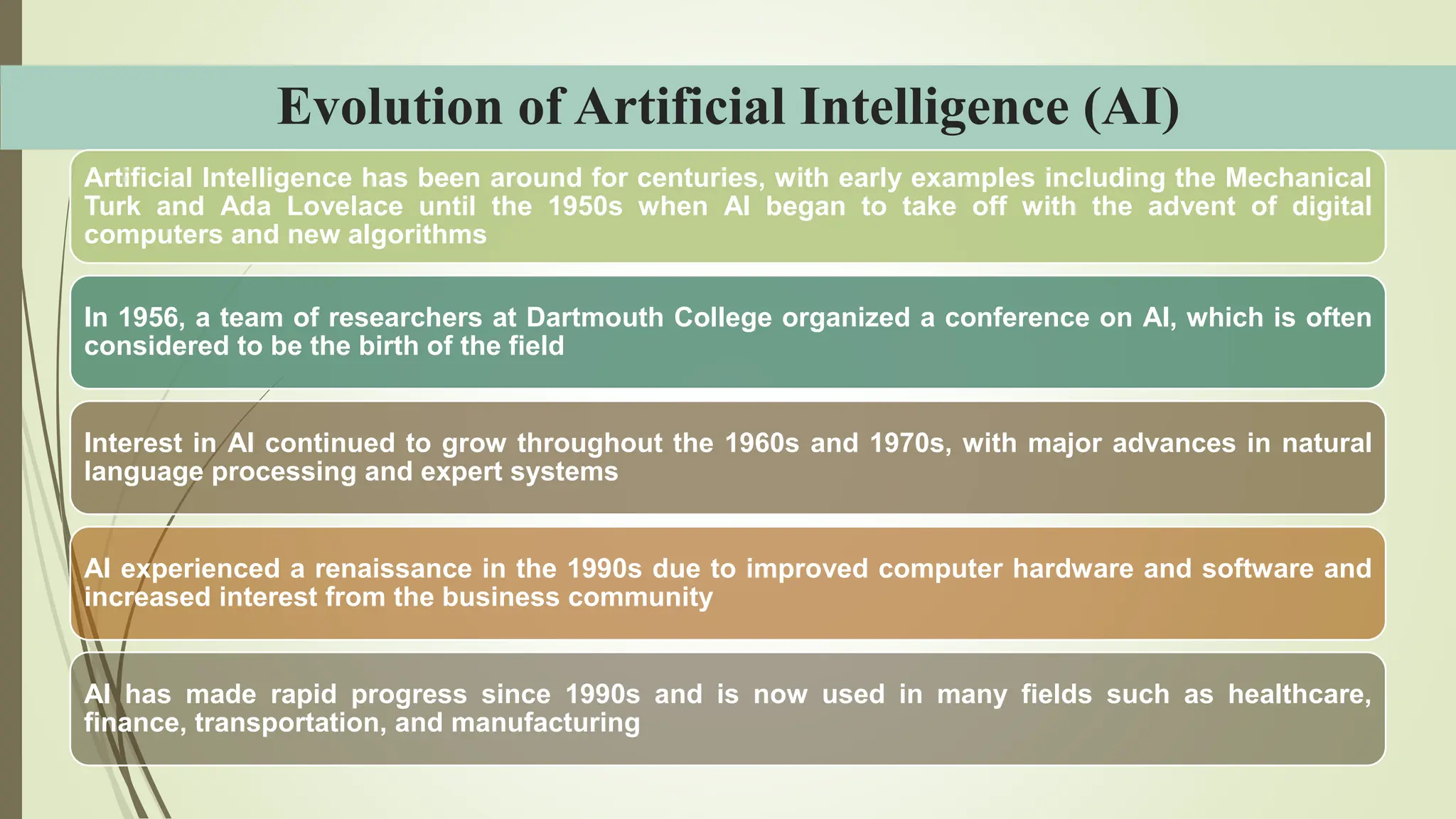
Evolution of Artificial Intelligence (AI)
Artificial Intelligence has been around for centuries, with early examples including the Mechanical
Turk and Ada Lovelace until the 1950s when AI began to take off with the advent of digital
computers and new algorithms
In 1956, a team of researchers at Dartmouth College organized a conference on AI, which is often
considered to be the birth of the field
Interest in AI continued to grow throughout the 1960s and 1970s, with major advances in natural
language processing and expert systems
AI experienced a renaissance in the 1990s due to improved computer hardware and software and
increased interest from the business community
AI has made rapid progress since 1990s and is now used in many fields such as healthcare,
finance, transportation, and manufacturing
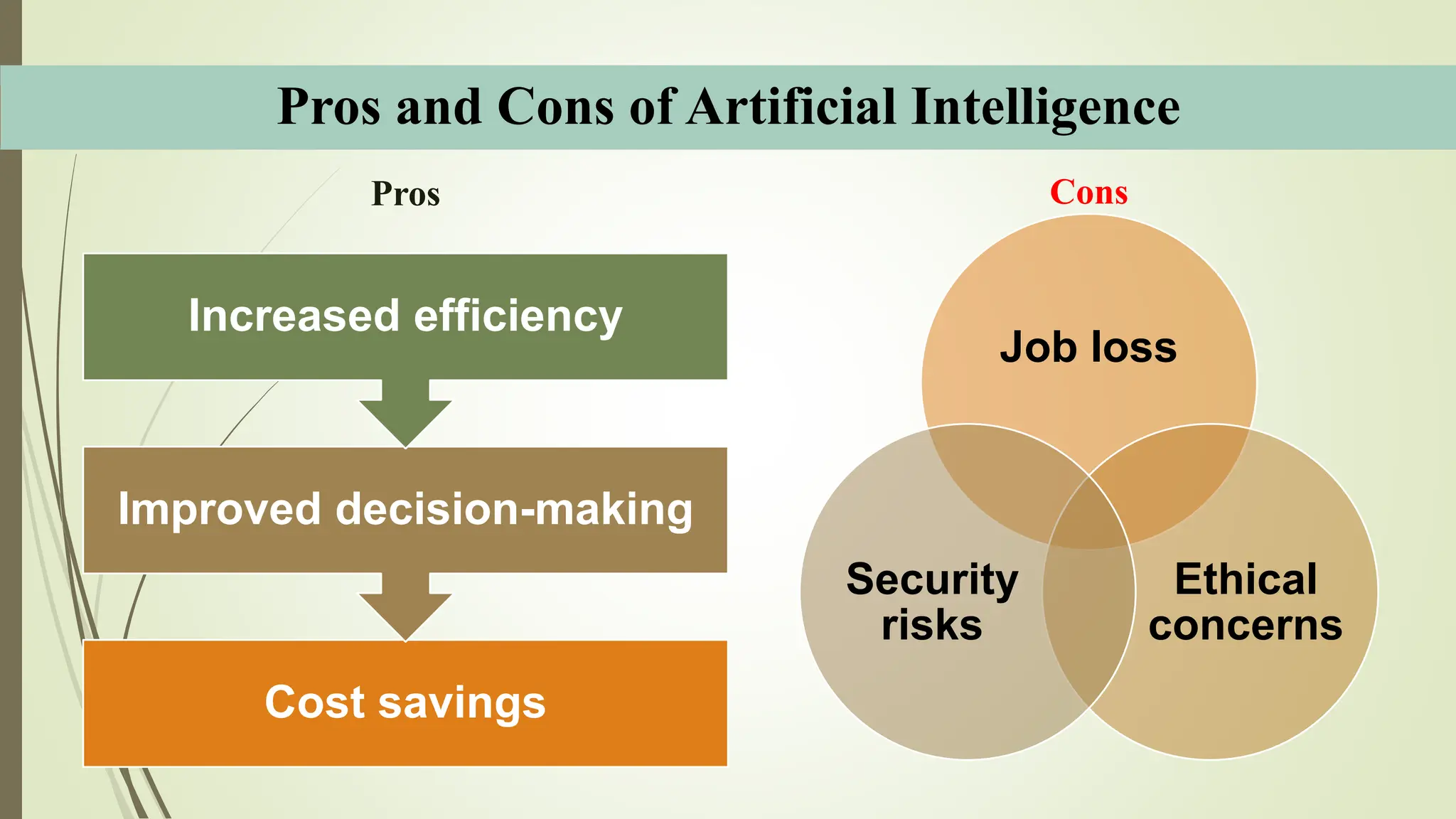
Pros and Cons of Artificial Intelligence
Cost savings
Improved decision-making
Increased efficiency
Job loss
Ethical
concerns
Security
risks
Pros Cons
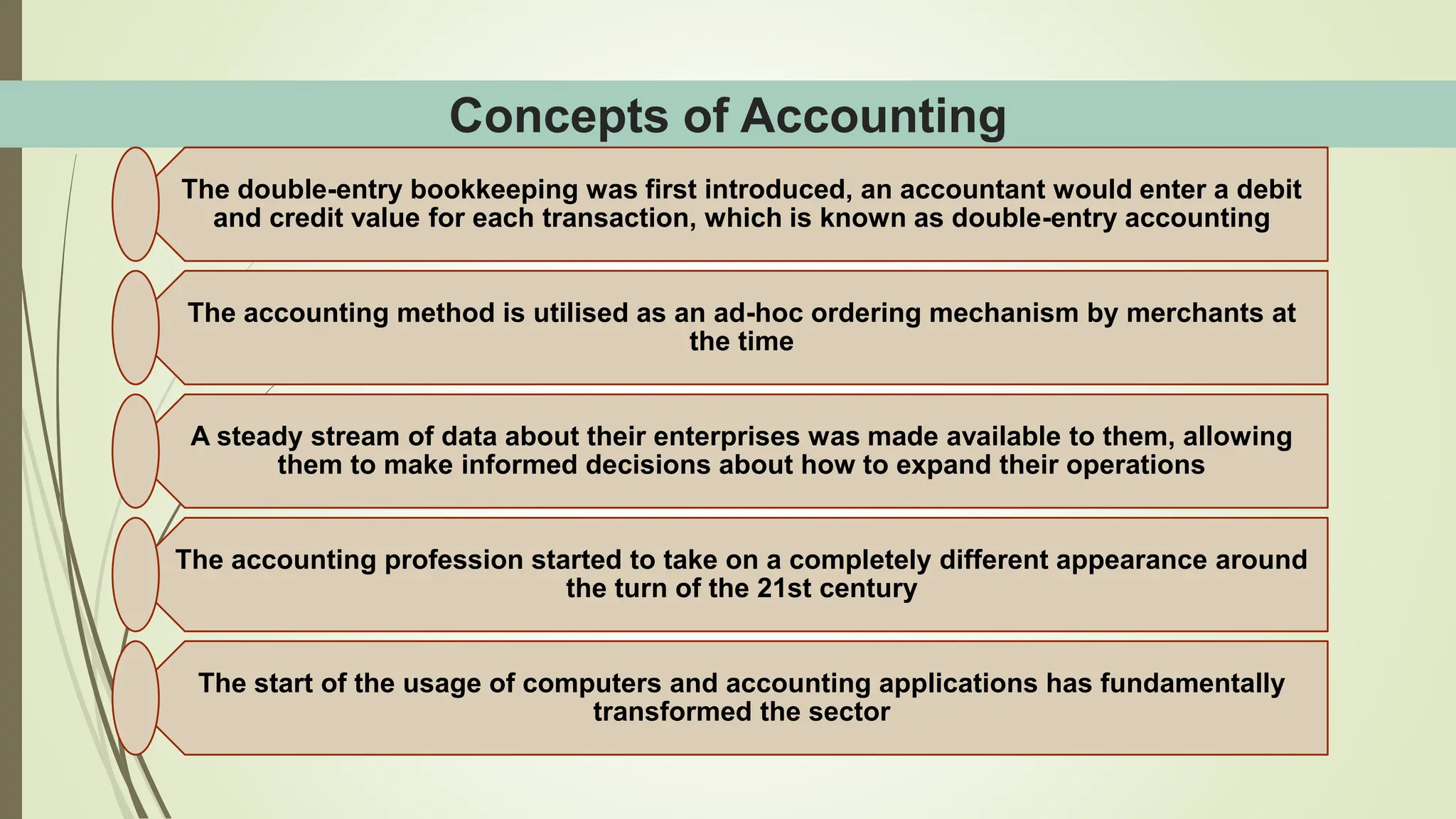
Concepts of Accounting
The double-entry bookkeeping was first introduced, an accountant would enter a debit
and credit value for each transaction, which is known as double-entry accounting
The accounting method is utilised as an ad-hoc ordering mechanism by merchants at
the time
A steady stream of data about their enterprises was made available to them, allowing
them to make informed decisions about how to expand their operations
The accounting profession started to take on a completely different appearance around
the turn of the 21st century
The start of the usage of computers and accounting applications has fundamentally
transformed the sector
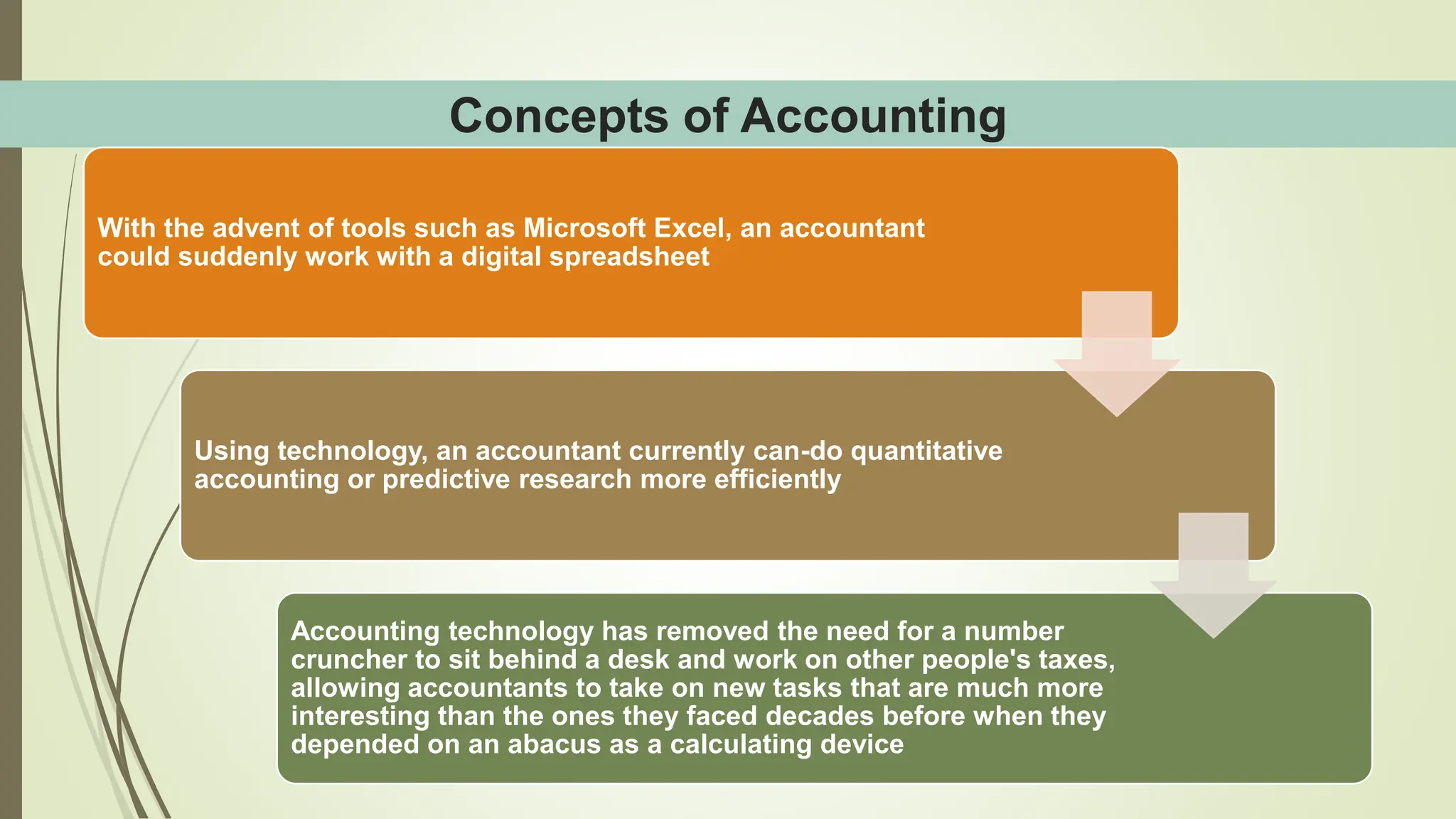
Concepts of Accounting
With the advent of tools such as Microsoft Excel, an accountant
could suddenly work with a digital spreadsheet
Using technology, an accountant currently can-do quantitative
accounting or predictive research more efficiently
Accounting technology has removed the need for a number
cruncher to sit behind a desk and work on other people's taxes,
allowing accountants to take on new tasks that are much more
interesting than the ones they faced decades before when they
depended on an abacus as a calculating device
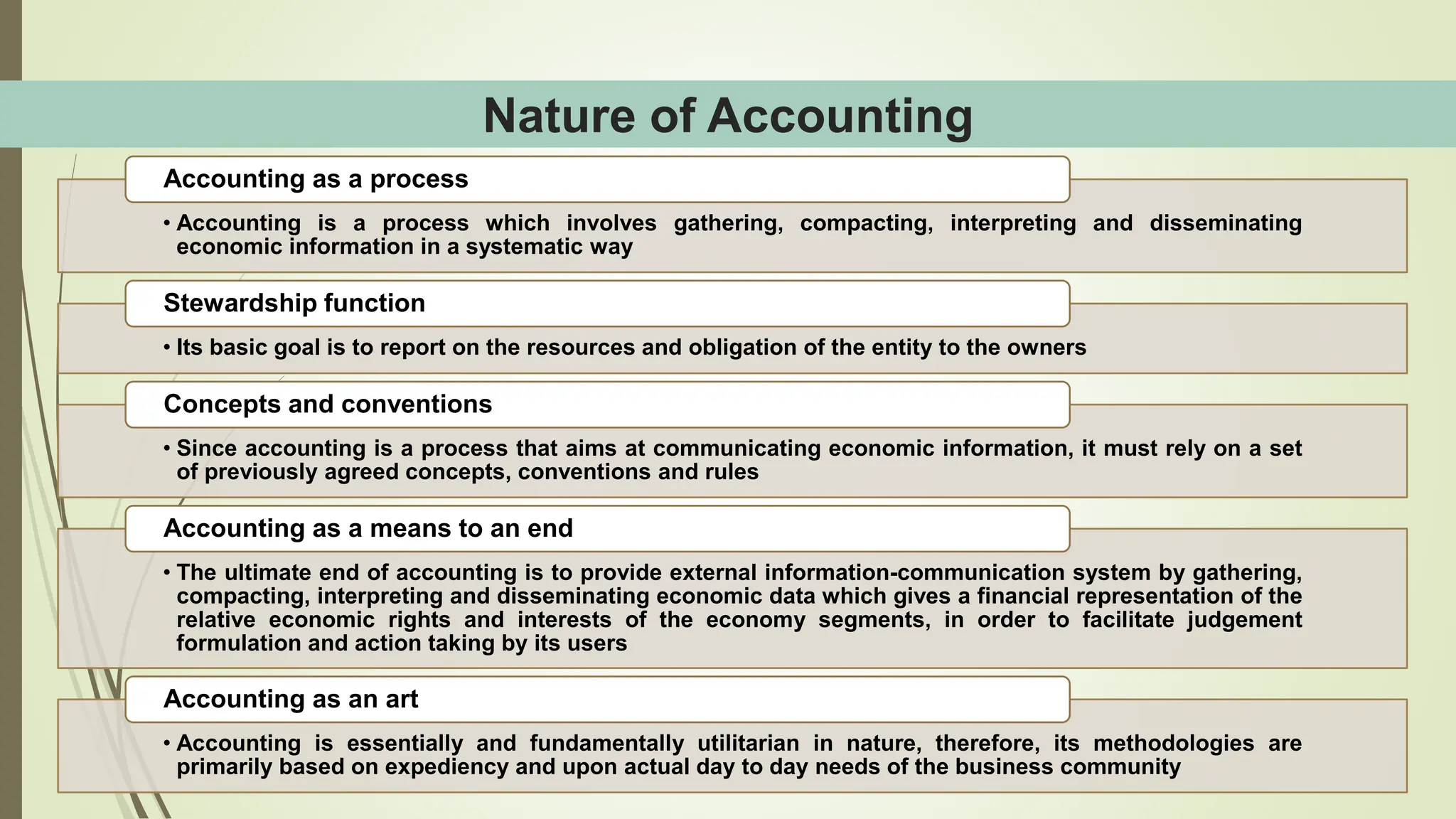
Nature of Accounting
• Accounting is a process which involves gathering, compacting, interpreting and disseminating
economic information in a systematic way
Accounting as a process
• Its basic goal is to report on the resources and obligation of the entity to the owners
Stewardship function
• Since accounting is a process that aims at communicating economic information, it must rely on a set
of previously agreed concepts, conventions and rules
Concepts and conventions
• The ultimate end of accounting is to provide external information-communication system by gathering,
compacting, interpreting and disseminating economic data which gives a financial representation of the
relative economic rights and interests of the economy segments, in order to facilitate judgement
formulation and action taking by its users
Accounting as a means to an end
• Accounting is essentially and fundamentally utilitarian in nature, therefore, its methodologies are
primarily based on expediency and upon actual day to day needs of the business community
Accounting as an art
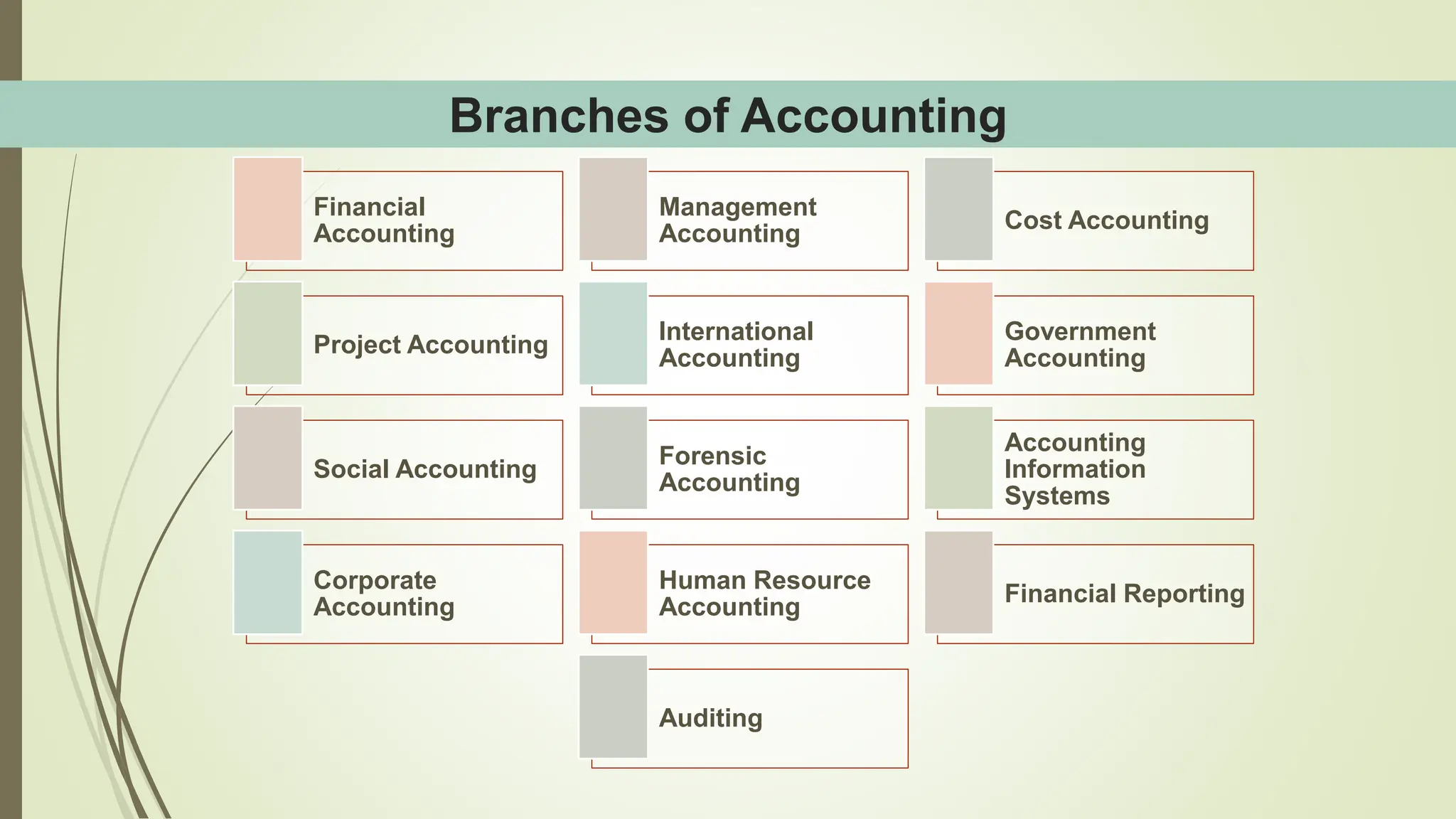
Branches of Accounting
Financial
Accounting
Management
Accounting
Cost Accounting
Project Accounting
International
Accounting
Government
Accounting
Social Accounting
Forensic
Accounting
Accounting
Information
Systems
Corporate
Accounting
Human Resource
Accounting
Financial Reporting
Auditing
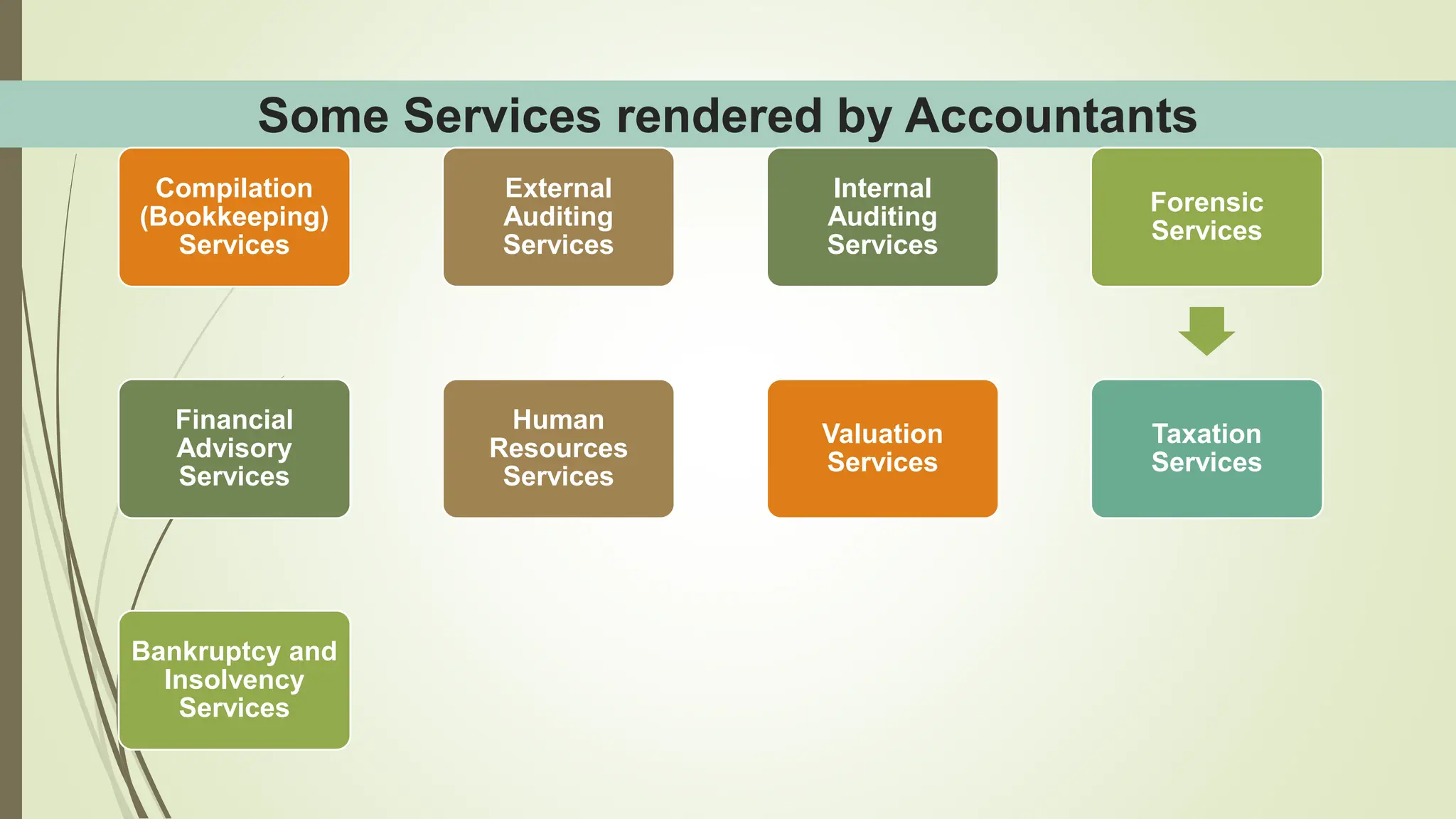
Some Services rendered by Accountants
Compilation
(Bookkeeping)
Services
External
Auditing
Services
Internal
Auditing
Services
Forensic
Services
Taxation
Services
Valuation
Services
Human
Resources
Services
Financial
Advisory
Services
Bankruptcy and
Insolvency
Services
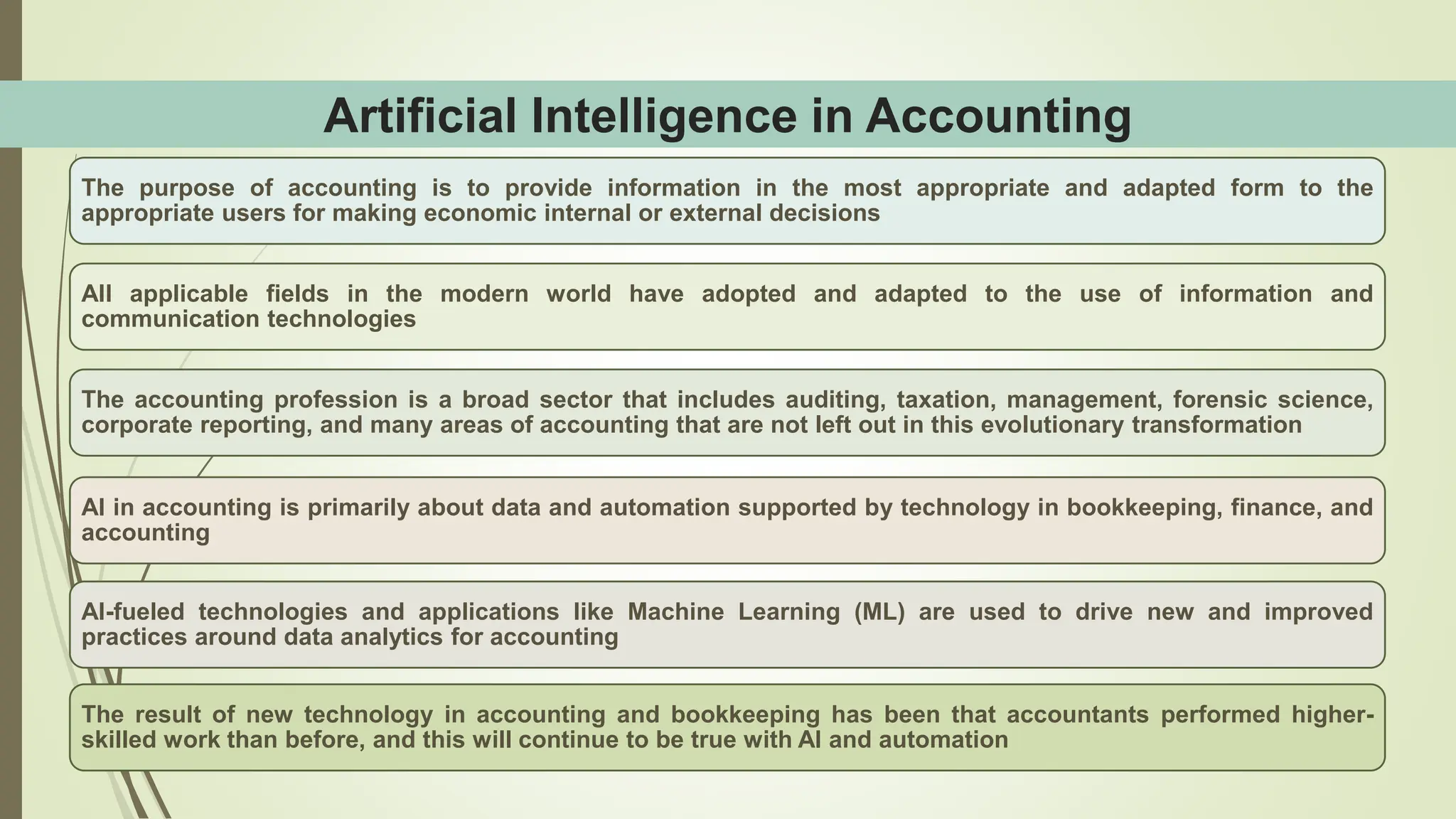
Artificial Intelligence in Accounting
The purpose of accounting is to provide information in the most appropriate and adapted form to the
appropriate users for making economic internal or external decisions
All applicable fields in the modern world have adopted and adapted to the use of information and
communication technologies
The accounting profession is a broad sector that includes auditing, taxation, management, forensic science,
corporate reporting, and many areas of accounting that are not left out in this evolutionary transformation
AI in accounting is primarily about data and automation supported by technology in bookkeeping, finance, and
accounting
AI-fueled technologies and applications like Machine Learning (ML) are used to drive new and improved
practices around data analytics for accounting
The result of new technology in accounting and bookkeeping has been that accountants performed higher-
skilled work than before, and this will continue to be true with AI and automation
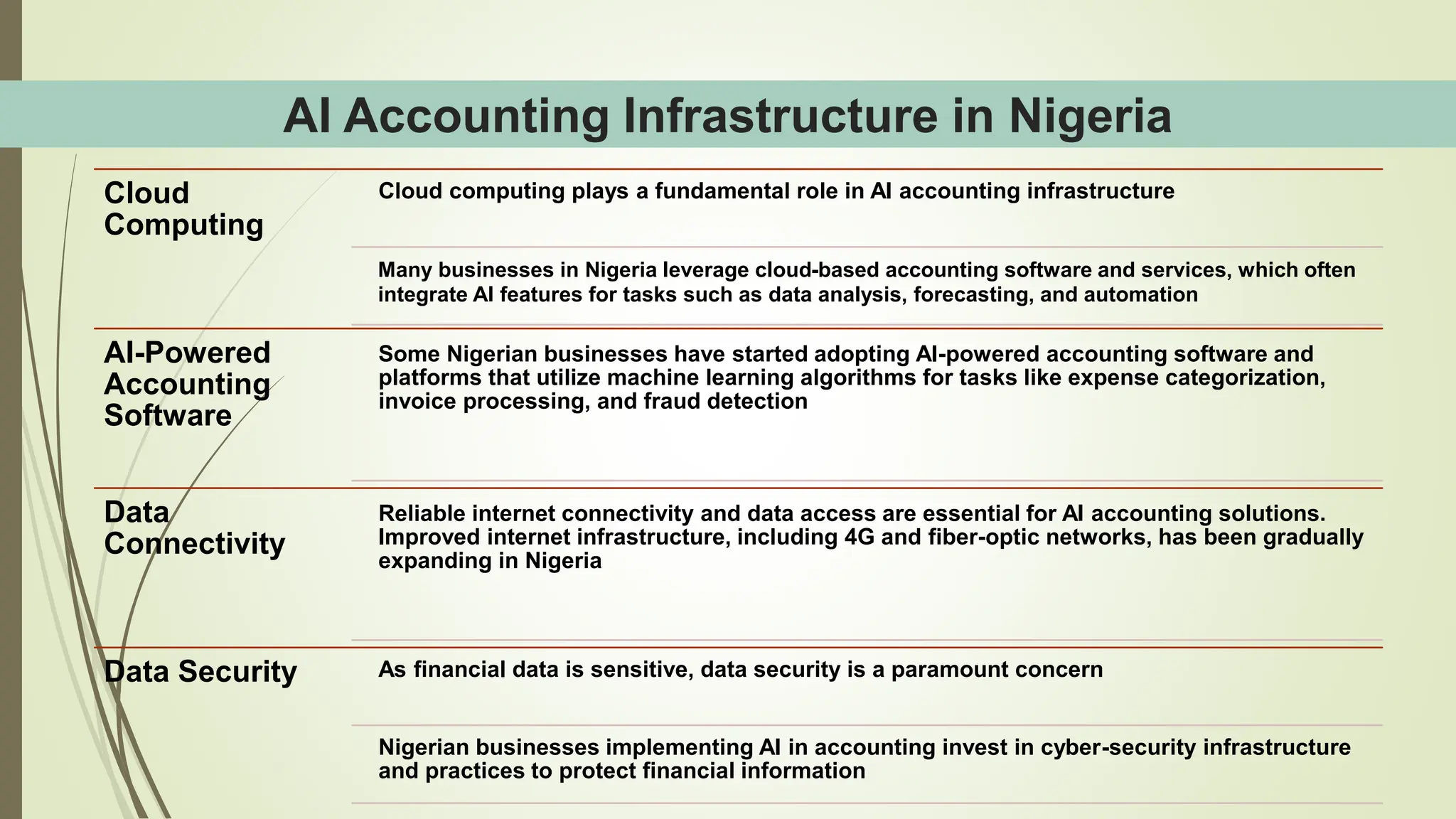
AI Accounting Infrastructure in Nigeria
Cloud
Computing
Cloud computing plays a fundamental role in AI accounting infrastructure
Many businesses in Nigeria leverage cloud-based accounting software and services, which often
integrate AI features for tasks such as data analysis, forecasting, and automation
AI-Powered
Accounting
Software
Some Nigerian businesses have started adopting AI-powered accounting software and
platforms that utilize machine learning algorithms for tasks like expense categorization,
invoice processing, and fraud detection
Data
Connectivity
Reliable internet connectivity and data access are essential for AI accounting solutions.
Improved internet infrastructure, including 4G and fiber-optic networks, has been gradually
expanding in Nigeria
Data Security As financial data is sensitive, data security is a paramount concern
Nigerian businesses implementing AI in accounting invest in cyber-security infrastructure
and practices to protect financial information
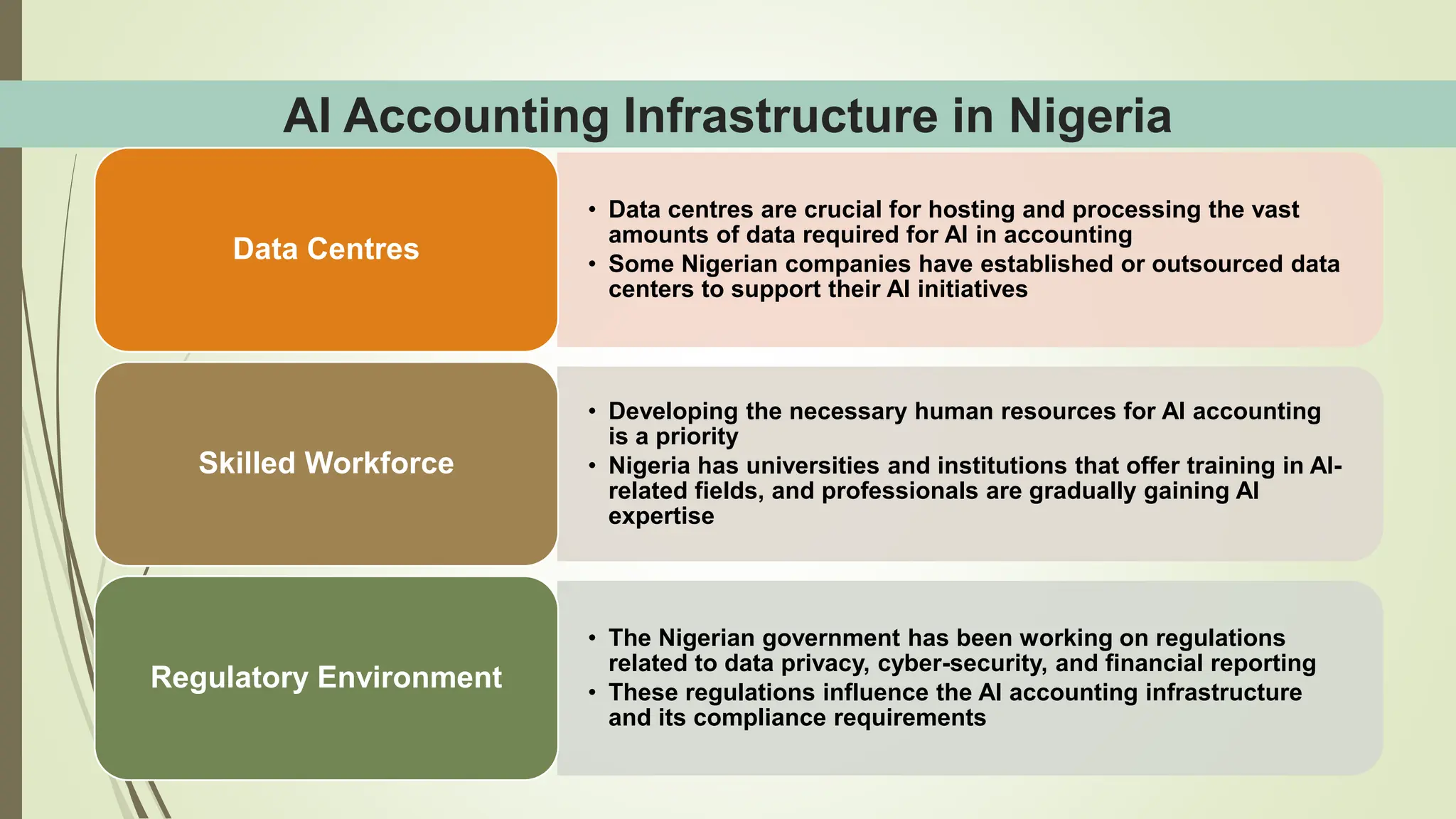
AI Accounting Infrastructure in Nigeria
• Data centres are crucial for hosting and processing the vast
amounts of data required for AI in accounting
• Some Nigerian companies have established or outsourced data
centers to support their AI initiatives
Data Centres
• Developing the necessary human resources for AI accounting
is a priority
• Nigeria has universities and institutions that offer training in AI-
related fields, and professionals are gradually gaining AI
expertise
Skilled Workforce
• The Nigerian government has been working on regulations
related to data privacy, cyber-security, and financial reporting
• These regulations influence the AI accounting infrastructure
and its compliance requirements
Regulatory Environment
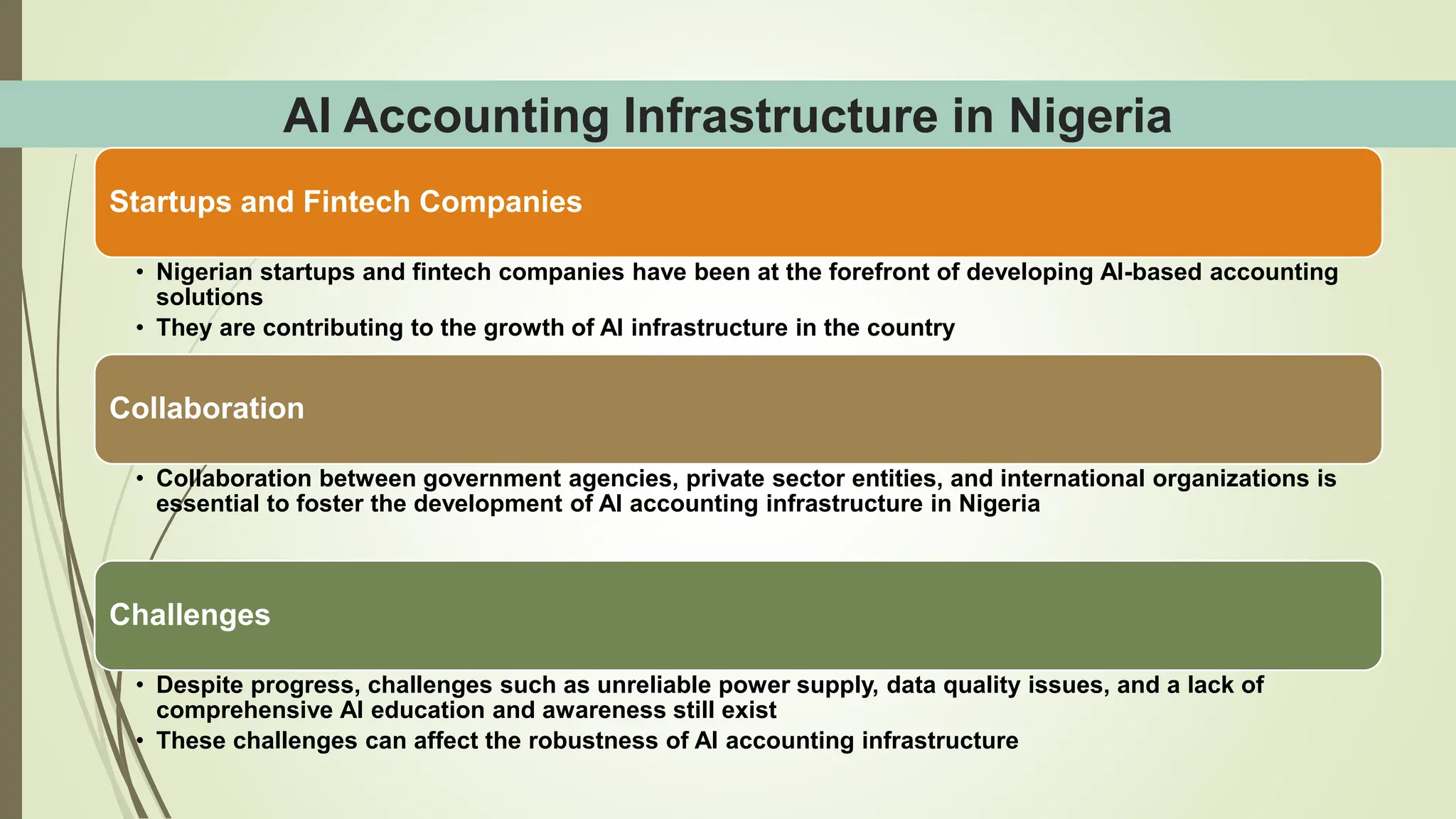
AI Accounting Infrastructure in Nigeria
Startups and Fintech Companies
• Nigerian startups and fintech companies have been at the forefront of developing AI-based accounting
solutions
• They are contributing to the growth of AI infrastructure in the country
Collaboration
• Collaboration between government agencies, private sector entities, and international organizations is
essential to foster the development of AI accounting infrastructure in Nigeria
Challenges
• Despite progress, challenges such as unreliable power supply, data quality issues, and a lack of
comprehensive AI education and awareness still exist
• These challenges can affect the robustness of AI accounting infrastructure
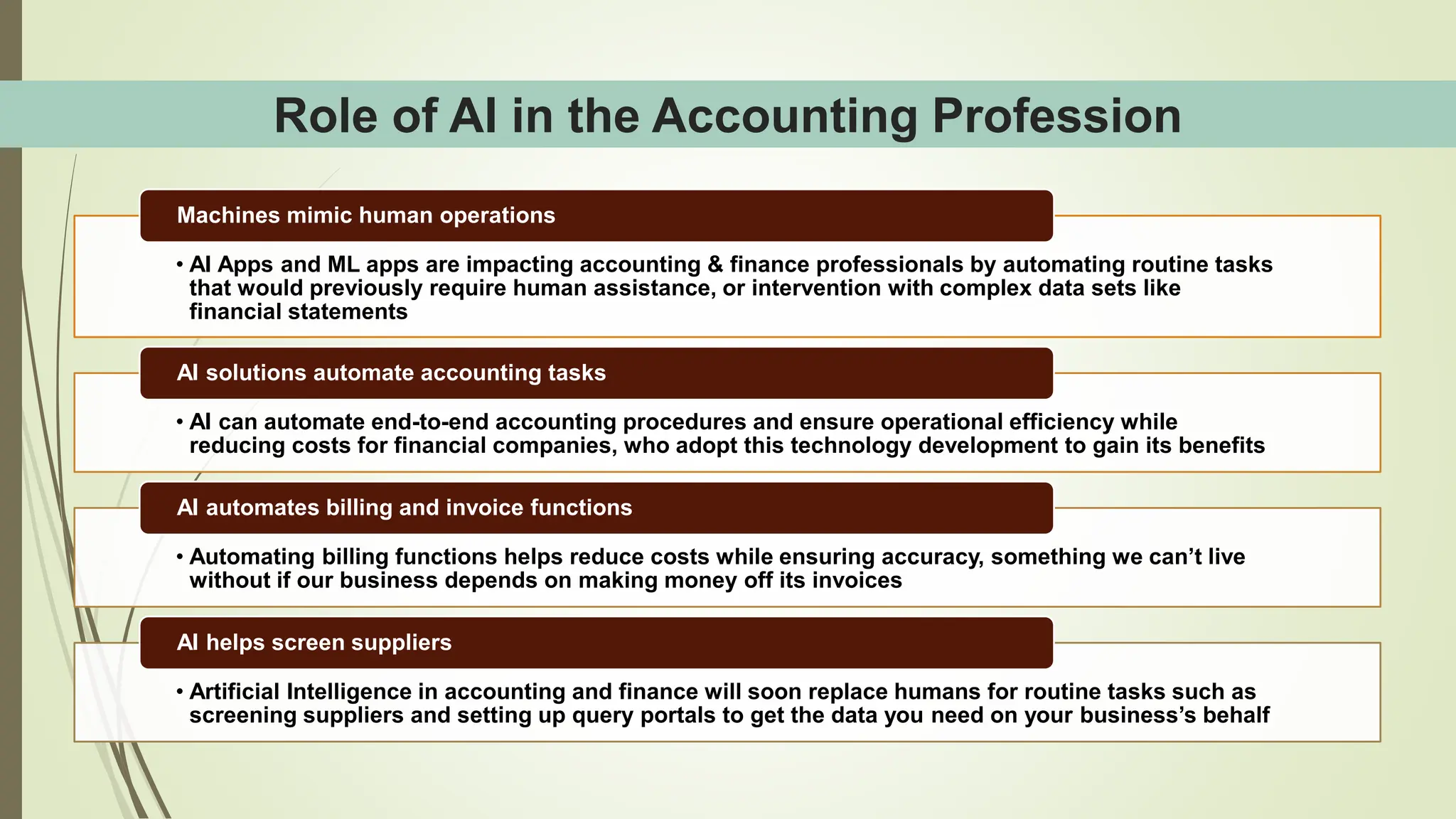
Role of AI in the Accounting Profession
• AI Apps and ML apps are impacting accounting & finance professionals by automating routine tasks
that would previously require human assistance, or intervention with complex data sets like
financial statements
Machines mimic human operations
• AI can automate end-to-end accounting procedures and ensure operational efficiency while
reducing costs for financial companies, who adopt this technology development to gain its benefits
AI solutions automate accounting tasks
• Automating billing functions helps reduce costs while ensuring accuracy, something we can’t live
without if our business depends on making money off its invoices
AI automates billing and invoice functions
• Artificial Intelligence in accounting and finance will soon replace humans for routine tasks such as
screening suppliers and setting up query portals to get the data you need on your business’s behalf
AI helps screen suppliers
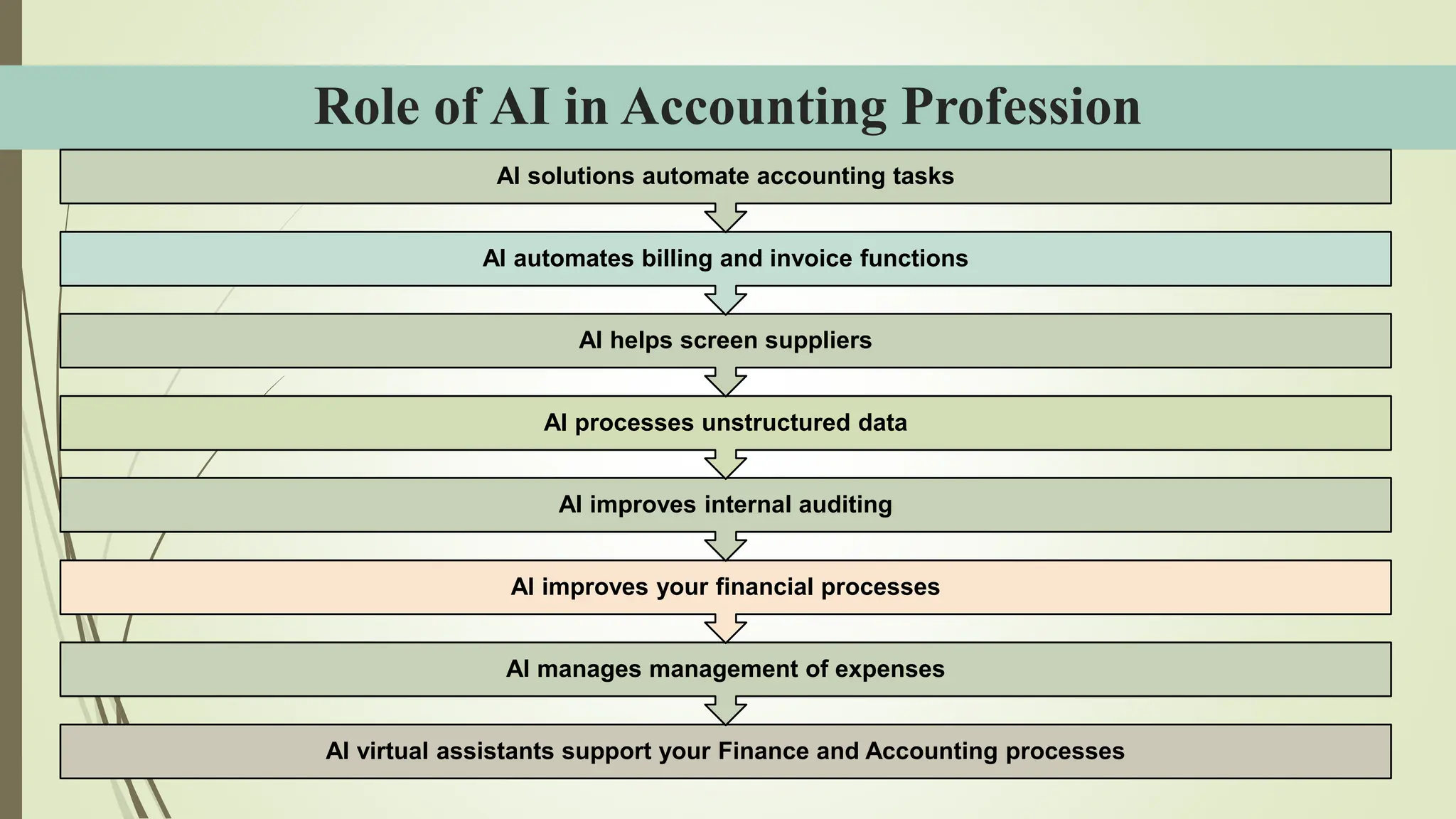
Role of AI in Accounting Profession
AI virtual assistants support your Finance and Accounting processes
AI manages management of expenses
AI improves your financial processes
AI improves internal auditing
AI processes unstructured data
AI helps screen suppliers
AI automates billing and invoice functions
AI solutions automate accounting tasks
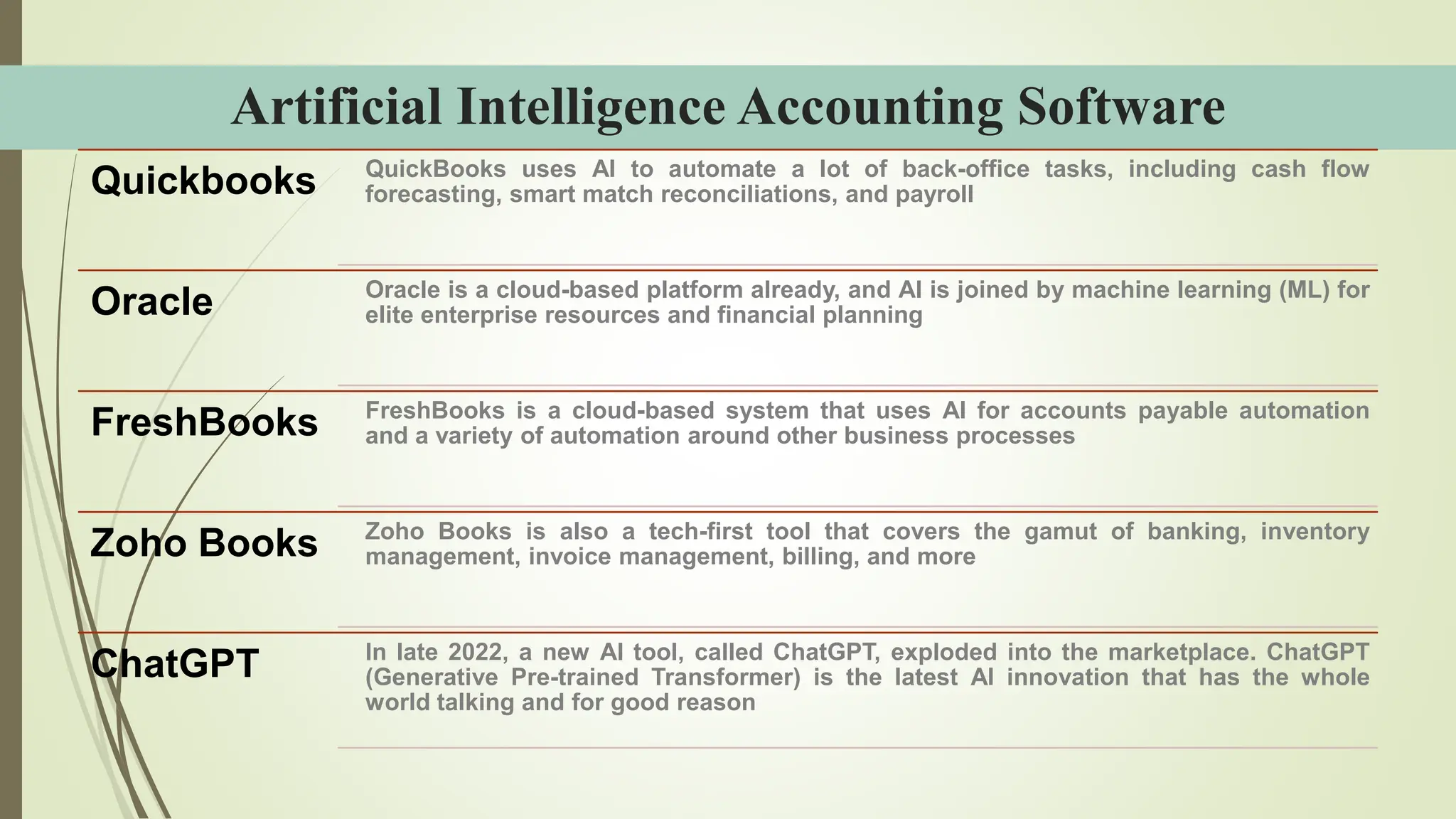
Artificial Intelligence Accounting Software
Quickbooks QuickBooks uses AI to automate a lot of back-office tasks, including cash flow
forecasting, smart match reconciliations, and payroll
Oracle Oracle is a cloud-based platform already, and AI is joined by machine learning (ML) for
elite enterprise resources and financial planning
FreshBooks FreshBooks is a cloud-based system that uses AI for accounts payable automation
and a variety of automation around other business processes
Zoho Books Zoho Books is also a tech-first tool that covers the gamut of banking, inventory
management, invoice management, billing, and more
ChatGPT In late 2022, a new AI tool, called ChatGPT, exploded into the marketplace. ChatGPT
(Generative Pre-trained Transformer) is the latest AI innovation that has the whole
world talking and for good reason
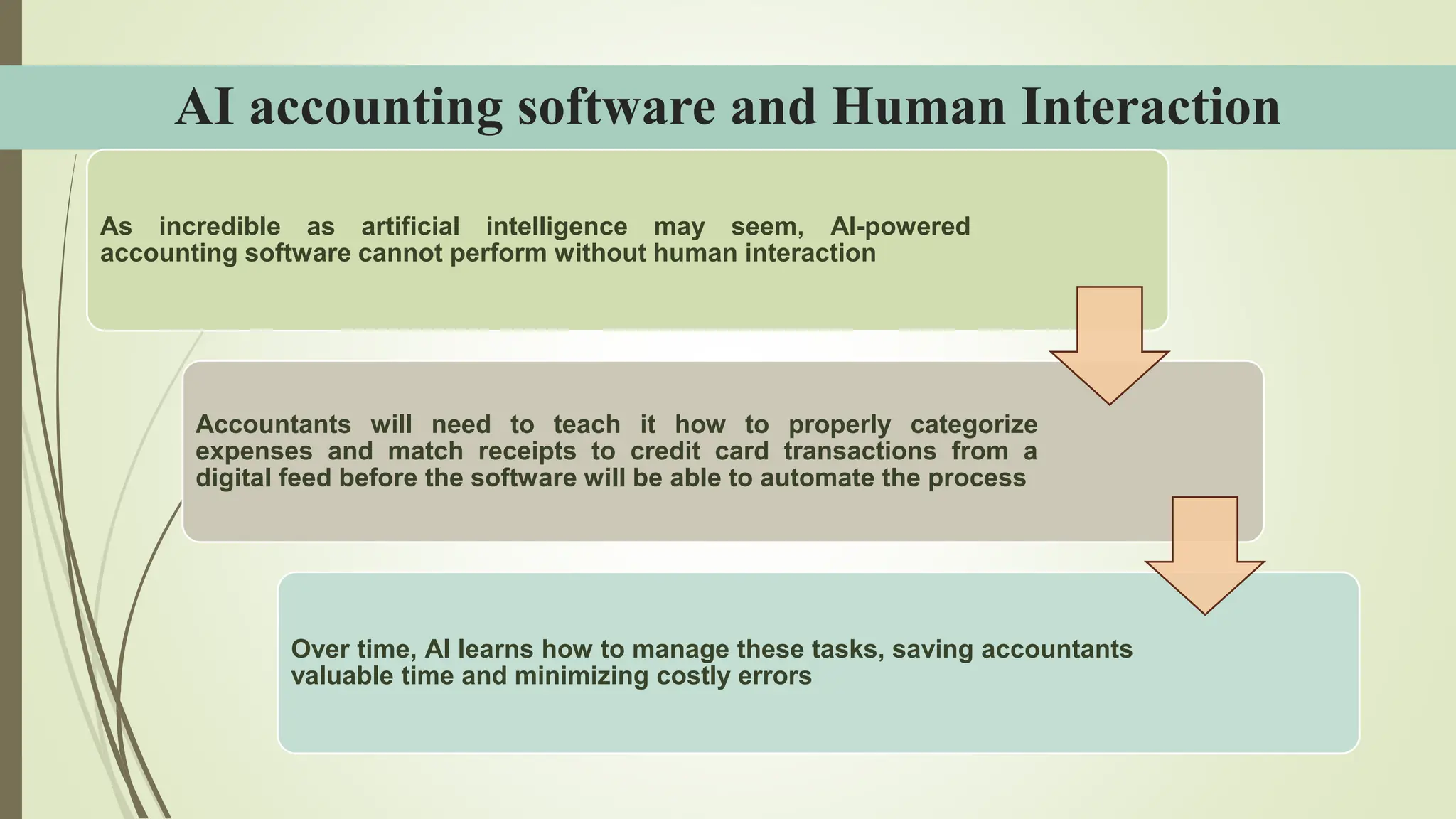
AI accounting software and Human Interaction
As incredible as artificial intelligence may seem, AI-powered
accounting software cannot perform without human interaction
Accountants will need to teach it how to properly categorize
expenses and match receipts to credit card transactions from a
digital feed before the software will be able to automate the process
Over time, AI learns how to manage these tasks, saving accountants
valuable time and minimizing costly errors
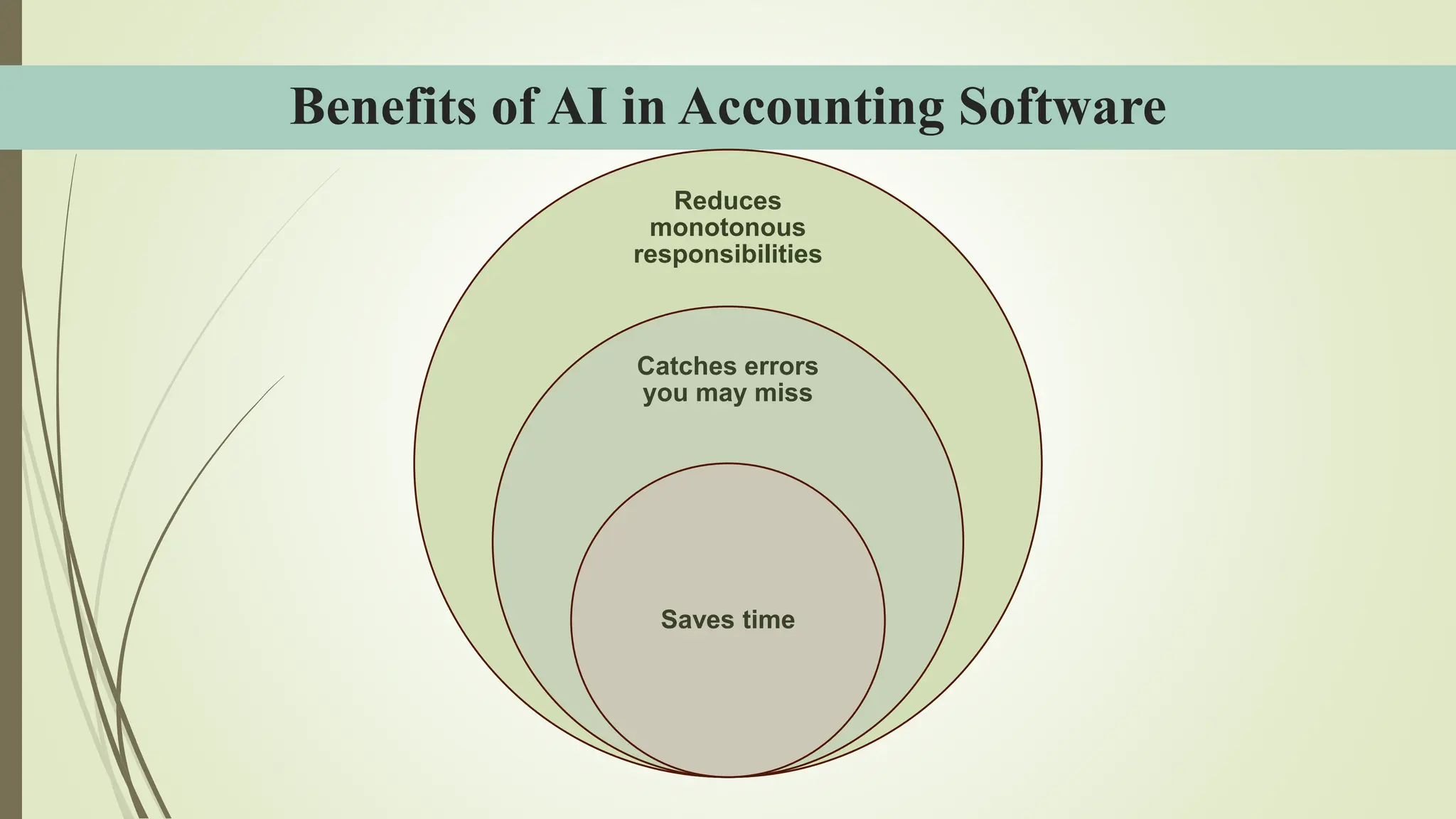
Benefits of AI in Accounting Software
Reduces
monotonous
responsibilities
Catches errors
you may miss
Saves time
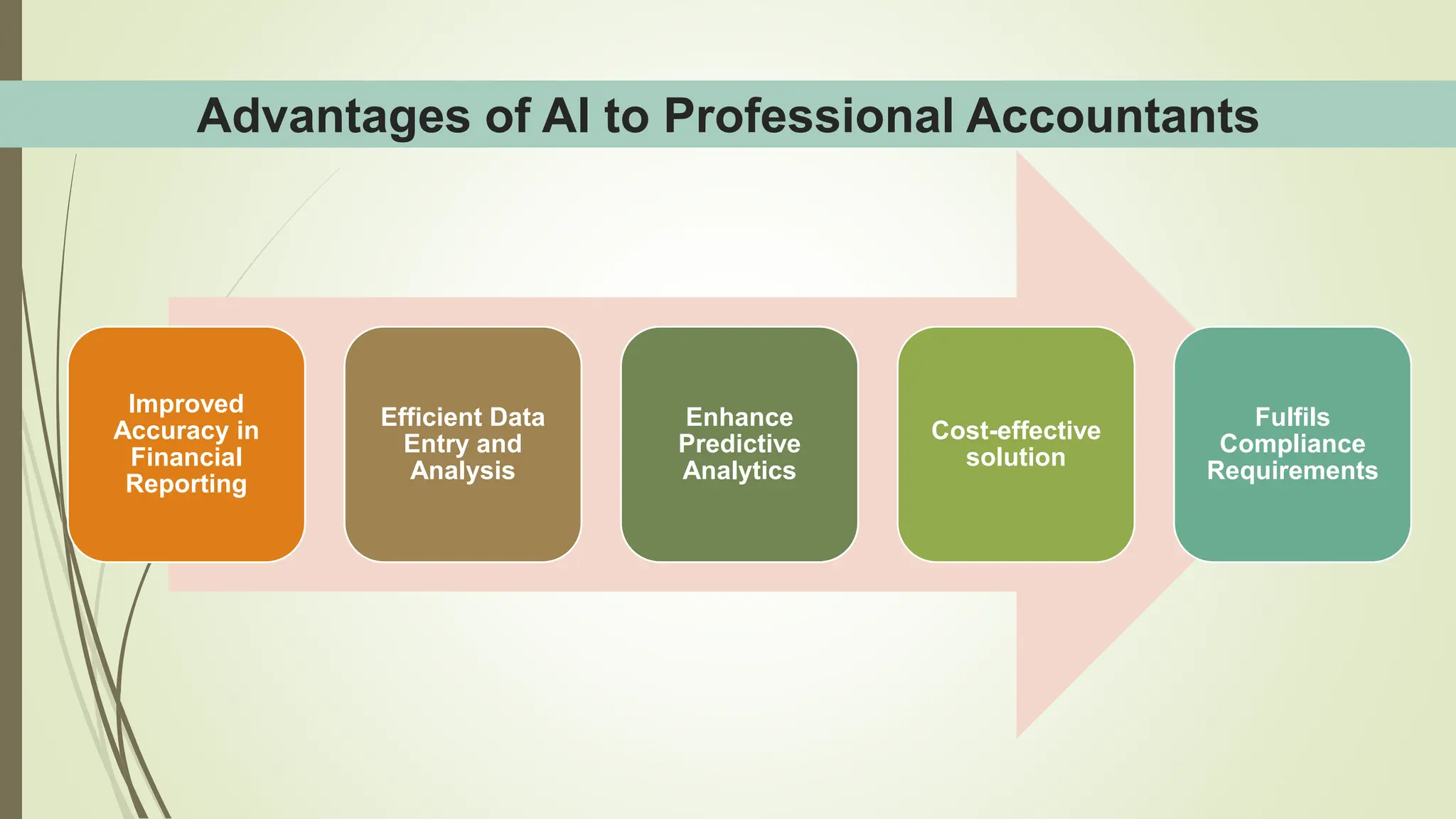
Advantages of AI to Professional Accountants
Improved
Accuracy in
Financial
Reporting
Efficient Data
Entry and
Analysis
Enhance
Predictive
Analytics
Cost-effective
solution
Fulfils
Compliance
Requirements
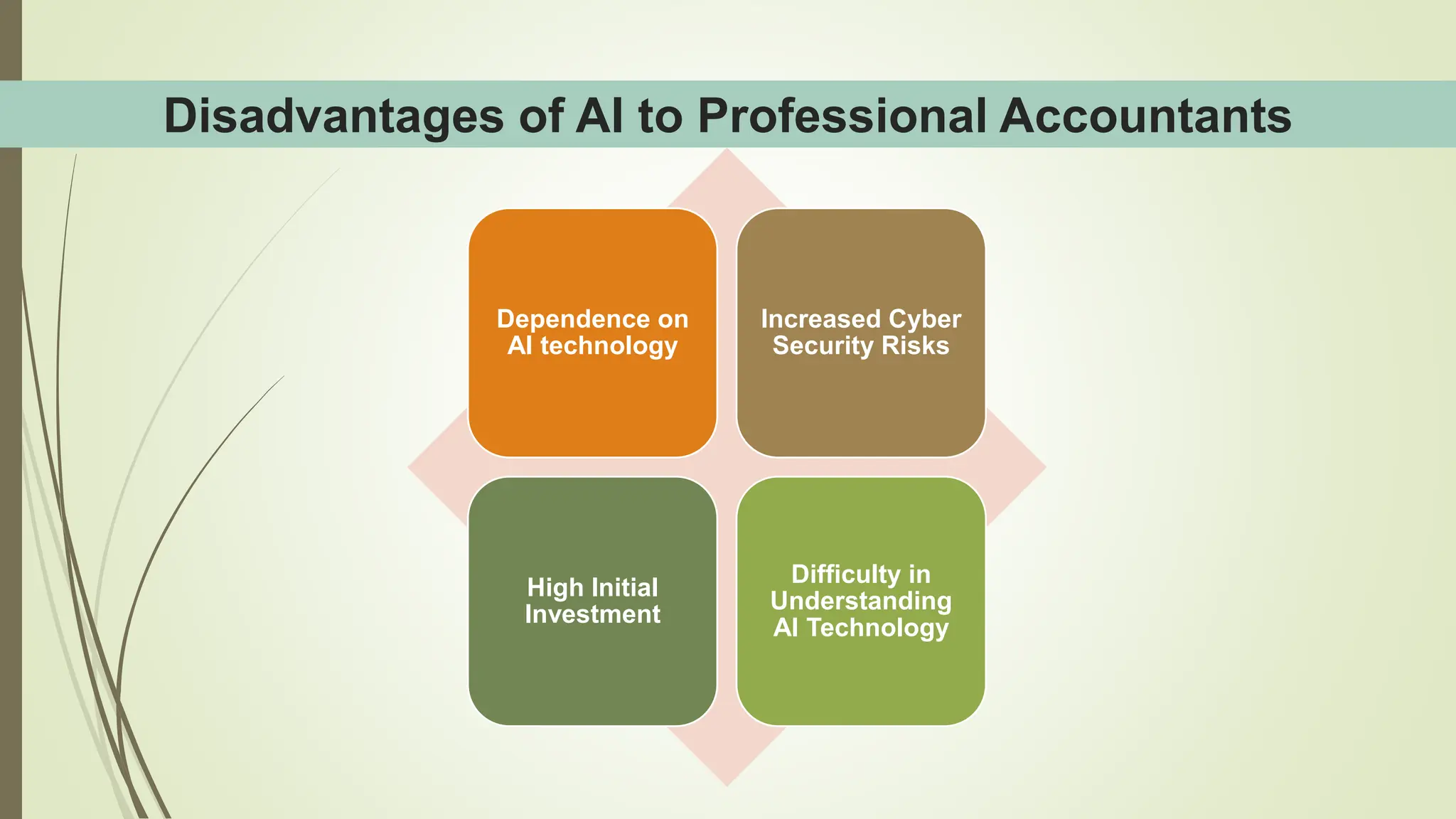
Disadvantages of AI to Professional Accountants
Dependence on
AI technology
Increased Cyber
Security Risks
High Initial
Investment
Difficulty in
Understanding
AI Technology
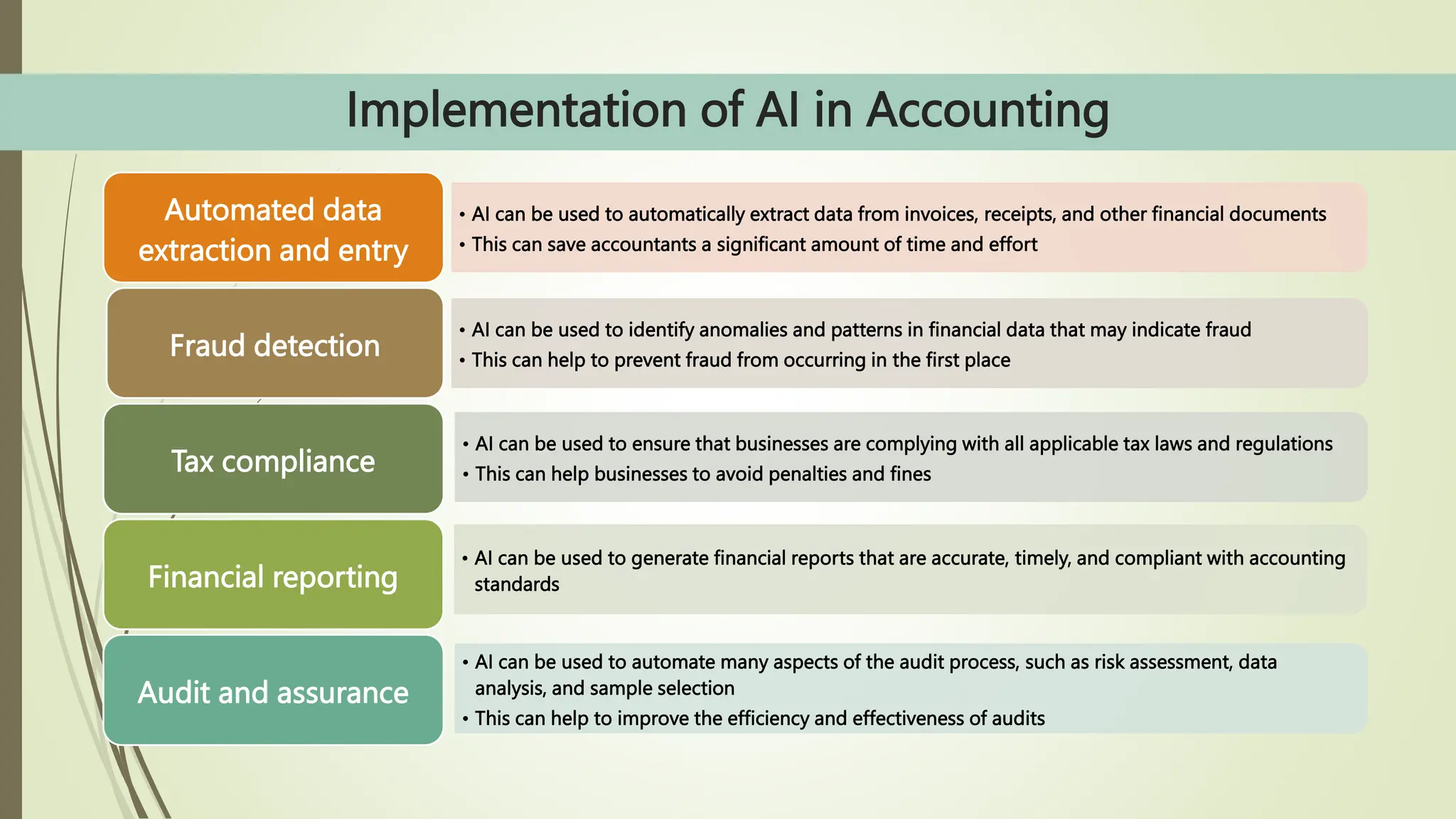
Implementation of AI in Accounting
• AI can be used to automatically extract data from invoices, receipts, and other financial documents
• This can save accountants a significant amount of time and effort
Automated data
extraction and entry
• AI can be used to identify anomalies and patterns in financial data that may indicate fraud
• This can help to prevent fraud from occurring in the first place
Fraud detection
• AI can be used to ensure that businesses are complying with all applicable tax laws and regulations
• This can help businesses to avoid penalties and fines
Tax compliance
• AI can be used to generate financial reports that are accurate, timely, and compliant with accounting
standards
Financial reporting
• AI can be used to automate many aspects of the audit process, such as risk assessment, data
analysis, and sample selection
• This can help to improve the efficiency and effectiveness of audits
Audit and assurance
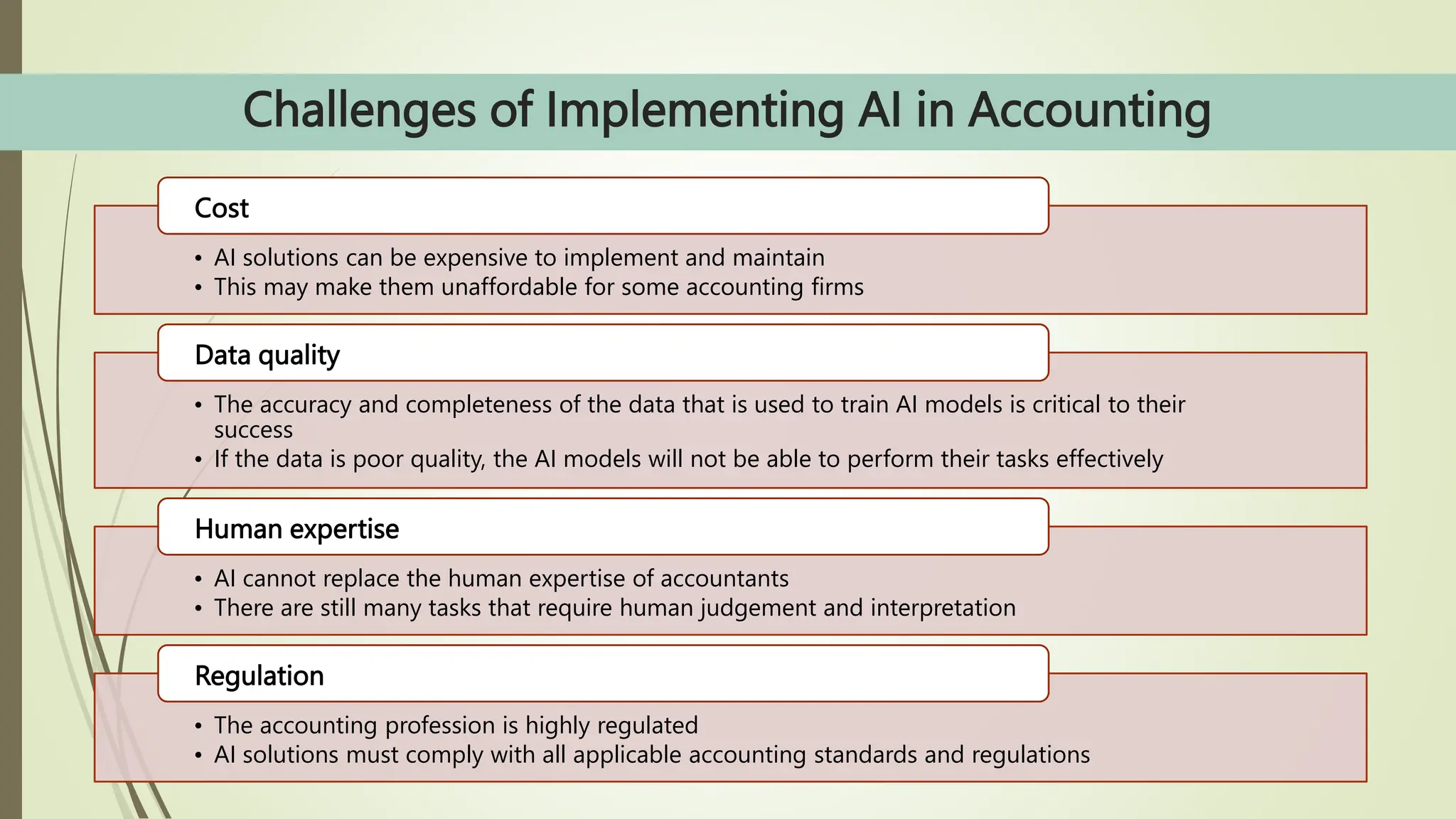
Challenges of Implementing AI in Accounting
• AI solutions can be expensive to implement and maintain
• This may make them unaffordable for some accounting firms
Cost
• The accuracy and completeness of the data that is used to train AI models is critical to their
success
• If the data is poor quality, the AI models will not be able to perform their tasks effectively
Data quality
• AI cannot replace the human expertise of accountants
• There are still many tasks that require human judgement and interpretation
Human expertise
• The accounting profession is highly regulated
• AI solutions must comply with all applicable accounting standards and regulations
Regulation
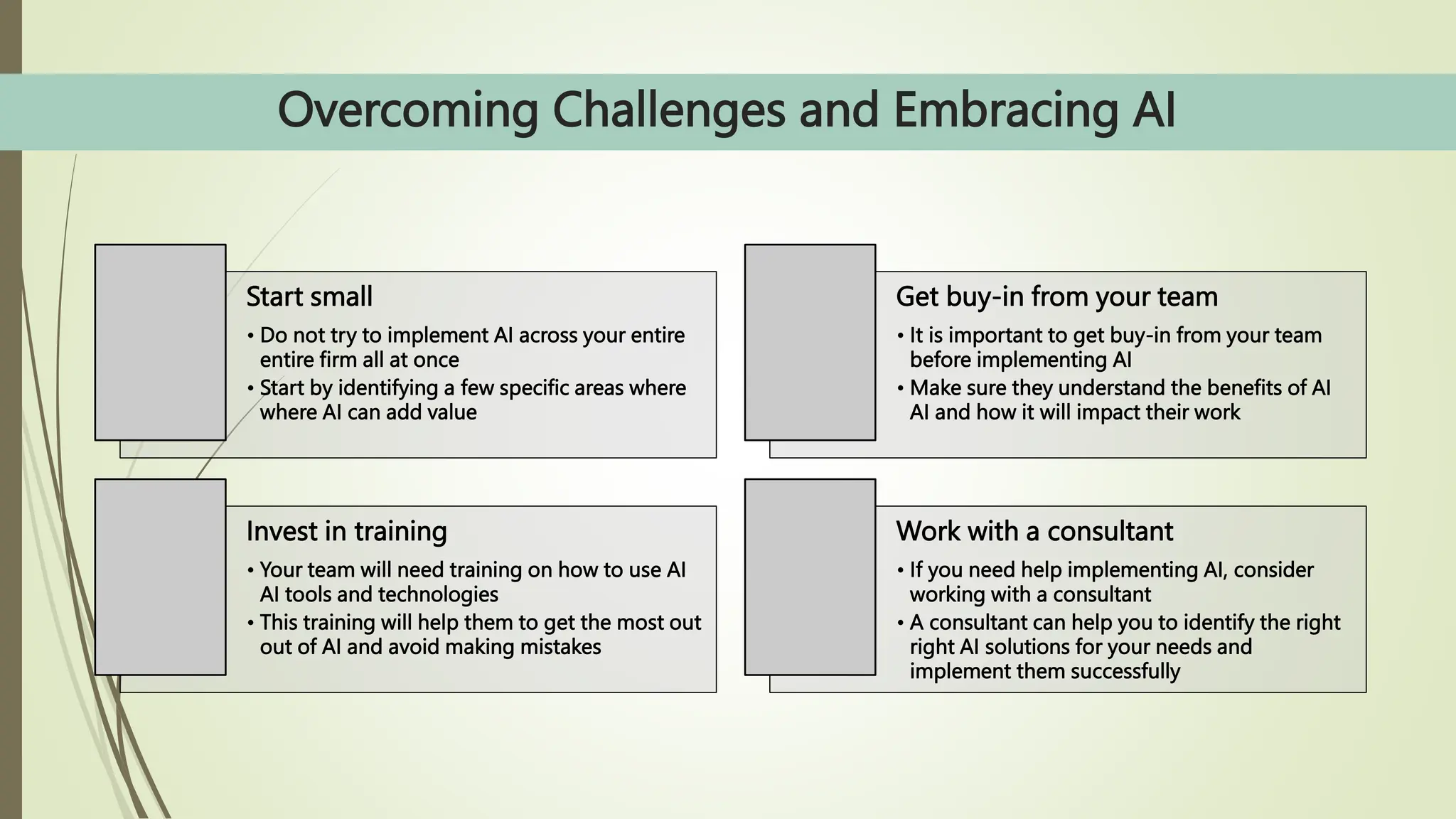
Overcoming Challenges and Embracing AI
Start small
• Do not try to implement AI across your entire
entire firm all at once
• Start by identifying a few specific areas where
where AI can add value
Get buy-in from your team
• It is important to get buy-in from your team
before implementing AI
• Make sure they understand the benefits of AI
AI and how it will impact their work
Invest in training
• Your team will need training on how to use AI
AI tools and technologies
• This training will help them to get the most out
out of AI and avoid making mistakes
Work with a consultant
• If you need help implementing AI, consider
working with a consultant
• A consultant can help you to identify the right
right AI solutions for your needs and
implement them successfully
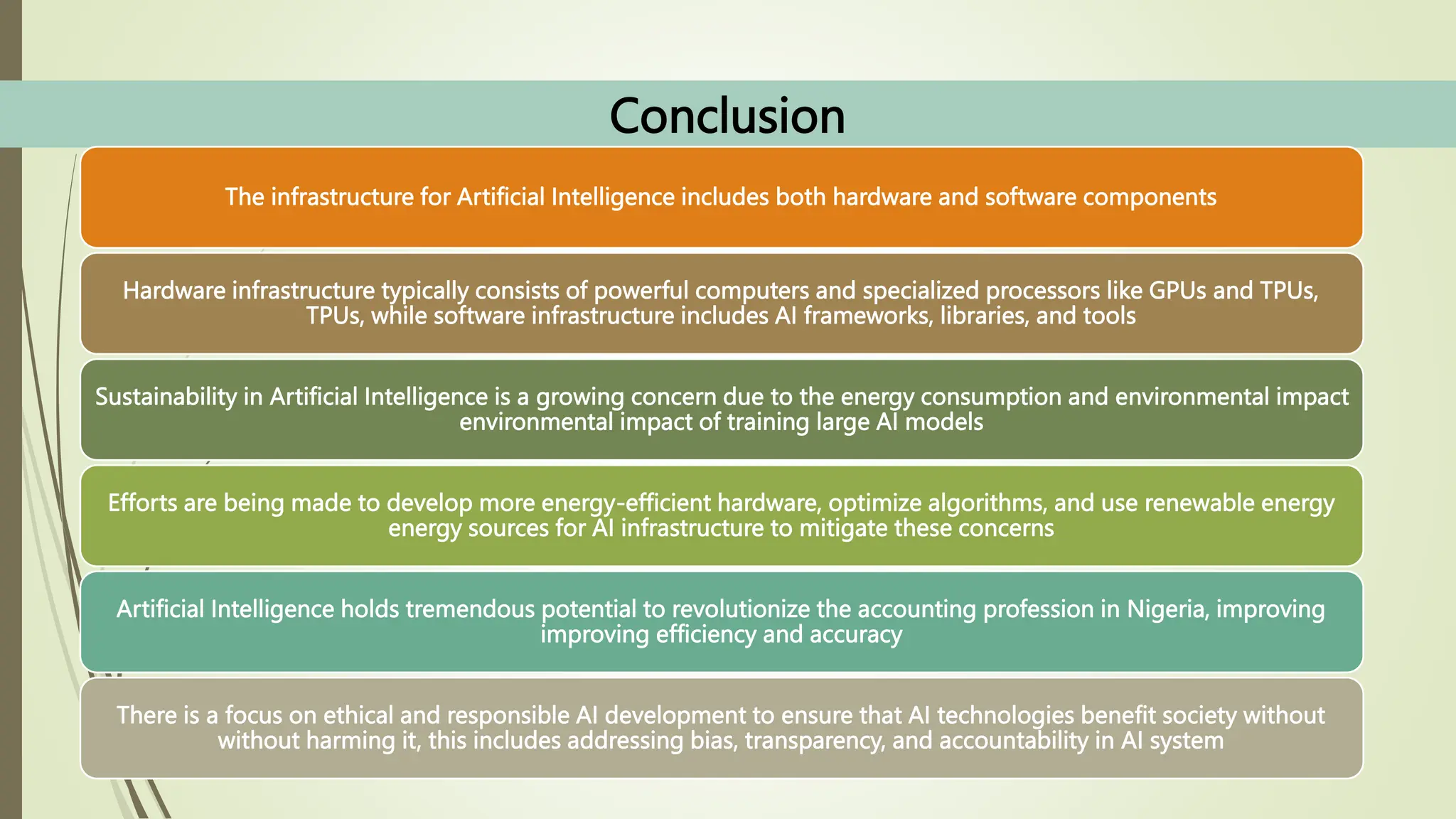
Conclusion
The infrastructure for Artificial Intelligence includes both hardware and software components
Hardware infrastructure typically consists of powerful computers and specialized processors like GPUs and TPUs,
TPUs, while software infrastructure includes AI frameworks, libraries, and tools
Sustainability in Artificial Intelligence is a growing concern due to the energy consumption and environmental impact
environmental impact of training large AI models
Efforts are being made to develop more energy-efficient hardware, optimize algorithms, and use renewable energy
energy sources for AI infrastructure to mitigate these concerns
Artificial Intelligence holds tremendous potential to revolutionize the accounting profession in Nigeria, improving
improving efficiency and accuracy
There is a focus on ethical and responsible AI development to ensure that AI technologies benefit society without
without harming it, this includes addressing bias, transparency, and accountability in AI system
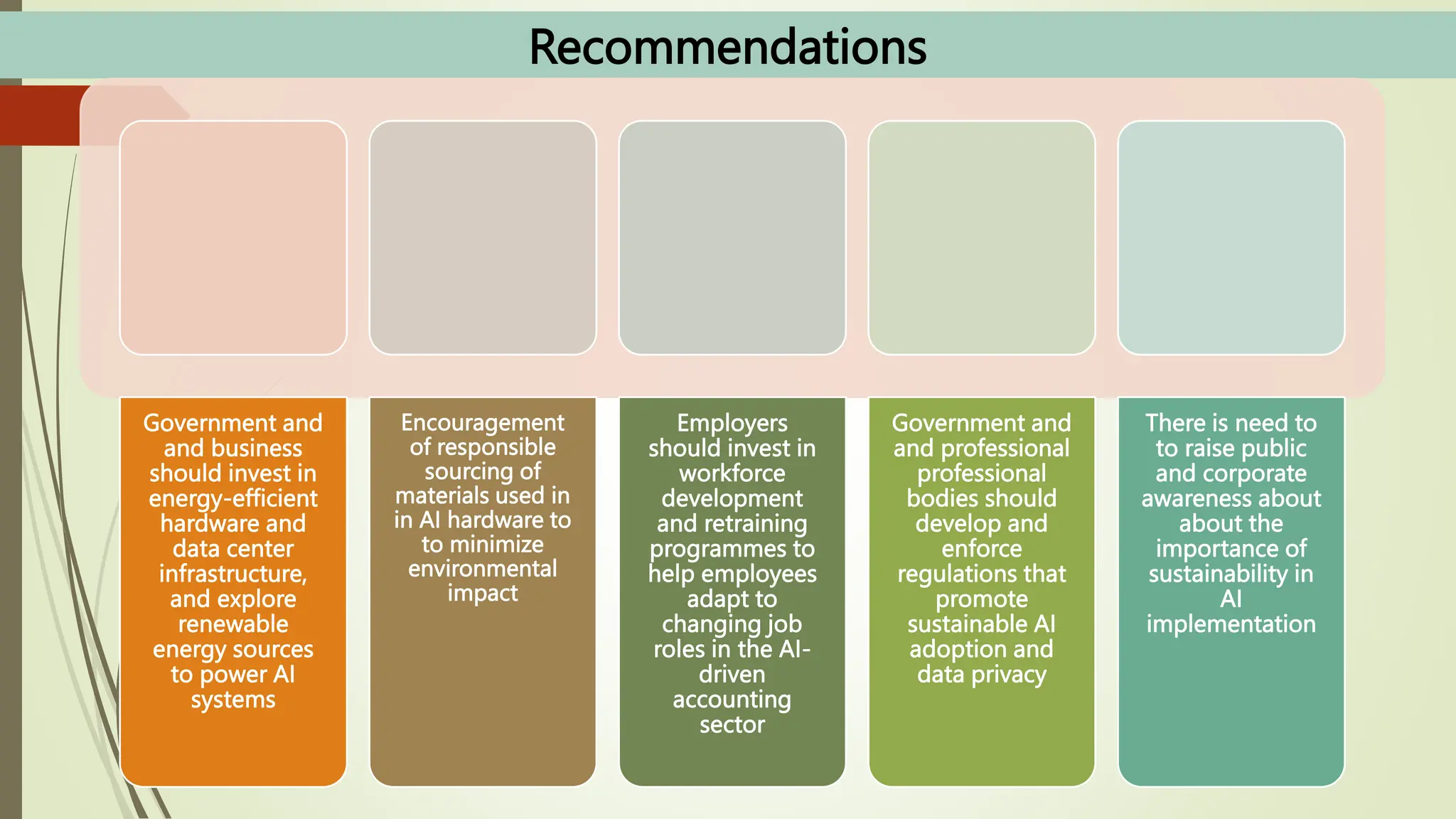
Recommendations
Government and
and business
should invest in
energy-efficient
hardware and
data center
infrastructure,
and explore
renewable
energy sources
to power AI
systems
Encouragement
of responsible
sourcing of
materials used in
in AI hardware to
to minimize
environmental
impact
Employers
should invest in
workforce
development
and retraining
programmes to
help employees
adapt to
changing job
roles in the AI-
driven
accounting
sector
Government and
and professional
professional
bodies should
develop and
enforce
regulations that
promote
sustainable AI
adoption and
data privacy
There is need to
to raise public
and corporate
awareness about
about the
importance of
sustainability in
AI
implementation
Prof. Godwin Emmanuel
Oyedokun
Professor of Accounting and Financial
Development
Lead City University, Ibadan, Nigeria
Principal Partner; Oyedokun Godwin
Emmanuel & Co.
(Chartered Accountants, Tax Practitioners &
Forensic Auditors)

Artificial Intelligence in Accounting Profession: Implementation and Challenges

  • 1.
    Artificial Intelligence inAccounting Profession: Implementation and Challenges Being a Paper Presented at the International Accounting Day Organised by Association of National Accountants of Nigeria (ANAN), Oyo State Branch 1 at The Polytechnic, Ibadan on Friday, November 10, 2023. Prof. Godwin Emmanuel Oyedokun Professor of Accounting and Financial Development Department of Management & Accounting Faculty of Management and Social Sciences Lead City University, Ibadan, Nigeria Principal Partner; Oyedokun Godwin Emmanuel & Co (Chartered Accountants, Tax Practitioners & Forensic Auditors)
  • 2.
    ND (Fin), HND(Acct.), BSc. (Acct. Ed), BSc (Fin.), LLB., LLM, MBA (Acct. & Fin.), MSc. (Acct.), MSc. (Bus &Econs), MSc. (Fin), MSc. (Econs), Ph.D. (Acct), Ph.D. (Fin), Ph.D. (FA), CICA, CFA, CFE, CIPFA, CPFA, CertIFR, ACS, ACIS, ACIArb, ACAMS, ABR, IPA, IFA, MNIM, FCA, FCTI, FCIB, FCNA, FCFIP, FCE, FERP, FFAR, FPD-CR, FSEAN, FNIOAIM, FCCrFA, FCCFI, JP
  • 3.
    Artificial Intelligence in AccountingProfession: Implementation and Challenges
  • 4.
    Contents Introduction Concepts of Artificial Intelligence (AI) Functionsof Artificial Intelligence (AI) Principles of Artificial Intelligence (AI) Guidelines on Artificial Intelligence (AI) Pros and Cons of Artificial Intelligence Concepts, Nature and Branches of Accounting Some Services rendered by Accountants Artificial Intelligence in Accounting AI Accounting Infrastructure in Nigeria Role of AI in the Accounting Profession Implementation of AI in Accounting Challenges of Implementing AI in Accounting Overcoming Challenges and Embracing AI Conclusion and Recommendation s
  • 5.
    Introduction The rapid emergence of artificial intelligence technologyin the wake of the corona virus outbreak has sparked widespread interest The accounting profession is at the same trend undergoing a significant transformation recorded due to advances in technology One of the most disruptive technologies in recent years is Artificial Intelligence (AI) as The traditional accounting method is slowly but steadily being phased out AI has the potential to revolutionize accounting practices in Nigeria, enhancing efficiency, accuracy, and decision-making However, the successful implementation of AI in accounting is contingent on addressing infrastructural and sustainability challenges
  • 6.
    Introduction 3The current adoptionof artificial intelligence (AI) and robotic process automation (RPA) in accounting and finance has resulted in a full overhaul of accounting systems Artificial intelligence (AI) has an impact on numerous sectors of accounting, auditing, and finance, and it has been stated that there have been ground breaking events in the deployment of cutting-edge ways to digitally alter revenue generation Artificial intelligence applications can readily fix issues such as incomplete taxpayer data and multiple taxation, boosting taxpayer confidence in paying their taxes Artificial Intelligence is being implemented in almost every facet of society, including taxation The advantages of using Artificial Intelligence to generate money cannot be overstated, as its implementation will ensure accuracy, reliability, and long-term revenue creation while also positively impacting taxpayer behaviour
  • 7.
    Concepts of ArtificialIntelligence (AI) Artificial Intelligence is the ability of a digital computer or computer-controlled robot to perform tasks commonly associated with intelligent beings such as the ability to reason, discover meaning, generalize, or learn from experience Artificial intelligence (AI) is the simulation of human thinking and learning by computer systems or machines that improves every time new data is introduced AI assistants and platforms can create a huge competitive advantage for firms, and firms of the future have already bought in Artificial intelligence is a revolutionary development that could put forward the accounting profession to execute and make strategic decisions more effectively than it has in the past Machine learning models and AI enhancements applied to data or other AI developments can complement human thinking, be used to mitigate fraud, and human error, and improve the accuracy of accounting functions
  • 8.
    Concepts of ArtificialIntelligence (AI) AI has been a game changer built on algorithms, it improves over time as they are fed with more data The application of artificial intelligence helps to solve the pain points of inefficiency and low added value in the accounting field, making the accountants turn to more creative work and bring greater value to the company Far from replacing all accounting jobs or presenting major threats to the industry, AI has the power to transform accounting for the better New technologies create better businesses, enabling them to enter new markets faster, make significant global contributions, gain insights, and build relationships with existing and potential customers Accounting managers will be freed from the intensive and monotonous work in the domestic accounting practice; the system will help to solve problems that have been missed or not identified by human input
  • 9.
    Functions of ArtificialIntelligence AI programmes can leverage their ability to parse news articles, emails, web links, and legal documents to choose and present the most salient parts to comprehend Artificial intelligence programs do more than perform advanced mathematical calculations, can also read, write, gather, and analyze information to produce written content that can accurately summarize data AI’s ability to deploy machine vision allows it to make informed decisions that can have a positive impact on quality control and other supply chain elements that are important to business efficiency AI-based programs built to pick up and interpret sounds helps busy professionals automate meeting minutes Speech-based AI makes it possible for businesses to schedule key appointments and complete phone-based tasks without the need to allocate an employee’s time to do so
  • 10.
    Distinction of AI NarrowAI • An AI application that is designed to deal with one task and reflects most currently existing applications of AI in daily life General or Broad AI • Reflects human intelligence in its versatility to handle different or general tasks
  • 12.
    Principles of ArtificialIntelligence (AI) Transparency Justice and fairness Non-maleficence Responsibility Privacy Reliability Safety
  • 13.
    Build-Ups of ArtificialIntelligence Fostering collaboratio n across functions Structuring and formalizing AI managemen t through a framework Focusing on AI as a strategic asset Defining how and who makes decisions. Developing supporting artifacts (policy, standards, and procedures) Monitoring compliance
  • 14.
    Guidelines on ArtificialIntelligence (AI) • It is a primary concern when it comes to AI governance, as AI systems can be used in ways that create safety risks • This includes ensuring that AI systems are built with robust security measures, such as access control and intrusion detection, and that they are tested and monitored for potential safety issues Safety • Given the sensitive and confidential nature of data, it is important to ensure that AI systems are secure • This requires implementing rigorous security measures, such as authentication, encryption, and auditing, to protect data from unauthorized access and to ensure that data remains secure Security • AI is often used for decision-making and predictive analytics, which can create ethical concerns that must be addressed • This includes ensuring that the decision-making process is transparent and that it is based on valid data and ethical principles Ethics
  • 15.
    Artificial Intelligence andEthics At relatively early stage in AI’s development and implementation, the issue has arisen of AI adhering to certain ethical principles, and the ability to exist laws to govern AI has emerged as key to how future AI will be developed, deployed, and implemented While originally confined to theoretical, technical, and academic debates, the issue of governing AI has recently entered the mainstream with both governments and private companies from major geopolitical powers including the US, China, European Union, and India formulating statements and policies regarding AI and ethics These arise around the enforceability of ethics statements regarding AI, both in terms of whether they reflect existing fundamental legal principles and are legally enforceable in specific jurisdictions and the extent to which the principles can be operationalised and integrated into AI systems and application in practice AI ethics serves for the self-reflection of computer and engineering sciences, which are engaged in the research and development of AI or machine learning In this context, dynamics such as individual technology development projects, or the development of new technologies as a whole, can be analysed, likewise, causal mechanisms and functions of certain technologies can be investigated using a more static analysis Another dimension of AI ethics concerns the degree of its normativity where ethics can oscillate between irritation and orientation; Irritation equals weak normativity
  • 16.
    Artificial Intelligence andEthics Fundamental Ethics • This is concerned with abstract moral principles Applied Ethics • This includes ethics of technology, which contains in turn AI ethics as a subcategory
  • 17.
    Key Demands ofAI Ethics The reflection of research goals and purposes The direction of research funding The linkage between science and politics The security of AI systems The responsibility links underlying the development and use of AI technologies The inscription of values in technical artifacts The orientation of the technology sector towards the common good
  • 18.
    Evolution of ArtificialIntelligence (AI) Artificial Intelligence has been around for centuries, with early examples including the Mechanical Turk and Ada Lovelace until the 1950s when AI began to take off with the advent of digital computers and new algorithms In 1956, a team of researchers at Dartmouth College organized a conference on AI, which is often considered to be the birth of the field Interest in AI continued to grow throughout the 1960s and 1970s, with major advances in natural language processing and expert systems AI experienced a renaissance in the 1990s due to improved computer hardware and software and increased interest from the business community AI has made rapid progress since 1990s and is now used in many fields such as healthcare, finance, transportation, and manufacturing
  • 19.
    Pros and Consof Artificial Intelligence Cost savings Improved decision-making Increased efficiency Job loss Ethical concerns Security risks Pros Cons
  • 20.
    Concepts of Accounting Thedouble-entry bookkeeping was first introduced, an accountant would enter a debit and credit value for each transaction, which is known as double-entry accounting The accounting method is utilised as an ad-hoc ordering mechanism by merchants at the time A steady stream of data about their enterprises was made available to them, allowing them to make informed decisions about how to expand their operations The accounting profession started to take on a completely different appearance around the turn of the 21st century The start of the usage of computers and accounting applications has fundamentally transformed the sector
  • 21.
    Concepts of Accounting Withthe advent of tools such as Microsoft Excel, an accountant could suddenly work with a digital spreadsheet Using technology, an accountant currently can-do quantitative accounting or predictive research more efficiently Accounting technology has removed the need for a number cruncher to sit behind a desk and work on other people's taxes, allowing accountants to take on new tasks that are much more interesting than the ones they faced decades before when they depended on an abacus as a calculating device
  • 22.
    Nature of Accounting •Accounting is a process which involves gathering, compacting, interpreting and disseminating economic information in a systematic way Accounting as a process • Its basic goal is to report on the resources and obligation of the entity to the owners Stewardship function • Since accounting is a process that aims at communicating economic information, it must rely on a set of previously agreed concepts, conventions and rules Concepts and conventions • The ultimate end of accounting is to provide external information-communication system by gathering, compacting, interpreting and disseminating economic data which gives a financial representation of the relative economic rights and interests of the economy segments, in order to facilitate judgement formulation and action taking by its users Accounting as a means to an end • Accounting is essentially and fundamentally utilitarian in nature, therefore, its methodologies are primarily based on expediency and upon actual day to day needs of the business community Accounting as an art
  • 23.
    Branches of Accounting Financial Accounting Management Accounting CostAccounting Project Accounting International Accounting Government Accounting Social Accounting Forensic Accounting Accounting Information Systems Corporate Accounting Human Resource Accounting Financial Reporting Auditing
  • 24.
    Some Services renderedby Accountants Compilation (Bookkeeping) Services External Auditing Services Internal Auditing Services Forensic Services Taxation Services Valuation Services Human Resources Services Financial Advisory Services Bankruptcy and Insolvency Services
  • 25.
    Artificial Intelligence inAccounting The purpose of accounting is to provide information in the most appropriate and adapted form to the appropriate users for making economic internal or external decisions All applicable fields in the modern world have adopted and adapted to the use of information and communication technologies The accounting profession is a broad sector that includes auditing, taxation, management, forensic science, corporate reporting, and many areas of accounting that are not left out in this evolutionary transformation AI in accounting is primarily about data and automation supported by technology in bookkeeping, finance, and accounting AI-fueled technologies and applications like Machine Learning (ML) are used to drive new and improved practices around data analytics for accounting The result of new technology in accounting and bookkeeping has been that accountants performed higher- skilled work than before, and this will continue to be true with AI and automation
  • 27.
    AI Accounting Infrastructurein Nigeria Cloud Computing Cloud computing plays a fundamental role in AI accounting infrastructure Many businesses in Nigeria leverage cloud-based accounting software and services, which often integrate AI features for tasks such as data analysis, forecasting, and automation AI-Powered Accounting Software Some Nigerian businesses have started adopting AI-powered accounting software and platforms that utilize machine learning algorithms for tasks like expense categorization, invoice processing, and fraud detection Data Connectivity Reliable internet connectivity and data access are essential for AI accounting solutions. Improved internet infrastructure, including 4G and fiber-optic networks, has been gradually expanding in Nigeria Data Security As financial data is sensitive, data security is a paramount concern Nigerian businesses implementing AI in accounting invest in cyber-security infrastructure and practices to protect financial information
  • 28.
    AI Accounting Infrastructurein Nigeria • Data centres are crucial for hosting and processing the vast amounts of data required for AI in accounting • Some Nigerian companies have established or outsourced data centers to support their AI initiatives Data Centres • Developing the necessary human resources for AI accounting is a priority • Nigeria has universities and institutions that offer training in AI- related fields, and professionals are gradually gaining AI expertise Skilled Workforce • The Nigerian government has been working on regulations related to data privacy, cyber-security, and financial reporting • These regulations influence the AI accounting infrastructure and its compliance requirements Regulatory Environment
  • 29.
    AI Accounting Infrastructurein Nigeria Startups and Fintech Companies • Nigerian startups and fintech companies have been at the forefront of developing AI-based accounting solutions • They are contributing to the growth of AI infrastructure in the country Collaboration • Collaboration between government agencies, private sector entities, and international organizations is essential to foster the development of AI accounting infrastructure in Nigeria Challenges • Despite progress, challenges such as unreliable power supply, data quality issues, and a lack of comprehensive AI education and awareness still exist • These challenges can affect the robustness of AI accounting infrastructure
  • 30.
    Role of AIin the Accounting Profession • AI Apps and ML apps are impacting accounting & finance professionals by automating routine tasks that would previously require human assistance, or intervention with complex data sets like financial statements Machines mimic human operations • AI can automate end-to-end accounting procedures and ensure operational efficiency while reducing costs for financial companies, who adopt this technology development to gain its benefits AI solutions automate accounting tasks • Automating billing functions helps reduce costs while ensuring accuracy, something we can’t live without if our business depends on making money off its invoices AI automates billing and invoice functions • Artificial Intelligence in accounting and finance will soon replace humans for routine tasks such as screening suppliers and setting up query portals to get the data you need on your business’s behalf AI helps screen suppliers
  • 31.
    Role of AIin Accounting Profession AI virtual assistants support your Finance and Accounting processes AI manages management of expenses AI improves your financial processes AI improves internal auditing AI processes unstructured data AI helps screen suppliers AI automates billing and invoice functions AI solutions automate accounting tasks
  • 32.
    Artificial Intelligence AccountingSoftware Quickbooks QuickBooks uses AI to automate a lot of back-office tasks, including cash flow forecasting, smart match reconciliations, and payroll Oracle Oracle is a cloud-based platform already, and AI is joined by machine learning (ML) for elite enterprise resources and financial planning FreshBooks FreshBooks is a cloud-based system that uses AI for accounts payable automation and a variety of automation around other business processes Zoho Books Zoho Books is also a tech-first tool that covers the gamut of banking, inventory management, invoice management, billing, and more ChatGPT In late 2022, a new AI tool, called ChatGPT, exploded into the marketplace. ChatGPT (Generative Pre-trained Transformer) is the latest AI innovation that has the whole world talking and for good reason
  • 33.
    AI accounting softwareand Human Interaction As incredible as artificial intelligence may seem, AI-powered accounting software cannot perform without human interaction Accountants will need to teach it how to properly categorize expenses and match receipts to credit card transactions from a digital feed before the software will be able to automate the process Over time, AI learns how to manage these tasks, saving accountants valuable time and minimizing costly errors
  • 34.
    Benefits of AIin Accounting Software Reduces monotonous responsibilities Catches errors you may miss Saves time
  • 35.
    Advantages of AIto Professional Accountants Improved Accuracy in Financial Reporting Efficient Data Entry and Analysis Enhance Predictive Analytics Cost-effective solution Fulfils Compliance Requirements
  • 36.
    Disadvantages of AIto Professional Accountants Dependence on AI technology Increased Cyber Security Risks High Initial Investment Difficulty in Understanding AI Technology
  • 37.
    Implementation of AIin Accounting • AI can be used to automatically extract data from invoices, receipts, and other financial documents • This can save accountants a significant amount of time and effort Automated data extraction and entry • AI can be used to identify anomalies and patterns in financial data that may indicate fraud • This can help to prevent fraud from occurring in the first place Fraud detection • AI can be used to ensure that businesses are complying with all applicable tax laws and regulations • This can help businesses to avoid penalties and fines Tax compliance • AI can be used to generate financial reports that are accurate, timely, and compliant with accounting standards Financial reporting • AI can be used to automate many aspects of the audit process, such as risk assessment, data analysis, and sample selection • This can help to improve the efficiency and effectiveness of audits Audit and assurance
  • 38.
    Challenges of ImplementingAI in Accounting • AI solutions can be expensive to implement and maintain • This may make them unaffordable for some accounting firms Cost • The accuracy and completeness of the data that is used to train AI models is critical to their success • If the data is poor quality, the AI models will not be able to perform their tasks effectively Data quality • AI cannot replace the human expertise of accountants • There are still many tasks that require human judgement and interpretation Human expertise • The accounting profession is highly regulated • AI solutions must comply with all applicable accounting standards and regulations Regulation
  • 39.
    Overcoming Challenges andEmbracing AI Start small • Do not try to implement AI across your entire entire firm all at once • Start by identifying a few specific areas where where AI can add value Get buy-in from your team • It is important to get buy-in from your team before implementing AI • Make sure they understand the benefits of AI AI and how it will impact their work Invest in training • Your team will need training on how to use AI AI tools and technologies • This training will help them to get the most out out of AI and avoid making mistakes Work with a consultant • If you need help implementing AI, consider working with a consultant • A consultant can help you to identify the right right AI solutions for your needs and implement them successfully
  • 41.
    Conclusion The infrastructure forArtificial Intelligence includes both hardware and software components Hardware infrastructure typically consists of powerful computers and specialized processors like GPUs and TPUs, TPUs, while software infrastructure includes AI frameworks, libraries, and tools Sustainability in Artificial Intelligence is a growing concern due to the energy consumption and environmental impact environmental impact of training large AI models Efforts are being made to develop more energy-efficient hardware, optimize algorithms, and use renewable energy energy sources for AI infrastructure to mitigate these concerns Artificial Intelligence holds tremendous potential to revolutionize the accounting profession in Nigeria, improving improving efficiency and accuracy There is a focus on ethical and responsible AI development to ensure that AI technologies benefit society without without harming it, this includes addressing bias, transparency, and accountability in AI system
  • 42.
    Recommendations Government and and business shouldinvest in energy-efficient hardware and data center infrastructure, and explore renewable energy sources to power AI systems Encouragement of responsible sourcing of materials used in in AI hardware to to minimize environmental impact Employers should invest in workforce development and retraining programmes to help employees adapt to changing job roles in the AI- driven accounting sector Government and and professional professional bodies should develop and enforce regulations that promote sustainable AI adoption and data privacy There is need to to raise public and corporate awareness about about the importance of sustainability in AI implementation
  • 43.
    Prof. Godwin Emmanuel Oyedokun Professorof Accounting and Financial Development Lead City University, Ibadan, Nigeria Principal Partner; Oyedokun Godwin Emmanuel & Co. (Chartered Accountants, Tax Practitioners & Forensic Auditors)