Coal Scam India
(coal gate).
Name:-
Course&Sem:-
Roll No:-
WHAT IS THE BASIC ISSUE?
• Coal allocation scam is a political scandal
concerning the Indian government's allocation
of the nation's coal deposits to Public Sector
Entities (PSEs) and private companies.
• In a draft report issued in March 2012, the
Comptroller and Auditor General of India
(CAG) office accused the Government of India
of allocating coal blocks in an inefficient
manner during the period 2004-2009.
FIRMS ELIGIBLE FOR A COAL
ALLOCATION
characterized as broadly socialist, with
government directing large sectors of
• Historically, the economy of India could be
the
the
economy through a series of Five-year Plans.
• In keeping with this centralized approach,
between 1972 and 1976, India nationalized its
coal mining industry, with the state-owned
companies Coal India limited(CIL) and
Singareni Collieries Company (SSCL) being
responsible for coal production.
This process culminated in the enactment of the Coal
Mines (Nationalisation) Amendment Act, 1976, which
terminated coal mining leases with private lease holders.
Even as it did so, however, Parliament recognized that the
nationalized coal companies were unable to fully meet
demand, and provided for exceptions, allowing certain
companies to hold coal leases:
 1976. Captive mines owned by iron and
steel companies.
 1993. Captive mines owned by power
generation companies.
 2007:Captive mining for Coal gasification and liquid
faction.
THE COALALLOCATION
PROCESS
• In July 1992, Ministry of Coal, issued the instructions for constitution of a
Screening Committee for screening proposals received for captive mining by
private power generation companies.
• The Committee was composed of government officials from the Ministry of
Coal, the Ministry of Railways, and the relevant state government.
• A number of coal blocks, which were not in the production plan of CIL and
SSCL, were identified in consultation with CIL/SSCL and a list of 143 coal
blocks were prepared and placed on the website of the MoC for information of
public at large.
• Companies could apply for an allocation from among these blocks. If they were
successful, they would receive the geological report that had been prepared by
the government, and the only payment required from the allocatee was to
reimburse the government for their expenses in preparing the geological report.
COAL ALLOCATION GUIDELINES
The guidelines for the Screening Committee suggest that preference be given to the Power
and Steel Sectors (and to large projects within those sectors).
They further suggest that in the case of competing applicants for a captive block, a further
10 guidelines may be taken into consideration:
status (stage) level of progress and state of preparedness of the projects;
net worth of the applicant company (or in the case of a new SP/JV, the net worth of their
principals);
production capacity as proposed in the application;
maximum recoverable reserve as proposed in the application;
date of commissioning of captive mine as proposed in the application;
date of completion of detailed exploration (in respect of unexplored blocks only) as
proposed in the application;
technical experience (in terms of existing capacities in coal/lignite mining and specified
end-use);
recommendation of the administrative ministry concerned;
recommendation of the state government concerned (i.e., where the captive block is
located);
track record and financial strength of the company.
RESULTS OF COAL
ALLOCATION PROGRAM
Given the inherent subjectivity in some of the allocation guidelines, as well as the
potential conflicts between guidelines it is unsurprising that in reviewing the
allocation process from 1993 to 2005 the CAG says that "there was no clearly
spelt out criteria for the allocation of coalmines.”
• 2005: the Expert Committee on Coal Sector Reforms provided recommendations on
improving the allocation process,
• 2010: the Mines and Minerals (Development and Regulation) Act, 1957 Amendment
Bill was enacted, providing for coal blocks to be sold through a system of
competitive bidding.
The foregoing supports the following conclusions:
• The allocation process prior to 2010 allowed some firms to obtain valuable coal
blocks at a nominal expense
• The eligible firms took up this option and obtained control of vast amounts of coal
in the period 2005-09
• The criteria employed for awarding coal allocations were opaque and in some
respects subjective.
MARCH 2012: COALGATE
EXPLODES- THE DRAFT REPORT
OVERVIEW
The CAG report is a performance audit focusing on the allocation of coal blocks
and the performance of Coal India in the 2005-09 period. The Draft Report,
stretching to 110 pages—far more detailed and containing more explosive
allegations than the toned-down Final Report of some 50 pages—was the document
that sparked the Coalgate furore. The Draft Report covers the followingtopics:
• Overview (pp. 1–2)
• Audit Framework (pp. 3–4)
• Institutional Framework (p. 5-10)
• Gaps in Supply and Demand (p. 11-17)
• Coal Blocks-Allocation and Production Performance (p. 18-55)
• Production Performance of CIL (p.56-83)
• Conclusion and Recommendations (pp. 84–88)
• Annexure (pp. 89–110)
FIRST CAG CHARGE
• The most important assertion of the CAG
Draft Report : Government had the legal
authority to auction the coal, but chose not
to do so.
• Any losses as a result of coal allocations, then,
between 2005 and 2009 are seen by the CAG
as being the responsibility of the Government.
SECOND CAG CHARGE
• If the most important charge made by the CAG
was that of the Government's legal authority to
auction the coal blocks, the one that drew the
most attention was certainly the size of the
"windfall gain" accruing to the allocatees. On
pp. 32–34 of the Draft Report, the CAG
estimates these to be 1,067,303 Crore.
MARCH-AUGUST 2012: COALGATE GROWS-
THE MEDIA, BJP & THE CBI INVESTIGATION
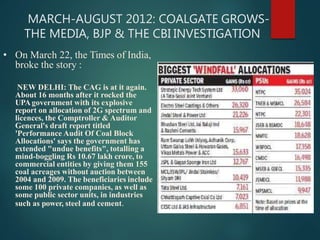
• On March 22, the Times of India,
broke the story :
NEW DELHI: The CAG is at it again.
About 16 months after it rocked the
UPAgovernment with its explosive
report on allocation of 2G spectrum and
licences, the Comptroller & Auditor
General's draft report titled
'Performance Audit Of Coal Block
Allocations' says the government has
extended "undue benefits", totalling a
mind-boggling Rs 10.67 lakh crore, to
commercial entities by giving them 155
coal acreages without auction between
2004 and 2009. The beneficiaries include
some 100 private companies, as well as
some public sector units, in industries
such as power, steel and cement.
ALLEGATIONS MADE AGAINST:
• S. JAGATHRAKSHAKAN: In September 2012, several news
reports alleged that family of S Jagathrakshakan, Minister of State
for Information and Broadcasting in the UPA government is a part of
a company named JR Power Gen Pvt Ltd. which was awarded a coal
block in Orissa in 2007.
• It was the same company which formed a joint venture with a public
sector company, Puducherry Industrial Promotion Development and
Investment Corporation (PIPDIC), on January 17, 2007. Barely five
days after, PIPDIC was allotted a coal block.
• According to the MoU, JR Power enjoyed a stake in this allotment.
However, JR Power had no expertise in thermal power, iron and
steel, or cement, the key sectors for consumption of coal. Later, in
2010, JR Power sold 51% stake to KSK Energy Ventures, an
established player with interests in the energy sector.
In this way, the rights for the use of the coal block ultimately passed
on to KSK
• AJAY SANCHETI: Ajay Sancheti's SMS
Infrastructure Ltd. was allegedly allocated coal
blocks in Chhattisgarh at low rates. He is a BJP
Rajya Sabha MP and is believed to be in close
relation with Nitin Gadkari.
• According to the CAG, the allocation of the
coal block to SMS Infrastructure Ltd. has
caused a loss of Rs. 1000 crore.
PREMCHAND GUPTA: UPA partner Rashtriya Janata Dal’s leader
Premchand Gupta's sons' company, new in the steel business
applied for a coal block when Premchand Gupta was the Union
minister for corporate affairs and bagged it about a month after his
tenure ended along with that of his government.
• The company in question is IST Steel & Power - an associate
company of the IST Group, which is owned and run by Premchand
Gupta’s two sons Mayur and Gaurav. IST Steel, along with cement
majors Gujarat Ambuja and Lafarge, was allocated the
Dahegaon/Makardhokra IV block in Maharashtra.
• The company, which applied for a block on January 12, 2007, and
was awarded it on June 17, 2009, is sitting on reserves of 70.74
million tonnes. The reserves it controls are more than the combined
reserves held by much larger companies - Gujarat Ambuja and
Lafarge.
• Mr Gupta maintains he had no involvement in IST Steel and denies
influencing the coal-block allocation process.
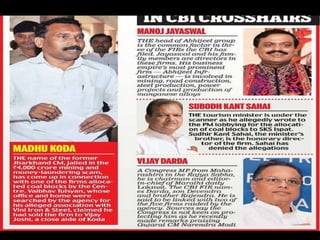
NAVEEN JINDAL: Jindal Steel and Power got a coal field in February
2009 with reserves of 1500 million metric tones while the government-run
Navratna Coal India Ltd. was refused.
• On February 27, 2009, two private companies got huge coal blocks. Both
the blocks were in Orissa and while one was over 300 mega metric tones,
the other was over 1500 mega metric tones. Combined worth of these
blocks was well over Rs 2 lakh crore and these blocks were meant for the
liquefaction of coal.
• One of these blocks was awarded to Jindal. Naveen Jindal's Jindal Steel
and Power was the company which was allotted the Talcher coal field in
Angul in Orissa in 2009, well after the self-imposed cut off date by the
Centre on allocation of coal blocks.
• The Opposition alleged that the Government violated all norms to give him
coal fields. Naveen Jindal, however, denied any wrongdoing.
• On 15 September 2012, an Inter Ministerial Group (IMG) headed by Zohra
Chatterji (Additional Secretary in Coal Ministry) recommended
cancellation of a block allotted to JSW (Jindal Steel Works), a Jindal Group
company.
• Naveen Jindal's company has filed an FIR against Zee
Business channel for allegedly demanding Rs 50 crore
for not doing a news story on coal scam.
• As per the FIR, the HR head of the Jindal company has
alleged that Sudhir Chaudhry and Sameer Ahluwalia
met officials of the Jindal Group and told them that
they had stories against them which could be dropped if
a certain amount of money was paid.
• The official alleged that when the company refused to
pay, the channel ran a series of malicious news items
targeting the Jindals.
BJP RESPONSE
• In response to the Times of India story there
was an uproar in Parliament, with the BJP
charging the government with corruption and
demanding a court- monitored probe into coal
allocations:
• The BJP governments
themselves were embroiled in this, since the
states ruled by BJP had also opposed public
auctions of the mines
CBI INVESTIGATION
• On 31 May 2012, Central Vigilance
Commission(CVC) based on a complaint
of two BJP Member of Parliament
Prakash Javadekar and Hansari Ahir
directed a CBI enquiry.
• There were leaks of the report in media in
March 2012 which claimed the figure to
be around 1,060,000 crore. It is called by
the media as the Mother of all Scams.
• Discussion about the issue was placed in
the Parliament on 26th Aug, 2012 by the
Prime Minister Manmohan Singh with
wide protests from the opposition.
• According to the Comptroller and Auditor
General of India, this is a leak of the initial
draft and the details being brought out
were observations which are under
discussion at a very preliminary stage.
• On 29 May 2012, Prime Minister
Manmohan Singh offered to give up his
public life if found guilty in this scam.
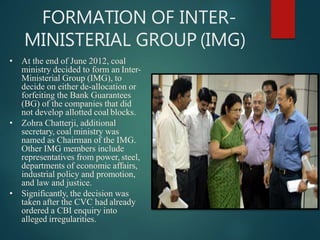
FORMATION OF INTER-
MINISTERIAL GROUP (IMG)
• At the end of June 2012, coal
ministry decided to form an Inter-
Ministerial Group (IMG), to
decide on either de-allocation or
forfeiting the Bank Guarantees
(BG) of the companies that did
not develop allotted coal blocks.
• Zohra Chatterji, additional
secretary, coal ministry was
named as Chairman of the IMG.
Other IMG members include
representatives from power, steel,
departments of economic affairs,
industrial policy and promotion,
and law and justice.
• Significantly, the decision was
taken after the CVC had already
ordered a CBI enquiry into
alleged irregularities.
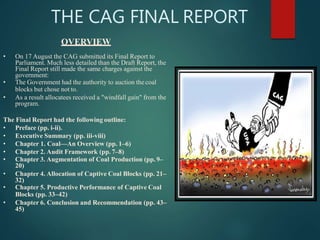
THE CAG FINAL REPORT
OVERVIEW
• On 17 August the CAG submitted its Final Report to
Parliament. Much less detailed than the Draft Report, the
Final Report still made the same charges against the
government:
• The Government had the authority to auction thecoal
blocks but chose not to.
• As a result allocatees received a "windfall gain" from the
program.
The Final Report had the following outline:
• Preface (pp. i-ii).
• Executive Summary (pp. iii-viii)
• Chapter 1. Coal—An Overview (pp. 1–6)
• Chapter 2. Audit Framework (pp. 7–8)
• Chapter 3. Augmentation of Coal Production (pp.9–
20)
• Chapter 4. Allocation of Captive Coal Blocks (pp. 21–
32)
• Chapter 5. Productive Performance of Captive Coal
Blocks (pp. 33–42)
• Chapter 6. Conclusion and Recommendation (pp. 43–
45)
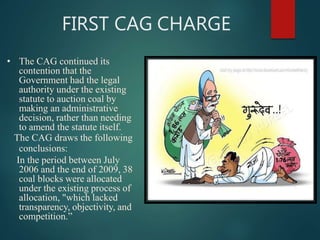
FIRST CAG CHARGE
• The CAG continued its
contention that the
Government had the legal
authority under the existing
statute to auction coal by
making an administrative
decision, rather than needing
to amend the statute itself.
The CAG draws the following
conclusions:
In the period between July
2006 and the end of 2009, 38
coal blocks were allocated
under the existing process of
allocation, "which lacked
transparency, objectivity, and
competition.”
SECOND CAG CHARGE
• The biggest change from the Draft Report was the dramatic
reduction in the windfall gains from 1,067,303 Crore to
185,591 Crore.
in the Draft
This change is due to:
• windfall gain/ton decreased 8% from 322
Report to 295 in the Final Report
• number of tons decreased 81% from 33.169 to 6.283 billion
metric tons of coal. This is because the Final Report
considers "extractable coal" (i.e. coal that could actually be
used in production) as against the Draft Report, which
considered coal in situ (i.e. coal in the ground without
taking into account losses that occur during mining and
washing the coal).
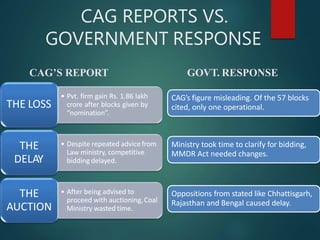
CAG REPORTS VS.
GOVERNMENT RESPONSE
• Pvt. firm gain Rs. 1.86 lakh
crore after blocks given by
“nomination”.
THE LOSS
• Despite repeated advicefrom
Law ministry, competitive
bidding delayed.
THE
DELAY
• After being advised to
proceed with auctioning,Coal
Ministry wasted time.
THE
AUCTION
CAG’s figure misleading. Of the 57 blocks
cited, only one operational.
Ministry took time to clarify for bidding,
MMDR Act needed changes.
Oppositions from stated like Chhattisgarh,
Rajasthan and Bengal caused delay.
CAG’S REPORT GOVT. RESPONSE
SEPTEMBER 2012: COALGATE REACHES
SUPREME COURT OF INDIA
• Advocate M L Sharma filed a Public Interest Litigation(PIL) in the
Supreme Court seeking to cancel the allotment of 194 coal blocks on
grounds of arbitrariness, illegality, unconstitutionality and public
interest.
• Defending the CAG, a Supreme Court bench of Justices R M Lodha
and A R Dave dismissed the Solicitor General Rohinton Nariman’s
objections that petition relies heavily on the CAG report by saying,
the CAG is a "constitutional authority" and that its report is "not a
piece of trash.”
• Moreover, the court ordered the government to inform it of reasons for
not following the 2004 policy of "competitive bidding" for coal block
allocation. The apex court wanted to know not only the steps that have
been taken but also proposed against companies that have breached
the agreement.
MONSOON
SESSION BEGINS
• The Parliament session, scheduled from August
8,2012 to September 7,2012, was expected to meet
for 20 sittings with the agenda listing 29 pending
bills for consideration.
• The government had planned to introduce 15 new
bills.
• Initially proceedings were disrupted over the
violence in Assam and concern over exodus of
Northeast students, the latter half has been washed
off with BJP's adamant stand demanding PM
Manmohan Singh's resignation over Coalgate.
• So far, during the budget and monsoon sessions,
Parliament has passed 16 bills in 2012
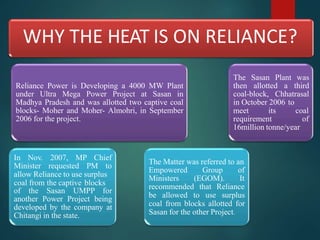
WHY THE HEAT IS ON RELIANCE?
Reliance Power is Developing a 4000 MW Plant
under Ultra Mega Power Project at Sasan in
Madhya Pradesh and was allotted two captive coal
blocks- Moher and Moher- Almohri, in September
2006 for the project.
In Nov. 2007, MP Chief
Minister requested PM to
allow Reliance to use surplus
coal from the captive blocks
of the Sasan UMPP for
another Power Project being
developed by the company at
Chitangi in the state.
The Matter was referred to an
Empowered Group of
Ministers (EGOM). It
recommended that Reliance
be allowed to use surplus
coal from blocks allotted for
Sasan for the other Project.
The Sasan Plant was
then allotted a third
coal-block, Chhatrasal
in October 2006 to
meet its coal
requirement of
16million tonne/year
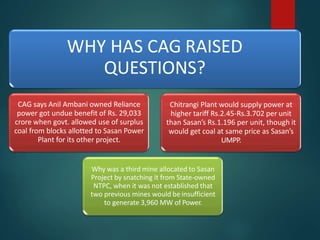
WHY HAS CAG RAISED
QUESTIONS?
CAG says Anil Ambani owned Reliance
power got undue benefit of Rs. 29,033
crore when govt. allowed use of surplus
coal from blocks allotted to Sasan Power
Plant for its other project.
Why was a third mine allocated to Sasan
Project by snatching it from State-owned
NTPC, when it was not established that
two previous mines would be insufficient
to generate 3,960 MW of Power.
Chitrangi Plant would supply power at
higher tariff Rs.2.45-Rs.3.702 per unit
than Sasan’s Rs.1.196 per unit, though it
would get coal at same price as Sasan’s
UMPP.
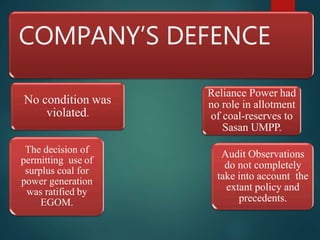
COMPANY’S DEFENCE
No condition was
violated.
The decision of
permitting use of
surplus coal for
power generation
was ratified by
EGOM.
Audit Observations
do not completely
take into account the
extant policy and
precedents.
Reliance Power had
no role in allotment
of coal-reserves to
Sasan UMPP.
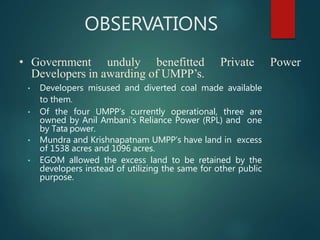
OBSERVATIONS
• Developers misused and diverted coal made available
to them.
• Of the four UMPP’s currently operational, three are
owned by Anil Ambani’s Reliance Power (RPL) and one
by Tata power.
• Mundra and Krishnapatnam UMPP’s have land in excess
of 1538 acres and 1096 acres.
• EGOM allowed the excess land to be retained by the
developers instead of utilizing the same for other public
purpose.
Power• Government unduly benefitted Private
Developers in awarding of UMPP’s.

Coal Scam India(Coal Gate) ppt.

  • 1.
    Coal Scam India (coalgate). Name:- Course&Sem:- Roll No:-
  • 2.
    WHAT IS THEBASIC ISSUE? • Coal allocation scam is a political scandal concerning the Indian government's allocation of the nation's coal deposits to Public Sector Entities (PSEs) and private companies. • In a draft report issued in March 2012, the Comptroller and Auditor General of India (CAG) office accused the Government of India of allocating coal blocks in an inefficient manner during the period 2004-2009.
  • 4.
    FIRMS ELIGIBLE FORA COAL ALLOCATION characterized as broadly socialist, with government directing large sectors of • Historically, the economy of India could be the the economy through a series of Five-year Plans. • In keeping with this centralized approach, between 1972 and 1976, India nationalized its coal mining industry, with the state-owned companies Coal India limited(CIL) and Singareni Collieries Company (SSCL) being responsible for coal production.
  • 5.
    This process culminatedin the enactment of the Coal Mines (Nationalisation) Amendment Act, 1976, which terminated coal mining leases with private lease holders. Even as it did so, however, Parliament recognized that the nationalized coal companies were unable to fully meet demand, and provided for exceptions, allowing certain companies to hold coal leases:  1976. Captive mines owned by iron and steel companies.  1993. Captive mines owned by power generation companies.  2007:Captive mining for Coal gasification and liquid faction.
  • 6.
    THE COALALLOCATION PROCESS • InJuly 1992, Ministry of Coal, issued the instructions for constitution of a Screening Committee for screening proposals received for captive mining by private power generation companies. • The Committee was composed of government officials from the Ministry of Coal, the Ministry of Railways, and the relevant state government. • A number of coal blocks, which were not in the production plan of CIL and SSCL, were identified in consultation with CIL/SSCL and a list of 143 coal blocks were prepared and placed on the website of the MoC for information of public at large. • Companies could apply for an allocation from among these blocks. If they were successful, they would receive the geological report that had been prepared by the government, and the only payment required from the allocatee was to reimburse the government for their expenses in preparing the geological report.
  • 7.
    COAL ALLOCATION GUIDELINES Theguidelines for the Screening Committee suggest that preference be given to the Power and Steel Sectors (and to large projects within those sectors). They further suggest that in the case of competing applicants for a captive block, a further 10 guidelines may be taken into consideration: status (stage) level of progress and state of preparedness of the projects; net worth of the applicant company (or in the case of a new SP/JV, the net worth of their principals); production capacity as proposed in the application; maximum recoverable reserve as proposed in the application; date of commissioning of captive mine as proposed in the application; date of completion of detailed exploration (in respect of unexplored blocks only) as proposed in the application; technical experience (in terms of existing capacities in coal/lignite mining and specified end-use); recommendation of the administrative ministry concerned; recommendation of the state government concerned (i.e., where the captive block is located); track record and financial strength of the company.
  • 8.
    RESULTS OF COAL ALLOCATIONPROGRAM Given the inherent subjectivity in some of the allocation guidelines, as well as the potential conflicts between guidelines it is unsurprising that in reviewing the allocation process from 1993 to 2005 the CAG says that "there was no clearly spelt out criteria for the allocation of coalmines.” • 2005: the Expert Committee on Coal Sector Reforms provided recommendations on improving the allocation process, • 2010: the Mines and Minerals (Development and Regulation) Act, 1957 Amendment Bill was enacted, providing for coal blocks to be sold through a system of competitive bidding. The foregoing supports the following conclusions: • The allocation process prior to 2010 allowed some firms to obtain valuable coal blocks at a nominal expense • The eligible firms took up this option and obtained control of vast amounts of coal in the period 2005-09 • The criteria employed for awarding coal allocations were opaque and in some respects subjective.
  • 9.
    MARCH 2012: COALGATE EXPLODES-THE DRAFT REPORT OVERVIEW The CAG report is a performance audit focusing on the allocation of coal blocks and the performance of Coal India in the 2005-09 period. The Draft Report, stretching to 110 pages—far more detailed and containing more explosive allegations than the toned-down Final Report of some 50 pages—was the document that sparked the Coalgate furore. The Draft Report covers the followingtopics: • Overview (pp. 1–2) • Audit Framework (pp. 3–4) • Institutional Framework (p. 5-10) • Gaps in Supply and Demand (p. 11-17) • Coal Blocks-Allocation and Production Performance (p. 18-55) • Production Performance of CIL (p.56-83) • Conclusion and Recommendations (pp. 84–88) • Annexure (pp. 89–110)
  • 10.
    FIRST CAG CHARGE •The most important assertion of the CAG Draft Report : Government had the legal authority to auction the coal, but chose not to do so. • Any losses as a result of coal allocations, then, between 2005 and 2009 are seen by the CAG as being the responsibility of the Government.
  • 11.
    SECOND CAG CHARGE •If the most important charge made by the CAG was that of the Government's legal authority to auction the coal blocks, the one that drew the most attention was certainly the size of the "windfall gain" accruing to the allocatees. On pp. 32–34 of the Draft Report, the CAG estimates these to be 1,067,303 Crore.
  • 12.
    MARCH-AUGUST 2012: COALGATEGROWS- THE MEDIA, BJP & THE CBI INVESTIGATION • On March 22, the Times of India, broke the story : NEW DELHI: The CAG is at it again. About 16 months after it rocked the UPAgovernment with its explosive report on allocation of 2G spectrum and licences, the Comptroller & Auditor General's draft report titled 'Performance Audit Of Coal Block Allocations' says the government has extended "undue benefits", totalling a mind-boggling Rs 10.67 lakh crore, to commercial entities by giving them 155 coal acreages without auction between 2004 and 2009. The beneficiaries include some 100 private companies, as well as some public sector units, in industries such as power, steel and cement.
  • 13.
    ALLEGATIONS MADE AGAINST: •S. JAGATHRAKSHAKAN: In September 2012, several news reports alleged that family of S Jagathrakshakan, Minister of State for Information and Broadcasting in the UPA government is a part of a company named JR Power Gen Pvt Ltd. which was awarded a coal block in Orissa in 2007. • It was the same company which formed a joint venture with a public sector company, Puducherry Industrial Promotion Development and Investment Corporation (PIPDIC), on January 17, 2007. Barely five days after, PIPDIC was allotted a coal block. • According to the MoU, JR Power enjoyed a stake in this allotment. However, JR Power had no expertise in thermal power, iron and steel, or cement, the key sectors for consumption of coal. Later, in 2010, JR Power sold 51% stake to KSK Energy Ventures, an established player with interests in the energy sector. In this way, the rights for the use of the coal block ultimately passed on to KSK
  • 14.
    • AJAY SANCHETI:Ajay Sancheti's SMS Infrastructure Ltd. was allegedly allocated coal blocks in Chhattisgarh at low rates. He is a BJP Rajya Sabha MP and is believed to be in close relation with Nitin Gadkari. • According to the CAG, the allocation of the coal block to SMS Infrastructure Ltd. has caused a loss of Rs. 1000 crore.
  • 15.
    PREMCHAND GUPTA: UPApartner Rashtriya Janata Dal’s leader Premchand Gupta's sons' company, new in the steel business applied for a coal block when Premchand Gupta was the Union minister for corporate affairs and bagged it about a month after his tenure ended along with that of his government. • The company in question is IST Steel & Power - an associate company of the IST Group, which is owned and run by Premchand Gupta’s two sons Mayur and Gaurav. IST Steel, along with cement majors Gujarat Ambuja and Lafarge, was allocated the Dahegaon/Makardhokra IV block in Maharashtra. • The company, which applied for a block on January 12, 2007, and was awarded it on June 17, 2009, is sitting on reserves of 70.74 million tonnes. The reserves it controls are more than the combined reserves held by much larger companies - Gujarat Ambuja and Lafarge. • Mr Gupta maintains he had no involvement in IST Steel and denies influencing the coal-block allocation process.
  • 16.
    NAVEEN JINDAL: JindalSteel and Power got a coal field in February 2009 with reserves of 1500 million metric tones while the government-run Navratna Coal India Ltd. was refused. • On February 27, 2009, two private companies got huge coal blocks. Both the blocks were in Orissa and while one was over 300 mega metric tones, the other was over 1500 mega metric tones. Combined worth of these blocks was well over Rs 2 lakh crore and these blocks were meant for the liquefaction of coal. • One of these blocks was awarded to Jindal. Naveen Jindal's Jindal Steel and Power was the company which was allotted the Talcher coal field in Angul in Orissa in 2009, well after the self-imposed cut off date by the Centre on allocation of coal blocks. • The Opposition alleged that the Government violated all norms to give him coal fields. Naveen Jindal, however, denied any wrongdoing. • On 15 September 2012, an Inter Ministerial Group (IMG) headed by Zohra Chatterji (Additional Secretary in Coal Ministry) recommended cancellation of a block allotted to JSW (Jindal Steel Works), a Jindal Group company.
  • 17.
    • Naveen Jindal'scompany has filed an FIR against Zee Business channel for allegedly demanding Rs 50 crore for not doing a news story on coal scam. • As per the FIR, the HR head of the Jindal company has alleged that Sudhir Chaudhry and Sameer Ahluwalia met officials of the Jindal Group and told them that they had stories against them which could be dropped if a certain amount of money was paid. • The official alleged that when the company refused to pay, the channel ran a series of malicious news items targeting the Jindals.
  • 19.
    BJP RESPONSE • Inresponse to the Times of India story there was an uproar in Parliament, with the BJP charging the government with corruption and demanding a court- monitored probe into coal allocations: • The BJP governments themselves were embroiled in this, since the states ruled by BJP had also opposed public auctions of the mines
  • 20.
    CBI INVESTIGATION • On31 May 2012, Central Vigilance Commission(CVC) based on a complaint of two BJP Member of Parliament Prakash Javadekar and Hansari Ahir directed a CBI enquiry. • There were leaks of the report in media in March 2012 which claimed the figure to be around 1,060,000 crore. It is called by the media as the Mother of all Scams. • Discussion about the issue was placed in the Parliament on 26th Aug, 2012 by the Prime Minister Manmohan Singh with wide protests from the opposition. • According to the Comptroller and Auditor General of India, this is a leak of the initial draft and the details being brought out were observations which are under discussion at a very preliminary stage. • On 29 May 2012, Prime Minister Manmohan Singh offered to give up his public life if found guilty in this scam.
  • 21.
    FORMATION OF INTER- MINISTERIALGROUP (IMG) • At the end of June 2012, coal ministry decided to form an Inter- Ministerial Group (IMG), to decide on either de-allocation or forfeiting the Bank Guarantees (BG) of the companies that did not develop allotted coal blocks. • Zohra Chatterji, additional secretary, coal ministry was named as Chairman of the IMG. Other IMG members include representatives from power, steel, departments of economic affairs, industrial policy and promotion, and law and justice. • Significantly, the decision was taken after the CVC had already ordered a CBI enquiry into alleged irregularities.
  • 22.
    THE CAG FINALREPORT OVERVIEW • On 17 August the CAG submitted its Final Report to Parliament. Much less detailed than the Draft Report, the Final Report still made the same charges against the government: • The Government had the authority to auction thecoal blocks but chose not to. • As a result allocatees received a "windfall gain" from the program. The Final Report had the following outline: • Preface (pp. i-ii). • Executive Summary (pp. iii-viii) • Chapter 1. Coal—An Overview (pp. 1–6) • Chapter 2. Audit Framework (pp. 7–8) • Chapter 3. Augmentation of Coal Production (pp.9– 20) • Chapter 4. Allocation of Captive Coal Blocks (pp. 21– 32) • Chapter 5. Productive Performance of Captive Coal Blocks (pp. 33–42) • Chapter 6. Conclusion and Recommendation (pp. 43– 45)
  • 23.
    FIRST CAG CHARGE •The CAG continued its contention that the Government had the legal authority under the existing statute to auction coal by making an administrative decision, rather than needing to amend the statute itself. The CAG draws the following conclusions: In the period between July 2006 and the end of 2009, 38 coal blocks were allocated under the existing process of allocation, "which lacked transparency, objectivity, and competition.”
  • 24.
    SECOND CAG CHARGE •The biggest change from the Draft Report was the dramatic reduction in the windfall gains from 1,067,303 Crore to 185,591 Crore. in the Draft This change is due to: • windfall gain/ton decreased 8% from 322 Report to 295 in the Final Report • number of tons decreased 81% from 33.169 to 6.283 billion metric tons of coal. This is because the Final Report considers "extractable coal" (i.e. coal that could actually be used in production) as against the Draft Report, which considered coal in situ (i.e. coal in the ground without taking into account losses that occur during mining and washing the coal).
  • 25.
    CAG REPORTS VS. GOVERNMENTRESPONSE • Pvt. firm gain Rs. 1.86 lakh crore after blocks given by “nomination”. THE LOSS • Despite repeated advicefrom Law ministry, competitive bidding delayed. THE DELAY • After being advised to proceed with auctioning,Coal Ministry wasted time. THE AUCTION CAG’s figure misleading. Of the 57 blocks cited, only one operational. Ministry took time to clarify for bidding, MMDR Act needed changes. Oppositions from stated like Chhattisgarh, Rajasthan and Bengal caused delay. CAG’S REPORT GOVT. RESPONSE
  • 26.
    SEPTEMBER 2012: COALGATEREACHES SUPREME COURT OF INDIA • Advocate M L Sharma filed a Public Interest Litigation(PIL) in the Supreme Court seeking to cancel the allotment of 194 coal blocks on grounds of arbitrariness, illegality, unconstitutionality and public interest. • Defending the CAG, a Supreme Court bench of Justices R M Lodha and A R Dave dismissed the Solicitor General Rohinton Nariman’s objections that petition relies heavily on the CAG report by saying, the CAG is a "constitutional authority" and that its report is "not a piece of trash.” • Moreover, the court ordered the government to inform it of reasons for not following the 2004 policy of "competitive bidding" for coal block allocation. The apex court wanted to know not only the steps that have been taken but also proposed against companies that have breached the agreement.
  • 27.
  • 28.
    • The Parliamentsession, scheduled from August 8,2012 to September 7,2012, was expected to meet for 20 sittings with the agenda listing 29 pending bills for consideration. • The government had planned to introduce 15 new bills. • Initially proceedings were disrupted over the violence in Assam and concern over exodus of Northeast students, the latter half has been washed off with BJP's adamant stand demanding PM Manmohan Singh's resignation over Coalgate. • So far, during the budget and monsoon sessions, Parliament has passed 16 bills in 2012
  • 30.
    WHY THE HEATIS ON RELIANCE? Reliance Power is Developing a 4000 MW Plant under Ultra Mega Power Project at Sasan in Madhya Pradesh and was allotted two captive coal blocks- Moher and Moher- Almohri, in September 2006 for the project. In Nov. 2007, MP Chief Minister requested PM to allow Reliance to use surplus coal from the captive blocks of the Sasan UMPP for another Power Project being developed by the company at Chitangi in the state. The Matter was referred to an Empowered Group of Ministers (EGOM). It recommended that Reliance be allowed to use surplus coal from blocks allotted for Sasan for the other Project. The Sasan Plant was then allotted a third coal-block, Chhatrasal in October 2006 to meet its coal requirement of 16million tonne/year
  • 31.
    WHY HAS CAGRAISED QUESTIONS? CAG says Anil Ambani owned Reliance power got undue benefit of Rs. 29,033 crore when govt. allowed use of surplus coal from blocks allotted to Sasan Power Plant for its other project. Why was a third mine allocated to Sasan Project by snatching it from State-owned NTPC, when it was not established that two previous mines would be insufficient to generate 3,960 MW of Power. Chitrangi Plant would supply power at higher tariff Rs.2.45-Rs.3.702 per unit than Sasan’s Rs.1.196 per unit, though it would get coal at same price as Sasan’s UMPP.
  • 32.
    COMPANY’S DEFENCE No conditionwas violated. The decision of permitting use of surplus coal for power generation was ratified by EGOM. Audit Observations do not completely take into account the extant policy and precedents. Reliance Power had no role in allotment of coal-reserves to Sasan UMPP.
  • 33.
    OBSERVATIONS • Developers misusedand diverted coal made available to them. • Of the four UMPP’s currently operational, three are owned by Anil Ambani’s Reliance Power (RPL) and one by Tata power. • Mundra and Krishnapatnam UMPP’s have land in excess of 1538 acres and 1096 acres. • EGOM allowed the excess land to be retained by the developers instead of utilizing the same for other public purpose. Power• Government unduly benefitted Private Developers in awarding of UMPP’s.