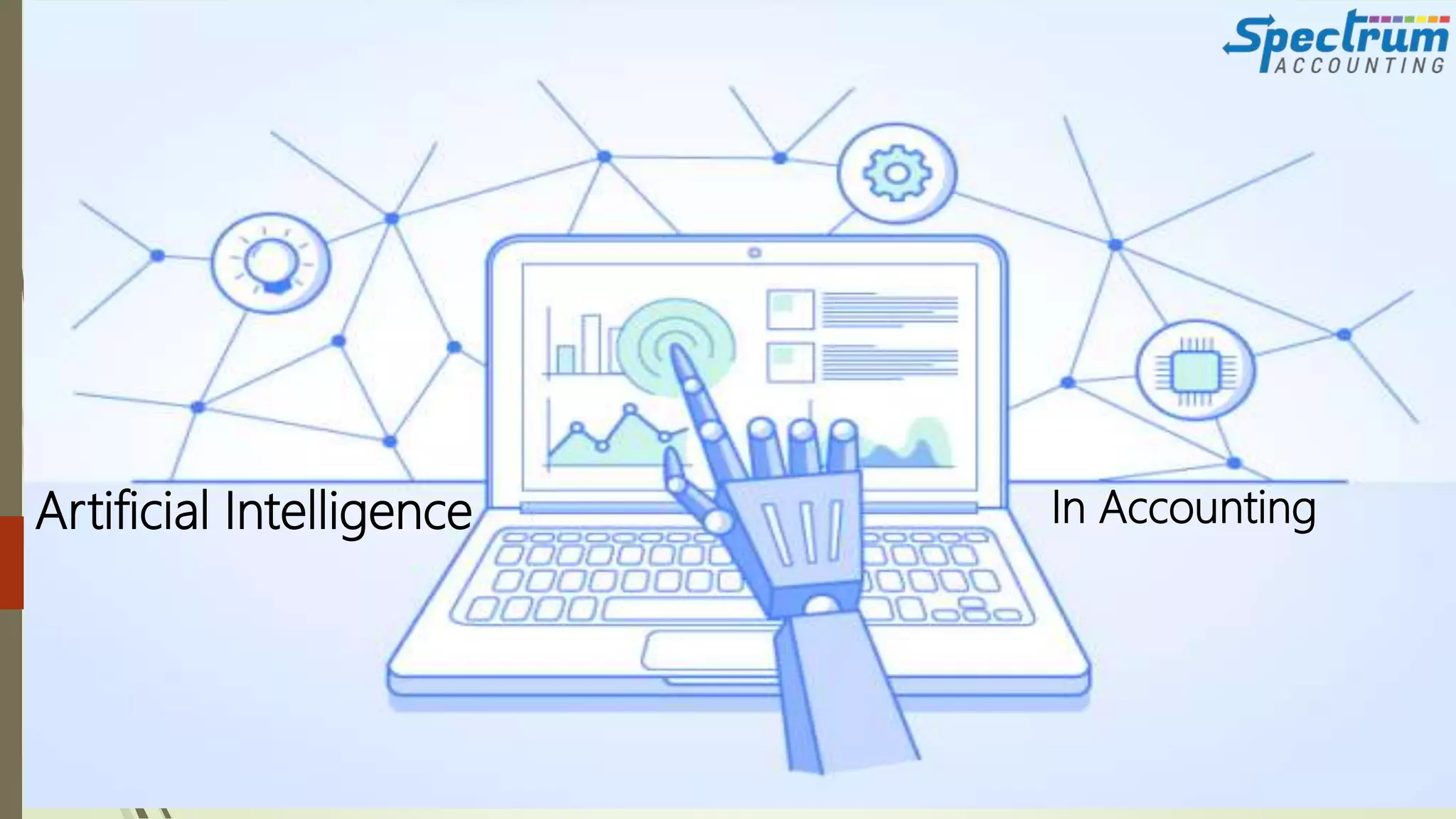
Artificial Intelligence In Accounting
Contents
 Introduction
 AI- Overview
 Accounting -Overview
 Adoption of AI in Accounting & Business
 RPA v/s AI
 How to prepare
 What is ahead
 Case Studies
Introduction
According to consulting firm Accenture, “automation, minibots, machine
learning and adaptive intelligence are becoming part of the finance team at
lightning speed.”
Who wouldn’t want to leave bank reconciliations to a machine?
Even though machines will become an accounting professional’s most valued
colleague in the future, there’s nothing that can replace the emotional
intelligence humans bring to the job.
AI – An overview
Isaac Asimov's "Three Laws of Robotics"
 A robot may not injure a human being or, through inaction, allow a human
being to come to harm.
 A robot must obey orders given it by human beings except where such
orders would conflict with the First Law.
 A robot must protect its own existence as long as such protection does
not conflict with the First or Second Law.
 AI is technology that enables computers to perform decision-based tasks
previously left to humans. It shows up in multiple forms, including
machine-based learning that can progressively become better at analysis
and decisions the more it is used, and speech-based technology that can
understand different voices and languages.
Current status of accounting
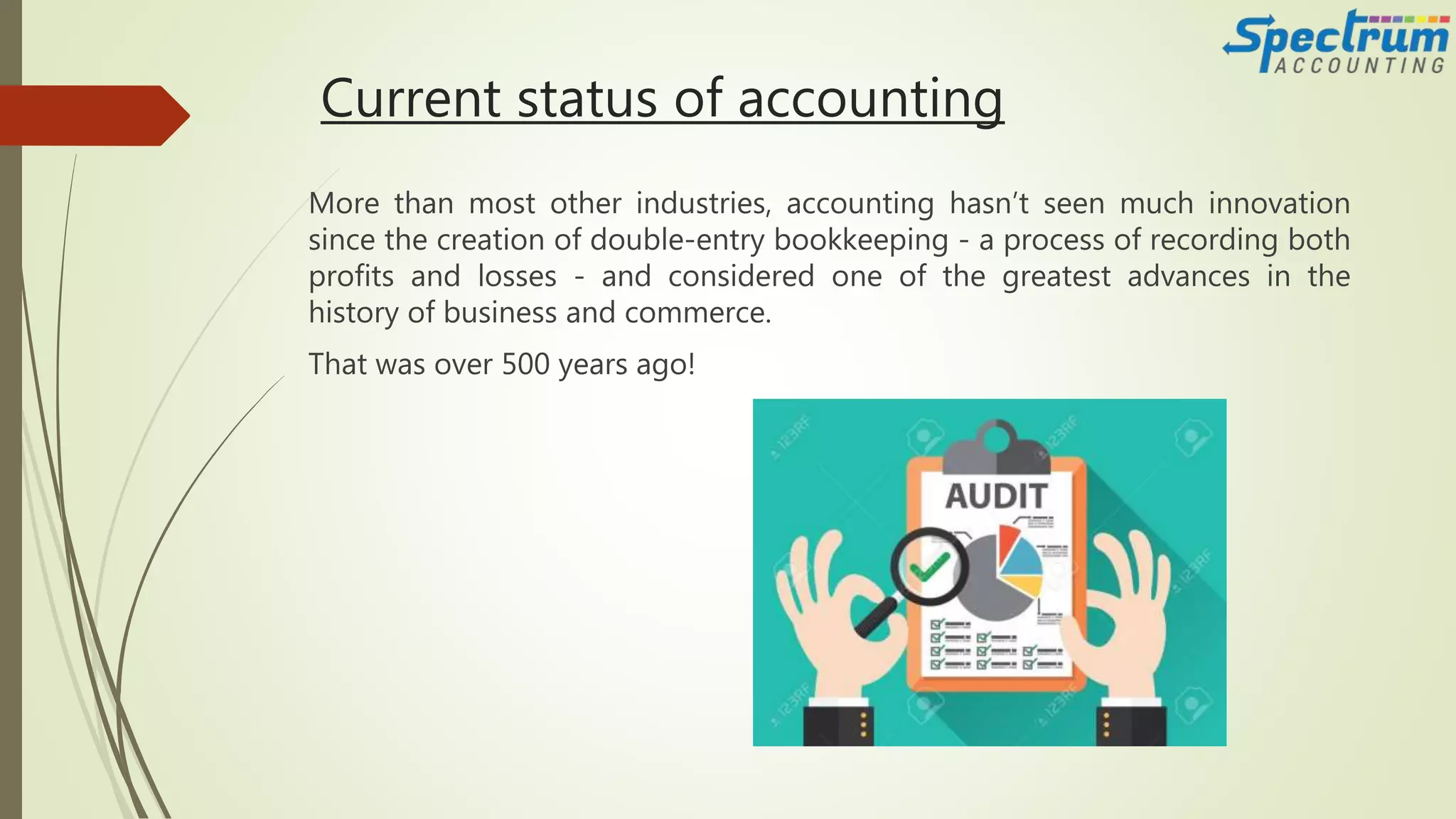
More than most other industries, accounting hasn’t seen much innovation
since the creation of double-entry bookkeeping - a process of recording both
profits and losses - and considered one of the greatest advances in the
history of business and commerce.
That was over 500 years ago!
Adoption of AI in Accounting & Business
 AI is giving high positive outcomes like reducing costs and time,
increasing productivity, and improving accuracy. Given its many positives,
AI is being increasingly used in administrative procedures, and accounting
and a host of structural changes are being brought about so that the
many benefits of bots and AI can be quickly put in place.
 One of the primary benefits of AI in accounting is in the area of
compliance, as all data handling and processing is being completely
automated. Hence, every tax report will have data that has guaranteed
accuracy levels, and has been generated quickly and reliably. Further, bots
can recognize and categorize data from various sources into the right
accounting head, which means that AI is doing this crucial task absolutely
on its own. Some dedicated tasks conventionally done by accountants,
such as processing of accounts payables and receivables, are being done
fully by AI, thereby leading to enhanced cost management by businesses.
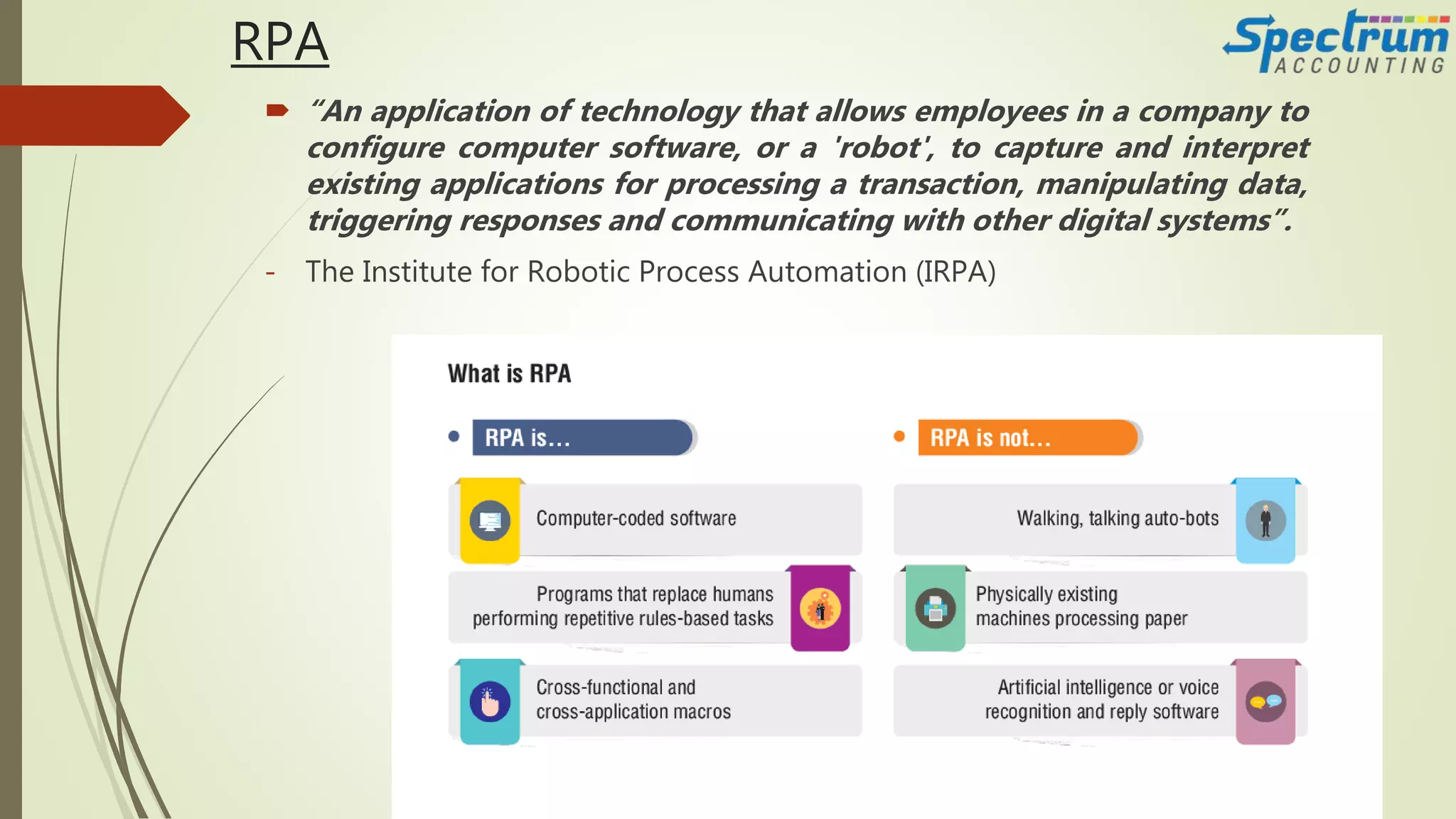
RPA
 “An application of technology that allows employees in a company to
configure computer software, or a 'robot', to capture and interpret
existing applications for processing a transaction, manipulating data,
triggering responses and communicating with other digital systems”.
- The Institute for Robotic Process Automation (IRPA)
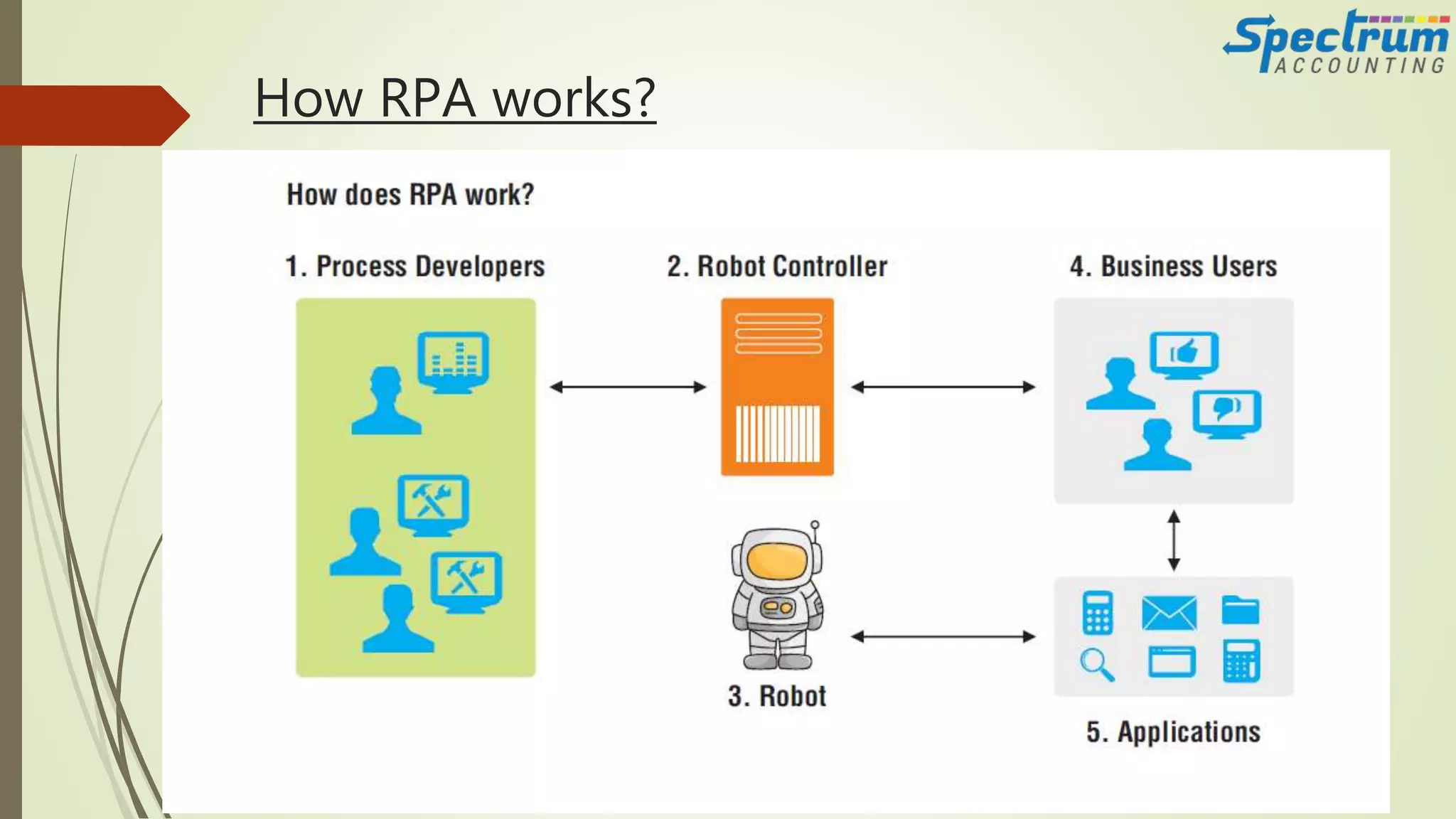
How RPA works?
Functional Areas where RPA is beneficial are
Human Resources
 Payroll Administration
 Benefits Enrolment
 Data of Employees Management
 Management of Claims
 Tracking of Leave Applications
 Routine Query Management
Finance & Accounting
 Accounts Receivable
 Procurement/ Sourcing
Functional Areas where RPA is beneficial are
 Order Management
 Invoice Processing
 Billing Management
 Records to Report (RTR)
Customer Services
 Billing Support
 Query Management
 Compliance Management
 Order Processing
 Sales Management
 Subscription Management
How to prepare
 To prepare for the oncoming wave of AI, interested accountants gain database
and IT skills by taking on specialized projects in their workplace, attending
seminars, completing self-directed learning, or taking classes.
 Having a solid basis in data management and a high comfort level with new
technologies will give those practitioners an edge as AI use increases in the
field.
 To be able to spot when the analyses are off and to deal with exceptions.
What is ahead
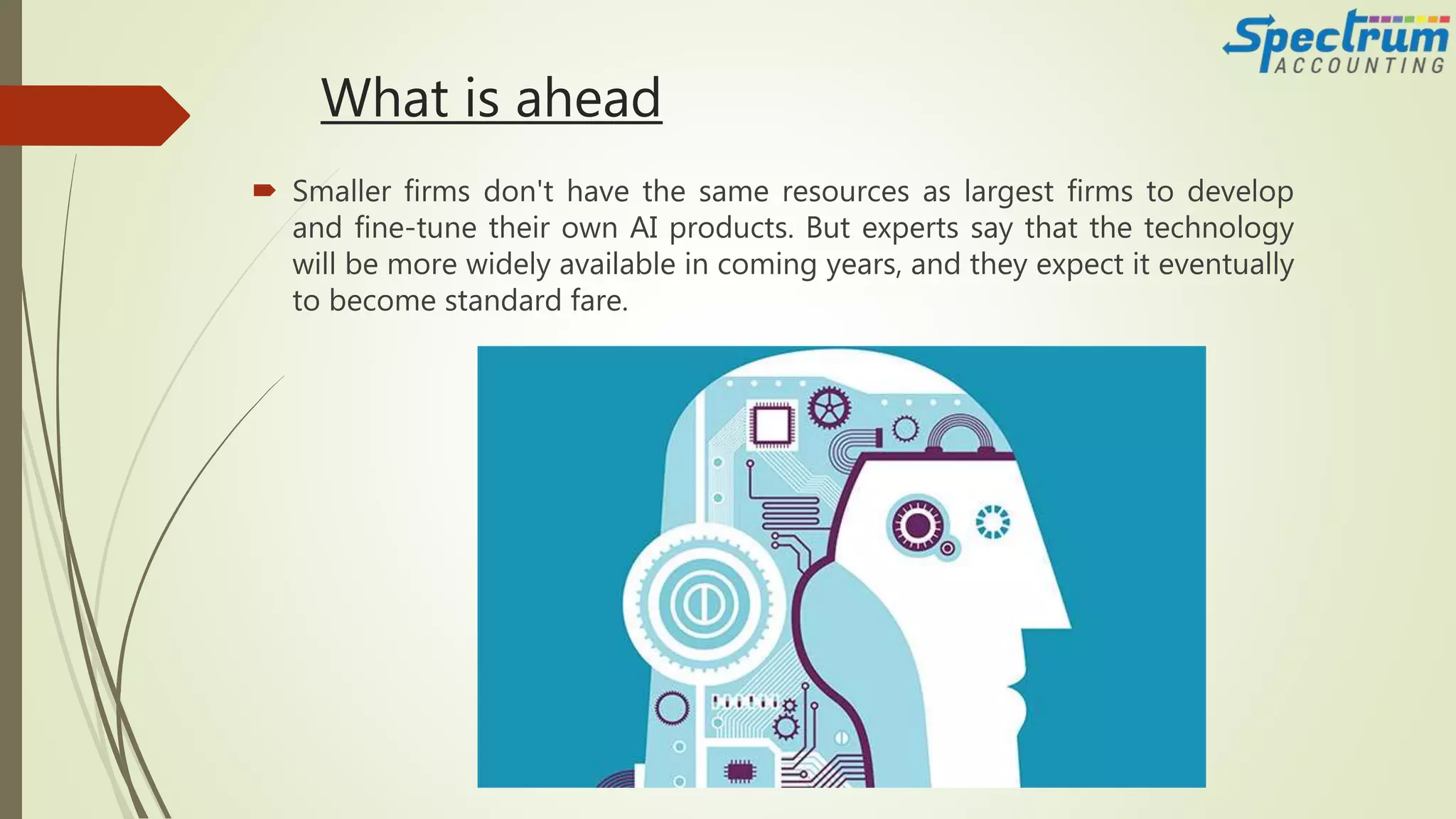
 Smaller firms don't have the same resources as largest firms to develop
and fine-tune their own AI products. But experts say that the technology
will be more widely available in coming years, and they expect it eventually
to become standard fare.
Case studies
 In an upcoming research study, they tested the automation capabilities of
4 of the most popular AI-enabled cloud-accounting solutions available in
the market today (OneUp, QuickBooks Online, SageOne, and Xero) and
rank them against their Accounting Automation Index (AAI) which
evaluates the accuracy of their AI engines to automatically recognize
transactions coming in from bank feeds and generate the correct
accounting without any user intervention.
 OneUp proved to be the most effective with an Automation Index rate of
95% after 5 months of use, followed by QuickBooks Online (77%), Xero
(38%) and SageOne (30%).
 Despite being very promising, the accuracy of the machine learning
algorithms used in most of today's solutions still needs to significantly
improve in efficiency to avoid accounting errors and really fulfill their
promise of automation.
Case studies
Accounting Close
 In a large organization, typically, financial closure requires rules-based processes, it
is conducted across multiple locations often requiring multiple handoffs that
involves predominantly manual closure processes, lots of emails and spread sheet-
based communications and calculations and the process lacks end-to-end process
visibility.
In above case, RPA can be leveraged to automate the process by -
 Automation of loading data into spreadsheets and tracking entity submissions;
 Update close tasks list;
 Period-e nd account reconciliations including, cash and ledger to spreadsheet;
 Gather and calculate sub-leger and non-financial information.
Case studies
Robotics in Tax Function
 All manual, repeatable, and time-consuming processes can be automated using RPA. In fact it
is predicted that RPA will be the future of Tax Function. In cases where IT has already
implemented Tax Function through technology solutions, then RPA can enhance its direct and
indirect tax compliance and reporting.
RPA can execute activities related to the following direct or indirect tax function -
 Auto reconciliation of inter-company transactions
 Review accounts to ensure consistency with the prior year and note changes
 Analyse account changes and evaluate potential tax impact
 Populate tax returns with financial data
 Automated import of financial tax workbook into tax return forms (using tax return software)
 Complete non-financial tax return line items and information fields
 Execute work-flow processes for tax returns and initiate electronic estimated payments
 Gather and analyse high volumes of data (from payroll, fixed assets, and financial systems)
 Auto-calculate and posting of current tax accounting
 Submit tax returns and related payments.
References
 Robotic Process Automation - Driving the Next Wave of Cost
Rationalisation ( Minefields, September 2017)
 Global Challenge Insight Report - “The Future of Jobs - Employment, Skills
and Workforce Strategy for the
 Fourth Industrial Revolution” (World Economic Forum, January 2016)
 Gartner Hype Cycle for Emerging Technologies.
 The Future of the Profession (ICAEW, 2017).
 Wikipedia
 Forbs online magazine
Thank you

Artificial Intelligence and Accounting

  • 1.
  • 2.
    Contents  Introduction  AI-Overview  Accounting -Overview  Adoption of AI in Accounting & Business  RPA v/s AI  How to prepare  What is ahead  Case Studies
  • 3.
    Introduction According to consultingfirm Accenture, “automation, minibots, machine learning and adaptive intelligence are becoming part of the finance team at lightning speed.” Who wouldn’t want to leave bank reconciliations to a machine? Even though machines will become an accounting professional’s most valued colleague in the future, there’s nothing that can replace the emotional intelligence humans bring to the job.
  • 5.
    AI – Anoverview Isaac Asimov's "Three Laws of Robotics"  A robot may not injure a human being or, through inaction, allow a human being to come to harm.  A robot must obey orders given it by human beings except where such orders would conflict with the First Law.  A robot must protect its own existence as long as such protection does not conflict with the First or Second Law.  AI is technology that enables computers to perform decision-based tasks previously left to humans. It shows up in multiple forms, including machine-based learning that can progressively become better at analysis and decisions the more it is used, and speech-based technology that can understand different voices and languages.
  • 6.
    Current status ofaccounting More than most other industries, accounting hasn’t seen much innovation since the creation of double-entry bookkeeping - a process of recording both profits and losses - and considered one of the greatest advances in the history of business and commerce. That was over 500 years ago!
  • 7.
    Adoption of AIin Accounting & Business  AI is giving high positive outcomes like reducing costs and time, increasing productivity, and improving accuracy. Given its many positives, AI is being increasingly used in administrative procedures, and accounting and a host of structural changes are being brought about so that the many benefits of bots and AI can be quickly put in place.  One of the primary benefits of AI in accounting is in the area of compliance, as all data handling and processing is being completely automated. Hence, every tax report will have data that has guaranteed accuracy levels, and has been generated quickly and reliably. Further, bots can recognize and categorize data from various sources into the right accounting head, which means that AI is doing this crucial task absolutely on its own. Some dedicated tasks conventionally done by accountants, such as processing of accounts payables and receivables, are being done fully by AI, thereby leading to enhanced cost management by businesses.
  • 8.
    RPA  “An applicationof technology that allows employees in a company to configure computer software, or a 'robot', to capture and interpret existing applications for processing a transaction, manipulating data, triggering responses and communicating with other digital systems”. - The Institute for Robotic Process Automation (IRPA)
  • 9.
  • 10.
    Functional Areas whereRPA is beneficial are Human Resources  Payroll Administration  Benefits Enrolment  Data of Employees Management  Management of Claims  Tracking of Leave Applications  Routine Query Management Finance & Accounting  Accounts Receivable  Procurement/ Sourcing
  • 11.
    Functional Areas whereRPA is beneficial are  Order Management  Invoice Processing  Billing Management  Records to Report (RTR) Customer Services  Billing Support  Query Management  Compliance Management  Order Processing  Sales Management  Subscription Management
  • 12.
    How to prepare To prepare for the oncoming wave of AI, interested accountants gain database and IT skills by taking on specialized projects in their workplace, attending seminars, completing self-directed learning, or taking classes.  Having a solid basis in data management and a high comfort level with new technologies will give those practitioners an edge as AI use increases in the field.  To be able to spot when the analyses are off and to deal with exceptions.
  • 13.
    What is ahead Smaller firms don't have the same resources as largest firms to develop and fine-tune their own AI products. But experts say that the technology will be more widely available in coming years, and they expect it eventually to become standard fare.
  • 14.
    Case studies  Inan upcoming research study, they tested the automation capabilities of 4 of the most popular AI-enabled cloud-accounting solutions available in the market today (OneUp, QuickBooks Online, SageOne, and Xero) and rank them against their Accounting Automation Index (AAI) which evaluates the accuracy of their AI engines to automatically recognize transactions coming in from bank feeds and generate the correct accounting without any user intervention.  OneUp proved to be the most effective with an Automation Index rate of 95% after 5 months of use, followed by QuickBooks Online (77%), Xero (38%) and SageOne (30%).  Despite being very promising, the accuracy of the machine learning algorithms used in most of today's solutions still needs to significantly improve in efficiency to avoid accounting errors and really fulfill their promise of automation.
  • 15.
    Case studies Accounting Close In a large organization, typically, financial closure requires rules-based processes, it is conducted across multiple locations often requiring multiple handoffs that involves predominantly manual closure processes, lots of emails and spread sheet- based communications and calculations and the process lacks end-to-end process visibility. In above case, RPA can be leveraged to automate the process by -  Automation of loading data into spreadsheets and tracking entity submissions;  Update close tasks list;  Period-e nd account reconciliations including, cash and ledger to spreadsheet;  Gather and calculate sub-leger and non-financial information.
  • 16.
    Case studies Robotics inTax Function  All manual, repeatable, and time-consuming processes can be automated using RPA. In fact it is predicted that RPA will be the future of Tax Function. In cases where IT has already implemented Tax Function through technology solutions, then RPA can enhance its direct and indirect tax compliance and reporting. RPA can execute activities related to the following direct or indirect tax function -  Auto reconciliation of inter-company transactions  Review accounts to ensure consistency with the prior year and note changes  Analyse account changes and evaluate potential tax impact  Populate tax returns with financial data  Automated import of financial tax workbook into tax return forms (using tax return software)  Complete non-financial tax return line items and information fields  Execute work-flow processes for tax returns and initiate electronic estimated payments  Gather and analyse high volumes of data (from payroll, fixed assets, and financial systems)  Auto-calculate and posting of current tax accounting  Submit tax returns and related payments.
  • 17.
    References  Robotic ProcessAutomation - Driving the Next Wave of Cost Rationalisation ( Minefields, September 2017)  Global Challenge Insight Report - “The Future of Jobs - Employment, Skills and Workforce Strategy for the  Fourth Industrial Revolution” (World Economic Forum, January 2016)  Gartner Hype Cycle for Emerging Technologies.  The Future of the Profession (ICAEW, 2017).  Wikipedia  Forbs online magazine
  • 18.