WELCOME
ARTIFICIAL INTELLIGENCE
IN FINANCE
PRESENTED BY
VIDYA BORADE
CONTENT
ENTRODUCTION
ARTIFICIAL INTELLIGENCE refers to machines or system that mimic
human intelligence to perform tasks.ai is intended to significantly
enhance human capabilities and contribution, making it very valuable
valuable assest.
FINANCE is the management of money and includes activities such as
investing ,Borrowing,lending,budgeting,saving and forecasting.
ARTIFICIAL INTELLIGENCE IN FINANCE can free up personal,improve
security measures and ensure that the business is moving in the right
technology-Advanced,ennovative direction.
HOW ARTIFICIAL INTELLIGENCE AND
MACHINE LEARNING IS USE IN FINANCE
machine learning works by extracting meaningful
insights from raw sets of data and provides accurate results. this
information is then used to solve complex and data-rich problems
that are critical to the banking & finance sector.
USES OF AI IN FINANCE SECTOR
Personalized Banking Experience
Customers can now effortlessly log into their banking apps by
simply looking at their phones. All this is thanks to advances in machine
learning and the development of cutting-edge neural engines
Credit Scoring
According to Forbes, 70% of financial firms are using machine
learning to predict cash flow events and adjust credit scores.
Fraud Detection and Risk Management
AI applications in the fintech industry range from recognizing
abnormal transactions to identifying suspicious and potentially fraudulent
activities by analyzing massive amounts of data. AI can quickly gain insights
that help protect organizations against losses and increase ROI for their
customers.
Advantages and disadvantages of
using AI in finance sector
advantages
 AI can automate manual work
 By relying on AI technology for data entry,
review, and verification, financial institutions
can reduce the time necessary to approve an
application while increasing accuracy by
avoiding human error.
 AI can quickly identify and prevent
fraud
 AI does an exponentially better job of
correctly identifying abnormal behavior than
any human could, and it, therefore, helps
financial services organizations reduce fraud
risk and costs, all while enhancing customer
satisfaction.
disadvantages
 Expensive
 It may not be possible for all the
finance companies to go for this big
expensive model
 Implementing the proper
algorithm
 Although the AI works flawlessly with
faster results, its accuracy depends on
the algorithm it works on.
 Lack of regulatory scrutiny
 AI and its technologies use data of the
individuals to drive results
APPLICATION OF AI IN FINANCIAL WORLD
AI in personal finance
AI in consumer finance
AI in corporate finance
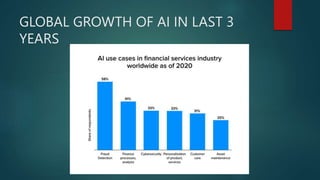
GLOBAL GROWTH OF AI IN LAST 3
YEARS
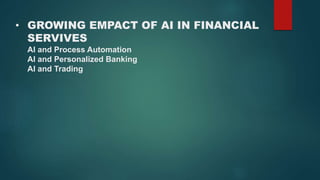
• GROWING EMPACT OF AI IN FINANCIAL
SERVIVES
AI and Process Automation
AI and Personalized Banking
AI and Trading
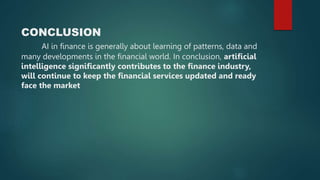
CONCLUSION
AI in finance is generally about learning of patterns, data and
many developments in the financial world. In conclusion, artificial
intelligence significantly contributes to the finance industry,
will continue to keep the financial services updated and ready
face the market
THANK YOU

PPT AI IN FINANCE.pptx

  • 1.
  • 2.
  • 3.
  • 5.
    ENTRODUCTION ARTIFICIAL INTELLIGENCE refersto machines or system that mimic human intelligence to perform tasks.ai is intended to significantly enhance human capabilities and contribution, making it very valuable valuable assest. FINANCE is the management of money and includes activities such as investing ,Borrowing,lending,budgeting,saving and forecasting. ARTIFICIAL INTELLIGENCE IN FINANCE can free up personal,improve security measures and ensure that the business is moving in the right technology-Advanced,ennovative direction.
  • 6.
    HOW ARTIFICIAL INTELLIGENCEAND MACHINE LEARNING IS USE IN FINANCE machine learning works by extracting meaningful insights from raw sets of data and provides accurate results. this information is then used to solve complex and data-rich problems that are critical to the banking & finance sector.
  • 7.
    USES OF AIIN FINANCE SECTOR Personalized Banking Experience Customers can now effortlessly log into their banking apps by simply looking at their phones. All this is thanks to advances in machine learning and the development of cutting-edge neural engines Credit Scoring According to Forbes, 70% of financial firms are using machine learning to predict cash flow events and adjust credit scores. Fraud Detection and Risk Management
  • 8.
    Fraud Detection andRisk Management AI applications in the fintech industry range from recognizing abnormal transactions to identifying suspicious and potentially fraudulent activities by analyzing massive amounts of data. AI can quickly gain insights that help protect organizations against losses and increase ROI for their customers.
  • 9.
    Advantages and disadvantagesof using AI in finance sector advantages  AI can automate manual work  By relying on AI technology for data entry, review, and verification, financial institutions can reduce the time necessary to approve an application while increasing accuracy by avoiding human error.  AI can quickly identify and prevent fraud  AI does an exponentially better job of correctly identifying abnormal behavior than any human could, and it, therefore, helps financial services organizations reduce fraud risk and costs, all while enhancing customer satisfaction. disadvantages  Expensive  It may not be possible for all the finance companies to go for this big expensive model  Implementing the proper algorithm  Although the AI works flawlessly with faster results, its accuracy depends on the algorithm it works on.  Lack of regulatory scrutiny  AI and its technologies use data of the individuals to drive results
  • 10.
    APPLICATION OF AIIN FINANCIAL WORLD AI in personal finance AI in consumer finance
  • 11.
  • 12.
    GLOBAL GROWTH OFAI IN LAST 3 YEARS
  • 14.
    • GROWING EMPACTOF AI IN FINANCIAL SERVIVES AI and Process Automation AI and Personalized Banking AI and Trading
  • 15.
    CONCLUSION AI in financeis generally about learning of patterns, data and many developments in the financial world. In conclusion, artificial intelligence significantly contributes to the finance industry, will continue to keep the financial services updated and ready face the market
  • 16.