Artificial Intelligence
Summary:
• Artificial intelligence (AI) enables machines to learn from experience, to adapt to new inputs and to carry out tasks
of human nature. Most of the AI examples you hear today– from chess computers to self- driving cars– rely heavily
on deep learning and the processing of natural languages. Utilizing these technologies, computers can be trained to
perform specific tasks by processing huge amounts of data and recognizing data patterns.
• Artificial intelligence (AI) enables machines to learn from experience, to adapt to new inputs and to carry out tasks
of human nature. AI has paved the way for the automation and formal reasoning that we see today in computers;
including decision- making support systems and smart search systems that can complement and enhance human
skills.
• •AI mechanizes repetitive learning and discovery using data.
• •AI performs computerized, high- volume tasks with reliability.
• •AI augments intelligence to existing products. AI capabilities improve the products one already uses.
• •AI finds structure and regularity in data so that the algorithm develops a competence to act as a predictor.
• Although the term artificial intelligence was first coined in 1956, this has
gained popularity only in recent times, thanks to increased data volumes,
advanced algorithms and improved computer power and storage.
• In the 1950s, early AI research used to examine issues like problem solving
and symbolic methods. In the 1960s, the US Defense Department moved
forward in this type of work and started training computers to imitate
fundamental human reasoning. For example, during 1970s the Defense
Advanced Research Projects Agency (DARPA) completed road mapping
projects. In 2003, DARPA produced intelligent personal assistants, long before
household names like Siri, Alexa or Cortana.
• These early works paved the way for the automation and formal reasoning
that we see today in computers; including decision- making support systems
and smart search systems that can complement and enhance human skills.
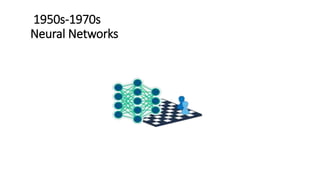
1950s-1970s
Neural Networks
1980s-2010s
Machine Learning
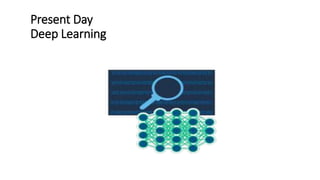
Present Day
Deep Learning
Why is AI Important?
• AI mechanizes repetitive learning and discovery using data. AI performs computerized, high- volume tasks with
reliability. Human inquiry is still essential for this type of automation for setting up the system and asking the
correct questions.
• AI augments intelligence to existing products. AI capabilities improve the products one already uses. Automation,
conversation platforms, bots and smart machines combining together with large amounts of data, improvement in
many technologies are brought at home and in the workplace.
• AI adapts the data to programming by means of progressive learning algorithms. AI finds structure and
regularity in data so that the algorithm develops a competence to act as a predictor.
• AI analyses more profound data through neural networks with many hidden layers. With incredible power of
computer and big data, deep learning models can easily be trained and they become more accurate.
• AI achieves incredible precision through deep neural network. For example, interactions with Alexa, Google
Search and Google Photos all depend on deep learning– and the more one uses them, the more accurate they
become.
AI in Today’s World
• AI in almost every industry: AI enabled hospital, AI assisted retail
store, and predictive analytics system-AI is everywhere.
• AI and the IOT: The Internet of Things (IoT) and sensors can use
large data volumes, while artificial intelligence (AI) can learn data
patterns to automate tasks for a variety of business advantages.
• AI integration into analytics program: In order for AI to be used
effectively, it is important that its strategy flows into broader business
strategy, always taking into account the convergence of people,
processes and technology.
Key points:
• 1.The term artificial intelligence was first coined in 1956, but has gained popularity only in recent times.
• 2.Artificial intelligence (AI) enables machines to learn from experience, to adapt to new inputs and to carry out
tasks of human nature, thus paving the way for the automation and formal reasoning.
• 3.AI mechanizes repetitive learning and discovery using data. AI performs computerized, high- volume tasks with
reliability.
• 4.AI augments intelligence to existing products. AI capabilities improve the products one already uses.
• 5.AI finds structure and regularity in data so that the algorithm develops a competence to act as a predictor.
• 6.AI analyses more profound data through neural networks with many hidden layers. AI achieves incredible
precision through deep neural network.
Published by Brainware University

Artificial intelligence

  • 1.
    Artificial Intelligence Summary: • Artificialintelligence (AI) enables machines to learn from experience, to adapt to new inputs and to carry out tasks of human nature. Most of the AI examples you hear today– from chess computers to self- driving cars– rely heavily on deep learning and the processing of natural languages. Utilizing these technologies, computers can be trained to perform specific tasks by processing huge amounts of data and recognizing data patterns. • Artificial intelligence (AI) enables machines to learn from experience, to adapt to new inputs and to carry out tasks of human nature. AI has paved the way for the automation and formal reasoning that we see today in computers; including decision- making support systems and smart search systems that can complement and enhance human skills. • •AI mechanizes repetitive learning and discovery using data. • •AI performs computerized, high- volume tasks with reliability. • •AI augments intelligence to existing products. AI capabilities improve the products one already uses. • •AI finds structure and regularity in data so that the algorithm develops a competence to act as a predictor.
  • 2.
    • Although theterm artificial intelligence was first coined in 1956, this has gained popularity only in recent times, thanks to increased data volumes, advanced algorithms and improved computer power and storage. • In the 1950s, early AI research used to examine issues like problem solving and symbolic methods. In the 1960s, the US Defense Department moved forward in this type of work and started training computers to imitate fundamental human reasoning. For example, during 1970s the Defense Advanced Research Projects Agency (DARPA) completed road mapping projects. In 2003, DARPA produced intelligent personal assistants, long before household names like Siri, Alexa or Cortana. • These early works paved the way for the automation and formal reasoning that we see today in computers; including decision- making support systems and smart search systems that can complement and enhance human skills.
  • 3.
  • 4.
  • 5.
  • 6.
    Why is AIImportant? • AI mechanizes repetitive learning and discovery using data. AI performs computerized, high- volume tasks with reliability. Human inquiry is still essential for this type of automation for setting up the system and asking the correct questions. • AI augments intelligence to existing products. AI capabilities improve the products one already uses. Automation, conversation platforms, bots and smart machines combining together with large amounts of data, improvement in many technologies are brought at home and in the workplace. • AI adapts the data to programming by means of progressive learning algorithms. AI finds structure and regularity in data so that the algorithm develops a competence to act as a predictor. • AI analyses more profound data through neural networks with many hidden layers. With incredible power of computer and big data, deep learning models can easily be trained and they become more accurate. • AI achieves incredible precision through deep neural network. For example, interactions with Alexa, Google Search and Google Photos all depend on deep learning– and the more one uses them, the more accurate they become.
  • 7.
    AI in Today’sWorld • AI in almost every industry: AI enabled hospital, AI assisted retail store, and predictive analytics system-AI is everywhere. • AI and the IOT: The Internet of Things (IoT) and sensors can use large data volumes, while artificial intelligence (AI) can learn data patterns to automate tasks for a variety of business advantages. • AI integration into analytics program: In order for AI to be used effectively, it is important that its strategy flows into broader business strategy, always taking into account the convergence of people, processes and technology.
  • 8.
    Key points: • 1.Theterm artificial intelligence was first coined in 1956, but has gained popularity only in recent times. • 2.Artificial intelligence (AI) enables machines to learn from experience, to adapt to new inputs and to carry out tasks of human nature, thus paving the way for the automation and formal reasoning. • 3.AI mechanizes repetitive learning and discovery using data. AI performs computerized, high- volume tasks with reliability. • 4.AI augments intelligence to existing products. AI capabilities improve the products one already uses. • 5.AI finds structure and regularity in data so that the algorithm develops a competence to act as a predictor. • 6.AI analyses more profound data through neural networks with many hidden layers. AI achieves incredible precision through deep neural network. Published by Brainware University