QN. 01
Review cyber-security and its cost
to the world economy.
PART 1. INTRODUCTION
 Cyber security Is the body of technologies,
processes, and practices designed to protect
networks, computers, programs and data from
attack, damage or unauthorized access.
SECURITY FUNDAMENTALS.
Confidentiality
 Is about preventing the disclosure of data to
unauthorized parties.
Its Standard measures to establish confidentiality
include:
 Data encryption
 Two-factor authentication
 Biometric verification
 Security tokens
Integrity:
 Refers to protecting information from being
modified by unauthorized parties. Standard
measures to guarantee integrity include:
Cryptographic checksums, Using file permissions
Uninterrupted power supplies, Data backups
Availability
 Is making sure that authorized parties are able to
access the information when needed.
 Standard measures to guarantee availability
include:
 Backing up data to external drives
 Implementing firewalls
 Having backup power supplies
 Data redundancy
Why is cyber security
important?
 This is due to Cyber-attacks which can be
extremely expensive for businesses to endure.
 Cyber-attacks can be classified into the following
categories:
 Web-based attacks
 System-based attacks
 Web-based attacks
1. Injection attacks
 It is the attack in which some data will be
injected into a web application to manipulate the
application and fetch the required information.
 Example- SQL Injection, code Injection, log
Injection, XML Injection etc
Web-based attacks cont….
2. Phishing
 Phishing is a type of attack which attempts to
steal sensitive information like user login
credentials and credit card number. It occurs
when an attacker is masquerading as a
trustworthy entity in electronic communication
Web-based attacks cont.….
3. Denial of Service.
 It is an attack which meant to make a server or
network resource unavailable to the users. It
accomplishes this by flooding the target with
traffic or sending information that triggers a
crash.
 It uses the single system and single internet
connection to attack a server
Web-based attacks cont….
4. Man in the middle attacks.
 It is a type of attack that allows an attacker to
intercepts the connection between client and
server and acts as a bridge between them. Due to
this, an attacker will be able to read, insert and
modify the data in the intercepted connection.
System-based attacks
1. Virus
 It is a type of malicious software program that
spread throughout the computer files without the
knowledge of a user.
System-based attacks
cont…
2. Worm.
 It is a type of malware whose primary function is
to replicate itself to spread to uninfected
computers.
 It works same as the computer virus. Worms
often originate from email attachments that
appear to be from trusted senders.
System-based attacks
cont…
3. Trojan horse.
 It is a malicious program that occurs unexpected
changes to computer setting and unusual activity,
even when the computer should be idle.
 It misleads the user of its true intent.
 It appears to be a normal application but when
opened/executed some malicious code will run in the
background.
System-based attacks
cont…
4. Backdoors.
 It is a method that bypasses the normal
authentication process.
 A developer may create a backdoor so that an
application or operating system can be accessed
for troubleshooting or other purposes.
System-based attacks
cont…
5. Bots
 A bot (short for "robot") is an automated process
that interacts with other network services.
 Some bots program run automatically, while
others only execute commands when they receive
specific input.
 Common examples of bots program are the
crawler, chatroom bots, and malicious bots.
PART 2. The above mentioned cyber-
security attacks cost the world economy
as follows.
1.Size of company
 The more employees you have the more opportunities for a cyber-attack to
occur (more computers, workstations, and devices are vulnerable to attacks).
 Larger organizations tend to require more in their cyber security spending than
smaller businesses.
 Example, Large enterprises like Microsoft spend $1 billion to drive
cybersecurity initiatives
 The financial industry spends 10% of its information Technology (IT) budget
average on cybersecurity.
 Cyber-crime cost businesses in the United States more than $3.5 billion in
internet-related cyber crimes and damages according to a 2019 FBI report.
Cyber security cost factors Cont.…
2. Type of data
Businesses that collect more sensitive data will need additional security
layers to ensure they are compliant with industry-standard legal
compliance.
 More money will be required to protect data that comes under
compliance
 For example, you need a bigger budget if your data falls under Health
Insurance Portability and Accountability act (HIPAA) or Businesses in
commerce, Payment Card Industry (PCI) to ensure privacy and
prevent breaches
 General business may need to allocate 0.2% to 0.9% of its annual
revenues to drive cybersecurity initiatives.
Cyber security cost factors Cont.…
3. Products and Services
 The more protection you have in the form of products and services,
the higher the cost. Example Firewalls range in prices between $400
and $6,000.
 Businesses that choose both cyber security products and services
should expect to pay more than if they just select products. For
example, a bank may need 24/7 monitoring to identify and track
threats.
 Example , The volume of cyber security services you use, like
antivirus, will determine your cost. According to Kaspersky, such a
setup can cost a business $54,300 on average per year. In addition,
companies also need to pay one-time costs of around $3,000.
 Using cloud-based security solutions can incur $33,500 annually on
cybersecurity
Cyber security cost factors Cont.…
4. Self-Install vs. Professional Install
 Cyber security companies can sell security products to set up
yourselves, or to contact a security vendor to help install the product
(usually for additional setup fees).
 A dedicated chief information security officer (CISO) can increase
prices/cost
 An average firewall configuration costs between $450 and $2,500.
 Expected cost for a vulnerability assessment: $1,500 – $6,000 for a
network with 1-3 servers and $5,000 – $10,000 for a network with 5-8
servers.
Cyber security cost factors Cont.…
5. Professional Audits
 Organizations can periodically conduct third-party audits to ensure they are
updated with the latest security and compliance standards.
 this involve hire personnel or rely on cybersecurity provider for added costs.
 Audit reveal that, the latest forecast is for global ransomware damage costs
to reach $20 billion by 2021 .
QN. 02
Explain Cyber security index, ranking of African
Countries and position of Tanzania.
THE CYBER SECURITY INDEX
 Is a sentiment-based measure of the risk to the corporate, industrial, and
governmental information infrastructure from a spectrum of cybersecurity
threats.
 To raise awareness of the importance and different dimensions of the issues
has classified African’s Member States into three categories:-
i. Leading stage: refers to the 6 countries (i.e., GCI score in the 50th percentile
and higher) that demonstrate high commitment.
ii. Maturing stage: refers to the 11 countries (i.e., GCI score between the 20th
and 49th percentile) that have developed complex commitments, and engage
in cybersecurity programs and initiatives.
iii. Initiating stage: refers to the 27 countries (i.e., GCI score less than the 20th
percentile) that have started to make commitments in cybersecurity.
TANZANIA POSITION IN
CYBERSECURITY INDEX
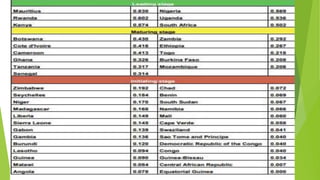
 Cyber security has improved dramatically in Tanzania
over the last three years apparently due to a conducive
legal and regulatory framework, according to the 2018
Global Cyber Security Index. Tanzania is now one of the
11 leading African countries; ranking 5th in the maturing
stage; up from being 12th in 2017.
 The table below show the Global Cyber Security
Index for Africa states ;-
To wind up , Better accounting for cybersecurity
will be essential for the digital world into which we
are moving to ensure return of technological
investment
THE END

ASSIGNMENT CYBER SECURITY ppt.pptx

  • 1.
    QN. 01 Review cyber-securityand its cost to the world economy.
  • 2.
    PART 1. INTRODUCTION Cyber security Is the body of technologies, processes, and practices designed to protect networks, computers, programs and data from attack, damage or unauthorized access.
  • 3.
    SECURITY FUNDAMENTALS. Confidentiality  Isabout preventing the disclosure of data to unauthorized parties. Its Standard measures to establish confidentiality include:  Data encryption  Two-factor authentication  Biometric verification  Security tokens
  • 4.
    Integrity:  Refers toprotecting information from being modified by unauthorized parties. Standard measures to guarantee integrity include: Cryptographic checksums, Using file permissions Uninterrupted power supplies, Data backups
  • 5.
    Availability  Is makingsure that authorized parties are able to access the information when needed.  Standard measures to guarantee availability include:  Backing up data to external drives  Implementing firewalls  Having backup power supplies  Data redundancy
  • 6.
    Why is cybersecurity important?  This is due to Cyber-attacks which can be extremely expensive for businesses to endure.  Cyber-attacks can be classified into the following categories:  Web-based attacks  System-based attacks
  • 7.
     Web-based attacks 1.Injection attacks  It is the attack in which some data will be injected into a web application to manipulate the application and fetch the required information.  Example- SQL Injection, code Injection, log Injection, XML Injection etc
  • 8.
    Web-based attacks cont…. 2.Phishing  Phishing is a type of attack which attempts to steal sensitive information like user login credentials and credit card number. It occurs when an attacker is masquerading as a trustworthy entity in electronic communication
  • 9.
    Web-based attacks cont.…. 3.Denial of Service.  It is an attack which meant to make a server or network resource unavailable to the users. It accomplishes this by flooding the target with traffic or sending information that triggers a crash.  It uses the single system and single internet connection to attack a server
  • 10.
    Web-based attacks cont…. 4.Man in the middle attacks.  It is a type of attack that allows an attacker to intercepts the connection between client and server and acts as a bridge between them. Due to this, an attacker will be able to read, insert and modify the data in the intercepted connection.
  • 11.
    System-based attacks 1. Virus It is a type of malicious software program that spread throughout the computer files without the knowledge of a user.
  • 12.
    System-based attacks cont… 2. Worm. It is a type of malware whose primary function is to replicate itself to spread to uninfected computers.  It works same as the computer virus. Worms often originate from email attachments that appear to be from trusted senders.
  • 13.
    System-based attacks cont… 3. Trojanhorse.  It is a malicious program that occurs unexpected changes to computer setting and unusual activity, even when the computer should be idle.  It misleads the user of its true intent.  It appears to be a normal application but when opened/executed some malicious code will run in the background.
  • 14.
    System-based attacks cont… 4. Backdoors. It is a method that bypasses the normal authentication process.  A developer may create a backdoor so that an application or operating system can be accessed for troubleshooting or other purposes.
  • 15.
    System-based attacks cont… 5. Bots A bot (short for "robot") is an automated process that interacts with other network services.  Some bots program run automatically, while others only execute commands when they receive specific input.  Common examples of bots program are the crawler, chatroom bots, and malicious bots.
  • 16.
    PART 2. Theabove mentioned cyber- security attacks cost the world economy as follows. 1.Size of company  The more employees you have the more opportunities for a cyber-attack to occur (more computers, workstations, and devices are vulnerable to attacks).  Larger organizations tend to require more in their cyber security spending than smaller businesses.  Example, Large enterprises like Microsoft spend $1 billion to drive cybersecurity initiatives  The financial industry spends 10% of its information Technology (IT) budget average on cybersecurity.  Cyber-crime cost businesses in the United States more than $3.5 billion in internet-related cyber crimes and damages according to a 2019 FBI report.
  • 17.
    Cyber security costfactors Cont.… 2. Type of data Businesses that collect more sensitive data will need additional security layers to ensure they are compliant with industry-standard legal compliance.  More money will be required to protect data that comes under compliance  For example, you need a bigger budget if your data falls under Health Insurance Portability and Accountability act (HIPAA) or Businesses in commerce, Payment Card Industry (PCI) to ensure privacy and prevent breaches  General business may need to allocate 0.2% to 0.9% of its annual revenues to drive cybersecurity initiatives.
  • 18.
    Cyber security costfactors Cont.… 3. Products and Services  The more protection you have in the form of products and services, the higher the cost. Example Firewalls range in prices between $400 and $6,000.  Businesses that choose both cyber security products and services should expect to pay more than if they just select products. For example, a bank may need 24/7 monitoring to identify and track threats.  Example , The volume of cyber security services you use, like antivirus, will determine your cost. According to Kaspersky, such a setup can cost a business $54,300 on average per year. In addition, companies also need to pay one-time costs of around $3,000.  Using cloud-based security solutions can incur $33,500 annually on cybersecurity
  • 19.
    Cyber security costfactors Cont.… 4. Self-Install vs. Professional Install  Cyber security companies can sell security products to set up yourselves, or to contact a security vendor to help install the product (usually for additional setup fees).  A dedicated chief information security officer (CISO) can increase prices/cost  An average firewall configuration costs between $450 and $2,500.  Expected cost for a vulnerability assessment: $1,500 – $6,000 for a network with 1-3 servers and $5,000 – $10,000 for a network with 5-8 servers.
  • 20.
    Cyber security costfactors Cont.… 5. Professional Audits  Organizations can periodically conduct third-party audits to ensure they are updated with the latest security and compliance standards.  this involve hire personnel or rely on cybersecurity provider for added costs.  Audit reveal that, the latest forecast is for global ransomware damage costs to reach $20 billion by 2021 .
  • 21.
    QN. 02 Explain Cybersecurity index, ranking of African Countries and position of Tanzania.
  • 22.
    THE CYBER SECURITYINDEX  Is a sentiment-based measure of the risk to the corporate, industrial, and governmental information infrastructure from a spectrum of cybersecurity threats.  To raise awareness of the importance and different dimensions of the issues has classified African’s Member States into three categories:- i. Leading stage: refers to the 6 countries (i.e., GCI score in the 50th percentile and higher) that demonstrate high commitment. ii. Maturing stage: refers to the 11 countries (i.e., GCI score between the 20th and 49th percentile) that have developed complex commitments, and engage in cybersecurity programs and initiatives. iii. Initiating stage: refers to the 27 countries (i.e., GCI score less than the 20th percentile) that have started to make commitments in cybersecurity.
  • 23.
    TANZANIA POSITION IN CYBERSECURITYINDEX  Cyber security has improved dramatically in Tanzania over the last three years apparently due to a conducive legal and regulatory framework, according to the 2018 Global Cyber Security Index. Tanzania is now one of the 11 leading African countries; ranking 5th in the maturing stage; up from being 12th in 2017.  The table below show the Global Cyber Security Index for Africa states ;-
  • 25.
    To wind up, Better accounting for cybersecurity will be essential for the digital world into which we are moving to ensure return of technological investment THE END